Quotulatiousness

December 14, 2019

Livingstone announced Labour’s defeat was at least partially down to “the Jewish vote”

Barbara Kay on the British general election results:

Boris Johnson’s Conservatives racked up a stunning victory in the U.K. elections, with numbers so decisive — 365 of 650 seats — we will hear no more rumblings about a “second referendum” on Brexit. You can love Boris or hate him, or struggle with mixed feelings (as I confess I do), but he now has a mandate to get Brexit done.

But I have no mixed feelings about the Labour Party’s humiliating loss, at 203 seats their lowest ebb since pre-World War Two. If ever a party leader deserved a definitive smackdown, it was Jeremy Corbyn, and a victory lap is in order for democracy doing what it does best.

On seeing the results, I said to myself, “Yay!” The second thing I said to myself was, “Who will be the first to pull a Jacques Parizeau and how long will it take?” As it turned out, not long at all, and it was former London mayor Ken Livingstone who reprised Parizeau’s infamous “money and the ethnic vote” blame-shift after the Yes side’s narrow loss in the 1995 Quebec sovereignty referendum.

As soon as it was clear the U.K. Conservatives had crossed the threshold majority number of 326 seats, Livingstone announced Labour’s defeat was at least partially down to “the Jewish vote.” In fact, a Jewish population of 260,000 could not by itself have greatly influenced the result, but it is a mark of the anti-Semitic mindset to constantly exaggerate Jewish power.

Livingstone, who has called allegations of anti-Semitism within the Labour Party “lies and smears,” was himself suspended from Labour in 2016 over an assertion that Hitler supported Zionism. It was by no means Livingstone’s only egregiously insensitive remark. In April, he reportedly told the group Labour Against the Witchhunt that “It is not anti-Semitic to hate the Jews of Israel.”

Disappointed progressives, of course, are handling the Labour defeat with calm resignation, patience, and a spot of rioting.

November 21, 2019

There’s nothing “confusing” about Labour’s Brexit policy

Filed under: Britain, Europe, Politics — Tags: , , , , — Nicholas @ 03:00

As Brendan O’Neill explains, the Labour Party knows exactly what it wants as far as Brexit is concerned:

I wish people would stop saying Labour’s Brexit policy is confusing. It is actually incredibly straightforward. Labour will kill Brexit. It will block the enactment of the largest democratic vote in UK history and ensure that we do not leave the EU in any meaningful way. It could not be clearer: Labour will betray millions of its working-class voters, its own history of Euroscepticism, and the values of Jeremy Corbyn’s own hero Tony Benn, by subverting British democracy and keeping us in the EU against the people’s will.

Anyone who doubts this – or anyone who is still, inexplicably, confused about Labour Brexit’s policy – only needed to listen to Crobyn’s comments at the Confederation of British Industry (CBI) on Monday. Corbyn first assured the assembled capitalists that he is not anti-business. Then he assured them that if he were prime minister, no harm would come to their beloved neoliberal institution, the European Union. Corbyn essentially promised the gathered bosses that he would override the stupid plebs’ democratic wishes and keep Britain entangled in the EU.

He said Labour’s policy is to get a good Brexit deal with the EU and then put it to the people in a confirmatory vote – otherwise known as a second referendum. This referendum would, in his words, be a choice between the “sensible deal” struck by Labour and fully remaining in the EU. That “sensible deal”, by the way, would include “a customs union, close Single Market relationship, and guarantees of rights, standards and protections”. So we’d have a choice between remaining and … remaining. A customs union, Single Market links, and EU-guaranteed rights and standards – that is, immovable EU regulations – do not not add up to Leave. By any stretch of the imagination. With complete contempt for the democratic will, and the basic principle of democratic choice, a Labour government would say to us: “You can stay in the EU or you can stay in the EU. It’s your choice.”

This is not confusing. Labour would pursue a backroom coup against Brexit. It would not only renege on the democratic vote to leave – it would then remove the option of leaving entirely from the ballot paper in a second referendum. It would deprive the British people of the thing that the largest number of us in the democratic history of this country called for: a break from the EU. Labour MPs, activists and bureaucrats would engage in a bloodless coup against the people’s will.

November 14, 2019

Albertan separatism – “we don’t want to become Newfoundland”

Filed under: Cancon, Government, Politics — Tags: , , , — Nicholas @ 03:00

Colby Cosh discusses the hot topic in western Canada, separatism:

In trying to puzzle out the immediate future of Greater Alberta’s struggle with Confederation, one is naturally exposed to many varieties of the question “What are you blue-eyed sheiks complaining about?” Alberta is still a province with relatively high incomes despite a labour market that has been in the doldrums for years: why, people ask, is there separatist panic in a place that is still far wealthier than, say, Newfoundland? A good short answer to this would be “That’s why everybody here is going nuts: we don’t want to become Newfoundland.”

Newfoundland, unlike Alberta, was given the choice of joining Confederation on a bare majority vote; the result, in time, is that the province’s defining cod industry was permanently annihilated … thanks to expert, scientifically informed, completely well-intentioned centralized management from Ottawa. Hey, mistakes happen! One long-term consequence of this one is that a large fraction of the ethnic stock of Newfoundland now lives and works in Alberta. It might be that “Wexit” sentiment is especially strong in this expatriate community, though no one has any hard data to hand yet.

A crucial purpose of Alberta Premier Jason Kenney’s “Fair Deal Panel,” announced on the weekend, is to gather some. Kenney announced, in a speech which reaffirmed his own strong commitment to federalism, that Preston Manning will head a group of MLAs and academics whose job will be studying ideas for giving Alberta more autonomy within Confederation. The “Fair Deal Panel” is going to look at a number of concepts that have been swirling around for decades but which were ignored by Alberta’s Progressive Conservative governments. One notes, however, that the panel does have a mandate to sound out public opinion quantitatively, through polling and focus groups.

Some of the political concepts recommended to the Fair Deal Panel for study appeared in what is remembered as the Alberta “Firewall Letter,” authored by Stephen Harper and a group of Calgary School fellow-travellers (not including Kenney); the letter was first published in this newspaper in 2001. The firewall had five components: Alberta withdrawal from the Canada Pension Plan, Alberta withdrawal from the federal Tax Collection Agreement, the revival of an Alberta Provincial Police force, a request for tax points from the federal government in place of cash transfers for health and welfare, and a provincial referendum on Senate reform, which was still a thing back then.

October 29, 2019

Parallels between the current Brexit mess and the 1906 general election

Filed under: Britain, Europe, History, Politics — Tags: , , , , , — Nicholas @ 09:10

Sean Gabb writes in the Libertarian Enterprise on the clusterfail in Parliament and an interesting historical parallel from the beginning of the 20th century:

… the Brexit debate that only began with the counting of the Referendum votes has been a valuable education. So far as it blurs the lines of accountability, membership of the European Union has been a useful entrenchment of our ruling class. It has also helped provide a mildly liberal and cosmopolitan gloss to a domestic project that has been anything but liberal. Its refusal to honour the Referendum has torn aside what remained of the democratic veil behind which power is exercised. These people are not our servants. They are a hostile elite. Their interests are not ours. They despise us. They fear us. They are determined not to give us even the shadow of what we were – perhaps unwisely – promised.

I have given a quotation from Chesterton. I am increasingly minded of parallels between his day and ours. In 1906, the Liberals won a large and unexpected majority in the House of Commons. They set about transforming the country on the lines they had been discussing since the end of their last majority government in 1885. In doing this, they faced a wall of resistance from the old ruling class. The Conservatives controlled the Law and education and most of the administration. They possessed the greatest mass of the national wealth. Above all, they dominated the House of Lords. They used their majority here to block the Liberal Government until such time as the people could be persuaded at the next election to bring back a Conservative Government.

Now, in that contest, I would have sided with the ruling class. I think England had a better future under the Conservatives than under the Liberals. I think most of the Liberal changes were bad. Moreover, the Conservative strategy showed some evidence of working. The Liberals lost a steady stream of by-elections — most notably Peckham in 1908. Then the Conservatives went too far. In 1909, the Liberals brought in a deliberately populist budget. The Conservatives broke more than two centuries of convention by voting this down in the Lords. This gave the Liberals their excuse. With the cry of “The People against the Peers,” they attacked the Conservatives in their most powerful stronghold. After two general elections in 1910, the Lords were stripped of their blocking veto. Of course, the Great War then changed everything. But it is reasonable to suppose that, had the Liberals won another election in 1915, most of the domestic changes that we blame on the War would have come about, if more slowly.

The lesson is that ruling classes often make strategic mistakes. Had the Conservatives before the Great War taken a more selective approach in their opposition, they might have won an election in 1911, and carried on with their own vision of the national future. As it is, they only lost the 1910 elections because the Liberals were able to rely on Labour and Irish support in the Commons. Because they overreached themselves, they eventually lost everything.

It may be the same now. Had our own ruling class pulled sad faces in 2016 and delivered a minimal Brexit — something like continued EEA membership and a Norwegian relationship — they might have put the issue to bed and continued riding us all to certain ruin. Instead, they went into a three-year filibuster, every so often drawing breath to suggest another referendum. The strategy appears to have failed. We may now have a more substantial Brexit than was intended. More to the point, the democratic veil has been torn aside. The continuing argument over Mr Johnson’s new Withdrawal Agreement is largely now unfinished business. The Agreement needs to be passed — but so we can go into a general election where the main issues will not be a new relationship with the European Union. These issues will be the nature and personnel of the country’s domestic government. I do not imagine that we shall become more “democratic.” But I can imagine that we shall find ourselves with a new ruling class that holds the mass of ordinary people in less vicious contempt.

October 26, 2019

A look into yet another dystopian future

Filed under: Britain, Europe, Humour, Politics — Tags: , , , , , — Nicholas @ 03:00

This time, it’s Tom Slater looking at the parliamentary situation well into the future:

The year is 2051. An 87-year-old Boris Johnson is still prime minister, commanding a majority of minus 200 in the House of Commons.

The taxidermied remains of Jeremy Corbyn looks lairily at him each day from across the chamber.

The Liberal Independent Group for Anti-Democratic Change, formed by breakaway elements of the other parties in the great merger of 2020, is by far the largest bloc.

For some reason it has never found the “right time” to assert control of the Commons. But by some convoluted means it has successfully delayed some 187 attempts to hold a General Election.

The UK is still a member of the European Union. But no one else is. Long since collapsed, it is now just a portacabin outside the Mini-Europe miniature park in Brussels.

It employs one man, whose job it is to sweep up, sort the post, and respond to the United Kingdom’s periodic requests for an extension to Article 50.

Somehow, his expenses are exorbitant.

They say making predictions these days is a mug’s game. But I’m pretty sure that’s where we’re headed. Or rather, given the Kafkaesque turn British politics has taken, nothing could surprise me now.

PM Boris Johnson has offered the opposition the election they claim to have been craving, again, and they appear set to reject it, again.

Labour leader Jeremy Corbyn has indicated he will back a General Election once the European Union grants an extension to Article 50. But the EU is holding off on making that decision until MPs vote on the election.

You can see the problem here. But at least it will keep half of Corbyn’s parliamentary party happy, who are apparently dead-set against an election and would rather we go for a second Brexit referendum first.

September 19, 2019

QotD: Parliament and democracy

Filed under: Britain, Government, History, Politics, Quotations — Tags: , , , , — Nicholas @ 01:00

In legal theory, the members of the Commons are representatives and they have the role that was enunciated in the famous letter to the electors of Bristol by Edmund Burke. “I owe you my discretion; I don’t merely owe you my vote.” That was nearly 250 years ago when there was no democracy and politics was run by a handful of families like the Marquess of Rockingham to whom he was the paid lackey (and by the way the electors of Bristol threw him out). There is a very vague relationship between Parliament and democracy. We have had Parliament for 800 years. We’ve had democracy for less than a century. And the great issue was: how do you reconcile the previous tradition of representative in a non-democratic Parliament with the position of delegate in a democratic Parliament. And the way it was dealt with — this is what all the fuss, all the things that we are talking about: Erskine May, A V Dicey, they all appear at a particular moment of time. They appear in the middle of the 1880s because it’s the 1884 reform act that introduces something like democracy.

But you see we’ve never worked out the relationship between the fact that we’ve got two sovereigns. There is the legal sovereign which is the Crown in Parliament and there is the real, political sovereign which is the sovereign people behind them. But what we did, and this is why Bercow’s behaviour is so disastrous; it’s why Theresa May’s behaviour has been so catastrophic: what we developed thanks to Erskine May and the Parliamentary Handbook and endorsed by Dicey, we developed a whole series of devices. They were conventions that turned MPs from more or less representatives into more or less delegates. And what are these things? They’re party affiliation. They are manifestos. They’re standing on a ticket and they’re being whipped when they’re in the house. That is the thing that binds them to the popular vote. No MP; Dominic Grieve was not elected in a personal capacity. He was elected because he stood as a Tory on a Tory manifesto which promised Brexit. That man did not dissent at the time. His claims to dignity, his claims to acting honourably, are totally false.

There are other rules in Erskine May about the procedures of Commons business which gives the government the basic control of the parliamentary timetable. Otherwise what happens is the house just dissolves into a talking shop. Becuase MPs have refused to vote for any deal: they’re strong in the negative but they’re hopelessly weak in the positive. They can’t agree on anything. We developed a series of conventions in the 1880s that turn MPs into something like the representatives of the people and what has systematically happened in this Parliament: we have broken those conventions.

Theresa May’s loss of the election and her absurd notion that you can keep people with completely contradictory opinions on a main platform of government policy in the same party broke down the whipping system. Bercow broke down the government’s control of legislation. And you’re left with this chaotic mess.

David Starkey talking to Brendan O’Neill on the Brendan O’Neill Show, 2019-09-15. (Transcription from The Great Realignment)

September 15, 2019

Explaining Brexit to liberal Americans

Filed under: Britain, Europe, History, Law, Politics — Tags: , , , , , — Nicholas @ 05:00

Andrew Sullivan tries to put the Brexit debate into terms that coastal, urban Americans can understand:

One of the frustrating aspects of reading the U.S. media’s coverage of Brexit is that you’d never get any idea why it happened in the first place. Brexit is treated, automatically, as some kind of pathology, a populist act of wanton self-harm, an absurd idea, etc etc. And from the perspective of an upstanding member of the left-liberal media establishment, that’s all true. If your idea of Britain is formed by jetting in and out of London, a multicultural, global metropolis that is as lively and European as any city on the Continent, you’d think that E.U. membership is a no-brainer. Now that the full hellish economic consequences of exit are in full view, what could possibly be the impulse to stick with it?

I get this. I would have voted Remain. I find London to be far more fun now than it was when I left the place. But allow me to suggest a parallel version of Britain’s situation — but with the U.S. The U.S. negotiated with Canada and Mexico to create a free trade zone called NAFTA, just as the U.K. negotiated entry to what was then a free trade zone called the “European Economic Community” in 1973. Now imagine further that NAFTA required complete freedom of movement for people across all three countries. Any Mexican or Canadian citizen would have the automatic right to live and work in the U.S., including access to public assistance, and every American could live and work in Mexico and Canada on the same grounds. This three-country grouping then establishes its own Supreme Court, which has a veto over the U.S. Supreme Court. And then there’s a new currency to replace the dollar, governed by a new central bank, located in Ottawa.

How many Americans would support this? How many votes would a candidate for president get if he or she proposed it? The questions answer themselves. It would be unimaginable for the U.S. to allow itself to be governed by an entity more authoritative than its own government. It would signify the end of the American experiment, because it would effectively be the end of the American nation-state. But this is precisely the position the U.K. has been in for most of my lifetime. The U.K. has no control over immigration from 27 other countries in Europe, and its less regulated economy has attracted hundreds of thousands of foreigners to work in the country, transforming its culture and stressing its hospitals, schools and transportation system. Its courts ultimately have to answer to the European Court. Most aspects of its economy are governed by rules set in Brussels. It cannot independently negotiate any aspect of its own trade agreements. I think the cost-benefit analysis still favors being a member of the E.U. But it is not crazy to come to the opposite conclusion.

More to the point, the European Economic Community has evolved over the years into something far more ambitious. Through various treaties — Maastricht and Lisbon, for example — what is now called the European Union (note the shift in language) has embarked on a process of ever-greater integration: a common currency, a common foreign policy and now, if Macron has his way, a common central bank. It is requiring the surrender and pooling of more and more national sovereignty from its members. And in this series of surrenders, Britain is unique in its history and identity. In the last century, every other European country has experienced the most severe loss of sovereignty a nation can experience: the occupation of a foreign army on its soil. Britain hasn’t. Its government has retained control of its own island territory now for a thousand years. More salient: this very resistance has come to define the character of the country, idealized by Churchill in the country’s darkest hour. Britain was always going to have more trouble pooling sovereignty than others. And the more ambitious the E.U. became, the more trouble the U.K. had.

September 8, 2019

Boris may have a viable escape hatch after all

Filed under: Britain, Government, Law, Politics — Tags: , , , , — Nicholas @ 05:00

It could not only untangle the current mess in Parliament but have the almost equally attractive feature of sending his opponents into paroxysms of rage:

The consensus is that the Government is trapped in an iron vice that will now be tightened till it cracks. The truth, however, is that this vice is less of iron than of hot air.

The Civil Contingencies Act 2004 is a constitutional outrage. It allows a government to declare an emergency, and then to rule by decree. It should never have been made. But it was made; and it can now be used as an instrument of liberation.

The Act defines “emergency” as just about anything the authorities may dislike. One possible definition is “an event or situation which threatens serious damage to human welfare in a place in the United Kingdom.” (s.1(1)) This sounds a promising excuse. It seems to cover what the Opposition claims would be the effect of a No-Deal Brexit.

Triggering the Act requires no more than “a senior Minister of the Crown” – that is, Boris Johnson – to announce an Emergency. This done, he can make, alter or suspend almost any law he likes. (s.22) He can do this for a period of thirty days. (s.26) All he has to do is preface his decree with a statement that he “is satisfied that the regulations contain only provision which is appropriate for the purpose of preventing, controlling or mitigating an aspect or effect of the emergency in respect of which the regulations are made.” (s.20(5)(b)(ii))

He cannot change the Act itself, or the Human Rights Act. He cannot set up concentration camps for his opponents, or put them before a firing squad. But the Fixed Term Parliament Act is fair game. He could suspend that. Then he could dissolve Parliament in the traditional way.

He must, “as soon as is reasonably practicable,” lay his decrees before Parliament. (s.27(1)(a)) No doubt, the Parliament we have would punish him with an Act of Attainder. But this Parliament would no sooner reassemble after the prorogation than it would be dissolved. The Speaker would barely have time to open his mouth. Assuming the general election went as hoped, the next Parliament would not be inclined to dispute the circumstances of its birth.

All the opposition parties would go screaming mad. But, as said, we are not talking about concentration camps and firing squads. The only use of the Emergency would be to give a voice to the people. Who could legitimately deny that? As for sharp practice in general, the opposition parties have spent this year turning the Constitution upside down. Who could complain if the Government now joined in the fun?

September 7, 2019

Mark Steyn – “So the Remainer leaves, putting a question mark over whether the Leaver can remain”

Filed under: Britain, Government, Politics — Tags: , , , , , — Nicholas @ 03:00

Despite the lovely scenery outside his cabin window … I guess that should be “porthole” … Mark Steyn still finds time to comment on the circus at Westminster:

Greetings from the Mark Steyn Cruise, currently sailing the beautiful Inside Passage of Alaska. Across the continent and an ocean, Westminster continues to be roiled by Brexiteers and Remoaners locked, like the latter seasons of Dynasty, locked in ever more demented plot twists. Today Her Majesty’s Government suffered its first resignation since Boris Johnson took over as Prime Minister. The Minister for Universities and Science quit, and is leaving Parliament. His name is Jo Johnson. Any relation? Why, yes. He’s Boris’ brother. In the normal course of events, no normal person knows who the Minister for Universities is, or indeed that such a post exists, or, if aware of this grand office, what the chap who holds it does all day long: He ain’t a heavy, he’s his brother — that’s all. But the junior Johnson, a Remainer, has walked out on the senior Johnson, a Leaver, so it’s the biggest thing since Cain fired his Secretary of State for Sheep-Herding. Boris was his brother’s keeper, but he couldn’t keep him. So the Remainer leaves, putting a question mark over whether the Leaver can remain.

~All sides are throwing around media accusations of “constitutional outrage”, ever since Boris got the Queen to prorogue Parliament and was instantly ungraded from PM to Caudillo of the new dictatorship. I am more sympathetic to the charges against his opponents: Jeremy Corbyn, Leader of Her Majesty’s Loyal Opposition, has been claiming for months to want a general election. Indeed, there is no reason not to have one. On Tuesday the Prime Minister formally lost his majority, when some Tory nobody I’d never heard of crossed the floor and became a Liberal. So Boris and his team cannot govern. Indeed, even their minority is shrinking by the hour, as he removes the whip, expels and deselects those who vote against him on Brexit.

And yet Corbyn voted down Boris’ motion for a general election — because the Opposition Leader is determined to force the Government to enact not its own but the Opposition’s policy, by making Boris go to Brussels, grovel, and beg for another extension of Britain’s zombie membership in the European Union. To put it in American terms, the legislative branch wants to maintain the executive branch in power purely as its dead-eyed sock puppet. That is certainly a constitutional abomination, and, cautious as she is in such matters, I have no doubt the Queen regards it as such.

~Why is Corbyn doing this? Isn’t an Opposition Leader supposed to bring down the Prime Minister so he can force an election and replace the bloke? Yes, but Corbyn would lose that election, and Boris would likely win. The guff about the will of Parliament and the people’s representatives obscures the reality — that this situation exists because of the ever wider chasm between the people and their representatives, between a citizenry that voted to leave the European Union and the fanatically Remainer Liberal Democrats, openly Remainer Celtic nationalists, covertly Remainer Labour Opposition, and semi-Remainer Tory backbench all determined to subvert the will of the people. You can dress that up in all kinds of parliamentary flimflam, but, when politicians who’ve been bleating about a “people’s vote” for over a year refuse to let the people vote, you know these tribunes of the masses have gone rogue and left the masses far behind.

September 5, 2019

The “Stop the Coup” movement and the chances for a British general election

Filed under: Britain, Government, Politics — Tags: , , , — Nicholas @ 05:00

Brendan O’Neill on the recent political upheavals in the Mother of Parliaments as Boris Johnson lost his parliamentary majority and the “Stop the Coup” activists celebrate by backing away from the election they claimed they wanted all along:

The ridiculousness of the “Stop the Coup” movement is now starkly exposed. For the past week a few thousand members of the obsessively anti-Brexit urban elites have taken to the streets to accuse Boris Johnson of behaving like a dictator by suspending parliament for a few more days than is normal. “It’s a coup d’état!”, they hysterically cry. And yet now our supposed dictator, the author of this foul, anti-democratic coup, is offering people a General Election, and how have the “Stop the Coup” saps responded? By saying they don’t want one.

What a momentous self-own. They have literally traipsed through the streets saying “Britain is a dictatorship” and “Boris has stolen our democracy”. Now, Boris hasn’t only disproven this claptrap (dictators don’t usually suggest holding an election). He has also helped to expose the fact that if anyone is agitated and even disgusted by the idea of democracy right now, it isn’t the imaginary jackbooted generals of Downing Street – it’s the pseudo-democratic Remainer elite.

All of them are running scared from the idea of a General Election. Labour has made clear that it will not be backing the call for an election, at least not until No Deal Brexit has been legally taken off the table. “We are not going to dance to Boris Johnson’s tune”, said Labour’s shadow Brexit secretary Keir Starmer this morning when asked if the party would back Boris’s General Election proposal in parliament later today. An election on Boris’s terms would be a “trap” for Labour, he said.

Jo Swinson, leader of the Lib Dems, is against an election too. And her justification is very revealing indeed. In the Commons she said “It is vital that this House acts with responsibility and does not tip our country into an election at a point when there is any risk that we will crash out of the European Union during that election campaign or immediately after.” With added emphasis she declared: “We must act responsibly.”

… but not democratically. After all, elected MPs know far better what’s good for the country than the majority of Britons who voted in favour of Brexit.

August 28, 2019

QotD: The secret power of Quebec separatists that Western separatists lack

Filed under: Cancon, Politics, Quotations — Tags: , , — Nicholas @ 01:00

Even back in the day Western or Alberta separatism could never pass the Tebbit cricket test: Albertans have always kept cheering for Canadians at the Olympics or the hockey worlds, even at times when we were convinced intellectually that Confederation was a swindle. Much less would Westerners ever consider rooting against Canada, or hoping for its humiliation, or sabotaging it in a context of warfare or geopolitical struggle. Reform intellectuals like Hill have always wanted to create a sort of Western Canadian nationalism; that the necessary basis for nationalism is a nation, or something even slightly like one, has always escaped them. This is the super-secret advantage that Quebec has when using the blackmail tactics Hill and others are trying to imitate. Quebeckers have a genuine alternative loyalty to their extended Quebecois family, and Westerners have no equivalent. If we did, we wouldn’t have to advertise for secessionist generalissimos in the papers.

Colby Cosh, “Advice on Western separatism: don’t take it any more seriously than it takes itself”, National Post, 2019-07-26.

August 21, 2019

British-EU negotiations under Boris Johnson

Filed under: Britain, Europe, Government, Politics — Tags: , , , , , , — Nicholas @ 03:00

In a speech to Slovak journalists, Sean Gabb outlines what he expects the British government to be doing about Brexit now that May has been put out to pasture and Boris Johnson is in charge:

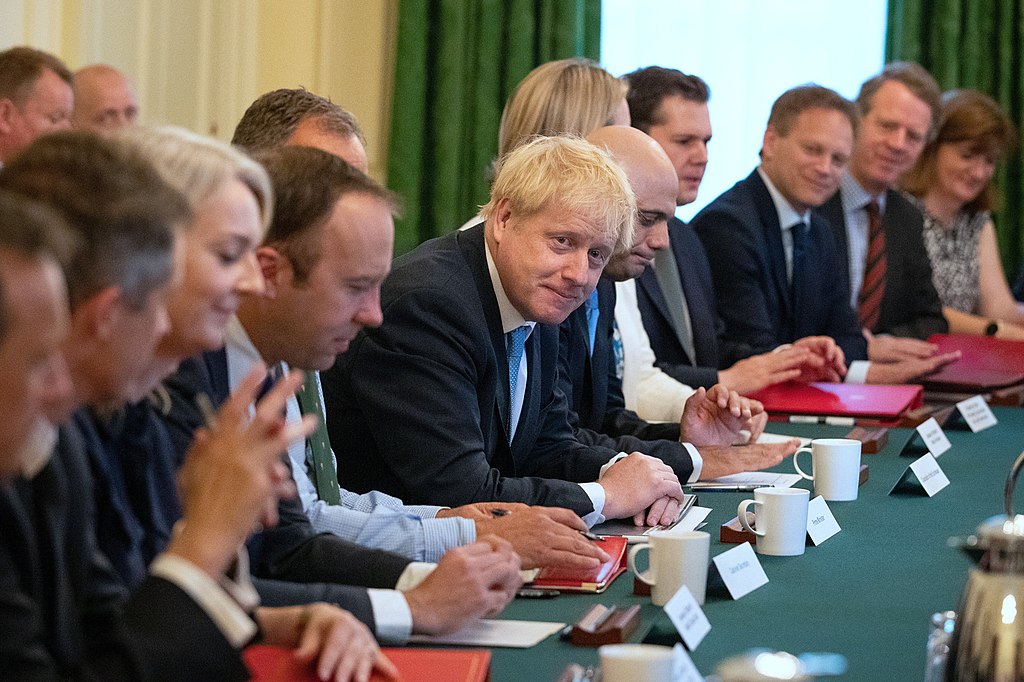
Prime Minister Boris Johnson at his first Cabinet meeting in Downing Street, 25 July 2019.
Official photograph via Wikimedia Commons.

Here, I come to a digression on the nature of how Britain is governed. My country is not particularly democratic. At the same time, there is no cabal of evil persons directing all events and appointments from behind the scenes. This is generally not how ruling classes operate. A more realistic model can be taken from Ian Kershaw’s analysis of the National Socialist revolution in Germany. This proceeded with limited central direction. Before 1939, the leaders were concerned mostly with foreign policy, after that with fighting a big war. Instead, the revolution was decentralised. Reliable men were put in key positions and told to “work towards the Fuhrer” – that is, to act in any situation as they might imagine Hitler himself would act. The result was often administrative chaos. The benefit was that the leadership could concentrate on what it saw as the essentials, and more local knowledge could be used in the overall revolution than would otherwise have been possible.

This is largely how things work in Britain. Our own Transformation is not driven by detailed orders from the Shadowy-Ones-on-High, but by creating a bias within every useful institution to those who are broadly in favour of the Transformation. The benefit is a constrained diversity of approaches that can be presented as a genuine diversity of opinion. The disadvantage is that executive power lies in this country where it has since 1701 – that is, in the hands of the Ministers of the Crown, who are accountable to the House of Commons. If the Prime Minister turns out to be a fool, and the other ministers are too cowardly to stab him in the back, there is no easy way to remove him.

I come at last to the Brexit strategy of the new Government. These people are not right-wing extremists who can eventually be forced to give in. Just like Theresa May, they see Brexit as a problem that needs to be solved. If they could wave a magic wand, they would roll back the calendar to 2016 and make sure that Remain won the Referendum. Or they would roll it back a little farther and make sure the Referendum was not called that year, or at all. But they cannot. Instead, they have to deal with the effects of leaving a political fool in charge for three years of the Brexit process.

Theresa May had one job after 2016. This was to produce the minimal departure I have mentioned. Instead, she negotiated a Withdrawal Agreement that caused a storm of outrage among the English. The details of what this Withdrawal Agreement contained are, again, unimportant. What does matter is that the Withdrawal Agreement was published in English on the European Commission website, and millions of us read its 585 pages. We may not have been that interested in the details of our membership. But the details of our “withdrawal” were unacceptable. She tried three times to force it through the House of Commons. Each time, a majority of some very trashy people were terrified to be seen supporting it. Anyone else less stupid would have tried something else. Instead, Theresa May treated us with open contempt. Whether or not we really cared about it, we had been asked if we wanted to remain in the European Union. Having voted “No!” we expected some show of respect for our clear instructions. We did not welcome a Brexit-in-Name-only.

At first, the damage was confined to the possibility of a Labour Government. Then, with the rise of the Brexit Party, the system as a whole moved towards a crisis of legitimacy. The European elections of the month before last were seen as the second Referendum the Remainers had demanded. It was won by the Leavers. The Conservative were crushed. Labour was humiliated. It seemed that a general election would, for the first time, produce a bloc in the House of Commons of Members opposed not only to the peripheral issue of the European Union, but also to the Transformation.

So Theresa May had to go, and she was replaced by Boris Johnson. His own inclination, I have no doubt, is to get a few cosmetic changes to the existing Withdrawal Agreement, and then tell us he is a diplomatic genius. His problem is that this will no longer do. Theresa May has left too much poison in those waters. Brexit must now be more meaningful than was at first projected. Last week, there was an election in Wales to fill a vacancy in the House of Commons – a bye-election. This should have been won by the Conservatives. Instead, the Brexit Party took enough Conservative votes to give the seat to one of the opposition parties – not the Labour Party, which did badly. The political arithmetic is that anything less than a No-Deal Brexit or a diplomatic triumph will mean a collapse of the Conservative vote at the next general election. And this will not mean a Labour Government, but political chaos and a crisis of legitimacy.

In a post at the Continental Telegraph, Alex Noble shows the quite different political trajectories of Change UK (or whatever they’re calling themselves this week) and the Brexit Party:

[Simon Jenkins in the Guardian claims that] the majority of Britain want to stay in the EU.

Is he right?

Well, the recent defectors from the main parties clearly believed he was – Chuka Umunna, Anna Soubry et al abandoned their positions to form the CUKs and provide the disenfranchised British masses with the staunch Remainer party they had all been failing to demand for so long.

They came out of the blocks fast, called in favours with journalists to get favourable press coverage, and burst upon the political consciousness of Great Britain like a glitter-filled Zeppelin of cross-party europhilia.

And then … oh the humanity.

Whereas Brexit geezer Nigel Farage sauntered out of the blocks under withering crossfire from the establishment and its pet churnalists, and immediately went hypersonic – from 0% to 20% before the establishment pollsters could unlimber their clipboards and stutter their leading questions.

Up and down the country, the British voter was encouraged to overlook the Brexit Party by an establishment still traumatised by the referendum, with pollsters snidely relegating the party to the column entitled “Other” during their obfuscatory enquiries.

And the British voter seized them by the lapels and yanked them into a ferocious Brexit headbutt.

The desperate EU stooges in the Tory party, realising their puppet Treason May was fatally wounded, threw her under the bus and began their Stop Boris campaign, but all the manufactured scandalettes failed to prevent the Johnson Juggernaut from roiling over them and into Downing Street.

For now, the Brexit Party have stalled on 20% – they hold their position now like a lioness crouched in the long grass, waiting for Boris Johnson to reveal the slightest Remainer tendencies. And if he does, the catastrophic injuries he and his party will suffer will make Theresa May’s mauling look like the amuse bouche at the Marquis de Sade’s final soundproofed basement party.

August 17, 2019

The British Empire in retrospect

Filed under: Books, Britain, History, India — Tags: , , , — Nicholas @ 03:00

It’s been fashionable to dismiss the British Empire as a positive force in history for about 100 years (partly in reaction to the losses during the First World War), but Casey Chalk reviews a recent book that counter-cherry-picks the facts to show it wasn’t all an authoritarian dystopia and cultural wasteland:

… the central argument of University of Exeter professor of history Jeremy Black’s new book Imperial Legacies: The British Empire Around the World, which, according to the book jacket, is a “wide-ranging and vigorous assault on political correctness, its language, misuse of the past, and grasping of both present and future.” The imperial legacy of Great Britain is also, in a way, an instructional lesson for the United States, which, much like the British Empire of the early to mid-20th century, is experiencing a slow decline in influence.

As a former history teacher who has visited many former British colonies in Africa and Asia, I’ve been well catechized in how British imperialism is interpreted. The British, so we are told, were violent aggressors and expert political manipulators. Using their technological superiority and command of the seas, they subjugated cultures across the globe, applied the “divide and rule” policy to set ethnic and linguistic groups against one another, extracted resources for profit, and stole cultural artifacts that now collect dust in their museums. Thus, so the story goes, blame for many of the world’s current problems lies squarely at the feet of the British Empire, for which she should still be paying reparations.

Yet, Black notes, “there is sometimes a failure to appreciate the extent to which Britain generally was not the conqueror of native peoples ruling themselves in a democratic fashion, but, instead, overcame other imperial systems, and that the latter themselves rested on conquest.” Take, for example, the Indian subcontinent, which was a disparate collection of kingdoms and competing empires — including Mughals, Sikhs, Afghan Durranis — during the early centuries of British intervention. All of these were plenty brutal and intolerant towards those they subjugated. Moreover, Hinduism promoted not only the oppressive caste system, but also sati, or the ritual of widow burning, in which widows were either volitionally or forcibly placed upon the funeral pyres of their deceased husbands. It was the British who stopped this practice, and others, with such legislation as the Hindu Widows’ Remarriage Act of 1856, the Female Infanticide Prevention Act of 1870, and the Age of Consent Act of 1891.

Nor has India been able to escape the same imperialist tendencies as the British. Just ask the Sikhs, whose demands to “free Khalistan” have gone unheeded by New Delhi, and who in 1984 suffered great atrocities at the hands of the Indian military and civilian mobs. Or ask Indian Muslims, of whom more than 1,000 died in the 2002 Gujarat riots and who suffer increasing persecution under the ruling Hindu nationalist party BJP. There’s also not a few folks in Kashmir who happen to call the Indians imperialists. One might note here that many of the problems in former European colonies are not solely, or even largely the result of European imperialism, but can be attributed to many other causes, population increase, modernization, and globalization among them. Corruption in some former colonies, including India, is almost certainly higher than it was during British rule.

India is only one such example where the modern narrative ignores both historical and contemporary realities, including, one might add, the fact that India as it now exists is largely a creation of British colonial efforts. It was Britain that united a disparate group of people into a single cohesive unit with a national identity. Indeed, as Black rightly notes, “modern concepts of nationality have generally been employed misleadingly to interpret the policies and politics of the past.”

This is further complicated by the fact that in many places, especially India, “alongside hostility, opposition and conflict,” between the imperialists and the colonized, “there was inter-marriage, intermixing, compromise, co-existence, and the process of negotiation that is sometimes referred to as the ‘middle-ground.'” One need look no further than the First and Second World Wars, in which more than 1.5 million and approximately 2.5 million Indians, respectively, fought willingly and bravely in the service of the British crown.

August 5, 2019

More on the still-damaged diplomatic relationship between India and Canada

Filed under: Cancon, India, Politics — Tags: , , , , , , — Nicholas @ 03:00

Ted Campbell quotes from a recent article in the Hindustan Times about the not-yet-healed damage in the diplomatic world between Justin Trudeau’s government and the Indian government of Narendra Modi:

Justin Trudeau and family during India visit
Image via NDTV, originally tweeted by @vijayrupanibjp

In the influential Hindustan Times, Toronto based journalist Anirudh Bhattacharya writes … “in an astonishing attack that will not help heal fraught ties between India and Canada, the former top advisor to the North American nation’s Prime Minister has accused the Indian Government of sabotaging Justin Trudeau’s visit to India in February 2018 to favour his political opponents [and] This scathing statement is in the forthcoming book, Trudeau: The Education of a Prime Minister, written by senior Canadian journalist John Ivison. The author [Ivison] confirmed to the Hindustan Times that Butts’ comment came during an interview.” The article adds that “Indian diplomats didn’t comment on the matter because it is so politically charged and the Canadian Government has yet to respond to questions from HT on its stand on the incendiary remark from Butts.”

So, while some pundits forecast that the return of Gerald Butts would reignite the whole SNC-Lavalin/Jane Philpott and Jody Wilson-Raybould scandal, it appears that the damage will be deeper and we will get a chance to revisit the disaster that Justin Trudeau and Chrystia Freeland visited upon Canadian foreign policy in 2018. India is a rising great power; it helps to contain China in new “Western Approaches:” the Arabian Sea, Indian Ocean and the Bay of Bengal. India is a growing trading power; it is a HUGE potential market for Canadian goods and services. India is one of the top three providers of new Canadians ~ and that’s where our problems with India originated. Someone in the Trudeau PMO thought (since thinking was the problem that probably lets Justin Trudeau off the hook) that it would be a good idea for Prime Minister Trudeau to attend a Khalsa Day parade in Toronto back in April 2017. I explained, back at the time of the India trip fiasco, why that was a mistake and how Jason Kenney had already set the example of doing it right. Now Khalsa Day, also known as Vaisakhi, is an important festival for Sikhs, it marks their New Year. But the festivities, especially in Toronto where 300,000 Sikhs live, are, sometimes, taken over or interrupted by Sikh separatists who advocate violent revolution in India. Jason Kenney saw that in 2012 and he stormed off a stage and berated his hosts, in public for trying to use him to undermine Canadian foreign policy, which valued, as it should, good relations with India. But, in 2017 all the Trudeau PMO (headed by Gerald Butts and Katie Telford) could see were all those Sikh voters. Neither the PMO team nor new Canadian foreign minister Chrystia Freeland was able to prevent Trudeau from being used as a photo-op prop by avowed Sikh separatists … there is no indication that anyone tried although, even though, given the bureaucracy’s corporate memory of events in 2012, I would be amazed in alarms were not sounded.

August 1, 2019

“Since I recently called [Johnson] ‘a bag of living offal,’ my view is unlikely to be positive”

Filed under: Britain, Politics — Tags: , , , , , — Nicholas @ 05:00

Sean Gabb provides a brief evaluation of new British PM Boris Johnson:

Boris Johnson, Secretary of State for Foreign and Commonwealth Affairs at an informal meeting of the Foreign Affairs Council on 15 February 2018.
Photo by Velislav Nikolov via Wikimedia Commons.

I have been asked to comment on Boris Johnson’s appointment as Leader of the Conservative Party and therefore as Prime Minister. Since I recently called him “a bag of living offal,” my view is unlikely to be positive. However, I will try to be fair. More to the point, I will try to relate this latest turn of events to my general analysis of British politics.

Last month, I wrote that membership of the European Union was a peripheral issue for our ruling class. The main agenda for this class is to carry through a neo-Puritan remodelling of our institutions, and indeed our minds. The details of a customs and regulatory union are less important than control of education, the media and the criminal law. This being said, membership is useful so far as it blurs the lines of accountability. It is also an article of belief among some elements of the Ruling Class. For this reason, the verdict of the 2016 Referendum was unwelcome. It meant a diversion of effort from the main purpose. It upset various important people. The obvious solution was to give us a minimal departure that would satisfy us, but would keep in place those elements of the European Project that really are important to the Ruling Class.

Here, I come to a digression on the nature of how we are governed. There is no cabal of evil persons directing all events and appointments from behind the scenes. This is generally not how ruling classes operate. A more realistic model can be taken from Ian Kershaw’s analysis of the National Socialist revolution in Germany. This proceeded with limited central direction. Before 1939, the leaders were concerned mostly with foreign policy, after that with fighting a big war. Instead, the revolution was decentralised. Reliable men were put in key positions and told to “work towards the Fuhrer” – that is, to act in any situation as they might imagine Hitler himself would act. The result was often administrative chaos. The benefit was that the leadership could concentrate on what it saw as the essentials, and more local knowledge could be used in the overall revolution than would otherwise have been possible.

This is largely how things work in England. Our own transformation is not driven by detailed orders from the Shadowy-Ones-on-High, but by creating a bias within every useful institution to those who are broadly in favour of the transformation. The benefit is a constrained diversity of approaches that can be presented as a genuine diversity of opinion. The disadvantage is that executive power lies in this country where it has since 1701 – that is, in the hands of the Ministers of the Crown, who are accountable to the House of Commons. If the Prime Minister turns out to be a fool, and the other ministers are too cowardly to stab him in the back, there is no easy way to remove him.

On balance, Theresa May was more stupid than malevolent. Her job was to produce the minimal departure I have mentioned. The question of who wrote her Withdrawal Agreement is less important than the fact that few who mattered wanted or dared to accept it. She should never have thought it would be accepted. Having discovered it was unacceptable, she should have tried something else. Instead, she tried four times to ram it through the House of Commons. She also reached out to a Labour leader who is feared or just hated by important strands within the Ruling Class. At first, the damage was confined to the possibility of a Labour Government. It then widened, with the emergence of the Brexit Party, to the threat of a general delegitimisation of the system as it has emerged since 1997, or perhaps 1979.

« Newer PostsOlder Posts »

Powered by WordPress