Sometime in the mid-first century a.d., an otherwise little known consular official, Gaius Petronius, wrote a brilliant satirical novel about the gross and pretentious new Roman-imperial elite. The Satyricon is an often-cruel parody about how the Roman agrarian republic of old had degenerated into a wealth-obsessed, empty society of wannabe new elites, flush with money, and both obsessed with and bored with sex. Most of the Satyricon is lost. But in its longest surviving chapter — “Dinner with Trimalchio” — Petronius might as well have been describing our own 21st-century nomenklatura.
[…]
Another farce in the Satyricon involves the nonchalant ignorance of Trimalchio and his guests. The wannabes equate influence and money with status and learning and so pontificate about current events, with made-up mythologies and half-educated references to history. When Trimalchio and his banqueters begin to sermonize on literature, almost everything that follows turns out to be wrong — as Petronius reminds us how high learning has become as inane a commodity as food or sex, and only sort of half consumed, rather like the 2008 campaign of faux Greek columns and Vero possumus, which were supposed to convey gravitas.
Likewise, in our version, what does a $200,000 Ivy League education or a graduate degree really get you any more? In the sophisticated world of our political and highly credentialed elites, there are 57 states. Atlantic Coast cities are said to lie along the Gulf of Mexico; after all, they are down there somewhere in the South. The Malvinas become the Maldives — Ma- with an s at the end seems close enough. Corps-men serve in the military (as zombies?). Medgar Evans was a civil-rights icon, but you know whom we mean. President Roosevelt addressed the nation on television after the stock-market crash in 1929 — well, he would have, had he been president then and if only Americans had had televisions in their homes. And how are we to know that what we read from celebrity authors is not just made up or plagiarized, whether a Maureen Dowd column or a Doris Kearns Goodwin book?
The famously nouveau-riche Trimalchio’s guests drop the names of the rich and powerful, mostly to remind one another that they are now among the plutocracy that is replacing the old bankrupt aristocracy. We too are seeing something like that metamorphosis. It is hard to guess on any given summer weekend which populist progressive family — the Obamas, the Clintons, the Kerrys, the Gores — will be ensconced on what particular Hamptons, Nantucket, or Martha’s Vineyard beach, rubbing shoulders with just the sort of Silicon Valley or Wall Street new zillionaires who during work hours are supposed to be the evil “1 percent” and “fat cats” who need to be forced to pay their “fair share.”
Victor Davis Hanson, “An American Satyricon”, National Review Online, 2013-08-27
November 16, 2013
QotD: Petronius was right
July 30, 2013
Was Caligula the victim of a historical smear campaign?
I confess, my views on Emperor Caligula (formally Gaius Julius Caesar Augustus Germanicus) were almost completely informed by the character in the novels I, Claudius and Claudius the God by Robert Graves. BBC News Magazine‘s Mary Beard thinks Caligula got a fearful load of bad press:
Of course, there had been some very nasty monarchs and despots before Caligula. But, so far as we know, none of his predecessors had ever ticked all the boxes of a fully fledged tyrant, in the modern sense.
There was his (Imelda Marcos-style) passion for shoes, his megalomania, sadism and sexual perversion (including incest, it was said, with all three of his sisters), to a decidedly odd relationship with his pets. One of his bright ideas was supposed to have been to make his favourite horse a consul — the chief magistrate of Rome.
Roman writers went on and on about his appalling behaviour, and he became so much the touchstone of tyranny for them that one unpopular emperor, half a century later, was nicknamed “the bald Caligula”.
But how many of their lurid stories are true is very hard to know. Did he really force men to watch the execution of their sons, then invite them to a jolly dinner, where they were expected to laugh and joke? Did he actually go into the Temple of the gods Castor and Pollux in the Roman Forum and wait for people to turn up and worship him?
It is probably too sceptical to mistrust everything that we are told. Against all expectations, one Cambridge archaeologist thinks he may have found traces of the vast bridge that Caligula was supposed to have built between his own palace and the Temple of Jupiter — so it was easier for him to go and have a chat with the god, when he wanted.
So the idea that Caligula was a nice young man who has simply had a very bad press doesn’t sound very plausible.
All the same, the evidence for Caligula’s monstrosity isn’t quite as clear-cut as it looks at first sight. There are a few eyewitness accounts of parts of his reign, and none of them mention any of the worst stories.
No revisionist slant on Caligula is complete without a few nasty cracks directed towards kindly old Uncle Claudius:
More topical though is the question of what, or who, came next. Caligula was assassinated in the name of freedom. And for a few hours the ancient Romans do seem to have flirted with overthrowing one-man rule entirely, and reinstating democracy.
But then the palace guard found Caligula’s uncle Claudius hiding behind a curtain and hailed him emperor instead. Thanks to Robert Graves, Claudius has had a good press, as a rather sympathetic, slightly bumbling, bookish ruler.
But the ancient writers tell a different story — of an autocrat who was just as bad as the man he had replaced. The Romans thought they were getting freedom, but got more of the same.
Considering what happened then, it’s hard not to think of the excitements and disappointments of the Arab Spring.
May 27, 2013
Recreating ancient hairstyles – the “Hairdo archaeologist”
BBC News has an interesting short video on the intersection of hairstyles and archaeology:
Janet Stephens earns a living trimming, straightening and dyeing the hair of customers seeking the latest look.
But the stylist from the US city of Baltimore is more interested in the hairdos of the past.
Stephens is a hairstyle archaeologist who specialises in recreating how women in ancient Rome and Greece wore their hair.
She spoke to the BBC about a museum visit that marked the start of a long journey of discovery on which she solved a historical mystery and had her work published in an academic journal.
March 5, 2013
David Friedman reviews The Birth of the West by Paul Collins
David Friedman on the recent book The Birth of the West: Rome, Germany, France, and the Creation of Europe in the Tenth Century, by Paul Collins.
Take five or six soap operas set in central and western Europe in the 10th century. Chop in pieces, stir, and glue together more or less at random. You now have something reasonably close to the picture that emerges from The Birth of the West, 427 pages of 10-century history as presented by the Australian author and broadcaster Paul Collins. The reader is left wondering whether the chaos is a bug or a feature, a failure of the author to shape his material into a coherent story or a deliberate attempt to show the reader the chaos of the period.
[. . .]
The most interesting thing about the book may be what it implies about how much we do not know. Thus, for instance, Collins offers a lurid account of Theodora and Marizia, a mother and daughter heavily involved in papal politics. (Marizia was supposedly the mistress at age 14 of an 80-year-old pope.) He then mentions that his source was writing 50 years after the events he describes, that another source presents a much more attractive picture, and that both have axes to grind. But he goes on to treat the first account as accurate. He offers a glowing portrait of Theophano, a Byzantine princess who became the wife of Otto II and mother of Otto III, dismissing a much more critical picture from a contemporary source. A historian with a different set of biases could have given us an equally convincing version in which some of the good guys and bad guys switched hats.
[. . .]
Collins presents the conventional view of the dominant role of religion in medieval Europe, cites several books by the French medievalist Georges Duby, but not the one in which Duby argues that the picture is badly distorted by the fact that almost all of our sources are clerical. The point is relevant for modern sources as well: Collins himself spent much of his life as a Catholic priest before resigning over a dispute with the Vatican and taking up a second career as writer and broadcaster.
None of that means that the story he tells is wrong. The modern reader inclined to take any single historical view as gospel might consider how much disagreement there is on issues for which we have enormously better information — the Vietnam War, say, or the evaluation of controversial political figures such as FDR, Reagan, or Thatcher. It does not even mean that the book should have been written differently. The story Collins tells is confusing enough as is; it would be far more confusing if he had tried to keep all of the alternative narratives going at once. And, to his credit, while he tells a single story, he makes it clear that alternatives exist — almost all of my critical comments are based on information he himself presents. I would not recommend the book as light reading, but it does provide a vivid picture of the century.
January 29, 2013
Economic analysis of Imperial Rome
A post by Jasmine Pui at History Today discusses a new online tool for economic analysis of the Roman Empire:
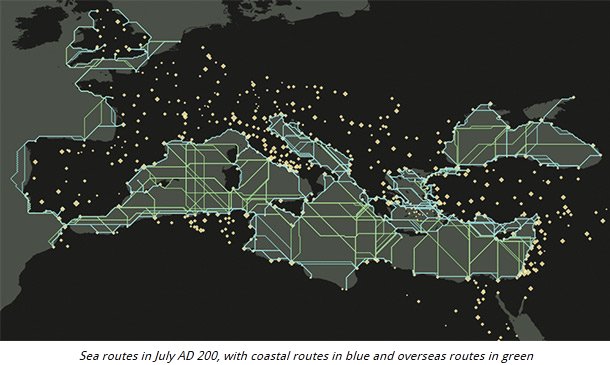
A recently launched online interactive research source, ORBIS, the Stanford Geospatial Network Model of the Roman World, has made it possible to analyse data about the Roman Empire in new ways that reveal the fragility of Roman communication and freight systems. Conventional maps are often unable to capture the environmental constraints that govern the flows of people, goods and information. Museum and ancient sites usually include titbits of information about the wide-ranging origins of artefacts, hinting at the relative cost of goods and labour in the Roman era, but factors such as sailing times and inland routes for freight cannot be precisely revealed through archaeological finds, Roman coins, taxation records or riot reports.
The first resource of its kind, ORBIS offers comprehensive graphic tools to portray the transport and communication infrastructure that underpinned the Roman Empire’s existence. By typing in a starting point, destination, an imagined weight of goods to transport and the time of year, the site shows whether such a movement would have been feasible and at what cost. Studying movement during the course of the empire’s existence suggests it was far more difficult to hold an empire together than to expand one. There are few scenarios where marching and conquering is not easier and less costly than moving goods and slaves between regions. Cost, rather than distance, was the principal determinant of connectivity in the Roman world.
ORBIS is based on a simplified version of the giant network of cities, roads, rivers and sea lanes that framed movement across the Roman Empire. The Stanford team has relied on data such as historical tide and weather information, size and grade of road surfaces and an average walking distance of 30 kilometres per day. Hundreds of cities, ports and routes, vehicle speeds for ships, ox carts and horses, as well as the variable cost of transport have been logged. The data mainly focuses on the period around AD 200, when Septimius Severus expanded control of Africa and Roman power was at one of its peaks.
November 9, 2012
Tomb discoveries cast light on Thracian culture
A recent discovery in Bulgaria promises to tell us more about the culture of the Getae, a powerful tribe in Thrace:
Archaeologists in Bulgaria are chuffed today to announce that golden treasures and artifacts produced by the ancient Thracians have been discovered in a subterranean tomb complex in the north of the country.
The treasures include snake-headed bracelets, a golden crown or tiara type affair, a golden horse head and piles of smaller solid gold items including rings, statuettes and buttons. They’re thought to date from the third century BC and to have been produced by the Getae, a tribe among the ancient Thracians.
[. . .]
Thracian warriors played prominent parts in many of the wars of antiquity. The peltast javelineer style of fighting was said to have originated in Thrace, gradually superseding the armoured hoplite warrior: an entire phalanx of the formidable Spartans was crushed by peltasts fighting for Athens during the Peloponnesian War, and the lightly armoured Greek/Thracian warriors are also said to have inflicted severe damage on heavy Persian cavalry.
Alexander the Great — from the neighbouring area of Macedonia — is also said to have used Thracian mercenaries in his world-spanning campaigns, and later on Thracian warriors were prominent in the armies of Rome and then the Eastern empire. In particular, the famous gladiator and rebel Spartacus had originally been a Roman auxiliary soldier from Thrace. Later on — after the fall of Rome, when the Empire was ruled from Constantinople — both the emperor Justinian and the great general Belisarius are said to have been Thracians.
August 28, 2012
What can Caesar’s Gallic War commentary tell us about Afghanistan?
According to this reading, lots and lots:
I finished Caesar’s Commentaries on the Gallic War this weekend […] and a few things struck me:
a. The successful Roman counterinsurgency campaign in Gaul took eight years.
b. The enemies against which Rome fought were not a unitary actor, and neither were Rome’s allies.
c. Rome’s allies one summer were often Rome’s enemies by winter. And visa versa.
But the two things that made the biggest impression on me were the following:
d. Caesar was the commander for eight full years, and he enjoyed similar continuity among his subordinate commanders.
e. Caesar very rarely sent green units into the offensive. By the fourth and fifth year of the campaign, he is still making those legions which were the last to be raised in Italy responsible for guarding the freaking baggage. He relies over and over again on those legions — most especially the Tenth — that have proven themselves in combat in Gaul.
With Caesar’s commentaries in mind, I read Doug Ollivant’s lament about Gen. Joe Dunford. Gen. Dunford will be the fifteenth commander of NATO-ISAF in eleven years of combat in Afghanistan and the ninth U.S. commander in Afghanistan. Each of his subordinate commanders have rotated on an annual basis. Gen. Dunford — who is, by all accounts, an excellent officer and highly respected by his peers — has never served in Afghanistan.
The cultures, politics, tribes and peoples of Afghanistan are at least as complex as those of ancient Gaul, yet we Americans are so arrogant to think that we can send officers there with no experience and, owing to our superior knowledge of combat operations, watch them succeed. We will then send units which have never deployed to Afghanistan to partner with Afghan forces and wonder why they do not get along.
H/T to Tim Harford for the link.
March 15, 2012
Rome Reborn 2.2: A Tour of Imperial Rome in 320CE
Rome Reborn 2.2: A Tour of Ancient Rome in 320 CE from Bernard Frischer on Vimeo.
This video presents a fly-through of the latest version of Rome Reborn (2.2). The new version incorporates some new content (including the Pantheon) and for the first time includes animations.
Rome Reborn is an international initiative to create a 3D digital model of the ancient city as it might have appeared in A.D. 320. For more about the project, please see: www.romereborn.virginia.edu.
For more information, contact the project director, Prof. Bernard Frischer at: bernard.d.frischer@gmail.com; cell +1-310-266-0183
December 30, 2011
Next up on the global agenda: the “soft” dark ages
Occasional commenter “Lickmuffin” sent a link to this article saying “Overly optimistic outlook here, I’m afraid. What good is digital storage when there won’t be any electricity?”:
We were discussing the dark ages, which not only were characterized by the disintegration of the Roman political order, but also the loss of an immense store of practical technological knowledge: agricultural practices and implements; construction techniques — it would take until the 19th century for Europeans to match the Romans’ road-building prowess — war machines; distribution and warehousing; science; art (which in Roman times was the realm of artisans, not self-absorbed “transgressive” pricks).
I said that I think we are headed for a “soft dark ages.” That took him aback. “How are we headed there,” he asked, “and how would they be ‘soft’?”
I answered his last question first. They would be “soft” because unlike what happened in Roman times, we have the ability to store gigantic amounts of information in small spaces. One person can carry around encyclopedic knowledge on a flash drive. Multiply him by the millions, and you have a vast repository of recoverable knowledge that is private, widely dispersed, and replicated many times over. No matter how determined or persistent this era’s barbarians — Marxists, Muslims, Democrats, unionists, academicians — they simply would not be able to track down and destroy all modern technological knowledge.
But beyond furtive individual efforts at hiding and protecting the knowledge we would need to create a New America or a New West, there would be vaster, more organized, more collective efforts to protect knowledge until better days. I suggested to Bob three institutions or concepts that would become the next dark ages’ hallmarks: The new castle fortress; the new monastic life; and the new Europe.
February 27, 2011
Sunday book post
No, not my books: I’ve written lots, but they’re all technical manuals for software products the vast majority of you will never have heard of, and wouldn’t want to read about even if you had. I mean books I’ve read recently that I consider to be very good. I’ll categorize for convenience (both yours and mine):
Science Fiction and Fantasy
- Darwin’s Watch: The Science of Discworld III, Terry Pratchett, Ian Stewart and Jack Cohen. An entertaining romp through (real) science placed within a fictional context. I read the first Science of Discworld book and quite enjoyed it, and this one is possibly even better. The Discworld, riding happily balanced on the backs of the four great elephants, who are in turn supported by the shell of the great turtle, has very different scientific principles than our own “exotic” roundworld. The most amusing part of the book is the wizards of the Unseen University attempting to ensure that Charles Darwin writes the “correct” book on roundworld. You’ll learn more science than you expect . . .
- I Shall Wear Midnight, Terry Pratchett. The fourth of the Tiffany Aching sequence in the Discworld series. Although written for a younger audience, Pratchett’s sense of humour and brilliant presentation make this book eminently readable for all ages.
- Cryoburn, Lois McMaster Bujold. The latest adventure of Miles Vorkosigan deals with the political and social implications of cryogenic preservation. No soaring battles in space, no stunner shootouts, no alien invasions. Sounds deadly dull, I realize, but I don’t think Lois could write a boring shopping list. It perhaps doesn’t stand alone quite as well as it might, but even if you haven’t read any of the other books in the series, I think you’ll find this worth reading.
History
- The Canadian Army and the Normandy Campaign, John A. English. A book that undermines several widely held beliefs about the efficiency and capability of the Canadian First Army in 1944-45. Between incompetent, scheming generals and political interference, the Canadian Army was less than the sum of its parts, and the importance of training methods and doctrine are highlighted (that is, the faulty training methods in use probably added to the casualty lists in combat). Field Marshal Montgomery didn’t like or trust General Harry Crerar, but was forced to keep him in command due to Canadian government sensitivities. Montgomery’s view of Crerar almost certainly was reflected in the roles assigned to First Canadian Army after the Normandy landings.
- The Grand Strategy of the Byzantine Empire, Edward N. Luttwak. A fascinating book about the differences between the Byzantine empire’s military and political goals and practices and those of the Roman empire from which it descended. Unlike Rome, the Byzantines were never the “superpower” of their part of the world, and their survival often depended on carefully constructed alliances, allies-of-convenience, and outright bribery of “enemies of their enemies”. Although not well remembered in the west, the survival of Byzantium almost certainly saved central Europe from conquest by the armies of the Caliph during the initial expansion of the Muslim empire. Byzantine armies rarely had much technological or doctrinal advantage over their opponents, so war had to be conducted with the key concept of retention of force: ambush, raid, counter-attack, feint, and misdirection became specialties because they offered (relative) effectiveness at lower risk of outright defeat.
- In the Name of Rome: The Men Who Won the Roman Empire, Adrian Goldsworthy. A selection of mini-biographies of some of the greatest generals of the Roman empire. What is amazing, in reading about some of their careers, is how little actual military instruction Roman officers received, yet how effective the army could be in spite of that. Being an army officer was viewed as just part of the normal public service — in fact, it would have been problematic for a Roman patrician to remain with the army for an extended period of time, as it would slow down his progress through the civil government ranks.
- The Defence of the Realm: The Authorized History of MI5, Christopher Andrew. If you wanted a thrilling account of the exciting and dangerous life of counter-espionage, you need to stick to works of fiction. The actual life of an MI5 officer is apparently much less James Bond and much more careful investigation, observation, and data correlation. Not that it isn’t an interesting career, but perhaps the “double oh” agents will get their own book (just kidding).
Economics
- The Ascent of Money, Niall Ferguson. I enjoyed reading this one far more than I expected to: the author has a knack for carrying you through the less interesting bits without boring or lecturing you. The evolution of the modern monetary system, and the heroic roles played by unlikely characters in the process.
- The Rational Optimist: How Prosperity Evolves, Matt Ridley. It’s easy to find depressing statistics and dreary anecdotes. Ridley’s view is that progress is a good thing, and that we’re enjoying a golden age even if we don’t realize it right now.
Biography
- Robert A. Heinlein: In dialogue with his century Volume 1, William H. Patterson, Jr. I’ve been a huge fan of Heinlein’s works since I read Starship Troopers at about age 11. This biography more than met my expectations: I’d always regretted never having met Robert Heinlein, but between this book and Heinlein’s own autobiographical writings (Tramp Royale and Grumbles from the grave) I feel I’ve gotten as close to knowing him as possible — until the publication of Volume 2, anyway.
- Thomas Paine’s Rights of Man, Christopher Hitchens. A lively appreciation of Thomas Paine’s most influential work, and much detail on his life. Paine was far from being the disreputable bomb-throwing anarchist his enemies painted him to be, but he also wasn’t the plaster saint his fans might imagine.
Wine
- Billy’s Best Bottles: Wines for 2011, Billy Munnelly. Still the best annual wine guide for the everyday wine drinker in Ontario. If you like an occasional bottle of wine, but don’t want to study dozens of books in order to make a decision on what to buy, this is the book for you. He likes more “rustic” wines than I do, so I don’t find his recommendations in that category to be as useful, but he does a great job of sorting through the plethora of $10-20 wines available at the LCBO and tells you which ones are worth buying (and when to serve them).
May 30, 2010
QotD: The first great back-to-the-land experiment
. . . the plundering, the lack of invention, the barbarians and above all Diocletian’s red tape did for Rome in the end. As the empire disintegrated under this bureaucratic burden, at least in the west, money lending at interest stopped and coins ceased to circulate so freely. In the Dark Ages that followed, because free trade became impossible, cities shrank, markets atrophied, merchants disappeared, literacy declined and — crudely speaking — once Goth, Hun and Vandal plundering had run its course, everybody had to go back to being self-sufficient again. Europe de-urbanised. Even Rome and Constantinople fell to a fraction of their former populations. Trade with Egypt and India largely dried up, especially once the Arabs took control of Alexandria, so that not only did oriental imports such as papyrus, spices and silk cease to appear, but those export-oriented plantations in Campania became the plots of subsistence farmers instead. In that sense, the decline of the Roman Empire turned consumer traders back into subsistence peasants. The Dark Ages were a massive experiment in the back-to-the-land hippy lifestyle (without the trust fund): you ground your own corn, sheared your own sheep, cured your own leather and cut your own wood. Any pathetic surplus you generated was confiscated to support a monk, or maybe you could occasionally sell something to buy a metal tool off a part-time blacksmith. Otherwise, subsistence replaced specialization.
Matt Ridley, The Rational Optimist: How Prosperity Evolves, p. 175
May 24, 2010
Racy archaeology
The theory is that these coins were created to ease language barriers between non-Latin speaking customers in brothels and the (often non-Latin speaking) prostitutes:
This is a spintria. They were used in ancient Rome to request and pay for different “services” in brothels and from prostitutes on the street. Since there were a lot of foreigners coming to the city that did not speak the language and most of the prostitutes were slaves captured from other places the coins made the transactions easy and efficient. One side of these coins showed what the buyer wanted and the other showed the amount of money to be paid for the act.
[. . .]
They may have been used to pay prostitutes, who at times spoke a different language. While this is subject to argument, the numbers on them line up with known prices for Roman prostitutes (University of Queensland reference). Some theorize them gaming tokens, and they may have been produced for only a short period, probably in the 1st century A.D.
So, either an innovative solution to an ongoing economic problem, or the Roman equivalent to the nudie card decks of the 1940s and 50s.
Images at the link. H/T to Radley Balko for the URL.