Every week it seems like the undemocratic powers-that-be in Europe have had to pull legalistic strings to ensure that the popular will is not translated into political power in nation after nation. Unsurprisingly, the candidates and parties subject to these serial interferences are almost all populist and right-wing. On his Substack, Frank Furedi explains “the EU’s quest to monopolize the doctrine of the Truth”:
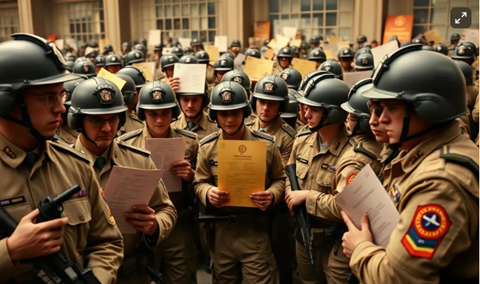
Army of Fact Checkers – Roots & Wings with Frank Furedi
In recent years globalist institutions – including the European Union Commission have become obsessed with the circulation of disinformation. In particular, they point the finger of blame on outside external actors whose fake news supposedly threatens the very existence of democracy. According to the EU Commission “Foreign information manipulation and interference is a serious threat to” European values. It claims that “it can undermine democratic institutions and processes by preventing people from making informed decisions or discouraging them from voting1.
The narrative of foreign misinformation is invariably used to discredit political parties and electoral results that are not to the liking of the centrist technocratic elites that run the EU as well as numerous western governments. Foreign information manipulation served as an excuse to bar a populist candidate from running for the post of the President of Romania. Since by all accounts he was the likely winner of this contest his elimination from the race could be interpreted as a soft coup d’etat. Similar objections were made about foreign interference during the referendum for Brexit as well as during the recent elections in Moldavia and Czechia.
Alarmist accounts of the threat posed by foreign information manipulation rest on the claim that the circulation of so much unreliable information makes it impossible for people to make an informed choice. Yet the electorate has always faced the challenge of having to distinguish factually accurate claims from false ones. Public life was always forced to confront the problem of who to believe and whose words are trustworthy. Throughout history different actors and technologies were blamed for misleading people with false information and dangerous ideas. In ancient Greece it was the smooth-tongued demagogue who could effortlessly and purposefully transmit lies to capture the attention of the public, who served as the personification of misinformation. During the centuries to follow the finger of blame has been pointed at books, mass-publication newspapers, radio, television and now the Internet
Since information manipulation has played an important role in the political life of western societies since the 18th century, it is far from evident why the contemporary public should no longer be able to make “informed choices” and why they should feel discouraged from voting? Despite the recent EU Commission induced panic about information manipulation, the percentage of people voting in the 2024 EU elections was 51 percent, the highest rate of turnout since 1994, when it was 56 percent.
People have always had to contend with fake news and propaganda. So why should they be more likely to be fooled by it today than in the past? The standard argument used to justify this EU elite promoted panic is that new technologies “have made it possible for hostile actors to operate and spread disinformation at a scale and with a speed never seen before”.2 It is worth remembering that the same arguments were used to warn against new information technologies since the 19th century. Even in the late 20th century the media was blamed by politicians for their electoral failures.
Kirsten Drotner has used the term media panic – that is a panic about the media -to highlight the recurrent tendency for change and innovation of the media to incite anxiety and fear.3 Such reactions were a response to the expansion of both publishing and the reading public in the 18th century. The expansion of the media and its commercialization created an environment where competing views and opinions helped foster a climate where the question of which sources could be trusted were raised time and again.
- https://commission.europa.eu/topics/countering-information-manipulation_en
- https://commission.europa.eu/topics/countering-information-manipulation_en
- Drotner, K.(1999) “Dangerous Media? Panic Discourses and Dilemmas of Modernity”, Paedagogica Historica: International Journal of the History of Education, 35:3, 593-619.