Quotulatiousness

September 16, 2020

The Canadian echo chamber on American political issues

Filed under: Cancon, Media, Politics, USA, Weapons — Tags: , , , , , — Nicholas @ 05:00

Ben Woodfinden’s latest for The Dominion looks at the weird effects political passions in the United States have on political stances in Canada:

Restricted and prohibited weapons seized by Toronto police in a 2012 operation. None of the people from whom these weapons were taken was legally allowed to possess them.
Screen capture from a CTV News report.

Participatory media increasingly defines and shapes our discourse. It submerges us in a broader reality but only does so by filtering it into a digital reality that offers a distorted reflection rather than picture of the real world. This has been going on for at least a decade now, but the pandemic has accelerated this transformation of our discourse and politics. By locking us in our homes the pandemic forces us to view the world through a digital lens even more than we already did, and in a world where we’re all viewing everything through our screens that digital reality becomes closer and closer to our primary reality.

One of the specific, and most pernicious effects of this, as I lamented in The Critic is that it turns us all into online Americans participating in their politics through the digital medium, rendering us virtual participants and not just foreign observers. I won’t repeat myself too much, I’d recommend just reading the piece [link], but the online realm is American, and what digital politics does is make politics everywhere more American. We participate in it as a game and a form of entertainment. This bleeds back into our own politics.

Americanized Discourse

Gun politics is one particular political issue where Americanized discourse is most pronounced. It captures perfectly how Americanization plays out. Every time there is some sort of tragic shooting or discussion of gun violence in Canada the debates play out in depressingly predictable ways. Progressives and Liberals paint a picture in which Canada suffers from the kind of rampant gun violence and mass proliferation of firearms as in America. This is the framing used to justify often highly symbolic or ineffective new gun laws and restrictions that, while often not all that effective, make the Liberals and progressives seem like the party for gun control in the face of this rampant violence. But only if you pretend we live in America.

And it’s not just the Liberals and progressives who play this game. Listen to some of the more vocal advocates of “gun rights” in Canada and you’d think we have a second amendment in the Charter. One side wants to make it seem like Canadians are walking around with and easily able to acquire assault weapons, the other side wishes it were so! The reality of course lies somewhere in between. Gun possession is heavily regulated, but lawful citizens can still buy firearms if they want to, and there is no explicit right in the Charter that prevents the government from regulating and restricting firearms. Talking about gun “rights” in Canada is itself quite a foreign and imported concept. At the same time we don’t have an epidemic of gun violence, and while we have experienced some horrific mass shootings, like the recent Nova Scotia tragedy, gun violence in Canada pales in comparison to the United States.

But because both sides are essentially happy to help paint a phantasmic picture of gun violence and/or gun regulations in Canada, we end up with a surreal politics around guns. Sensible debates around guns are made harder by this because debates take place on top of a framing and narrative that draws explicitly on American political culture more than it does Canada’s. Both sides want to take on American roles and are happy to contribute to this framing.

Gun politics is just one example, and there are so many others. Our discourse is so often built around framings that make it seem as if the issues and political cleavages here are indistinguishable from American ones, but it only happens because we import American framing and narratives into our own discourse and then build are arguments around these phantasms. We, like many other countries around the world, are in the middle of a moment of racial reckoning, or whatever you want to call it, because of something that happened in Minneapolis, not in Canada.

Racism is a real thing in Canada, no honest person should deny this, because there is racism in absolutely every country and society. But in the wake of George Floyd’s killing we ended up having a conversation about racism that reflected the particular ways racism works in America.

September 15, 2020

Critical Race Theory

Filed under: Government, Politics, USA — Tags: , , , — Nicholas @ 05:00

Dan Sanchez, Tyler Brandt, and Brad Polumbo discuss President Trump’s recent Executive Memo banning the use of federal government funds for Critical Race Theory training:

Critical Race Theory is a branch of Critical Theory, which began as an academic movement in the 1930s. Critical Theory emphasizes the “critique of society and culture in order to reveal and challenge power structures,” as Wikipedia states. Critical Race Theory does the same, with a focus on racial power structures, especially white supremacy and the oppression of people of color.

The “power structure” prism stems largely from Critical Theory’s own roots in Marxism — Critical Theory was developed by members of the Marxist “Frankfurt School.” Traditional Marxism emphasized economic power structures, especially the supremacy of capital over labor under capitalism. Marxism interpreted most of human history as a zero-sum class war for economic power.

“According to the Marxian view,” wrote the economist Ludwig von Mises, “human society is organized into classes whose interests stand in irreconcilable opposition.”

Mises called this view a “conflict doctrine,” which opposed the “harmony doctrine” of classical liberalism. According to the classical liberals, in a free market economy, capitalists and workers were natural allies, not enemies. Indeed, in a free society all rights-respecting individuals were natural allies.

Classical Race Theory arose as a distinct movement in law schools in the late 1980s. CRT inherited many of its premises and perspectives from its Marxist ancestry.

The pre-CRT Civil Rights Movement had emphasized equal rights and treating people as individuals, as opposed to as members of a racial collective. “I look to a day when people will not be judged by the color of their skin, but by the content of their character,” Martin Luther King famously said.

In contrast, CRT dwells on inequalities of outcome, which it generally attributes to racial power structures. And, as we’ve seen from the government training curricula, modern CRT forthrightly judges white people by the color of their skin, prejudging them as racist by virtue of their race. This race-based “pre-trial guilty verdict” of racism is itself, by definition, racist.

The classical liberal “harmony doctrine” was deeply influential in the movements to abolish all forms of inequality under the law: from feudal serfdom, to race-based slavery, to Jim Crow.

But, with the rise of Critical Race Theory, the cause of racial justice became more influenced by the fixations on conflict, discord, and domination that CRT inherited from Marxism.

Social life was predominantly cast as a zero-sum struggle between collectives: capital vs. labor for Marxism, whites vs. people of color for CRT.

QotD: Racism and the minimum wage

Filed under: Africa, Economics, History, Quotations, USA — Tags: , , , — Nicholas @ 01:00

During South Africa’s apartheid era, racist unions, which would never accept a black member, were the major supporters of minimum wages for blacks. In 1925, the South African Economic and Wage Commission said, “The method would be to fix a minimum rate for an occupation or craft so high that no Native would be likely to be employed.” Gert Beetge, secretary of the racist Building Workers’ Union, complained, “There is no job reservation left in the building industry, and in the circumstances, I support the rate for the job (minimum wage) as the second-best way of protecting our white artisans.” “Equal pay for equal work” became the rallying slogan of the South African white labor movement. These laborers knew that if employers were forced to pay black workers the same wages as white workers, there’d be reduced incentive to hire blacks.

South Africans were not alone in their minimum wage conspiracy against blacks. After a bitter 1909 strike by the Brotherhood of Locomotive Firemen and Enginemen in the U.S., an arbitration board decreed that blacks and whites were to be paid equal wages. Union members expressed their delight, saying, “If this course of action is followed by the company and the incentive for employing the Negro thus removed, the strike will not have been in vain.”

Our nation’s first minimum wage law, the Davis-Bacon Act of 1931, had racist motivation. During its legislative debate, its congressional supporters made such statements as, “That contractor has cheap colored labor that he transports, and he puts them in cabins, and it is labor of that sort that is in competition with white labor throughout the country.” During hearings, American Federation of Labor President William Green complained, “Colored labor is being sought to demoralize wage rates.”

Walter E. Williams, “Minimum Wage and Discrimination”, Creators Syndicate, 2017-02-08.

September 13, 2020

“Systemic racism” in Canada

Filed under: Cancon, Government, Politics — Tags: , , , — Nicholas @ 03:00

At The Line, a useful examination of what is meant in the Canadian context by the term “systemic racism”:

Can we go back one step? “Systemic racism.” Let’s start there: which system? The legal system? Our social welfare system? The policing system? The media? Our corporations? All of human society? Are we talking about Canadian society, or North American society as whole? Are there geographic limits to the systems we’re talking about? Is China systemically racist?

Let’s break this down further: what definition of “racism” are we using? Are we using the old definition whereby any bigotry based on skin colour is “racist”? Or are we engaging the new definition, where “racism” is an expression of structural power — and, therefore, only white people can be racist because only they hold structural power?

It’s impossible to fix a problem if we can’t come to a common understanding about plain meanings of the terms we are using. Vague in, vague out.

There are many statements of “systemic racism” that we, at The Line, would have no qualms agreeing with, i.e.; “The Indian Act is a clear example of systemic racism in Canadian law.” That isn’t a controversial position — but it also isn’t an unclear one. Asserting a belief in “systemic racism” sounds like a broadly agreeable thing to do, but the term is loaded with meaning and ideological baggage that is not immediately apparent.

Take, for example, a claim that Canadian society is systemically racist because it is structured at all levels to favour white dominance — and that any disparity of outcome between racial groups is proof of that fact. Well, that’s a much more all-encompassing ideological position, isn’t it? There’s a perfectly legitimate framework for critique in here, but there’s also a lot to unpack.

It’s easy to find legitimate examples of systemic racism while leaving the actual meaning and implications of the term both vague and tautological. But if we’re going to use statement of belief in “systemic racism” as some kind of litmus test for political acceptability, the clear meaning of the term matters.

In the absence of that clarity, using it as a gotcha question and backing people in public life into reciting this stuff as if it were some kind of statement of faith comes off as not a little creepy.

September 9, 2020

Today’s intelligentsia: helpless captives of their uber-woke disciples

Filed under: Education, Media, Politics, USA — Tags: , , , , — Nicholas @ 05:00

Theodore Dalrymple on the temptations of power:

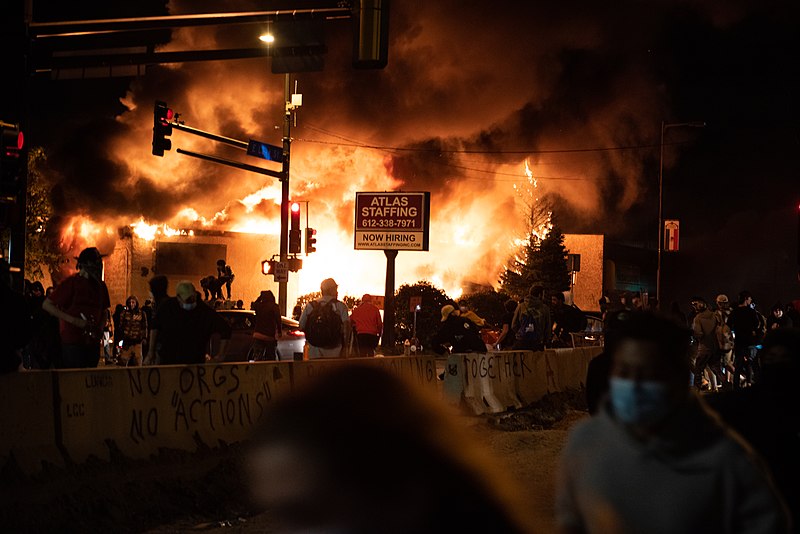
A building burning in Minneapolis following the death of George Floyd.
Photo by Hungryogrephotos via Wikipedia.

One must not exaggerate, of course. We do not yet live under a Soviet-type tyranny in which every university thesis, on no matter how arcane a subject, was obliged by hook or by crook to quote Lenin. It is still possible, though not at all easy, to live as a scholar in our societies outside the university system. But it does not require the tyranny of the complete police state to obtain a high degree of intellectual conformity, as we can now observe at our leisure. Young university academics of my acquaintance in several countries tell me that they are now afraid to speak their mind, not because they would fear for their lives, but fear for their promotion. This is not the same, or as terrible, as fearing for their lives, but it is nonetheless very far from the Millian ideal of freedom of thought and speech.

There is much worse. It is not merely that they must keep their mouth shut and not say what they think, bad enough as this must be for those who have chosen the life of the mind; it is that they must positively subscribe to things that they believe to be bad or false. And this is a mark of totalitarianism. They must subscribe to doctrines they believe absurd, for example by describing in job applications their future efforts to promote diversity, so-called. By making the expression of untruth the condition of employment, probity is destroyed in advance. Those who lack it are easier to control.

Increasingly, social movements do not allow any neutrality with regard to the causes that they promote. Non-adherence is no different from enmity and derogation is evil: if you are not part of the solution you are part of the problem. In vain might you argue that your interest is elsewhere, in the taxonomy of grasshoppers, for example, or in the biochemistry of acorns, or in the bibliography of Alexander Pope: there is one subject that trumps all others in importance, and on it only one opinion is permissible. You must pass a test of loyalty.

The latest of these movements is, of course, Black Lives Matter, and its success in cowing so large a part of the intelligentsia is in a way admirable, a model of political organization for the future, though one much to be feared. By claiming that silence is violence, it has made hand-wringing (to avoid its anathema) the mark, and almost the whole, of virtue. It has successfully reversed Martin Luther King’s goal, such that the colour of a man’s skin is once again more important than the content of his character, and it has made respectable that most Stalino-Maoist of notions, that people should be promoted and rewarded according to their social (in this case, racial) origins. And anyone who disagrees is an Enemy of the People, the word People being here used in a severely technical sense, to mean the arbiters of the allocation of rewards.

September 3, 2020

“[L]ooting is a powerful tool to bring about real, lasting change in society.”

Filed under: Books, Law, Politics, USA — Tags: , , , — Nicholas @ 03:00

Not everyone on the progressive team is all-in on the “Loot your way to utopia”, as Graeme Wood (risking cancellation by his co-religionists) criticizes Vicky Osterweil’s paean to looters and looting:

Last week, NPR’s Code Switch published an interview with Vicky Osterweil, the author of In Defense of Looting: A Riotous History of Uncivil Action. NPR summarizes the book as an argument that “looting is a powerful tool to bring about real, lasting change in society.” If the real, lasting change you wish to effect is burning society to cinders and crippling for a generation its ability to serve its poorest citizens, then I suppose I am forced to agree. Osterweil sees an upside. Looting is good, she says, because it exposes a deep truth about the great American confidence game, which is that “without police and without state oppression, we can have things for free.” She came to this conclusion six years ago, and in her book, which is written “in love and solidarity with looters the world over,” she defends this view as ably as anyone could.

Osterweil’s argument is simple. The “so-called” United States was founded in “cisheteropatriarchal racial capitalist” violence. That violence produced our current system, particularly its property relations, and looting is a remedy for that sickness. “Looting rejects the legitimacy of ownership rights and property, the moral injunction to work for a living, and the ‘justice’ of law and order,” she writes. Ownership of things — not just people — is “innately, structurally white supremacist.”

The rest of the remedy is more violence, which she celebrates as an underrated engine for social justice. The destruction of businesses is an “experience of pleasure, joy, and freedom,” Osterweil writes. It is also a form of “queer birth.” “Riots are violent, extreme, and femme as fuck,” according to Osterweil. “They rip, tear, burn, and destroy to give birth to a new world.” She reserves her most pungent criticism for advocates of nonviolence, a “bankrupt concept” primarily valuable for enlisting “northern liberals.” Liberal is pejorative in this book. Martin Luther King Jr. is grudgingly acknowledged as a positive figure, but not as positive a figure as he would have been if he had kicked some white-capitalist ass and put a few pigs in the ICU. The “I Have a Dream” speech was, Osterweil writes, “the product of a series of sellouts and silencings, of nonviolent leaders dampening the militancy of the grass roots” and “sapping the movement’s energy.” More to her taste is Robert F. Williams, who practiced armed resistance, and Assata Shakur, who murdered a New Jersey police officer and remains a fugitive in Cuba. The violence needn’t be in self-defense — Shakur’s certainly was not. Osterweil quotes the “wisdom” of Stokely Carmichael: “Responsibility for the use of violence by black men, whether in self-defense or initiated by them [emphasis mine], lies with the white community.”

By now you have guessed that I am not the audience for this book. I have a job, and am therefore invested in building a system where you get paid for your work and pay others for theirs, and then everyone pays taxes to make sure that if these arrangements don’t work out, you can still have a dignified life. (Easily my favorite line in the book was written not by the author but by her publisher, right under the copyright notice: “The scanning, uploading, and distribution of this book without permission is a theft of the author’s intellectual property,” it says. “Thank you for your support of the author’s rights.”) My job sometimes entails traveling to countries recently or currently destroyed by civil unrest, and that experience has made me appreciate the fragility of peace, and has not made me eager to conduct a similar experiment in my own city.

QotD: Racism

Filed under: History, Politics, Quotations, USA — Tags: , , , — Nicholas @ 01:00

Racism is stupid. Humans come in different shades for obvious biological reasons to do with the intensity of sunlight where their ancestors grew up. Apart from calculating intake of Vitamin D when living in cold climates, it shouldn’t matter. Yet people keep on making it matter — for all kinds of reasons; few if any of them good.

America’s race relations problems arise from its shameful history with slavery. Black Americans clearly feel a sense of solidarity based on that history. I can understand the magnificent language of the Declaration of Independence or the majestic ideas behind the US Constitution are tainted for black American students knowing, as they learn about them, that they didn’t apply to their ancestors. It must be hard for them to take the same pride in the foundation of their great nation as white classmates. I get that “Plymouth Rock landed on us” idea.

Many White Americans do feel a corresponding sense of shame but it’s daft to feel guilty for stuff people who share some random attribute with you did. Short people are not to blame for Napoleon and nor (fun though it is to tease them about him) are French people. No doubt we all do feel pride and shame about our ancestors’ achievements and sins, but it’s nuts to base law or policy on those irrational feelings or to allow them to taint relationships today.

Even if we were to go down the mad road of punishing people for the sins of the fathers, we’d have to find out what those “fathers” actually did, person by person. To do it skin tone by skin tone would itself be racist. It would involve, for example, some British people being heroes because their ancestors sailed with the Royal Navy squadron detailed to suppress the Slave Trade while others are villains because theirs crewed slave ships. There would be no way of knowing if you were hero or villain until you played that historical lottery.

As I told a Jewish American friend who teased me one Fourth of July about losing the American Revolutionary War, “That was a dispute between two sets of my ancestors — yours were in Germany at the time. Stay out of our family quarrels.” That’s a good joke but it would be dumb to base a social science on it. Yet America’s “grievance studies” types have done something remarkably similar in creating the wicked notion of “white privilege”.

Tom Paine, “Checking my privilege”, The Last Ditch, 2020-06-02.

August 31, 2020

QotD: The Alt-right and Jordan Peterson

Filed under: Cancon, Media, Politics, Quotations — Tags: , , , , — Nicholas @ 01:00

You can hear this in the visceral contempt with which Peterson’s “young white male” audience is described by his journalistic detractors, (most of whom are white, and many of whom are male). And yet this crucial piece of hearsay, linchpin of the Peterson narrative, is not true. It hasn’t been true for a while, if it ever was. Anyone who cares to know the truth can go out and find it: I saw it myself with my own eyes at three events I attended in the winter, as did the Maclean’s reporter who found that:

    They are new Canadians, people of colour, men and women. And in a way that seems out of sync with op-ed portrayals of Peterson’s supporters as committed to preserving old hierarchies and positions of privilege — they often see themselves as searchers, truth-seekers and iconoclasts.

Popularity, even among people of color, is not, of course, proof in itself of the salubriousness of anything, especially in a world where Fox News, Breitbart, and InfoWars also command the attention of tens of millions. And indeed, Peterson really was avidly embraced at first by the far-right when he emerged, denouncing concepts of unconscious bias and white privilege, and stated his intention to defy any prospective attempt through the force of law to compel him to adopt gender-neutral pronouns in his classroom at the University of Toronto. In his rather coarse-grained and Manichaean analysis of so-called Social Justice Warriors, Peterson occasionally invoked a term, “Cultural Marxism,” whose lineage was said, by others, to have also birthed a far-right conspiracy theory that, in turn, figured prominently in the manifesto of the Norwegian mass murderer Anders Breivik. So anyone playing a game of connect the dots in order to portray Peterson as part of a recrudescence of reactionary modernism has material to work with, some of it even provided by Peterson himself.

Yet it soon enough became clear to anyone paying attention that Peterson’s initial embrace by the alt-right was a case of mistaken identity. Eventually, the spokesmen of that poisonous and amorphous internet tendency decided in concert that Peterson had been sent by the left to disrupt their “movement” and siphon off its energies by redirecting it toward an individualistic creed that would prove fatal to their own racist ethnonationalism. Peterson then rapidly crossed over to an audience that is now many multiples the size of the cohort of problematic young males who first embraced, then rejected him, even as the progressive left tried to hold on to the alt-right’s original, mistaken read.

Wesley Yang, “The Shocking Truth About Jordan Peterson”, Tablet, 2018-05-28.

August 30, 2020

“When I use the word looting, I mean the mass expropriation of property, mass shoplifting during a moment of upheaval or riot. That’s the thing I’m defending.”

Filed under: Books, Law, Politics, USA — Tags: , , , — Nicholas @ 05:00

An NPR interview with author Vicky Osterweil about her new book In Defense of Looting, published last week:

During the uprisings of this past summer, rioting and looting have often gone hand in hand. Can you talk about the distinction you see between the two?

“Rioting” generally refers to any moment of mass unrest or upheaval. Riots are a space in which a mass of people has produced a situation in which the general laws that govern society no longer function, and people can act in different ways in the street and in public. I’d say that rioting is a broader category, in which looting appears as a tactic.

Often, looting is more common among movements that are coming from below. It tends to be an attack on a business, a commercial space, maybe a government building — taking those things that would otherwise be commodified and controlled and sharing them for free.

Can you talk about rioting as a tactic? What are the reasons people deploy it as a strategy?

It does a number of important things. It gets people what they need for free immediately, which means that they are capable of living and reproducing their lives without having to rely on jobs or a wage — which, during COVID times, is widely unreliable or, particularly in these communities is often not available, or it comes at great risk. That’s looting’s most basic tactical power as a political mode of action.

It also attacks the very way in which food and things are distributed. It attacks the idea of property, and it attacks the idea that in order for someone to have a roof over their head or have a meal ticket, they have to work for a boss, in order to buy things that people just like them somewhere else in the world had to make under the same conditions. It points to the way in which that’s unjust. And the reason that the world is organized that way, obviously, is for the profit of the people who own the stores and the factories. So you get to the heart of that property relation, and demonstrate that without police and without state oppression, we can have things for free.

Importantly, I think especially when it’s in the context of a Black uprising like the one we’re living through now, it also attacks the history of whiteness and white supremacy. The very basis of property in the U.S. is derived through whiteness and through Black oppression, through the history of slavery and settler domination of the country. Looting strikes at the heart of property, of whiteness and of the police. It gets to the very root of the way those three things are interconnected. And also it provides people with an imaginative sense of freedom and pleasure and helps them imagine a world that could be. And I think that’s a part of it that doesn’t really get talked about — that riots and looting are experienced as sort of joyous and liberatory.

[…]

What would you say to people who are concerned about essential places like grocery stores or pharmacies being attacked in those communities?

When it comes to small business, family owned business or locally owned business, they are no more likely to provide worker protections. They are no more likely to have to provide good stuff for the community than big businesses. It’s actually a Republican myth that has, over the last 20 years, really crawled into even leftist discourse: that the small business owner must be respected, that the small business owner creates jobs and is part of the community. But that’s actually a right-wing myth.

A business being attacked in the community is ultimately about attacking like modes of oppression that exist in the community. It is true and possible that there are instances historically when businesses have refused to reopen or to come back. But that is a part of the inequity of the society, that people live in places where there is only one place where they can get access to something [like food or medicine]. That question assumes well, what if you’re in a food desert? But the food desert is already an incredibly unjust situation. There’s this real tendency to try and blame people for fighting back, for revealing the inequity of the injustice that’s already been formed by the time that they’re fighting.

H/T to Amy Alkon for the link.

Update: Ann Althouse also commented on the NPR interview:

I don’t know if other people in “the movement” are happy to see that idea spoken aloud [that looters and rioters have “always been a part of our movement”]. I’ve been hearing that there are 2 groups of people — the peaceful protesters and these mysterious other people, who, I’ve noted, the journalists don’t seem to care to identify and investigate. Osterweil is saying these are not 2 different groups. It’s one movement, and it’s been going on for a long time.

[…]

That seems to present looting as street theater with a message. It makes an argument. A terrible argument. We’ve heard that argument in words many times over the years, and most Americans reject it. We want to work and build wealth and enjoy our lives and we want the great mutual benefits of hard work and wealth. Osterweil’s looting is a switch from making the argument against property in words and to speak with actions — the destruction of property. But that doesn’t make the argument more convincing! It’s a nasty tantrum thrown because you can’t convince people with your ideas. Ironically, fortunately, it makes the argument for the other side.

Andrew Sullivan – “… let’s be frank about this and call this by its name: this is very Weimar. The center has collapsed.”

In the latest Weekly Dish, Andrew Sullivan finds himself in agreement with Marcus Aurelius: “The object of life is not to be on the side of the majority, but to escape finding oneself in the ranks of the insane.”

A building burning in Minneapolis following the death of George Floyd.
Photo by Hungryogrephotos via Wikipedia.

I don’t think I’m the only one, as even the Democrats seem now to realize. And this massive blindspot is not hard to understand. When a political party finds itself so wedded to a new and potent ideology it cannot call out violence when it sees it, then it is walking straight into a trap. When the discourse on the left has become one in which scholars and editors and Tweeters vie with one another to up the ante on how inherently evil America has always been, redescribe it as a slaveocracy, and endorse racist books that foment the most egregious stereotypes about “whiteness”, most ordinary people, who love their country and are mostly proud of its past, will rightly balk. One of the most devastating lines in president Trump’s convention speech last night was this: “Tonight, I ask you a very simple question: How can the Democrat Party ask to lead our country when it spends so much time tearing down our country?” A cheap shot, yes. But in the current context, a political bullseye.

The key theme of the RNC was reminding people of the American narrative that once was. Yes, it was unbelievably vulgar. Yes, it looked like a cross between a sophisticated CGI video-game and a crude car dealer ad with a dollop of Leni Riefenstahl. But it was extremely effective. To see that, you have to remove your frontal cortex and put it in a jar, accept that it’s all going to be a series of lies so massive they stupefy us into stutters, and then cop the feels. Pence gave us a vision of America that was a souped up Disney special from the early 1960s — from Fort McHenry no less. And look at the icons Trump invoked: Wyatt Earp, Annie Oakley, Davy Crockett, and Buffalo Bill. You can mock. But in the midst of a culture being redescribed by the left as a form of foul and relentless “white supremacy”, and in a moment of arson and rioting, it felt like a kind of balm.

All this reassurance played out against a backdrop of Kenosha, which was burning, and Minneapolis, where a suicide led to a bout of opportunistic looting, and Washington DC, where mobs of wokesters went through the city chanting obscenities, invading others’ spaces, demanding bystanders raise fists in solidarity, with occasional spasms of violence. These despicable fanatics, like it or not, are now in part the face of the Democrats: a snarling bunch of self-righteous, entitled bigots, chanting slogans rooted in pseudo-Marxist claptrap, erecting guillotines — guillotines! — in the streets as emblems of their agenda. They are not arguing; they are attempting to coerce. And liberals, from the Biden campaign to the New York Times, are too cowardly and intimidated to call out these bullies and expel them from the ranks.

[…]

And let’s be frank about this and call this by its name: this is very Weimar. The center has collapsed. Armed street gangs of far right and far left are at war on the streets. Tribalism is intensifying in every nook and cranny of the culture. The establishment right and mainstream left tolerate their respective extremes because they hate each other so much.

The pattern is textbook, if you learn anything from history: an economic crisis resulting in mass unemployment; the pent-up psychological disorders a long period of lockdown can and will unleash; a failure of nerve on the part of liberals to defend the values and institutions of liberal democracy, and of conservatives to keep their own ranks free of raw demagogues and bigots. But critically: a growing sense of disorder and violence and rioting as simply the background noise; and a sense that authorities do not have the strength or the stomach to restore order. What most people want in that kind of nerve-wracking instability is a figure who will come in and stamp it out. In Trump, we have someone who would happily trample any liberal democratic norm to do it. And the left seems to be all but begging him to do it — if only to prove them right.

A long time ago, I was mocked for saying that I believed that the election of Donald Trump was an extinction-level event for liberal democracy. But this is where we are. There is no place for liberal debate or dissent, just competing mobs deploying propaganda, intimidation and mutual racial hatred. Norms are trashed, from the shameful cooptation of national monuments for partisan purposes, to violating the privacy and peace of ordinary citizens because they are not in the ranks of agitators. Liberals are now illiberal; conservatives are revolutionaries. The Republican convention we are witnessing makes no pretense of even publishing a platform — all to demonstrate total and unfailing fealty to the leader whose own family is now assumed to succeed him. What about this pattern of events do we not already understand?

August 27, 2020

QotD: Racism and the minimum wage

Filed under: Australia, Business, Cancon, Economics, Quotations, USA — Tags: , , , , , , — Nicholas @ 01:00

Minimum-wage laws can even affect the level of racial discrimination. In an earlier era, when racial discrimination was both legally and socially accepted, minimum-wage laws were often used openly to price minorities out of the job market.

In 1925, a minimum-wage law was passed in the Canadian province of British Columbia, with the intent and effect of pricing Japanese immigrants out of jobs in the lumbering industry.

A Harvard professor of that era referred approvingly to Australia’s minimum wage law as a means to “protect the white Australian’s standard of living from the invidious competition of the colored races, particularly of the Chinese” who were willing to work for less.

In South Africa during the era of apartheid, white labor unions urged that a minimum-wage law be applied to all races, to keep black workers from taking jobs away from white unionized workers by working for less than the union pay scale.

Some supporters of the first federal minimum-wage law in the United States — the Davis-Bacon Act of 1931 — used exactly the same rationale, citing the fact that Southern construction companies, using non-union black workers, were able to come north and underbid construction companies using unionized white labor.

These supporters of minimum-wage laws understood long ago something that today’s supporters of such laws seem not to have bothered to think through. People whose wages are raised by law do not necessarily benefit, because they are often less likely to be hired at the imposed minimum-wage rate.

Thomas Sowell, “Why racists love the minimum wage laws”, New York Post, 2013-09-17.

August 24, 2020

Theodore Dalrymple reviews White Fragility by Robin DiAngelo and How to Be an Antiracist by Ibram X. Kendi

Filed under: Books, Media, Politics, USA — Tags: , , — Nicholas @ 05:00

The two books share many characteristics, says the good doctor (in his “Anthony Daniels” guise), and the most noteworthy is a shared hectoring tone:

DiAngelo’s book displays a curious admixture of influences: the Chinese Cultural Revolution, Jimmy Swaggart, Freudian psychoanalysis, and Uriah Heep, the four of them being present in approximately equal proportion.

DiAngelo has apparently made a career of anti-racist struggle sessions in which ordinary employees of various organizations must confess publicly to their racism however hidden it might be, as university professors, primary school teachers, doctors working in slums, etc., had once in China to confess to bourgeois propensities and counter-revolutionary ideas. They may never have uttered a racist sentiment, they may never have been rude to a person of another race, let alone violent towards one, they may have friends of other races or even be married to a person of another race, but they carry racism deep within them like Original Sin, with this difference: there can be no redemption from it even after having read DiAngelo’s book and attended her struggle sessions. Personally, I should not be at all surprised if the end result of all her efforts, at least among the men she has “trained” (which is to say tried to indoctrinate), was to have acted as a recruitment officer for the Ku Klux Klan.

After thirty years of constant work of supposedly anti-racist training, she confesses — like the tearful Jimmy Swaggart — to being still guilty of racism herself, promising to reform, although reform is ex hypothesi impossible because racism is in her society’s DNA, as it were. One is reminded of the type of psychoanalysis which after thirty years of hourly sessions four times a week fails to get to the root of the analysand’s problem, let alone solve it, because it doesn’t even know what the problem is. But failure is also an opportunity, because, like psychoanalysis, the more anti-racist training fails, the more it is needed. DiAngelo, all credit to her, has found an economic niche for herself for the rest of her life. One has a sneaking admiration for such entrepreneurs. They are the asset-strippers of the soul.

As for Uriah Heep, DiAngelo has obviously heard, read, marked, learned, and inwardly digested (as my teachers used to demand of me) David Copperfield. Her oleaginous approach to all “people of color,” as she coyly calls them, makes Uriah Heep seem positively blunt and straight-talking. DiAngelo regards all nonwhite people, ex officio, as being incapable of exaggeration or unjustified self-pity, let alone of lying. As well as being sycophantic, this is, to coin a word, racist, for one of the most important manifestations of free will, and therefore of humanity itself, is the capacity to lie. In effect, then, she regards “people of color” as infra-human truth-uttering mechanisms: they speak, therefore what they say is true. No critical faculties need be applied to what they say.

[…]

DiAngelo is a tremendous moral narcissist. This is shown by her use of the term “people of color.” Until page 31, I thought that it meant black, but on that page I learned that it meant non-white. She shows no interest in the question of whether the Japanese, Chinese, Indians, Burmese, Vietnamese, Cambodians, Austronesians, Amerindians, and Africans, et al., would all be delighted to be put in the same category, let alone interest in their many cultures. On page 33, we read:

    White supremacy is more than the idea that whites are superior to people of color; it is the deeper premise that supports the idea — the definition of whites as the norm or standard of human, and people of color as a deviation from that norm.

Lumping non-white people together as “people of color” is precisely an instance of what she criticizes: this is what happens when moral rhetoric far outruns intelligence.

August 21, 2020

Virtuesplaining Blazing Saddles

Filed under: History, Humour, Media, Politics, USA — Tags: , , , , , , — Nicholas @ 03:00

Paul du Quenoy says that Mel Brooks is cancelled after all:

It seems like only yesterday that HBO Max, the financially troubled American cable television network’s new film streaming service, signalled its virtue by removing Gone With The Wind from viewing so that the classic film could be properly “contextualised” as what presenter and University of Chicago film professor Jacqueline Stewart calls “a prime text for examining expressions of white supremacy in popular culture”. She believes this is useful for the “re-education” of audiences who might otherwise stray into thoughtcrime.

Mel Brooks’s smash hit 1974 comedy Blazing Saddles, which seems to have been added to HBO Max since the Gone With The Wind dust up and is known for its liberal use of the feared and loathed “n-word”, arrived with a similarly patronising disclaimer already installed. In a three-minute introduction that apparently cannot be skipped over, Stewart is there again, this time to inform viewers that “racist language and attitudes pervade the film”, while instructing them that “those attitudes are espoused by characters who are portrayed here as explicitly small-minded, ignorant bigots … The real, and much more enlightened, perspective is provided by the main characters played by Cleavon Little and Gene Wilder”.

Thanks, Aunt Jacqueline. If you have not seen Blazing Saddles – and if you are under the age of forty there is an excellent chance some prudish authority figure sanitised it out of your cosseted millennial existence – it stands as one of the greatest, and the certainly the funniest, anti-racist films of all time. Based on a story by Andrew Bergman, Brooks conceived it as a scathing send-up of racism and the hypocrisy that still enabled it after the great civil rights victories of the 1960s. Brooks’s idiom was a parody of the classic Western, by then an exhausted genre that had, among other flaws, become inanely predictable and was much criticised for leaving out minorities. A landmark of American film, Blazing Saddles was selected in 2006 for inclusion in the US National Film Registry, which recognises “culturally, historically, or aesthetically significant films” worthy of preservation.

Drenched in hilarity – and by my count using the “n-word” 17 times in its 93-minute run – the plot involves a conspiracy by an avaricious U.S. state attorney general who wants to drive white settlers off land he needs to complete a profitable railroad project. After having outlaws wreak mayhem on the townspeople, he recommends that the governor appoint a black sheriff to restore law and order, cynically assuming that their racism will cause them to reject the new lawman and give up. Despite a rough initial reception, the sheriff outwits attempts to get rid of him and, with the help of a washed up but sympathetic alcoholic gunslinger, leads the townspeople to victory, winning their love and respect before moving on to other brave deeds.

While HBO no longer wants to risk having its paying customers think for themselves (and what stale corporate outfit uneasily transitioning to a crowded new market wouldn’t?), it could rightly be said that anyone dumb enough to miss the film’s message might be a recent product of Anglo-American higher education. I do not mean this at all facetiously. Decaying and run by a self-important clerisy whose demands to be taken seriously only become shriller as it declines in reach and vitality – and from which any participant can be dismissed for even the slightest speech or behavioural infraction – academia naturally discourages humour. Jokes, which can almost always cause some kind of offence, are simply too risky to be told or laughed at, even in private. Finding the wrong thing funny can invite career-hobbling accusations that one has demeaned a student or colleague and thereby made them feel unacceptably “uncomfortable” or even physically “unsafe”. Perceived flippancy bruises sanctified “professional seriousness” in a way tantamount to sacrilege. The only tolerated exceptions are a kind of solemn irony that offers comfort in coping with academia’s increasing irrelevance and a resigned gallows humor about its ever more limited prospects.

August 14, 2020

From protests to riots to …

Filed under: History, Media, Politics, Religion, USA — Tags: , , , , , , — Nicholas @ 03:00

In the Claremount Review of Books, Angelo M. Codevilla looks at historical patterns that may prefigure what is going on in major urban areas today:

Hagia Sophia in the Faith district of Istanbul, 18 November 2004.
Photo by Robert Raderschatt via Wikimedia Commons.

The Americans who confess other people’s racism absolve themselves inexpensively by a moral mechanism common to humanity: the more I profess to hate evil, the more I showcase my own goodness. Such confessions, however, have a particular history of tragedy in Christian civilization. Again and again over the centuries, persons who have imagined themselves cleansed by ritual confessions have believed themselves elevated above the rest of humanity and, hence, entitled to oppress or even annihilate those around them. Today’s self-purifiers, arms outstretched in supine submission, who then countenance violence against persons, property, and cultural symbols, are mostly unwitting protagonists in yet another chapter of a hoary history.

Although Judeo-Christianity teaches that perfection is not of this world, nevertheless the Old Testament (see the Book of Daniel) and the New (Revelation, chapter 20) refer tangentially to a final state in human affairs in which all evil will have been defeated and the virtuous will have triumphed over their enemies. In the Book of Revelation, this final stage is to last for a thousand years. Jesus Christ’s warnings notwithstanding, people have hearkened periodically to “false prophets” who brandish the prospect of ultimate vengeance over evil. Between the 11th and 16th centuries, any number of movements of this sort used ritual confessions to cleanse themselves, and energized the mobs that waged Europe’s bloodiest wars of that age. Thereafter, though such movements secularized their terms, they fit into the same moral and intellectual categories. Now as ever, they are about destroying civilization in the name of altering the human condition.

But whereas revolutionary movements from the Middle Ages to roughly the middle of the 20th century opposed the ruling classes wholeheartedly and found no friends among them, this generation’s movements have intense, problematic relations with those classes, about which more below.

Today we see scenes of monuments which had stood for decades, now destroyed and defaced, as well as the forceful cancellation of names from circulation. Smashing others’ idols was, and remains, a staple of tribal warfare. The Old Testament recalls the divine command to destroy idols, and the clashes between Christian and Muslim armies always aimed as much at symbols as at people. The Song of Roland contains a lyrical account of Charlemagne’s iconoclasm in his campaign against the Saracens. In the 6th century, Emperor Justinian made Constantinople’s Hagia Sophia cathedral the Christian world’s biggest and most important church. The Muslims who added that city to the Ottoman Empire in 1453 killed its priests, toppled its statues, and made it into the principal mosque of the Muslim caliphate at war with Christendom. In 1923, Kemal Atatürk, Turkey’s modernizer, turned the building into a museum in order to end that war. But in July 2020 Turkey’s Islamist president Recep Erdogan, consistent with his hostility to Judeo-Christian civilization, turned it into a mosque again and began covering up what remain of the Christian frescoes on its walls. Destroying symbols, however, has had no place within Christian civilization. As the equivalent of torturing dead men, it has always been the work of cowards likelier to run from living enemies. On the other hand, war against statues, paintings, books, biographies, etc., has been a defining feature of civilization’s revolutionary enemies, consistent with their chosen identities as alien tribes.

What follows is a glance at the bloody history of this little-known flaw. It is a tale whose cautionary moral Aleksandr Solzhenitsyn best expressed: the line between good and evil runs not between persons — never mind between parties, classes, or races — but down the middle of every human heart. That is central to our civilization.

H/T to David Warren for the link.

August 9, 2020

Canadian Art magazine’s “woke suicide pact”

As a cultural barbarian and all-around Neanderthal, it will come as little surprise to both my readers that I’d never even heard of Canadian Art magazine. As a result, the recent decision to cease publication due to the unresolved (and almost certainly unresolvable) issues of needing to be funded by rich white people:

These evils were explained in a long article published by Canadian Art‘s former editor-in-chief, David Balzer (self-describedgay, fag, queer. Ambivalent Libra“), in which he complains that the progressive agenda of the magazine he edited was forever being undercut by the need to solicit funds from wealthy white donors. Or, as he describes it, the pursuit of: “white, liberal money — the champagne socialists.”

Shockingly, these donors are not especially fond an incessant slew of articles with titles such as Drop the Charges and Defund the Police, Says New Artists’ Letter for Black Lives, Give Us Permanence — Ending Anti-Black Racism in Canada’s Art Institutions, and A Crisis of Whiteness in Canada’s Art Museums.

Balzer’s analysis of the growing tension between establishment donor and do-good editor is spot on:

    Most boards, which are also majority white, are [interested] in going to where they believe the money is. So the argument goes: It takes a certain talent, panache, to be president, director, or CEO, to open those pocketbooks, and without these skills, culture cannot run. This argument implies that culture cannot run if its backrooms are not white … Many corporate partners make possible the lavish, yearly fundraising galas that cultural organizations host: ostentatious displays of whiteness and wealth that are the public-facing versions of the aforementioned work done by white presidents, directors and CEOs.

It’s a problem that every charity, art outlet, and activist organization in Canada will face. Supporting the arts is rarely an act of pure altruism. It has always been a status flex by the well-connected barons and baronesses of privilege. At its most cynical, arts funding is a high-class game of reputation laundering.

« Newer PostsOlder Posts »

Powered by WordPress