Let’s start with the fact that apparently there are so many women getting “ghosted” (abandoned by men after brief romantic encounters) that they now constitute a demographic cohort big enough to be a presidential voting bloc.
Which is surprising, because for the last twenty years or so, American girls have been raised from birth to be premium dating fodder, primed from the first whiff of puberty to be Available for Sex on Saturday Night. So why are they being ghosted in droves? Abandoned and left to die alone, clutching their pets and Warren for President signs?
You’d think these girls would be experts at snagging a mate. Years of sex ed, birth control pills, and permission to date early and often with no judgement from the grownups should have guaranteed they’d have suitors dangling from their every finger, lines outside the door, dates every night, so many engagement rings shoved under their noses they’d be blinded by the shimmering sight of all those diamonds nestled against black velvet.
What happened?
Parenting: The New Sex Trafficking
Munchausen by proxy is a mental illness in which the mother (it’s almost always the mother) injures or sickens her own child on purpose for attention and sympathy. Grooming is a crime in which an adult nurtures a child over a long period of time to be open to receiving sexual advances.
American parenting is starting to resemble a terrifying combination of both.
How else to explain why girls are being turned out — groomed for extreme antisocial sexual behavior from a young age — not by pimps, but by their parents and teachers?
When it comes to sex ed, I believe in the screenwriting theory known as Chekhov’s gun: if you show a gun in the first act, it must be fired by the third. If you show kids the sex toys (and worse) in the first grade, the sex toys will be used by high school.
Recently, NPR published “What Your Teen Wishes You Knew About Sex Education”. In the article, we meet Electra McGrath-Skrzydlewski, who made a point of telling her fourth-grade daughter Lily, well, everything. “She was very open from the get-go, even before those were things that I needed to know about,” her daughter recounts.
Lily came out as pansexual at age 12.
At an institutional level, we are creating a cursed generation of females expert at every imaginable permutation of sex with an infinite number of partners, while largely shunning the other thing, the main thing, the only thing still emitting any heat in the cold, merciless hearth of contemporary life: the dream of forming a family.
Because the shocking truth is: No one wants to wife a sex expert.
Peachy Keenan, “Big Pimping: How American Parents Turn Their Daughters Out”, The American Mind, 2020-03-05.
October 1, 2021
QotD: Raising your daughter to be “premium dating fodder”
September 29, 2021
QotD: Lizard people
Many years ago I read a penetrating analysis of UFOlogy arguing that the reports of people who believed themselves UFO contactees or witnesses were expressing the same sorts of psychological drama that in past centuries would gave been coded as religious experiences – eruptions of nigh-incomprehensible powers into the mundane world.
In this telling, to understand UFO reports and the weird little subculture that has grown up around their believers, you need to understand that for those people the imagery of the cheesiest sort of B-movie science fiction has taken up the same receptors in their minds that religious mythology does for the conventionally devout. What they are really grappling with is mystical experience – altered states of consciousness, mindstorms that are very real phenomena in themselves but one which they lack any context to understand in a rational and generative way.
When I remembered this, I found a fruitful question to ask. That is, what is it about their experience of reality that believers in lizard people are coding in this cheesy SFnal imagery? What are they actually trying to talk about?
The answer came to me almost immediately once I managed to formulate the question. That was the moment at which I realized that, barring one unimportant detail, lizard-people theory is actually true.
The unimportant detail is the part about the lizard people being actual extraterrestrials. But let’s look at the rest of it. The believer says: Our elites behave as though they are heavily infiltrated by beings hostile to the interests of ordinary humans. They hide behind a mask of humanity but they have alien minds. They are predators and exploiters, cunning at hiding their nature – but sometimes the mask slips.
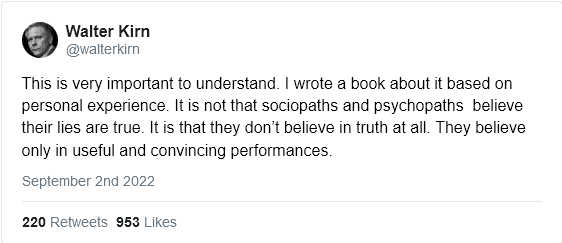
Nothing about this is in any way wrong, once you realize that “lizard” is code for “sociopath”. Sociopaths do, differentially, seek power over others, and are rather good at getting it. The few studies that have dared to look have found they are concentrated in political and business elites where drive and ruthlessness are rewarded.
“Lizard” is actually a rather clever code, if you happen to know your evolutionary neuroanatomy. Oversimplifying a little, humans have an exceptionally elaborate neocortex wrapped around a monkey brain wrapped around a lizard brain. The neocortex does what we are pleased to consider higher cognitive functions, the monkey brain does emotions and social behavior, and the lizard brain does territoriality/aggression/dominance.
What is wrong with sociopaths (and psychopaths – these categories are not clearly distinguished) is not entirely clear, but it is certain that their ability to experience emotions is damaged. The monkey brain is compromised; sociopaths live more in their lizard brain and display a lizard-like ability to go from flat affect to aggressive violence and back again in two blinks of an eye.
So, yeah, aliens. We have a live conspiracy theory because a lot of people can sense the alienness in their sociopathic/psychopathic bosses and politicians – and sometimes the mask slips. Not having any grasp of the language of abnormal psychology, they reach for the nearest metaphor handy. There’s a close relative of lizard-people theory in which which many of our elites are held to be members of an ancient Satanic conspiracy and have become demon-ridden; this is different language carrying the same freight.
Eric S. Raymond, “The reality of the lizard people”, Armed and Dangerous, 2020-02-15.
September 14, 2021
“If life is a status game … The logic of the status game dictates that humiliation must be uniquely catastrophic”
In Quillette, Will Storr recounts some harrowing early life experiences for three young men ‐ that read like setups for bad horror novels — and how those early humiliations led to tragedy:
If life is a status game, what happens when all our status is taken from us? What happens when we’re made to feel like nothing, again and again and again? Humiliation can be seen as the opposite of status, the hell to its heaven. Like status, humiliation comes from other people. Like status, it involves their judgement of our place in the social rankings. Like status, the higher they sit in the rankings, and the more of them there are, the more powerful their judgement. And, like status, it matters. Humiliation has been described by researchers as “the nuclear bomb of the emotions” and has been shown to cause major depressions, suicidal states, psychosis, extreme rage, and severe anxiety, “including ones characteristic of post traumatic stress disorder.” Criminal violence expert Professor James Gilligan describes the experience of humiliation as an “annihilation of the self.” His decades of research in prisons and prison hospitals, seeking the causes of violence, led him to “a psychological truth exemplified by the fact that one after another of the most violent men I have worked with over the years have described to me how they had been humiliated repeatedly throughout their childhoods.”
The logic of the status game dictates that humiliation must be uniquely catastrophic. For psychologists Professor Raymond Bergner and Dr Walter Torres humiliation is an absolute purging of status and the ability to claim it. They propose four preconditions for an episode to count as humiliating. Firstly, we should believe, as most of us do, that we’re deserving of status. Secondly, humiliating incidents are public. Thirdly, the person doing the degrading must themselves have some modicum of status. And finally, the stinger: the “rejection of the status to claim status.” Or, from our perspective, rejection from the status game entirely.
In severe states of humiliation, we tumble so spectacularly down the rankings that we’re no longer considered a useful co-player. So we’re gone, exiled, cancelled. Connection to our kin is severed. “The critical nature of this element is hard to overstate,” they write. “When humiliation annuls the status of individuals to claim status, they are in essence denied eligibility to recover the status they have lost.” If humans are players, programmed to seek connection and status, humiliation insults both our deepest needs. And there’s nothing we can do about it. “They have effectively lost the voice to make claims within the relevant community and especially to make counterclaims on their own behalf to remove their humiliation.” The only way to recover is to find a new game even if that means rebuilding an entire life and self. “Many humiliated individuals find it necessary to move to another community to recover their status, or more broadly, to reconstruct their lives.”
But there is one other option. An African proverb says, “the child who is not embraced by the village will burn it down to feel its warmth.” If the game rejects you, you can return in dominance as a vengeful god, using deadly violence to force the game to attend to you in humility. The life’s work of Professor Gilligan led him to conclude the fundamental cause of most human violence is the “wish to ward off or eliminate the feeling of shame and humiliation and replace it with its opposite, the feeling of pride.”
Of course, it would be naive to claim Ed, Ted, and Elliot were triggered solely as a response to humiliation. If the cauterisation of status was a simple mass killing switch, such crimes would be common. Various further contributory factors are possible. All three were men, which dramatically increases the likelihood they’d seek to restore their lost status with violence. Elliot Rodger was said to be on the autism spectrum, which might’ve impacted his ability to make friends and girlfriends; a court psychiatrist claimed Ed Kemper had paranoid schizophrenia (although this remains contested); and Kaczynski’s brother said Ted once “showed indications of schizophrenia.” But none of these conditions are answers in themselves, because the vast majority of those that have them don’t burn down their villages.
The ordeal endured by Kaczynski as a teen at Harvard beggars the imagination and could easily provide conspiracy theorists with copious confirmations of their fears: “What Ted didn’t know was that Murray had a history of working on behalf of secretive government agencies. This would be a study of harsh interrogation techniques, specifically the ‘effects of emotional and psychological trauma on unwitting human subjects.’ Once he’d detailed his secrets and philosophies, Ted was led into a brightly lit room, had wires and probes attached to him, and was sat in front of a one way mirror. There began a series of what Murray called ‘vehement, sweeping, and personally abusive’ attacks on his personal history and the rules and symbols by which he lived and hoped to live. ‘Every week for three years, someone met with him to verbally abuse him and humiliate him,’ Ted’s brother said. ‘He never told us about the experiments, but we noticed how he changed.’ Ted himself described the humiliation experiments as ‘the worst experience of my life.'”
September 9, 2021
Did Freudian Psychology Create Modern Art? | B2W: ZEITGEIST! I E.25 Harvest 1924
TimeGhost History
Published 8 Sep 2021The Surrealist Movement is born this season with unsurprising eccentric drama. Salvador Dali will one day be a part of it, but for now he is still in art school and has actually only just come out of prison. Also this season, a crime which sees police chasing America’s first ever “Public Enemy No. 1”
(more…)
September 4, 2021
QotD: Modern childhood
While it’s hard to argue against safer playgrounds, it’s also true that by design the transparent playground offers kids no privacy. “As [playgrounds] were childproofed to improve safety, they inadvertently reduced the opportunities for the young to take part in forms of fantasy, sensory, and exploratory play, and construction activities apart from adults,” writes historian Mintz. “Unstructured, unsupervised free play outside the home drastically declined for middle-class children. As more mothers joined the labor force, parents arranged more structured, supervised activities for their children. Unstructured play and outdoor activities for children 3 to 11 declined nearly 40 percent between the early 1980s and the late 1990s. Because of parental fear of criminals and bad drivers, middle-class children rarely got the freedom to investigate and master their home turf in ways that once proved a rehearsal for the real world.”
So much for the roving pack of kids each block boasted during Mintz’s childhood, and my own. “The empty lot has disappeared,” he quips. “And we are so concerned with legal liability that if kids do find one, you’d better be sure you’ll get a call from the police.”
Beth Hawkins, “Safe Child Syndrome: Protecting kids to death”, City Pages, Volume 26 – Issue 1267 (posted to the old blog, 2005-03-31).
August 30, 2021
QotD: “Veneer theory” of human nature
Before the Blitz the consensus was that a little light bombing was all it took to make the wheels come off civilisation. This is based on veneer theory — our good behaviour is a thin veneer laid on our fundamentally selfish, violent nature, and that under pressure our true nature will out.
This turned out not to be true. So spectacularly untrue that we still talk about the Blitz Spirit. With our trademark humility, the British concluded that this was due to our exceptional moral fibre and, with help from the Americans, set about bombing German civilians to hell and back. Regrettably the Germans too responded by pulling together, and working harder in the war effort. Literally no one thinks this was due to their exceptional moral fibre. Instead, it seemed that crisis led to teamwork. Bregman is able to quote similar behaviour on the Titanic, on September 11th and in the aftermath of Hurricane Katrina.
Despite this mountain of evidence, veneer theory is still overwhelmingly believed. In 1951 William Golding wrote Lord of the Flies — a book about how a group of British boys crash-landed on a Pacific island would really behave. They start with ideals of co-operation, but quickly descend to violence and anarchy. Weeks later when they’re rescued half of them are dead. The book became a massive best seller, and a much-studied classic. For those who lived through World War I, World War II, and were now watching communism demonstrate that you didn’t even need an enemy to slaughter tens of millions, you can see the appeal of a cynical view of human nature. However it is pure fiction. In 1966 Lord of the Flies happened for real — 6 teenagers went for a joy ride in a fishing boat, got swept out by a storm and washed up on an inhospitable island in the Pacific. When they were found 11 months later, they were all alive and healthy. They had survived by fortitude, resourcefulness and above all, teamwork.
An anonymous reviewer, “Your Book Review: Humankind”, Astral Codex Ten, 2021-05-28.
August 24, 2021
QotD: Happiness and aging
… our immune system evolved to hum along at peak capacity when we’re happy but to slow down dramatically when we’re not. This is why long-term unhappiness can literally kill you through its immune-suppressing effects, and why loneliness in late adulthood is deadlier than smoking. Indeed, once you’re over sixty-five you’re better off smoking, drinking, or overating with your friends than you are sitting at home alone.
With this background in mind, Trivers hypothesized that older adults evolved a strategy of turning this relationship on its head, becoming more focused on the positive things in life in an effort to enhance their immune functioning. Such a strategy would be more sensible for older than younger adults for two reasons. First, older adults have a weaker immune system than younger adults, and face greater threats from tumors and pathogens. Second, older adults know much more about the world than younger adults do, so they don’t need to pay as much attention to what’s going on around them. For example, when older adults interact with a surly bank employee or a harried flight attendant, they have a library of related experiences to draw upon and can respond to the situation effectively without giving it much thought. As a result, they can afford to gloss over some of the unpleasant things in life.
William von Hippel, The Social Leap: The New Evolutionary Science of Who We Are, Where We Come From, and What Makes Us Happy, 2018.
August 14, 2021
QotD: Modern parenting
I took an informal poll of parents I know. At what age or stage of development can Mom or Dad go ahead and sit down, reasonably assured their little darlings will survive a solo whirl on the jungle gym? Instead of a hard-and-fast answer, what I got was the sense that we hover for numerous and complicated reasons. We fear school buses, babysitters, and sometimes even Grandma and Grandpa, who may not know any better than to let the baby cry a little on her way to sleep. We’re scared adversity will scar our kids or, conversely, that they’ll be bored — a condition that, left untreated, might turn them into school shooters.
But we also fear their independence. We’re up there in the climber because we can’t afford to miss a minute of face time, you see. We believe our physical presence is the linchpin to the children’s emotional well-being and, although we never say so out loud, we want it that way — because it’s central to our well-being. We’re scared the kids will grow up to resent the fact that Mommy works, or — the biggest golem on the list — they just plain won’t like us. And in an age of high divorce rates and transient communities, kids who don’t like us suggest the possibility that we might really end up alone.
Beth Hawkins, “Safe Child Syndrome: Protecting kids to death”, City Pages, Volume 26 – Issue 1267 (posted to the old blog, 2005-04-01).
August 13, 2021
August 11, 2021
“What war is for a soldier, global pandemic is for a health professional – most might never wish for it, but it is what they have been preparing for their whole lives”
I spent most of my life avoiding the healthcare profession … not from antipathy but from the awareness that others almost always needed access far more than I did. That changed for me at the end of 2015, although I still avoid bothering any of “my” healthcare professionals for anything that isn’t fairly clearly urgent and I’d like to maintain as low a level of contact with doctors, clinics, hospitals, and other outposts of the profession as much as I can. That said, most of the doctors, nurses, and other professionals in that line of work I’ve dealt with have been professional, competent, and (within normal limits) friendly. This doesn’t mean I don’t take Arthur Chrenkoff‘s concerns quite seriously:
If it’s up to our health experts – doctors, scientists and researchers, administrators and bureaucrats – we will never return to the “old normal”. If it’s up to our health professionals, COVID restrictions – border closures, lockdowns, masks, social distancing, etc. – will go on and on in the foreseeable future. The advent of COVID and its never ending mutations and strains might, in fact, mark the end of our life as we knew it and herald the “new normal”, ever under the shadow of a rolling pandemic.
Why? Because our health experts and professionals are enjoying it too much.Before you get outraged at my imputation, let me assure you I don’t mean the medical-industrial complex out there is hooting with joy and cracking up bottles of champagne to celebrate every new variant. By and large – and not being able to peer inside the souls of men and women I prefer to give them benefit of the doubt, though you, my reader, might have a different opinion about just how large in “by and large” is – they are honourable people with best intentions at heart. They want to save lives, prevent needless pain and suffering, minimise risks and banish sickness, save the grandmas from being killed and save the young from unforeseen long term consequences of what for them is generally a mild infection. These people take their Hippocratic Oath seriously, even those who are not medical practitioners and so not explicitly bound by it.
No, by enjoyment I really mean the satisfaction of what ancient Greeks called thymos, and which can be broadly translated into contemporary realities as the the desire to be valued and the desire for recognition.
What war is for a soldier, global pandemic is for a health professional – most might never wish for it, but it is what they have been preparing for their whole lives. It’s their time. It can be frustrating being a health expert during ordinary times; you are just one of many different voices competing to be heard about your priorities, opinions and your vision for a better life for all. Now, you are centre stage. You are important and respected. People, from a next door neighbour to the Prime Minister or the President, seek your guidance, listen to you, act on your input, appreciate your expertise. You finally have influence, real influence, if not actually a degree of control. What you say goes. The media hang on your every word, punters out there are your captive audience, leaders feel more or less strongly obliged to follow – after all, you’re the expert, you know what you’re talking about, you have the answers. Finally, you count, you really count, big time. Years of hard study and years of hard work have come to fruition, previous frustrations fall away. Millions of people appreciate your contribution and are grateful for your public service. You are a hero who is trying to keep the dragons at bay, save people from harm and death. This is not your everyday toil, patient by patient or a demographic by demographic; hell, this is the entire population, the whole humanity. There can’t be anything bigger or more important than that. Professional and public rewards are nice, but it’s not even about that – it’s the satisfaction of job well done, of having made a difference, of having made an impact, having done good.
Once you have tasted and experienced this God-like power to order entire societies according to your best designs, once you acquire this unparalleled position, with its influence and its quasi-saintly public status, do you really want to give it back and retreat again into the previous obscurity when hardly anyone listens to you?
August 5, 2021
Sarah Hoyt on “scientific government”
In the latest Libertarian Enterprise (which came out a few days ago, but I’ve been very busy), Sarah Hoyt outlines the genesis of the push for “scientific government” to save us all from ourselves and set right all the ills of the world:
Look, guys, since the middle of the 19th century, the idea of “scientific government” has been running around with pants on its head screaming insults at passerbys.
I like to say we’re still suffering from the consequences of WWI, but things were if not terminal very ill before then. Kings and emperors and Lord knows what else had got the idea of “science” and “permanent progress” stuck in their pin-like heads, which frankly couldn’t retain much more than the correct fork. And there were pet “scientists” and philosophers (the distinction was sometimes arguable. I mean, after all while doing experiments on electricity the 18th century was also fascinated with astral projection and other such things, and made no distinction. And the 19th was not much better.)
By the 20th century with mechanics and the Industrial Revolution paying a dividend in lives saved and prosperity created, these men of “science” were sure that it was only a matter of time till humanity and its reactions, thoughts and governance were similarly under control. And in the twentieth they expected us to become like unto angels.
Now, is there science that saved lives and created the wealthiest society every in the 20th century. DUH. Who the hell is arguing it. Oh, wait, there’s an entire cohort of people denying it. Not so many in the US — I think it’s hard to tell the real thing from foreign idiots posing. But in any case a minuscule contingent — but in France I know there’s a ton of them. They’re running with the bit in their teeth against rationality (I swear to bog) and thought and science. And trying to rebuild the religion of the middle ages. I read them and shake my head.
You see, you have to separate rationality and science from what the government and experts TELL you is rationality and science.
Yes, I know that France built a “Temple to Reason” and you know what? That by itself tells you their revolution was self-copulating and not right in the head. But you don’t need to go that far. Anyone who says they’re “for science” and want equality of results among disparate humans is not reasonable. Or reasoning. Or rational. They are however for sure completely and frackingly insane.
But I do understand the temptation, because so much of what’s being sold as “science” in the schools is not science but the worn out dogmas of people too stupid to know science if it bit them in the fleshy part of the buttocks.
I mean, never mind 2020. Which … you know? Remember how the flu vanished? Turns out the rat bastards were using a test that diagnosed flu as COVID. No, seriously. Malice or stupidity? I don’t know. And neither do you. Probably yes in most cases, though a lot of people have a ton of “learned stupidity”.
Even before 2020 a lot of our ideas on how things worked were lies, particularly those that hinged on or supported the leftist ideas of human kind. Things like Zimbardo’s (Is he dead yet? I need to know when to mark myself safe from being kidnapped by Zimbardo for crazy experiments. No, he really did that.) prisoner experiments; or the rat habitat experiments that supposedly showed that overpopulation had all sorts of bad effects, and therefore we should stop having kids. Turns out those effects are from the loss of social role. Which honestly, anyone who has looked at a conquered country could tell them. Of course, anyone who had looked at mice would also know they’re not humans, but never mind that. […] In fact, practically everything we think we know about psychology or sociology is likely to be a load of crap, if not outright faked.
And history, which is not really a science. Oh. Dear. Lord. Like, you know, the early form of internationalism, with international supply chains and empires caused WWI and … nationalism was blamed for it. Makes perfect sense … in hell.
In fact all this “science” stuff needs to be judged on one thing only: Does it make human lives better/save them? Or is it the astral projection of economics, sociology and psychology? By their fruits, etc.
July 30, 2021
The British government reaches deep into the bag of “nudge” tricks yet again
Britain’s public health boffins have got the government agitated enough to try major incentives to encourage British shoppers to buy healthier, lower-calorie foods. Tim Worstall explains that, because those shoppers are human beings, this suite of incentives won’t do at all what Nanny expects them to do:
Now consider how it has to work. You go shopping, you present your DimbleCard and gain points for the healthiness of that shopping basket. Lettuce and carrots galore, super, free ticket to London on the choo choo.
So, where are the chocco biccies? If you buy them when presenting your card then no choo choo for you. What happens?
The lettuce and the carrots are bought on the card, the chocco biccies are not. Everyone simply does two transactions, with DimbleCard and sans. Lots of free choo choo and no change, whatsoever, in diet.
Yes, of course people will do this. For that’s what people do. Survey the landscape of incentives in front of them then maximise their utility, the outcome, in the face of them. It’s a restricted rationality, restricted by knowledge, but it is there. Everyone will fiddle the system because that’s what it is to be human. Collecting the fire from the lightning strike is fiddling the universe, that’s just what we do.
This being why so many clever schemes to encourage or deter this or that just don’t work. This being why those detailed plans for men, if not mice, gang aft into idiocy. Because we out here, hom sap, will play whatever system there is to our benefit.
No, this will not work out like supermarket loyalty cards. Yes, it’s true, most of us do use them. But the incentive is for us to do so. The more we do use them then the more discounts we gain, the better off we are, even at the cost of that data. How does this new government one work? The less we buy of certain things the better off we are. So, less of those things will be bought using the cards.
It is not possible to insist that people must use the card to buy things. Well, not unless we’re about to descend into the dystopia desired by Caroline Lucas it’s not. There might be a card reader at the point of purchase but the supermarkets will not demand that a sale can only happen when a card is read.
Therefore there will be those sales which gain points which make prizes. There will also be those DimbleCardless sales which do not gain points, or even demerits, and are done without their being registered in the system.
July 19, 2021
QotD: Antifa
As noted here many times, it helps if you think of Antifa not as a political movement but as a metastasising personality disorder, a Cluster B contagion. An attempt to dominate by deranged and spiteful egos, rendered in shattered glass and burning livelihoods. They will never be satisfied and can never be appeased, merely encouraged and emboldened by any concession, any excuse, any hesitation.
They destroy and burn and intimidate, and beat people senseless, because they enjoy it. It’s something they wish to do, and choose to do, repeatedly. It makes them feel powerful. Everything else is a pretext, a rationalisation, a lie:
This is us taking the high road. This is us trying to create a world filled with love.
David Thompson, commenting on “Files of the Severely Educated”, DavidThompson, 2021-04-18.
July 18, 2021
A different kind of “tone policing”
John McWhorter on a recent study on interactions between the police and the general population:

“Police stop” by San Diego Shooter is licensed under CC BY-NC-ND 2.0
A fascinating, and depressing, new study will be celebrated as revealing the subtle but powerful operations of racism. It also reveals, however, the pitfalls in the way we are taught to address that racism these days.
The study shows that police officers tend to talk in a less friendly way to black people they stop than white ones. People were played slivers of body-cam audio of the officers talking to citizens, with the content of the exchange disguised. People could tell with dismaying regularity what color person the officer was speaking to simply by the tone of voice. It wasn’t that officers outright sneer at black people. Rather, their tone with whites tends to be more pleasant, to have a hint of cheer, whereas with black people it is more impersonal, flat, unwarm.
The study also shows how these things fashion a vicious cycle. People tested who had negative experiences with cops and/or less trust in them processed even the exchanges the cops had with white citizens as less positive than other people tested did. That is, their life experience has implanted in them a distrust of the cops, that can anticipate actual interactions with them – and certainly, of course, unintentionally pollute them.
* * *
This study reminds me of something else that goes in the other direction. To whites, subtle things about black communication, including vocal tone, can come off as threatening when no threat is intended.
I once happened to hear two 30-something black men talking about a misunderstanding one of them had had at work. They were just unwinding, but there was what many might process as a tinge of impending battle in their voices, inflections and gestures. “Man, I wanted to ‘Mmmph!’ [jab of the arm, click of the tongue] Gimme a break! An’ I was like … [putting on a challenging glare] don’t even start.”
No black listener would assume these guys actually meant the hints at violence literally. However, outside listeners can hear this way of talking as edgy. Kelefa Sanneh’s term for this twenty years ago, writing about rap and its lyrics, was perfect: a certain “confrontational cadence”.
Yes, all people trash-talk. But this particular way of talking has a special place in black American culture. No, that’s not stereotyping: sympathetic black academics have documented it. CUNY’s Arthur Spears, today one of the deans of the academic study of black American speech, has written about what he calls “directness”. Speech “that may appear to outsiders to be abusive or insulting is not necessarily intended to be nor is it taken that way by audiences and addressees,” Spears noted. He then quoted a father-child exchange: Father: “Go to bed!” Little boy: “Aw, Daddy, we’re playing dominoes.” Father: “I’m gonna domino your ass if you don’t go to bed now.” Notice how awkwardly this, or Eddie Murphy’s routine about the mother throwing the shoe in Delirious, would translate into the world of Modern Family.
This “confrontational cadence” can inflect even casual exchanges between black and white people. Aspects of black intonation, steeped in a lifetime’s experience in a language culture that values performative aggression as a kind of communal élan, can sound cranky, disrepectful, and even aggressive to a white person. It is all but impossible that this does not color encounters between black people and white cops; I highly suspect a study like the first one I mentioned would reveal it.
July 10, 2021
The early growth of “Dianetics”, later known as Scientology
In Quillette, David S. Wills outlines the early years of L. Ron Hubbard’s quasi-religion that eventually turned into a full-fledged cult:
In the 21st century, Scientology has become a synonym for “cult”. Thanks to an array of investigative exposés and testimony from former members, few people in the Western world are unaware of at least some of the Church’s fantastical beliefs and more alarming behaviours. Sixty years ago, however, it was viewed quite differently. Scientology — or dianetics, as it was originally known — was an appealing idea to many intellectuals and creatives at a time when the world was rapidly changing and notions that had once been taken for granted were suddenly being tossed out of the window. In science, art, and philosophy, accepted norms were being turned on their heads, and in the 1950s and ’60s, L. Ron Hubbard’s ideas — peddled as an alternative to psychiatry — fit quite nicely among the emerging doctrines dreamed up by his contemporary thinkers.
Indeed, the original concepts that launched Hubbard’s movement were not as outrageous as those that define it today. Among these, the idea of “engrams” and the “reactive mind” were perhaps the most appealing. Hubbard theorised that humans are marked by unconscious traumas that essentially pre-determine “aberrant” behaviour. Naturally, he claimed that his organisation held the key to removing these traumas and freeing people from a great deal of suffering. Stripped down to its fundamentals, dianetics seemed to be no more implausible than the strange new ideas espoused by Freud and Jung, or even those previously espoused by Nietzsche.
Of course, there were always oddball beliefs bundled in as well, and as the years went by, these became more prominent. Hubbard — a science fiction author prior to his metamorphosis into quasi-religious guru — enjoyed adding new elements of fantasy to his central theories, layering sci-fi storylines on top of one another until his movement had become an extravagant sort of space opera. The more obvious cult-like elements would emerge in due course: charging adherents for advancement in the organisation; trapping them with manipulation and blackmail; the development of esoteric jargon known as “Scientologese” that made it almost impossible for real communication to take place between members and outsiders; and shocking campaigns of harassment against critics and apostates.
In the early days, however, none of this was particularly obvious. Hard as it is to believe now, many intelligent people were once drawn to Scientology out of an overabundance of curiosity, and its absurdities were generally perceived as harmless, affable eccentricities. Among those lured into the fold of this mysterious new organisation were two of the most important authors of the 20th century: Aldous Huxley and William S. Burroughs. Although Hubbard’s own novels elicit little more than derision from critics, his ideas wormed their way into some very influential books and left an indelible mark on American literature.
When people first hear about Huxley’s and Burroughs’s interest in Scientology, they typically express some degree of shock and/or scepticism. These men were highly intelligent thinkers famous for their insightful criticisms of the dominant culture. And both wrote extensively on the topic of coercion — Huxley was keenly aware of how humans could be manipulated into subservience by technodictators, and Burroughs was fascinated by the idea that language could be employed for the purposes of mind control. How then could they have fallen for the very thing they critiqued?