
Tasting History with Max Miller
Published 4 Oct 2022
(more…)
October 5, 2022
Ancient Roman Jellyfish for the Black Banquet
Comments Off on Ancient Roman Jellyfish for the Black Banquet
QotD: The deceptive nature of youth
I remember my youth and the feeling that will never come back any more — the feeling that I could last for ever, outlast the sea, the earth, and all men; the deceitful feeling that lures us on to joys, to perils, to love, to vain effort — to death; the triumphant conviction of strength, the heat of life in the handful of dust, the glow in the heart that with every year grows dim, grows cold, grows small, and expires — and expires, too soon — too soon before life itself.
Joseph Conrad, “Youth”, 1898.
Comments Off on QotD: The deceptive nature of youth
October 3, 2022
“Still, what about the boys?”
Janice Fiamengo on the far-from-impartial emphasis of concern on young people being pushed toward radical “solutions” to gender dysphoria:
Last year, conservative educational institution Prager U published “Why Girls Become Boys“, a short video by journalist Abigail Shrier, the author of Irreversible Damage: The Transgender Craze Seducing Our Daughters, published in 2020. Shrier’s focus is evident from the titles: girls. Previously, Shrier had been profiled in an interview with Candace Owens when she was still working on the book. Though the interview is now three years old, its canvassing of teen transitioning — in a discussion that moves from concern about girls being “seduced” into trans, to anger at society’s failure to protect girls from boys who transition — provides a fairly accurate representation, I believe, of conservative positioning on this subject. Girls who transition are seen as victims; while boys who transition are seen (if they are seen at all) as predators.
This double emphasis is clear in the interview. Shrier and Owens describe the collusion of media influencers, the public school system, woke punditry, and medical authorities to encourage girls (but not boys, it seems) to consider their gender identity “fluid”. Feelings of discomfort are too readily interpreted as signs of a trans identity. Girls can be made to believe themselves trans very quickly, sometimes simply from viewing one or more internet videos; and schools are not required to tell parents if their daughter begins identifying as male. From age fifteen, girls can find gender clinics willing to prescribe testosterone without their parents’ consent; a girl can have her breasts amputated as early as age sixteen. The lifetime of dependency on hormones (their consequences unknown), the risky surgeries, and the tragic missed opportunities — of motherhood in particular, but even of having breasts — were emphasized by both pundits.
It’s almost impossible to imagine these two women discussing the tragedy of losing a penis, of being denied the opportunity to become a father, of being denied the joy of male sexuality.
From this point, the conversation moved seamlessly into discussing the victimhood of girls forced to share their private spaces — and of course their sporting competitions — with biological males (often called “men” as in “Men are invading girls’ sports”). These males are not discussed as vulnerable innocents duped into taking body-altering hormones or undergoing dangerous surgeries. No imaginative effort was spent on why these boys want to live as trans female. The underlying assumption seemed to be that boys’ transition, far from being an attempt to relieve real distress, is an act of appropriation of female experience. The boys were depicted as aggressors who invade girls’ locker-rooms and deny girls opportunities (or, even worse, masquerade as trans in order to prey on girls sexually). Are there boys made uncomfortable in their change rooms or other private spaces by the presence of biological girls? The question seems never to have occurred to Shrier and Owens.
Shrier and Owens agree in decrying feminism for failing to protect girls and for failing (allegedly) to affirm femininity and girlhood. “Girls aren’t being told how wonderful it is to be a girl!” Their own feminist — or at least female-centered — assumptions are clearly evident in their conviction that the trans phenomenon is about multiple harms to females, harms which must always take precedence over the legitimate needs and experiences of males. And in fact, contrary to what Shrier and Owens seem to believe, there are many feminists who vehemently denounce biological male incursions into female bodies and spaces; many of them, such as Meghan Murphy, Julie Bindel, and Sheila Jeffreys, to name only a few, advocate from an avowedly anti-male perspective.
Shrier might respond that the overwhelming majority of adolescents who believe themselves to be trans are female (as she states in her Prager U video). This may be true (a recent Psychology Today article puts the number at greater than 80% female) but does not mitigate my objection. Teen suicide is about 80% male (more on this later), but it is hard to imagine concerned pundits ignoring the troubles of girls. Many discussions of teen suicide, in fact, make much of the fact that girls attempt suicide more often than boys, downplaying the fact that boys carry out their suicides in such distinctively high numbers. Don’t get me wrong: I have no objection to a focus on girls’ difficulties in adolescence — except when it improperly ignores and even maligns boys.
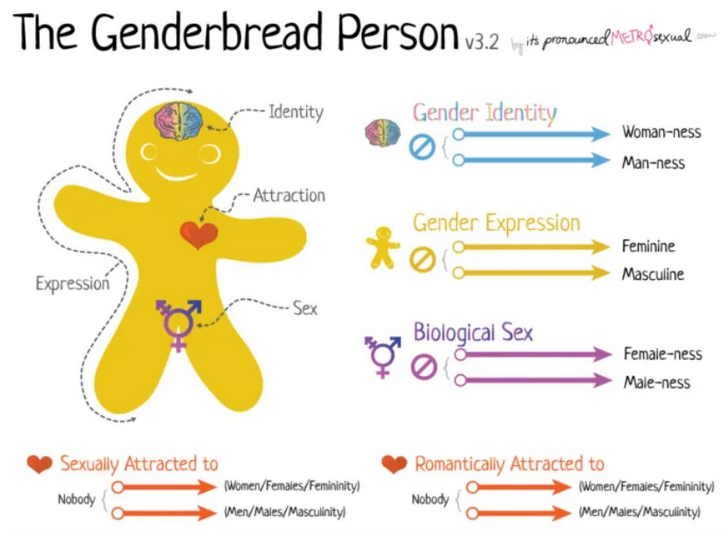
It wasn’t all that long ago that the vast majority of young people seeking “gender-affirming” therapy were males hoping to become trans-females. In the last few years, that proportion has flipped completely.
Comments Off on “Still, what about the boys?”
October 2, 2022
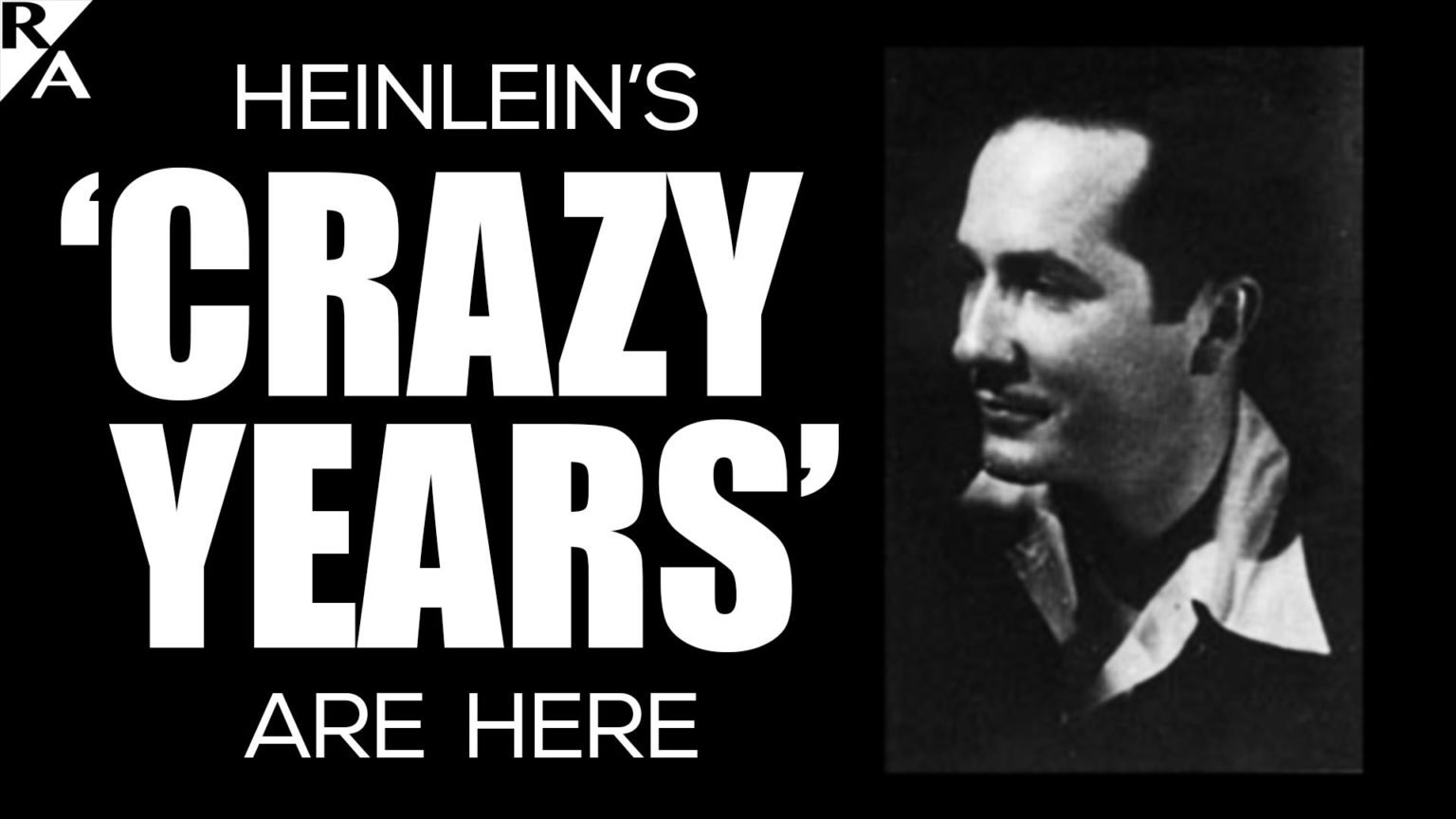
Robert Heinlein’s “Crazy Years” have nothing on real headlines in 2022
Ed West on what he calls the “triumph of the blank slate” in western culture:
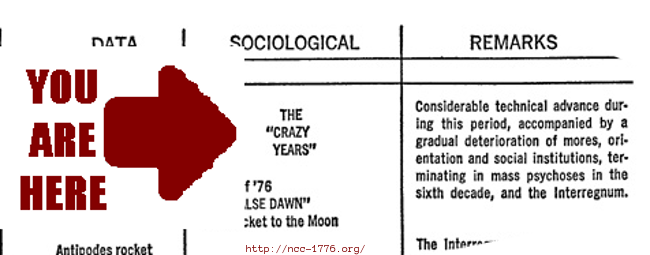
As a depressive conservative who always sneered at the new atheist movement, I’ve enjoyed a certain, almost masochistic smugness about the way the sharp decline in American religious practice has led to a proliferation of wacky beliefs. I told you so, I laugh, as our boat heads for the rocks and certain doom for all of us. And every month I read something else in the media which makes me think, with the best will in the world and a sincere belief in improving our lot, that country’s ruling class is losing its grip on reality.
To take one recent example, an article in the Atlantic recently made the case that separating sport by sex doesn’t make sense, because it “reinforces the idea that boys are inherently bigger, faster, and stronger than girls in a competitive setting — a notion that’s been challenged by scientists for years”.
The author stated that “though sex differences in sports show advantages for men, researchers today still don’t know how much of this to attribute to biological difference versus the lack of support provided to women athletes to reach their highest potential”.
Quoting an academic who claim “that sex differences aren’t really clear at all” the author reported of some studies showing that “the gap they did find between girls and boys was likely due to socialization, not biology”.
On a similar theme, a few weeks back the New York Times ran a piece arguing that “maternal instinct is a myth that men created”. In the essay, published in the world’s most influential newspaper, it was stated that “The notion that the selflessness and tenderness babies require is uniquely ingrained in the biology of women, ready to go at the flip of a switch, is a relatively modern — and pernicious — one. It was constructed over decades by men selling an image of what a mother should be, diverting our attention from what she actually is and calling it science.”
Even the most prestigious science magazines increasingly make claims about sex that a decade ago would have seemed wacky. Just recently, Scientific American stated that “Before the late 18th century, Western science recognized only one sex — the male — and considered the female body an inferior version of it. The shift historians call the ‘two-sex model’ served mainly to reinforce gender and racial divisions by tying social status to the body.”
If you find any of these beliefs strange, then you might need to “educate” yourself about “the science” because this is the direction of travel now. This kind of stuff is everywhere, growing in popularity in all areas, but all ultimately having the same common inheritance — the blank slate.
Yet what is strange is that such ideas are triumphant, even as the scientific evidence against them mounts up, with the expanding understanding of genetics and the role of inheritance. The tabula rasa should by all rights be dead, indeed it should have been killed twenty years ago with the publication of one of the most important books of the century so far, Steven Pinker’s The Blank Slate.
With its subtitle “the modern denial of human nature”, Pinker’s worked looked at the various ideas that had emerged out of academia and into wider society: that rape was not about sex, that hunter-gatherer societies were peaceful, that sex differences were learned, all of these beliefs having the common theme that humans are born with infinitely malleable minds and that that life outcomes are entirely shaped by society.
Pinker felt, quite reasonably, that many of these comforting beliefs were on the way out. Of the idea that differences in intelligence were entirely environmental, he wrote that “even in the 1970s the argument was tortuous, but by the 1980s it was desperate and today it is a historical curiosity”. And yet this historical curiosity continues to flourish, and 20 years after publication, the blank slate is stronger than ever. More so than in 2002, it’s taboo to discuss the genetic components of human intelligence or the biological factors involved in differing male and female behaviour. The ground has shifted – towards the blank slate.
Pinker is an optimistic Whiggish liberal who has since produced books looking at the decline of violence and making the case that things are getting better — that’s taken a wobble this decade, but I think he’ll be proven right, even if I think the new atheist-aligned cognitive psychologist has a slight blind spot about religion. In the Blank Slate he argued that worthy progressive goals should not rest on untrue scientific assumptions about human nature. When those ideas are proven false, the political argument will crumble too — and yet this hasn’t happened. Instead the taboos just grows stronger.
Comments Off on Robert Heinlein’s “Crazy Years” have nothing on real headlines in 2022
October 1, 2022
Johann Hari’s unlikely career resurrection
I have to admit that Johann Hari was pretty much just a British media personality I had a vague awareness of, but I hadn’t paid much attention to him (his Wikipedia sockpuppeting came to my attention in 2011, and I quoted from an article he wrote for the Los Angeles Times in 2019). As this post by Ben at Ben’s Comedy News outlines, I’d largely missed the rest of his fall and rise:
Nowadays, Johann Hari is known as a pop psychology expert. He does TED talks and writes books with simplistic messages like:
- your smartphone is ruining your attention span! (Stolen Focus)
- you should cure your depression by throwing away your medication and joining a book club! (Lost Connections)
- the war on drugs is bad! (Chasing the Scream)
His books get positive blurbs from distinguished thinkers, such as the comedian and twink admirer Stephen Fry, the listicle entrepreneur Arianna Huffington, the feminist and sex offender’s wife Hillary Clinton, the comedian and fake revolutionary Russell Brand, and the TV doctor Doctor Rangan Chatterjee.
But when you look at how actual experts assess his work, it’s not so positive. The neuroscientist Dean Burnett responded to an extract of Lost Connections in his Guardian column, under the title Is everything Johann Hari knows about depression wrong? Burnett points out that:
despite Hari’s prose suggesting he’s uncovered numerous revelations, pretty much everything he “reveals” is well known already
Hari, in pursuit of an anti-anti-depressant narrative, makes the claim that you can be diagnosed with depression and put on medication immediately after a traumatic event like losing a child, which Burnett (who teaches psychiatry) describes as:
at best a staggering exaggeration, at worst an active fabrication to support a narrative.
But this article isn’t about what Johann Hari has been doing recently. It’s about what Hari was up to before he reinvented himself as some kind of expert, back when he was a journalist who ended up being disgraced.
It’s about how Hari has somehow rounded allegations of serious fabrication down to a record of minor plagiarism. It’s about how in trying to attack his critics, he seems to have inadvertently revealed his penchant for little brother incest fantasies with a troubling racial dimension. It’s about how I tried to fix the record on Wikipedia, and ran into trouble as Wikipedia’s policies collided with the sorry state of British journalism.
Back in 2010, Johann Hari was a star newspaper columnist (if you’re a millennial that means he wrote hot takes that got lots of clicks; if you’re Gen Z, think of him as a viral TikTok star but with words on paper).
In 2011 he was disgraced and kicked out of the profession.
Now if you look at the articles that were written about his comeback, like this New Statesman piece or this Guardian piece you’d conclude that he was disgraced for two things:
plagiarism – specifically, taking quotes from text someone had written in a book or article, and pretending that the person had said it directly to him
abuse of Wikipedia – in particular, using a fake identity to edit the pages of professional rivals with false allegations
I followed the whole Hari affair pretty closely at the time (I didn’t like him because he had been a cheerleader for the Iraq War, so I enjoyed watching his career go down in flames).
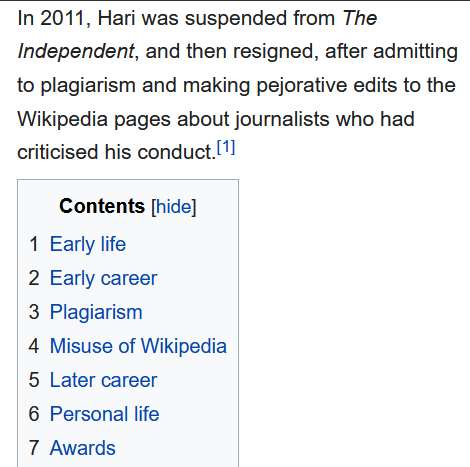
When his latest book came out a month ago, I looked at his Wikipedia entry. Wikipedia saves the history of all the different versions of each page, so here is a link to what I saw when I did that.
And here’s part of the summary and the table of contents:
The whole article struck me as weird because it didn’t mention two things I clearly remembered:
- Hari got in trouble, not just for minor plagiarism, but for allegedly making things up completely.
- Even more memorably, the fake identity he used to edit Wikipedia, “David Rose”, was also used to author an incest kink porn story with a hilarious title.
You can see why Hari (and whatever reputation management consultants he has working for him) would want to focus on the “plagiarism” angle. It’s not good to pass off a quote you got from someone’s book as something they told you directly, but it’s not as serious as completely inventing something. I suppose technically it’s plagiarism because you’re pretending you elicited the quote in an interview and you’re not citing the original book; but it’s a lot better than the typical case of plagiarism that involves passing off someone else’s work as your own. Hari’s defence is that he was “cutting corners” because he was under so much pressure due to his meteoric success at young age, etc. etc.
Comments Off on Johann Hari’s unlikely career resurrection
September 28, 2022
There are two kinds of people online talking about mental illness: those suffering with mental illness and those glorying in the attention they get for faking it
Freddie deBoer on the phenomenon of mental health culture online and the two primary kinds of participants (my headline over-dramatizes the case he’s actually making):
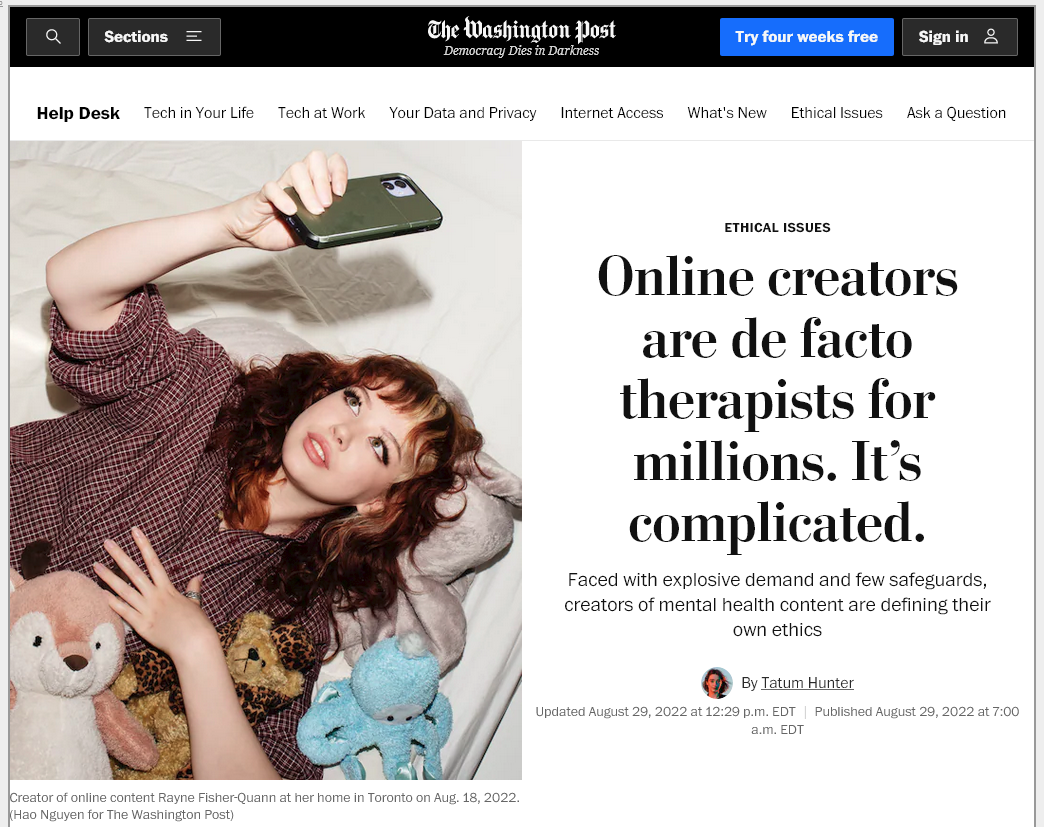
I was not, at first glance, inspired with confidence by this Washington Post piece on online mental illness culture. The piece has a header image of a “mental illness influencer” lounging in bed, taking a selfie. I’m someone who’s committed to de-glamorizing mental illness, and I’ve been begging people to stop romanticizing pathology for a long time. I suppose there’s an implied critique in that photograph, but it’s not ideal.
On substance, Tatum Hunter’s piece fails the way so many others have failed in this milieu: it studiously avoids the possibility that some people who talk about their mental illnesses online don’t really have them. I’m not specifically talking about simple fraud and lies, which I suspect are rare, but rather the weird combination of hypochondria, Munchausen’s syndrome, and social contagion that we see all around us in these spaces. Spend any time at all in these communities on Tumblr or Tik Tok and you will find many people, most of them young, who are using mental illness as a means to self-define, to differentiate themselves from the hordes of other people they see online who are just like them. I’ve written again and again about why it’s a bad idea to want to be your mental illness, and it’s even worse to want to be mentally ill, period – not just bad for other people, but bad for you. But there are people who have become influencers and garnered hundreds of thousands of followers on their apps of choice by performing mental illness. People use their disorders to chase clout. That’s just reality.
Hunter considers the problems of misdiagnosis, of self-diagnosis, of people undertaking mental health care on the advice of internet randoms rather than under the care of a doctor, but nowhere does she seriously consider the possibility that the basic problem for many people is that they believe they have mental disorders they don’t in fact have. I think doing so is seen, at this point, as a kind of identity crime, and thus unlikely to be found in the Washington Post.
But hypochondria exists. Munchausen’s syndrome exists. Psychosomatic illness exists. I can get people to admit to those realities in the abstract, now, but they stay entirely in the abstract – to suggest that any group of people is suffering under those conditions, rather than under authentic mental illness, is treated as a sin. This was my biggest disappointment with Ross Douthat’s book on his chronic illness, which I quite liked overall; Douthat never stops his narrative to ask whether any of the people who believe themselves to be sick from chronic illness actually aren’t. (Surely he himself suffered, but because of the woo and mysticism found in that space, an accounting was necessary.) And I don’t know how we confront the spiraling number of people claiming to have illnesses for which there are no objective tests without being frank about the existence of hypochondria, Munchausen’s, and psychosomatic illness – particularly when people insist on deepening the social incentives by giving the sick more and more attention.
Even for the authentically ill, online culture is fraught. The meta-problem with pieces like that in WaPo, obviously, is that by giving certain members of this community the glamour shot treatment (literally in this case), they’re creating direct incentive for people to make illness their identity -and to not get better. Young people understand the allure of being seen; they don’t yet understand the horror of being frozen in other people’s gazes. They don’t understand the costs of being defined. There have been many opportunities for me to make myself the mental illness guy, certainly including financial opportunities. Perhaps I’ve already fallen into that trap, despite my efforts to remain a generalist. But I’ve fought to avoid that because I know just how painful and limiting self-definition can become. I’m sorry to pull wizened old guy here, but young people don’t understand. They don’t understand that pinning yourself down that way can produce a kind of horror.
Comments Off on There are two kinds of people online talking about mental illness: those suffering with mental illness and those glorying in the attention they get for faking it
September 24, 2022
The end of crisis culture – “[Y]ou can’t go on having a culture of crisis if people stop showing up for it”
Chris Bray on the inevitable endgame of “all crisis, all the time” culture:
The journalist John Tierney has described the Crisis Crisis, “the incessant state of alarm fomented by journalists and politicians”. What we’re experiencing now is the Crisis Crisis crisis, the emerging crisis caused by the Crisis Crisis. Over and over again, interventions in some invented or overhyped form of the crisis, undertaken in the hysterical spirit of the Crisis Crisis, cause a form of the Crisis Crisis crisis, which eventually results in a course correction that may or may not be fully apparent for a while. Skip right over the next paragraph if you don’t need to see examples again.
The Sri Lankan government intervenes in climate change by instantly ending the use of commercial fertilizers in agriculture, which causes a dangerous decline in the production of food. The German government intervenes in climate change by declaring a commitment to 100% clean energy, which causes dangerous instability in the availability of actual energy (“committing national suicide“), with some help from the Nord Stream shut-off valve, which nobody ever could have seen coming. The Dutch government intervenes in climate change by declaring an intention to limit agricultural production, which doesn’t cause anything yet, because Dutch farmers won’t stand for it, but final outcome TBD.
All over the world, things that work stop working because of excessive and unwarranted interventions led by people who cry crisis and throw sand in functioning gears. Dutch agriculture was just fine; then the government decided to help end the crisis. The interventions — the interveners, the people who get in the way — are harming us, when their harm could be prevented by literal nothing, by the simple choice to not perform the interventions. What we need is for the interveners to go play Risk in their basement or something, and forget their important duty to help.
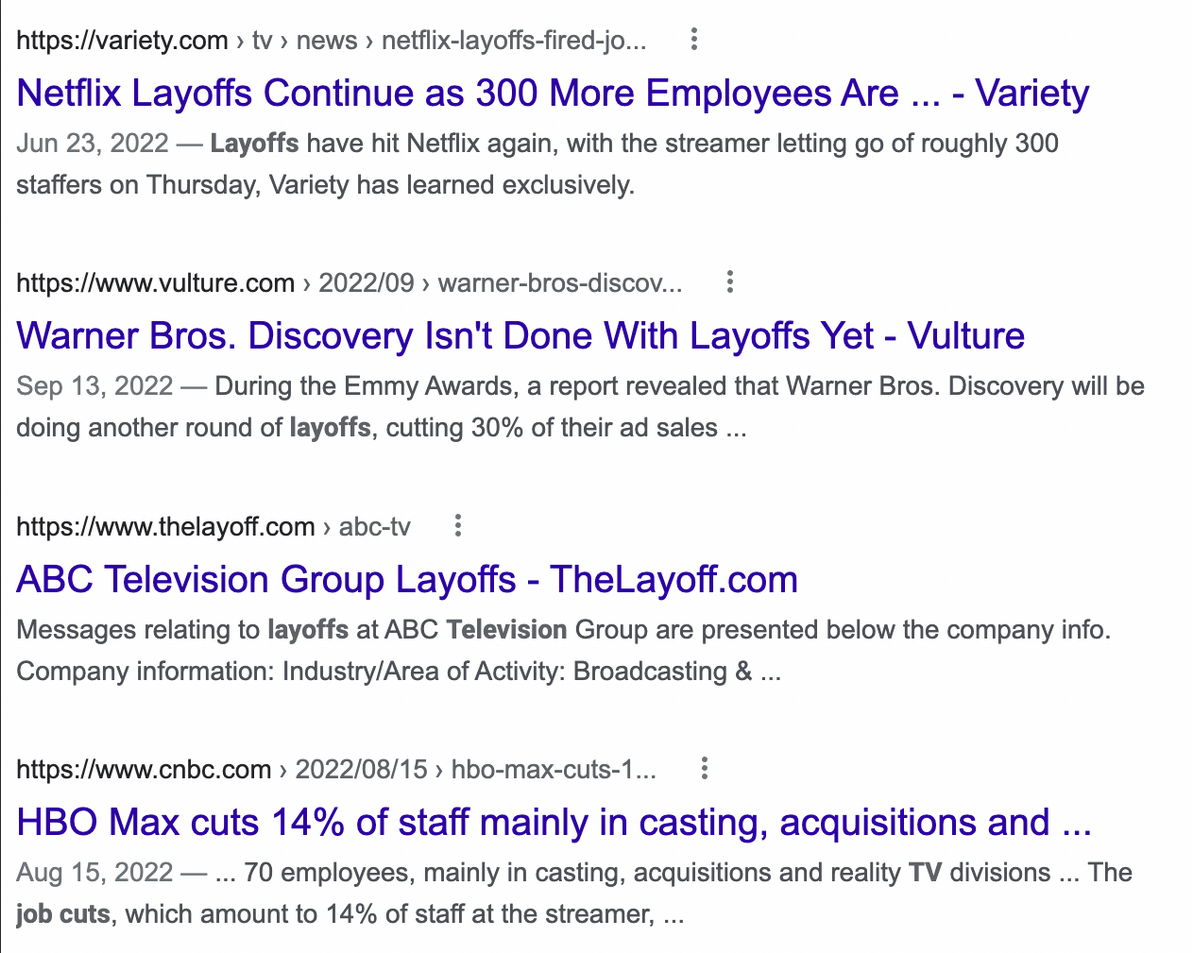
The entertainment industry has had its own intervention, famously described on Substack, in woke-facing talent purges and narrative shifts and insulting “It’s Ghostbusters … but with WOMEN!” reboots. And now some hint about the endgame of the one big cycle of fraud comes from woke Hollywood — which has pounded audiences with The Message for years, resulting in a catastrophic loss of audience. The result is starting to look like this:
The social justice intervention in Hollywood storytelling is harming Hollywood; the intervention in that industry is causing the decline of the industry. At some point, people stop eating shit.
Comments Off on The end of crisis culture – “[Y]ou can’t go on having a culture of crisis if people stop showing up for it”
September 20, 2022
Hannah Arendt in postwar Germany
In Quillette, Roger Berkowitz discusses what Hannah Arendt found when talking to Germans after the Second World War, which she characterized as their collective “escape from reality”:
In 1949, when Hannah Arendt (1906–1975) went to Germany as part of the New York-based Jewish Cultural Reconstruction Commission, she was struck by the way the Germans showed an “at times vicious refusal to face and come to terms with what really happened”. This “escape from reality”, as Arendt named it, meant that the reality of the Holocaust and the death factories was spoken of as a hypothetical. And when the truth of the Holocaust was admitted, it was diminished: “The Germans did only what others are capable of doing”.
The Germans, at times, simply denied the facts of what had happened. One woman told Arendt that the “Russians had begun the war with an attack on Danzig”. What Arendt encountered was a “kind of gentleman’s agreement by which everyone has a right to his ignorance under the pretext that everyone has a right to his opinion”. The underlying assumption for such a right is the “tacit assumption that opinions really do not matter”. Opinions are just that, mere opinions. And facts, once they are reduced to opinions, also don’t matter. Taken together, this led to a “flight from reality”.
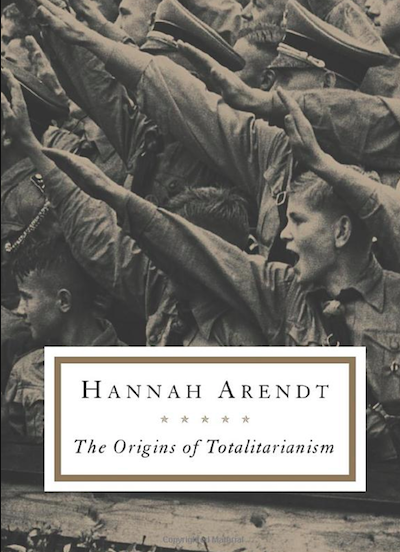
The focus of Arendt’s lifelong engagement with the human flight from reality was her encounter with ideologies, specifically Nazism and Bolshevism. In The Origins of Totalitarianism and other texts (especially her essay, “On the Nature of Totalitarianism“), Arendt defines an ideology as a system that seeks to explain “all the mysteries of life and the world” according to one idea. Nazism is an ideology that blames economic disaster, political loss, and the evils of modernity on the Jews — inhuman flotsam who must be exterminated to allow a master race to flourish. Bolshevism, on the other hand, “pretends that all history is a struggle of classes, that the proletariat is bound by eternal laws to win this struggle, that a classless society will then come about, and that the state, finally, will wither away”. The bourgeoisie are not simply class traitors, they are a dying class, and killing them only supports a law of history. As ideologies, both Nazism and Bolshevism insist on explaining the events of the world according to theories “without further concurrence with actual experience”. The result, Arendt argues, is that such ideologies bring about an “arrogant emancipation from reality”.
Because an ideology “looks upon all factuality as fabricated”, it “no longer knows any reliable criterion for distinguishing truth from falsehood”. As reality recedes, ideologies organize society to transform their ideas into living reality. If antisemitism as an ideology says that all Jews are beggars without passports, the fact of wealthy and established Jews must be eliminated. If Bolshevism says that the bourgeoisie are corrupt, they must admit their corruption or be killed. The realization of such ideological realities can be accomplished, of course, through terror.
But even before a totalitarian movement takes power and mobilizes the secret police in the machinery of terror, ideological movements can employ propaganda to deny and nullify facts, or change them. The Nazis, she writes, “did not so much believe in the truth of racism as desire to change the world into a race reality”. Similarly, the Bolshevist ideology that classes were dying was not something real, but something that had to be made real. The purges and terror that Stalin unleashed were supposed to “establish a classless society” by exterminating all social groups that might develop into classes. In both instances, the purpose of the ideology was to transform a mere opinion — race consciousness or class consciousness — into the “the lived content of reality”.
The point, as Arendt concludes, is that “ideological consistency reducing everything to one all-dominating factor is always in conflict with the inconsistency of the world, on the one hand, and the unpredictability of human actions, on the other”. What ideology demands is that man — an unpredictable and spontaneous being — cease to exist as such, that all humans be subjected to laws of development that follow ideological truth. That is why the turn from an unreliable reality to coherent fantasy requires an absolute elimination of human spontaneity and freedom.
Comments Off on Hannah Arendt in postwar Germany
September 19, 2022
There’s a difference between “caring what kids think” and “pandering for kids’ attention and affection”
Rob Henderson wonders why so many adults these days are clearly desperate for the approval of young people:
During my recent re-watch of the entirety of Mad Men, which takes place in the 1960s, a recurring thought entered my mind: This was the last generation where young adults behaved like they were older than their real age. Don Draper is around thirty-five at the start of the series, and carries himself in a more adult manner than many 45 year olds today.
Recently, Abigail Shrier quoted a physician and psychologist who stated that “Fifty years ago, boys wanted to be men. But today, many American men want to be boys”.
Until the early 1960s, young people acted older than their actual age. Now, older adults pretend to be younger than their actual age.
Which is perhaps one reason why boomers are so easy to mock. They don’t act their age.
[…]
About two years later, I was at a breakfast gathering with some other students on campus. Our guest was a former governor and presidential candidate. He was gracious, and spent most of the time answering questions from students.
And in his answers, he continually returned to variations of the same response: “We screwed up, and it’s up to you guys to fix it. I’m so happy to see how bright you all are and how sharp your questions have been, because you will fix the mistakes my generation made.”
This mystified me. This guy was well into his sixties, with a lifetime of unique experiences in leadership roles, was telling a bunch of 20-year-olds (though I was a little older) that older adults are relying on them.
In the military, we thought of those senior to us as the leaders. It was okay to give feedback, of course. Commanding officers would regularly consult lower ranking and enlisted members to see what was working and what could be improved. But that happens only after getting through the filter of the initial training endeavors.
I remember in the first week of basic training, our instructor declared, “I don’t want any of you [expletive] thinking you are doing anyone a favor being here. I could get rid of all of you clowns and have your replacements here within the hour.” (This was 2007, well before the recruitment crisis).
My 17-year-old brain heard that thought, yeah, he’s probably right. I thought of the bus loads of other ungainly young guys I saw stepping off and being confronted with “Pick ’em up, and put ’em down” and other mind games from the instructors while waiting in the endless in-processing lines.
So then I got to college and learned that even though any seat, at least at selective schools, can be filled immediately with a bright applicant (top colleges reject thousands of them each year), students are never ejected for disrespecting professors or anyone else. In the military the first message was, you are a peon and less than nothing and we can easily have you replaced (this changes as you advance in rank, of course — at least to some degree). In college, the first message was, you are amazing and privileged and a future leader (and marginalized and erased) and you will never lose your position here among the future ruling class. That feeling of whiplash will forever linger in my mind.
[…]
Older adults crave validation from the youth, which is one reason they are mocked. Young people sense their desire to be seen as cool and deprive them of this by taunting them.
This desire for esteem may be why older adults won’t exert any authority in response to energetic young conflict entrepreneurs who yell at them or threaten them.
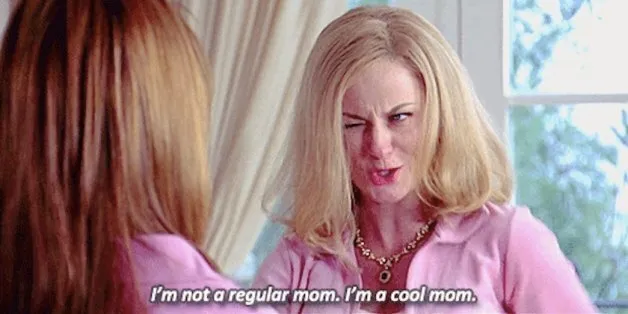
Older adults want to be on the side of youth. So desperate to pencil themselves out of the “old” category. Every parent wants to be the “cool parent”, every professor wants to be the “cool” professor. You can be cool and still be an authority figure. Maybe decades of imbibing the worst of U.S. pop culture made everyone forget this.
Comments Off on There’s a difference between “caring what kids think” and “pandering for kids’ attention and affection”
September 16, 2022
The rise of the “golden penis”
Look folks, there are some headlines that just write themselves, but it’s not my coining — here’s Janice Fiamengo to explain where that … memorable term … came from:

We’ve been told for years that the future is female, that everyone benefits from female leadership and everything improves when women take charge.
Any man on a college campus who has ever objected to the plethora of special university programs and women-only scholarships and pro-woman propaganda was told he had a problem with gender equality.
But now it turns out that some women themselves are not entirely happy with the deal feminists engineered for them, which sees them outnumbering men at close to 3-2 at most English-speaking universities, and thousands of words have already been devoted to the idea that college women deserve a more satisfactory dating experience.
According to Monica Greep in an article from last fall for the Daily Mail, “How Golden Penis Syndrome is ruining dating for university women”, the “deficit of male students” at college “means men develop inflated egos and become Casanovas who cheat — despite a lack of social and sexual skills”.
The formulation reminds me of an old Woody Allen joke from his movie Annie Hall. In my updated version, two women are discussing college dating: “The guys are awful, egotistical schmucks who think they’re really great,” says one. “I know,” says the other, “And there are so few of them!”
If these men are so lacking in “social and sexual skills”, as the article tut tuts, then why are the women upset that there are not more of them? If the women don’t want guys who are Casanovas, they don’t have to date them. But admitting that women have any role in creating the hookup culture being decried is impossible for most commentators today; the fault must always be found in the men. There is even a “relationship therapist” quoted in the article who tells us that Golden Penis Syndrome “speaks of the delusional belief that you are unusually and uniquely gifted as a man”.
Really? Did any of these analysts interview any young men who actually said that about themselves, or is this a case of women projecting onto men their own self-delusions, angry because the men have failed to respond to them as they, the women, would prefer?
As has become typical of pronouncements about men and women, the article blames men for being in the minority at college: at some institutions, they make up only 25% of the student body (see Mark Perry’s charts, for example here, showing the decades-long gender asymmetries; and see his proof that women outnumber men in STEM fields too). The shortage apparently causes men “to see themselves as a prize to be won by female suitors”.
What articles such as this one won’t admit is that these guys are “prizes to be won”, and increasingly so in light of the reported imbalance.
It is well known that college-educated men who marry are, on average, likely to work the longest hours, seek promotion most aggressively, and become high earners focused on supporting their wives and families (even post-divorce, as too often happens). A woman who is fortunate enough to marry a man like this stands to secure a materially better life, often at her husband’s expense of health and leisure, than she would have had if she had depended solely on her own earning power and work ethic (women are famously more interested in “work-life balance” than men are). Now with these men in the minority, women are having to compete for the men’s attention, and we’re supposed to feel sorry for them.
Of course the alleged problem has an obvious solution: the women could date and marry non-university-educated men. Why won’t they? The article mentions this somewhat embarrassing reality in gender-neutral terms by noting that “At the same time [that] university sex ratios have been skewing female, there’s been a simultaneous increase in what academics call ‘assortative mating’.” The article explains, “That’s a fancy way of saying that college grads only want to date and marry other grads.”
Wrong.
It’s not male college grads who won’t marry anyone other than a female college grad. As a 2019 study confirmed, it is almost exclusively women who insist on the need for their mates to earn more. In a sane age genuinely committed to “gender equality”, we might criticize women for their stereotypical behavior, for perceiving men as “success objects”. But we never criticize women for acting out of self-interest.
Only men are criticized for that, as well as for uncouth dating behaviors that everyone knows women also engage in when circumstances favor them: playing the field, cheating, “ghosting”, and so on. Being picky, demanding, and often downright rude are all recognized as a woman’s prerogative because women ARE seen as inherently valuable.
Comments Off on The rise of the “golden penis”
September 15, 2022
“Presentism is … a disease, a contagion here in America as infectious as the Wuhan flu”
Jeff Minick on the mental attitude that animates so many progressives:
My online dictionary defines presentism as “uncritical adherence to present-day attitudes, especially the tendency to interpret past events in terms of modern values and concepts”. To my surprise, the 40-year-old dictionary on my shelf also contains this eyesore of a word and definition.
To be present, of course, is a generally considered a virtue. It can mean everything from giving ourselves to the job at hand — no one wants a surgeon dreaming of his upcoming vacation to St. Croix while he’s cracking open your chest — to consoling a grieving friend.
But presentism is altogether different. It’s a disease, a contagion here in America as infectious as the Wuhan flu. The latter spreads by way of a virus, the former through ignorance and puffed-up pride.
Presentism is what inspires the afflicted to tear down the statues of such Americans as Washington, Jefferson, and Robert E. Lee for owning slaves without ever once asking why this was so or seeking to discover what these men thought of slavery. Presentism is why the “Little House Books” and some of the early stories by Dr. Seuss are attacked or banned entirely.
Presentism is the reason so many young people can name the Kardashians but can’t tell you the importance of Abraham Lincoln or why we fought in World War II.
Presentism accounts in large measure for our Mount Everest of debt and inflation. Those overseeing our nation’s finances have refused to listen to warnings from the past, even the recent past, about the clear dangers of a government creating trillions of dollars out of the air.
Presentism has led America into overseas adventures that have invariably come to a bad end. Afghanistan, for example, has long been known as the graveyard of empires, a cemetery which includes the tombstones of British and Russian ambitions. By our refusal to heed the lessons of that history and our botched withdrawal from Kabul, we dug our own grave alongside them.
H/T to Kim du Toit for the link.
Comments Off on “Presentism is … a disease, a contagion here in America as infectious as the Wuhan flu”
September 11, 2022
QotD: De-institutionalization
Deinstitutionalization began slowly at first, in the 1950s, but the pace accelerated around 1970, despite signs that all was not going according to plan. On the ground, psychiatrists noticed earlier than anyone else that the most obvious question — where are these people going to go when they leave the mental institutions? — had no clear answers. Whatever misgivings psychiatrists voiced over the system’s abandonment of the mentally ill to streets, slums, and jails was too little and too late.
That modern psychiatry is mostly practiced outside of mental institutions is not its only difference from premodern psychiatry. Scull devotes extensive coverage to two equally decisive developments: the rise and fall of Freudianism, and psychopharmacology.
The Freudians normalized therapy in America and provided crucial intellectual support for the idea that mental health care is for everyone, not just the deranged. Around the same time as deinstitutionalization, Freud’s reputation, especially in elite circles, was on a level with Newton and Copernicus. Since then, Freudianism has mostly gone the way of phlogiston and leeches. That happened not just because people decided the psychoanalysts’ approach to therapy didn’t work but also because insurance wouldn’t pay for it. Insurance would, however, pay for modes of therapy that were less open-ended than the “reconstruction of personality that psychoanalysis proclaimed as its mission”, more targeted to a specific psychological symptom, and, most crucially of all, performed by non-M.D.s. Therapy was on the rise, but psychiatrists found themselves doing less and less of it.
As psychiatry cast aside Freudian concepts such as the “refrigerator mother”, which rooted mental illness in psychodynamic tensions, it increasingly trained its focus on biology. Drugs contributed to, and gained a boost from, this reorientation. Scull loathes the drug industry and only grudgingly allows that it has made improvements in the lives of mentally ill Americans. He divides up the vast American drug-taking public into three groups: those for whom they work, those for whom they don’t work, and those for whom they may work, but not enough to counter the unpleasant side effects. He argues that the last two groups are insupportably large.
Stephen Eide, “Soul Doctors”, City Journal, 2022-05-18.
Comments Off on QotD: De-institutionalization
September 9, 2022
Britain’s “Lord of Misrule” at the end of the “Borisarchy”
In Quillette, John Lloyd considers the parts of Boris Johnson’s personality that allowed him to achieve the premiership but not to retain it:

The respectable consensus on Boris Johnson’s resignation is that the Lord of Misrule was an opportunist who rose to power amid the mayhem of Brexit that he’d helped to create, but that his fecklessness finally caught up with him. There’s something in that, but more in what’s not. Although his critics will refuse to admit it, what’s mostly missing is the laughter, which is now a more important factor in British public life than before.
Much of public and media life in the UK — and it isn’t unique in this — is a search for laugh lines, and Johnson — instinctively but also with calculation — played heartily into this. He always had. In a largely affectionate biography, Andrew Gimson, Johnson’s former colleague at the Spectator and the Daily Telegraph, writes that, “To make people enjoy being led by him was an aspect of leadership which Boris mastered at a very young age. He made people helpless with laughter, and so great was their enjoyment that they scarcely cared what he did with their support, as long as he kept on amusing them.”
With the laughter came Johnson’s inchoate libertarianism — a strong aversion to condemning activities in which others like to indulge, especially those in which he likes to indulge himself, such as adultery. He is fond of telling the story of when Churchill, Johnson’s lodestar as a public figure, was taken aside during his second administration (1951–55) by his chief whip and told that a cabinet minister had been discovered having sex with a guardsman in Hyde Park at 3am on a freezing morning in February. The press had found out, which the whip advised, meant the minister would have to resign. “Caught with a guardsman?” Churchill asked. “Yes Prime Minister.” “In Hyde Park?” “Yes Prime Minister.” “On a park bench?” “That’s right, Prime Minister.” “At three o’clock in the morning?” “That’s correct, Prime Minister.” “In this weather! Good God man, it makes you proud to be British!”
To Johnson, this is evidence of Churchill’s goodhearted tolerance and defiance of narrow prejudice (this was a time when homosexual acts were quite severely punished), which are matched only by his own in generosity and wit. To be generous and broadminded in his speech (he is said to be quite mean with his money) is attractive to the many sinners among us. We see in the Prime Minister a person with the moral outlook of Casanova and yet (or, and so) finds attractive women willing to dally with him — a cheering thought. As one of these, Allegra Mostyn-Owen, who became his first wife, later admitted, “at least he made me laugh.”
[…]
Accustomed to lying to wriggle out of embarrassments like the discovery of an adultery, he continued to mislead when he joined aides for impromptu parties at No. 10, when the strictest lockdowns and prohibitions on the public were in force. How could a man of such intelligence fail to realise that his bluster would unravel almost as soon as they were uttered? He had, it seemed, an inbuilt arrogance — a conviction that he was able to avoid consequences that brought others down, but which only made him stronger.
In the end, he ran out of that road. Ironically, what finished him was denying that he knew that a government whip, Chris Pincher, had a history of groping other men. Johnson refused to take the scandal seriously enough to fire Pincher, as his senior colleagues pressed him to do — an echo of the Churchill joke he liked to tell, and a reaction which accorded with his libertarian instincts. However, his colleagues finally wearied of delivering statements to the media that made them look ridiculous within days or even hours. It was the last straw.
When Lord Dannatt, a former head of the British Army, was confronted with the (admittedly faint) possibility that Johnson would be considered for the post of NATO Secretary General, he was quoted as saying: “There is no doubt that [Johnson] has done a lot of good, and our full support for Ukraine is just fantastic. But I am afraid that these are personal things, a lack of integrity, a lack of trust. Frankly, we do not want to put Boris Johnson on the international stage for further ridicule. He is a disgrace to the nation.”
Comments Off on Britain’s “Lord of Misrule” at the end of the “Borisarchy”
September 7, 2022
QotD: Gender Dysphoria
Beyond that, I believe that my art-based theory of “sexual personae” is far more expansive and truthful about human psychology than is current campus ideology: who we are or want to be exceeds mere gender, because every experimental persona that we devise contains elements of gesture, dress, and attitude rich with historical and cultural associations. (For Halloween in childhood, for example, I defiantly dressed as Robin Hood, a Roman soldier, a matador, Napoleon, and Hamlet.) Because of my own personal odyssey, I am horrified by the escalating prescription of puberty-blockers to children with gender dysphoria like my own: I consider this practice to be a criminal violation of human rights. Have the adults gone mad? Children are now being callously used for fashionable medical experiments with unknown long-term results.
In regard to the vexed issue of toilets and locker rooms, if private unisex facilities can be conveniently provided through simple relabeling, it would be humane to do so, but I fail to see why any school district, restaurant, or business should be legally obligated to go to excess expense (which ultimately penalizes the public) to serve such a minuscule proportion of the population, however loud their voices. And speaking of voices: as a libertarian, I oppose all intrusion by government into the realm of language, which belongs to the people and which evolves organically over time. Thus the term “Ms.” eventually became standard English, but another 1970s feminist hybrid, “womyn”, did not: the populace as a whole made that decision, as it always does with argot or slang filtering up from ethnic or avant-garde subgroups. The same principle applies to preferred transgender pronouns: they are a courtesy that we may choose to defer to, but in a modern democracy, no authority has the right to compel their usage.
Camille Paglia, “Prominent Democratic Feminist Camille Paglia Says Hillary Clinton ‘Exploits Feminism’”, Washington Free Beacon, 2017-05-15.
Comments Off on QotD: Gender Dysphoria
September 6, 2022
QotD: The fitness club
The second problem, though, is: What to do with the True Believers?
Let’s return to the metaphor of the
gymfitness club. As we noted yesterday, the real money isn’t in the hardcore people who actually do the exercising. It’s in all the lardasses who sign up, and keep paying the membership fee, but never actually go. This leads to the perverse-seeming conclusion that the best gym, from the gym-owner’s perspective, is one that stands empty — gleaming, never-used equipment that just sits there, one mute inglorious depreciation tax writeoff, un-maintained by no paid staff. See what I mean? The whole point of owning a gym — the cult dogma, as it were — is to get people in shape, but the optimal gym from the cult leader’s perspective is a group of perpetual fatasses, buying themselves workout indulgences at $75 a month.I trust that the analogues in the eco-scam are obvious, so let’s move on. Even the most optimal-for-the-owner gym, though, is going to have a few True Believers who are in there day after day, grinding out sets and jogging on treadmills and doing whatever those CrossFit freaks do.* If you let them, they’ll take over everything. Ever been in a gym and seen a piece of equipment designed to isolate one muscle that you’d never think could be worked out in the first place? Congrats, your gym’s got a True Believer. Just stake out the Urethra-cizer for a few hours; you’ll see her; she’s unmistakable. She’s pushing 50 but has the body of a 20-year old, except made out of beef jerky …
… anyway, the point is, savvy gym owners know how to handle True Believers. You don’t buy ’em off with new equipment; you buy ’em off with new exercises. P90X is for pussies. Do Ultra-Kegels, and in just 60 days you’ll be able to lift an entire can of paint with your …
* Obviously I can’t write about gyms and cults without taking a cheap shot at CrossFit. They’re probably chock full of lessons on how to business-optimize your cult without letting it go mainstream, but I’m too terrified to look. Honest to God, there are some days where the only exercise I get is dodging and weaving away from the CrossFit cultists at the office.
Severian, “If the UFO Actually Comes, Part II”, Rotten Chestnuts, 2019-09-26.
Comments Off on QotD: The fitness club


