
The desire not to have one’s feelings hurt has been erected into a right, a right increasingly enforceable at law. Of course, not everyone’s feelings are treated with the solicitude that we show to a nice fluffy colorful species of animal that is, regrettably, on the verge of extinction. But there is no doubt that treating people’s feelings with this solicitude tends not only to preserve them but to cause them to flourish and multiply. The more you are preserved from hurt feelings, the more of them you have.
Theodore Dalrymple, “Once More With Feelings”, Taki’s Magazine, 2017-05-13.
September 18, 2023
QotD: Feelings
Comments Off on QotD: Feelings
September 15, 2023
The old “war of the sexes” has been won decisively by women … and the aftermath won’t be pretty for any of us
I saw an article earlier today in The Free Press on the plight of young men in the dating scene these days (discussed earlier this month here and in July here). In short, men who don’t meet certain arbitrary minimums will have almost no chance with modern women in their age cohort. If you’re not at least six feet tall (males average 5’9″ worldwide), earn at least six figures (US men average under $60K per year), and have a penis at least six inches long (official estimates say American men average 5.1″ to 5.5″), you might as well give up on the dating scene.
Tom Knighton links all that from the Free Press article with some advice for young men on the off-chance they ever do have a date:

First, let’s look at this from Fox News, where a mother laments some of the issues at college with regard to Title IX and rape accusations.
If my two sons were starting college this Fall I would tell them this: be doubly sure you get consent — for her sake and yours. Maybe even record that consent (how romantic!). Your education and future may depend on it.
Under Biden’s proposed Title IX rules, if a college student is accused of sexual assault or harassment, he will no longer have the right to a live hearing, to cross-examine his accuser and witnesses, or to be represented by an attorney. Instead, a school administrator can decide to forgo a hearing and weigh the “credibility” of each party on his own, acting as investigator, judge, and jury in the case.
The standard for determining guilt will also be weakened from “clear and convincing” to a “preponderance of the evidence” — in other words, that there’s a 50.1 percent or greater chance an assault occurred. Not great odds in what are often “he said, she said” cases.
…
College students — mainly young men — should be worried. Biden’s Title IX changes are a reversal of rules implemented by the Trump administration in 2020, and a return to the “believe all women” attitude laid out in the Obama administration’s 2011 “Dear Colleague” letter.
This suggests a fraught landscape for young men, many of whom might just decide not to risk it.
As it is, our educational system actually favors women in many ways.
The primary, middle, and high school classrooms are constructed in a way that actually favors the way girls typically learn as opposed to how boys do. As a result, girls tend to get better grades and a leg up on getting into college.
Further, as a protected class, even before the recent Supreme Court ruling, women had a bit of an edge at being accepted to college under affirmative action guidelines, though race did tend to play a larger factor.
Now you’re favoring women’s position in a “he said/she said” environment of sexual assault allegation, even when there’s no other evidence. I say this because I’ve covered these stories off and on for years now. That’s how it happens in a surprising number of cases.
It’s a situation where young men are disfavored and operating at a disadvantage from day one, then it gets worse from there.
Schools often have all kinds of support services for female students on top of the support services open to all students. Guys, however, get no such help.
With all that in mind, it’s not surprising that women graduate college at a much higher rate than men.
The relationship between graduating university and earning a higher salary isn’t as robust as it used to be, but it’s still financially advantageous to have a degree in most careers. More and more women do and fewer and fewer men do. That means more higher-income women are competing for fewer high-status men. That tiny proportion of men benefit disproportionally from their increasing rarity in the dating pool.
Men aren’t graduating college at a similar rate to women? Well, who cares? At least women aren’t being kept out of education.
Men can’t find romantic partners and instead, turn to online porn? Well, who cares? At least women are empowered enough to be picky.
I’m not saying we should dictate anything to do with people’s personal choices, but we could at least start to realize that young men are in crisis mode and that we might want to do something about that before we have real problems.
Then we have the potential decrease in the population as fewer and fewer families are starting and I just don’t see good things happening going forward.
Large numbers of angry young men with no chance at forming relationships with women and generally under- or unemployed? This is not a scenario for a happy or stable future.
Comments Off on The old “war of the sexes” has been won decisively by women … and the aftermath won’t be pretty for any of us
September 11, 2023
QotD: The nature of human memory
One would not want a life of endless novelty, if only because that would mean a procession of superficial impressions and comparisons. Static, surprisingly, is impossible to compress without losing information, because its randomness makes prediction or interpolation impossible. Yet static is also meaningless. Too many random novelties, too fast, produces a lived experience not unlike static.
One of the virtues of experience is that it can attune us to subtle details and deep connections: “a world in a grain of sand, and a heaven in a wild flower”. (It may also allow us to draw out meaning from a brief allusion to a larger body of work.) But if repeated experience becomes humdrum, and we do not look for the depths, our days will be thin and forgettable.
So if you want a full life, rich with memories, keep searching for new experiences. That is far easier for the young than the old, but it should be possible for anyone. Surprising conversations are always there for the having and, while a holiday on the other side of the world is a costly (if reliable) source of vivid experiences, novelty is affordable for almost anyone in the form of new music, books, even walking an unfamiliar path through your own home town. It is always worth seeking out whatever is excellent — but for vivid memories, the same old excellence is not quite enough. Freshness matters, too.
Tim Harford, “Why going on holiday gives us more memories”, Financial Times, 2019-04-26.
Comments Off on QotD: The nature of human memory
September 6, 2023
QotD: Functional delusions
Did they really believe what they were claiming? The human mind, as I am sure many people will by now have observed, is a complex instrument, and works at several levels at the same time. Hence one can be sincere and fraudulent at the same time. It isn’t necessary to be a psychoanalyst to believe in the reality and prevalence of self-deception; indeed, it is necessary to be a kind of Candide not to believe in them, and to be utterly impervious to self-examination into the bargain.
Theodore Dalrymple, “The Grand Illusion”, Taki’s Magazine, 2017-08-19.
Comments Off on QotD: Functional delusions
September 5, 2023
“… the misogyny myth persists because both sexes want to believe it”
In City Journal, John Tierney disassembles the “misogyny myth” of modern culture:
Misogyny is supposedly rampant in modern society, but where, exactly, does it lurk? For decades, researchers have hunted for evidence of overt discrimination against women as well as subtler varieties, like “systemic sexism” or “implicit bias”. But instead of detecting misogyny, they keep spotting something else.
[…]
If you haven’t heard of this evidence, it’s because of the well-documented misandrist bias in the public discussion of gender issues. Scholars, journalists, politicians, and activists will lavish attention on a small, badly flawed study if it purports to find bias against women, but they’ll ignore — or work to suppress — the wealth of solid research showing the opposite. Three decades ago, psychologists identified the “women-are-wonderful effect”, based on research showing that both sexes tended to rate women more positively than men. This effect has been confirmed repeatedly — women get higher ratings than men for intelligence as well as competence — and it’s obvious in popular culture.
“Toxic masculinity” and “testosterone poisoning” are widely blamed for many problems, but you don’t hear much about “toxic femininity” or “estrogen poisoning”. Who criticizes “femsplaining” or pretends to “believe all men”? If the patriarchy really did rule our society, the stock father character in television sitcoms would not be a “doofus dad” like Homer Simpson, and commercials wouldn’t keep showing wives outsmarting their husbands. (When’s the last time you saw a TV husband get something right?) Smug misandry has been box-office gold for Barbie, which delights in writing off men as hapless romantic partners, leering jerks, violent buffoons, and dimwitted tyrants who ought to let women run the world.
Numerous studies have shown that both sexes care more about harms to women than to men. Men get punished more severely than women for the same crime, and crimes against women are punished more severely than crimes against men. Institutions openly discriminate against men in hiring and promotion policies — and a majority of men as well as women favor affirmative-action programs for women.
The education establishment has obsessed for decades about the shortage of women in some science and tech disciplines, but few worry about males badly trailing by just about every other academic measure from kindergarten through graduate school. By the time boys finish high school (if they do), they’re so far behind that many colleges lower admissions standards for males — a rare instance of pro-male discrimination, though it’s not motivated by a desire to help men. Admissions directors do it because many women are loath to attend a college if the gender ratio is too skewed.
Gender disparities generally matter only if they work against women. In computing its Global Gender Gap, the much-quoted annual report, the World Economic Forum has explicitly ignored male disadvantages: if men fare worse on a particular dimension, a country still gets a perfect score for equality on that measure. Prodded by the federal Title IX law banning sexual discrimination in schools, educators have concentrated on eliminating disparities in athletics but not in other extracurricular programs, which mostly skew female. The fact that there are now three female college students for every two males is of no concern to the White House Gender Policy Council. Its “National Strategy on Gender Equity and Equality” doesn’t even mention boys’ struggles in school, instead focusing exclusively on new ways to help female students get further ahead.
Comments Off on “… the misogyny myth persists because both sexes want to believe it”
September 4, 2023
The temptations of envy
Rob Henderson discusses the phenomenon of envy in the modern world:
A couple of sample items in the social comparison scale are “I often compare myself with others with respect to what I have accomplished in life” and “I often compare how I am doing socially (social skills, popularity) with other people.”
Social comparison, by definition, is relative. Here is a question often used in these kinds of scales.
Suppose you are presented with two options:
A. You get 2 weeks of vacation; your coworkers get 1 week
B. You get 4 weeks of vacation; your coworkers get 8 weeks
A sensible, rational, objective person should choose B. One week of vacation versus 4 weeks is a no-brainer. But a surprisingly high number of people will choose A over B.
Consider the reality of working in an environment in which you know everyone gets twice as much vacation time as you. It’s unfair. And as we’ve discussed before, our preoccupation with the idea of fairness is in part rooted in concerns about status.
So what are some of the traits associated with social comparison orientation?
Unsurprisingly, social comparison orientation is associated with the Dark Triad personality traits (psychopathy, narcissism, Machiavellianism), fear of failure, interest in exhibiting status, FoMo (Fear of Missing Out), utilitarian moral preferences, malicious envy, and benign envy. We’ll discuss the difference between these two forms of envy later.
The utilitarian finding is interesting. When you present trolley problems to people high on social comparison orientation, they are more likely to report that they would flip the switch to kill one person or push the fat man off the bridge in order to save five people. They seem to favor cold calculations for decision-making, which may be why they tend to score highly on psychopathy.
Narcissism is unsurprising. People who compare themselves with others are more likely to be preoccupied with their social image and want others to admire them and think highly of them.
This is of course related to fear of failure. Failure means that you come off looking comparatively worse than others. Social comparers are interested in status displays, that’s not a surprise given the link with narcissism.
In fact, some researchers have found that narcissistically-oriented people often report intense reactions to the perception of others’ envy. They experience a hidden sadistic satisfaction in causing a sense of inferiority and painful feelings in others.
Social comparers report greater levels of Fear of Missing Out, because if they are left out or excluded, this reflects poorly on them. Most people want to be a part of the excitement, but social comparers have an especially intense desire to be among those who are seen.
And this brings us to envy.
What is envy? Plainly, it is the emotional consequence of upward social comparison. Envy is an emotion that regulates the navigation of status hierarchies.
It is a painful emotion. People might say they will occasionally feel pride, or greed, or lust, but seldom do people confess to feelings of envy. To confess to envy is to acknowledge that you believe someone else has more status than you. Few people are eager to intentionally lower themselves in this way.
Envy is an unpleasant feeling, as many of your emotions are. But negative emotions are evolutionarily adaptive. Envy alerts you when you might be falling too low on the status ladder. It is a kind of status leveling mechanism.
Here’s how some psychologists have described it:
At its core, envy is born out of the perceived danger to lose respect and social influence in the eyes of others … envy’s function may be to foster the motivations to re-gain status or harm the superior position of others.
What does envy look like? Here’s a still from season 1 of the superb television series Mad Men.
Here, two advertising executives, Peter Campbell and Paul Kinsey, are reacting to their colleague Ken Cosgrove, who has just told them one of his stories was published in a prestigious magazine. Ken’s colleagues are smiling and congratulating him, but you can observe a bit of surprise, a bit of skepticism, and an attempt to show Ken that they are happy for him but also surprised that he had this talent for writing. It’s a way of being cordial while also communicating that Ken shouldn’t get too full of himself. This kind of contorted smile might be a uniquely American expression, because Americans are culturally conditioned to suppress envy and be happy for one another’s success. This is a good cultural practice, in my view.
There’s a term used in New Zealand and Australia called “Tall Poppy Syndrome”. The idea is that tall poppies, or people who rise too far up beyond others, get cut down because the smaller poppies are envious. Bids for status can incur envy in other people. If you try to achieve something, others might attack you or resent you or cut you down in some way. Some of you may be familiar with the crabs in the bucket metaphor, and this is similar to that idea of crabs at the bottom of the bucket pulling down the crabs higher in the bucket. People are often intuitively aware of this, which is why people conceal their desire for wealth or status or power.

Comments Off on The temptations of envy
September 3, 2023
Online dating apps
The modern dating scene is evidently catastrophic for the majority of men:
After all, dating apps digitally castrate 85 percent of men.
On Bumble, sixty percent of women say they’re looking for a six-foot-tall or taller man. Just 30 percent will drop their requirements one inch lower. Just 15 percent of women would consider a man just one inch shorter than the average 5’9 man. Shorter than that? Your chances fall with each descending inch. Understandably, 80 percent of men lie about their height. Why? Dating apps are merciless, Latin American economies. Most women on dating apps like Tinder and Bumble seek the top 20 percent of men, leaving the rest to compete for a small portion of the dating pool. Reader, I’m not bearing a tall grudge from a short height, I’m six-foot-two.
When I was younger, we used to meet people in person. This antiquated exercise was meritocracy in action.
For the genetically ungifted, that is, the ordinary 80 percent of men, this was the great leveller.
No matter how short or aesthetically unblessed, meeting in person gave all a fair hearing. As the great Christopher Hitchens once wrote, there’s a good reason why men employ humour and why women tend to value a man’s mastery of humour.
Dating apps are anti-merit. Essentially, they provoke a biological feudalism that determines your prospects before you escape the womb.
The 5’9 guy with good humour, high intelligence, seasoned wit, and good manners? Nope.
Social media mutates the ideal into the ordinary. Every man is six-foot-plus. Every woman resembles a Reality TV star: big lips, ballooning bum, bouncing boobs.
In this strange, digital landscape, some porn-addled men use dick pics as a greeting. Three-quarters of women have endured such “greetings”.
Dating apps are a primitive world in which some men say “hello” by showing you their rather ugly organs.
Offline, leery weirdoes masturbating vigorously (Is there any other way?) on the night Tube often end up in jail or in the newspaper. Endearingly, the Daily Telegraph still calls this “performing a sexual act” as if on a stage before a ticket-waving audience and a shrivel of critics.
Reader, I’m no reactionary prude — I’m spiritually French — the only people on earth a majority of whom think adultery is an invigorating hobby rather than a grave sin.
The business of life works better without a screen and an algorithm.
Unsurprisingly, presenting oneself as a product on the “dating marketplace” degrades self-esteem, afflicts mental health, and corrodes our sense of reality. I’m no philosopher, but maybe our burgeoning mental health crisis has something to do with our living as if products on a shelf to be thumbed over by complete strangers.
As Rob Henderson reported last year, the world of dating apps is a hellscape for everyone but the tiny minority of men who get a “swipe right” from vast numbers of women:
Some findings on dating apps:
- 18 to 25 percent of Tinder users are in a committed relationship.
- Women aged 23 to 27 are twice as likely to swipe right (“liked”) on a man with a master’s degree compared with a bachelor’s degree.
- Men swipe right (“liked”) on 62 percent of the women’s profiles they see; women swipe right (“liked”) on only 4.5 percent of the men’s profiles they see.
- Half of men who use dating apps while in a committed relationship reported having sex with another person they met on a dating app. All women who used dating apps while in a committed relationship reported having sex with another person they met on a dating app.
- 30 percent of men who use Tinder are married.
- In terms of attractiveness, the bottom 80% of men are competing for the bottom 22% of women and the top 78% of women are competing for the top 20% of men.
Comments Off on Online dating apps
August 26, 2023
QotD: The psychological value of “making”
This makes perfect sense, of course: I don’t have a deep and intimate knowledge of these things because I don’t need one. Still, though, it’s important to have a certain very basic familiarity with how the things around you work — enough, say, to know what to Google when something breaks and how to put the results into practice, or to turn fifteen feet of arching blackberry cane into an actual bush — because it gives you power over your world. The particular powers don’t really matter (it’s easy enough to pay someone else to fix your plumbing or grow your berries); the key is the patterns of thought they engender. There are, for example, apparently some enormous number of people who don’t change the batteries in their beeping smoke detectors. I have no idea whether it’s drug-induced apathy, ignorance of how things work (in the same way that drilling a hole in your wall to hang something seems scary if you don’t know that your wall is
a liejust painted drywall in front of empty space between the studs), or simply a pathological lack of personal agency, but it’s hard to believe you can change anything dissatisfactory about your life if you can’t change a 9V battery.Making and doing things, even when you don’t have to, is practice in believing that you can change your own world. It’s weightlifting for agency. You can outsource the making of your physical world, but social worlds — the arrangement of your family life, your personal relationships, the organizations and institutions you’re involved in — must be created by the participants themselves. A good society would be one where the default “builder-grade” scripts lead to human flourishing, but unfortunately that isn’t ours, so you have to be able to decide on your own changes. Start practicing now: find one little thing about your physical environment that annoys you and fix it. Put the new toilet paper roll actually on the holder. Replace the burned-out lightbulb. Hang the artwork that’s listing drunkenly against the wall. Pull some weeds. And then, once you’ve warmed up a little bit, go and make something new.
Jane Psmith, “REVIEW: The Domestic Revolution by Ruth Goodman”, Mr. and Mrs. Psmith’s Bookshelf, 2023-05-22.
1. They’re oak dining chairs, probably (judging by the construction) about a hundred years old, and they looked a lot better on Facebook Marketplace than in real life. When I showed up to buy them, the sellers turned out to be an elderly couple moving to assisted living in six hours; they admired my baby and showed me pictures of their grandchildren and explained they had inherited the chairs from the wife’s mother, who in turn had gotten them from her friend’s mother, and by this point I couldn’t really say “yeah I can tell” and leave, so home they came. When I took apart the seats to recover them I discovered the original horsehair padding and some extremely questionable techniques applied over the years, but anyway now my chairs have eight-way hand-tied springs and I have some new calluses.
Comments Off on QotD: The psychological value of “making”
August 25, 2023
QotD: Passive-aggressive “fashion”
This is why the doctrine of multiculturalism, far from making people behave better and more sensitively to the feelings of others, allows them to behave worse and less sensitively to the feelings of others. It is almost normal or instinctive human behaviour when in unfamiliar social surroundings to look around and see how other people are behaving, estimate what might offend them, and adjust one’s own conduct accordingly. Of course, one sometimes gets it wrong, but at least one tries. However, if multiculturalism is the demand that we accept the conduct of others, it is at least as much the demand that they accept our conduct, whatever it might be. And therefore there is no need for us to adjust it merely for their comfort.
Theodore Dalrymple, “Suit Yourselfie”, Taki’s Magazine, 2017-09-16.
Comments Off on QotD: Passive-aggressive “fashion”
August 24, 2023
Speaking of Just-so stories, here’s “a simple story of fetish formation”
Scott Alexander ventures far from shore in this extended discussion of the notion that fetish research can help us understand more about artificial intelligence:

“Cologne BDSM 07” by CSD2006 is licensed under CC BY-SA 3.0 

 .
.
We try to explain AI alignment by analogy to human alignment. Evolution “created” humans. Its “goal” is for humans to spread their genes by (approximately) having as many children as possible. It couldn’t directly communicate that goal to humans – partly because it’s an abstract concept that can’t talk, and partly because for most of biological history it was working with lemurs and ape-men who couldn’t understand words anyway. Instead, it tried to give us instincts that align us with that goal. The most relevant instinct is sex: most humans want to have sex, an action that potentially results in pregnancy, childbearing, and genes being spread to the next generation. This alignment strategy succeeded well enough that humans populations remain high as of 2023.
We’ve talked before about a major failure: humans can invent contraception. Evolution’s main alignment strategy was totally unprepared for this. It made us interested in a certain type of genital friction, which was a good proxy for its goal in the ancestral environment. But once we became smarter, we got new out-of-training-distribution options available, and one of those was inventing contraception so that we could get the genital friction without the kids. This is a big part of why average-children-per-couple is declining from 8+ in eg pioneer times to ~1.5 in rich countries today, even though modern rich people have more child-rearing resources available than the pioneers.
Another major alignment failure is porn. Giving evolution a little more credit, it didn’t just make people want genital friction – if that had been the sole imperative, we would have died out as soon as someone inventing the dildo/fleshlight. People want genital friction associated with attractive people and certain emotions relating to complex relationships. But now we can take pictures of attractive people and write stories that evoke the complex emotions, while using a dildo/fleshlight/hand to provide the genital friction, and that does substitute for sex pretty well. There’s still debate over whether porn makes people less likely to go out and form real relationships, but it’s at least plausibly another factor in the rich-country fertility decline. At the very least it doesn’t scream “well-thought-out alignment strategy robust to training-vs-deployment differences”.
But these are boring examples. These are like 2015-level alignment concerns, from back when we thought the big problem was AIs seizing control of their reward centers or something. I think we might genuinely be able to avoid problems shaped like these. Unlike evolution, which had to work with lemurs, even weak GPT-level modern AIs are able to understand language and complicated concepts; we can tell them to want children instead of using genital friction as a proxy. 2023 alignment concerns are more about failed generalization – that is, about fetishes.
Evolution’s alignment problem isn’t just that humans have learned to satiate their libido in ways other than procreative sex. It’s that some humans’ libidos are fundamentally confused. For example, some men, instead of wanting to have sex with women, mostly want to spank them, or be whipped by them, or kiss their feet, or dress up in their clothes. None of these things are going to result in babies! You can’t trivially blame this on the shift from training to deployment (ie the environment of evolutionary adaptedness to the modern world) – women had feet in the ancestral environment too. This is a different kind of failure.
Here’s a simple story of fetish formation: evolution gave us genes that somehow unfold into a “sex drive” in the brain. But the genome doesn’t inherently contain concepts like “man”, “woman”, “penis”, or “vagina”. I’m not trying to make a woke point here: the genome is just a bunch of the nucleotides A, T, C, and G in various patterns, but concepts like “man” and “woman” are learned during childhood as patterns of neural connections. We assume that the nucleotides are a program telling the body to do useful things, but that has to be implemented through deterministic pathways of proteins and the brain’s neural connections are too complex to trivially influence that way (see here for more). The genome probably contains some nucleotides that are supposed to refer to the concepts “man” and “woman” once the brain gets them, but there’s are a lot of fallible proteins in between those two levels.
So the simple story of fetish formation is that the genome contains some message written in nucleotides saying “have procreative sex with adults of the opposite sex as you”, some galaxy-brained Rube Goldberg plan for translating that message into neural connections during childhood or adolescence, and sometimes the plan fails. Here are some zero-evidence just-so-story speculations for how various fetishes might form, more to give you an idea what I’m talking about than because I claim to have useful knowledge on this topic:
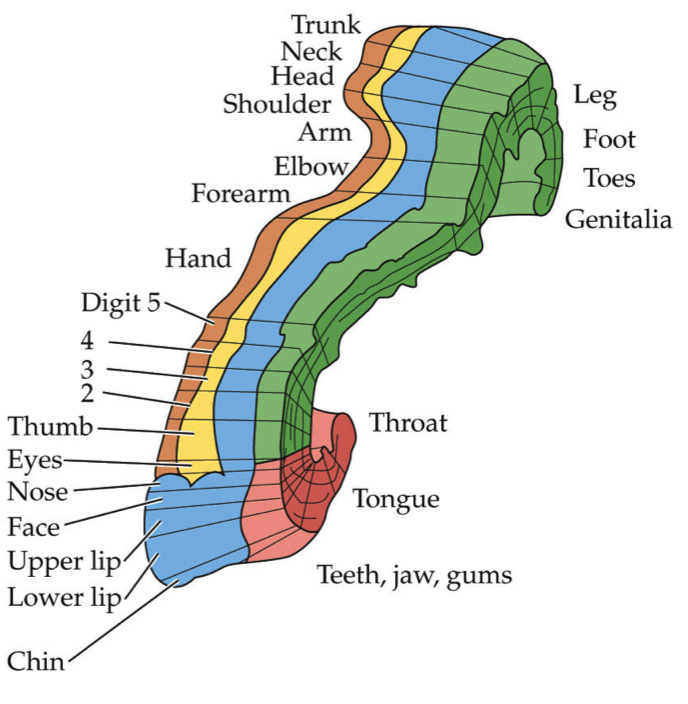
- Foot fetish: On the somatosensory cortex, the area representing the feet is right next to the area representing the genitalia. If the genome includes an “address” for the genitalia, plus the instructions “have sexual urges towards this”, then getting the address slightly wrong will land you in the feet.
A reasonable next question would be “what’s on the other side of the genitalia, and do people also have fetishes about that one?” The answer is “the somatosensory cortex is a line with the genitalia at the far end, because God is merciful and didn’t want there to be a second thing like foot fetishes.”
(source for cortex image)- Spanking: From the male point of view, penetrative PIV sex involves applying force to the bottom half of a woman, at rhythmic intervals, in a way that causes her very intense emotions and makes her make moan and scream. Spanking is exactly like this, and most kids encounter spanking at a very early age and sex only after they’re much older. If the evolutionary message is something like “find the concept that looks vaguely like this, then be into it”, spanking is the first concept like that most people will find; by the time they learn about actual sex, spanking might be a trapped prior.
- Sadomasochism: Sex is painful for virgins, can be mildly painful even for some non-virgins, and when it’s pleasurable, it still looks a lot like pain (screams, intense emotions). Imagine you are a little boy/girl who stumbles in on your parents having sex. Your father is impaling the most sensitive part of your mother’s body, and your mother is moaning and squealing. A natural generalization might be “sex is the thing where a man causes a woman pain”.
- Latex/rubber: Plausibly the evolutionary specification includes details about attractiveness. Attractive people (ie those you should be most interested in having babies with) should be young and healthy (characteristics associated with better pregnancy outcomes, especially in the high-risk ancestral environment). The simplest sign of youth and good health is smooth skin, so the evolutionary message might say something about preferring sex with smooth-skinned people. Latex is a superstimulus for smooth skin, and maybe if you see it at the right time, in the right situation, it can totally overwhelm the rest of the message.
- Urine/scat: Procreative sex involves a sticky substance that comes out of the genitals, it doesn’t take much misgeneralization to get to other sticky substances that come out of the genitals or nearby regions.
- Bondage/domination/submission: Okay, I admit I don’t have a good just-so explanation for this one. Maybe it’s more psychological – people who have been told that sex is shameful can only fully appreciate it if they feel like a victim who’s been forced into it (and so carries no guilt). And people who have been told they’re undesirable and nobody could ever really love them can only fully appreciate it if their partner is a victim who has no choice in the matter.
- Furries: This has to be because of all the cute cartoon animals, right? But why do some people sexually imprint on them? I found this article on worshippers of the 1990s cartoon mouse Gadget helpful here. Gadget obviously has many desirable characteristics — she’s a very cute nerdy woman who sometimes ends up in damsel-in-distress situations. Maybe she is the most sexualized being that some six-year-old boys have encountered. When I watched Rescue Rangers as a six-year old, I could feel my brain trying to figure out whether to have a crush on her before deciding that no, it was too deep in latency stage. I assume most people who get their first crushes on Gadget or some other desirable cartoon character end up with their brains later generalize properly to “I like cute nerdy women in damsel-in-distress situations”, but a small minority misgeneralize to “nope, I’m only attracted to mice now, that’s where I’m going to go with this.”
Combine this with equivalent animal “fetishes” — things like beetles species where the females have red dots on their backs, and the males try to mate with anything that has a red dot — and you get a picture where evolution tries to communicate a lot of contingent features of sex in the hopes that one of them will stick, then tells you to be attracted to whatever is most associated with those features. At least for men, I think the features communicated in the genomic message are simple things like curves and thrusting and genitals and smooth skin, plus something that somehow picks out the concept of “woman” (except in 3% of the male population, where it picks out the concept of “men” instead, plus another 3% where it doesn’t pick out a sex at all).
Real procreative sex usually matches enough of features of the genomic message to be attractive to most people, but if the original triggers were associated with some contingent characteristics, the brain might misinterpret that as part of the target — for example, if it was a cartoon animal, the brain might think the target includes cartoon animals.
Other times, something that isn’t procreative sex matches the genomic message closely enough to be misinterpreted as the center of the target (eg getting whipped); usually procreative sex is somewhere in the target space, but maybe not the exact center, and a few people have such strong fetishes that procreative sex doesn’t register as erotic at all.
The process of forming the category “sexually attractive things” is just a special case of the process of forming categories at all. I discuss the formation of categories like “happiness” and “morality” in The Tails Coming Apart As Metaphor For Life. Society feeds us some labeled data about what is good or bad — for example, we might see someone commit murder on TV, and our parents tell us “No! That’s bad! Don’t do that!” (and the other TV characters hate and punish that character). Then we try to extrapolate such incidents to a broader moral system. If we’re philosophers, we might go further and try to formally describe that moral system, eg Kantianism, utilitarianism, divine command theory, natural law, etc. All of these correctly predict the training data (eg “murder is bad”) while having different opinions on out-of-distribution environments. Which one you choose is just a function of some kind of mysterious intellectual preference for how to generalize inherently ungeneralizeable things — what I previously described as “extrapolating a three-dimensional shape from its two-dimensional reinforcement-learning shadow”.
Fetishes are the same way. Here the evolutionary message provides semi-labeled data, giving people weird feelings when they see certain kinds of curvy, smooth-skinned people. Then people try to generalize that into an idea of what’s sexy. Usually their category is centered (in the sense that the category “bird” is centered around “sparrow” and not “ostrich”) around something close to procreative heterosexual sex. Other times they generalize in some very unexpected way, and are only attracted to cartoon mice. I think if we understood the laws of generalization, this would make sense. It would seem like a reasonable mistake that someone using Occam’s Razor and all the rest of the information-theoretic toolkit for generalization could make. But we don’t really understand those laws beyond faint outlines, so instead we’re reduced to YKINMKBYKIOK.
August 20, 2023
QotD: Fear of death
[…]
As pretty much every Victorian anthropologist remarked, “savages” all seem deliriously happy — when life is a constant struggle, your every moment is filled with deep meaning, high purpose. So, too, with men at war — Robert Graves or someone like that once said that his time in the trenches were the greatest moments of his life, because everything other than the now disappeared. I can’t speak from personal experience, but I’d lay good money that no combat veteran completely re-enters the civilian world, largely for this reason.
Those are reasonable fears of death. We all accept, intellectually, that we could go at any time, and we will inevitably go eventually, but unless you’ve had a brush with death — a moment where you know, with perfect clarity, that there’s a significant chance you’re going now — you can’t really appreciate it, emotionally.
Severian, “Communal Salvation”, Rotten Chestnuts, 2020-11-19.
Comments Off on QotD: Fear of death
August 16, 2023
QotD: Cognitive dissonance, or when cultists retcon reality
For those with even a moderate level of commitment to the cult (and I’ll leave it to you to speculate what moderate commitment to a cult might be; Festinger’s work is not without its critics), disconfirmation of the cult’s central belief led, astoundingly, to an even greater commitment to the cult. “The world will end on X date” was immediately retconned into “the world didn’t end on X date because of our righteousness“.
You know you’re really onto something when it seems head-slappingly obvious in retrospect. Yeah, of course they did that. Everybody does that to a degree. You expect something isn’t going to work out, then it does work out — it must be because you’re special, right? It’s another way of assigning yourself agency in a world where you’re basically powerless over the big stuff. Humans are wired to believe they have agency, that things happen for a reason. It sounds like I’m giving Festinger at best a backhanded compliment, but I’m very seriously singing his praises — “everybody knows” this stuff, but no one had isolated and described it before. That’s a major achievement — if I could have the equivalent of “discovered cognitive dissonance” on my tombstone, I’d die an ecstatically happy man.
Severian, “Quick Takes: Festinger Edition”, Rotten Chestnuts, 2021-01-19.
Comments Off on QotD: Cognitive dissonance, or when cultists retcon reality
August 15, 2023
“Babies are nature’s little smoke detectors”
Rob Henderson covers some evolutionary arguments on how “we” became who we are today, including some of the ways parents and babies interact:

“Crying Baby” by iamprince160812 is licensed under CC BY 2.0 .
Intriguingly, some researchers have suggested that infant crying is a signal of vigor that evolved to reduce the withdrawal of parental care.
The idea is that in the ancestral environment, inert, inanimate, lifeless infants were considered by parents to be physically weak or possibly in poor health and thus unlikely to survive. In contrast, being loud and relentlessly fussy demonstrated high energy, strong lungs, and good health. Indeed, infant crying is calorically costly, with a 13% increase in metabolic rate compared to resting.
Exhausted parent: “I’ve tried feeding you, changing you, holding you…What is it that you want?”
Crying baby: “To demonstrate to you how robust I am!”
This is likely why babies will often cry even when there is seemingly no immediate need, such as distress or hunger. Their unconscious, evolutionary aim is to ensure caregivers don’t neglect them or withdraw care or resources from them.
Of course, like most signals individuals send, babies don’t “know” they are doing this.
Infant crying also falls under the framework of error management theory. The idea is that it is more costly to under-react to potential dangers than overreact. In this case, it is better for a baby to be oversensitive and cry even when there is nothing wrong than to be under-reactive and not cry when something is wrong. A variation of this is the smoke detector principle.
A smoke detector produces a piercing, unmistaken alarm in the event of a fire. But it doesn’t actually detect fire — it detects smoke particles and activates upon the merest hint of potential danger. A false positive (e.g., alarm in response to burnt toast) is far more favorable than a false negative (failing to activate in response to flames). Thus these devices are calibrated to be annoyingly over-reactive.
Babies are nature’s little smoke detectors.
Comments Off on “Babies are nature’s little smoke detectors”
August 9, 2023
QotD: The “Merry Pranksters”
To make ends meet, he got a job as an orderly at the local psych hospital. He also ran across some nice people called “MKULTRA” who offered him extra money to test chemicals for them. As time went by, he found himself more and more disillusioned with the hospital job, finding his employers clueless and abusive. But the MKULTRA job was going great! In particular, one of the chemicals, “LSD”, really helped get his creative juices flowing. He leveraged all of this into his Great American Novel, One Flew Over The Cuckoo’s Nest, and became rich and famous overnight.
He got his hands on some extra LSD and started distributing it among his social scene – a mix of writers, Stanford graduate students, and aimless upper-class twenty-somethings. They all agreed: something interesting was going on here. Word spread. 1960 San Francisco was already heavily enriched for creative people who would go on to shape intellectual history; Kesey’s friend group attracted the creme of this creme. Allan Ginsberg, Hunter S. Thompson, and Wavy Gravy passed through; so did Neil Cassady (“Dean Moriarty”) Jack Keroauc’s muse from On The Road. Kesey hired a local kid and his garage band to play music at his acid parties; thus began the career of Jerry Garcia and the Grateful Dead.
Sometime in the early 1960s, too slow to notice right away, they transitioned from “social circle” to “cult”. Kesey bought a compound in the redwood forests of the Santa Cruz Mountains, an hour’s drive from SF. Beatniks, proto-hippies, and other seekers – especially really attractive women – found their way there and didn’t leave. Kesey and his band, now calling themselves “the Merry Pranksters”, accepted all comers. They passed the days making psychedelic art (realistically: spraypainting redwood trees Day-Glo yellow), and the nights taking LSD in massive group therapy sessions that melted away psychic trauma and the chains of society and revealed the true selves buried beneath (realistically: sitting around in a circle while people said how they felt about each other).
What were Kesey’s teachings? Wrong question – what are anyone’s teachings? What were Jesus’ teachings? If you really want, you can look in the Bible and find some of them, but they’re not important. Any religion’s teachings, enumerated bloodlessly, sound like a laundry list of how many gods there are and what prayers to say. The Merry Pranksters were about Kesey, just like the Apostles were about Jesus. Something about him attracted them, drew them in, passed into them like electricity. When he spoke, you might or might not remember his words, but you remembered that it was important, that Something had passed from him to you, that your life had meaning now. Would you expect a group of several dozen drug-addled intellectuals in a compound in a redwood forest to have some kind of divisions or uncertainty? They didn’t. Whenever something threatened to come up, Kesey would say — the exact right thing — and then everyone would realize they had been wrong to cause trouble.
Scott Alexander, “Book Review: The Electric Kool-Aid Acid Test”, Slate Star Codex, 2019-07-23.
Comments Off on QotD: The “Merry Pranksters”
July 30, 2023
“Give me Andrea Dworkin’s anti-fella fury over this matrician tripe any day of the week”
Brendan O’Neill clearly doesn’t think Caitlin Moran’s new book What About Men? is worth reading:
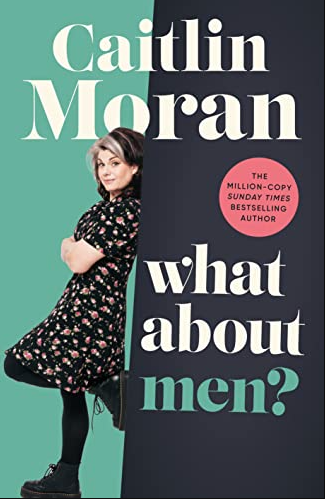
Men, I have bad news: Caitlin Moran is coming for us. She comes not to man-bash, not to holler: “All men are rapists!” It’s worse than that. She feels sorry for us. “I’m violently opposed to the branches of feminism that are permanently angry with men”, she writes at the very start of her very bad book. Instead she pities us. She frets over our toxic stoicism, our inability to be vulnerable, our unwillingness to be open about our fat bodies and small cocks. She wants to save us from all the “rules” about “what a man should be”. From all that “swagger” and “the stiff upper lip”. By the end I found myself pining for some good ol’ angry feminism. Give me Andrea Dworkin’s anti-fella fury over this matrician tripe any day of the week.
What About Men? is, I’m going to be blunt, rubbish. I knew it would be from the very first page where Moran says that “when it comes to the vag-based problems, I have the bantz”. Imagine using the word bantz unironically in 2023. What she means is that she’s done all the vagina stuff. She’s completed feminism. She’s known as “the Woman Woman”, she says, in an arrogant timbre that puts to shame those cocksure blokes who stalk her nightmares. She wrote the bestselling pop-feminist tome, How To Be a Woman (2011), which contained such gems of wisdom as “don’t shave your vagina” because it’s better to have a “big, hairy minge”, a “lovely furry moof”, “a marmoset sitting in [your] lap”, than a bald cooch. (Emmeline Pankhurst, I’m so sorry.) So now, naturally, she’s turning her attention to men. She’s discovered there is “a lot to say” about “men in the 21st-century”. Lucky us.
What she says about us is almost too daft for words. You realise by about page 22 that she’s never met a bloke from outside the media-luvvie, ageing rock-chick, “Glasto”-loving circle she famously inhabits. (I almost died of second-hand embarrassment when she said in How To Be a Woman that she lives an edgy existence, “like it’s 1969 all over again and my entire life is made of cheesecloth, sitars and hash”. Maam, you write a celebrity column for hundreds of thousands of pounds for The Times.)
Even her cultural references in What About Men? are off, as befits a woman who is essentially a square person’s idea of a cool person. She laments that young men are in “the grip of a fad” for super-skinny jeans. Jeans so tight they look “sprayed-on”. Jeans so tight that the poor lad’s balls end up “crushed against the crotch seam, in vivid detail”. Really? It’s not 2006. Bloc Party aren’t in the charts. I’m no follower of fashion but even I know most young men haven’t been wearing bollock-squashing jeans for a few years now. My nephews wear baggy jeans, à la Madchester. Pretty much the only time you see unyielding denim these days is on the portly thigh of a mid-life-crisis middle-class dad. The kind of men, dare I say it, that Ms Moran mixes with.
Her commentary on t-shirts is a dead giveaway, too. The only fashion flare the tragic male sex is allowed to enjoy is the tee, she says. Especially past the age of 40. You’ll see fortysomething fellas in “band t-shirts, slogan t-shirts, t-shirts with swearing on”, she says. Will you? Where? Again, only in the knowingly dishevelled privileged set Moran exists in. Every man in his forties I know always manages to put a shirt on. So desperate are emotionally repressed men to express themselves, says Moran, that some even buy t-shirts “from the back pages of Viz” that say things like “Breast Inspector” or “Fart Loading: Please Wait”. Not once in my life have I seen a man in a Viz tee. The problem here isn’t men – it’s Moran’s man-friends. She could have saved herself the trouble of this entire book by befriending some normal blokes.
That Moran’s pool of men is shallow is clear from the fact that all the men she talks to for the book seem to be as steeped as she is in chattering-class orthodoxy. She includes a transcript of long chats with male acquaintances and, honestly, reading it feels like being stuck in a lift with craft-beer wankers who do IT for the Guardian. At one point she informs her readers that her male friends are mostly “middle-aged, middle-class dads who know about wine, recycle, have views on thoughtful novels” and would probably “cry if they saw a dog struggling with a slight limp”. Writing a book about men from the perspective of men like that is like writing a book about women from the perspective of Princess Anne.
Comments Off on “Give me Andrea Dworkin’s anti-fella fury over this matrician tripe any day of the week”


