Quotulatiousness

November 21, 2019

Battle of Sedan: How did Prussia Win The Franco-Prussian War? | Animated History

Filed under: France, Germany, History, Military, Weapons — Tags: , , , — Nicholas @ 06:00

The Armchair Historian
Published 16 Feb 2018

The Battle of Sedan. How did Prussia Win the Franco-Prussian War?

Our Website: https://www.thearmchairhistorian.com/

Our Twitter:
@ArmchairHist

Our Discord:
https://discord.gg/Ppb2cUd

Sources:
http://1.bp.blogspot.com/-Q9vpKOSgFHs…
https://www.britannica.com/event/Batt…
https://www.thoughtco.com/franco-prus…
https://www.warhistoryonline.com/hist…
https://www.military-history.us/2011/…

100 Decisive Battles by: Paul K. Davis
50 Battles That Changed the World by: William Weir

Music: “Danse Macabre” by Kevin MacLeod is licensed under a Creative Commons Attribution license (https://creativecommons.org/licenses/…)
Source: http://incompetech.com/music/royalty-…
Artist: http://incompetech.com/

September 8, 2019

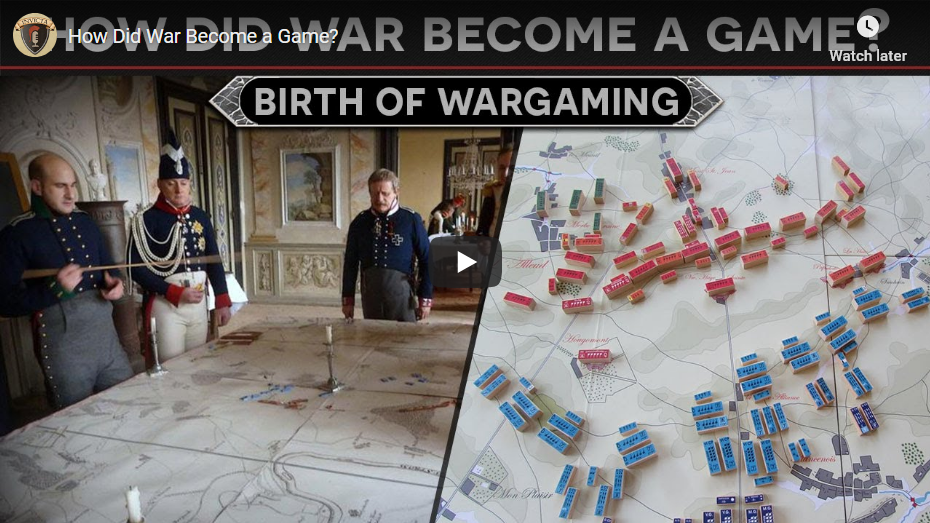
How Did War Become a Game?

Filed under: Gaming, Germany, History, Military — Tags: , , , — Nicholas @ 02:00

Invicta
Published on 28 Jun 2019

Get your first audiobook and two Audible originals when you try Audible for 30 days. Visit https://www.audible.com/Invicta or text “Invicta” to 500 500!

In this video we continue to take a look at the history of Kriegsspiel and explore the early days of wargaming that eventually gave rise to modern table top games such as Warhammer and Dungeons & Dragons.

Research: Jon Peterson
Script: Invicta
Narration: Invicta
Artwork: Gabriel Cassata
Editing: Invicta

Bibliography
Playing at the World by Jon Peterson
Debugging Game History: A Critical Lexicon by Henry Lowood
War Games: A History of War on Paper by Philipp von Hilgers
Pluie de Balles – Complex Wargames In the Classroom by Jorit Wintjes and, Steffen Pielstrom

August 8, 2019

QotD: Austrians – strudel-eating surrender monkeys

Filed under: Europe, History, Italy, Military, Quotations, WW1 — Tags: , , , , , , — Nicholas @ 01:00

Oh yes, did I mention the Austrians? A grand military tradition. The Radetzky march, all that stuff. Let’s look at their record more closely, shall we?

The Austrians (or rather the Habsburgs) built up a moderately large empire by persuading the Magyars that they could be sort of equal partners in the empire in an unequal sort of way, expert politicking and setting one lot of Slavs against another in the Balkans and central Europe, and marrying into the right ducal families in bits of what was later to become Italy. They never quite managed to sort out the Serbs, however, who felt that fighting nobly against the Turks was their speciality, and they were forced out of Switzerland early on by a small boy with an apple on his head.

The year 1683 may reasonably be considered a turning point for Western Christendom. Over the preceding century or so the Turkish Ottoman Empire had steadily advanced up the Balkan peninsula and after being balked, as it were, for many years by Macedonians, Bulgars, Albanians, Serbs, Bosnians, Croats, Slovenians, Slavonians and some I’ve probably forgotten, finally got as far as the Habsburg capital, Vienna, to which they laid siege. The siege failed, and the Turks were repelled, never again to return. Why? Because Austria was rescued by the Poles under Jan III Sobieski.

Under the noted and renowned Empress Maria Theresa, a War of the Austrian Succession was held. In keeping with tradition, it was mainly fought between the French and the English in Belgium (the French, opposed to Austria, won), except for an unimportant sideshow which appears to have been between the French and the Indians in Saratoga. The upshot was naturally that the Austrians let the Prussians have Silesia. Twice, to be on the safe side. A few years later the Seven Years War, largely fought between the English and the French in Belgium (the English, opposed to the Austrians, won) confirmed the result.

When it came to the French revolutionary and the Napoleonic wars, the Habsburgs were naturally on the side of the divine right of kings (well, Marie-Antoinette was a Habsburg herself) and against mob rule, liberty, fraternity, and most certainly equality. In furtherance of this cause, the Austrians fought the French at such places as Marengo, Austerlitz, and Wagram – among other names listed on the Arc de Triomphe in Paris. By 1812 the Austrians decided to try being on the same side as Napoleon for a change. Napoleon promptly invaded Russia, with predictable results. Following Napoleon’s final defeat at a battle in Belgium which the Austrians fortunately weren’t in time to get to, they regained most of their possessions in Italy at the peace talks due to diplomatic manoeuvrings by the master of the art, Metternich, but lost influence in Germany.

In the 1850s Austria failed to back her treaty partner Russia when the latter was invaded by the Turks, French and English in the Crimean war. Sardinia/Savoy/Piedmont, the leading state in the Italian peninsula, fought with the Allies, gaining international favour when it came to removing the Austrian influence during the subsequent wars of the Italian unification. Austria lost battles at places like Magenta and Solferino, and with them most of its Italian possessions except Venice.

In 1864 the Austrians did actually win a battle, a small naval engagement near Heligoland in the North Sea, against the Danes, against whom they were fighting in support of the Prussians over the Schleswig-Holstein question, of course. Emboldened by this masterstroke, they promptly came to blows with their erstwhile allies and were soundly whipped at the battle of Sadowa-Königgratz. The Italians got most of the rest of their country back in the resulting confusion.

The Austrians managed to stay out of trouble for another few decades after that, building up a national economy based on cheap dance music and diplomatic manoeuvrings in the Balkans. Unfortunately they got out of their depth in this respect; in 1914 the foreign minister [actually Chief of the General Staff] Conrad von Hötzendorff, believing himself to be the reincarnation of Metternich, decided to start the First World War to impress a woman he fancied. It could reasonably be argued that all the countries involved lost the First World War, even the winners, but Austria, after some Pyrrhic successes against the Serbs, a certain amount of back-and-forth against the Russians in Galicia and a cheap and ultimately futile win at Caporetto after the Russians had pulled out and the Germans had sent rather a lot of extra troops, ended up losing its entire empire, its monarchy, access to the sea and any self-respect whatsoever. It also managed to export Adolf Hitler to Germany during this period, which was singularly unfortunate; he absorbed Austria into a Greater Germany and then lost a rather big war in the most spectacular of fashions, as you are probably aware. This ended the military involvement of Austria in world affairs, at least for the moment.

I rest my case.

Albert Herring, “Why neither the French nor the Italians are the worst military nation”, Everything2, 2002-01-07.

April 14, 2019

British diplomatic blunders in history – German unification

Filed under: Britain, Europe, Germany, History — Tags: , , , , , — Nicholas @ 05:00

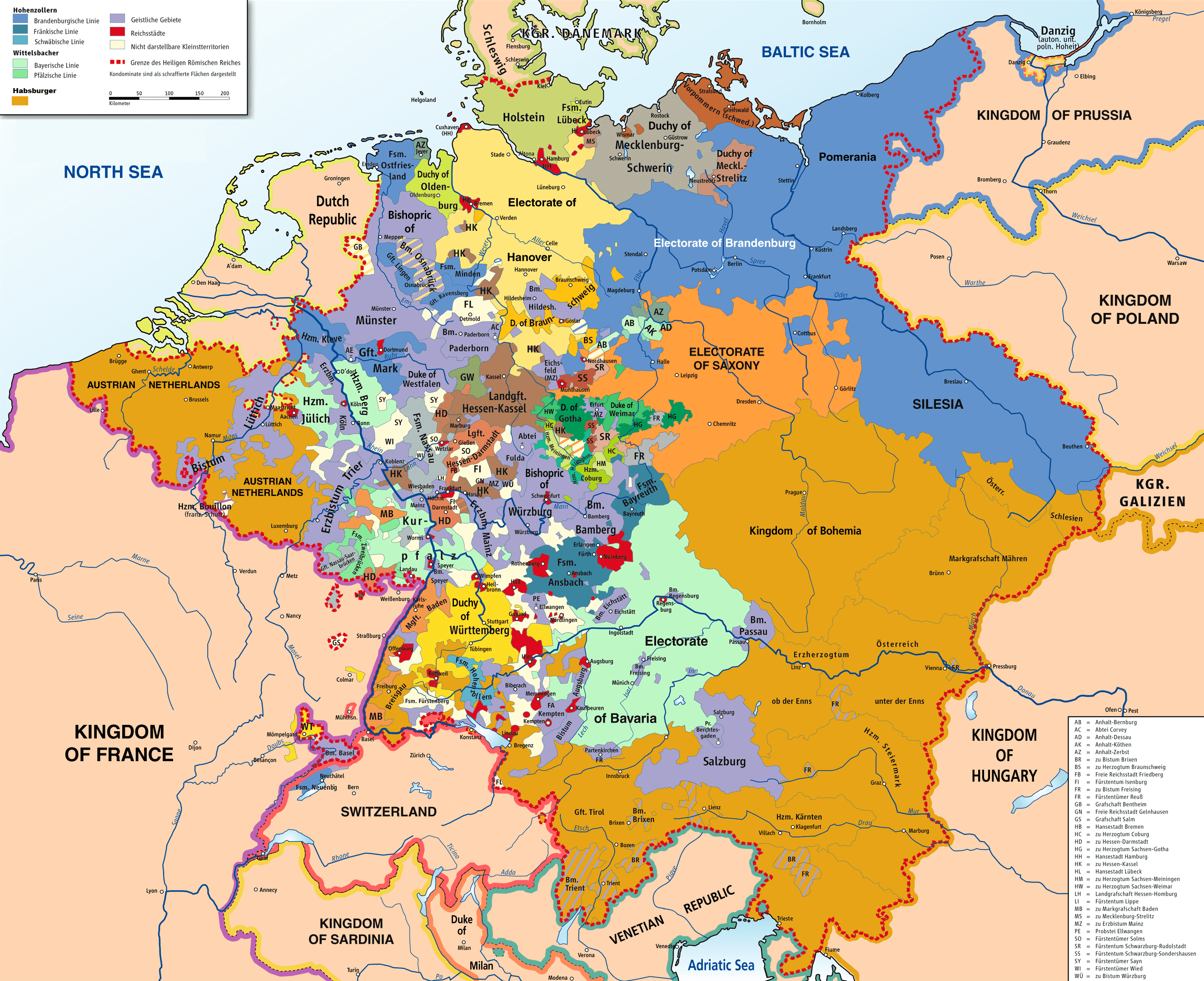
An interesting article in Vox, suggesting that the gradual unification of all the German principalities, electorates, duchies, counties, bishoprics, free cities, and miscellaneous other semi-independent bits and bobs of the Holy Roman Empire was not inevitable and that — absent British blundering after the Napoleonic wars — it would have produced a very different 20th century:

The Holy Roman Empire in 1789, before Napoleon “rationalized” hundreds of smaller entities into the Confederation of the Rhine.
Image from Wikimedia Commons.

The boundaries of states are the heart of many recent debates, be it the European refugee crisis, the Transatlantic Trade and Investment Partnership (TTIP), or Brexit (Snower and Langhammer 2019). After decades of stability, today we are again seeing heated discussions about the shape and extent of political borders. Clearly, borders are neither naturally given nor random. In Europe and elsewhere, the current state borders have been formed and changed over centuries, sometimes peacefully, often in bloody wars. In Huning and Wolf (2019), we look at the formation of the German nation state led by Prussia and trace it back to a change in borders decided at the Congress of Vienna in 1814/15.

In a nutshell, we have two findings:

  • First, the geographic position of a state can be a crucial factor for institutional change and development.
  • Second, the formation of the German Zollverein in 1834 under Prussian leadership was a truly European story, involving Britain, the Russian Empire, and the Belgian revolution of 1830/31. We show in particular that the Zollverein formed as an unintended consequence of Britain’s intervention in 1814/15 to push back Russian influence over Europe.

In theory, why would the geographic position of a state relative to that of other states matter? Intuitively, it should matter as long as the costs of trade and factor flows depend on their routes. If a large share of my trade has to pass the territory of one or several neighbours, my trade and trade policy will depend on the trade policy of my neighbours. Moreover, if tariffs are levied not only on imports but also on transit trade, as was general practice until the Barcelona Statute of 1921 (Uprety 2006), policymakers face the problem of multiple marginalisation, which is well known from the literature on supply chains. In our work, we provide a simple theoretical framework (in partial equilibrium) to show how the location of a revenue maximising state planner will affect its ability to set tariffs. Some states can increase their tariff revenue at the expense of their hinterland. Next, we show that a customs union can be beneficial for a group of states exactly because it solves the problem of multiple marginalisation.

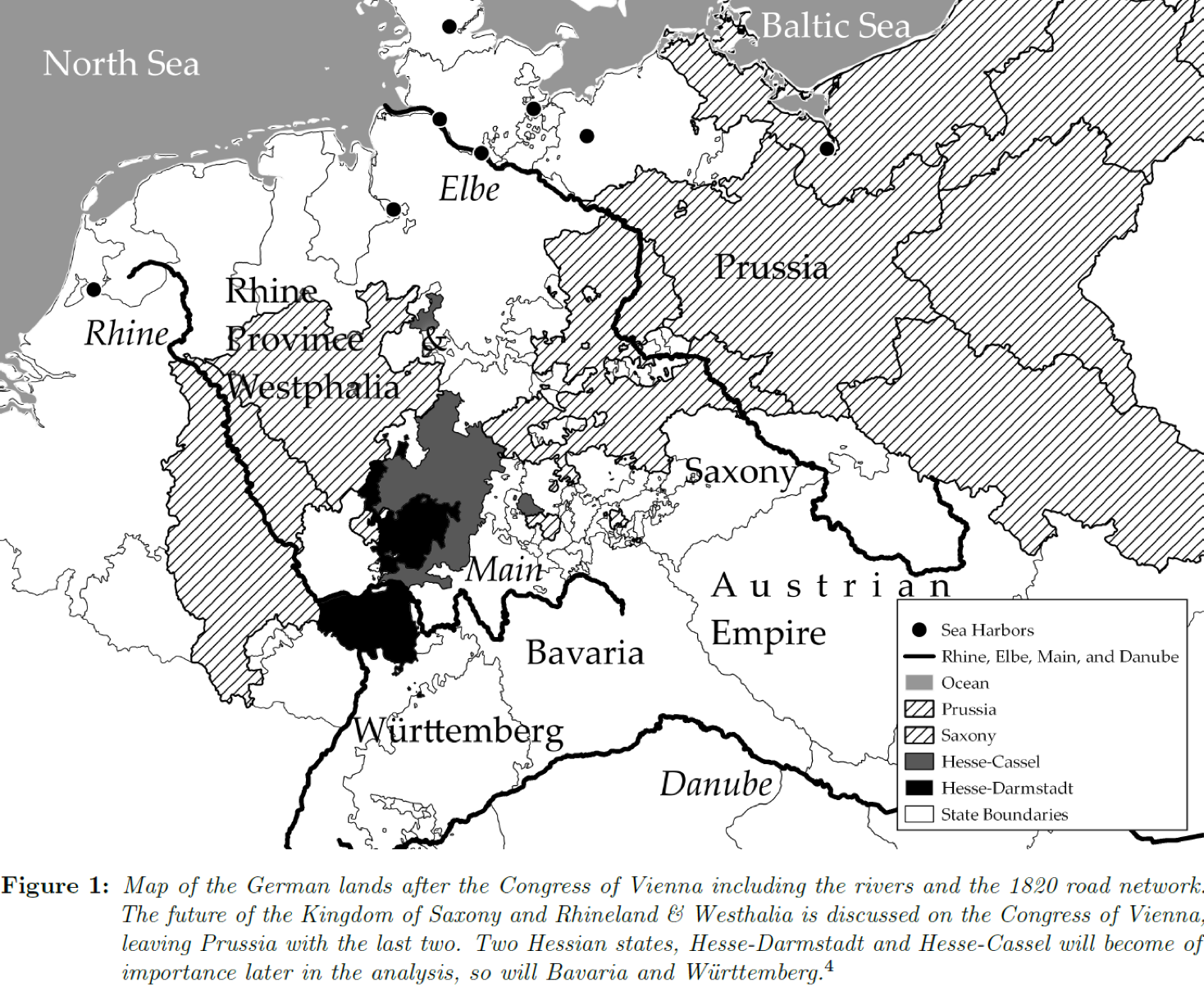
A major challenge to testing our idea empirically is that a state’s political boundaries (and hence its location) do not change very often, and if they do, the change is unlikely to be unrelated to trade or factor flows. However, the formation of the German Zollverein in 1834 can be considered as a quasi-experiment. Let us briefly revisit this historical episode. At the end of the Napoleonic wars of 1792-1814/15, only Russia and the UK were left as major military powers. Habsburg, Prussia, and the defeated France attempted to consolidate their positions at the expense of the many smaller states that had just about survived the wars, notably the former allies of Napoleon such as Saxony and Poland. Overall, the negotiations at the Congress of Vienna in 1814 were dominated by military-strategic considerations between the two great powers. Russia wanted to expand westwards, Prussia was desperate to annex the populous Kingdom of Saxony, which bordered Prussia in the south and would create a large and coherent territory. To this end, Prussia was willing to give up not only her Polish territories to Russia, but also her positions and claims on the Rhineland (Müller 1986). This met stiff resistance from Britain, joined by Habsburg and France, which feared a new Russian hegemony on the continent – the ‘Polish Saxon question’. After weeks of diplomatic struggle, the outcome was a division of Saxony, another division of Poland and Prussia being established as the “warden of the German gate against France” (Clapham 1921: 98). Figure 1 shows the result of these negotiations.

H/T to Continental Telegraph for the link.

March 10, 2019

Prussian Infantry under Frederick the Great

Filed under: Germany, History, Military — Tags: , , , , — Nicholas @ 03:00

Military History Visualized
Published on 6 Oct 2017

Prussian Infantry during the time of Frederick the Great of Prussia. Basic background on infantry types like Grenadiers, Fusiliers, etc., organization and combat formations.

»» SUPPORT MHV ««
» patreon – https://www.patreon.com/mhv
» paypal donation – https://www.paypal.com/cgi-bin/webscr…

Military History Visualized provides a series of short narrative and visual presentations like documentaries based on academic literature or sometimes primary sources. Videos are intended as introduction to military history, but also contain a lot of details for history buffs. Since the aim is to keep the episodes short and comprehensive some details are often cut.

» SOURCES «

Guddat, Martin: Grenadiere, Musketiere, Füsiliere. Die Infanterie Friedrich des Großen
Fiedler, Siegfried: Taktik & Strategie der Kabinettskriege
Ortenburg, Georg: Waffen der Kabinettskriege
Militärgeschichtliches Forschungsamt: Friedrich der Große und das Militärwesen seiner Zeit. Vorträge zur Militärgeschichte. Band 8.
Chandler, David: The Art of War in the Age of Marlborough
Buchner, Alex: Handbuch der Infanterie 1939-1945
Bucher, Alex: Handbook on German Infantry 1939-1945
Haythornthwaite, Philip: Frederick the Great’s Army (2) – Infantry
Militärgeschichtliches Forschungsamt: Deutsche Militärgeschichte 1648-1939. Band 1.
Militärgeschichtliches Forschungsamt: Deutsche Militärgeschichte 1648-1939. Band 6.
Clark, Christopher: Iron Kingdom, The Rise and Downfall of Prussia 1600-1947
Guddat, Martin: Kürassiere, Dragoner, Husaren. Die Kavallerie Friedrichs des Großen.
Hawkins, Vincent B.: “Frederick the Great”, in: Brassey’s Encyclopedia of Military History and Biography, p. 339-345

» DISCLAIMER «

Amazon Associates Program: “Bernhard Kast is a participant in the Amazon Services LLC Associates Program, an affiliate advertising program designed to provide a means for sites to earn advertising fees by advertising and linking to amazon.com.”

Bernhard Kast ist Teilnehmer des Partnerprogramms von Amazon Europe S.à.r.l. und Partner des Werbeprogramms, das zur Bereitstellung eines Mediums für Websites konzipiert wurde, mittels dessen durch die Platzierung von Werbeanzeigen und Links zu amazon.de Werbekostenerstattung verdient werden können.

» TOOL CHAIN «

PowerPoint 2016, Word, Excel, Tile Mill, QGIS, Processing 3, Adobe Illustrator, Adobe Premiere, Adobe Audition, Adobe Photoshop, Adobe After Effects, Adobe Animate.

» CREDITS & SPECIAL THX «

Song: Ethan Meixsell – Demilitarized Zone

November 8, 2018

The Franco-Prussian War

Filed under: France, Germany, History, Military — Tags: , , , — Nicholas @ 02:00

Epic History
Published on 29 Dec 2015

The Franco-Prussian War or Franco-German War, often referred to in France as the War of 1870 (19 July 1870 – 10 May 1871), was a conflict between the Second French Empire and the German states of the North German Confederation led by the Kingdom of Prussia. The conflict was caused by Prussian ambitions to extend German unification. Prussian chancellor Otto von Bismarck planned to provoke a French attack in order to draw the southern German states — Baden, Württemberg, Bavaria and Hesse-Darmstadt — into an alliance with the North German Confederation dominated by Prussia.

July 30, 2018

Pour Le Merite – Persia – Polish Legions I OUT OF THE TRENCHES

Filed under: Europe, Germany, History, Middle East, Military, WW1 — Tags: , , , — Nicholas @ 04:00

The Great War
Published on 28 Jul 2018

Chair of Wisdom Time!

May 14, 2018

The Austro-Prussian War

Filed under: Europe, Germany, History, Military — Tags: , — Nicholas @ 02:00

Epic History
Published on 28 Dec 2015

The Austro-Prussian War or Seven Weeks’ War (also known as the Unification War, Prussian–German War, German Civil War, or Fraternal War and in Germany as German War) was a war fought in 1866 between the German Confederation under the leadership of the Austrian Empire and its German allies on one side and the Kingdom of Prussia with its German allies and Italy on the other, that resulted in Prussian dominance over the German states.

March 16, 2018

How Rifles & Railroads influenced Warfare in the 19th Century

Filed under: Europe, History, Military, Railways, Weapons — Tags: , , , , — Nicholas @ 02:00

Military History Vlogs
Published on 23 Feb 2018

The introduction of the breech-loading rifle and the railroad had a tremendous influence on Warfare in the 19th Century. Although, not everyone was as fast or able to adopt then the Prussians. Austria, France and Russia had major issues. Most notably visible in the Austro-Prussian War (1866) and Franco-Prussian War (1870-1871).

February 13, 2018

Feature History – Seven Years’ War

Filed under: Americas, Britain, Europe, France, History, India, Military, Russia — Tags: , , , — Nicholas @ 02:00

Feature History
Published on 14 Jan 2017

Hello and welcome to Feature History, featuring the Seven Years’ War, an overdue video, and the reason you don’t record after just waking up

December 4, 2017

Otto von Bismarck – Lies – Extra History

Filed under: Europe, Germany, History — Tags: , , , — Nicholas @ 04:00

Extra Credits
Published on 2 Dec 2017

We’ve wrapped up our series on Otto von Bismarck, but we’ve only touched on the first half of his life! Maybe someday we’ll get to come back. Until then, James answers questions and discusses errors in this episode of Lies!

November 21, 2017

Otto von Bismarck – VI: Germany! – Extra History

Filed under: France, Germany, History, Military — Tags: , , , , , — Nicholas @ 04:00

Extra Credits
Published on 18 Nov 2017

You would think that capturing the Emperor of France would end the war, but… no. Who could Bismarck negotiate with? Eventually he forced an interim government to cave to his demands, and at the same time convinced the rest of the German states to unite with Prussia.

November 14, 2017

The Last Hussar – August von Mackensen I WHO DID WHAT IN WW1?

Filed under: Europe, Germany, History, Military, WW1 — Tags: , , , — Nicholas @ 04:00

The Great War
Published on 13 Nov 2017

August von Mackensen was one of the most prolific generals of World War 1. He served with distinction on the Eastern theatres. The Gorlice-Tarnow Offensive, the conquest of Serbia and Romania were all possible thanks to him. He was raised with the belief in Prussian glory and held onto this belief even after the war ended.

November 13, 2017

Otto von Bismarck – V: Prussia Ascendant – Extra History

Filed under: Europe, France, Germany, History — Tags: , , , , , , — Nicholas @ 06:00

Extra Credits
Published on 11 Nov 2017

The northern German states now looked to Prussia for leadership, but that power brought increased attention from their enemies. Bismarck engineered a war with France by striking at Napoleon III’s pride and wound up winning a runaway victory to secure Prussia’s diplomatic power.

November 6, 2017

Otto von Bismarck – IV: The Iron Chancellor – Extra History

Filed under: Europe, Germany, History, Military — Tags: , , , , — Nicholas @ 04:00

Extra Credits
Published on 4 Nov 2017

Bismarck turned up the heat on his long-term plan to unite the German Confederation under Prussian leadership. He allied with Austria to seize a piece of disputed land, then maneuvered them into a war that he decisively won. Even an assassination attempt could not stop him.

« Newer PostsOlder Posts »

Powered by WordPress