Quotulatiousness

August 23, 2019

Loving “science”

Filed under: Media, Politics, Religion, Science, USA — Tags: , , — Nicholas @ 03:00

At Rotten Chestnuts, Severian explains the differences between how ordinary people view science and many progressives “f*cking love” science:

For the benefit of younger readers: If you think Lefties Fucking Love Science(TM) now, you have no idea of the torrid affair they carried on with it back when the USSR was still a going concern. Karl Marx, of course, pretended that his sub-Hegelian flatulence was the only truly scientific world view, and his disciples have been playing along ever since. “The facts have a liberal bias,” you’d routinely be informed, by people who spent $200 to have their chakras cleansed by a Navajo shaman once every two months.

I can’t think of a better illustration of what I call (for lack of a better term) the Left’s grammar problem. Lefties tend to get nouns and verbs mixed up. “Science,” for instance. I’m not going to go all Vox Day here and start making up words, but when normal people say “science,” we generally mean it as a verb:

    “Science” is what scientists do; it’s shorthand for “applying the scientific method.”

This is why, when we’re presented with a startling new find from the white coat guys — that the polar ice caps have all melted, say — we ask to see the lab work. If it’s really science, then we should be able to replicate the experiment ourselves. Or, at the very least, you should be able to show us the satellite photos…

Which nicely highlights the Left’s notion of “science.” To them, it’s a noun:

    “Science” is a fixed body of knowledge; upon which “scientists” operate the way theologians work on the Bible.

What “scientists” do in the Left’s world, then, is what normal people call “hermeneutics.” This is why the bizarre phrase “the science is settled!” makes sense to Leftists. You don’t get to see God’s lab work, after all, and you’re not allowed to make up new Scriptures. To them, an ordinary person challenging a “scientist” on a point of “science” is like a layman challenging the Pope on a point of theology.

August 22, 2019

The “tragedy of the corporate commons”

Filed under: Business, Law, Politics — Tags: , , — Nicholas @ 03:00

Corporations are being urged to take on responsibility to a wider — in fact, the widest possible — group of people rather than the narrowly defined group of shareholders. Arthur Chrenkoff explains why this is not likely to improve either corporate governance or the wider world:

Whatever you thought of Friedman’s formulation, at least both the chain of accountability and the performance assessment criteria were pretty clear. Now, not so much. It sounds great on paper, this corporate social responsibility on steroids; we take everyone’s interests into account: shareholders, employees, customers, the society in general; everyone is a stakeholder. But what does it mean in practice? Previously, boards were accountable to people whose investment in the company made the company’s existence possible. That the company should have a good workforce, satisfy the customers, and obey the laws of the land all went without saying, being the necessary conditions for successful operations. Now, the Business Roundtable recommends everyone and everything has to be taken into consideration and companies need to “deliver value to all of them”. What if you can’t? What if the interests of the nearly infinite number of stakeholders conflict with one another? How do you gauge all these interests? How do you prioritise? How do you assess “value for all”?

What this initiative seems to me to be about is giving the official blessing for corporations to be political and social actors, to pursue every trendy cause and campaign for issues that have nothing to do with the actual business conducted or business in general, and to do so without the fear of any negative consequences for the management. It’s a great way to avoid any responsibility and accountability, particularly if the bottom line suffers as a result. “Sure, our revenue is way down, but our campaign for separate toilets for each of the 32 separate genders is what the society needs and expects from us”. Previously, you assessed the management on their stewardship of the company and its commercial performance. But since now that’s only one of the criteria to be taken into consideration, it will become more difficult to sanction bad and underperforming directors. They might suck at business but they’re woke enough so, hey, it balances out. Or more than balances: after all, why should the interests of a thousand shareholders be privileged over the interests of the amorphous but clearly much numerically bigger community? Satisfying the interests of shareholders is an objective exercise, delivering value to the country as a whole – or to the whole world – is so vague that it’s impossible to disprove; it’s unmeasurable and very much in the eye of the beholder. Which is how the new corporate class wants to keep it; if you are answerable to everyone, you are answerable to no one.

August 14, 2019

QotD: Proto-progressive thought

Filed under: Government, History, Liberty, Politics, Quotations — Tags: , — Nicholas @ 01:00

[Robert Southey] conceives that the business of the magistrate is not merely to see that the persons and property of the people are secure from attack, but that he ought to be a jack-of-all-trades, architect, engineer, schoolmaster, merchant, theologian, a Lady Bountiful in every parish, a Paul Pry in every house, spying, eavesdropping, relieving, admonishing, spending our money for us. His principle is, if we understand it rightly, that no man can do anything so well for himself as his rulers, be they who they may, can do it for him, and that a government approaches nearer and nearer to perfection in proportion as it interferes more and more with the habits and notions of individuals.

Thomas Babington Macaulay, “Southey’s Colloquies on Society”, 1830.

August 11, 2019

“Saying ‘Donald Trump is not my president’ is like saying that your stepfather isn’t your real dad and slamming your bedroom door”

Filed under: Britain, Cancon, Politics, USA — Tags: , , , , , — Nicholas @ 03:00

Colby Cosh looks at the oddly immature and childish meme of “Not my President”/”Not my Prime Minister” declarations that seem to be ubiquitous these days:

If you sent me back to grad school I would love to do some proper research into the history of the “Not My President”/”Not My Prime Minister”-type statements that are everywhere now. They do seem especially popular with liberals, although they are not exclusive to them. A strong memetic influence was obviously the multi-city “Not My Presidents Day” protests that followed Donald Trump’s inauguration. But the indignant, huffy insistence that Trump is “not my president” obviously had to gain traction in the first place.

The theme has been taken up internationally: if you Google “not my prime minister” most of the top hits are Boris Johnson-related (no doubt the “Theresa May: not my prime minister” T-shirts and buttons will sell in the online shops at a significant discount now), and the theme has become a formal slogan of street protest in the U.K. Adding “Trudeau” to the search string reveals a few comment threads. The Canadian politician who gets the most “Not my X” action is certainly Doug Ford. In Alberta, Rachel Notley and Jason Kenney have been getting roughly equal helpings of “Not my premier!”, presumably not from the same people. Who knows, maybe there’s someone out there who feels that his real premier is still Harry E. Strom.

In analyzing this emerging cliché, I suppose one could interpret it as a small act of libertarian or even anarchist rebellion. Is anybody really deserving of being “my” prime minister? Should we not all, in the glorious Utopia, be the prime ministers of ourselves? But the psychological force and intention of the statement that Joe Blow is not “my prime minister” or “my president” is not really anarchistic. The implication of the assertion is always that someone else might really deserve the title, or that there existed past statesmen nobody was ashamed to follow and identify completely with. Saying “Donald Trump is not my president” is like saying that your stepfather isn’t your real dad and slamming your bedroom door.

Meanwhile, of course, your stepfather is probably covering the mortgage and cleaning the eavestrough. “Not my X!” is a defection from democracy more than it is a challenge to the idea of the state. Donald Trump is definitely the lawful, constitutional president of the United States of America, and anyway possesses the powers thereof; those who say it ain’t so are making an incantation, trying to will a state of affairs into existence. If enough people say it, maybe it sorta automatically comes true. There is a lot of this kind of attempted magic going around these days.

August 10, 2019

QotD: Progressives and spontaneous order

I suspect that the single biggest factor that distinguishes “Progressives” from libertarians and free-market conservatives is the simple fact that “Progressives” do not begin to grasp the reality of spontaneous order. “Progressives” seem unable to appreciate the reality that productive and complex economic and social orders not only can, but do, emerge unplanned from the countless local decisions of individuals each pursuing his or her own individual plans. Therefore, “Progressives” naturally adopt a creationist view of society and of the economy: without a conscious and visible (and well-intentioned) guiding hand, society and the economy cannot possibly work very well. Indeed, it seems that for many (most?) “Progressives,” the idea that a spontaneously ordered economy can work better than one directed consciously from above – or, indeed, that a spontaneously ordered economy can work at all – is so absurd that when “Progressives” encounter people who oppose “Progressive” schemes for regulating the economy, “Progressives” instantly and with great confidence conclude that their opponents are either stupid or, more often, evil cronies for the rich and the powerful.

Conduct an on-going experiment: whenever well-meaning “Progressives” (of which there are very many) propose this government intervention or oppose that policy of reducing government’s role in the economy, ask if these “Progressives'” stated reasons can be understood to be nothing more than a reflection of a failure to understand the power and range of spontaneous-ordering forces in private-property settings. The answer will almost always be “yes.” Very often, no further explanation for “Progressives'” policy stances is necessary.

“Progressives” simply don’t “get” spontaneous order in human society. They see a problem and leap to the only conclusion that for them is sensible – namely, that that problem’s only realistic “solution” is that it be directly addressed by government officials. Indeed, even “Progressives'” frequent misdiagnoses of the results of trade-offs as being “problems” (or “market failures”) reflect a failure to understand spontaneous-ordering processes. Many phenomena and patterns that “Progressives” assume to be problems – for example, increasing inequality of monetary incomes – are often the benign results of the countless and nuanced individual trade-offs made by individuals. For “Progressives,” though, these “outcomes” are often assumed to be the consequence of sinister designs.

Don Boudreaux, “Bonus Quotation of the Day…”, Café Hayek, 2017-06-24.

July 28, 2019

QotD: Anglo-Italian relations, 1922-1940

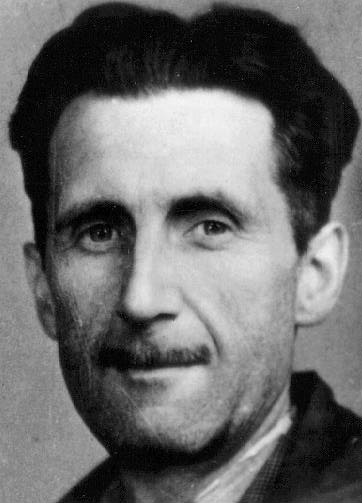
Orwell’s press card portrait, 1943

The history of British relations with Mussolini illustrated the structural weakness of a capitalist state. Granting that power politics are not moral, to attempt to buy Italy out of the Axis — and clearly this idea underlay British policy from 1934 onwards — was a natural strategic move. But it was not a move which Baldwin, Chamberlain and the rest of them were capable of carrying out. It could only have been done by being so strong that Mussolini would not dare to side with Hitler. This was impossible, because an economy ruled by the profit motive is simply not equal to rearming on a modern scale. Britain only began to arm when the Germans were in Calais. Before that, fairly large sums had, indeed, been voted for armaments, but they slid peaceably into the pockets of the shareholders and the weapons did not appear. Since they had no real intention of curtailing their own privileges, it was inevitable that the British ruling class should carry out every policy half-heartedly and blind themselves to the coming danger. But the moral collapse which this entailed was something new in British politics. In the nineteenth and early twentieth centuries, British politicians might be hypocritical, but hypocrisy implies a moral code. It was something new when Tory M.P.s cheered the news that British ships had been bombed by Italian aeroplanes, or when members of the House of Lords lent themselves to organized libel campaigns against the Basque children who had been brought here as refugees.

When one thinks of the lies and betrayals of those years, the cynical abandonment of one ally after another, the imbecile optimism of the Tory press, the flat refusal to believe that the dictators meant war, even when they shouted it from the house-tops, the inability of the moneyed class to see anything wrong whatever in concentration camps, ghettos, massacres and undeclared wars, one is driven to feel that moral decadence played its part as well as mere stupidity. By 1937 or thereabouts it was not possible to be in doubt about the nature of the Fascist régimes. But the lords of property had decided that Fascism was on their side and they were willing to swallow the most stinking evils so long as their property remained secure. In their clumsy way they were playing the game of Machiavelli, of “political realism”, of “anything is right which advances the cause of the Party” — the Party in this case, of course, being the Conservative Party.

All this “Cassius” brings out, but he does shirk its corollary. Throughout his book it is implied that only Tories are immoral. “Yet there is still another England,” he says. “This other England detested Fascism from the day of its birth… this was the England of the Left, the England of Labour.” True, but only part of the truth. The actual behaviour of the Left has been more honourable than its theories. It has fought against Fascism, but its representative thinkers have entered just as deeply as their opponents into the evil world of “realism” and power politics.

“Realism” (it used to be called dishonesty) is part of the general political atmosphere of our time. It is a sign of the weakness of “Cassius”s position that one could compile a quite similar book entitled The Trial of Winston Churchill, or The Trial of Chiang Kai-shek, or even The Trial of Ramsay MacDonald. In each case you would find the leaders of the Left contradicting themselves almost as grossly as the Tory leader quoted by “Cassius”. For the Left has also been willing to shut its eyes to a great deal and to accept some very doubtful allies. We laugh now to hear the Tories abusing Mussolini when they were flattering him five years ago, but who would have foretold in 1927 that the Left would one day take Chiang Kai-shek to its bosom? Who would have foretold just after the General Strike that ten years later Winston Churchill would be the darling of the Daily Worker? In the years 1935-9, when almost any ally against Fascism seemed acceptable, left-wingers found themselves praising Mustapha Kemal and then developing tenderness for Carol of Rumania.

George Orwell, “Who are the War Criminals?”, Tribune, 1943-10-22.

July 21, 2019

Debunking the “common wisdom” about the “Scopes Monkey Trial”

Filed under: Education, History, Law, Media, USA — Tags: , , , , , , — Nicholas @ 05:00

Mark Pulliam explains what really caused the “Scopes Monkey Trial” and what was at stake … which doesn’t match up well at all against what little most people will remember about it today:
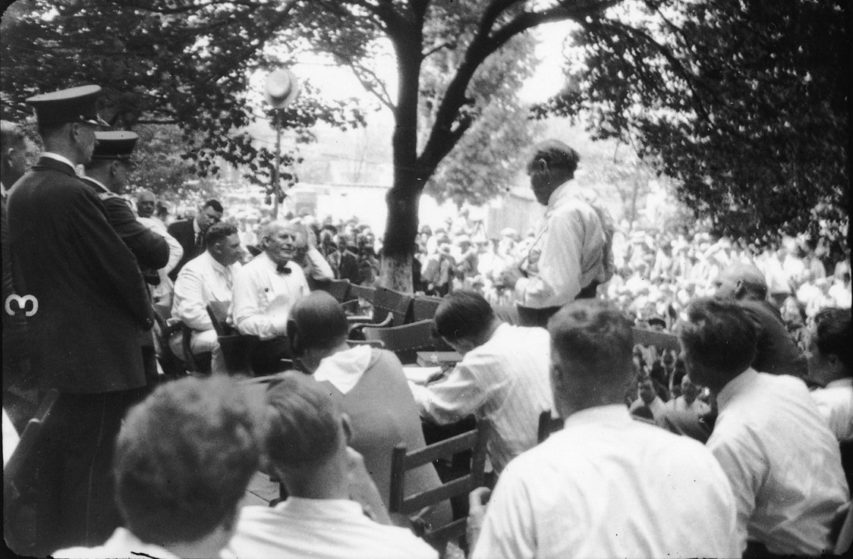
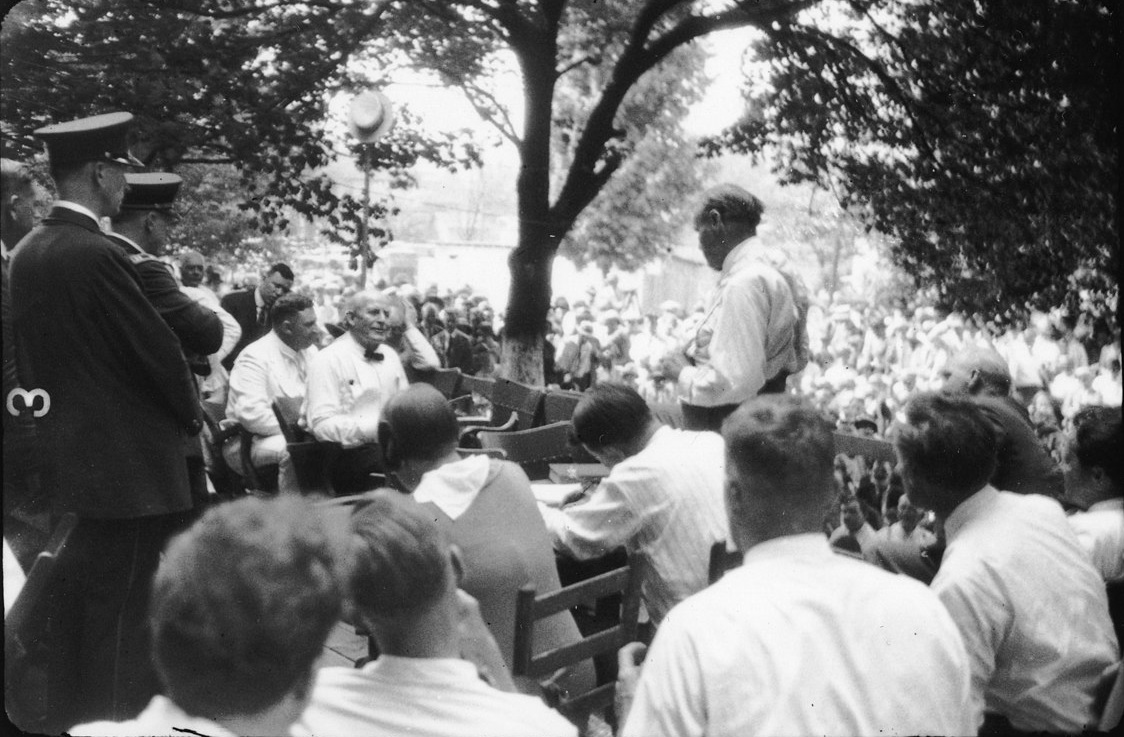
William Jennings Bryan (seated at left) being interrogated by Clarence Darrow, during the trial of the State of Tennessee v. John Thomas Scopes, July 20, 1925. That Monday afternoon, because of the extreme heat, Judge Raulston moved court proceedings outdoors. The session was held on a platform that had been erected at the front of the Rhea County Courthouse to accommodate ministers who wanted to preach during the time of the trial. Defense lawyers for Scopes (John R. Neal, Arthur Garfield Hays, and Dudley Field Malone) are visible seated to the extreme right. One of the men at left, with his back to the photographer, appears to be Scopes. The court reporters are seated at the table.
Photograph by Watson Davis via Wikimedia Commons.

We are again in another contentious period in America where battles over our culture and how we should live together are acrimonious. But there have been many points in our history that indicate we are only re-engaging a form of politics that is quintessentially American. One prominent past episode that occurred in Dayton, Tennessee during the summer of 1925 — the so-called “Scopes Monkey Trial” — has captured the American imagination like few legal proceedings ever have. Noted trial lawyer Clarence Darrow was part of the large legal team representing a 24-year-old substitute high school teacher, John Thomas Scopes, who was accused of violating the state’s Butler Act, which prohibited the teaching of evolution in a state-funded school. The celebrity co-prosecutor was William Jennings Bryan, the three-time Democratic presidential nominee, former Nebraska congressman, and Secretary of State to President Woodrow Wilson. Both Darrow and Bryan were prominent Progressive figures. Bryan, a left-wing evangelical and a fiery orator, is best known for his “Cross of Gold” speech at the 1896 Democratic National Convention.

The trial provided an opportunity for Darrow, whose reputation had been sullied by questionable tactics employed in the defense of radical labor leaders, to vindicate himself before a national audience. Chicago’s WGN radio station broadcast the trial nationwide and hundreds of reporters, some of them from overseas, covered the case. Geoffrey Cowan, author of the exhaustively-researched book The People v. Clarence Darrow, notes that Darrow achieved national notoriety, “won the support of Eastern sophisticates,” and “found new acceptance” as a result of the widely-publicized trial, especially his alleged humiliation of Darrow’s “old hero,” Bryan. This canard, which formed the dramatic crux of the 1960 movie Inherit the Wind, a highly-fictionalized depiction of the trial adapted from the 1955 play written by Jerome Lawrence and Robert E. Lee, is just one aspect of the popular mythology that surrounds the case.

Almost all of the “conventional wisdom” concerning the Scopes trial is false. Contrary to the impression created by Inherit the Wind and other popular accounts (including the sensational reportage of H. L. Mencken of The Baltimore Sun, one of the leading journalists of his day), the trial was not a fundamentalist inquisition, but an ill-conceived publicity stunt by Dayton businessmen who were trying to attract tourists to the small town — to put Dayton on the map. To generate a test case challenging the statute, the American Civil Liberties Union had offered to defend any teacher charged with violating the Butler Act, gratis. Dayton businessmen recruited Scopes to agree to serve as the defendant, even though he was unsure he had actually taught evolution. Nonetheless, Scopes volunteered to be charged. The trial — for a misdemeanor offense — was staged. Celebrity lawyers were solicited to participate for the sole purpose of increasing public interest in the case. The Baltimore Sun paid part of the defense’s expenses because it knew that the spectacle would sell newspapers, and it did. A lot of them.

I think it would be fair to say that H.L. Mencken had a passionate dislike for William Jennings Bryan, even after Bryan’s death a few days later:

It is the national custom to sentimentalize the dead, as it is to sentimentalize men about to be hanged. Perhaps I fall into that weakness here. The Bryan I shall remember is the Bryan of his last weeks on earth — broken, furious, and infinitely pathetic. It was impossible to meet his hatred with hatred to match it. He was winning a battle that would make him forever infamous wherever enlightened men remembered it and him. Even his old enemy, Darrow, was gentle with him at the end. That cross-examination might have been ten times as devastating. It was plain to everyone that the old Berserker Bryan was gone — that all that remained of him was a pair of glaring and horrible eyes.

But what of his life? Did he accomplish any useful thing? Was he, in his day, of any dignity as a man, and of any value to his fellow-men? I doubt it. Bryan, at his best, was simply a magnificent job-seeker. The issues that he bawled about usually meant nothing to him. He was ready to abandon them whenever he could make votes by doing so, and to take up new ones at a moment’s notice. For years he evaded Prohibition as dangerous; then he embraced it as profitable. At the Democratic National Convention last year he was on both sides, and distrusted by both. In his last great battle there was only a baleful and ridiculous malignancy. If he was pathetic, he was also disgusting.

Bryan was a vulgar and common man, a cad undiluted. He was ignorant, bigoted, self-seeking, blatant and dishonest. His career brought him into contact with the first men of his time; he preferred the company of rustic ignoramuses. It was hard to believe, watching him at Dayton, that he had traveled, that he had been received in civilized societies, that he had been a high officer of state. He seemed only a poor clod like those around him, deluded by a childish theology, full of an almost pathological hatred of all learning, all human dignity, all beauty, all fine and noble things. He was a peasant come home to the dung-pile. Imagine a gentleman, and you have imagined everything that he was not.

H/T to “WarEagle82” for the link.

July 16, 2019

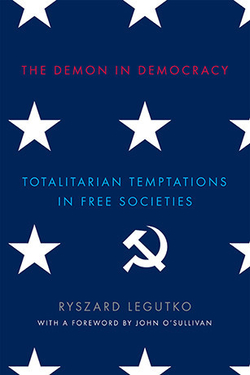
Totalitarian Temptations in Free Societies by Ryszard Legutko

Filed under: Books, Economics, Government, History, Politics — Tags: , , , , — Nicholas @ 05:00

Daniel Pipes reviews a recent translation (from Polish) by Teresa Adelson:

Legutko does not claim liberalism resembles communism in its monstrosity, much less that the two ideologies are identical; he fully acknowledges that the first is democratic and the second brutally tyrannical. After recognizing this contrast, however, he gets down to the more pungent topic of what the two have in common.

He first perceived those commonalities in the 1970s when visiting the West, where he saw how its liberals preferred communists to anti-communists; later, with the overthrow of the Soviet Bloc, he watched liberals warmly welcome communists, but not their anti-communist opponents. Why so?

Because, he argues, liberalism shares with communism a powerful faith in rational minds finding solutions which translates into a drive to improve the citizen, modernize him, and mold him into a superior being. Accordingly, both ideologies politicize, and thereby debase, every aspect of life, including sexuality, the family, religion, sports, entertainment, and the arts. (Here’s a mischievous but deadly serious question: which is the more awful art, the communist or the liberal, Stalin’s or the Venice Biennale’s?) [see below]

Both engage in social engineering to create a society whose members are “indistinguishable, in words, thoughts, and deeds ” from one another, aiming for a largely interchangeable population with no dissidents making trouble. Each sublimely assumes its specific vision constitutes the greatest hope for mankind and represents the end of history, the final stage of mankind’s evolution.

Trouble is, such grand schemes for improving mankind inevitably lead to severe disappointment; human beings, it turns out, are far more stubborn and less malleable then dreamers would like. When things go badly (say, food production for communists, unfettered immigration for liberals), two nasty consequences follow.

July 11, 2019

The genesis of the administrative state during the Great Depression

Filed under: Cancon, History, Law, USA — Tags: , , , , — Nicholas @ 03:00

Leonid Sirota provides some interesting background on the rise of the administrative state during the 1930s:

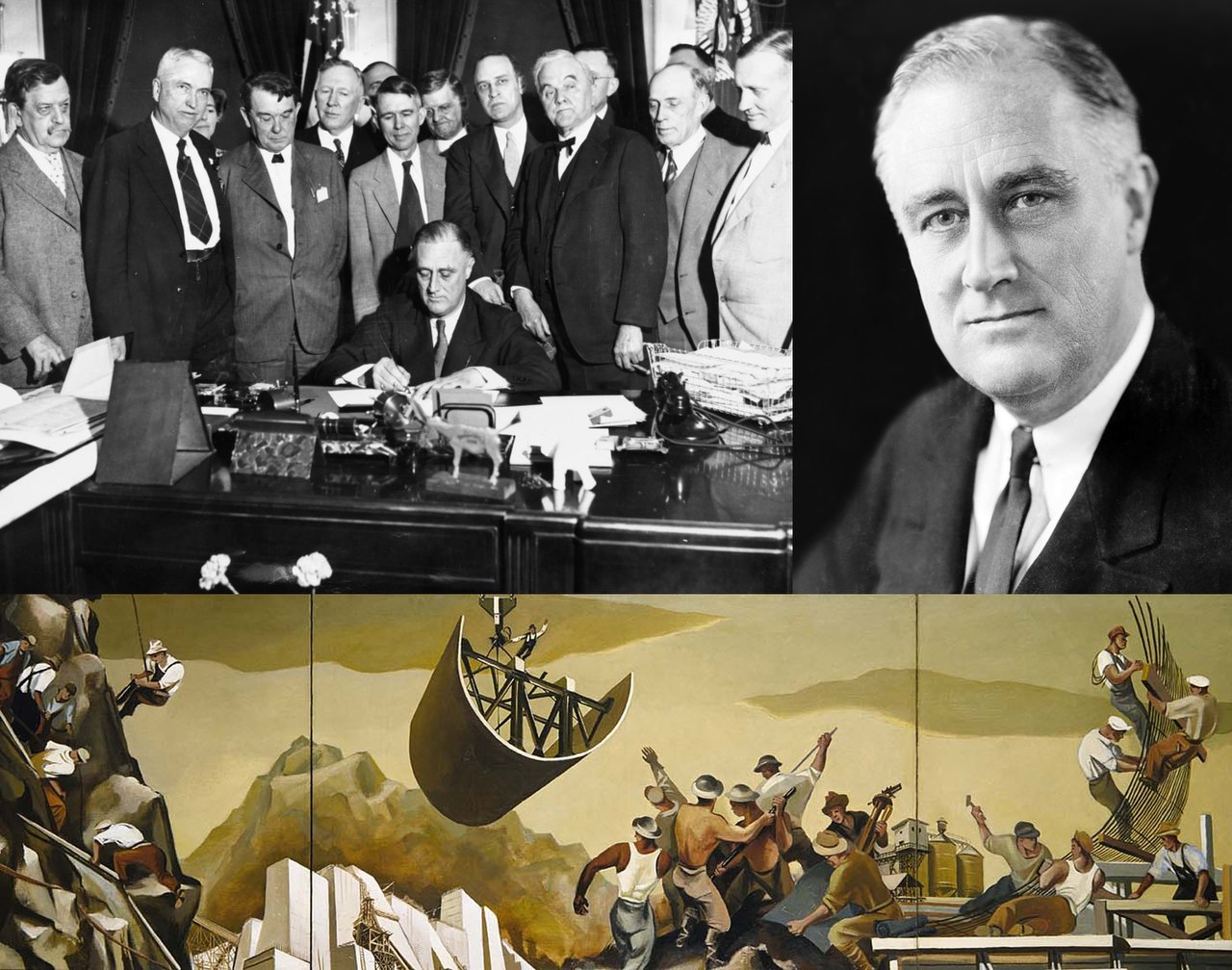
Top left: The Tennessee Valley Authority, part of the New Deal, being signed into law in 1933.
Top right: FDR (President Franklin Delano Roosevelt) was responsible for the New Deal.
Bottom: A public mural from one of the artists employed by the New Deal’s WPA program.
Wikimedia Commons.

To a degree that is, I think, unusual among other areas of the law, administrative law in the United States and, to a lesser extent, in Canada is riven by a conflict about its underlying institution. To be sure there, there are some constitutional lawyers who speak of getting rid of judicial review of legislation and so transferring the constitution to the realm of politics, rather than law, but that’s very much a minority view. Labour unions have their critics, but not so much among labour lawyers. But the administrative state is under attack from within the field of administrative law. It has, of course, its resolute defenders too, some of them going so far as to argue that the administrative state has somehow become a constitutional requirement.

In an interesting article on “The Depravity of the 1930s and the Modern Administrative State” [PDF] recently published in the Notre Dame Law Review, Steven G. Calabresi and Gary Lawson challenge the defenders of the administrative state by pointing out its intellectual origins in what they persuasively argue was

    a time, worldwide and in the United States, of truly awful ideas about government, about humanity, and about the fundamental unit of moral worth—ideas which, even in relatively benign forms, have institutional consequences that … should be fiercely resisted.

That time was the 1930s.

Professors Calabresi and Lawson point out that the creation of the administrative state was spearheaded by thinkers ― first the original “progressives” and then New Dealers ― who “fundamentally did not believe that all men are created equal and should democratically govern themselves through representative institutions”. At an extreme, this rejection of the belief in equality led them to embrace eugenics, whose popularity in the United States peaked in the 1930s. But the faith in expertise and “the modern descendants of Platonic philosopher kings, distinguished by their academic pedigrees rather than the metals in their souls” is a less radical manifestation of the same tendency.

The experts, real or supposed ― some of whom “might well be bona fide experts [while] [o]thers might be partisan hacks, incompetent, entirely lacking in judgment beyond their narrow sphere of learning, or some combination thereof” ― would not “serve as wise counselors to autonomous individuals and elected representatives [but] as guardians for servile wards”. According to the “advanced” thinkers of the 1930s, “[o]rdinary people simply could not handle the complexities of modern life, so they needed to be managed by their betters. All for the greater good, of course.” Individual agency was, in any case, discounted: “the basic unit of value was a collective: the nation, the race, or the tribe. Individuals were simply cells in an organic whole rather than ends in themselves.”

H/T to Colby Cosh for the link.

July 3, 2019

A sneak peak at the new “History of Diversity” course outline at Woke State University

Filed under: History, Humour, Politics, USA — Tags: , , , — Nicholas @ 05:00

At Rotten Chestnuts, Philmon gives us a taste of the new mandatory American history program to be introduced this Fall at WSU:

Photo by “SurlyDuff” via Wikimedia Commons.

… people from other parts of the world had heard about this wonderful place where they, too, could come and be diverse, and they started coming … from China, from Japan, from Mexico, and the Middle East, with only the distant dream of Diversity on their minds.

We also created great UniDiversities to increase our knowledge and awareness of Diversity (especially after the Democrats freed the slaves!)

But in 1972, the Republican (aka, “Nazi”) Party was founded by Richard Nixon specifically to ban Diversity and put to everybody who wasn’t white into concentration camps. Fortunately, the Democrats came roaring back with Jimmy Carter in 1976, who created the Department of Education that has vastly improved Education in the United States by teaching us all to be more Diverse. Since then our education has become the best in the world! And! he graciously let 52 Americans be the guests of some nice Iranian students for more than a year just so they could become more diverse.

But then Ronald Reagan inexplicably won the election of 1980 (due to a clerical error at Trump, Inc*) and he immediately started a nuclear war with Russia. This was because he was not diverse and they were … well never mind, but it greatly reduced the Diversity in the world. Plus, Toxic Masculinity. Which is not Diverse. Everyone should be more like women. That would be Diverse.

After 12 years of cruel, oppressive Republican rule during which Reagan coerced some Germans to vandalize an historic, diverse wall, the great Bill Clinton was elected the First Black President, which Americans thought finally ushered in Diversity once and for all.

But alas, it wasn’t to be, because G.W. Bush (aka “Hitler”) stole the election 8 years later by cleverly winning a majority of the votes in the Electoral College (like that was even legal!) and had the CIA fly planes into the World Trade Center and Pentagon so that he could attack Iraq. This was clearly because they were brown and he hated Diversity, and also for oil. The United Nations had asked Saddam Hussein nicely 17 times to stop killing his own people, but it turned out he was doing it to reduce Iraq’s carbon footprint. Well this was the last straw (before California bravely banned them). Bush viciously attacked and removed Hussein from office because racism. And also blood for oil. Halliburton!!!! By the time he left office he personally had 100% control of all Iraqi oil, which he quickly lost to Dick Cheney (aka “Darth Vader”) in a drunken bet at a bar the night before the next election (Cheney then poured the oil all over Grand Teton National Park just so it could be drilled up again — also because he hates nature and especially fly-fishing).

After that, America came to its senses and elected Barack Obama, Savior of the Universe, to be the Second First Black President. Under his wise and kind rule, Americans began to get along Diversely like never before. Some people in Ferguson, Missouri even burned and looted a bunch of minority owned business just so they could get insurance money which they were owed by their former oppressors, who were now forever banished. It was almost the Paradise that Michael Moore proved Iraq was before G.W. Bush (aka “Hitler”) went in and started terrorism as we know it today (and stole all their oil).

July 2, 2019

Antifa strikes back against the White Patriarchy … by assaulting a gay, visible minority journalist

Filed under: Media, Politics, USA — Tags: , , , , — Nicholas @ 05:00

Andy Ngo suffered potentially serious injuries in an assault by Antifa “activists” during a Portland demonstration:

Andy Ngo, a photojournalist and editor at Quillette, landed in the emergency room after a mob of antifa activists attacked him on the streets of Portland during a Saturday afternoon demonstration.

The assailants wore black clothing and masks, and were engaged in a counter-protest against several right-wing groups, including the Proud Boys. Ngo is a well-known chronicler of antifa activity, and has criticized their illiberal tactics on Fox News. He attended the protest in this capacity — as a journalist, covering a notable public event.

According to Ngo, his attacker stole his camera equipment. But video footage recorded by another journalist, The Oregonian‘s Jim Ryan, clearly shows an antifa activist punching Ngo in the face. Others throw milkshakes at him:

Quillette posted their reaction to the attack:

All revolutionary movements seek to sanctify their lawless behaviour as a spontaneous eruption of righteous fury. In some cases, such as the Euromaidan movement in Ukraine, this conceit is justified. But usually their violence is a pre-meditated tactic to intimidate adversaries. Or as Bolshevik theorist Nikolai Bukharin put it, “In revolution, he will be victorious who cracks the other’s skull.”

The Antifa thugs who attacked Quillette editor and photojournalist Andy Ngo in Portland yesterday did not quite manage to crack his skull. But they did manage to induce a brain hemorrhage that required Ngo’s overnight hospitalization. (For those seeking to support Ngo financially as he recovers, there is a third-party fundraising campaign.) […]

Andy Ngo is an elfin, soft-spoken man. He also happens to be the gay son of Vietnamese immigrants — salient details, given Antifa’s absurd slogans about smashing the heteronormative white supremacist patriarchy. Like schoolboy characters out of Lord of the Flies, these cosplay revolutionaries stomp around, imagining themselves to be heroes stalking the great beast of fascism. But when the beast proves elusive, they gladly settle for beating up journalists, harassing the elderly or engaging in random physical destruction.

Antifa’s first prominent appearance was in 2017, when black-clad protestors at Berkeley used violence to shut down an appearance by provocateur Milo Yiannopoulos. This set a pattern whereby their rallies have been presented as counter-demonstrations aimed at “taking back the streets” from right-wing groups. But more and more, this conceit has dissolved into farce — as in Washington last year, when Antifa gangs showed up to protest largely non-existent conservative protestors. “Again and again, small groups of Antifa members harassed, threatened and occasionally jostled reporters,” the Washington Post reported. “The activists demanded not to be photographed as they marched down public streets — even as many of them hoisted their own phone cameras and staged their own photo ops.”

Update: I’m told that this is the lawyer who will be acting on Mr. Ngo’s behalf:

July 1, 2019

QotD: Canada Day, if we have to…

Filed under: Cancon, History, Politics, Quotations — Tags: , , — Nicholas @ 01:00

It is Perfectly All Right that a country should be entirely unable, on the anniversary of its founding as a state, to think of a single reason to celebrate it. It is Perfectly All Right, likewise, that it should be so devoid of fellow-feeling amongst its citizens that its government does not dare mention the reason for the generic celebrations it has ordered up, for fear of alienating one section of the population or another.

The reasons for this bouncy nihilism vary: either because nationalism is icky, or because Canada’s lack of nationalism is in fact a kind of inverted nationalism, a way of distinguishing ourselves from other nations. Anomie is part of our unique cultural identity. Yadda yadda yadda never had a civil war blah blah blah we’re a shy, diffident country yadda yadda something about the wilderness, and we’re done.

It’s interesting that this anti-nationalism, mostly on the left, should coincide with the rise of nationalism — mostly imported, in one of the many ironies of this debate — on the right. The ur-text among the latter is that interview Justin Trudeau gave the New York Times Magazine, in which he referred to Canada as the world’s “first post-national state,” inasmuch as it has no “core identity, no mainstream,” thus confirming populist suspicions of him as a treasonous stooge of globalist elites.

Andrew Coyne, “On Canada Day let us remind ourselves we have done well, even as we strive to do better”, National Post, 2017-07-01.

June 22, 2019

Cuban socialism still gets good press from western progressives

Filed under: Americas, History, Politics, USA — Tags: , , , — Nicholas @ 03:00

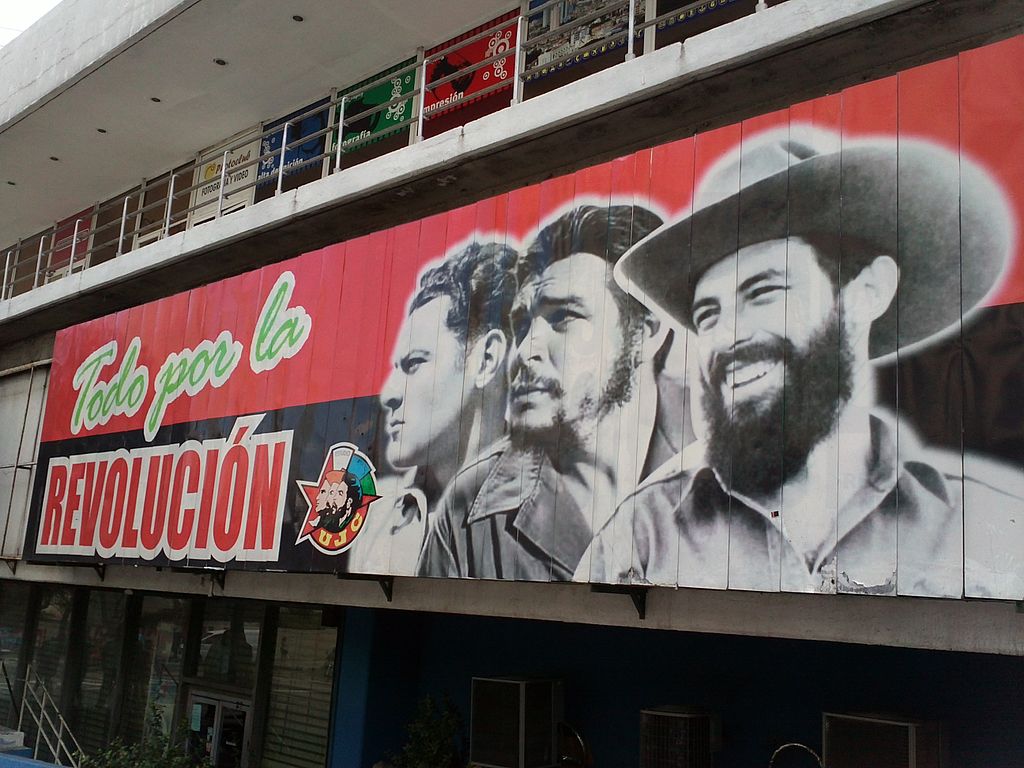
Unlike most other socialist states that have fallen out of the good graces of western progressives, Cuba is still frequently treated as a kind of “true socialist state” by those who want western culture to move further in a socialist direction. Why has Cuba maintained its lustre? Kristian Niemietz discusses Cuba’s progressive halo for the IEA:

A billboard in Havana, showing Camilo Cienfuegos, Ernesto “Che” Guevara, and Fidel Castro, 4 November 2014.
Photo by Tumpatumcla~commonswiki via Wikimedia Commons.

Last week, Shadow Chancellor John McDonnell gave a speech at the Rail and Maritime Transport (RMT) Union’s “Garden Party for Cuba” event, attended, among other luminaries, by the Cuban ambassador. McDonnell made the following pledge:

    “We’re here in solidarity with the Cuban revolution […] I want to say this to our Cuban comrades. When […] a Labour government is elected, not if, we will be your staunchest allies to support the Cuban revolution. And that means the support, the political support of course, but it means also the support, financial and on trade […] We stand with you comrades.”

This was greeted with chants of “Viva Cuba” and “Viva socialismo“. Just two weeks earlier, when asked about the poor track record of socialism in Cuba, Venezuela and the former Soviet Union, McDonnell had declared that “it was never socialism”.

So which one is it? Is Cuba socialist now, or not? Did it suddenly become socialist in the last two weeks, after 60 years of faux-socialism? Is it an on-and-off kind of socialism, which alternates between the real thing, and the fake version? Is it a Schrödinger’s socialism?

June 16, 2019

QotD: Critical gender studies

The first thing you must understand is that gender is a social construct. “Woman” and “man” are concepts arbitrarily invented by society. They have nothing to do with reality. A child is assigned one of these labels randomly at birth by primitive, backward-thinking doctors who, for no good or objective reason, have decided that a human child with a penis must be a boy and a human child with a vagina must be a girl. These words are all interchangeable, as are the body parts. None of it means anything, really.

But remember that the generic people we meaninglessly call “women” are beautiful and powerful and their arbitrary womanhood should be constantly celebrated. Women must band together and lift each other up. Women must be represented equally in all of our institutions. Women are truly wonderful, splendid, special creatures.

But there is nothing special about women. Literally anyone can be a woman. A woman is not anything in particular. A person with a penis can be a woman. A person with a vagina can be a woman. If a bucket of sand came to life and wanted to be a woman, it could be a woman. There is no aspect of womanhood that is ingrained or biological or inaccessible to males. And womanhood certainly has nothing at all to do with your body parts.

But if you don’t have a uterus then you shouldn’t be giving your opinion on women’s rights. No uterus, no opinion. That’s the motto. We’re tired of men making decisions about women’s bodies.

But there is no such thing as a woman’s body. Transwomen are women, too. A transwoman is just a much a woman as any other woman. There is absolutely no difference between the two and to suggest otherwise is the height of bigotry.

Matt Walsh, “Explaining Progressive Gender Theory To Right Wing Bigots”, The Daily Wire, 2019-05-14.

June 14, 2019

“[P]eople aren’t really arguing about the existence or logic of the Laffer Curve they just hate the empirical answer”

Filed under: Economics, Government, Politics — Tags: , , — Nicholas @ 03:00

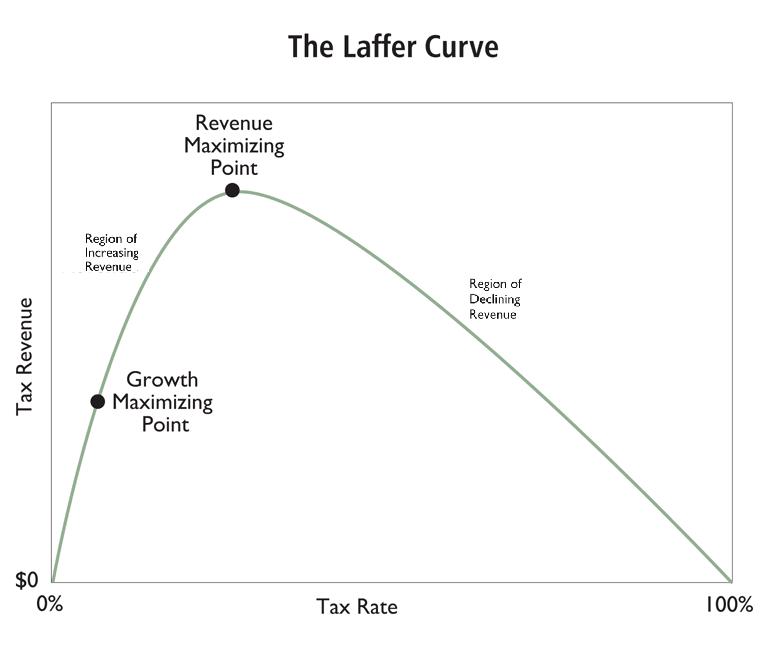
The Laffer Curve is one of those ideas that drives some people mad, because if it’s true (and empirically it appears to hold most of the time), it militates against raising taxes on the wealthy:

That working out where the peak of the Laffer Curve is is difficult is entirely true. That it’s going to be different for each tax in each different legal and societal set up is also true. But that doesn’t excuse drivel like this:

    The ends of the curve are basic enough – at a tax rate of 0, the government will raise $0 in revenue, and at a tax rate of 100, the government will still raise $0 in revenue because people won’t work without take-home pay. At the extremes, the Laffer curve is correct, but that doesn’t tell us anything about the points in the middle. Laffer’s idea, however, was that a “tipping point” existed on the continuum in between, where people’s incentives to work and invest decreased because tax rates were too onerous.

If the end points are true – something admitted – then it’s a matter of simple, pure, and true logic that there are one or more revenue maximising points inbetween. For it’s simple enough for us to observe that there are tax rates which do raise revenue. And if we have tax rates which raise no revenue and tax rates which raise some then there are those one or more rates which raise the most.

So, please, can we stop the drivel?

Sure, Art Laffer himself is incorrect when stating that all tax cuts always pay for themselves through increased economic growth. But that doesn’t invalidate the logic of the curve, only the use to which it is put.

Fifty-four percent. That’s approximately it: the tax maximizing point on the curve when you include all of the taxes on income (including the things they often don’t call taxes — social security, unemployment insurance, and other non-tax taxes — but which are still withheld from paycheques or payable at tax deadline time). Go much above that and the government’s take begins to decrease, defeating the purpose of raising the tax rate in the first place. (Unless the real purpose is just to harm the rich … which might be true in a number of cases.)

« Newer PostsOlder Posts »

Powered by WordPress