Quotulatiousness

June 11, 2021

The concept of philanthropy is another one with conflicting meanings to the left and to the right

Filed under: Government, Politics, USA — Tags: , , , , — Nicholas @ 05:00

In the Daily Chrenk, Arthur Chrenkoff has a bit of fun outlining the recent kerfuffle over Alexandria Ocasio Cortez’s attempt to use her grandmother’s situation in Puerto Rico for scoring political points, and then explains why the notion of philanthropy is a very different thing to progressives than it is to conservatives:
“Charity in the dictionary” by HowardLake is licensed under CC BY-SA 2.0

Well may we laugh about (and be disgusted by) the hypocrisy, corruption and indifference shown by prominent members of the left towards the very people they supposedly care about. But it would be to miss the broader point relating to how the left views the world, the role of politics, and the place of the individual.

It might surprise many that the caring and compassionate left isn’t actually all that big on philanthropy and charity, i.e. people helping other people. What could be wrong with that? Wouldn’t the world be a better place if even more people helped even more other people? Well, no, the left would say, because it’s not something that people should be doing in the first place; it’s not their responsibility. It is up to the state to solve all the social and economic problems; our role as citizens (as well as, thanks to the open borders advocates, non-citizens) is to be the grateful recipients of the government’s largesse. For the more elite group (no pun intended) – “the rich” – their role is to pay for all this with their taxes. Private initiative is by its very nature limited and patchy; only the all-seeing and all-powerful state can ensure that everyone who needs “free” assistance (and that’s literally everyone) gets it in a comprehensive, uniform and fair way. Hence, AOC won’t lift a finger to help her grandmother because it’s the state’s duty to help everyone rebuild their lives after a natural disaster. Occasional Cortex already contributes with her taxes on the hard-earned Congressional salary, and in any case, she’s not some billionaire, you know.

With that attitude, needless to say, you won’t be surprised to learn that much of what goes for the left-wing philanthropy does not actually go to help those in need to solve their problems and provide them what they are lacking. Instead, it is largely channels to finance political agitation by the activist-industrial complex to make the government (whether through lobbying, campaigning or helping elect sympathetic law-makers) take responsibility instead. That’s what people like Soros, Laurene Powell-Jobs (Steve Jobs’ widow) and MacKenzie Scott (Jeff Bezos’ ex) are all about – billions spent to create more activist jobs to agitate for the state to create more public sector jobs to run the “Big Daddy”.

But it goes deeper than that, back to Marx himself in fact and to his analysis of what’s wrong with the world and how to fix it. According to Marxism, both in its original class-based iteration and the more recent race/gender/sexuality variants, every society is divided into two mutually antagonistic groups: the powerful oppressors and the powerless oppressed, with the society structured in the interest of the former by facilitating in every possible way the exploitation and keeping down of the latter. Thus, all the problems, ills and injustices are “systemic” in nature; they are a feature, not a bug. To solve them and so to help the downtrodden you need to overthrow the entire old unjust system and build a new one that benefits the masses. Based on this sort of understanding of the world – to which, coincidentally, people like AOC and BLM founders all subscribe – any private charity is bound to be ineffectual and shortcoming. After all, what can a person, however generous with their money and time – even if there are multitudes of them – do to solve problems that are the direct (and intended) consequence of the way the society has been set up? Nothing, of course. You can’t mend it, you have to end it. But not only is it naïve and pointless to try, it’s actually counter-productive and therefore positively wrong. Because while no philanthropic effort can solve systemic problems, it can actually provide some limited and temporary relief. Such relief, however, by its very nature is a band-aid solution, i.e. not a solution at all. All it does it momentarily numbs the pain, and that is bad, because the oppressed masses need to feel the pain and feel it good in order to spur them into revolutionary action to overthrow their oppressors and on the ruins of the old build the utopian new society of equality and justice. This is the far-left’s accelerationism: the worse it gets, the better it gets (for the prospects of radical change).


June 7, 2021

QotD: Toronto in summertime

Filed under: Cancon, Environment, Humour, Media, Quotations — Tags: , , , — Nicholas @ 01:00

I notice from an article in the Toronto Scar, that a problem with walking in the city parks and ravines is now publicly acknowledged. This is caused by redwing blackbirds, who resumed breeding recently, in honour of the spring. There is a population explosion of them, and they are extremely aggressive towards anyone who passes within fifty yards or so of any one of their innumerable nests. Brave, too, considering their size. I call them “hairdresser birds,” for the delight they take in rearranging hair styles. I noticed in scanning 63 comments on this and related local media articles that all were on the side of the birds, and inclined to condemn people like me for failing to avoid their quickly expanding ranges. This would be a good example of Canadian environmental liberalism. My countrymen are trained from birth always to take the side of another species. (I missed this brainwashing, somehow.)

On the other hand, the raccoon population appears to be dwindling. It would seem that the skunks are driving them away. Perhaps they will turn on the coyotes, next.

The geese and swans along the Lakefront are also acting unionized, having long nursed a powerful dislike for the city’s other inhabitants. They are large, and forceful in expressing their opinions. Ditto, the trolley drivers. And the schoolchildren are about to be released from their cages, in time for what is now called “Canada Day.” Monstrous little creatures in the main, especially after they have shot up their drugs. (The older-looking ones are their teachers.)

David Warren, “Sumer is icumen in”, Essays in Idleness, 2018-06-16.

June 6, 2021

Decoding NPR’s revised approach to reporting in a social justice age

Filed under: Media, Politics, USA — Tags: , , , , — Nicholas @ 03:00

At Ace of Spades H.Q., K.T. listens to some NPR broadcasts (so you don’t have to) including an insight into how NPR and probably other media organizations are changing how they report the news:

We Hold These Truths: How Newsroom Leaders Wrestled With Covering A Tumultuous Year

This was sort of a panel discussion (light on the “discussion”), with commentary on things like how social media pressured newsrooms, for example, to say that “police murdered George Floyd” rather than “George Floyd died”.

But I kind of homed in on an academic phrase that bothers me. Sara Just from PBS:

    Yeah, I think that you’re absolutely right. There’s been a deeper understanding and deeper conversation about how much our lived experiences play into the reporting that we do. And there’s no question that it does for each and every one of us in different ways. And I think that lived experience we especially highlight now is valuable, whether it’s race or gender or the challenges. I don’t think people with those lived experiences have to carry the burden, though, of being the only ones to report on it by any means. And so that’s something that we are always balancing. (emphases mine)

So, are they balancing whether or not people without “lived experiences” can report on issues involving “lived experiences”? Like Lori Lightfoot deciding she would only do one-on-one interviews with journalists of color? Will white people be allowed to report on stories involving black people? Will men be allowed to report on stories involving women?

This is partly about local sources, but it is largely about people thought of as being in “oppressed groups”. This panel is informing us that news reporting will now be filtered through the language and perspective of Critical Social Justice, whether we realize it or not.

The indispensable Translations from the Woke at New Discourses provides the following information on Lived Experience:

    In the Theory of Critical Social Justice, for what turn out to be surprisingly deep and philosophically (almost) sophisticated reasons, lived experience is the overwhelmingly primary way in which knowledge can be obtained. This should not be mistaken to mean one’s firsthand experience, which most of us already recognize to provide a rather weak claim upon knowledge, though it is both implied and claimed that this is what “lived experience” refers to in Critical Social Justice. Lived experience, as Critical Social Justice uses the term, refers more specifically to one’s life experiences in allegedly systemic power dynamics of dominance and oppression that shape society structurally as understood with a critical consciousness and interpreted through Theory. That is, one’s “lived experience” refers to the interpretation that Critical Social Justice Theory gives for the anecdotal accounts of experiences one has had.

    Because “lived experience” refers to an interpretation through Theory, it is only the “lived experience of oppression,” as Theory will have it, that counts …

It appears that you can’t really understand the reporting on PBS, and probably NPR, now unless you have studied Critical Social Justice.

    Certainly, the claimed “lived experience” of members of dominant groups cannot be in any way used to challenge or dispute the assertions of Theory or those claiming to speak from it …

    This restriction extends to members of “minoritized” groups who disagree with Theory as well — Theory cannot be authentically disagreed with. One might think that the lived experience of a member of oppressed groups would be admissible as a valid challenge to the claims of Theory, but this not so. They may be talking about their own experiences in life, but they aren’t appealing to lived experience, which must comport with Theory …

    This is all very confusing and appears to be exactly what it is — a form of manipulating knowledge and epistemology as a means of asserting power and rigging the system such that those assertions of power cannot be challenged. Nevertheless, it isn’t merely an application of power and has a rather interesting and deep philosophical explanation that must be understood to understand why “lived experience” holds the status that it does and why it must comport with Theory to be granted veridical status and epistemic weight. This has everything to do with the fact that the roots of Critical Social Justice are in critical theories and, especially, postmodern philosophy.

There is much more, but it is way too deep to include here.

The NPR panel goes on to discuss new understandings of “balance” and “objectivity”. They do not intend to be objective. “Balance” will mean something different than what it has meant in the past in the news business.

Many people have found the way that TV news shows report on events since 2016 to be rather different than what they’d been used to before that. Some changes are subtle and others are quite blatant and hard to ignore unless you already agree with the viewpoint of the presenter. TV news used to at least pretend to present the news objectively but from the start of the Trump presidency most media outlets abruptly changed from a pseudo-objective (but leaning progressive) to an outright full-on progressive stance from start to finish with little or no attempt to provide other points of view for balance.

QotD: The Soviet Union in the Cold War, China today

Filed under: China, History, Media, Quotations, Russia, USA — Tags: , , , , , — Nicholas @ 01:00

Back in the days of the Cold War, much was said about the titanic power of the Soviet Union. The USSR, we were told, was a superpower the equal of the United States, possibly even superior. This meme was spread by lefties who wanted the USSR to win, by sincere pacifists hoping to stop war before it could begin, and by an enormous cohort of liberals who repeated it because they heard it from the first two. (Much liberalism can be explained this way. It’s the ultimate “I heard it from somebody” ideology.)

Needless to say, it was gibbering nonsense. The late ’80s Soviet collapse revealed that the USSR was never any kind of power at all – an economy that didn’t produce, weapons that didn’t work, a populace addicted to drink and overwhelmed with despair. “Bulgaria with nukes” is how someone characterized it, and truer words were never spoken. That remains the case today, despite Vlad Putin’s chest-beating, and it’s likely to remain the case as far ahead as anyone can see.

The same trope is being repeated regarding China. China, we are told, is the coming nation. The second largest economy on Earth, soon to be the first. A billion and a half people, each more educated than any American; a military power second to none, with advanced weapons of a nature that we can only gape at. A country exercising its power over vast reaches of the Pacific and moving into the Indian Ocean, Africa, and the Mideast with no one to oppose it.

We hear this from the likes of Thomas Friedman, who has spent much of his career looking for his personal Mussolini. It’s repeated by deeper figures across the political spectrum. In fact, it can be said without exaggeration to have become received wisdom.

There’s no point in asking how true this is. The proper question to ask is whether it embodies any truth at all.

J.R. Dunn, “The Myth of China as Superpower”, American Thinker, 2019-01-09.

May 30, 2021

New frontiers in cultural appropriation

Filed under: Politics, USA — Tags: , , , , , — Nicholas @ 05:00

John McWhorter considers the notion that white people shouldn’t be allowed to use “black” words and phrases because it’s a form of cultural appropriation and therefore another aspect of white supremacy:

Screencap from NBC’s Saturday Night Live highlights for “Gen-Z Hospital” skit.

A little while ago, a Saturday Night Live skit depicted a multiracial group of teens communicating in what was depicted as “Gen Z slang”, with the doctor they were talking with having to “translate” his thoughts into it to communicate with them.

A lot of people didn’t like it, because the slang in question was mostly of Black English origin. The complaint is that the skit was denying the black roots of these terms, and instead ascribing them to Americans in general – i.e. (shudder) white persons. As in, yes – the problem was cultural appropriation.

As I write, there are still people grousing on social media in the wake of that skit about whites “stealing” black language, with a leitmotif being that we should apply our N-word taboo more widely. To wit, many propose that whites should not be allowed to use Black English terms because they are “ours”. Many who haven’t outright proposed this give the notion Likes, which suggests that a considerable group of people – and from what I can see, quite a few of them are white – concur with this line of reasoning.

Let’s break this down. To do so we must understand the sorts of terms in question. The SNL skit included, among others, yo, bestie, vibes, feels for feelings, salty for irritated, bro / bruh and no cap for “I’m not kidding” (as in, these are actual whole gold teeth, not golden caps on teeth).

Is there a case that you should only use these terms if you’re black, or that if you use them as a white person you should “do the work” of thinking hard about whether or not it is problematic (blasphemous)?

May 29, 2021

QotD: Academia and capitalism

Filed under: Business, Economics, Education, Quotations — Tags: , , — Nicholas @ 01:00

It is pretty well-established that the American academic community is disproportionately of the Left, and in fact tilts pretty strongly in many cases to the far Left / progressive side. People debate a lot about why this should be, but I think one contributing factor (but certainly not the only one) that I have never heard anyone discuss is the zero-sum game these academics must play in their own careers. I think that many of them incorrectly assume that all professions, and all of the economy and capitalism, is dominated by this same dog-eat-dog zero sum-game — remember, for most, academia is the only industry they have ever experienced from the inside. And once you assume that the whole economy is zero-sum, it is small step from there to overly-narrow focus on distribution of wealth and income.

One of the mistakes folks on the Left make about capitalism is to describe capitalism as mostly about competition. In fact, capitalism is mostly about cooperation, it’s a self-organizing process where people who don’t even know each other cooperate to deliver products and services, facilitated by markets and the magic of prices. Sure, competition exists but it is not the fundamental feature, but an enabler that makes sure the cooperation occurs as efficiently as possible. Capitalism in fact is about zillions of voluntary trades and transactions every day that each make both parties better off — or else both sides would not have agreed to it. Capitalism in fact is a giant positive sum game, a fact that many on the Left simply do not grasp.

Warren Meyer, “Does the Zero-Sum Nature of Academic Success Contribute to the Left-wards Bias of Academia?”, Coyote Blog, 2018-11-09.

May 27, 2021

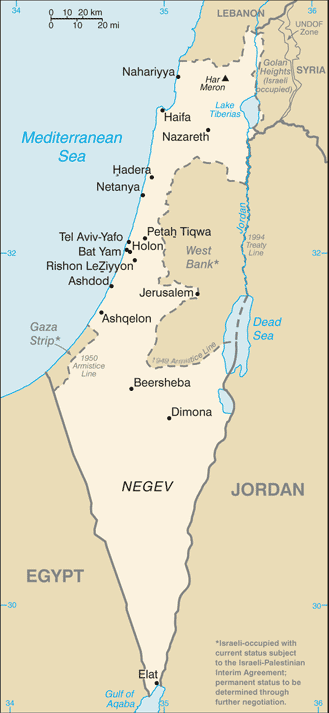
“Are you an ally of an all-powerful white supremacist, colonialist apartheid regime led by baby-killing oppressors, the likes of whose evil the world has never seen?”

Filed under: History, Media, Middle East, Politics, Religion — Tags: , , , , , — Nicholas @ 05:00

Why, yes. Yes I am, Barbara Kay. And you should be too:

Nobody with eyes to see can press on with the myth that this is a political conflict. The anti-Semitism that lurks behind obsessive Israel-bashing can no longer be credibly passed off as “criticism of Israel”. It’s not about Israel and never was. It’s about those maddening Jews. Wherever they are, they make trouble. What is it with their stubborn insistence on their right to live and flourish in their homeland, when they know they are not wanted there?

Never mind the historical facts surrounding Jews’ indigenous rights, or the painstaking legal journey to national sovereignty (along with other newly minted Middle Eastern countries like Iraq and Syria, both of which have appalling human rights records, but never have their right to exist questioned). Treaties and international law are too dull, nuanced and complex. They take time and effort to understand. It’s very taxing for the brain. Narrative, though, takes no time at all to absorb. Stories of good and evil are simple, unnuanced and satisfyingly emotive.

If you attend to the myth-mongering on social media, it seems your choice is stark. Are you an ally of an all-powerful white supremacist, colonialist apartheid regime led by baby-killing oppressors, the likes of whose evil the world has never seen? Or are you a decent, compassionate human being, committed to social justice and ready to lend your support to those infamous Zionist monsters’ powerless, oppressed, racialized victims, who are languishing in their open-air prisons?

It’s a tough choice for progressive Jews. Before 1967, living with oneself as a Jew was easy. Socialist Israel was little David then and the massed hostile Arab states were Goliath. Even Bernie Sanders enjoyed his time on a kibbutz in 1963. (Mind you, that particular kibbutz, Sha’ar Ha’amakim, was so far left, one of its members was convicted of spying for the Soviet Union.)

Then those upstart Jews dared to win a war against incredible odds and had the chutzpah to take back territory that had been stolen from them in the 1948 War of Independence. The pivot from victim to victor, from powerlessness to power, was the kiss of death for their support from the left.

May 25, 2021

John McWhorter’s new book announced

Filed under: Books, Media, Politics, USA — Tags: , — Nicholas @ 05:00

Following on to his Nine Nasty Words, which just became a New York Times best-seller (somewhat to his surprise), John McWhorter’s next book will be Woke Racism: How a New Religion Has Betrayed Black America from Random Penguin:

That manuscript will be released as a book by Portfolio (also a Penguin Random House imprint) in October. It will be published under a new title: Woke Racism: How a New Religion Has Betrayed Black America.

I should mention that the often sharp and insightful subscriber comments, as well as the brilliant editorial counsel of Bria Sandford at Portfolio, have already made Woke Racism significantly different from the The Elect excerpts. Woke Racism will express what the Substack excerpts did and then some. It will still analyze Third-Wave Antiracism as a religion. It will still make legions of black people see me as a race traitor. It will still make legions of white people see me as a tragically deluded white supremacist with brown skin who merits dismissal and ostracization.

And amidst all of that, it will still represent what I consider the most pro-black book I have ever written.

But this does mean that from now on, my Substack “newsletter” will be exactly that. I am glad many of you have enjoyed my posts here beyond the The Elect excepts, and they will continue, at the rate of once or twice (and I hope, more often, twice) a week. I have loved communicating to you as well as the feedback I get. Let’s keep this going.

Only: get “The Elect” as a real book, Woke Racism, around Halloween. Here, get my take on things as they happen, unfiltered.

May 24, 2021

The hard core of “mostly peaceful protest” activists

Filed under: Media, Politics, USA — Tags: , , , , , , — Nicholas @ 03:00

In the most recent Libertarian Enterprise, Sarah Hoyt explains why the same people seem to show up at “mostly peaceful” riots protests in so many different cities and even in the rare cases they’re arrested, are quickly bailed out again:

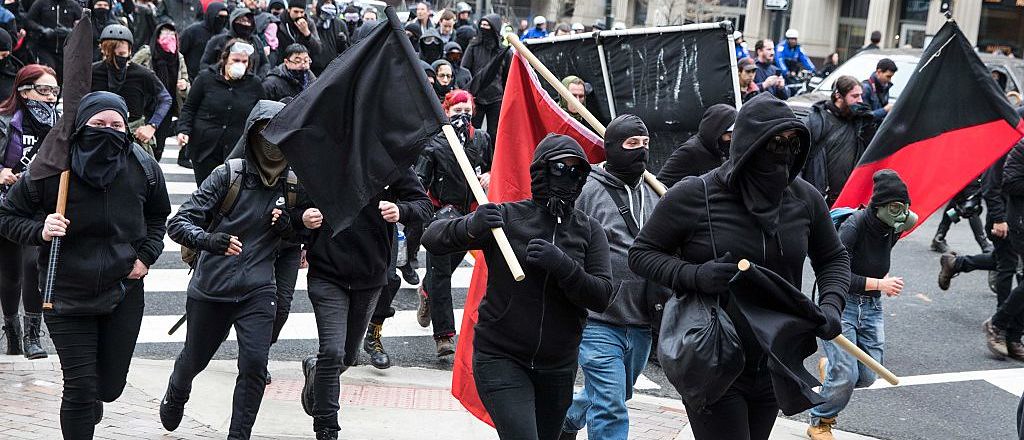
“antifa 8973ag” by cantfightthetendies is licensed under CC BY 2.0

One of the advantages of the collectivists is that they organize like nobody’s business, while we liberty minded … Well — pats heads all around — well, you guys are adorable, but the individualists failed to organize, okay.

Now, while many of you translate this to a paramilitary clash and panic, don’t. Most of their supporters aren’t nor will they commit violence, unless the can do it when no one is looking, sneakily, and against someone old, disabled, frail or very young.

Most of their supporters are in fact the “go alongs to get along” who just want to be “nice people” by siding with lunatics who want to put a boot on their necks. Oh, they also want to be smart because their college professors told them every “very smart” person believes in Marxism. This is why at the back of their brains every single one of the infantile “activists” thinks he or she will be in charge and not one of the lumpenpoletariat. No, they have never looked at actual communist countries, and if they did, as their panic at the Xi-flu proved, they don’t get statistics or numbers at all.

So, yeah, the people they are using and weaponized-and-paid psychopaths, whom they bus from city to city. They’re armed and well organized partly because they do this all time and are given weapons and training. They’re very fearsome FOR ONE CITY AT A TIME.

In other words they are a Potemkin army, raging across the country to intimidate the citizens. Which is why they have to punish Kyle Rittenhouse, because he pierced the paper silhouette. And why blue states refuse to arrest the rioters. They have very few of them. They’re the precious.

It does work on corporations and — apparently — Supreme Court Judges who, being in a highly social profession just buy what the news tell them and don’t investigate anything for themselves.

Look, I don’t think this bullshit will hold. And it’s part of the reason I think we’re going to have a brief, intense, localized clash.

This is not the seventies. They really had a majority of the indoctrinated youth then, and the youth then were a majority. With the attendant side effect that the youth then hadn’t been raised as little emperors, because they were the all-too-precious single offspring.

Those were the real Marxist riots. This is the Memorex. And like Chinese troops clashing with Indian troops, their rank and file are more likely to cry for their mommies, if they meet real opposition.

They have the psychos they train and bus around and which have a rap sheet long as their arm, and then they have the daft survivals of the sixties, at protests with their oxygen bottles and walkers.

And they have the get alongs. Who are useless in battle, but quite good at coordinated action on other fronts.

May 23, 2021

Portlanders “have developed rituals, devotions, and self-criticisms to fight ‘systemic racism’ and ‘white supremacy'”

Filed under: Education, Politics, USA — Tags: , , , , — Nicholas @ 05:00

In City Journal, Christopher F. Rufo talks about the “child soldiers of Portland”:

“Portland, Oregon” by Ben Amstutz is licensed under CC BY-NC 2.0

There are only a few places on earth where radicals and their children ritualistically burn the American flag and chant “Death to America”: Tehran, Baghdad, Beirut, Kabul, Ramallah — and Portland, Oregon.

The City of Portland, a cloud-covered metro on the south bank of the Columbia River, has become known for its political protesters. Anarchists, Communists, ecofascists, and various other agitators regularly denounce the police, politicians of both parties, and America itself, and flag-burning has become part of the protesters’ liturgy. Last summer, protesters associated with Antifa upped the ante with chants of “Death to America” and participated in months of violent protests to avenge the death of George Floyd while he was in police custody in Minneapolis. Children as young as four marched with the crowd to the federal courthouse, raising the Black Power fist and chanting “Fuck the Police!”

Famously the “whitest city in America”, Portland has become the unlikely headquarters of race radicalism in the United States. The city has elevated white guilt into a civic religion; its citizens have developed rituals, devotions, and self-criticisms to fight “systemic racism” and “white supremacy”. The culminating expression of this orthodoxy is violence: street militias, calling themselves “antiracists” and “antifascists”, smash windows and torch the property of anyone transgressing the new moral law.

We might be tempted to dismiss this as the work of a few harmless radicals “keeping Portland weird”, but in recent years, their underlying ideology on race has become institutionalized. The city government has adopted a series of Five-Year Plans for “equity and inclusion”, shopkeepers have posted political slogans in their windows as a form of protection, and local schools have designed a program of political education for their students that borders on propaganda.

I have spent months investigating the structure of political education in three Portland-area school districts: Tigard-Tualatin School District, Beaverton School District, and Portland Public Schools. I have cultivated sources within each district and obtained troves of internal documents related to the curriculum, training, and internal dynamics of these institutions. We can best understand the political education program in Portland schools by dividing it into three parts: theory, praxis (or practice), and power. The schools have self-consciously adopted the “pedagogy of the oppressed” as their theoretical orientation, activated it through a curriculum of critical race theory, and enforced it through the appointment of de facto political officers within individual schools, generally under the cover of “equity and social-justice” programming. In short, they have begun to replace education with activism.

The results are predictable. By perpetuating the narrative that America is fundamentally evil, steeping children in race theory, and lionizing the Portland rioters, they have consciously pushed students in the direction of race-based “revolution”. In the language of the Left, the political education programs in Portland-area districts constitute a “school-to-radicalism pipeline”: a training ground for child soldiers. This is not hyperbole: some of the most active and violent anarchist groups in Portland are run by teenagers, and dozens of minors were arrested during last year’s riots. These groups have taken up the mantle of climate change, anticapitalism, antifascism, and Black Lives Matter — whatever provides a pretext for violent “direct action”.

Contrary to those who believed that the end of the Trump presidency would bring a “return to normalcy”, the social and political revolution in Portland has only accelerated under President Joe Biden. On Inauguration Day, teenage radicals marched through southeast Portland, smashing the office windows of the state Democratic Party and unfurling large banners with hand-painted demands: “We don’t want Biden, we want revenge”; “We are ungovernable”; “A new world from the ashes”. Intoxicated by revolution and enabled by their elders, Portland’s kids are not all right.

May 12, 2021

Looking at a highly influential document among progressive groups

Filed under: Education, Media, Politics, USA — Tags: , , , — Nicholas @ 03:00

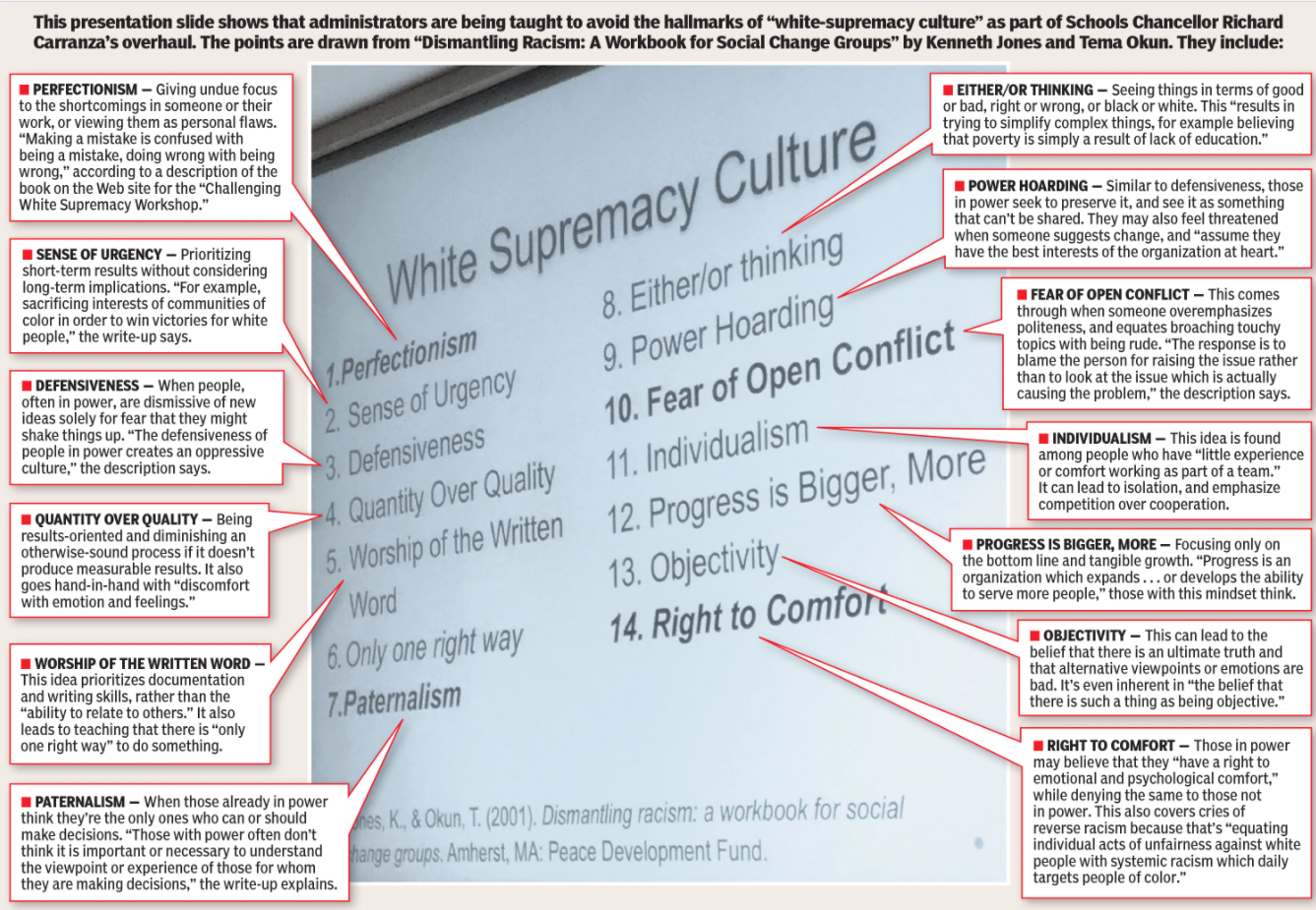
Matthew Yglesias on Tema Okun’s “The Characteristics of White Supremacy Culture” and its role in furthering progressive emotions over what they consider to be the most racist society in human history (that is, the modern west but especially the United States):

Click to see full-size image.

Debating abstractions is difficult and frustrating, and the discourse about “wokeness” and “cancel culture” has become a snakepit of semantic debates, bad-faith actors, and people of goodwill talking past each other.

So I want to talk instead about one specific document, not because I think it’s the most important document in the world, but because I don’t really see anyone who I read and respect talking about it even though I’ve seen it arise multiple times in real life.

I’m talking about “The Characteristics of White Supremacy Culture” by Tema Okun, which I first heard of this year from the leader of a progressive nonprofit group whose mission I strongly support. He told me that some people on the staff had started wielding this document in internal disputes and it was causing big headaches. Once I had that on my radar, I heard about it from a couple of other nonprofit workers. And I saw it come up at the Parent Teacher Association for my kid’s school.

It’s an excerpt from a longer book called Dismantling Racism: A Workbook for Social Change Groups that was developed as a tool for Okun’s consulting and training gigs.

But today, even though it’s not what I would call a particularly intellectually influential work in highbrow circles — even ones that are very “woke” or left-wing — it does seem to be incredibly widely circulated. You see it everywhere from the National Resource Center on Domestic Violence to the Sierra Club of Wisconsin to an organization of West Coast Quakers.

Which is to say it’s sloshing around quite broadly in progressive circles even though I’ve never heard a major writer, scholar, or political leader praise or recommend it. And to put it bluntly, it’s really dumb. In my more conspiratorial moments, I wonder if it’s not a psyop devised by some modern-day version of COINTELPRO to try to destroy progressive politics in the United States by making it impossible to run effective organizations. Even if not, I think the document is worth discussing on its own terms because it is broadly influential enough that if everyone actually agrees with me that it’s bad, we should stop citing it and object when other people do. And alternatively, if there are people who think it’s good, it would be nice to hear them say so, and then we could have a specific argument about that. But while I don’t think this document is exactly typical, I do think it’s emblematic of some broader, unfortunate cultural trends.

H/T to Colby Cosh for the link.

May 10, 2021

QotD: Against the notion of the “Social Contract”

Filed under: Liberty, Politics, Quotations — Tags: , , , , , — Nicholas @ 01:00

As a modern conservative, [Roger] Scruton defends a form of democracy unknown to Aristotle. Following David Hume and Edmund Burke, however, he opposes the idea that the “political order is founded on a contract.” For Scruton, the state of nature is a chimera — an invention of modern political philosophers who had forgotten the debt and gratitude owed to our predecessors. The fictitious state of nature — so central to philosophical liberalism — obscures the fact that membership in a community, with its requisite duties and obligations, is a precondition for meaningful freedom. “Absolute freedom” — doing whatever one wants — is always an invitation to anarchy or tyranny. In the modern world, the nation is the political form that guarantees membership and self-government.

In all of his political writings, Scruton takes on the Left for scorning existing norms and customs, and for promoting a “culture of repudiation.” The Left is “negative.” It dismisses “every aspect of our cultural capital” with the language of brutal invective: accusing every defender of human nature and sound tradition of “racism,” “xenophobia,” “homophobia,” and “sexism.” Like 1984‘s “two minutes of hate,” this language tears down, intimidates, and can never build anything humane or constructive — it is nihilistic to the core. At the same time, Scruton wants to reach out to reasonable liberals who eschew ideology and who still believe in civility and the promise of national belonging. His conservatism can discern the truth in liberalism (another Aristotelian trait) while the partisans of repudiation see half the human race as enemies.

Daniel J. Mahoney, “Beyond the Culture of Repudiation”, Claremont Review of Books, 2018-06.

May 8, 2021

QotD: That time the global elites were against diversity

There was simply no debate back then [in the aftermath of the Great War] that a mass influx of European refugees to Africa would have been a conquest, not a “humanitarian crisis” that Africans, with their ample space and nutrient-rich soil, had some kind of responsibility to sit back and accept. And to be clear, many of the European refugees who would have trekked across Sörgel’s newly reclaimed land were genuinely in need. They were impoverished, homeless, destitute. And a lot of them were fleeing political violence. Those folks were as poor, wretched, and persecuted as any Honduran is today. But in fully rejecting Atlantropa as a goal to be pursued, the international community took the position that “it sucks that you’re impoverished and mistreated in your home country, but it ain’t Africa’s problem. Stay where you are.”

See, in those days, the elites believed in keeping people in their own damn land. Hard as that might be to fathom now, that used to be a mantra of the progressive internationalists. There was a die-hard belief that the key to world peace was the separation of people, the segregation of populations by race, religion, and ethnicity. That was the entire point of the Greek/Turkish population exchange of 1923, overseen by the League in the name of keeping Greek Christians and Turkish Muslims separated for the sake of peace. As UNC Chapel Hill history professor Sarah Shields wrote in her 2016 essay in the Journal of the History of International Law, the prevailing belief at that time was that “Muslims and non-Muslims could not live together peacefully, and modernity required rejecting a diverse past in favor of a nation-state along European (unmixed) lines.”

Separation was the future, diversity was the past. Damn near 1.6 million Greeks and Turks were sent from the land of their birth to the land where they could live with those of a similar faith. Many of the other population transfers and redrawn boundaries that followed World War I were based on that same concept of giving people their “own” homeland based on characteristics like religion or ethnicity. It was simply taken as fact back then that nations function better with some level of homogeneity. That was canon back then. By the time the U.N. came around, that notion was still very much a guiding principle, as the internationalists realized that a vision of a multireligious, multiethnic Palestine was unrealistic and unattainable. And the Jews and the Arabs realized that too, which is why they started slaughtering each other, because they couldn’t bear to live in a partitioned state. Being separate but equal was not enough. They wanted to be separate and separated.

David Cole, “When Refugees Were Conquerors”, Taki’s Magazine, 2018-10-29.

May 4, 2021

Our modern verbal taboos

John McWhorter tackles the dreaded “N-word” — perhaps the most powerful taboo word in our current quasi-religious culture:

John McWhorter’s Twitter thumbnail image

The question is why we have become so extremely sensitive about that word since the 1990s, despite that our times are so much further from the ones where whites casually levelled the term with abandon. Why are we making a finger-cross and hanging garlic in the doorway against even any semblance or suggestion of a sequence of sounds?

Supposedly because the word recalls slavery, Jim Crow and horrific abuses. But then, even black people just a few decades ago didn’t typically think this meant that one cannot utter the word even to refer to it. That’s new, and it is, quite simply, a taboo — as in what we associate with societies vastly different from our own.

There are languages in Australia where you use a separate vocabulary with your mother-in-law, and it is taboo to use the regular word equivalents for it with her. In one of the languages, there is a general word for moving that you use when talking to your mother-in-law about going, walking, sailing and crawling. To use the regular words for these things with her would be like hauling off with a curse word in English.

This sounds quaint to us, but should not, because our treatment of the N-word is hardly different. The idea that the word is simply never to be uttered is so deeply entrenched now that it may seem odd to many people under about 40 that in times that seemed quite modern not so long ago, one could produce the sounds of the word nigger in public if you were talking about it rather than using it. With taste, of course — one didn’t go about saying it over and over. But there was an understanding that to refer to it — especially since this was usually in condemnation — was harmless. Because it was.

If you think about it, this made perfect sense. It’s today’s situation that is odd, in that suddenly we have a taboo of a kind we associate with pre-scientific indigenous societies. The word must be chased away whenever it seeps in through the cracks in the floor, just as if you pick up the phone and the Devil is on the line, you hang up. To wit, this is more evidence that Electness is a religion. The evolution in sensibility about the N-word has been an early manifestation of Elect ideology, penetrating so quickly because of the especially loaded nature of the word. It’s pretty easy to classify it as heresy for saying a word that is used as a slur; getting people fired for saying reverse racism — as happened to former San Francisco Museum of Modern Art Gary Garrels — takes a while.

Some will despise that I am calling the new take on the word pious. But 25 years ago we all knew exactly those things about the word’s heritage, and felt modern and enlightened to, with sensible moderation, utter the word in reference rather than gesture. Under normal conditions, the etiquette would have stayed at that point. The only thing that makes that take on the word now seem backwards is a sense of outright “cover-your-mouth” taboo: i.e. religion. This performative refusal to distinguish, this embrace of the mythic, shows a take on the N-word analogous to taking the Lord’s name in vain.

I call this refusal performative — i.e. a put-on — because I simply cannot believe that so many people do not see the difference between using a word as a weapon and referring to the word in the abstract. I would be disrespecting them to suppose that they don’t get this difference between, say, Fuck! as something yelled and fuck as in a word referring to sexual intercourse. They understand the difference, but see some larger value in pretending that it doesn’t exist.

In my experience, a common idea is that if we allow the word to be used in reference, there is a slippery slope from there to whites feeling comfortable hurling the slur as well. There are two problems with this point. One: for decades civilized people could use the word in reference, and yet there was no sign of the epithet coming back into style. Today’s crusaders can’t claim to be holding off some rising tide. Second: what is the sociohistorical parallel? At what point in human history has a slur been proscribed, but then returned to general usage because it was considered okay to refer to the word as opposed to use it? That many people can just imagine this happening with the N-word is not an argument, especially since it’s hard not to notice that this hypothetical scenario fits so cozily into their professionally Manichaean take on race.

April 25, 2021

The causes and effects of “ostrich parasitic syndrome”

Filed under: Media, Politics, Science — Tags: , , , , , — Nicholas @ 03:00

Barbara Kay on Canadian academic Gad Saad, who sometimes lets his “inner honey badger” get out on social media:

Gad Saad 2010 JMSB Faculty Portrait

Saad, 57, is a professor of marketing at the John Molson School of Business at Montreal’s Concordia University. His domain is evolutionary psychology as applied to business — a niche field, to be sure. He’s written such papers as “Gender differences in information search strategies for a Christmas gift,” and “Menstrual cycle effects on prosocial orientation, gift giving and charitable giving,” which provide valuable information to guide marketing strategies.

You’d be hard pressed to find any academic in Canada who’s more deeply steeped in knowledge about the ineluctable differences between the sexes. (Speaking of “the sexes,” business schools may be the last places left in academia to use those words to designate men and women and acknowledge their differences. Perhaps because their students want to succeed in the real world.)

[…]

Since then, Saad has understood the absolute necessity for critical thinking and freedom of speech. In the present, unhealthy climate, feelings rule, while critical thinking’s value declines daily. Just as our immune systems are designed to cope with novel intruders or atrophy, if we live in an intellectual bubble — as university students do now, rarely confronting opposing views — our cognitive immune systems atrophy, Saad says.

The consequence is what Saad calls “ostrich parasitic syndrome” (OPS). This disorder, in his words, “causes a person to deny realities that are otherwise as clear as the existence of gravity.” Science, reason, infinite data, common sense — all are rejected.

Cognitively disarmed, OPS sufferers accept alternate realities: climate change is “related to terrorism” (Bill Nye, the “science guy”); it is “gross and racist” to suggest Islam is connected to Islamism (Ben Affleck); the Israeli military “dehumanizes” Palestinian women by choosing not to rape them (not a typo: this was the thrust of an award-winning thesis by a radically leftist Israeli sociologist); men can literally be women (nearly everyone says this now, for fear of being labelled transphobic).

It used to be that you could “stand off on the sidelines” when you called out postmodern BS. No longer. There’s no middle ground anymore. You call out the BS or you keep schtum. If you choose the former, as Saad’s writing and actions demonstrate, you need to cultivate your own inner honey badger. Nothing else works.

« Newer PostsOlder Posts »

Powered by WordPress