Quotulatiousness

April 8, 2014

Map of the day

Filed under: Europe, USA — Tags: , , — Nicholas @ 08:37

Here’s an interesting map. What do you think it shows? An epidemic? Outbreaks of zombies? Incidents of flashmobbing?

Click to see full-sized image at the Washington Post

Click to see full-sized image at the Washington Post

The real answer is this shows where participants in an American survey plotted the location of Ukraine. The headline of the story is “The less Americans know about Ukraine’s location, the more they want U.S. to intervene“.

Where’s Ukraine? Each dot depicts the location where a U.S. survey respondent situated Ukraine; the dots are colored based on how far removed they are from the actual country, with the most accurate responses in red and the least accurate ones in blue. (Data: Survey Sampling International; Figure: Thomas Zeitzoff/The Monkey Cage)

I’m not sure which responses worry me the most: the ones that show Ukraine in “flyover country”, Alaska, or Greenland or those that show Ukraine as an underwater modern-day Atlantis…

Update 10 April: I’m kicking myself for forgetting this Bierce quote.

January 23, 2014

QotD: The media, politicians, and moral panics

Filed under: Media, Politics, Quotations, USA — Tags: , , , , , , — Nicholas @ 10:45

No one who has given any study to the development and propagation of political doctrine in the United States can have failed to notice how the belief in issues among politicians tends to run in exact ratio to the popularity of those issues. Let the populace begin suddenly to swallow a new panacea or to take fright at a new bugaboo, and almost instantly nine-tenths of the master-minds of politics begin to believe that the panacea is a sure cure for all the malaises of the republic, and the bugaboo an immediate and unbearable menace to all law, order and domestic tranquillity. At the bottom of this singular intellectual resilience, of course, there is a good deal of hard calculation; a man must keep up with the procession of crazes, or his day is swiftly done. But in it there are also considerations a good deal more subtle, and maybe less discreditable. For one thing, a man devoted professionally to patriotism and the wisdom of the fathers is very apt to come to a resigned sort of acquiescence in all the doctrinaire rubbish that lies beneath the national scheme of things — to believe, let us say, if not that the plain people are gifted with an infallible sagacity, then at least that they have an inalienable right to see their follies executed. Poll-parroting nonsense as a matter of daily routine, the politician ends by assuming that it is sense, even though he doesn’t believe it. For another thing, there is the contagion of mob enthusiasm — a much underestimated murrain. We all saw what it could do during the war — college professors taking their tune from the yellow journals, the rev. clergy performing in the pulpit like so many Liberty Loan orators in five-cent moving-picture houses, hysteria grown epidemic like the influenza. No man is so remote and arctic that he is wholly safe from that contamination; it explains many extravagant phenomena of a democratic society; in particular, it explains why the mob leader is so often a victim to his mob.

H.L. Mencken, “Roosevelt: An Autopsy”, Prejudices, Second Series, 1920.

January 11, 2014

Poll on women’s head coverings in Islamic countries

Filed under: Middle East, Religion — Tags: , , , — Nicholas @ 12:17

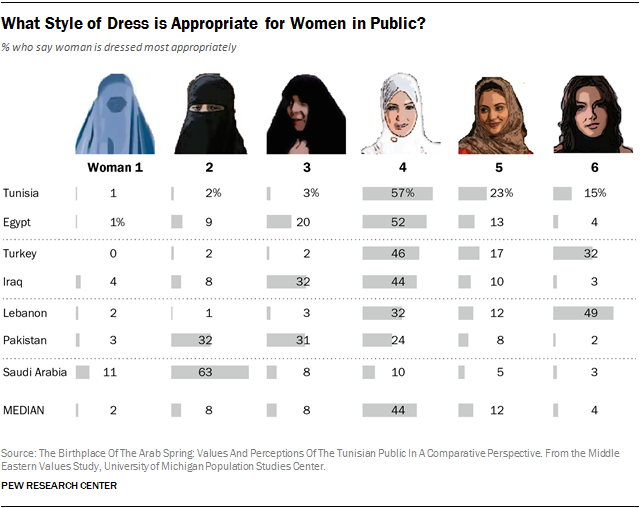
From this graphic, you’d have to draw the conclusion that most people in Islamic nations are scandalized by the appearance of women’s hair:

Click to see the original report (PDF)

Click to see the original report (PDF)

An important issue in the Muslim world is how women should dress in public. A recent survey from the University of Michigan’s Institute for Social Research conducted in seven Muslim-majority countries (Tunisia, Egypt, Iraq, Lebanon, Pakistan, Saudi Arabia and Turkey), finds that most people prefer that a woman completely cover her hair, but not necessarily her face. Only in Turkey and Lebanon do more than one-in-four think it is appropriate for a woman to not cover her head at all in public.

The survey treated the question of women’s dress as a visual preference. Each respondent was given a card depicting six styles of women’s headdress and asked to choose the woman most appropriately outfitted for a public place. Although no labels were included on the card, the styles ranged from a fully-hooded burqa (woman #1) and niqab (#2) to the less conservative hijab (women #4 and #5). There was also the option of a woman wearing no head covering of any type.

Overall, most respondents say woman #4, whose hair and ears are completely covered by a white hijab, is the most appropriately dressed for public. This includes 57% in Tunisia, 52% in Egypt, 46% in Turkey and 44% in Iraq. In Iraq and Egypt, woman #3, whose hair and ears are covered by a more conservative black hijab, is the second most popular choice.

Update: Of course, no discussion of the oppression of women in other countries can be considered complete until we’ve managed to find an angle where Western culture is significantly worse:

Studies have found that the average woman in the UK spends £26,500 on her hair over her lifetime, with 25% of respondents saying they would rather spend money on their hair than food. And women don’t just spend serious money on their hair, they spend serious time on it. On average, British women spend just under two years of their lives styling their hair at home or in salons.

Whether it’s covered by a veil or coloured by Vidal Sassoon, hair is a feminist issue. Indeed, hair is so bound up with ideals of femininity that, to some degree, the measure of a woman is found in the length of her hair. In the semiotics of female sexuality, long hair is (hetero)sexual, short hair is non-sexual or homosexual, and no hair means you’re either a victim or a freak. When Natalie Portman shaved her head for a film role she summed up these stereotypes with the observation that: “Some people will think I’m a neo-Nazi or that I have cancer or I’m a lesbian.” But Portman also added: “It’s quite liberating to have no hair.”

[…]

In a sense, women’s hair in the west functions as it’s own sort of veil, one which most of us are unconsciously donning. The time and money women spend on their hair isn’t just the free exercise of personal preferences, it’s part of a broader cultural performance of what it means to be a woman; one that has largely been directed by men. Rather than fixating on what the veil means for Muslim women, then, we should probably spend a little more time thinking about our own homegrown veils. Because it’s still an unfortunate fact that, across the Muslim and non-Muslim world, women are often judged more by what is covering their head that what is in it.

January 5, 2014

Polarized America, not

Filed under: Government, Media, USA — Tags: , , , , — Nicholas @ 10:50

In Time, Nick Gillespie goes through the polling numbers and finds that despite frequent claims that the United States is more polarized than ever before, it’s certainly not over the issues you’d expect:

The apparently massive and unbridgeable gulfs between Republicans and Democrats, men and women, gays and straights, secularists and believers, rich and poor, and coastal elites and heartland Americans are belied by data that substantial and growing majorities of folks actually agree on a wide variety of important social and policy issues and attitudes.

Here’s a sampling:

  • Pot legalization. As Colorado and Washington state begin selling legal weed, fully 58 percent of Americans believe the drug should be legal. That’s up from just 12 percent in 1969, says Gallup.
  • Abortion. Few issues are as hotly contested and few issues have generated such consistent support, with 78 percent of us thinking abortion should be legal under either all or some circumstances, and just 20 percent thinking it should be illegal in all circumstances. Those numbers basically haven’t changed since 1975.
  • Homosexuality. In 2001, just 40 percent of Americans thought that that “gay or lesbian relations” were morally acceptable. Last year, 59 percent had no problem with them. And 53 percent now think same-sex marriage should be given equal status to conventional couplings. That’s up almost 20 points from the start of the century.
  • Health Insurance. As Obamacare cranks up, 56 percent believe that it is not “the responsibility of the federal goverment to make sure all Americans have healthcare coverage.” That’s up from 28 percent in 2006. Only 42 percent — down from 69 percent in 2006 — think providing health insurance is the government’s responsibility.
  • Trust in Government. Just 19 percent of Americans “trust the government in Washington to do what’s right” all or most of the time. That’s down from 60 percent in 2002. Meanwhile, 81 percent of us don’t expect the government to do what’s right all or most of the time, up more than 40 points in the last decade. And a record-high 72 percent believe government “will be the biggest threat to the country in the future.” During the Obama presidency, 55 percent say that the government “is doing too much.”

Of course, all of these issues — and many others — contain nuances and contexts that need to be taken into account. And most issues show partisan differences too, with Republicans pulling in one direction, Democrats in another, and Independents (who are, at 44 percent, the single-largest bloc of voters by far) somewhere in between. But it’s striking that Americans seem to be becoming more socially liberal and fiscally conservative with every passing year. That just isn’t reflected in the platforms of the major parties, with the GOP only getting more conservative and the Democrats only more liberal.

December 4, 2013

The rising tide of “isolationism”

Filed under: Liberty, Media, Politics, USA — Tags: , , — Nicholas @ 08:23

Justin Raimondo on the irritating-to-pundits-and-politicians increase in what they mis-characterize as isolationism:

For years the Pew folks have been yelping about “isolationism.” They’ve been telling us it’s on the march — except among the elites — with the strong implication being that this is not a Good Thing. But do they know what the heck they’re talking about?

One has to wonder what extending peaceful commercial links with other nations has in common with invading them, meddling in their internal politics, or otherwise bullying them around. Indeed, establishing voluntary non-coercive relations with other nations — otherwise known as international trade — is the polar opposite of military and/or political intervention in their affairs. The American people know this. The Pew folks — not so much.

The bias of the Pew Center is evident in every line of the report, and also in its structure: the Pew Poll is really two polls, one a survey of the hoi polloi (you and I), the other a poll of members of the “internationalist” Council on Foreign Relations (CFR), the elite foreign policy group founded by Elihu Root and dominated by the Morgan banking interests from the get-go. The gulf between us plebeians and the Very Serious People in Washington (and New York) has been growing for years, but today it is a vast chasm: The CFR types are aghast at the “isolationism” of the rest of us, and ascribe to this various causes: “war fatigue,” the costs — and of course our narrow plebeian “isolationist” anti-cosmopolitan country-bumpkin outlook.

While 51 percent of normal Americans say we’re pushing our weight around far too much, the exact opposite opinion is held by the Washington-New York know-it-alls: “By contrast, about twice as many CFR members say the US does too little internationally as say it does too much (41% vs. 21%); 35% say the US does the right amount.” While us Normals were overwhelmingly opposed to US intervention in Syria, the CFR’ers were for it 2-to-1. Yes, they’re wrong about practically everything, including what it means to be an “isolationist” — a creature that has never existed and could not exist outside of North Korea.

[…]

The political class in this country has a far different view of commercial relations between nations than the Average American. To the latter, it is simply Good Old American Free Enterprise, albeit engaged in overseas. The former are not so naïve: they realize it is all about buying political influence, and, failing that, using the US military to guarantee the safety, security, and profitability of American investments abroad.

Viewed through this lens, American foreign policy since 1890 takes on a whole new dimension, which Rothbard’s Wall Street, Banks, and American Foreign Policy reveals in scintillating detail. The One Percent have been utilizing the US military as their private security force ever since that time: indeed, every war we have fought — yes, including the Good War — was fulsomely supported by the economic elite and their journalistic camarilla against the overwhelming desire of the American people to stay out. The political class has deliberately conflated commercial contacts with military and political intervention into the affairs of other nations — because, for them, the two are synonymous.

According to the mindset of the Pew Center and their good buddies at the CFR, “isolationism” has to mean commercial isolation. While this may puzzle the average person, look at it from the perspective of a professional thief: without the threat of US sanctions and the ultimate bludgeon of US military intervention, how else will the big banksters and their sycophants enforce a “world order” that exists so they can make a fast buck off the sweat of Chinese coolies, Eurasian oil workers, and Mexican maquiladores?

November 19, 2013

Anti-semitism on the rise in Europe

Filed under: Europe, Religion — Tags: , , — Nicholas @ 10:00

Cathy Young outlines the depressing findings from a recent study:

The evidence is especially compelling since it comes from a neutral source: the European Union Agency for Fundamental Rights (FRA). The agency surveyed nearly 6,000 self-identified Jews in eight European Union countries (Belgium, France, Germany, Hungary, Italy, Latvia, Sweden and the United Kingdom). While the online survey, publicized through Jewish community organizations and media outlets, did not have a random sample of respondents, it was designed with expert input to be as representative as possible.

A few findings:

  • Two-thirds of respondents said that anti-Semitism was a serious problem in their country; three out of four felt it had worsened in the past five years.
  • One in four said they had personally experienced anti-Jewish harassment in the past twelve months; while this included verbal attacks on the Internet, almost one in five had been harassed in person.
  • During the same period, three percent said they had been targets of anti-Semitic vandalism; four percent reported hate-motivated physical assaults or threats.
  • Nearly half worried about anti-Jewish harassment or violence; two-thirds of those with school-age children or grandchildren were concerned that the children might experience such harassment at school or on the way to school.
  • Close to a quarter said they sometimes refrained from visiting Jewish events or sites out of safety concerns. Nearly two out of five usually avoided public displays of Jewish identity such as wearing a Star of David.
  • Almost one in three had considered emigrating because they did not feel safe as Jews.

Even if the self-selected the pool of respondents was skewed toward those affected by or strongly concerned about anti-Semitism, these are still disturbing results.

October 15, 2013

Lies we tell to pollsters

Filed under: Politics, USA — Tags: , , , — Nicholas @ 06:46

David Harsanyi wishes the nonsense we tell to pollsters was a bit closer to the truth, at least in some cases:

A recent Rasmussen poll found that one in three Americans would rather win a Nobel Prize than an Oscar, Emmy or Grammy.

Though there’s no way to disprove this peculiar finding, I’m rather confident that it’s complete baloney. The average American probably can’t name more than one Nobel Prize winner — if that. Even if they could, it’s unlikely many would choose a life in physics or “peace” over being a celebrated actor, musician or television star. Put it this way, any man who tells you he wants the life of Nobel Prize-winning Ahmet Uzumcu, Director General of the Organization for the Prohibition of Chemical Weapons, instead of George Clooney is lying. And that includes Ahmet Uzumcu.

Polls might have been precise in forecasting recent elections (though, 2012 pollsters only received an average “C+ grade” in a poll conducted by Pew Research Center; we’re waiting on a poll that tells us what to think about polls that poll polls), but it’s getting difficult to believe much of anything else. Beyond sampling biases or phraseology biases, many recent polls prove that Americans will tell pollsters what they think they think, but not how they intend to act. Part of the problem is social desirability bias — the tendency to give answers that they believe will be viewed favorably by others. That might explain why someone would tell a pollster that he would rather win a Nobel Prize than a Grammy. There is also confirmation bias — the tendency of people to say things that confirm their beliefs or theories. Whatever the case, voters are fooling themselves in various ways. And when it comes to politics, they’re also giving small-government types like myself false hope.

Over the last few months, we seem to have been added to some sort of polling telephone list, as we’ve had dozens of calls from various institutions conducting “important public research” and insisting that we have to take part in their surveys. It’s quite remarkable how angry they get when I say we don’t want to take part. They go from vaguely pleasant at the start of the call to downright authoritarian by the time I hang up the phone … how dare I not want to give them the data they’re asking for? They’ve collectively become more irritating than the calls from “Bob” at “Windows Technical Support”.

September 15, 2013

Back to school shopping fails to rescue the clothing chains

Filed under: Business, USA — Tags: , , — Nicholas @ 10:18

We all spent less than we were supposed to last quarter, and the clothing business is feeling tight:

Fantasies about a strong back-to-school shopping season had already gotten slammed when teen retailer American Eagle Outfitters, back in August, chopped its second-quarter earnings in half and confessed to lousy sales — down 2% overall and 7% on a comparable-store basis. CEO Robert Hanson blamed weak traffic and women who hadn’t bought enough of the stuff on the shelf. “The domestic retail environment remains challenging,” he concluded.

Competitor Abercrombie & Fitch reported its quarterly results the same day. While total sales were down “only” 1% year over year, booming international sales — up 15% overall and up 60% in China on a comparable store basis — papered over a debacle in the US, where sales plunged 8%. CEO Michael Jeffries summed up the US phenomenon: a “challenging environment,” “weaker traffic,” and “softness in the female business.” While “consumers in general” might be feeling better, he ventured, “that’s not the case for the young consumer.”

Alas, by today, his “consumers in general” had gotten the blues too, according to the University of Michigan/Thomson Reuters consumer-sentiment index. It plunged from 82.1 in August to 76.8 in September, the lowest since April. “Economists” on average had expected a flat 82 — they don’t get out much, do they? Particularly brutal was the collapse of the economic outlook index from 73.7 to 67.2, the lowest since January. So, a retail recovery in the second half? Maybe not so much.

September 13, 2013

Medicare costs as seen by the public

Filed under: Government, Health, USA — Tags: , , — Nicholas @ 07:58

The Harvard School of Public Health released a summary of public opinion on various issues surrounding the Medicare system:

As debate over the national debt and the federal budget deficit begins to heat up again, an analysis of national polls conducted in 2013 shows that, compared with recent government reports prepared by experts, the public has different views about the need to reduce future Medicare spending to deal with the federal budget deficit. Many experts believe that future Medicare spending will have to be reduced in order to lower the federal budget deficit [1] but polls show little support (10% to 36%) for major reductions in Medicare spending for this purpose. In fact, many Americans feel so strongly that they say they would vote against candidates who favor such reductions. Many experts see Medicare as a major contributor to the federal budget deficit today, but only about one-third (31%) of the public agrees.

This analysis appears as a Special Report in the September 12, 2013, issue of New England Journal of Medicine.

One reason that many Americans believe Medicare does not contribute to the deficit is that the majority thinks Medicare recipients pay or have prepaid the cost of their health care. Medicare beneficiaries on average pay about $1 for every $3 in benefits they receive. [2] However, about two-thirds of the public believe that most Medicare recipients get benefits worth about the same (27%) or less (41%) than what they have paid in payroll taxes during their working lives and in premiums for their current coverage.

Differences between experts on the financial condition of Medicare and the public can also be seen when examining the reasons for rising Medicare costs and ways to reduce future Medicare spending. Unlike many experts, the public does not see overuse of medical care and the cost of new medical technologies as among the most important reasons for rising Medicare costs. Only one in six Americans (17%) believes that “people receiving drugs and medical treatments they don’t need” is one of the most important reasons why Medicare care costs are rising, and only 6% see “new drugs, tests and treatments being offered to the elderly” as one of the most important reasons. The three reasons cited most often by the public are poor management of Medicare by government (30%), fraud and abuse in the health sector (24%), and excessive charges by hospitals (23%).

Many experts believe that one of the most important reasons for rising Medicare costs is unnecessary care provided to patients. The public, however, sees the bigger problem for people on Medicare as not getting the health care they need (61%), rather than receiving unnecessary care (21%). Many experts see capitated payments (doctors getting paid a fixed amount of money so they can manage all of a patient’s health care for the year) as a preferred way of reducing future Medicare spending. However, a majority of the public favors continuing fee-for-service payments (65%) rather than changing to capitated health care arrangements (30%). This resistance to change may be related to the fact that a majority of the public sees Medicare in some cases already withholding treatments and prescription drugs to save money, including 63% who believe this happens very or somewhat often.

September 12, 2013

American voters suddenly decide to take a serious look at foreign policy

Filed under: Media, Politics, USA — Tags: , , , — Nicholas @ 10:58

A guest post at Zero Hedge by Robery W. Merry suggests that somnolent American interest in foreign policy may be waking up:

Political analysts over the next year or so, and historians well into the future, are likely to point to the fall of 2013 as a fundamental inflection point in American politics. That period, they will say, is when the American people forced a major new direction in American foreign policy. Before the events of this fall, the country’s electorate largely delegated foreign policy to its political elite — and largely supported that elite as it projected American military power with more abandon than the country had ever before seen. Even as the government steadfastly expanded the range of international problems that it said required U.S. military action, the electorate accepted that expanded international role and that increasingly promiscuous use of force.

Those days are gone now. The American people conveyed emphatically, in public opinion surveys and in communications to their representatives in Washington, that they did not want their country to launch air strikes against the Bashar al-Assad regime in Syria. Not even if Assad used chemical weapons against his people, as they generally believe he did. Not even if the strikes are limited in magnitude and duration, as Obama promises they will be. Not even if the president of the United States says the strikes are in the country’s national interest. They don’t buy it, and they don’t want it.

Poll numbers in recent days have demonstrated this turnaround in stark fashion. In addition, congressional reluctance to support the president’s authorization request was growing inexorably. The New York Times reported Tuesday that the president was “losing ground in both parties in recent days,” while the Wall Street Journal said support for Mr. Obama’s position on Syria “was slipping in Congress.” If Russia’s Vladimir Putin hadn’t interrupted the U.S. political process with his call for a negotiated end to Assad’s possession of chemical weapons, it seems inevitable that the president would have suffered a devastating political defeat in Congress. That’s still the likely outcome if it ever comes to a vote.

[…]

In a survey reported in Tuesday’s New York Times, the paper asked broader questions about American foreign policy, and the results were revealing. Fully 62 percent of respondents said the United States shouldn’t take a leading role in trying to solve foreign conflicts, while only 34 percent said it should. On a question whether the United States should intervene to turn dictatorships into democracies, 72 percent said no. Only 15 percent said yes. The Times said that represents the highest level of opposition recorded by the paper in various polls over the past decade.

To understand the significance of these numbers, along with the political pressures building on lawmakers on the issue, it’s important to note that American political sentiment doesn’t change willy-nilly, for no reason. What we’re seeing is the emergence within the American political consciousness of a sense that the country’s national leaders have led it astray on foreign policy. And, given the country’s foreign-policy history of the past two decades, it isn’t surprising that the people would begin to nudge their leaders with a certain amount of agitation.

September 7, 2013

Here’s a poll we’d like to see

Filed under: Government, Humour, Middle East, USA — Tags: , , , — Nicholas @ 08:14

Zero Hedge conducts its own poll on this question:

As President Obama continues to push for a plan of limited military intervention in Syria, a new poll of Americans has found that though the nation remains wary over the prospect of becoming involved in another Middle Eastern war, the vast majority of U.S. citizens strongly approve of sending Congress to Syria.

The New York Times/CBS News poll showed that though just 1 in 4 Americans believe that the United States has a responsibility to intervene in the Syrian conflict, more than 90 percent of the public is convinced that putting all 535 representatives of the United States Congress on the ground in Syria — including Senate pro tempore Patrick Leahy, House Speaker John Boehner, House Majority Leader Eric Cantor, and House Minority Leader Nancy Pelosi, and, in fact, all current members of the House and Senate — is the best course of action at this time.

“I believe it is in the best interest of the United States, and the global community as a whole, to move forward with the deployment of all U.S. congressional leaders to Syria immediately,” respondent Carol Abare, 50, said in the nationwide telephone survey, echoing the thoughts of an estimated 9 in 10 Americans who said they “strongly support” any plan of action that involves putting the U.S. House and Senate on the ground in the war-torn Middle Eastern state. “With violence intensifying every day, now is absolutely the right moment — the perfect moment, really — for the United States to send our legislators to the region.”

“In fact, my preference would have been for Congress to be deployed months ago,” she added.

July 26, 2013

New poll shows Liberals trailing in two byelection races

Filed under: Cancon, Politics — Tags: , , , , , — Nicholas @ 08:14

The Toronto Star reports on the latest polling information for the Ontario byelections:

The Progressive Conservatives are well ahead in two longtime Liberal strongholds — one in Toronto and the other former premier Dalton McGuinty’s Ottawa riding, according to a Forum Research poll.

The polling firm on Wednesday looked at three of the five Aug. 1 races:

  • Etobicoke—Lakeshore, where Toronto deputy mayor Doug Holyday is leading.
  • Scarborough—Guildwood, where the Liberal candidate Mitzie Hunter has the edge.
  • Ottawa South, where almost half of the voters would support Tory candidate Matt Young.

Regardless of the outcomes, the Liberals’ minority position in the 107-seat legislature will not be affected.

Winning Etobicoke—Lakeshore would mark a crucial breakthrough for the Conservatives in Toronto, where they have been shut out of since 2003, and an important win for Tory Leader Tim Hudak, who is consistently the least popular party leader.

“This race was very competitive to start with, and Tim Hudak has been showing up a lot. Doug Holyday has been handling the media well and it’s beginning to show,” Forum Research president Lorne Bozinoff told the Star Thursday.

Holyday was a high-profile last minute entry in the race.

July 5, 2013

Dudley Do-Wrong

Filed under: Bureaucracy, Cancon, Law — Tags: , , , , — Nicholas @ 09:32

The Royal Canadian Mounted Police have a great PR image in the rest of the world … for many people, the image of the scarlet-coated Mountie is synonymous with Canada. But for Canadians, there’s a growing unease about the RCMP:

Canadians have mixed views of our national police force, the Royal Canadian Mounted Police. We seem to admire the RCMP as an institution but are increasingly suspicious of the actions of individual Mounties and of the force’s brass — its senior officers and policymakers.

Our attitudes are further complicated by the fact that we seem to see the officers in our local detachments as good guys — they play on our men’s league hockey teams, help out with community charities, take their kids to school like the rest of us — yet we are beginning to see more bad apples elsewhere.

According to an Abacus Data poll of 1,000 Canadians conducted in late June, the Mounties remain one of our most trusted national institutions. A symbol of the country, the RCMP ranks right up there (69%) with the maple leaf (83%) and universal health care (78%).

Yet a majority of Canadians believe officers have used excess force (51%) and that sexism is rampant (54%) within the RCMP. Significant pluralities are also convinced problems within the force are “widespread” (43%) and are not being exaggerated (42%).

[. . .]

But I would guess, the biggest strains on the Mounties’ credibility, particularly in rural Canada and the West, have been over guns. And the warrantless seizure of hundreds of firearms from the homes of evacuees following the flooding in High River, two weeks ago — in which Mounties broke open doors and removed private property arbitrarily — will only widen the existing trust gap.

July 3, 2013

US public opinion on abortion has been stable for decades

Filed under: Health, Law, Media, Politics, USA — Tags: , , , , — Nicholas @ 10:31

Nick Gillespie says the stability of beliefs on the topic of abortion is one of the most striking things about the whole debate:

So despite decades of polling data showing that large majorities of Americans believe abortion should be legal under some circumstances, you could be excused for thinking there are only two possible positions when it comes to terminating pregnancies: either all abortions should be allowed, or none should be.

Yet the most striking thing about attitudes toward abortion is how stable they’ve been over the 40 years since Roe v. Wade. Gallup has been tracking public sentiment on the matter since 1975, when 22 percent of Americans agreed that abortion should be illegal under any circumstances and 21 percent believed it should be legal under any circumstances. Those numbers are now 18 percent and 28 percent respectively. In 1975 54 percent believed abortion “should be legal only under certain circumstances.” The number is now 52 percent and has never gone above 61 percent or below 48 percent. Over the past 15 years, the number of Americans calling themselves “pro-life” and “pro-choice” has narrowed to a few points, with 48 percent identifying as pro-choice and 44 percent as pro-life (in 2011, those figures were basically flipped).

Official political stances on abortion are absolutely Manichaean, however, with the Republican Party and most of its leading figures stressing that life begins at conception, a belief that would outlaw virtually all abortions except those necessary to protect the health of the mother. The Democratic Party platform — and most of its highest-profile members, including President Barack Obama — “strongly and unequivocally supports” abortion at any time and for any reason during a pregnancy.

Most Americans reject such categorical, extreme views and instead offer conditional support for abortion depending on when it’s performed. Gallup found that while 61 percent of Americans think abortion for should mostly be legal in the first three months of pregnancy and 27 percent felt it should be legal in the second trimester, just 14 percent agreed it should be allowed on demand in the final three months.

Unlike their political representatives, then, Americans hold a far more nuanced view of abortion, and one that comports with the reality of the procedure. Of the roughly 1 million abortions performed a year in America, about 90 percent take place within the first 12 weeks of pregnancy and only 1 percent take place after 20 weeks (in fact, over the past decade, there has been a marked trend toward earlier abortions). That helps explain why 62 percent of Texans supported S.B. 5, the bill that Wendy Davis filibustered.

Update: You went full Satanist. Never go full Satanist:

Not that invoking Satan isn’t serious, but the response on Twitter included some great humor. A few of my favorites:


The Blaze noted:

Obviously, it is much more likely that the abortion supporters were chanting “Hail Satan!” to mock pro-lifers rather than actually hailing Lucifer, but anything is possible.

Ed Morrissey responded:

I’m certain that the intent was mockery. The overall effect of chanting “Hail Satan”? That’s another story, but one of those effects is surely clarity.

Right. Having been to Texas, I can assure you that the defense of “We were mocking Christians by invoking Satan,” might actually make things worse.

June 26, 2013

Australian PM deposed in party coup

Filed under: Australia, Politics — Tags: , , — Nicholas @ 08:22

It may seem fitting that Julia Gillard was ousted from the premiership in the same way she achieved the position – an internal party coup:

Former Prime Minister Kevin Rudd on Wednesday pulled off one of the most sensational political comebacks in Australian history, ousting in a party vote Prime Minister Julia Gillard, the woman who replaced him as leader of the Labor Party in a 2010 party coup.

The victory by Mr. Rudd in a closed-door vote late Wednesday paves the way for an end to the rocky tenure of Ms. Gillard, who had called the surprise vote in an effort to head off a challenge from Mr. Rudd’s backers. Much of the momentum to reinstate Mr. Rudd came from a steady drumbeat of polls showing that the party under Ms. Gillard was almost certain to face a catastrophic loss in elections to be held in September.

Ms. Gillard became Australia’s first female prime minister in a 2010 party coup that ousted Mr. Rudd, who was derided during his tenure for an authoritarian leadership style. But she has seen her poll ratings plummet since announcing in January, unusually early, that federal elections would be held in September.

[. . .]

Despite Mr. Rudd’s victory within his own party, he is not automatically assured of becoming the new prime minister. It remained immediately unclear whether he had enough support from the independent lawmakers whose backing allowed Ms. Gillard to form a government after Labor’s disappointing showing in the last elections. The process starts when Ms. Gillard now formally asks the country’s governor general to make Mr. Rudd prime minister.

« Newer PostsOlder Posts »

Powered by WordPress