Quotulatiousness

January 27, 2026

Minneapolis – protest, insurrection, or massive distraction?

On the social media site formerly known as Twitter, Eric Schwalm talks about the organized nature of the Minneapolis protests and points out how much work it takes to set up and run:

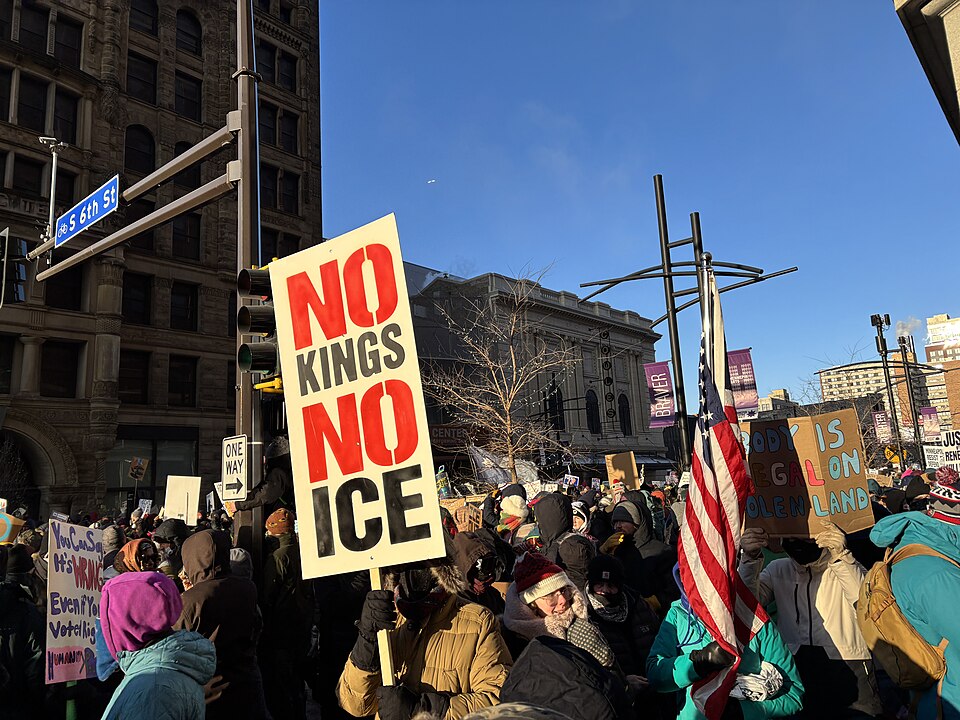
“No Kings, No ICE” protest on Hennepin Avenue in Minneapolis, Minnesota on 23 January, 2026.
Photo by Myotus via Wikimedia Commons.

As a former Special Forces Warrant Officer with multiple rotations running counterinsurgency ops — both hunting insurgents and trying to separate them from sympathetic populations — I’ve seen organized resistance up close. From Anbar to Helmand, the pattern is familiar: spotters, cutouts, dead drops (or modern equivalents), disciplined comms, role specialization, and a willingness to absorb casualties while bleeding the stronger force slowly.

What’s unfolding in Minneapolis right now isn’t “protest”. It’s low-level insurgency infrastructure, built by people who’ve clearly studied the playbook.

Signal groups at 1,000-member cap per zone. Dedicated roles: mobile chasers, plate checkers logging vehicle data into shared databases, 24/7 dispatch nodes vectoring assets, SALUTE-style reporting (Size, Activity, Location, Unit, Time, Equipment) on suspected federal vehicles. Daily chat rotations and timed deletions to frustrate forensic recovery. Vetting processes for new joiners. Mutual aid from sympathetic locals (teachers providing cover, possible PD tip-offs on license plate lookups). Home-base coordination points. Rapid escalation from observation to physical obstruction — or worse.

This isn’t spontaneous outrage. This is C2 (command and control) with redundancy, OPSEC hygiene, and task organization that would make a SF team sergeant nod in recognition. Replace “ICE agents” with “occupying coalition forces” and the structure maps almost 1:1 to early-stage urban cells we hunted in the mid-2000s.

The most sobering part? It’s domestic. Funded, trained (somewhere), and directed by people who live in the same country they’re trying to paralyze law enforcement in. When your own citizens build and operate this level of parallel intelligence and rapid-response network against federal officers — complete with doxxing, vehicle pursuits, and harassment that’s already turned lethal — you’re no longer dealing with civil disobedience. You’re facing a distributed resistance that’s learned the lessons of successful insurgencies: stay below the kinetic threshold most of the time, force over-reaction when possible, maintain popular support through narrative, and never present a single center of gravity.

I spent years training partner forces to dismantle exactly this kind of apparatus. Now pieces of it are standing up in American cities, enabled by elements of local government and civil society. That should keep every thinking American awake at night.

Not because I want escalation. But because history shows these things don’t de-escalate on their own once the infrastructure exists and the cadre believe they’re winning the information war.

We either recognize what we’re actually looking at — or we pretend it’s still just “activism” until the structures harden and spread.

Your call, America. But from where I sit, this isn’t January 2026 politics anymore. It’s phase one of something we’ve spent decades trying to keep off our own soil.

On his Substack, Glenn Reynolds points out that the “protests” are serving to distract attention away from state and local officials’ role in enabling massive fraud rings in Minnesota which reportedly scored billions of federal dollars for phantom organizations:

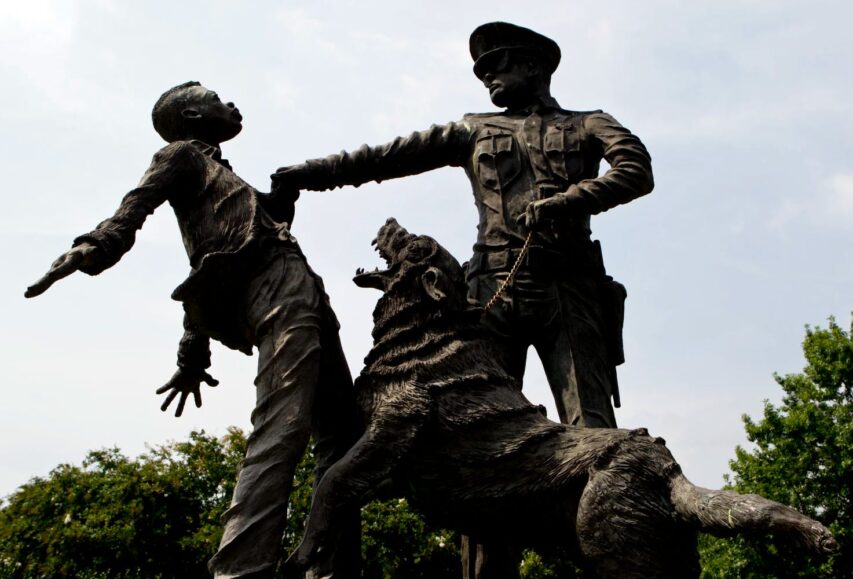
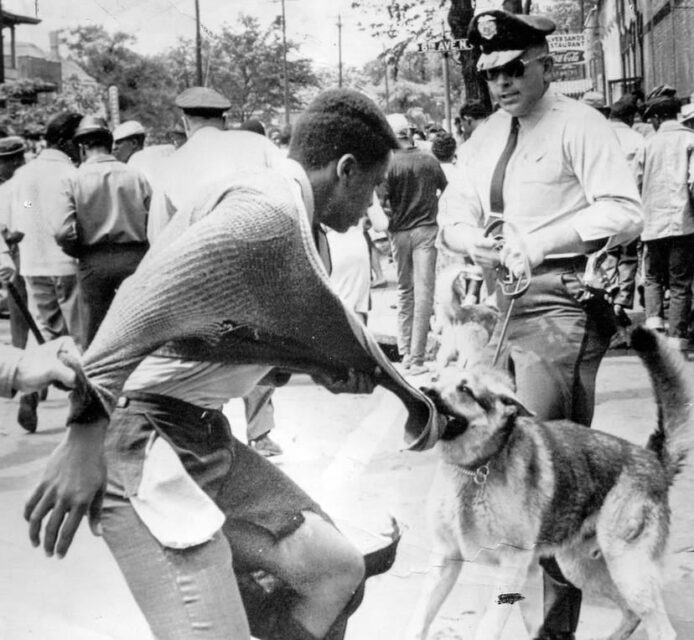
This image depicts a similar action by the Trusts at the turn of the last century. (Library of Congress).

The squid was frightened, so we got the ink: Increasingly violent “protests”-cum-riots explicitly aimed at blocking ICE operations with the stated goal of forcing federal authorities out of Minnesota entirely, while generating maximum media attention.

These are not spontaneous uprisings of the aggrieved, but organized actions featuring out-of-state actors and organizations, detailed training programs for demonstrators, and large amounts of intentionally murky funding from organizations like Indivisible, George Soros’ Open Society Foundations and others.

They’re coordinating their anti-ICE operations — identifying, chasing and blocking agents to keep them from arresting illegal-immigrant criminals — through highly organized chat groups on Signal, a secure communications platform, Fox News reported.

And Minnesota government officials are proudly touting their involvement in this coordination.

Sen. Bernie Sanders made much of Lt. Gov. Peggy Flanagan’s role in a fundraising email this weekend, praising her for “playing a key role in mobilizing grassroots opposition to Trumpism”.

That’s making these often violent, deliberately obstructive demonstrations look less like a civil rights sit-in and more like a government-backed insurrection.

Tragically, this aggressive and confrontational strategy has produced martyrs who can now be exploited for political purposes.

“Two things can be true at the same time,” Fox News’ Asra Nomani posted Monday.

The death of Alex Pretti, the armed demonstrator who got into a fatal tussle with ICE agents Saturday, “is a real and devastating tragedy, and there are several investigations appropriately occurring into the circumstances behind his killing”.

But also, “A far-left organizing network put Pretti in harm’s way and then turned him into a martyr … to sow the perception of chaos in America”.

Whatever investigators determine about how Pretti’s death unfolded, the fact remains that a cynical and corrupt political machine has fostered for its own purposes a situation that’s dangerous for its own supporters, and for the political future of our nation.

January 19, 2026

Regulating the clankers

At the Foundation for Economic Education, Kevin T. Frazier and Antoine Langrée consider how artificial intelligence can be regulated by state and federal bodies:

Yes, I’m still 12

President Donald Trump’s executive order on artificial intelligence invites analysis of a question so complex that it rarely gets asked: “What exactly do states have the authority to regulate?”

The current, somewhat trite answer is, “The residuary powers reserved under the Tenth Amendment”. Omitting the legalese, that means that states can do whatever the federal government cannot.

States have the power to look out for the health, safety, and welfare of their residents. Thus, for instance, they have the power to address local concerns through zoning laws, professional certifications via licensing regimes, and ensure public safety through law enforcement. These authorities make up what’s often referred to as a state’s “police powers”.

While this generic reading of state power is not necessarily wrong, it’s imprecise. As the AI Litigation Task Force created by Trump’s EO starts its work, a more specific answer is warranted.

The task force is charged with challenging “unconstitutional, preempted, or otherwise unlawful State AI laws that harm innovation”. Reading between these lines, its mission is to contest state laws that interfere with the Administration’s vision for a national AI policy framework. This isn’t an unlimited charge, though. Federal courts reviewing state laws will only strike them down if they fail to align with the Constitution’s allocation of authority or otherwise prove unlawful.

Many stakeholders in AI debates liberally interpret the authorities afforded to states. Based on concerns of existential risk to humanity and the idea that states must protect the health of their citizens, state legislators have proposed and enacted laws that impose significant obligations on the development of AI. Some assume they must have this right, since protecting the lives of their residents is a core priority and unquestioned authority of state governments. After all, since the founding, states have been able to enforce quarantines out of a concern for public health — aren’t aggressive AI laws just extensions of such public health measures, but tailored to the threat of modern threats?

It’s not that simple. States’ police powers are reasonably broad, but not unlimited. States must respect both an upper bound — the purview of enumerated powers reserved for federal authority — and a lower bound—the rights retained by the states’ citizens. These constraints have been tested in litigation throughout our Constitution’s history, notably when state law conflicts with the federal government’s exclusive authority over interstate commerce and when states unduly limit the freedoms of their residents.

These notions are relatively blurry and highly contextual. As national regulatory policy evolves, so too does the extent of preemption. The Lochner era, for example, was a paradigm shift for state police power: as courts expansively interpreted the individual liberty to contract, states’ police power over health, labor protections, and market regulation shrank significantly — only to be restored later. Likewise, individual liberties and valid justifications for their abridgment have evolved to fit developments in civil rights law — from Brown v. Board to Dobbs and Lawrence.

Despite these significant changes in context, the constitutionality of states’ exercise of their police powers follows a bounded framework. This can be observed in the jurisprudence on public health measures — a prime example of police powers. Quarantine orders, from nineteenth-century epidemics to Covid-19, have a direct link to protecting local communities — one of the most important elements of state police powers. They respect the upper and lower bounds of police powers. First, they are geographically specific: they only affect local residents or people coming into local communities. Second, they directly reduce the risk to state residents: quarantines are known solutions to real threats to the health and safety of local communities. They infringe the individual liberties only insofar as is necessary to protect state residents’ vital interests.

December 28, 2025

Colt SMG: First of the 9mm ARs

Filed under: History, USA, Weapons — Tags: , , , , , — Nicholas @ 10:10

Forgotten Weapons
Published 8 Aug 2025

With the expansion of SWAT teams throughout law enforcement in the 1980s, Colt realized that it was leaving a lot of sales on the table by not having a submachine gun it could offer alongside M16/CAR-15 rifles and carbines. They addressed this in the early 1980s by adapting a CAR-15 to 9x19mm. It used an adapter in the magazine well to fit modified Uzi pattern magazines (they were given hold-open tabs on the followers), and retained the same handling and controls as the full size AR. The SMG was made as a closed bolt, hammer fired, simple blowback action. By adding weight to the bolt carrier and buffer, the rate of fire was kept down to around 800 rpm.

The Colt SMG never really captured wide appeal. It was reasonably successful for Colt in large part because of their ability to market it alongside rifles, but it was dogged by reliability problems. A bunch of different models were made with different fire control options, including a couple civilian semiautomatic models and the distinctive DoE “briefcase gun” and the integrally suppressed DEA model, although neither of those saw very substantial sales. Still, it remains available to this day.

Colt 633 DoE Reproduction: • PSA/H&R Clones the Department of Energy Co…
(more…)

December 23, 2025

QotD: Vacations

Filed under: Britain, Humour, Law, Quotations — Tags: — Nicholas @ 01:00

Going on holiday is much more hazardous than it used to be. Squatters have discovered they have an absolute right in law to occupy your house, sleep in your bed, drink all your wine, sodomise your cat and insult the goldfish. If you try and get back into your house, the police will beat you up with truncheons, pull your fingernails out and arrest you under the Vagrancy Act of 1203.

Auberon Waugh, diary entry for 23 July 1975, republished in William Cook, Kiss Me Chudleigh: The World according to Auberon Waugh, 2010.

December 20, 2025

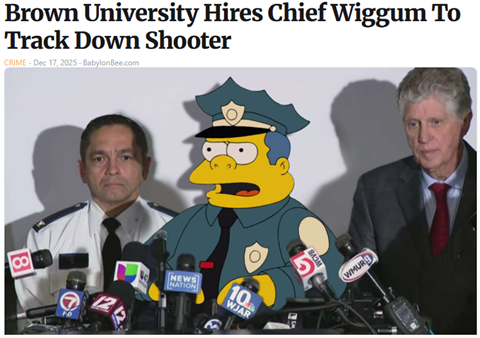
The “pursuit” of the Brown University shooter as a parable of incompetence

Filed under: Law, Media, USA — Tags: , , , , , , — Nicholas @ 04:00

Mark Steyn is supremely unimpressed with the quality of police work demonstrated by the “forty-seven genius law-enforcement agencies” apparently involved in investigating the murders at Brown University and the murder of an MIT nuclear fusion expert:

The Brown University shooter has been found dead by his own hand in a storage locker in southern New Hampshire. The entire officialdom of Providence, Rhode Island celebrated by throwing “the most worthless, uninformative, cover-your-ass press conference I have ever seen in my entire life“.

You’ll be glad to hear that the DEI Mayor of Providence has declared “we believe that you remain safe in our community“. He said this at 11pm last Sunday, but his statement was technically true because at that point the shooter was driving out of “our community” up to someone else’s community to kill an MIT professor, who would assuredly be alive today had not everybody in Providence bungled everything that could be bungled. The storage-locker guy and the Boston guy are both Portuguese nationals of the same age who are believed by the FBI to have attended the same university in Lisbon at the end of the last century. What that means, who knows? A random mass-shooting as prelude to something more personal and targeted? As is now traditional, I doubt we shall ever know, […] However, we do know how the forty-seven genius law-enforcement agencies “cracked the case”. An Internet user saw this post on Reddit, and brought it to the attention of one of the forty-seven agencies, who shortly thereafter swung into what passes for action. Here’s what the Redditor wrote:

    I’m being dead serious. The police need to look into a grey Nissan with Florida plates, possibly a rental. That was the car he was driving. It was parked in front of the little shack behind the Rhode Island Historical Society on the Cooke St side. I know because he used his key fob to open the car, approached it and then something prompted him to back away. When he backed away he relocked the car. I found that odd so when he circled the block I approached the car and that is when I saw the Florida plates. He was parked in the section between the gate of the RIHS and the corner of Cooke and George St.

That’s it. That’s the entire “investigation”. “He blew this case right open. He blew it open,” cooed the Rhode Island Attorney-General, Peter Neronha. “That person led us to the car, which led us to the name, which led us to the photographs of that individual renting the car, which matched the clothing of our shooter here in Providence, that matched the satchel which we see here in Providence.”

Great. His name is “John”, and he had multiple interactions with the killer on the day of the shooting — both in the bathroom of the building two hours beforehand and by the car to which the killer kept circling back to see if “John” had ended his apparent stakeout of the vehicle. He spoke to the man long enough to determine that he had an “Hispanic” accent. In fact, Portuguese. But close enough. Or closer than the forty-seven kick-ass agencies.

But here’s the thing: “John” only wrote his post on Reddit because nobody on the scene was interested in what he’d seen that day. “John” is apparently a homeless man who lives in the basement below the scene of the shooting.

Come again? Brown University lets the homeless live in its faculty buildings? You might want to bear that in mind if you’re thinking of taking on six-figure debt to be gunned down at the Ivy League.

Oh, wait, no, relax: “John” is not any old homeless man but a graduate of Brown. They’re not all working as baristas. So it’s some grandfathered-in alumni legacy racket.

Which brings us to the other thing: He was generally known to be living there. So, on Saturday or at the very latest Sunday, why did no-one from the forty-seven kick-ass agencies seek to interview him? His would surely have been a unique perspective: neither teacher nor pupil, but someone who knows the building after-hours and observes the comings and goings. One expects the three-mil-a-year DEI president’s “campus security” to totally suck, but how can you call in the FBI and then the elite best-of-the-best G-men not be aware that there’s a guy living in the basement under the scene of the crime who had multiple interactions with the perp?

As I have had cause to remark a thousand times, nothing works anymore. When I observe that of the UK, English readers get mildly peeved. When I observe it of the Fifth Republic, French readers start gabbling and waving their Gauloise-stained hands around so animatedly their strings of onions fall from their shoulders. And, when I observe it of the United States, American readers get particularly chippy. But I’m an equal-opportunity civilisational doom-monger: we’re all going over the falls, and arguing that the canoe of the Euro-pussies or the tight-assed Brits is a foot-and-a-half ahead isn’t really much consolation. Police-wise, the Aussie constabulary bollocksed Bondi Beach and the forty-seven Yank agencies bollocksed Brown and MIT.

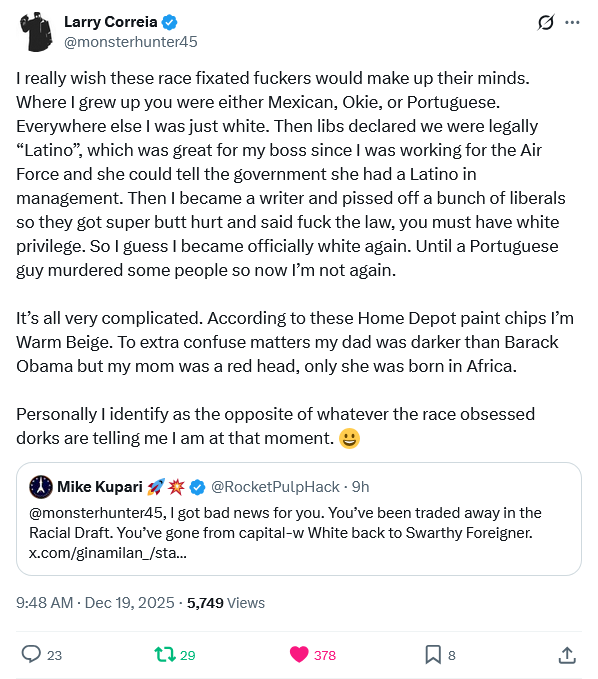
Of course, with the revelation that the shooter may have been Portuguese, the race hustlers are busy re-sorting the hierarchies of victimhood:

November 8, 2025

Think Before You Post | How the UK fell to a sinister new form of censorship

spiked
Published 27 Oct 2025

“Think before you post.” Those were the words screamed out by government social-media accounts, threatening to lock up people for “hate speech”, as riots swept the United Kingdom in the summer of 2024. To those who hadn’t been paying attention, it offered a stark insight into a supposedly liberal, democratic nation that had come to police speech as much as, sometimes even more so, than actual violence. Inciting racial hatred, inciting religious hatred, “grossly offensive” online communications – over the past 60 years or so, Britain has written one new speech crime after another into its statute books. And it has led to a situation in which at least 30 people a day are now arrested in England and Wales for social-media posts. This is a documentary about some of those speech criminals. What we found out was even more chilling than the headlines would have you believe. Featuring: Maxie Allen, Rosalind Levine, Toby Young, Allison Pearson, Luke Gittos and Jamie Michael.

October 26, 2025

The financial gap between Zohran Mamdani’s promises and what NYC can afford

Short of a couple of political earthquakes, Zohran Mamdani is going to be the next mayor of New York City. He has, as Andrew Sullivan admits, a lot going for him with Democratic voters, but he’ll have to get some special magic formula working to fund all the things he’s promising:

New York State Assemblymember Zohran Mamdani photographed in Assembly District 36, 10 February 2024.
Photo by Kara McCurdy via Wikimedia Commons.

It is not hard to see the appeal of Zohran Mamdani. He is, after all, not Andrew Cuomo — another corrupt, old, Democratic sexual harasser who’s already spent years in power and thinks he’s entitled to be mayor because of his last name. He doesn’t appear steeped in petty corruption like Mayor Adams. He’s not as obviously nutty as Sliwa seems to be. And he has done politics, pace Ezra, the right way: listening to the other side, earning people’s votes one by one, talking to people on the street, and, of course, mastering our new collective replacement for civil discourse: 30-second videos on TikTok.

Those videos are fantastic. Check out this one in favor of freezing rents in NYC, with the man, in full suit and tie, jumping into a freezing bay and out again. Or this one about “Halalflation” — on how licensing food carts has become a grift for middlemen. Or this one, when he sits down with two old white men — one for Adams and one for Cuomo — and tries to talk them into an alternative. If I were a Democrat, I’d be thrilled to see someone this fresh, this approachable, and this likable as a new face of the party. He’s young and charming and upbeat in a party lacking in all three.

He’s also right to focus his campaign on the question of affordability. New York City is ridiculously expensive in every way; the toll that high taxes and inflation have taken on working-class residents has been huge. Capitalism isn’t working the way it should, and we need to reboot our economic policies to address that as a priority. Trump has promised this but is delivering the opposite. Just this morning, we see an accelerating inflation rate. An opening beckons.

So I get why Mamdani is popular. And I have little doubt he will be the next mayor, as well as a major national figurehead for the Democrats — a nice dose of youth to a party debilitated by seniorityitis. He will define the Democrats nationally — certainly if the GOP has any say in it. And in many ways, he is the perfect candidate for today’s Dem elites: wealthy, woke, with a degree in “Africana studies.” His only problem is not being female — but since he denies that the category of female exists, no big deal I suppose. He will give the MSNBC/Bulwark crowd a new lease on self-righteousness.

But to be honest, when I read his proposals, at first I thought I was reading a high-schooler’s essay. Free everything! I mean: why not? Free universal childcare for kids as young as six weeks old. Free buses for everyone. Rent control for everyone already privileged by it. Subsidized collective supermarkets. $30-an-hour minimum wage by 2030 — up from $16.50. Woohoo! And arresting Bibi as an added bonus. (I have to say the last plank might even tempt me to vote for him.)

The problem, of course, is how to pay for it. And a NYC mayor, quite simply, cannot. Mamdani simply won’t have the power. None of the tax hikes he proposes — a new 2 percent tax on everyone earning over $1 million a year, and jacking up the corporate tax to 11.5 percent — can be passed by his council. Albany has the final say, will almost certainly say no, and the Democratic governor, Hochul, opposes the hikes.

So a lot of this is purely performative, no? He has a good chance to create his Soviet bodegas and, in all likelihood, freeze rents if he replaces members of the board. (That will, of course, make housing availability and expense even worse.) He may be able to wangle some increase in NYC’s minimum wage — by trying to bypass Albany. But doubling it in five years? Meh. All of the economic stuff is iffy because of the very probable lack of funding. Maybe a big victory will change the dynamics and allow a big tax hike in one of the most highly taxed cities on earth. But it’s hard to believe it.

So what’s left? What’s left is cultural leftism on hormones. You may get daycare — but it will come with full woke indoctrination of kids from the earliest years on. No more “boys” or “girls” allowed! Mamdani, as we all know, regards the police as the enforcers of “white supremacy“, supports the end of Israel as a Jewish state, will subsidize the transing of children with no safeguards, and has erased gays and lesbians from our own history, re-marginalizing us as “queers”. There’s no one the woke left hates more than an empowered and integrated person who just happens to be gay or lesbian.

Like all good critical-theory racists, Mamdani believes in a racial hierarchy with whites, Jews, and Asians as oppressors, and blacks and Hispanics and “queers” as victims; he wants to make NYC “the strongest sanctuary city in the country” — i.e. go to war with ICE — and kill the educational programs that help gifted poor kids in kindergarten — because most turn out to be of the oppressor races. A racist, in other words — to his fingertips.

And he is a near-perfect foil for Trump. “Queer liberation means defund the police,” he once tweeted — though he says he no longer wants to defund the cops. It’s the kind of 2020 slogan almost designed to ensure MAGA control of the national discourse forever. And if I were a show-runner on the Trump show, Mamdani would be central to provoking the kind of real fascist putsch that Trump and Miller are itching for, if they can find a suitable provocation. Mamdani is that provocation. He will go to war with ICE in NYC, and Trump will go to war with him. And broadcast it every day.

October 19, 2025

Mandating the use of bodycams for ICE agents

On the social media site formerly known as Twitter, ESR discusses the results of mandating bodycams for police officers, suggesting that bodycams on ICE agents won’t drive the changes activists are hoping for:

This is a followup on my earlier post about the expected effects of requiring bodycams on ICE agents.

I used Grok to do some digging into the literature examining the effects of bodycams on measurable statistics of unlawful police violence.

I did not have any strong expectations about what I was going to find.

Do the query yourself if you like, but I can tell you that the answer is going to reduce to two sentences:

1. Bodycams do not have any statistically significant effect on measures of unlawful police violence.

2. Body cams do have a statistically significant effect, reducing allegations of unlawful police violence.

This means that the only statistically significant effect of bodycams is to deter false claims of police brutality and bigotry.

Note: do not read this as me claiming that cops are untarnished angels. I know people who have been brutally abused by police. I know this does occasionally happen, and I condemn the police culture of silence about such abuses.

What I am saying is that what you see on bodycam footage, which is almost always police exercising commendable restraint in dealing with extremely violent and stupid people, reflects reality. If it didn’t, reality would leak around the edges of the camera non-coverage as an observable effect on incident statistics.

I don’t expect the effect on ICE to be any different. I expect mandatory body cams to backfire rather badly on people who pushed them in the hopes of exposing ICE as some sort of out-of-control Gestapo.

If anything, I expect the consequence to be an increase in already high levels of public support for mass deportations of illegals. Because I know what the results of lots of bodycam and security camera footage has been about public perception of underclass criminality. It gets more difficult to sell the narrative of these people as innocent victims of a repressive society after you’ve seen your 47th video of a screaming semi-psychotic trying to knife a cop during a traffic stop.

Some of the activist orgs that wanted the body cams made mandatory for street cops now want them turned off. I think it’s pretty likely the same thing is going to happen with immigration enforcement sooner or later. Most likely sooner.

October 11, 2025

QotD: Riot control tips

Filed under: Media, Military, Politics, Quotations, USA — Tags: , , , , , , — Nicholas @ 01:00

1. The press is not only the enemy; they must be presumed to be an utterly unprincipled and dishonest enemy. Anything and everything the riot control force does will be filmed and, if necessary, edited, to present it in the worst possible light. Therefore, they must have their own camera teams recording everything to both clear themselves of wrongdoing or spurious charges of indiscipline, as well as to discredit the press which will have edited the truth heavily. NB: There is no real limit to how dishonest the modern press can be and will be in support of the leftist agenda. There is no placating them. There is no degree of righteous conduct they will not twist into wrongdoing. There is thus no sense in trying to placate them, in trying to be nice, in tightly limiting violence, etc.; because they will lie about you and all those who want to believe their lies will.

2. Riot Control Women. They’re rather preposterous, in the main, if employed on the riot control line. It’s one of the reasons why MPs have for long been useless at riot control; they’re simply too heavily laden with women, who almost universally lack the size, strength, and aggressiveness for hand to hand combat with stone age weapons. Indeed, while the infantry and other combat and combat support unit in the old 193rd were excellent at riot control, the MPs – yes, I have seen it – were useless. Worse, riot control is a perfect environment to cause what the Israeli’s found out when they mixed men and women in the same units in their War of Independence; men will abandon the mission to succor one of their own women. This is the fault of the men, by the way, and not of the women, but it is even more the fault of the dogmatic shitheads of the left who refuse to see men and women for what they are.

3. Rioting women. I don’t care if you have a warrant for their arrest for murder, arson, mayhem, and massacre, plus cellulite and bad makeup, do not arrest or detain them at the scene. Shoot them if their conduct (to include dress) warrants it, but otherwise just push them away or wound them slightly and push them away. Why? Because, though ill-disciplined rabble, for the most part, the rioters are also mostly male and will also rush to the defense of “their” women. There is no better substitute for the cohesion and moral fiber a mob usually lacks than going after the women in the mob. They can turn ferocious very quickly, indeed, if you do.

And that’s all good and maybe it will get us through the summer, should it turn out as badly as it might, but, America, I suspect that you and the president are ultimately still going to need a dedicated, well trained, highly mobile, professional force for riot suppression.

Tom Kratman, The social media site formerly known as Twitter, 2025-06-11.

Update, 12 October: Welcome, Instapundit readers! Please do have a look around at some of my other posts you may find of interest. I send out a daily summary of posts here through my Substackhttps://substack.com/@nicholasrusson that you can subscribe to if you’d like to be informed of new posts in the future.

October 9, 2025

Freedom Convoy 2022 – “… proving once again the Liberal mastery of combining high drama with low farce”

Filed under: Cancon, Government, Media, Politics — Tags: , , , , , — Nicholas @ 05:00

In the National Post, Michael Higgins states the obvious fact that Tamara Lich, Chris Barber, and the rest of the Freedom Convoy protesters were never insurrectionists. Trudeau had decided in advance that the convoy was a maple-flavoured January 6th attempt to overthrow the government — if not an attempt to re-stage the storming of the Winter Palace — and merely waited for the violence to break out and/or the Parliament buildings to be stormed. But nobody other than a few particularly glowy federal provocateurs was interested … because they were there to protest government policy not to start a revolution:

Marco Mendicino, the public safety minister of the day, portrayed them as extremists intent on overthrowing the government.

“This so-called ‘freedom convoy’ called for the overthrow of the government. They called for the Governor General to unilaterally remove the Prime Minister from office,” Mendicino told a Commons parliamentary committee.

Indeed, the Office of the Secretary to the Governor General was inundated with calls and emails by protesters demanding then prime minister Justin Trudeau be fired.

But since the Governor General can’t just decide to sack a prime minister, these email-writing anarchists were particularly inept as well as being constitutionally illiterate.

It was Shakespearean farce, but Liberals like Mendicino were happy to play politics and paint the convoy protesters as lawless subversives bent on destroying democracy.

Although, to be fair, Trudeau only said they were a “small fringe minority” with “unacceptable views” — more retrogrades than revolutionaries.

Meanwhile, Ottawa’s Keystone Kops had all the laws, rules and regulations needed to disband the convoy, they just lacked the leadership.

Days into the occupation, Ottawa Police Services chief, Peter Sloly, appeared to have thrown up his hands in resignation, stating, “There may not be a policing solution” to the crisis. Two weeks later, he quit.

In his report, the public inquiry commissioner Paul Rouleau would later criticize the “serious dysfunction within the OPS’s leadership”.

The government theatrics escalated with the imposition of the Emergencies Act, proving once again the Liberal mastery of combining high drama with low farce. Within days, police had cleared the convoy and several other blockades without incident.

This was less the power of the Emergencies Act and more to do with getting the police to just act.

October 6, 2025

Fatherland: Alternate History with a Point

Filed under: Books, Germany, Media — Tags: , , , , — Nicholas @ 02:00

Feral Historian
Published 11 Oct 2024

The 1992 novel by Robert Harris is a great example of the otherwise generally mediocre “Germany won WWII” alternate history premise. By removing the regime from its current almost mythologized status as a unique and singular evil, instead portraying it as merely a repressive state in a Cold War, Fatherland illustrates an uncomfortable truth about realpolitik and atrocities.

00:00 Intro
00:55 The Case
02:20 Out of Myth, into the Mundane
06:13 Detente and Bureaucracy
09:11 HBO’s Adaptation
10:01 Ignoring Inconvenient Truths

CORRECTION: Somehow I put up a picture of Bormann when I was talking about Buhler.

🔹 Patreon | patreon.com/FeralHistorian
🔹 Ko-Fi | ko-fi.com/feralhistorian

And my own book, not alternate history, Ninti’s Gate is available on kindle and in paperback,
🔹 https://www.amazon.com/dp/B0CYXH9BWD

September 26, 2025

“Create no-go zones for federal forces”

Filed under: Government, Media, Politics, USA — Tags: , , , , , — Nicholas @ 03:00

On the social media site formerly known as Twitter, ESR responds to a comment about his three possible futures after the Charlie Kirk assassination (linked here):

    Mike Benz @MikeBenzCyber

    Antifa websites totally open to the public explicitly call to so utterly terrorize ICE that federal agents are physically afraid to enter a city. If the Proud Boys wrote this about the FBI how fast would every single person around that website be indicted by Merrick Garland.

“Create no-go zones for federal forces.’

In one of my previous analysis postings, I outlined three possible scenarios for the future after the assassination of Charlie Kirk.

This corresponds to scenario 3, the one where insurrection edges into a simmering civil war a la Bosnia. I caught some flak in my replies at the time from people who thought an insurrection based in urban areas isn’t practical under modern conditions.

Antifa thinks it is. It’s what they’re planning for.

One of the things I have to remind myself of occasionally is that most people know essentially nothing about Communist theory and Communist revolutionary tactics.

Antifa is running the classic Communist playbook. Make the enemy fight you where you are strong and they are weak — where you have support among the people and (when possible) cover from sympathetic local officials.

Historically that has usually meant fighting from rural areas where the reach of the government is weak. But the Russian Revolution was an exception, and the revolution Antifa is trying to fight is another. Their natural home ground is large coastal cities run by left-wing Democrats.

September 20, 2025

“[V]iolent crime [in Canada] had increased by 30% over the last decade”

Filed under: Cancon, Government, Law — Tags: , , , , — Nicholas @ 04:00

A lot of Canadians are noticing how much social peace has deteriorated in and near major cities, but police and local media increasingly are not sharing full information about suspects — often to avoid accusations of racism. It’s gotten bad but as James Pew points out … it’s just getting worse and worse:

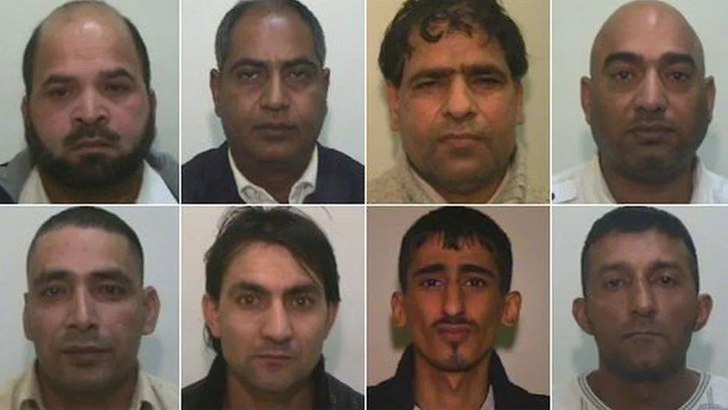
Some of the 18 people charged with violent home invasions and carjackings in the Peel Region, July 2025.

Almost every day we hear new stories of violent crime in Canada. Many of us are shocked into speechlessness. Violent youth offences, home invasions, arsons and assaults are on the rise. The rate of car jackings in the York Region increased by 523% between the years 2019 and 2024. Home invasions in Canada are now a regular occurrence. Last year, Kiernan Green did some number crunching for The Hub. He found that violent crime had increased by 30% over the last decade. And Livio Di Matteo, of the Fraser Institute found that “while Canadian homicide rates remain lower than in the U.S., the Canadian rate has increased at a higher rate since 2014”. In the blink of an eye Canada went from a safe high trust society to a dangerous low trust society. Everything is upside down.

The swarming attack and murder of 59-year old homeless man Kenneth Lee of Toronto in December of 2022 was a somewhat early indication that something was dreadfully off. Eight girls, ranging in age from 13 to 16 attacked Lee, stabbing him with knives and small scissors multiple times. He later died in hospital. Initially charged with second degree murder, ultimately all eight girls had their charges reduced and were sentenced to probation only. The Mayor at the time, John Tory, referred to the judgment as “deeply disturbing.”

So far this year there have been thirteen cases in which youth offenders were charged with homicide in the Greater Toronto Area. The most recent involves a 12-year old who has been charged with murdering a 62-year old homeless man. He had been on a release order at the time of the murder. He was also accompanied by a 20-year-old man named Isaiah Byers. The two went on a spree of unprovoked violent attacks in downtown Toronto, targeting vulnerable individuals. Five in total were attacked with a hammer.

Frustrated with the city’s catch-and-release protocol, the Toronto Police Association recently took to X and asked, “Where are the judges who make these decisions?” And further, in a written statement the TPS pointed out, “Our members are held accountable for the decisions they make and the actions they take. Why isn’t anyone else?”

The Youth Criminal Justice Act (YCJA) is currently protecting the identities of youth offenders involved in shocking levels of violence across the GTA. On July 17th, a 14-year old boy, described as a black youth, was charged with fatally stabbing a 71-year-old woman, Shahnaz Pestonji, while attempting to rob her in a grocery store parking lot. The youth admitted later on a social media livestream that he “didn’t mean to kill the old lady” and was just trying to steal her car.

On August 16th, 8-year old Jahvai Roy was shot and killed by a stray bullet while at home sleeping in his mothers bed. Many bullets were shot that night by thugs outside the Roy home in North York, but tragically one of them passed through a window of Holly Roy’s bedroom and struck Jahvai. She wrote on Facebook, “My baby was preparing for one of his best friend’s birthday celebration. He was so excited he couldn’t sleep!” A 16-year old boy has been arrested, and two others are still being sought by police on Canada-wide warrants: 17-year old Ibrahim Ibrahim of Toronto, and 18-year old Amarii Lindner of Toronto.

On August 23rd a 16-year-old girl was charged with aggravated assault and assault with a weapon after stabbing a woman in her 80s in Scarborough, Ontario. Due to the YCJA, the name of the woman, who is suffering in hospital with life-threatening injuries, was not disclosed by the media. It was reported that the teen and the victim lived in the same residence. The story seems to have vanished. After August 23rd, there are no more media reports.

September 12, 2025

A primer on patterns in past political assassinations

Filed under: History, Media, Politics, USA — Tags: , , , — Nicholas @ 03:00

On the social media site formerly known as Twitter, ESR shares his observations on common patterns in political assassinations which may be relevant to the investigation of the assassination of Charlie Kirk:

The Salt Lake City FBI office released these photos of a “person of interest” in the Charlie Kirk assassination.

I don’t know anything other than public information about the assassination of Charlie Kirk.

However, a primer follows about patterns in past political assassinations. I will sketch what scenarios an intelligence analyst would come up with looking at this one.

The first and most important rule in this kind of investigation is: when you hear hoofbeats, think horses not zebras.

In political assassinations, as an ordinary murders, the correct suspect is usually the most obvious suspect. Airport-thriller-style convoluted plots and false-flag ops pulled off by unlikely people or organizations are rare in the real world.

Accordingly, when you’re trying to solve a political assassination, the right question to ask is “Who said they wanted him dead?”

Then, you infiltrate those organizations, or arrest a bunch of members, and do contact tracing. Usually you do in fact find your killer that way. It’s not very different from ordinary police work except for the stakes.

There are broadly speaking three different kinds of assassin: the nutter, the zealot, and the pro. They are not difficult to distinguish once you got your hands on them.

Nutters don’t have a coherent political ideology, though they may spout semi-random slogans that political actors can seize on to pretend that they do. They generally have quite an obvious history of mental illness

Before capture, given the kind of public evidence we have now in Charlie Kirk’s assassination, it’s difficult to tell the zealots from the pros by their MO. It used to be easier, but as I noted in a previous post sniper doctrine and technique have been leaking into popular culture for decades.

It’s easier to spot the nutters; they tend to have poor forward-planning capacity. A very obvious way this manifests is a weak or non-existent plan for exfiltrating after the hit. Thus, the nutter is very likely to get caught quite soon after the assassination, often at the site.

This also produces a false-prominence effect – people think political assassins are more likely to be nutters than is actually the case.

Pros – professional assassins working for intelligence agencies or militaries – are also rare. They do occasionally strike – as when, for example the Bulgarian secret service whacked Pope John Paul – but high-profile public assassinations carry a risk of diplomatic and political blowback the most nations are unwilling to assume.

Also, trained assassins are a scarce resource and exfiltrating in the hue and cry following a very public assassination is chancy. Usually you’re going to send them against more obscure targets like exiled dissidents that you think might still be dangerous, hoping not to trigger a full law-enforcement and counterintelligence response.

There’s been talk in some of the wackier corners of the Right that the Mossad did this one. No analyst would take this seriously; the blowback risk to the Israelis is far too high to justify any gain. Same goes for the Russians, though they have a higher risk tolerance than the Israelis and had a much higher tolerance in Soviet times.

In the case of Charlie Kirk it’s pretty high odds we’re looking at a zealot. That’s usually the way to bet, and in this case, the quality of his exfiltration plan and the fact that he has successfully disappeared raises the odds.

Given all these factors, LEOs are going to be looking for zealots associated with domestic organizations that said they wanted Charlie Kirk dead.

Yes, this seems boring and obvious. The main point I’m trying to drive home here is that the boring and obvious theory about a political assassination is usually the correct one.

Accordingly, the first place investigators of the assassination of Charlie Kirk are going to be looking is gun clubs associated with Antifa and the hard left, like the John Brown Gun Club and Redneck Revolt.

It’s not certain that Kirk’s assassin is a member of one of those groups, but if you had to place a bet that would be where to put it.

Update: while I was composing my analysis there was a leak from inside the ATF. They found a .30-06 with engravings expressing “anti-fascist” and transgender ideology.

As I said: When you hear hoofbeats, think horses not zebras. The obvious suspect is usually the correct one.

And later, on the particulars of this particular assassin’s work:

PSA for those speculating about the sniper who killed Charlie Kirk:

No, the shot he made was not a difficult one, and does not constitute evidence that he was a professionally-trained sniper.

His choice of hide and the quality of his exfiltration plan was impressive. That could indicate pro-level training. Or, it could just mean he played the right videogames.

Information about sniper practice has been leaking into popular culture for decades. It used to be that good practice could enable you to make deductions about the background of the sniper, but that time is past.

Nothing has yet been released about what ammunition or weapon he used. It is highly likely that the bullet has been recovered and identified.

About the most we’re likely to be able to extract from the caliber is whether the sniper used an American traditional caliber like .30-06, NATO-standard 7.62, or Russian 7.62. The latter two cases may not be distinguishable if the bullet is deformed.

Knowing this won’t really tell us anything, as rifles in all plausible calibers are generally available in the United States. Furthermore, if this were a pro-level hit, misdirecting investigators by choosing an adversary or third party weapon is part of normal covert operations doctrine.

All in all, it is not possible to deduce anything of significance about the sniper from the publicly available information. Mistrust anyone who claims otherwise.

QotD: Modern riot-control gear

Filed under: Media, Military, Politics, Quotations, USA, Weapons — Tags: , , , , — Nicholas @ 01:00

What the well-dressed riot controller is wearing this year:

I’ve hinted already at my severe disenchantment with the riot control manual. Most of the following will tend to indicate some of why. Note that this is pretty military specific, but you all ought to know what’s happening, what should happen, and what isn’t happening with regards to riot control.

Head: Protection of the head involves also protection of the face, neck, and, especially, the eyes. The standard military issue Kevlar helmet is adequate for protecting the head from blunt force trauma and even some bullets . It does nothing for the face. There are shields that attach to the helmets to protect the face and which usually reach down enough for neck guard. However, after a cursory search or three for what’s on offer now, as with the old style ones I discussed previously, they can be blurred and ruined with solvents. Yes, this would seem to include polycarbonate as well; that’s how pieces of Lexan are glued together, actually. It’s a problem. Neither can I find a face shield that is glass over Lexan, though they may exist.

Moreover, while there are masks – nicely intimidating motorcycle rider masks, for example – that are black and which could have relatively cheap replaceable clear eyepieces made, they are close fitting, hence would interfere with donning the protective mask when it comes time to use RCA or when smoke from burning buildings gets to be a bit much. The only solution I can see is twofold: 1) Have a ready supply of extra face shields on hand, and 2) make the immediate penalty for attacking a mask with solvents a reasonably severe beating with some kicks and stomping.

Special Tip #1: If you’re using your issued helmets, troops and commanders, turn the camouflage band around so the rioters can’t see your name. This is for two reasons. One is to prevent personal retaliation against your men or their families. The other is to send a message the rioters will understand very clearly because they’re using anonymity for the same purpose, to stay out of court. In other words, the message you send is, “Get close enough to this soldier or policeman for him to hurt you and he will, all the more readily because you can’t identify him for civil suit or criminal complaint.

Chest: The current issue torso armor seems adequate for most threats it will encounter in riot control, but, at thirty-three pounds, strikes me as awfully heavy for an activity that is already about as physically intense as a battlefield, if not even more so. With an E-SAPI plate in front, that runs nearly to forty pounds, which is simply too damned much. There is room for some minor weight savings, as will be shown below, under “Protective Mask.”

There are lighter and quite likely better armor suites coming along or already on hand for the special operations folks, but if they are not available for a unit tasked for riot control, I’ll have to say, “Suck it up; wear the vests you have; keep about ten percent of your force in reserve, unarmored but ready and drilled to suit up in a hurry, to relieve people who become exhausted from the weight and heat retention.

Special Tip #2: You want the armor not only to protect your men, but also to protect them enough to keep them from losing their tempers and running wild. When they hurt somebody, it needs to be because the commander wants that somebody hurt, that the mission is advanced by that somebody being hurt, and not because of a breakdown in discipline.

Armament: For a number of reasons, I recommend against using bayoneted rifles. The downsides are numerous, so I’ll limit myself to a few. 1) They require both hands; this means that the riot controller cannot use a shield. 2) The act of fixing bayonets, all on its own, constitutes deadly force. Yeah, just fixing them. So you won’t be allowed to do it. 3) That means you end up with this bullshit:

https://en.wikipedia.org/wiki/Flower_Power_(photograph)

Instead, use batons. However, for that I have no less than two tips.

Special Tip #3: Grease the last eighteen inches or so of the batons with something non-water soluble, like Vaseline. No, this is not as an aid to anally raping the rioters with the batons, however tempting that may come to seem. Rather, it is to keep the rioters from snatching your batons away, which snatching encourages them to no end. If you don’t have petroleum jelly handy, thicker rifle lubricant, like LSA, can work, but spread it very thinly, so it doesn’t run.

Special Tip #4: Drive finishing nails into the ends of your batons and snip them off to leave about an inch sticking out. No need to sharpen the part sticking out; it’s sharp enough to penetrate and leave a painful puncture wound, whether directed at arms or torsos or thighs or groins (ouch!).

Shields: There are any number of makers of perfectly serviceable riot control shields, some of which are, although frightfully heavy, bullet proof. If you need bullet proof shields, I would suggest that you’re way past the point of suppressing a riot and already involved in a civil war. In that case, shoot back accordingly.

Assuming for discussion’s sake, however, that we aren’t quite at that point yet, the shields are extremely useful. They deflect rocks and bags of shit. They can cause a Molotov to go off somewhere other than on the riot controller or at his feet. They are, themselves, offensive weapons. As Suetonius said, just before kicking Boudicca’s Britannic ass: “Knock them down with your shields, then finish them off with your swords”.

The world being as it is, however, full of iniquity and injustice, when Battalion X of the YYth division gets alerted for riot control, the shields will probably not be available. A careful search by J4 will show that “They are either in Iraq or were left behind on Johnson Island, lest Greenpeace show up some day. Or maybe they were turned into a reef for some endangered fish. Who knows?” Hence, make your own. The example below was made by one of the handier troops of B-3/5 Infantry, Panama Canal Zone, in 1983. It’s just half inch plywood, 19 by 24 inches, though they can be cut larger to fit the larger troops, with arm straps cut from condemned nylon webbing and bolted on. The almost horizontal piece is one shoulder strap from the harness of nylon load bearing equipment, stapled on and serving as a shock pad for the arm. Yes, if you actually have to make something like these do not forget the shock pad. I’d recommend not painting them with unit insignia. We were, at the time, on testosterone overload and wanted people to know who was kicking their butts.

Note, a larger shield doesn’t necessarily protect more, it just moves more slowly to protect what needs protection. These shields are very light and, given the geometry of the matter, able to be moved very quickly indeed to protect any exposed part of the body, to include the thighs and crotch. Speaking of the …

Crotch: Move your/have the troops move their protective mask and carrier from the left hip to right in front of the family jewels. It won’t slow down donning the mask appreciably and it will save a little weight while providing adequate crotch coverage.

Tom Kratman, Twitter, 2025-06-09.

« Newer PostsOlder Posts »

Powered by WordPress