Life, as it is often called, was conceived as a modern take on a board game designed in 1860 … called the Checkered Game of Life …
By 1960, the Checkered Game of Life had disappeared from most American game tables. It had been replaced by such as entrants as Monopoly, which rewarded winners with riches, punished losers with penury and became one of the top-selling board games in the United States during the Depression. Mr. Klamer’s task, as assigned by the Milton Bradley Co., was to create a game to mark the company’s 100th anniversary … With the assistance of colleagues … Mr. Klamer updated [the Checkered Game of Life] for the aspirations of contemporary players. For instance, players of the new version would choose between a “business” route, which afforded an immediate salary, and “college”, which promised a larger but delayed one … To board game enthusiasts, the Game of Life was a beauty: a marvel of topography with raised roads that players traversed in their station-wagon game pieces. According to the volume Timeless Toys: Classic Toys and the Playmakers Who Created Them, by Tim Walsh, Life was “the first three-dimensional game board using plastic.” … Destinations in the 1960 version included “Millionaire Acres” — or the “Poor Farm”.
From “Reuben Klamer, toy inventor who created the Game of Life, dies at 99” (WaPo).
I played that game when it was new in the 1960s, and I guess those 3-dimensional aspects and the built-in spinner were pretty exciting. But what a drag it made life seem! You’re a peg in a car and you gather family members to fill the hole in the car and keep driving till you get to the end. At least the end wasn’t called Death.
And it seems that this is where we Baby Boomers learned we’d better go to college. The game had determined the income difference. But you didn’t even have any fun in college or learn anything deep. You just upped your earning potential, and the point of life/Life was to make the most money. What an awful game!
Ann Althouse, “Life as it is often called, was conceived as a modern take on a board game designed in 1860 … called the Checkered Game of Life“, Althouse, 2021-09-17.
December 18, 2021
QotD: The Game of Life
November 27, 2021
QotD: The zombie that used to be Abercrombie & Fitch
Back when Abercrombie & Fitch was the NYC outfiter for affluent sportsmen, it carried high end guns and fishing tackle and outdoor equipment. Its Madison Avenue store had a shooting range and a casting pool on the roof. Griffin & Howe custom rifles, London best shotguns, and Payne fly rods were waiting there for sale. Alas! the real Abercrombie & Fitch died in the mid-1970s.
The name changed hands repeatedly and was revived in the late 1990s as a completely different kind of entity. The new revival markets sissy fashions to metrosexuals. It’s rather as if after Papa Hemingway shot himself, his name was sold repeatedly, and revived decades later as “Ernestine Hemingway”, an authoress of Gay Romance Novels.
David Zincavage, “From the Good Old Days: Abercrombie & Fitch, Change Sucks”, Never Yet Melted, 2021-08-24.
November 9, 2021
Led Zeppelin IV, fifty years on
In Monday’s NP Platformed newsletter, Colby Cosh helps a lot of “late Boomers” and Gen X’ers to feel even older:

This very day, friends, marks the 50th anniversary of the release of Led Zeppelin’s fourth studio album, whose title is technically a series of glyphs representing the band’s four members. Frustrated writers and editors usually just call it Led Zeppelin IV, and will have to go on doing so until the Unicode Consortium comes to its senses.
Zep IV is generally considered the band’s strongest LP, and it contains the song “Stairway to Heaven”, which has been played so often over 50 years of life that it is now somewhat divisive. It’s possible the species can be split into people who are sick of “Stairway” and those of us who still have to let it play all the way through, every time, even though it has nothing left to disclose and no remaining power to surprise. (How could it? We all know every note, every overtone of every chord, every syllable of incomprehensible Robert Plant doggerel.) NP Platformed is cheered by the thought that there are babies being born every day who will, at some time or other, get to hear “Stairway” for the first time. It’s not like they’ll get very far without hearing it.
“Stairway” makes for a hell of a cleanup hitter, but on Zep IV the lineup is immense from top to bottom. There are those who would argue that other Zeppelin studio LPs are stronger on the whole. If you like the heavy-blues side of the group, you might be tempted to vote for Zeppelin II (1969); folkies appreciate Zeppelin III (1970).
The fifth record, Houses of the Holy (1973), was once called “Zeppelin’s best record” by Chuck Klosterman, an undoubted authority in such matters … but please note that Klosterman wrote this in a listicle about the greatest metal albums that had Zeppelin IV No. 2 overall, with Houses of the Holy altogether omitted. Later, when trendsetting music-review site Pitchfork.com did a listicle of the top 100 albums of the 1970s, they ranked Zep IV seventh and spent a couple hundred words apologizing for not putting it first. (“We must be lying to ourselves …”) Zep IV: too big to ignore.
November 4, 2021
You think software is expensive now? You wouldn’t believe how expensive 1980s software was
A couple of years ago, Rob Griffiths looked at some computer hobbyist magazines from the 1980s and had both nostalgia for the period and sticker shock from the prices asked for computer games and business software:
A friend recently sent me a link to a large collection of 1980s computing magazines — there’s some great stuff there, well worth browsing. Perusing the list, I noticed Softline, which I remember reading in our home while growing up. (I was in high school in the early 1980s.)
We were fortunate enough to have an Apple ][ in our home, and I remember reading Softline for their game reviews and ads for currently-released games.
It was those ads that caught my eye as I browsed a few issues. Consider Missile Defense, a fun semi-clone of the arcade game Missile Command. To give you a sense of what games were like at the time, here are a few screenshots from the game (All game images in this article are courtesy of MobyGames, who graciously allow use of up to 20 images without prior permission.)
Stunning graphics, aren’t they?

Not quite state of the art, but impressive for a home computer of the day. My first computer was a PC clone, and the IBM PC software market was much more heavily oriented to business applications compared to the Apple, Atari, Commodore, or other “home computers” of the day. I think the first game I got was Broderbund’s The Ancient Art of War, which I remembered at the time as being very expensive. The Wikipedia entry says:
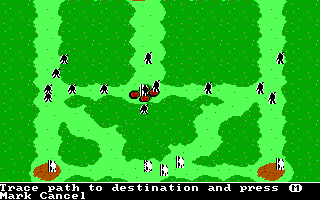
A screenshot from the DOS version of The Ancient Art of War.
Image via Moby Games.
In 1985 Computer Gaming World praised The Ancient Art of War as a great war game, especially the ability to create custom scenarios, stating that for pre-gunpowder warfare it “should allow you to recreate most engagements”. In 1990 the magazine gave the game three out of five stars, and in 1993 two stars. Jerry Pournelle of BYTE named The Ancient Art of War his game of the month for February 1986, reporting that his sons “say (and I confirm from my own experience) is about the best strategic computer war game they’ve encountered … Highly recommended.” PC Magazine in 1988 called the game “educational and entertaining”. […] The Ancient Art of War is generally recognized as one of the first real-time strategy or real-time tactics games, a genre which became hugely popular a decade later with Dune II and Warcraft. Those later games added an element of economic management, with mining or gathering, as well as construction and base management, to the purely military.
The Ancient Art of War is cited as a classic example of a video game that uses a rock-paper-scissors design with its three combat units, archer, knight, and barbarian, as a way to balance gameplay strategies.
Back to Rob Griffiths and the sticker shock moment:
What stood out to me as I re-read this first issue wasn’t the very basic nature of the ad layout (after all, Apple hadn’t yet revolutionized page layout with the Mac and LaserWriter). No, what really stood out was the price: $29.95. While that may not sound all that high, consider that’s the cost roughly 38 years ago.
Using the Bureau of Labor Statistics’ CPI Inflation Calculator, that $29.95 in September of 1981 is equivalent to $82.45 in today’s money (i.e. an inflation factor of 2.753). Even by today’s standards, where top-tier games will spend tens of millions on development and marketing, $82.45 would be considered a very high priced game — many top-tier Xbox, PlayStation, and Mac/PC games are priced in the $50 to $60 range.
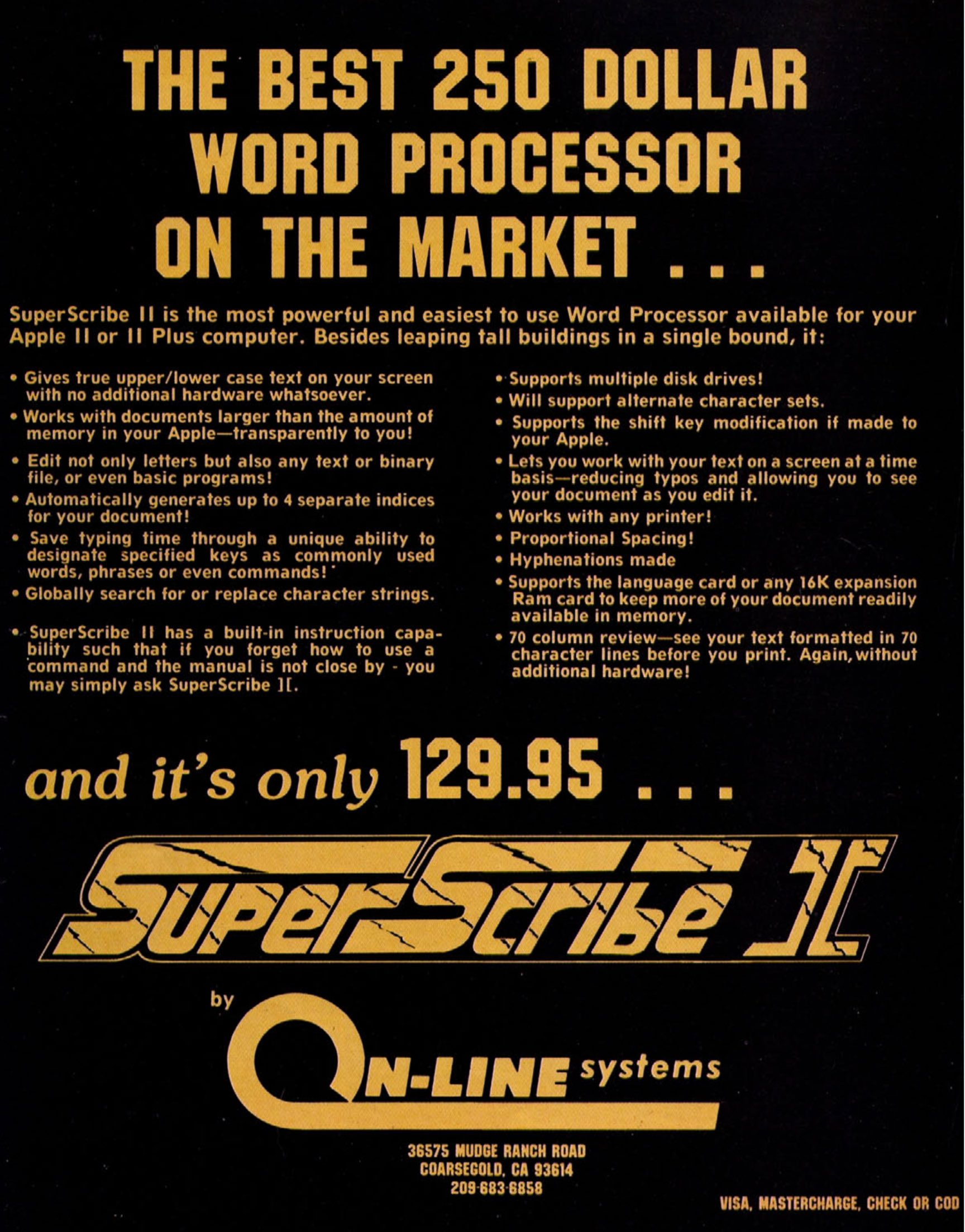
Business software — what there was of it available to the home computer market — was also proportionally much more expensive, but I found the feature list for this word processor to be more amusing: “Gives true upper/lower case text on your screen with no additional hardware support whatsoever.” Gosh!
H/T to BoingBoing for the link.
October 30, 2021
Look at Life — Turning Blades (1962)
PauliosVids
Published 20 Nov 2018The world of the helicopter in 1962; from the Belvedere to the experimental Rotodyne VTOL craft.
October 26, 2021
What is Marmite?
Atomic Shrimp
Published 13 Mar 2021I used Marmite to flavour gravy in a previous video — loads of people asked what it was. Here (I hope) is the answer you need.
I’ve tried — and liked — both Marmite and Vegemite and I have a very slight preference for Marmite, but now I’ll need to search for the reduced salt and XO versions … for science, of course.

October 18, 2021
Look at Life — The Rocket Age Lancers (1961)
PauliosVids
Published 20 Nov 2018Looking to the future with the 9th Queen’s Royal Lancers.

October 15, 2021
QotD: England and the English
But talk to foreigners, read foreign books or newspapers, and you are brought back to the same thought. Yes, there is something distinctive and recognizable in English civilization. It is a culture as individual as that of Spain. It is somehow bound up with solid breakfasts and gloomy Sundays, smoky towns and winding roads, green fields and red pillar-boxes. It has a flavour of its own. Moreover it is continuous, it stretches into the future and the past, there is something in it that persists, as in a living creature. What can the England of 1940 have in common with the England of 1840? But then, what have you in common with the child of five whose photograph your mother keeps on the mantelpiece? Nothing, except that you happen to be the same person.
And above all, it is your civilization, it is you. However much you hate it or laugh at it, you will never be happy away from it for any length of time. The suet puddings and the red pillar-boxes have entered into your soul. Good or evil, it is yours, you belong to it, and this side the grave you will never get away from the marks that it has given you.
Meanwhile England, together with the rest of the world, is changing. And like everything else it can change only in certain directions, which up to a point can be foreseen. That is not to say that the future is fixed, merely that certain alternatives are possible and others not. A seed may grow or not grow, but at any rate a turnip seed never grows into a parsnip. It is therefore of the deepest importance to try and determine what England is, before guessing what part England can play in the huge events that are happening.
George Orwell, “The Lion And The Unicorn: Socialism and the English Genius”, 1941-02-19.
October 3, 2021
The Triumph Spitfire Story
Big Car old account
Published 8 Mar 2019To help me continue producing great content, please consider supporting me: https://www.patreon.com/bigcar
Help support my channel through these Amazon US affiliate links:
Triumph Spitfire t-shirt: https://amzn.to/2KdY33m
Triumph Spitfire baseball cap: https://amzn.to/2U1SrZF
Triumph sweatshirt: https://amzn.to/2KgGIXq
Triumph Spitfire model car: https://amzn.to/2U4gnvo
Triumph keyfob: https://amzn.to/2YTeKV4
Triumph Spitfire metal sign: https://amzn.to/2U2u4ejThe Spitfire is a beautiful automobile, a thing of wonder penned by an Italian genius, but it almost never happened. If not for a chance find in the dusty corner of a factory it would have remained merely a “could have been”. But Triumph produced a car that still inspires new creations today and has a strong and loyal fan base around the world, nearly sixty years since it burst on the scene.
#TriumphSpitfire

September 15, 2021
QotD: The cult of Napoleon
Other Europeans see him very differently. While French historians amplify the myth that Napoleon himself created by dictating his idealized Memoires on St. Helena, English, German, Russian and Spanish authors count up the massacres and the destruction of their cities and their civilization.
Napoleon began shaping his reputation while he was still alive. He commonly wrote reports of his victories before the battles had even begun, which makes him the founding father of fake news. Certain disasters, such as the Battle of Eylau (now in Poland) against the Russians and Prussians, for example, are still inscribed in the walls of the Arc de Triomphe in Paris as if they were victories, since that is how they were first announced.
Since France is now part of Europe — rather than Europe becoming part of France, as Napoleon wished — what should we commemorate? French victories, such as Austerlitz, were defeats for the Russians and Austrians. Waterloo, a day of mourning for the French, is a symbol of liberation for the British, Germans, and Dutch. In any case, since the return of Napoleon’s ashes, our view of history has changed; the fate of people concerns us more than the fate of armies. Napoleon’s stature does not benefit from this change of perspective. To finance his wars, he ruined Europe, banning international commerce (only smugglers got rich), conscripting peasants, ravaging harvests, and confiscating horses. How should we commemorate the Russian and German campaigns of 1812 and 1813, when the Grand Army left in its wake not the liberation of peoples, but famine and epidemic? Worst still, how should we commemorate the restoration of slavery in the French Antilles, Guadeloupe, and Santo Domingo (Haiti), where the deputies of France’s Revolutionary Convention had abolished it in 1794?
Guy Sorman, “Which Napoleon?”, City Journal, 2021-05-14.
September 13, 2021
QotD: Those classic British children’s stories
In a boarding school near the Kentish coast, a ruffian sneaks along the corridor, hunting for the rare stamp that will make him rich. In a Home Counties village, a tousled-haired schoolboy lies awake, putting the finishing touches to his scheme that will win the war for the Allies. Many miles to the north, a boat pulls away from Wildcat Island, bound for fortune and glory. And far across the oceans, a group of schoolboys tremble in terror, as their South Sea captors prepare to sacrifice them to their idol …
Such is the world of the classic British children’s story: the world of Billy Bunter and his Greyfriars chums, William Brown and his fellow Outlaws, Titty, Roger and the rest of the Swallows and Amazons, Jennings, Molesworth and the Secret Seven. For more than half a century, such stories dominated the imagination of millions of readers. You can still buy second-hand editions of Richmal Crompton’s Guillermo el Detective, and wonder what on earth readers in General Franco’s Spain made of them.
When I was growing up, the books of Frank Richards, Arthur Ransome and Richmal Crompton were still everywhere, just about. Our local library groaned with stories in which middle-class British children spent their weekends in the barn across the fields and their weeknights sneaking out of the dormitory for some stolen tuck. Raised on the virtues of teamwork and courage, the boys grew up to become hunters, naval commanders and Spitfire pilots. I never found out what happened to the girls. For a boy in the early Eighties, to have been caught reading Mallory Towers would have been social suicide.
Dominic Sandbrook, “Children don’t need woke stories”, UnHerd, 2021-05-17.
June 19, 2021
Airfix Catalogue 1962 Page by Page — The Very First Catalogue
MOS6510 Models
Published 29 May 2020Airfix Catalogue 1962 Page by Page — The Very First Catalogue
We turn back time and go through the very first Airfix Model kit Catalogue one page at a time. 1962 was the year of the first edition Catalogue of Airfix Constant Scale Construction Kits. Filled with 135 kits — planes, trains and automobiles the norm, with figures trackside OO/HO constant scale. There is lots in here to look at and enjoy.
As you flip through the pages of this Airfix Catalogue, you will see details of over 135 constant scale plastic construction kits. From the photographs and brief descriptions you will get an idea of the look and size of the finished models. Not until you begin to build them, however, will you feel the excitement and satisfaction of creating miniature exact scale models of famous fighter planes, tanks and ships. So put this video on HD 1080p and make it full screen … sit back and enjoy this catalogue page by page
If you liked the video you can buy me a coffee here
https://www.buymeacoffee.com/mos6510Music credit : Music by @ikson -alive https://youtube.com/ikson
Find me on
Twitter : https://twitter.com/MOS6510YT
instagram : https://www.instagram.com/mos6510yt/
Reddit : https://www.reddit.com/r/Scalemodelclub/
Discord : https://discord.gg/e8dp3SGInformation on kits was researched using https://www.scalemates.com plus other websites and forums found on the internet
Links below are affiliated and i will get a small commission which help keep the channel in models
Buy Airfix kits here https://www.tagserve.com/clickServlet…
Tools….
Hardcastle 9 Drawer Red Lockable Topchest Tool Box https://amzn.to/32BjwJ2TaoTronics LED Desk Lamp, 5 Lighting Modes with 7 Brightness Levels, Touch Control, USB Charging Port, https://amzn.to/2Ts3D3k
Smart Weigh SWS600 Elite Pocket Sized Digital Scale https://amzn.to/2vgD5uc
Buy The Humbrol Workstation Bundle here https://amzn.to/2o0aLIr
I get all my Tamiya supplies from http://elementgames.co.uk/?d=10388
Small Acrylic Caddie For Paints, Glues Brushes https://ebay.us/60PFMj
Tweezers I use are https://amzn.to/37B7UXQ
Sprue Cutters
Tamiya 74035 – https://amzn.to/36wqhfP
Plato Model 170 – https://amzn.to/37th0pTHobbyZone Paint Stand / Rack 36mm They fit Tamiya Paints and other paints under 36mm diameter. https://amzn.to/38JgEw7
26mm version https://amzn.to/2NhMIQL
41mm version https://amzn.to/2I1naTC
Other Racks Here https://amzn.to/2Q2qK6g0:01 Airfix Catalogue 1962
0:05 Airfix catalog 1962,
0:10 first edition airfix catalogue,
0:31 Vintage airfix catalog,
0:32 vintage airfix catalogue,
0:33 the very first airfix catalog,
the very first airfix catalogue,
constant scale plastic construction kits,
airfix first edition 1962,
catalogue design of airfix constant scale construction kits,
Airfix aircraft series 2,
Airfix scale model kits catalogue,
1:00 airfix first ever catalogue,
1:15 airfix catalog,
1:20 airfix catalogue
2:20 airfix old catalogue

May 6, 2021
Il Duce and the Fascist Abuse of History | B2W: ZEITGEIST! I E.17 – Harvest 1922
TimeGhost History
Published 5 May 2021The modern age is an age of modern things. But it is also an age when people yearn for times past. One of the main men to weaponize this yearning is Benito Mussolini, and this season, he moves to recreate the Roman Empire in his fascist image.
Get your own Indy Neidell Tie here: https://www.youtube.com/channel/UC4Mi…
Join us on Patreon: https://www.patreon.com/TimeGhostHistory
Hosted by: Indy Neidell
Written by: Francis van Berkel
Director: Astrid Deinhard
Producers: Astrid Deinhard and Spartacus Olsson
Executive Producers: Astrid Deinhard, Indy Neidell, Spartacus Olsson, Bodo Rittenauer
Creative Producer: Maria Kyhle
Post-Production Director: Wieke Kapteijns
Research by: Francis van Berkel and Timothy Smith
Image Research by: Lucas Aimo
Edited by: Lucas Aimo
Sound design: Marek KamińskiColorizations:
– Daniel Weiss
– Mikołaj UchmanArchive by Screenocean/Reuters https://www.screenocean.com.
A TimeGhost chronological documentary produced by OnLion Entertainment GmbH.
From the comments:
TimeGhost History
2 days ago (edited)
The only thing more interesting than learning about history is learning about how people in history learned about history.For starters, it is just interesting in itself. Anyone with a passion for history will want to hear about the circumstances of how a new discovery was made or how certain historical narratives were preserved over time. But more analytically, looking at how a society understood its history can tell you a lot about that society understood itself and the contemporary world around it. That second point is particularly true of the modern age. Ironically, it is a very modern “thing” to be so aware of history. Indeed, the modern age saw the birth of the museum, of nationalist histories, and even the concept of what “History” itself was (note the capital H).
It’s such a massive topic and one that perhaps isn’t suited to a single pinned comment. Interested in learning more? Maybe we’ll do another video on it someday. In the meantime, you can read up the works of Reinhart Koselleck … that should keep you occupied.

April 23, 2021
QotD: Why the British despise the middle class
The aristocracy have always looked down upon the middle class. That gross and inelegant disdain for trade for example. The insistence that actually doing something for a living – even professionally – just isn’t as good as doing nothing off a rent roll.
From the other end we’ve that very bolshie – in the colloquial sense – insistence that the middle class are just parasites upon the toil of the workers. This being what also informs – misinforms – that idea that we’d be better off if we had much more manufacturing. Men in flat caps doing something physical etc.
That is, much of the society dislikes the very existence of the middle class. Actually, more than dislikes, from above they’re – we’re – despised and from below hated to the point that we bourgeoisie should be eliminated as a class.
The surprise that fewer claim to be of that section of the hierarchy than are is thus, well, it’s a surprise, right?
Tim Worstall, “Sociologist Can’t Do Sociology”, Continental Telegraph, 2021-01-19.
April 17, 2021
Can you build a Starter Set Model Kit using ONLY the included paints and glue?
Model Minutes
Published 10 Dec 2020Quite often I get asked if you can build a Starter Set Model Kit using ONLY the included paints and glue? Well, why not? What would it actually look like? I feel like there might be a bit of a CHALLENGE coming on …
Join me in this video as I build (and review) the Airfix Messerschmitt Bf109E-3 plastic model kit in 1/72 scale which comes as part of a starter set — with glue, paint and brush included. I will be building this kit with only these products to see how it turns out.
Unboxing review of this kit:
https://youtu.be/NWHsWtxot_cPlease consider pledging your support to help keep the channel growing from strength to strength. Find out what’s in-store and how to unlock additional perks here: https://www.patreon.com/modelminutes
If you like what I do, why not buy me a coffee over at http://ko-fi.com/modelminutes
Come join the live conversation over at Discord, chat to other modellers in real time! https://discord.gg/JP4tk2n
If you want to buy any of the kits I’ve built or recommend — take a look here (it helps support the channel):
https://www.amazon.co.uk/shop/modelmi…Let’s get social!
https://twitter.com/ModelMinutes
https://www.instagram.com/modelminutes/This video is intended for adult scale model enthusiasts.
Model Minutes holds no responsibility for any accidents, damage or injury that could occur as a result of attempting to replicate any steps depicted in this video.
All music used from the YouTube Audio Library.
#Airfix #Model #Modelkit #starterset #scale #bf109
From the comments:
Model Minutes
4 days ago
Before you leave a comment about thinning the paint or using extra tools/products, read this:I don’t think a lot of people watching this one quite “got” what I was going for here. My aim (if it wasn’t clear) was to see how good I could make this model kit using only the included products and a knife. I gave myself really strict rules to follow in an attempt to get a “best case” model out of a “worst case” situation.
Many people seem to think that beginners would instantly know that they are supposed to thin their paints, sand the plastic, fill the gaps, use extra brushes … and if, as a beginner you knew that, then you were so fortunate!
But this video is for those of us (me included) who knew nothing about model building, had no one to help us and nothing to look to for reference. When I started, YouTube didn’t exist (the internet wasn’t really a thing for me growing up either) and if I wanted to read up about modelling it meant buying magazines and looking for the information.
My build in this video is a throwback to my early days, where I built what I wanted, how I wanted, and usually with only what I had, could borrow, recycle or afford with my small amount of pocket money.
Ultimately though, I think the point of this build and video has been missed by some.
It’s meant to be fun, a light and entertaining look at our hobby. After all, isn’t this hobby supposed to be fun anyway?
I’d also like to think that some beginners out there see this one and realise that you don’t have to build a model kit with all these extra things that so many youtubers use these days. Although it’s good to have aspirations I think it’s unrealistic and can put newcomers off. If my video encourages just one new person to start building, then that’s a success right? We should be encouraging new members to the hobby because it’s in our interest too! If you agree, send someone this video and encourage them to start!
TLDR: I made this video for entertainment. It’s not a tutorial. I added extra restrictions because otherwise it wouldn’t be a “challenge” — it would be a normal build video.