mikeknell
Published 6 May 2014This 1954 documentary is uploaded in a couple of places, but here it is without breaks and in the correct aspect ratio. One of the classic railway films.


mikeknell
Published 6 May 2014This 1954 documentary is uploaded in a couple of places, but here it is without breaks and in the correct aspect ratio. One of the classic railway films.
Classic Vehicle Channel
Published 19 Apr 2020

I’ve never been much of a movie-goer, even before the neverending pandemic lockdown theatre landed on us in 2020, so the chances of me going to see something like Top Gun: Maverick were pretty low (especially as I never bothered to watch the original, back in the day). Paul Wells is in the middle of a European trip, so he did what every travelling North American would do somewhere on the continent of history and culture: he watched a current-release American movie:

The mystery of Maverick is why, by next weekend, it will pass Doctor Strange in the Convolution of Fan Service as the year’s biggest movie, why it is the biggest film of Tom Cruise’s charmed life — why it strikes such a chord in this moment, even though its premises, visual vocabulary and soundtrack are 36 years old. In terms of chronological distance from the original Top Gun, it’s as though the top-grossing movie of 1986 had been a sequel to 1950’s Annie Get Your Gun. (“And there has never been a star as sensational as Betty Hutton!” Annie‘s trailer proclaims. Switch Tom Cruise in for poor Betty and suddenly the claim may actually be true.)
The simplest hypothesis is that Maverick is just big and loud, so you can leave your brain at home and enjoy the spectacle. But lots of lousy movies nobody watched were big and loud, including Matrix: Resolutions and Ghostbusters: Afterlife, so there must be some fuller explanation.
This being a Substack newsletter, I suspect I’m contractually encouraged to argue that Maverick wins because it isn’t woke. I’m afraid I can’t oblige. I mean, the movie definitely makes only the barest acknowledgment of taking place in the 21st century. None of the hotshot young recruits pauses from the action to specify their pronouns. None decorates their flight helmets with empty square brackets to acknowledge their privilege. The film’s few concessions to cultural change since the MTV era have the effect, not of engaging today’s fights on provocatively old-fashioned terms, but of declining to engage. Joseph Kosinski, the journeyman special-effects technician brought in to direct this film in note-perfect homage to the style of the original Top Gun director Tony Scott, doesn’t even bother to make the film’s racial politics as minimally complex as Scott did in 1995’s Crimson Tide. Maverick‘s young recruits, diverse in gender and ethnicity, are awesomely interchangeable in every other way. One smirks, one has a moustache; the others have no identifying characteristics. (When half the recruits get cut from the big mission at the 90-minute mark, there is no dramatic payoff because it’s impossible to tell these people apart. “Sorry, Component A, I’ve decided to go with Component B.”) Nobody under 30 in this film has sex for either pleasure or procreation. Yearning for intimate touch is plainly something only old people do, like writing in cursive script or owning books.
As a cultural argument, Maverick is so close to being tabula rasa that there’s no real point interrogating it. But on another front, it succeeds resoundingly in popular art’s primary function of tantalizing simplification. It started to make sense when I realized that Cruise’s character, despite the denial inherent in his call sign, is a career civil servant.
This is a movie about the action of a large modern state. It’s a film about public policy. Its central claim is a cathartic feat of Avengers-level denial. Just as the superhero movies offer us a made-up universe in which we have any hope of telling the good characters and the evil characters apart, Maverick posits a world in which modern governments can get anything done at all.
I may be influenced in this reading by the fact that I work in contemporary Ottawa. I’ve been writing variations on a simple question — Can Justin Trudeau get big things built? — since 2017. I’m hardly alone. And it’s hardly just a question about Trudeau, Ottawa or Canada. It’s been fun reading about chaos at Toronto’s Pearson airport, but last week the Financial Times ran a “big read” feature story about global airport chaos that didn’t even mention Pearson, Toronto or Canada. Joe Biden promised to Build Back Better. It’s not going great. Here in France, Emmanuel Macron is the first president to be re-elected in 20 years, a genuine feat, but it’s not going great. Brexit? Don’t ask.
A generic term for the ability of governments to do stuff is “state capacity”, and there’s a vague sense in the quasi-academic literature that it’s in decline, although, the real world being the real world, every element of this claim — that state capacity is declining, that it can be measured, that it even exists in any measurable form — is open to dispute. Still, it feels true, don’t it? The world was never great. In important ways it was worse than today. But it used to feel like it was possible to improve the thing, and now it just feels like everyone’s just firing blind and hoping for the best. COVID is a dynamite demonstration of this. Three successive Canadian federal health ministers were told, by a prime minister who prides himself on his ability to read the room, to get cracking on plain-paper packaging for tobacco products. And then the biggest public-health disaster of our lifetimes opened up its jumbo can of whup-ass, and it wasn’t even in the mandate letters. And it’s hard to blame anyone involved. All the chaos that has ensued had its roots in the original chaos. Real life doesn’t have a plot. As Homer Simpson said, it’s just a bunch of stuff that happens.
The Lindy effect, recently popularised by Nassim Nicholas Taleb in Skin in the Game, tries to explain the “Test of Time”, or granny’s wisdom. It’s a heuristic to streamline decisionmaking over the long term, and it has predictive qualities. For example, if a business is only a year old, the most likely scenario is that it will last one year more. However, if it does last two years, then the likelihood that it will last an additional two years increases.
To state the hypothesis as it applies to music: If a song or an album has been remembered for 20 years, then it’s more likely to be remembered for another 20 years. If it’s been remembered for 50 years, then it’s probably pretty damn good. If it’s been remembered for centuries, then it’s probably better than you can understand.
If this is true, then it might explain why anyone who has been listening to music for more than a decade has the sense that music was simply better back in the day. It’s not that music is necessarily worse now, on average – we’re in the moment, and it’s difficult to sort the wheat from the chaff.
What we hear in the daily soundtrack of life, when you’re getting your hair cut, out shopping, something coming from someone’s phone at the other end of the bus, is noise. The quality of this music is going to vary wildly because what is popular doesn’t necessarily correlate to what is good. The signal is the true state of music, which fluctuates, and can come from anywhere from the top of the pop charts to underground niche movements.
What we think of as “good older music” is not representative of the general state of music back then. It might be the case those songs that are remembered, and still played on the radio, TV and movies, happen to be the exceptional outliers. The Lindy effect is about filtering: Time has sifted out the mediocre songs that were popular for arbitrary or non-universal reasons, or were just faddish. If you’re going to go to the trouble of looking back to the 1980s now, what you bring back for us better be good.
And what is considered as great music from decades ago wasn’t necessarily chart material. But in the long term, they have been rediscovered by subsequent generations.
James Smith, “The myth of ‘bad’ modern music”, Being Libertarian, 2019-02-25.
PauliosVids
Published 20 Nov 2018A look at helicopter training within the British Army.

Classic Vehicle Channel
Published 29 Jan 2021This film, part of the Look At Life series explores the various ways folk put old disused items of transport back into use. Fascinating archive of engines and rolling stock being cut up for scrap and factory footage of the “new” diesel locomotives being assembled. We take a glimpse into the lives of people upcyling railway memorabilia, steam wagons and rollers and there’s great footage of a Wynns Pacific transporting a steam locomotive to a museum.
And then you get hold of primary sources on the thirties or fifties. Let’s say it’s particularly hilarious to read stuff from the right lauding that time of great freedom in either of those decades. Let’s just say that if some of the things happening back then were happening now we’d all be talking about how we were ready for revolution. (And the only reason they weren’t then is that the press was mass-media. You think it’s bad enough now, with a lying press? They had the same, but no way to check it. It was that concentration and lack of individual communication or access to the public by individuals unfiltered by the media/publishers that put us in the situation we’re in, with what is functionally the enemy of western civilization in control of the vital organs of culture. Before you get discouraged, it helps to remember, we’re only now fighting back. Continue fighting, but remember things take time. The larger a movement is, the longer it takes for it to become noticeable, much less prominent in the culture.)
And as for the left thinking that everyone before the oughts were good white Christians or whatever … Oh, sweet summer children. Let’s say when they get their freak on, with witchcraft or being naked in public, or talking about their poly relationships, or whatever the actual hell they have in their heads that day, they rarely if ever (I’ve never seen it) would have managed to shock their ancestors or ancestresses 100 years ago. Those Edwardians … well … Let’s just say they had fewer hangups. Yes, I know what the public image is. But none of them would have worried about things that the left worries about now like “differential of power” or “implied patriarchy” which meant they were much freer to do whatever crossed their heads at the moment. Of course they also thought they would have shocked their ancestors. And I bet you they wouldn’t.
At some point, if you have a chance, read a book called Our Bones Are Scattered about the Indian revolt in Victorian times. I only read it once because it’s a deeply disturbing book, one of those clashes of civilization where you feel sorry for both sides. But it is very well written, and the beginning of the book is … revealing. The British commander was … well … sort of married to a woman who had been sort of married something like six times before and who went from man to man, collecting kids along the way. Notwithstanding which, they were Victorian nobility and had a bunch of kids of their own and …
Let’s just say Victorians aren’t the way we’ve learned to think of them either. In fact you can be sure pretty much no one ever was. People kept and keep the front they need to, but behind the scenes things were always messy and complicated.
Which often makes finding our own way in this messy and complicated way very difficult.
Sarah Hoyt, “Finding Your Way”, According to Hoyt, 2019-02-18.
KPICS
Published 10 Mar 2014The London Taxi industry in 1960.
In the most recent Weekly Dish, Andrew Sullivan looks at the quasi-Imperial goals of Vladimir Putin:

Imperial Standard of the Emperor of Russia, used from 1858 to 1917.
Image by Trajan 117 via Wikimedia Commons.
“The huge iceberg Russia, frozen by the Putin regime, cracked after the events in Crimea; it has split from the European world, and sailed off into the unknown,” – Vladimir Sorokin, New York Review of Books, 2017.
The greatest mistake liberals make when assessing reactionaryism is to underestimate it. There is a profound, mesmerizing allure — intensified by disillusion with the shallows of modernity — to the idea of recovering some great meaning from decades or centuries gone by, to resurrect and resuscitate it, to blast away all the incoherence and instability of post-modern life into a new collective, ancient meaning.
Even when it’s based on bullshit. You’d be amazed how vacuous slogans about returning to a mythical past — “Make America Great Again!”, “Take Back Control!” — can move public opinion dramatically in even the most successful modern democracies. That’s one reason it’s self-defeating for liberals to press for maximal change in as many things as possible. National identity, fused often with ethnic heritage, has not disappeared in the human psyche — as so many hoped or predicted. It has been reborn in new and strange forms. Now is the time of monsters, so to speak. Best not to summon up too many.
This, it seems to me, is what many of us have missed about the newly visible monster of post-Communist Russia. It would be hard to conjure up a period of post-modern bewilderment more vividly than Russia in the post-Soviet 1990s. A vast empire collapsed overnight; an entire totalitarian system, long since discredited but still acting as some kind of social glue and cultural meaning, unraveled in chaos and confusion.
Take away a totalitarian ideology in an instant, and a huge vacuum of meaning will open up, to be filled by something else. We once understood this. When Nazi Germany collapsed in total military defeat, the West immediately arrived to reconstruct the society from the bottom up. We de-Nazified West Germany; we created a new constitution; we invested massively with the Marshall Plan, doing more for our previous foe than we did for a devastated ally like Britain. We filled the gap. Ditto post-1945 Japan.
But we left post-1991 Russia flailing, offering it shock therapy for freer markets, insisting that a democratic nation-state could be built — tada! — on the ruins of the Evil Empire. We expected it to be reconstructed even as many of its Soviet functionaries remained in place, and without the searing experience of consciousness-changing national defeat. What followed in Russia was a grasping for coherence, in the midst of national humiliation. It was more like Germany after 1918 than 1945. It is no surprise that this was a near-perfect moment for reactionism to stake its claim.
It came, like all reactionary movements, not from some continuous, existing tradition waiting to be tweaked or deepened, but from intellectuals, making shit up. They created a near-absurd mythology they rescued from the 19th and early 20th centuries — packed with pseudo-science and pseudo-history. Russia was not just a nation-state, they argued; it was a “civilization-state”, a whole way of being, straddling half the globe and wrapping countless other nations and cultures into Mother Russia’s spiritual bosom. Russians were genetically different — infused with what the reactionary theorist Lev Gumilev called “passionarity” — a kind of preternatural energy or will to power. They belonged to a new order — “Eurasia” — which would balance the Atlantic powers of the US and the UK, and help govern the rest of the world.
In The Line (which is operating on skeleton staff due to March break), Laura Mitchell considers the existential question of Canadian nationhood: what if we’re just a bunch of hosers?

Bob and Doug MacKenzie’s “Great White North” on SCTV.
Screencapture from YouTube.
Remember Bob and Doug MacKenzie? I’m old enough to have owned a bag featuring this pair, Canada’s quintessential Hosers. But for those of you who might not remember, Bob and Doug were a pair of TV characters played by Canadian comedians Rick Moranis and Dave Thomas, who played up Canada’s silly, self-deprecating sense of humour on SCTV.
[…]
Now, The Canadian Encyclopedia has a definition and an entry to define this particular personality subtype, and it’s not terribly flattering:
Hoser: is a slang word for a Canadian of limited intelligence and little education.
I profoundly disagree. Hoser is all of us and we are all hosers.
Hidden in the silliness of baby bottle beer chugging and yodelling, there is subtle genius to the premise behind these characters (beyond the genius of the entire concept, of course — Bob and Doug sketches were cheekily and overtly mocking “CanCon” rules by providing government regulators content that was wildly over the top in its stereotypical portrayal of an average Canadian). In this particular sketch, we see just two normal dudes concerned about local matters and asking basic questions. They don’t try to be anything more than they are and they don’t apologize.
In the entry above in the Canadian Encyclopedia, there is much hand wringing over the idea that a hoser has to be white. This obviously stems from the fact Rick Moranis and Dave Thomas are white and the skits are set in rural Ontario in the early ’80s, when Canada was noticeably less diverse. But focusing on race misses the point of the whole thing. Hoserdom isn’t racial, it is a state of mind. To be a Hoser is to accept your place in the world and to be at peace with it.
[…]
The Canada of the 21st century is suffering from an identity crisis — somewhere along the line we stopped feeling inferior and began to fancy ourselves superior. Whether it be our health-care system, immigration policies, perceived influence on global affairs or success of some of our celebrities (looking at you, Celine Dion), we took on a feeling of grandiose majesty we simply don’t deserve. Our current prime minister is the personification of this collective delusion — pretty on the outside but hollow and fake beneath. Canada is alarmingly little more than a two-bit Instagram influencer with a closet full of free designer clothes but no ability to pay the gas bill.
QI
Published 15 Nov 2021Follow QI on Twitter ▶ http://twitter.com/qikipedia
Follow QI on TikTok ▶ https://www.tiktok.com/@theqielves
Follow QI on Instagram ▶ http://instagram.com/theqielves
For more visit ▶ http://qi.comThis clip is from QI Series I, Episode 8, “Inequality” with Stephen Fry, Alan Davies, Clive Anderson, Sandi Toksvig and Henning Wehn.

travelfilmarchive
Published 12 Nov 2008An educational film about train travel in the 1950s. To purchase a clean DVD or digital download of this film for personal home use or educational use contact us at questions@archivefarms.com. To license footage from this film for commercial use visit: www.travelfilmarchive.com
In The Critic, Alexander Larman celebrates the centenary of Richmal Compton’s William Brown books:

Growing up in suburban Bristol in the Eighties and Nineties, my reading matter was of a suitably timeless disposition, even if it seldom, if ever, included any Enid Blyton. Amidst the colonial and deeply un-PC likes of Biggles and Rider Haggard, my trio of preferred characters never really changed: Jennings, Billy Bunter and William Brown. Of the three, Jennings was probably my favourite, being closest to my own life as a prep school boy of a vaguely similar appearance and age, and also because the situations were the most recognisable. Bunter I found uproarious but also rather tasteless and absurd, for reasons that have now, alas, become much clearer. And then there was William Brown: would-be outlaw, committed dog owner and perpetual enemy of soap-and-water, to say nothing of his perpetual nemeses, Hubert Lane and Violet Elizabeth Bott.
I enjoyed the books as picaresque stories of bad behaviour without seeing much of myself in William, or indeed his friends. Their author Richmal Crompton’s evocation of invincible pre-war suburbia — not so very far from a benign version of the half-idylls, half-nightmares portrayed by Orwell in Coming Up For Air and Patrick Hamilton in Hangover Square — was certainly compelling, but I was too young to appreciate Crompton’s social satire, itself considerably more piquant than anything that could be found in Jennings and Bunter, let alone the stiff-upper-lip fantasias of English manhood peddled by WE Johns with Biggles, Gimlet and the rest. All of them now sound to me like nothing so much as industrial-strength cocktails. Drink a couple, and you too will want to revive the Empire.
Yet now, a century after the first appearance of Just William, I reassess Crompton’s universe afresh, and so I respond far more warmly to her characters and creations. William Brown himself is an entertaining if undeniably two-dimensional figure, at his most amusing when he is required to fit into the adult world temporarily, as in the story William’s Truthful Christmas, when he causes social outrage and misery by offering an honest opinion of the gifts that he has received. But it is the rich panoply of figures around William who give the stories their interest and colour, and which make them as entertaining for adults to read today as they ever might be for their children. If, of course, eleven-year olds can be distracted from their iPads and Netflix and nefarious online activities long enough to enjoy the William books.
Leaving aside the children for a moment, the adult supporting characters in the unnamed village provide endless humour and intrigue. There is William’s neurotic mother, desperately saying of her son that “he means well” even as he is involved in yet another humiliating scrape. His father, meanwhile, is a hard-drinking Conservative whose cynicism at the world sees him reward his errant son with extra pocket money for his more outrageous actions, as long as he is not bedbound with “his liver”. Not for nothing is this stalwart representative of middle England named John Brown.
Then there is William’s would-be romantic elder brother Robert, desperately professing each of his girlfriends “the most beautiful girl in the world” until his eye is taken by another. Mr and Mrs Bott are a pair of arriviste millionaires who have made their money via “Bott’s Digestive Sauce”, a substance that William contends, probably accurately, has been constructed from squashed beetles. Needless to say, they take up residence in the nouveau riche establishment Bott Hall, where their social status irks them. (“We ought to have some ancestors, Botty,” said Mrs Bott. “We’ve got ’em, dear,” said Mr Bott after a moment’s thought. “We must have. Come to think of it, we shouldn’t be here now if we’d not.”) Floating around the periphery is Robert’s friend, the splendidly named Jameson Jameson, of whom Crompton writes, with caustic humour, “[his] parents had perpetrated on him the supreme practical joke of giving him his surname for a Christian name, so that people who addressed him by his full name seemed always to be indulging in some witticism.”
Sebastian Milbank on the often disparaged nostalgic view of “the good times of old England”:
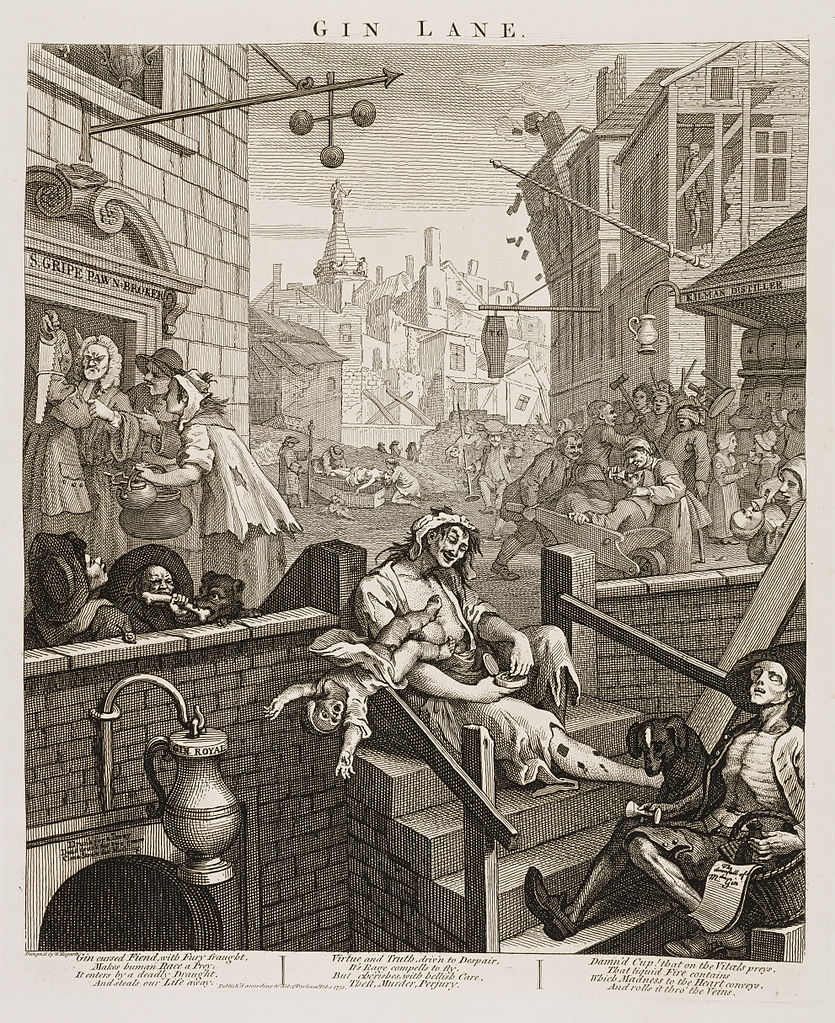
Gin Lane, from Beer Street and Gin Lane. A scene of urban desolation with gin-crazed Londoners, notably a woman who lets her child fall to its death and an emaciated ballad-seller; in the background is the tower of St George’s Bloomsbury.
The accompanying poem, printed on the bottom, reads:
Gin, cursed Fiend, with Fury fraught,
Makes human Race a Prey.
It enters by a deadly Draught
And steals our Life away.
Virtue and Truth, driv’n to Despair
Its Rage compells to fly,
But cherishes with hellish Care
Theft, Murder, Perjury.
Damned Cup! that on the Vitals preys
That liquid Fire contains,
Which Madness to the heart conveys,
And rolls it thro’ the Veins.
Wikimedia Commons.
The decadence and excess of the city is of a piece with puritanical restraint
William Wordsworth wrote:
They called Thee Merry England, in old time;
A happy people won for thee that name
With envy heard in many a distant clime;
And, spite of change, for me thou keep’st the same
Endearing title, a responsive chime
To the heart’s fond belief; though some there are
Whose sterner judgments deem that word a snare
For inattentive Fancy, like the lime
Which foolish birds are caught with. Can, I ask,
This face of rural beauty be a mask
For discontent, and poverty, and crime;
These spreading towns a cloak for lawless will?
Forbid it, Heaven! and Merry England still
Shall be thy rightful name, in prose and rhyme!Merry England is an easily mocked concept in today’s society, but in my view it carries a perennial insight: that the decadence and excess of the city is of a piece with puritanical restraint. Both apparently opposite features reflect an urban sophistication and the ruling imperative of commerce. The moneymaking frenzy of cities like London gave rise to excessive consumption and the relaxing of prior moral and social norms. Yet the 17th century Puritans were in large part cityfolk, alienated from rural tradition and well represented amongst bankers, merchants and urban middle class trades and professions.
William Hogarth’s most famous engraving is Gin Lane, which shows a street filled with people immiserated by the gin craze, a child toppling out of its mother’s arms, emaciated figures dying in the open, madmen dancing with corpses, a pawn-shop with the grandeur of a bank eagerly sucking in objects of domestic industry and converting them into gin money. Less well known is the image that accompanied it, the engraving Beer Street. In this latter engraving, plump and prosperous individuals pause from their labour to receive huge foaming mugs of ale, buxom housemaids flirt with cheerful tipplers, bright inn signs are painted, buildings are going up, and the pawn-shop is going out of business.
Merry England is an image of a society centred on human life and happiness rather than the demands of commerce. Here labour and rest both have their place: noble objects like a fine building and a bounteous meal are provided by hard work, but once completed, time is devoted to appreciating and relishing the finished product. Decoration and adornment are the outward sign of this; they are by their nature a form of abundance. The finite object of labour and production thus gives rise to an infinite realm of feast, celebration, adornment and signification. This enchanted public sphere, shaped to the human person, is limitless within its limits, and points beyond itself to the truly limitless and eternal world of the transcendent.
In the commercially determined sphere of modernity, it is instead work and consumption that are rendered limitless. The objects have become entirely ones of consumption — there is no limit to the consumption of gin, which stands in for all consumer objects. Hogarth shows us the humane objects of household industry — the good cooking pots, the tongs, the saw and the kettle — replaced with money. Liquidity is everywhere, capital has broken down the social order, removing all distinctions of sex, age and class. Now all persons and all things are joined together by a single seamless system of predation.
The alternative that many advocated to this situation was embodied in the Temperance movement: a Puritan-dominated enterprise which saw drinking as a threat to industry as well as the spiritual and moral health of the nation. This is a deep tendency in the British character: the impulse to look upon poverty and distress as a culpable disease and to preach individual self-restraint as the cure. Puritans were often well-to-do, literate townspeople, whose collective refusal to participate in dancing, drama, drinking, gambling, racing and boxing not only set them apart from the boisterous lower orders, but also from the quaffing, hunting, hawking and whoring nobility.
James Lileks



Powered by WordPress