
March 22, 2011
March 18, 2011
Ignoring death threats to politicians (but only on the right)
An interesting article at the Huffington Post on the relative media silence on the spate of death threats against Wisconsin politicians:
Why isn’t the mainstream media talking about the death threats against Republican politicians in Wisconsin?
Try to set aside whatever biases or preconceptions you might have for a moment and ask yourself why death threats against politicians aren’t considered national news, especially in the wake of the all too fresh shooting of Rep. Gabrielle Giffords and other bystanders. And there hasn’t just been one death threat, but a number of them.
Here’s an example and it’s real. According to Wisconsin State Department of Justice, authorities have found a suspect who admitted to sending the following email:
I want to make this perfectly clear. Because of your actions today and in the past couple of weeks I and the group of people that are working with me have decided that we’ve had enough. We feel that you and your republican dictators have to die. This is how it’s going to happen: I as well as many others know where you and your family live, it’s a matter of public records. We have all planned to assult you by arriving at your house and putting a nice little bullet in your head. However, this isn’t enough. We also have decided that this may not be enough to send the message. So we have built several bombs that we have placed in various locations around the areas in which we know that you frequent. This includes, your house, your car, the state capitol, and well I won’t tell you all of them because that’s just no fun. Since we know that you are not smart enough to figure out why this is happening to you we have decided to make it perfectly clear to you. If you and your goonies feel that it’s necessary to strip the rights of 300,000 people and ruin their lives, making them unable to feed, clothe, and provide the necessities to their families and themselves then We will “get rid of” (in which I mean kill) the 8 of you. Please understand that this does not include the heroic Senator that risked everything to go aganist what you and your goonies wanted him to do. The 8 includes the 7 senators and the dictator. We feel that it’s worth our lives becasue we would be saving the lives of 300,000 people. Please make your peace with God as soon as possible and say goodbye to your loved ones we will not wait any longer. Goodbye ASSHOLE!!!!
After the Giffords shooting, authorities have to take this sort of threat seriously. The media should too, even if the disturbed person who sent that email was motivated by exactly the kind of rhetoric that’s been used by many liberals against GOP officials over and over again during the Madison protests. And there are more threats floating around the internet, in varying degrees of scary and credible.
The Google search for the string “Wisconsin death threats” only returned 704 results for me this morning, and the only major media outlets represented on the first page were the Chicago Sun-Times and Fox News.
March 16, 2011
Nick Clegg: “These laws make a mockery of British justice”
Every now and again, you find a politician with the right approach to solving a problem. Right now, that politician appears to be Nick Clegg:
London is the number one destination for libel tourism, where foreign claimants bring cases against foreign defendants to our courts — even when the connection with England is tenuous at best. It is a farce that has prompted Barack Obama to legislate to protect his citizens from rulings in our courts.
These laws make a mockery of British justice. They kill debate and smother scientific inquiry. They undermine our moral authority as we seek to promote the values of an open society in other parts of the world.
And it is ordinary people who really suffer: protecting their interests means ensuring corruption can be unearthed and charlatans exposed. Of course, individual citizens must be able to protect their reputations from false and damaging claims, and we cannot allow companies to be the victims of damaging, untrue and malicious statements.
But from the humble blogger to the consumer watchdog, corporate whistleblower, medical researcher, or roving reporter, public-spirited voices must be heard.
Here’s hoping that the new legislative changes will address the worst of the problems, not just paper over a few of the lesser sins.
March 14, 2011
Canadian in Japan claims government “providing no help” to him
Phillip Ilijevski is shocked that the Canadian government hasn’t been providing him with personalized information on what’s happening near him:
A Toronto man living in Japan says the federal government is “providing no help” to Canadians wanting to know if they should leave the earthquake and tsunami-ravaged country, especially given the nuclear threat.
Phillip Ilijevski teaches English in Takasaki, about 100 kilometres north of Tokyo. He called Canada’s Department of Foreign Affairs and International Trade to find out if it’s safe to stay in Japan, but says the only advice they gave him was to watch the news.
I have no idea why the Canadian government is expected to have better information on what’s happening in Japan in the aftermath of the earthquake and tsunami than the Japanese government, but it must be Stephen Harper’s fault, right?
If Mr. Ilijevski was in a third world nation with poor communications and little infrastructure, it might be reasonable to assume that Canadian officials would be in a better position to provide advice than local government, but in this case there’s no reason — Japan is better equipped to handle this kind of disaster (and public information flow) than just about any other nation on earth.
As jonkay said in a Twitter update: “As usual,when disaster strikes abroad, TStar’s #1 focus is finding a Canuck to bitch about how Ottawa isn’t helping him”
I’m not sure what a “paprade” is, but apparently Toronto had one
 I guess the weekend staff were celebrating St. Patrick’s day a little early, as not only the photo caption (left) but also the pa(p)rade directions leave you a little misdirected:
The parade begins at Bloor and St. George Sts. and heads west to Yonge, where it turns south and goes to Queen and then heads west again to University, ending just south of Dundas on University.
The streets are expected to be closed from 8 a.m. to 3 p.m., making driving to the parade difficult.
Highlighting mine. Going west from Bloor and St. George won’t get you to Yonge Street for a fair amount of time:
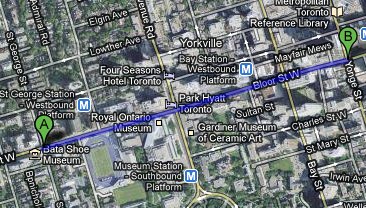
H/T to Chris Greaves for bringing this to my attention.
March 5, 2011
Local SCA group gets a bit of newspaper coverage
Actually, compared to a lot of newspaper articles on the SCA, this one isn’t too bad:
The Society is a global organization with some 30,000 registered members reliving the world before the 17th century. Most stick to European history, but there are plenty of katana-wielding Japan enthusiasts among the ranks. Members get together and do any and everything medieval and renaissance, from armored combat and blacksmithing to the craftier trades such as glass-etching and embroidery.
The Toronto group is know as the Canton of Eoforwic
of, one chapter of the Kingdom of Ealdormere, which encompasses most of Ontario and is one of 19 worldwide kingdoms. Each kingdom has its own King, Queen and handful of other royals and nobility.Unlike a Renaissance Faire, these gatherings are not for anyone’s entertainment but their own.
“We’re not playing to an audience, we’re just doing things for fun,” Ms. Carroll-Clark says.
No mention of rapier combat (my bit of the SCA), but that’s not surprising — even in the SCA it’s a minority interest.
February 27, 2011
Athletes in the age of Facebook and Twitter
John Holler makes several good points in this story about a couple of NFL hopefuls who are having to defend their reputations due to the wonderful rumour-spreading abilities of social media and the willingness of sports reporters to try to create controversy:
Saturday at the Scouting Combine in Indianapolis, we got our first intense view of this media “New World Order.” Cam Newton and Ryan Mallett are two of the top quarterback candidates in this year’s draft. Yet, both of them spent significant portions of their media access to address questions that have nothing to do with football.
Newton, who has been under the media microscope for the last several months, had to clarify a comment he made about wanting to be “an entertainer” and “an icon.” It was a flippant comment made by a kid who is going to turn 22 in May. In his case, the question should be, “Yeah, so?” not a sanctimonious rant by media “entertainers” and/or “icons” to pass judgment that he is not focused on being a football player, but more interested in being a rock star.
Guess what? Newton should have nothing to apologize for. If you’re a star in the NFL, you are an entertainer. People drop hundreds of dollars to watch you perform for three hours. There are thousands of people employed to discuss what you do for a living. There is little difference between Peyton Manning and Bruce Springsteen. They do the same thing — entertain packed houses wherever they perform. [. . .]
Mallett is a different story. He has been called to task by what everyone reporting on it claims are rumors that he not only has taken drugs in college (no!) but might have an addiction to the party lifestyle. If it is true, he won’t be the first and he won’t be the last college football player to do things he wouldn’t put on his résumé. The timing of the accusations, the week of the NFL Scouting Combine, seems interesting. However, his response was hard to justify.
If there was no basis to the accusations, Mallett should have been advised to come out aggressive — denying the charges immediately and owning the situation before he gets his 15 minutes with NFL teams. Instead, he deflected the questions, which only gives rise to more speculation. In the Facebook/TMZ world we live in now, you can bet that media members are going to be provided with information — some will pay for it, others won’t — that will portray a bad side of Mallett that he likely doesn’t deserve, but will surely have to answer to.
The stakes are high for both of these young men: a badly chosen phrase could lose them literally millions of dollars by lowering their chances of being a high draft choice. It’s tough enough for media personalities and politicians to tap-dance around awkward situations, but young 20-something athletes don’t have the experience to avoid falling into the verbal traps.
February 20, 2011
Tunnelling man desperate for coffee
An amusing story from Yolk Region News:
Duane Oppenheimer, 59 1/2, of Newmarket was charged with mischief and unlawful excavation on Wednesday evening, after cleaning staff at Upper Canada Mall discovered a large rectangular crack in a utility closet floor. The crack turned out to be a hatch leading to Oppenheimer’s tunnel, a 200-metre subterranean passageway that extended under the mall’s south parking lot and continued below Davis Drive into an adjacent subdivision where it emerged inside the Oppenheimer’s garage.
H/T to Jon, my former virtual landlord, who said “Who knew that people in Newmarket were so industrious?”.
February 13, 2011
February 4, 2011
The Montreal Gazette‘s 1969 view of the year 2000
Paleofuture‘s Matt Novak digs up a Montreal Gazette cartoon from 1969:

The January 18, 1969 Montreal Gazette ran this most peculiar comic, chock full of hilarious expositional dialogue and dystopian delights.
We follow the futuristic misadventures of George Daedalus, also known as Daeda 928 502 467, in the year 2000 AD. George lives in Oshtoham, Canada’s second largest city — which I’m guessing is a combination of the cities Oshawa, Toronto and Markham — and works as a travel agent. George lives his life surrounded by technological wonders like robot servants, videophones, moving sidewalks and 3D hologram walls, but we come to find out that he’s really just not that happy. The last panel shows George taking drugs and using a computer to escape his reality. Boy am I glad I don’t live in that future!
H/T to Cory Doctorow for the link.
January 21, 2011
Remaking Red Dawn as a metaphor for US fear of China
David Harsanyi notes the remake of the 1980’s movie Red Dawn with the Chinese taking the place of the original film’s Soviet and Cuban troops:
Doubtlessly, the remake will be entertaining and offer a far more plausible plot line than the original — seeing that the Chinese, well, they have a proper army. Producers will almost certainly capitalize on a growing alarmism regarding China’s growth. Few issues, in fact, can bring right and left together in this polarized world of ours than a shared knowledge that China is bad news.
Now, the American populace can typically be divided into two categories: 1. Those who don’t care one whit about foreign policy. 2. Newspaper editors.
So before Chinese President Hu Jintao was here meeting with the president, Andrew Kohut of the Pew Research Center took to the pages of The Wall Street Journal and explained what we think about the topic.
Apparently, 47 percent of those he surveyed cited China as the world’s top economic power. (Only 31 percent properly identified it as the U.S., which has an economy nearly three times the size.) Another Pew survey from last year found that 47 percent of us consider China’s growth a “bad thing” for the United States. A new CNN poll found that 58 percent of us believe that China’s “wealth and economic power” are a threat to the U.S.
I’m certain our relationship with China is layered with international complexity and fraught with danger. But why would we fear the aspects of China’s ascendancy — its “wealth and economic power” — that pose the least threat to United States? Unlike ideological clashes, economic competition can be mutually beneficial. A country with real economic wealth is typically free and doesn’t look kindly on radical behavior. Suicide bombers rarely drive top-of-the-line BMWs.
I have a long history of doubting the stated size and growth of the Chinese economy and therefore feeling that the “threat” they pose is overstated. Overall, the economic growth in China is a good thing, both for China and for the world economy, but there’s still too much malignancy from the “bad old days” of the command economy that haven’t been properly dealt with. China is big, and getting bigger, but will face severe problems the longer these historical artifacts remain unexamined and unresolved.
January 20, 2011
In case you weren’t worried enough about the rise of China
The Wall Street Journal rounds up the leading indicators of the current “USA sliding down the ladder” worries:
Of all the differences between dictatorship and democracy, probably none is so overlooked as the ability of the former to project strength, and the penchant of the latter to obsess about its own weakness.
In 1957 the Soviets launched Sputnik and the U.S. went into a paroxysm of nerves about our supposed backwardness in matters ballistic. Throughout the 1980s Americans lived with “Japan as Number One” (the title of a book by Harvard professor Ezra Vogel, though the literature was extensive) and wondered whether Mitsubishi’s purchase of Rockefeller Center qualified as a threat to American sovereignty.
Now there’s China, whose President is visiting the U.S. this week amid a new bout of American hypochondria. In an op-ed last week in these pages, Andrew Kohut of the Pew Research Center noted that a plurality of Americans, 47%, are under the erroneous impression that China is the world’s leading economy. News reports regarding Chinese military strides, or the academic prowess of Shanghai high school students, contribute to Western perceptions of Chinese ascendancy. So does the false notion that Beijing’s holdings of U.S. debt amounts to a sword of Damocles over Washington’s head.
Oh, we nearly forgot: Tough-as-nails Chinese mothers are raising child prodigies (a billion of them!) while their Western counterparts indulge their kids with lessons in finger-painting.
There you go, more than enough to keep you up late tonight worrying about the inevitability of China’s rise to top economic dog in the pack. Of course, most of it is misinterpretation of the facts, but you can worry about it if you want.
H/T to Jon, my former virtual landlord, for the link.
January 3, 2011
Healthy skepticism about study results
John Allen Paulos provides some useful mental tools to use when presented with unlikely published findings from various studies:
Ioannidis examined the evidence in 45 well-publicized health studies from major journals appearing between 1990 and 2003. His conclusion: the results of more than one third of these studies were flatly contradicted or significantly weakened by later work.
The same general idea is discussed in “The Truth Wears Off,” an article by Jonah Lehrer that appeared last month in the New Yorker magazine. Lehrer termed the phenomenon the “decline effect,” by which he meant the tendency for replication of scientific results to fail — that is, for the evidence supporting scientific results to seemingly weaken over time, disappear altogether, or even suggest opposite conclusions.
[. . .]
One reason for some of the instances of the decline effect is provided by regression to the mean, the tendency for an extreme value of a random quantity dependent on many variables to be followed by a value closer to the average or mean.
[. . .]
This phenomenon leads to nonsense when people attribute the regression to the mean as the result of something real, rather than to the natural behavior of any randomly varying quantity.
[. . .]
In some instances, another factor contributing to the decline effect is sample size. It’s become common knowledge that polls that survey large groups of people have a smaller margin of error than those that canvass a small number. Not just a poll, but any experiment or measurement that examines a large number of test subjects will have a smaller margin of error than one having fewer subjects.
Not surprisingly, results of experiments and studies with small samples often appear in the literature, and these results frequently suggest that the observed effects are quite large — at one end or the other of the large margin of error. When researchers attempt to demonstrate the effect on a larger sample of subjects, the margin of error is smaller and so the effect size seems to shrink or decline.
[. . .]
Publication bias is, no doubt, also part of the reason for the decline effect. That is to say that seemingly significant experimental results will be published much more readily than those that suggest no experimental effect or only a small one. People, including journal editors, naturally prefer papers announcing or at least suggesting a dramatic breakthrough to those saying, in effect, “Ehh, nothing much here.”
The availability error, the tendency to be unduly influenced by results that, for one reason or another, are more psychologically available to us, is another factor. Results that are especially striking or counterintuitive or consistent with experimenters’ pet theories also more likely will result in publication.
December 15, 2010
This is a sign of a slow news week
When the National Post carries a story about someone purloining one of the wise men figures from a church in Brooklin:
Durham Region police reported that the 6′ x 3′ plywood cutout of one of the Three Wise Men was stolen in the early morning hours Dec. 12, and the church had said they would like it returned.
“It’s a bit of an insult,” said Brooklin United Church council chair Rick Barnes.
Mr. Barnes said the thieves were caught on camera, and said they appeared to be “a bunch of kids goofing around and having fun.” The wooden cut-out, which was fastened to a metal post and then attached to the larger constructed scene, would be hard to remove quickly, he said.
“It didn’t take all night but it took them a considerable effort to get it removed,” he said.
Mr. Barnes said that although Brooklin United doesn’t plan to make a big deal out of the incident, it is unfortunate for the church, who have limited resources to begin with.
Brooklin is kind of a quiet place . . . but even here, this isn’t really a big story. Why the National Post bothered to report on it, I can’t begin to imagine.
December 4, 2010
QotD: “Every futuristic vision that starts with a clean slate has a genocide or an apocalypse lurking in it”
Here’s a clip of HG Wells in 1943 predicting the demise of the newspaper, as people abandon print journalism in favor of using their telephones for up-to-the-minute news.
In one way, it’s very prescient — “using the telephone to get the news” isn’t so far off from what we do on the web today. But in another way, it’s exactly wrong (after all, it’s been nearly 70 years and there are still newspapers), And it’s wrong in a way that futurists are often wrong: it assumes a clean break with history and the positive extinction of the past. It predicts an information landscape that is reminiscent of the Radiant Garden Cities that Jane Jacobs railed against: a “modern” city that could only be built by bulldozing the entire city that stood before it and building something new on the clean field that remained. Every futuristic vision that starts with a clean slate has a genocide or an apocalypse lurking in it. Real new cities are build through, within, around, and alongside of the old cities. They evolve.
As Bruce Sterling says, “The future composts the past.” What happened to newspapers is what happened to the stage when films were invented: all the stuff that formerly had to be on the stage but was better suited to the new screen gradually migrated off-stage and onto the screen (and when TV was invented, all the “little-screen” stories that had been shoehorned onto the big screen moved to the boob-tube; the same thing is happening with YouTube and TV today). Just as Twitter is siphoning off all the stuff we used to put on blogs that really wanted to be a tweet.
Cory Doctorow, “Newspapers are dead as mutton – HG Wells, 1943 (No, they’re not)”, BoingBoing, 2010-12-03


