A few visits to this site will quickly disabuse you of that feeling.

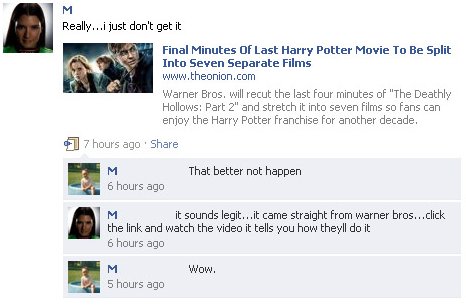
It’s how some folks on Facebook react to stories from The Onion as if it was real news.

A few visits to this site will quickly disabuse you of that feeling.
It’s how some folks on Facebook react to stories from The Onion as if it was real news.
It’s the 190th anniversary, so the folks at The Guardian have virtually turned the calendar back:
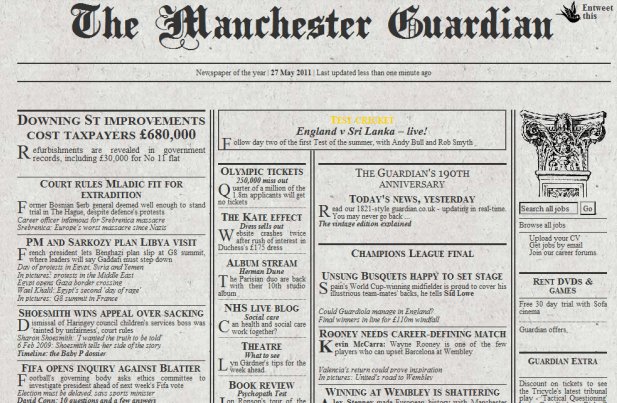
More information about the “experiment in the typesetting of the mechanical facsimile we operate at guardian.co.uk” here.
William Easterly and Laura Freschi have determined the decision tree for publishing crappy social science research:
Aid Watch has complained before about shaky social science analysis or shaky numbers published in medical journals, which were then featured in major news stories. We questioned creative data on stillbirths, a study on health aid, and another on maternal mortality.
Just this week, yet another medical journal article got headlines for giving us the number of women raped in the DR Congo (standard headline: a rape a minute). The study applied country-wide a 2007 estimate of the rate of sexual violence in a small sample (of unknown and undiscussed bias). It did this using female population by province and age-cohort — in a country whose last census was in 1984.
We are starting to wonder, why does dubious social science keep showing up in medical journals?
The medical journals may not have as much capacity to catch flaws in social science as in medicine. They may desire to advocate for more action on tragic social problems. The news media understably assume the medical journals ARE vetting the research.
H/T to Tim Harford for the link.
Stephen Gordon points out that there appear to be some dangerous assumptions out in the market about whether and when the Bank of Canada will change interest rates:
The Bank of Canada is scheduled to make its next interest rate announcement on May 31, and my understanding is that the consensus of opinion among private sector analysts is that interest rates will remain unchanged, because there was no explicit warning of an increase in its April 12 decision.
This consensus of opinion may turn out to be well-founded — but not for that reason. Recent reports confirm what Bank officials have said several times: the Bank of Canada believes that it under no obligation to provide guidance about short-term interest rates. Governor Mark Carney has already noted that one of the contributing factors of the financial crisis was the private sector’s overconfidence in its ability to predict central banks’ behaviour.
This doesn’t automatically mean the Bank will raise interest rates at their next meeting, but it does mean that it could happen (despite the “lack of warning” in April).
Well, that’s the only way to explain the causes when the reflexively right-wing Toronto Sun starts frothing at the mouth about “unregulated derivative speculators” while the staunchly left-wing Toronto Star claims “The oil industry doesn’t like high gasoline prices any more than you do.”
Jon, who sent me links to both articles, titled it “Human sacrifice, dogs and cats living together… mass hysteria!”
I think the election has unhinged people — or at least finally driven out the pins for those who were already well on their way to being unhinged. [. . .] Go to Google and search the Sun‘s site for “fat cats AND pigs” and you’ll find a Saganesque hyperbole of hits from just the last three days. And a similar number of calls for increased government regulation of the oil industry.
I’ll cut the linked Sun article above some slack, as the author does mention unwashed hippies as being part of the problem — the guy does just a little to maintain the Sun‘s conservative front — but the overall tone from the paper in the last few days has been just a little weird.
That, and you could see the track marks all over yesterday’s Sunshine Girl. What is that paper coming to, I ask?
Update: On the other, other hand, here’s Stephen Gordon from the Globe & Mail‘s Economy Lab on why high gasoline prices are good for Canada:
If there is a proposition in economics that can aspire to law-like status, it is surely Easterbrook’s Law: “All economic news is bad.” This is a truly powerful insight, and it explains how phenomena that would ordinarily be seen as good news are generally portrayed as a problem demanding government intervention. And so it is with the recent rise in gasoline prices.
[. . .]
So how can higher gasoline prices be consistent with increased purchasing power? The answer is that we are observing a relative price shift. The prices of some goods — notably gasoline — have increased. But the prices of other goods have fallen, most notably imported goods that have been made cheaper by an appreciating Canadian dollar. The overall net effect on Canadians’ buying power is positive.
To be sure, there are some people for whom this shift is genuinely bad news: many with low incomes may not be able to easily reduce their consumption of gasoline. But the real problem facing these households is that they have low incomes.
Apparently, even a short summary and a hyperlink are considered to be a violation of copyright in Belgium:
A Belgian appeals court has upheld an earlier ruling that Google infringes on newspapers’ copyright when its services display and link to content from newspaper websites, according to press reports.
The search engine giant is responsible for infringing the copyrights of the papers when it links to the sites or copies sections of stories on its Google News service, the Belgian Court of Appeals said, according to a report in PC World.
Google must not link to material from Belgian newspapers, the court said, according to the report (in French). No translation of the ruling is yet available.
[. . .]
The newspapers argued that they were losing online subscriptions and advertising revenue because Google was posting free snippets of the stories and links to the full article on Google News.
Google’s search engine offers links to the websites it indexes but also to “cached” copies of those pages. The copies are stored on Google’s own servers.
British law is already difficult enough for outsiders to suss out, but the recent use of superinjunctions to prevent even the hint that a story is being legally suppressed makes it even tougher:
The high profile are gagging, the press is losing the ability to speak, and now the Twitterati is vomiting up half-digested rumours. All the signs are that Britain is in the grip of the legal virus known as ‘injunctionitis’.
It makes for an unedifying spectacle. In between news of uprisings in the Middle East, the killing of Osama bin Laden and the marriage of Will’n’Kate, the British press has been running another set of stories about what it is forbidden from reporting. The reason for this is the increasingly problematic use of the injunction, a legal prohibition issued by a judge that prevents a particular story from being published. While these have been issued for a few years now with largely little public knowledge — especially after the use of so-called superinjunctions, which forbid people from mentioning the fact that an injunction exists — over the past year or so, the injunction in all its forms has started to make the news all by itself. Which, you’d be correct in thinking, rather defies the point.
In fact, over the past few weeks, the attempts by certain individuals to gag the press has resulted in an outbreak of calculated press indiscretion. There has been the tale of the unnamed English actor who employed the services of Helen Wood, a prostitute whose previous clients include footballer Wayne Rooney. Of course, given the injunction, Wood couldn’t do a proper bonk-and-blab about the actor, but there was enough detail there for a salacious few pages’ worth. Then there was the unnamed Premier League footballer who had allegedly been having an affair with Big Brother 7 victim/star Imogen Thomas. She has since been frequently pictured looking disconsolate in a series of fetching bikinis.
It’s bad enough when the government uses its powers to suppress public discussion of items of importance to “national security” (with the definition as loose as possible). It’s much worse when the courts are allowing private individuals and corporations to have their own version of court-imposed censorship, as there’s no possibility of it being a “national security” issue.
It has not just been the tabloids making news of the unreportable. There has also been the case of ex-Royal Bank of Scotland boss Fred Goodwin who took out a hyper-injunction, which absurdly forbids anyone from even talking about the subject of the injunction to the lawmakers themselves — namely, parliament. (Although, of course, someone did, hence we know about its existence if not any of the details.) And things became even crazier when a prominent member of the media, BBC journalist Andrew Marr, revealed that he himself had violated his own profession’s freedom by taking out an injunction in 2008 to hush up an infidelity. In fact, as The Times gleefully reported, there are over 30 high-profile injunctions currently in operation involving a whole heap of public figures, from footballers to politicians.
So, in at least one area, we’re back to there literally being two different kinds of law, differentiated by the wealth of the plaintiff.
Box Turtle Bulletin lays out the details of a very disturbing development:
By providing blockquotes, we let the source material speak for itself without any inadvertent inaccuracies or biases which may creep in if we were to paraphrase it. And by providing links, we allow you, the reader, to click through for more information. Of course, we cannot copy the source material in its entirety, nor can we copy major portions of it. That would violate copyright laws, which is a very serious issue. But copyright laws do allow us to copy small portions of source material for commentary and discussion purposes.
As I said, copyright laws — or more specifically, copyright lawsuits — are serious business. And now, three newspaper chains have discovered that filing copyright lawsuits can become yet another profit center. The problem is, their definition of copyright infringement not only contradicts copyright law, but also poses a serious threat to bloggers and other online outlets everywhere.
Righthaven LLC is a copyright holding company which acquires “rights” to newspaper content after finding the content published on other web sites without permission, and files lawsuits against those web site. Righthaven was created as a partnership with Stephens Media, publisher of the Las Vegas Review-Journal, and their business model rests entirely on suing web site owners and operators for extravagant “damages” as a shakedown exercise. (“Rights” are in quotes, because, contrary to what is required under copyright law, Righthaven doesn’t actually acquire any legitimate copyright “rights,” which is yet another problem with their business model.) Two other newspaper chains, WEHCO Media and Media News Group have entered into agreements with Righthaven to split the profits from lawsuits stemming from their respective newspapers’ contents.
The three newspaper chains partnering with Righthaven represent some very important voices in the newspaper industry, including the Las Vegas Review-Journal, Denver Post, Salt Lake Tribune, San Jose Mercury News, Oakland Tribune, St. Paul Pioneer Press, Detroit News, El Paso Times, Arkansas Democrat-Gazette, and Charleston Daily Mail.
I had already heard that the Las Vegas Review-Journal had some unusual views on quoting from their website, so I’ve avoided using that site for years. I didn’t know that the St. Paul Pioneer Press had also adopted that highly restrictive view of copyright, and they were one of the newspapers I read regularly for Minnesota Vikings information. I’m going to have to avoid quoting from them, however. Here is how Box Turtle Bulletin will be handling the situation in future:
And so to protect ourselves and this web site, we will no longer cite any content from Denver Post, Las Vegas Review-Journal, Salt Lake Tribune, or any of the other news sources listed no linkhere. There will be no links, no blockquotes, nothing. For the most part, it will be as if these sources simply don’t exist.
But if it happens that, for example, the Denver Post has an exclusive story that no one else has, we will do what the Associated Press does whenever the New York Times breaks a story. We will write about the story by paraphrasing the Post’s article, but we will not quote from it or provide a link to it — just like the Associated Press does. There will be however one tweak from standard AP practice: we will provide a link, but it will be to an explanation as to why there is no link. It will look something like this:
“The Denver Post (no link) reports blah, blah, blah…”
H/T to Walter Olson for the link.
Brendan O’Neill won’t expect his name to show up on the royal honours list after this scathing piece:
Now that the I do’s have been done and the dress has been papped to death, it’s time to put the wedding of Prince William and Catherine Middleton into perspective. Friday’s knees-up in London and other parts of Britain was not, as both right-wing fantasists and bitter republicans would have us believe, evidence that everyday Brits remain in thrall to monarchy. Rather, the Big Day confirmed just how far the monarchy has been hollowed of meaning, and the extent to which it has rather desperately thrown its lot in with one of the few institutions that still has political purchase in Britain today: celebrity culture.
The observing classes were in equal measure overexcited and disgusted to see so many little people waving Union flags on Friday. For monarchists, this was evidence that Britons still have ‘great affection’ for their Queen and her brood and all that they represent — including hereditary privilege. For the more fashionable Windsor-weary set — republican commentators at publications such as the Guardian and the New Statesman — the sight of hordes of happy people cheering a prince and his gal was utterly alien. They are ‘brainwashed drones’, sniffed one columnist, partaking in a ‘monstrous [display] of imperial pride’, said another.
What both these cheerers and sneerers amongst the chattering classes fail to appreciate is the extent to which the royal wedding was a celebrity event rather than an imperial one. And people related to it accordingly, cheering and photographing Will’n’Kate not as their future natural rulers, but as individuals who have the aura, and authority, of celebrity. This was a celebrity happening not only in the much commented-upon fact that slebs such as David Beckham, Elton John and Tara-Wotsit-Wonkynose squeezed into the pews alongside the King of Tonga and the Queen of Denmark, but also in the fact that all those Union flags were handed out to the revellers by Hello! magazine. Responsibility for adding a nationalist gloss to Friday’s proceedings was effectively outsourced to the army of ‘Hello! helpers’ who ‘lined the royal wedding route’ armed with thousands of factory-made Union flags.
[. . .] the second issue is how people find out about stuff. We exist in a blizzard of information, and stuff goes missing: as we saw recently, research shows that people don’t even hear about retractions of outright fraudulent work. Publishing a follow-up in the same venue that made an initial claim is one way of addressing this problem (and when the journal Science rejected the replication paper, even they said “your results would be better received and appreciated by the audience of the journal where the Daryl Bem research was published”).
The same can be said for the New York Times, who ran a nice long piece on the original precognition finding, New Scientist who covered it twice, the Guardian who joined in online, the Telegraph who wrote about it three times over, New York Magazine, and so on.
It’s hard to picture many of these outlets giving equal prominence to the new negative findings that are now emerging, in the same way that newspapers so often fail to return to a debunked scare, or a not-guilty verdict after reporting the juicy witness statements.
All the most interesting problems around information today are about structure: how to cope with the overload, and find sense in the data. For some eyecatching precognition research, this stuff probably doesn’t matter. What’s interesting is that the information architectures of medicine, academia and popular culture are all broken in the exact same way.
Ben Goldacre, “I foresee that nobody will do anything about this problem”, Bad Science, 2011-04-23
Ilkka is enjoying the spectacle of the “right-thinking” (i.e., left-thinking) folks in Finland who are horrified at the rise of a new party:
Canada will have yet another federal election that will bring yet another minority government, and back in the old country, the parliamentary elections have begun with the first early voting days, and the right-wing protest party True Finns is predicted to grab a significant chunk of the parliamentary seats. The impotent tantrum of the SWPL greens and leftists, along with the media that they still mostly control, reacting to the cognitive dissonance of the working class abandoning them has certainly been a laugh riot. Besides, this whole surge illustrates how just one voice of just the right pitch can smash a sufficiently ossified, smug and complacent echo chamber to little shards of glass by its mere existence. One can only imagine what the Finland of the 1970’s would have been like, had the Internet existed back then to give these voices a voice, as all leftism and progressivism can keep the reality at bay only if they get to have a totalitarian control of all media to constrain the parameters of debate.
Jon sent me this link, which discusses the media coverage of the Fukushima workers:
We hear of Fukushima workers “fleeing” the plant, when what happened is they left for a few hours.
We hear about the appearance of tiny amounts of radioactive iodine in Tokyo tap water — but nothing the next day, when it returns to safe levels.
We hear a thousand commentators mention one measurement that was ten million times normal — but nothing when that turns out to have been a measurement error, made by someone who had little sleep and the weight of the world on his shoulders.
We hear people spinning tales of “worst case scenarios” ten thousand times worse than anything that could plausibly happen — and almost nothing about the fact that the Fukushima reactors endured an earthquake 32 times as forceful as they had been designed for, followed by a tsunami twice as high, and still largely survived.
We hear about “plutonium in the soil” — but not that it’s an amount so tiny that pound for pound, bananas in the grocery store are five thousand times more radioactive.
The London Daily Mail reports that the workers “expect to die,” but not that the worst radiation exposure among all the workers amounts to about as much as 15 CT scans, a dose that not only isn’t fatal, but that has no observable health effects.
A lot of bad reporting seems to come from mere scientific illiteracy.
Not only scientific illiteracy, but willful illiteracy. Combine the need to file a story — the more sensational, the better — with the anti-scientific bias that’s been “baked in” to journalism students for two generations, and this is what you get.
Some of it may be simply that fear sells papers, and a headline that says “Catastrophe imminent” sells more papers than “Catastrophe averted.”
But a lot of it appears to be purposeful — it’s no coincidence that the people spinning the wildest tales of catastrophe have also turned out to be associated with vehemently anti-nuclear think tanks and political pressure groups.
Whether it’s because of ignorance or on purpose, the effect of this misreporting it to keep people afraid.
A very detailed apology from Britain’s The Sun newspaper:
IN an article published on The Sun website on January 27 under the headline ‘Gollum joker killed in live rail horror’ we incorrectly stated that Julian Brooker, 23, of Brighton, was blown 15ft into the air after accidentally touching a live railway line.
His parents have asked us to make clear he was not turned into a fireball, was not obsessed with the number 23 and didn’t go drinking on that date every month.
Julian’s mother did not say, during or after the inquest, her son often got on all fours creeping around their house pretending to be Gollum.
Also, quotes from a witness should have been attributed to Gemma Costin not Eva Natasha. We apologise for the distress this has caused Julian’s family and friends.
Bold in the original post.
Andrew Orlowski gives the media a damn good whacking over their deliberate panic-mongering:
Sensationalism has always been part of the popular media — but Fukushima is a telling and troubling sign of how much the media has changed in fifty years: from an era of scientific optimism to one where it inhabits a world of fantasy — creating a real-time Hollywood disaster movie with a moralising, chivvying message.
Not so long ago, the professionals showed all the deferential, forelock-tugging paternalism of the dept of “Keep Calm And Carry On”. That era lasted into the 1960s. Now the driving force is the notion that “We’re all DOOMED — and it’s ALL OUR FAULT” that marks almost every news bulletin. Health and environment correspondents will rarely be found debunking the claims they receive in press releases from lobby groups — the drama of catastrophe is too alluring. Fukushima has been the big one.
The Fukushima situation has yet to cause any measurable radiological health effects, and workers at the site were far less hard hit by the quake, tsunami and related events than just about anyone in the disaster zone, but nonetheless the nuclear story rapidly eclipsed the tens of thousands killed directly by the quake. TV’s reaction to the crisis shows how at odds it is with a more rational audience, those who know something about radiation, its consequences, and the human body’s capacity to absorb it and recover from it. The crisis for the media is that thanks to the internet, we can now all bypass these conduits for superstition and stupidity.
Thousands of people died in the earthquake and tsunami (28,000 at last report), yet the media coverage has been unrelentingly focused on Fukushima (where there have been no radiation-linked deaths so far). Surely things like this are scary enough to get equal coverage:
H/T to wormme for the link.
Update: Brendan O’Neill finds a perfect example of journalism:
In a post on the Channel 4 News website, Jon Snow, newsreader, Twitterer, cyclist and “pinko liberal” (his words), unwittingly captures the narcissism and ignorance that are fuelling Western fears over the Fukushima nuclear plant. Never mind the 20,000 who have died and the 200,000 who have been made homeless as a result of the tsunami — what Snow wants to know is what will become of the “dumping of radioactive material in sea water off Japan”.
“When will it pitch up off Cornwall?,” he asks. “Never? Do we know? Will it cause cancers? Will it kill eventually?” Perhaps he has a holiday home in Cornwall, in which case he might possibly be forgiven for thinking that the burning issue of Japan’s monumental tragedy is what impact it will have in St Ives.
Snow’s attempt to justify his navel-gazing obsession with the troubles at Fukushima (apparently he can’t get it out of his mind) is telling. Media coverage of the damaged nuclear plant has understandably “overwhelmed the continuing awfulness of the consequences of the natural disaster itself”, he says, because the natural disaster is “somehow more determinable than the unseen, unknown quantity of danger residing in the reactors, or outside them, in Fukushima”. In short, the natural disaster is too much of a done deal, a proven fact, whereas something far more tantalising lurks within Fukushima: dark, mysterious dangers, uncertainties, swirling unknowns that could unleash their fury at any moment against the unsuspecting Japanese and even us Brits.



Powered by WordPress