Quotulatiousness

July 13, 2011

Calling the PM “a limp-wristed, tofu-eating, faux-Tory abomination”

Filed under: Britain, Media, Politics — Tags: , , — Nicholas @ 11:28

Oddly enough, he’s not talking about Stephen “Liberal-lite” Harper:

Today David Cameron finds himself in the “awkward” position of having to back a Labour motion calling for Murdoch’s News Corporation to drop its bid for BSKyB. Of course in the current climate of almost Death-of-Diana outrage (so brilliantly orchestrated by the BBC and the Guardian), there is probably not much wriggle room for doing otherwise. But in fact it all suits him very nicely for the very last thing our pathologically Heathite prime minister really wants is for the BSkyB to go through.

Why? Because the purpose of Murdoch’s BSkyB bid is essentially so that he can set up a UK version of America’s most popular news channel Fox News. Fox News acts as the conscience of the right in the US: it’s one of the things which made the Tea Party possible. A British version would achieve the same over here, destroying the crushing hegemony enjoyed by the BBC, restoring a balance to the political debate in Britain which for decades has been so sorely lacking – whatever the BBC’s supposed charter to commitment to fairness and balance might pretend.

[. . .]

If the BSkyB deal ever goes through, Cameron will no longer have that option available. Worse still, he will have a new TV news channel explaining to viewers every day of the week what a limp-wristed, tofu-eating, faux-Tory abomination their supposedly Conservative prime minister really is.

I don’t think he wants that. Do you?
July 11, 2011

The highly localized outrage in the News of the World affair

Filed under: Britain, Media — Tags: , , — Nicholas @ 09:09

Frank Furedi points out the amazingly restricted view of the media:

The furore that surrounds the demise of the News of the World has little to do with the specific morally corrupt practices at that tabloid. Rather, as with other highly stylised outbursts of outrage in recent years — from ‘cash for questions’ to the MPs’ expenses scandal to bankers’ bonuses — this is a media-constructed and media-led furore. The main reason the sordid phone-hacking affair has become the mother of all scandals is because the media assume that anything which affects them is far more important than the troubles facing normal human beings.

It’s understandable: media folks frequently point out that politicians and celebrities move in “bubbles” which rarely bring them into contact with ordinary people — yet only occasionally seem to be aware that the media lives in its own set of bubbles.

Outrage-mongering, which is essentially an accomplishment of the media, is parasitical on today’s depoliticised and disorganised public life. In the absence of true political conviction, of any meaningful political alternative, strongly held views have been replaced by expressions of frustration and outrage. In such circumstances, the cultural elite can substitute its own agenda for that of the public, and in effect an outraged media reality becomes the reality.

Over the past week, many have claimed that the News of the World’s phone-hacking practices have offended the British public. Time and again, journalists claim to have detected a powerful public revulsion against the machinations of News International. Even a sensible columnist like Matthew d’Ancona argues that ‘David Cameron and Rupert Murdoch are swept up in a public fit of morality’. In truth, this ‘public fit of morality’ is actually confined to a relatively narrow stratum of British society. People in the pub or on the streets are not having animated debates about the News of the World’s heinous behaviour. Rather it is the Twitterati and those most directly influenced by the cultural elite and its lifestyle and identity who are emotionally drawn to the anti-Murdoch crusade.

July 8, 2011

A contrarian view on the News of the World closure

Filed under: Britain, Liberty, Media — Tags: , , , — Nicholas @ 09:28

Well, somebody had to point out the cloud to this lovely silver lining that everyone else is enjoying:

Around the world, miles of column inches and hours of television and radio debate have been devoted to the closure of the News of the World. And yet the gravity of what occurred yesterday, the unprecedented, head-turningly historic nature of it, has not been grasped anywhere. A newspaper of some 168 years’ standing, a public institution patronised by millions of people, has been wiped from history — not as a result of some jackbooted military intrusion or intolerant executive decree or coup d’état, but under pressure from so-called liberal campaigners who ultimately felt disgust for the newspaper’s ‘culture’. History should record yesterday as a dark day for press freedom.

In a civilised society we tend to associate the loss of a newspaper, the pressured shutting down of a media outlet, with some major corrosion of public or democratic values. We look upon the extinction of a paper for non-commercial reasons, whatever the paper’s reputation or sins, as a sad thing, normally the consequence of a tyrannical force stamping its boot and its authority over the upstarts of the media. Yet yesterday’s loss of a newspaper has given rise, at best, to speculative analysis of what is going on inside News International, or at worst to expressions of schadenfreude and glee that the four million dimwits who liked reading phone-hacked stories about Wayne Rooney on a Sunday morning will no longer be at liberty to do so. Many of those politically sensitive commentators who shake their heads in solemn fury upon hearing that a newspaper in a place like Belarus has closed down have barely been able to contain their excitement about the self-immolation of a tabloid here at home.

Many people, including us at spiked, had reservations about the News of the World’s mode of behaviour, especially following this week’s revelations of deplorable phone-hacking activity involving murdered teenager Milly Dowler and the families of dead British soldiers. The paper undoubtedly infuriated many people, too. Yet this was a longstanding public institution. Just because a newspaper is the private property of an individual — even if that individual is Rupert Murdoch — does not detract from the fact that it is also a public institution, with an historic reputation and an ongoing political and social engagement with a regular, in this case numerically formidable readership. That such a public institution can be dispensed with so swiftly, that a huge swathe of the British people can overnight be deprived of an institution they had a close relationship with, ought to be causing way more discomfort and concern than it is. How would we feel if other public institutions — the BBC, perhaps, or parliament — were likewise to disappear?

July 7, 2011

British tabloids

Filed under: Britain, Liberty, Media, Politics — Tags: , , , , — Nicholas @ 09:19

Brendan O’Neill views with some puzzlement the degree of outrage at the News of the World phone-hacking compared to earlier tabloid excesses:

Even some of those involved in the campaign recognise that there is a disparity between their earlier reaction to breaches of morality by tabloid newspapers and their reaction to this one. The campaigner who has successfully managed to get some big corporations to withdraw their advertising from the News of the World says she had previously learned to live with a ‘generalised, low-level irritation with the content of some of the tabloids’, yet following the Milly Dowler revelations those ‘years of irritation were transformed into rage’. Others have referred to the Dowler claims as ‘a tipping point’, arguing that we knew Murdoch’s tabloids were value-free and ethics-lite, but we didn’t know ‘they were this bad’.

In truth, there has been a distinct lack of journalistic integrity amongst some of the tabloids (and other media outlets) for many years now. For example, in 1988 the News of the World hounded the mentally ill EastEnders actor David Scarboro, not only revealing that he was in a psychiatric institution but also publishing photos of the institution and describing Scarboro as ‘mad’. Forced, under the glare of tabloid publicity, to flee the institution, Scarboro committed suicide by leaping off Beachy Head. He was just 20 years old. More famously, or rather infamously, the Sun libelled Liverpool football supporters following the Hillsborough disaster in 1989, falsely claiming that they had pickpocketed and urinated on dead and dying fans. There are many other instances over the past 30 years where the tabloids have used harassment and intimidation to get stories that have sometimes ruined people’s lives or denigrated the dead.

Yet none of those episodes gave rise to a widespread anti-tabloid campaign that galvanised prime ministers, opposition leaders, the respectable media, political activists and lawyers, as the Milly Dowler revelations have. Nor did they result in three-hour emergency debates in the House of Commons, with politicians battling it out to see who could express the most vociferous disdain for tabloid culture. The most striking thing about the anti-Murdoch campaign that has been so speedily consolidated over the past 48 hours is that it includes a smorgasbord of people who are normally at each other’s throats — from Conservative MPs to left-wing agitators, from big businesses such as William Hill and Coca-Cola (which are withdrawing their adverts from the News of the World) to religious spokespeople.

The Innocent Bystander’s Survival Guide

Filed under: Humour, Media, Randomness — Tags: , , , , — Nicholas @ 09:05

You know that it’s bound to happen, especially if you’re a comic nerd or rabid anime fan. Be prepared to survive:

9. If an acquaintance of yours seems to disappear everytime the Hero puts in an appearance, rub some of those brain cells together and see what comes up.

[. . .]

11. If you are a news reporter, find a happy medium between the people’s right to know and your right to not get kidnapped/held hostage/etc.

12. Likewise, if you are a policeman, bank guard, or night watchman, and your first shot bounces off of the intruder’s chest, try shooting other areas of the intruder’s body, like their face, groin, etc. If this also fails, do not waste the rest of your ammo on him/her/it, or risk your neck in hand-to-hand combat; instead, fall back and observe.

[. . .]

21. If a Superhero takes up residence in your city, a nice spacious estate in the country will help you to actualize your potential lifespan.

22. If you are a security guard for a vast, powerful corporation, try to get assigned to the Marketing or Personnel departments, rather than R&D.

[. . .]

49. No matter how hooked you are on phonics, don’t try to pronounce things you find inscribed in ancient artifacts.

H/T to Nicholas Rosen for the link.

July 5, 2011

Would-be terrorists advised to pretend to be gay

Filed under: Britain, Media — Tags: , , , , — Nicholas @ 09:42

A link from Jon, my former virtual landlord, discussing a document that fell into the hands of the Sunday Mirror:

al-Qaeda fanatics in Britain are being taught to avoid detection — by pretending to be gay.

A new terror training manual tells Islamic extremists to lie about their sexuality if a woman approaches them in case she is a “honeytrap” spy sent by security services.

The handbook, which was uncovered by a Sunday Mirror ­investigation, says: “Many hotels — especially in busy UK cities — have women hanging around the lobby areas in order to attract men.

“A young beautiful woman may come and talk to you. The first thing you do to protect yourself from such a ­situation is to make dua (prayers) to Allah for ­steadfastness.

“The second thing is to find an excuse to get away from her that is realistic and sensible, such as you having a girlfriend for the past few years and you are loyal to her or you are ­homosexual.”

The suggestion is one of many tips in the manual, called Class Notes From The Security and ­Intelligence Course.

Of course, if they were drawing their recruits from Pashtun tribesmen, they might not have to pretend much.

July 1, 2011

Guardian contributer learns not to confuse “sociopathy” with “social network”

Filed under: Britain, Media, Technology — Tags: , , , , — Nicholas @ 11:40

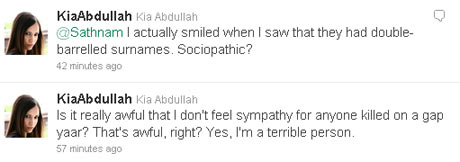
Kia Abdullah will think twice before letting her inner sociopath out on Twitter in future:

In the early hours of Tuesday morning, three young British men were killed in a bus crash in Thailand, just days after starting their gap year travels. A deeply tragic case — and one that will have left many British parents sick with worry. Annually about 100,000 young Brits take gap years.

But here’s a Twitter reaction from Kia Abdullah, a Guardian contributor:

Even if you think this sort of thing, sending it out immediately over Facebook or Twitter is just asking for a landslide of public abuse to land on your head. People who work in media have the least excuse for this kind of absent-minded faux pas, as they often pounce on celebrity or politician errors of exactly this sort.

June 28, 2011

The Daily Mail tries to drum up moral outrage (again)

Filed under: Britain, Law, Media — Tags: , , , — Nicholas @ 09:23

Patrick Hayes views with disdain the latest Freedom of Information trolling exercise performed by the Daily Mail in an attempt to spice up their “news” coverage:

Is Britain in the grip of a hidden crimewave? Are thousands of crimes being committed each year by feral youths, which the police know about but are powerless to prevent? Is Britain being stalked by troublemaking toddlers, committing vandalism with no comeuppance for their ‘crimes’ because of their tender age?

In a word, no. Though you’d never know that by reading yesterday’s hysterical news reports. ‘As many as 3,000 criminals, including rapists, robbers and burglars, escaped punishment last year because they were too young to be prosecuted’, declared the Daily Mail. The paper published the results of a pretty shameless trawling exercise, having placed Freedom of Information (FOI) requests to police forces around Britain about underage crime. It managed to dredge up various accounts of childish ‘criminal’ activity, including a ‘rape’ in Levenmouth committed by two eight-year-old boys, a ‘kidnapping’ in Rochdale also carried out by an eight-year-old, and a ‘spate of vandalism’ conducted by a three-year-old boy and four-year-old girl.

The Mail received responses to its FOI request from 30 out of 52 police forces, discovering that ‘1,605 crimes were blamed on someone aged under 10 in the last financial year’. Guestimating how many crimes might have been committed by kids in those parts of Britain policed by the 22 forces that did not respond to its requests, it came up with a total of 3,000 offences. And rather than caution its readers that these figures only cover accusations of a crime, rather than guilt having been proven, the Mail implies its findings could be the tip of the iceberg: ‘Many police forces do not even record crimes where they believe youngsters under 10 have been responsible.’

June 24, 2011

Newspapers still trying to adapt to a vastly changed world

Filed under: Britain, Economics, Media — Tags: , , — Nicholas @ 09:04

In a blog post at the Guardian, Roy Greenslade puts the financial changes into a bit of perspective:

So prepare — if you’re of a certain age — for a warm nostalgic bath. In 1950, with TV sets in only 9% of homes, a British street of 100 houses could be relied on to buy 140 newspapers a day and 220 on Sunday.

In 2010, with each of those houses containing an average of 2.6 TVs, the same street bought just 40 papers a day, Monday to Sunday.

Some advertising revenues fled to TV as it developed in the 1950s, 1960s and 1970s, but not in such great numbers as to ruin newspapers, which could still rely on huge circulation sales income.

In 1966, the Daily Mirror sold 5.1m copies a day, the Daily Express 4m and the Daily Telegraph 1.4m. Last month, those titles had circulations of 1.2m, 631,000 and 635,000 respectively.

It was one of the things that struck me on my first trip back to England in 1979 — although not as badly as the bone-chilling damp — was the profusion of newspapers available. I was used to Toronto, where you could get the Toronto Star, the Globe and Mail, and the horrible little upstart pleb rag, the Toronto Sun. Seeing all the different papers was quite an eye-opener.

No wonder why he chose to title the post “Those were the days, my friends, we’d thought they’d never end…”

June 15, 2011

The “Amina Arraf” hoax

Filed under: Media, Middle East — Tags: , , , , — Nicholas @ 07:48

Brendan O’Neill on how easily the hoaxer’s blog became “a go-to place for liberal hacks, bloggers and tweeters who wanted to know ‘the truth’ about life in Syria.”

The revelation that the Gay Girl in Damascus is actually a stubbly bloke in Edinburgh has sent shockwaves through the media. ‘How could he have done this?’, journalists are demanding of Tom MacMaster, the American self-confessed nerd based in Scotland who for six months pretended to be a dissident dyke in Syria. ‘Doesn’t he know the damage he has done to gay people in the Middle East and to the reputation of political blogging?’

These are the wrong questions. Because the most striking thing about this blogging hoax is not its potential impact over there, but what it reveals about culture, politics and journalism over here. The thing that ought to cause jaws to drop and eyebrows to rise is not Mr MacMaster’s deceitfulness — he isn’t the first mundane man to masquerade as something sexier on the world wide web — but rather the ease with which he planted himself in the cultural consciousness. It is the manipulability of the modern media, their wide-eyed openness to unchecked foreign stories that seem to confirm their prejudices, which should really be in the spotlight.

[. . .]

The media’s current focus on the clever nature of the gay-girl hoax (‘it is an elaborate hoax’, says a track-covering Guardian), overlooks what is easily the most important dynamic in this story: not MacMaster’s alleged powers of persuasion, but the media’s susceptibility to delusion. However well-written or seemingly authentic MacMaster’s blog was — and as it happens, some Syrians have said it was unconvincing — the fact is that it was just a blog; just a self-started website with various bits of personal writing and nothing to suggest that any of it was accurate or authoritative. Those complaining about being duped, Scooby Doo-style, by the apparent master of disguise that is Tom MacMaster need to have a word with themselves: it was their openness to being duped, their embrace of the seemingly made-in-heaven ‘gay girl in Damascus’ narrative with its achingly right-on contrast between a morally sensitive LGBT gal and a male-dominated regime, which really blew this blog out of all proportion.

June 2, 2011

Pity the poor, over-used em-dash

Filed under: Media, Randomness — Tags: , , , , — Nicholas @ 09:39

Noreen Malone — who admits to being an em-dash abuser herself — makes an appeal for everyone to just leave the em-dash alone!

According to the Associated Press StylebookSlate‘s bible for all things punctuation- and grammar-related — there are two main prose uses— the abrupt change and the series within a phrase — for the em dash. The guide does not explicitly say that writers can use the dash in lieu of properly crafting sentences, or instead of a comma or a parenthetical or a colon — and yet in practical usage, we do. A lot — or so I have observed lately. America’s finest prose — in blogs, magazines, newspapers, or novels — is littered with so many dashes among the dots it’s as if the language is signaling distress in Morse code.

What’s the matter with an em dash or two, you ask? — or so I like to imagine. What’s not to like about a sentence that explores in full all the punctuational options — sometimes a dash, sometimes an ellipsis, sometimes a nice semicolon at just the right moment — in order to seem more complex and syntactically interesting, to reach its full potential? Doesn’t a dash — if done right — let the writer maintain an elegant, sinewy flow to her sentences?

Nope — or that’s my take, anyway. Now, I’m the first to admit — before you Google and shame me with a thousand examples in the comments — that I’m no saint when it comes to the em dash. I never met a sentence I didn’t want to make just a bit longer — and so the dash is my embarrassing best friend. When the New York Times‘ associate managing editor for standards — Philip B. Corbett, for the record — wrote a blog post scolding Times writers for overusing the dash (as many as five dashes snuck their way into a single 3.5-paragraph story on A1, to his horror), an old friend from my college newspaper emailed it to me. “Reminded me of our battles over long dashes,” he wrote — and, to tell the truth, I wasn’t on the anti-dash side back then. But as I’ve read and written more in the ensuing years, my reliance on the dash has come to feel like a pack-a-day cigarette habit — I know it makes me look and sound and feel terrible — and so I’m trying to quit.

Bloggers (some of us, anyway) tend to use the em-dash a bit too frequently, and that’s one of the downsides to being one-person shows — there’s no kindly editor to strike through the excess punctuation with a red pen.

May 31, 2011

QotD: The paternalistic view of (some) crime victims

. . . there are certain regularities, and one of them is the way in which the victims of men such as Griffiths are described in the Guardian, the house journal of the British intelligentsia and its bureaucratic hangers-on. This is important because it illustrates the way in which a dominant elite — dominant de facto if not always de jure — thinks about social problems.

An article describing the victims of Wright, the Ipswich murderer, was titled THE WOMEN PUT INTO HARM’S WAY BY DRUGS. A similar article about Griffiths’s victims was headed “CROSSBOW CANNIBAL” VICTIMS’ DRUG HABITS MADE THEM VULNERABLE TO VIOLENCE. In other words, these women became prostitutes by force majeure, on the streets not because of choices they had made but because of chemical substances that controlled them without any conscious intervention on their part — no more than if, say, an abyss caused by an earthquake had suddenly opened up and swallowed them.

Now either we are all like this — no different from inanimate objects, which act and react mechanically, as Descartes supposed that dogs and cats did — or we are not. The view that we are brings with it certain difficulties. No one could live as if it were true; no one thinks of himself, or of those about him, as automatons; we are all faced with the need to make conscious decisions, to weigh alternatives in our minds, every waking hour of every day. Human life would be impossible, literally inconceivable, without consciousness and conscious decision making. It is true that certain medical conditions, such as temporal-lobe epilepsy during fits, deprive people of normal consciousness and that they nevertheless continue to behave in a recognizably human way; but if all, or even most, of humanity suffered from those conditions, human life would soon be at an end.

Assuming, then, that not everyone is driven to what he does by his own equivalent of drug addiction, the Guardian must assume that Wright’s and Griffiths’s victims were fundamentally different from you and me. Unlike us, they were not responsible for their actions; they did not make choices; they were not human in the fullest sense. Not only is this a view unlikely to find much favor with women who resemble the victims in some way; it also has potentially the most illiberal consequences. For it would justify us, the full human beings, in depriving such women of liberty. If “their hopeless addiction to heroin, alcohol or crack cocaine led them to sell their bodies in the red light district on the edge of Bradford city centre and made them vulnerable to violence,” as the article tells us, surely we should force our help on them to recover their full humanity, or, if that proves impossible, take them into preventive detention to protect them. They are the sheep, we the shepherds.

Theodore Dalrymple, “Murder Most Academic: A British Ph.D. candidate puts “homicide studies” into practice”, City Journal, 2011-05-31

May 28, 2011

Feeling optimistic about peoples’ common sense?

Filed under: Humour, Media, Technology — Tags: , , — Nicholas @ 00:15

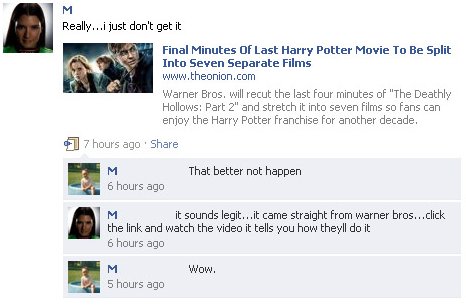
A few visits to this site will quickly disabuse you of that feeling.


It’s how some folks on Facebook react to stories from The Onion as if it was real news.

May 27, 2011

Happy 190th anniversary to the good old Grauniad

Filed under: Britain, History, Media — Tags: , — Nicholas @ 12:08

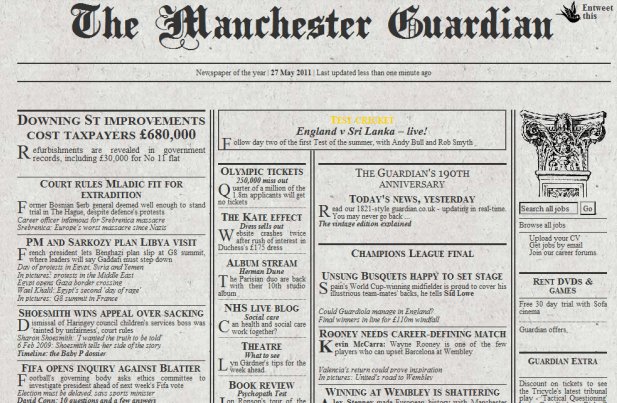
It’s the 190th anniversary, so the folks at The Guardian have virtually turned the calendar back:

More information about the “experiment in the typesetting of the mechanical facsimile we operate at guardian.co.uk” here.

May 24, 2011

“Why does dubious social science keep showing up in medical journals?”

Filed under: Economics, Media, Science — Tags: , , , , — Nicholas @ 10:08

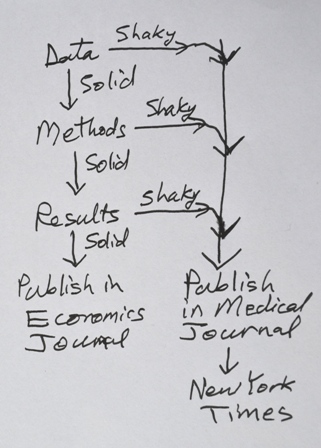
William Easterly and Laura Freschi have determined the decision tree for publishing crappy social science research:

Aid Watch has complained before about shaky social science analysis or shaky numbers published in medical journals, which were then featured in major news stories. We questioned creative data on stillbirths, a study on health aid, and another on maternal mortality.



Just this week, yet another medical journal article got headlines for giving us the number of women raped in the DR Congo (standard headline: a rape a minute). The study applied country-wide a 2007 estimate of the rate of sexual violence in a small sample (of unknown and undiscussed bias). It did this using female population by province and age-cohort — in a country whose last census was in 1984.

We are starting to wonder, why does dubious social science keep showing up in medical journals?

The medical journals may not have as much capacity to catch flaws in social science as in medicine. They may desire to advocate for more action on tragic social problems. The news media understably assume the medical journals ARE vetting the research.

H/T to Tim Harford for the link.

« Newer PostsOlder Posts »

Powered by WordPress