Quotulatiousness

March 5, 2013

The Daily Mail Song

Filed under: Britain, Humour, Media — Tags: , — Nicholas @ 10:39

Hello everyone. Me & Dan have written a song about The Daily Mail (a British newspaper).

We’re aware this video won’t mean an awful lot if you’ve never heard of The Daily Mail, but on the plus side, you’ve never heard of The Daily Mail.

H/T to John Lennard for the link.

March 2, 2013

QotD: “One way to know that you’re doing the right thing”

Filed under: Bureaucracy, Government, Politics, Quotations — Tags: , , , , — Nicholas @ 10:27

Is to look at peoples’ reactions to what you’re doing. If, for example, you decided that you wanted to clean up the MPs’ expenses system and every MP then started howling about how we mere ignorant citizenry aren’t supposed to control them then we’d know that we were on the right track. Similarly, if every criminal in the country (to the extent that this is a different group from MPs) starts to complain about the length of sentences after just and righteous trials then you would at least begin to suspect that you might have created sentences which have a deterrent effect.

Tim Worstall, “One way to know that you’re doing the right thing”, Adam Smith Institute blog, 2013-03-02

February 28, 2013

White House staffer tells Bob Woodward he’ll “regret doing this” over sequestration criticisms

Filed under: Media, Politics, USA — Tags: , , — Nicholas @ 09:38

The White House has taken note of the Washington Post columnist’s out-of-line comments:

The best-selling author and Washington Post reporter is protesting White House pushback over his criticism of how Obama and aides are handling the sequester issue.

“It was said very clearly, you will regret doing this,” Woodward told CNN, citing an e-mail he received from “a senior person” at the White House.

“I mean, it makes me very uncomfortable to have the White House telling reporters, you’re going to regret doing something that you believe in,” Woodward said.

In a statement, the White House said that “of course no threat was intended. As Mr. Woodward noted, the e-mail from the aide was sent to apologize for voices being raised in their previous conversation. The note suggested that Mr. Woodward would regret the observation he made regarding the sequester because that observation was inaccurate, nothing more. And Mr. Woodward responded to this aide’s e-mail in a friendly manner.”

All we can say is: We know more than a few reporters have received similar e-mails from White House officials. Yelling has also been known to happen.

Nice newspaper you’ve got here, Mister Woodward. It’d be a shame if something were to happen to it, yeah?

Update: Matt Welch rounds up the media reactions here.

It has been a special night on Twitter for those of us who take a perverse interest in the way that ideologically aligned journalists and politicos will pack-attack critics of a sitting American president. Seems that Washington Post investigative-journalism legend Bob Woodward crossed a bridge too far when, in talking about reaction to his narrative-debunking Feb. 22 piece pinning the origination of the sequester directly on a White House that had vociferously denied paternity, has now gone on to dish on a “senior White House official” (later identified as White House Economic Council Director Gene Sperling) who “yelled at me for about a half hour” about the op-ed, and warned that “I think you will regret staking out that claim.”

February 25, 2013

The difference between professional journalists and mere bloggers

Filed under: Law, Media, USA — Tags: , , , , , — Nicholas @ 13:03

Ken at Popehat explains “the game”:

Here we have the heart of the matter. “Professional” journalists may, indeed, be brilliant, talented, well-trained, professional, with an abiding appetite for hard-hitting but neutral reporting. Yet professional journalists also depend on relationships. Ms. Caldwell calls that fact out, sending law enforcement’s core message to the press: if you want access, play the game.

The game colors mainstream media coverage of criminal justice. Here’s my overt bias: I’m a criminal defense attorney, a former prosecutor, and a critic of the criminal justice system. In my view, the press is too often deferential to police and prosecutors. They report the state’s claims as fact and the defense’s as nitpicking or flimflam. They accept the state’s spin on police conduct uncritically. They present criminal justice issues from their favored “if it bleeds it leads” perspective rather than from a critical and questioning perspective, happily covering deliberate spectacle rather than calling it out as spectacle. They accept leaks and tips and favors from law enforcement, even when those tips and leaks and favors violate defendants’ rights, and even when the act of giving the tip or leak or favor is itself a story that somebody ought to be investigating. In fact, they cheerfully facilitate obstruction of justice through leaks. They dumb down criminal justice issues to serve their narrative, or because they don’t understand them.

This “professional” press approach to the criminal justice system serves police and prosecutors very well. They favor reporters who hew to it. Of course they don’t want to answer questions from the 800-pound bedridden guy in fuzzy slippers in his mother’s basement. But it’s not because an 800-pound bedridden guy can’t ask pertinent questions. It’s because he’s frankly more likely to ask tough questions, more likely to depart from the mutually accepted narrative about the system, less likely to be “respectful” in order to protect his access. (Of course, he might also be completely nuts, in a way that “mainstream” journalism screens out to some extent.)

Western media suddenly notices problems in South Africa

Filed under: Africa, Media — Tags: , , , , , , — Nicholas @ 09:33

In the Telegraph, Brendan O’Neill shows how the western media has managed to ignore horrific things in South Africa, but suddenly the murder of a pretty white woman has them all utterly rivetted to what’s happening in that country:

Last year, 34 black striking miners were gunned down by South African police at the Lonmin mine in Marikana. Some were shot in the back as they attempted to flee. Some were killed as they surrendered. Others were killed 300 metres from where the main massacre took place, suggesting they had been chased — that is, hunted down — by the armed servants of the ANC. Yet there was no outrage in the Western liberal press. There were no fuming leaders; very few angry columns. Amnesty International, guardian of the modern liberal conscience, issued a weak, almost uninterested statement about this act of mass murder, and then went back to throwing money and staff at the campaign to have Pussy Riot — prettier and way more fashionable than those dead miners — freed from jail in Russia.

This month, a pretty white woman, Reeva Steenkamp, was killed by her boyfriend, Oscar Pistorius, in a gated community in South Africa. And this time, right-thinking observers went crazy. The shock and outrage have been palpable. Feminists have popularised the Twitter hashtag #hernamewasReevaSteenkamp, to draw attention to the scourge of domestic violence in South Africa. Column after column tells us that the Steenkamp killing shows that the New South Africa is sick, that it’s a fear-ruled, crime-ridden, corrupt nation. This tragic shooting and the fractured court case and debate it has given rise to have cast a “lurid light” on South Africa, commentators tell us, calling into question its image as a “Rainbow Nation”. Where the massacre of 34 black workers elicited a collective shrug of the shoulder among observers over here, the killing of Steenkamp has got them tearing their hair out, demanding answers, wondering what the hell went wrong with the country they once admired (the New South Africa) and its ruling party that they once cheered (the ANC).

All of which raises a very awkward question: why is the shooting of a white woman in a domestic setting more shocking to liberal commentators than the massacre of 34 black miners at a public strike and demonstration? This isn’t a complaint about how the media elevates celebrity news over all other forms of news. I can understand why there is so much media and public interest in the Pistorius/Steenkamp case: it isn’t every day a global sports star shoots his famous, beautiful girlfriend in questionable circumstances. But what is striking is the fact that it took this incident — and not, say, the ANC’s massacre of 34 miners — to open Western liberals’ eyes to the profound problems, the moral and political decay, in modern-day South Africa.

February 17, 2013

Whinnygate is just a useful distraction from the real scandal in the NHS

Filed under: Britain, Bureaucracy, Health, Politics — Tags: , , , , , — Nicholas @ 11:09

The British media is doing a great job of distracting the public with the horsemeat story, and the politicians and National Health Service bureaucrats are delighted that nobody is paying attention to the real scandal:

At any given moment, there exists at least one delicate subject that all mainstream political parties would much rather not discuss. For many years the abuse of MPs’ expenses fell into this category. After this was exposed by a Telegraph investigation, everyone joined a tacit agreement to keep quiet about the criminality inside the Murdoch newspaper empire.

Now the subject which nobody wants to talk about is the National Health Service. It is just over a week since the publication of the Francis report into Stafford hospital, where some 1,200 patients died in appalling circumstances. Had any other institution been involved in a scandal on this scale, the consequences would have been momentous: sackings, arrests and prosecutions. Had it involved a private hospital, that hospital would have been closed down already, and those in charge publicly shamed and facing jail.

Astonishing to relate, nothing has happened. Politicians have made perfunctory expressions of concern, while agreeing that there must be “no scapegoats”, and that Sir David Nicholson (the senior figure responsible) must remain in his job.

Then, almost at once, the political class turned its attention to a far more lively subject: horse meat. Few “scandals” in living memory have carried less significance. And yet few stories have dominated the press quite as comprehensively since rival teams of crack reporters from The Sun and The Star pursued Blackie the Donkey across Southern Spain in 1987, in the wake of some dubious allegations of mistreatment by his Spanish owners.

Misdirection is a vital tool in the arsenal of the magician — and it can be even more valuable in the political arena. If they can fool you into watching the hand that isn’t hiding the coin, they can get away with a great trick (magicians) … or a great evil (politicians).

February 16, 2013

“The mainstream news has become the Boy who Cried Internet”

Filed under: Media, Technology — Tags: , , , , , , — Nicholas @ 11:29

In Maclean’s, Jesse Brown explains why the mainstream media still doesn’t seem to “get” the internet or social media channels like Twitter, Google+, and Facebook:

While I was delivering some talking-head sound-bites on this item for a certain newscast, the reporter asked me why the Twitter hack was such a huge deal. I was stumped – it wasn’t. So she asked me why it was getting so much attention. I knew the answer, but held my tongue.

Here’s what I was thinking: it gets so much attention because print and TV news love to bash technology, especially social media, and can’t resist a scary story about how the people who use it should be very, very afraid. The truth is, despite years of fear-mongering stories about Facebook identity theft, Gmail phishing attacks and massive Twitter hacks, public interest and concern about these things remains very low. That’s because these things haven’t happened to the vast majority of us, or to anyone we know. For the small number of people this has happened to, the impact is typically minimal. The mainstream news has become the Boy who Cried Internet.

This is not to say privacy isn’t a valid concern when it comes to free Internet services. There’s much to worry about, but little of it has to do with Russian digital mobsters, Chinese military hackers or spammy Nigerian princes. The real data privacy danger – with social media, and beyond – comes from government.

February 13, 2013

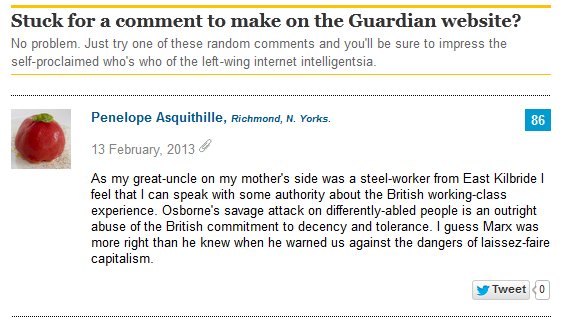
Can we get versions of this for the Toronto Star and National Post?

Filed under: Humour, Media — Tags: , — Nicholas @ 11:49

The Guardian-style comment generator:

Guardian-style comment generator

February 12, 2013

Calvin Coolidge — The Great Refrainer

Filed under: Books, History, Media, Politics, USA — Tags: , , , , — Nicholas @ 11:37

Amity Shlaes has written a new biography on President Calvin Coolidge, reviewed here by Gene Healy:

If there was ever a time when the president could simply preside, it has long passed. As early as the Eisenhower era, political scientist Clinton Rossiter observed that the public had come to see the federal chief executive as “a combination of scoutmaster, Delphic oracle, hero of the silver screen, and father of the multitudes.” Under the pressure of public demands, the office had accrued a host of responsibilities over and above its constitutional ones: “World Leader,” “Protector of the Peace,” “Chief Legislator,” “Manager of Prosperity,” “Voice of the People,” and more.

To that daunting portfolio add “Feeler-in-Chief,” a term coined in all earnestness by The New York Times‘s Maureen Dowd in 2010 while lashing out at Barack Obama for being insufficiently emotive about the BP oil spill. Obama, she wrote, had “resisted fulfilling a signal part of his job: being a prism in moments of fear and pride, reflecting what Americans feel so they know he gets it.”

Poor MoDo would have kicked the cat in sheer frustration if confronted by the implacable, inscrutable Calvin Coolidge, whose reaction to the job’s more unreasonable demands was a Bartleby-like “I prefer not to.”

[. . .]

Here was “a rare kind of hero: a minimalist president,” Shlaes argues. And though history remembers “Silent Cal” mostly for his reticence and frequent napping, Shlaes reminds us that “inaction betrays strength.” In politics, it’s often easier to “do something,” however unwise, than it is to hold firm: “Coolidge is our great refrainer.”

Alas, after Coolidge‘s elegant introduction, the sledding gets much tougher. Long stretches of this 456-page tome read like an info-dump from Shlaes’s clearly formidable research files. Like the hardscrabble farmers of Plymouth Notch, you need to set your jaw grimly and persevere through a long winter of sentences that should have been left on the cutting room floor, like: “Coolidge met with [Budget Director Herbert] Lord six times and reduced a tariff on paintbrush handles by half, his second cut that year, the other a reduction in duty on live bob quail.” Shlaes should have followed the example of her famously taciturn subject, who in his 1915 opening address as president of the Massachusetts Senate delivered a crisp little homily of 44 words, ending in “above all things, be brief.”

Still, the level of detail she provides inspires reflection on the vast gulf between today’s GOP and the grand party of old. Presidents Warren Harding and Calvin Coolidge cut taxes and shrank spending. They were pro-peace and anti-wiretapping. They embraced “normalcy” instead of stoking fear. And — go figure — they were also popular. Today’s Republicans could profit from studying their example.

February 10, 2013

QotD: The internet really did change everything

Filed under: Liberty, Media, Quotations — Tags: , , , , — Nicholas @ 00:01

For all of those thousands of years, most important communication in civilization has been vertical, and almost always from the top down.

Think of a church bell (or before that, and in other places, a drum or a gong): a means of communication far too expensive in a primitive society for an individual to own, one with extremely low bandwidth, conveying simple imperatives that individuals had been conditioned from earliest childhood to obey: wake up, serf! Come to prayer, serf! Go to work, serf! Come back to prayer, serf! Go to bed, serf!

There was no talking back to the commanding bells.

Over the centuries, nothing changed except the bandwidth. By turns we had Big Ben, Rudy Valee, D.W. Griffith, Arthur Godfrey, I Love Lucy; but there was no way to talk back to them, either. Nor to the “news” thrust upon us by media controlled or even owned outright by authority.

Then, suddenly, the whole situation, the entire 8000-year-old structure of human interaction, was pitched on its ear. The Internet landed with a crash and knocked communications sideways, making it an egalitarian — “peer-to-peer” — undertaking. Information traveled uncontrollably, in both directions, to the anger and distress of those who still believed that they were in authority. (One politician, a wealthy former governor and senator has recently announced that he’s leaving politics, having previously claimed society would be better off had the Internet never been invented.) And all the pus, 8000 years of dictatorial threats and dirty lies, burst out with the fall of power.

Humanity will never be the same again. This is change at the most fundamental level conceivable, barring the evolution of new limbs or individuals developing gills. As a student of history, I believe it to be more significant than Gutenberg’s invention of the printing press, possibly more important than the invention of writing itself. And authority, as it disintegrates, is striving hysterically to bring it all back under control. But it’s too late by at least a decade. We have the idea of laterality now, and it cannot be disinvented or unlearned.

L. Neil Smith, “‘And That’s the Way It Is…'”, Libertarian Enterprise, 2013-02-03

February 8, 2013

Charles Stross: that invasion from Mars really did happen

Filed under: Bureaucracy, Government, Media, Politics — Tags: , , , , , — Nicholas @ 09:31

Charles does a good job of explaining why our representative democracies in the west seem to have all become bland, indistinguishable minor variants of one another:

For a while I’ve had the unwelcome feeling that we’re living under occupation by Martian invaders. (Not just here in the UK, but everyone, everywhere on the planet.) Something has gone wrong with our political processes, on a global scale. But what? It’s obviously subtle — we haven’t been on the receiving end of a bunch of jack-booted fascists or their communist equivalents organizing putsches. But we’ve somehow slid into a developed-world global-scale quasi-police state, with drone strikes and extraordinary rendition and unquestioned but insane austerity policies being rammed down our throats, government services being outsourced, peaceful protesters being pepper-sprayed, tased, or even killed, police spying on political dissidents becoming normal, and so on. What’s happening?

Here’s a hypothesis: Representative democracy is what’s happening. Unfortunately, democracy is broken. There’s a hidden failure mode, we’ve landed in it, and we probably won’t be able to vote ourselves out of it.

[. . .] Parties are bureaucratic institutions with the usual power dynamic of self-preservation, as per Michels’s iron law of oligarchy: the purpose of the organization is to (a) continue to exist, and (b) to gain and hold power. We can see this in Scotland with the SNP (Scottish National Party) — originally founded with the goal of obtaining independence for Scotland and then disbanding, the disbanding bit is now nowhere to be seen in their constitution.

Per Michels, political parties have an unspoken survival drive. And they act as filters on the pool of available candidates. You can’t easily run for election — especially at national level — unless you get a party’s support, with the activists and election agents and assistance and funding that goes with it. (Or you can, but you then have to build your own machinery.) Existing incumbent representatives have an incentive to weed out potential candidates who are loose cannons and might jeopardize their ability to win re-election and maintain a career. Parties therefore tend to be self-stabilizing.

[. . .]

So, here’s my hypothesis:

  • Institutional survival pressure within organizations — namely political parties — causes them to systematically ignore or repel candidates for political office who are disinclined to support the status quo or who don’t conform to the dominant paradigm in the practice of politics.
  • The status quo has emerged by consensus between politicians of opposite parties, who have converged on a set of policies that they deem least likely to lose them an election — whether by generating media hostility, corporate/business sector hostility, or by provoking public hostility. In other words, the status quo isn’t an explicit ideology, it’s the combined set of policies that were historically least likely to rock the boat (for such boat-rocking is evaluated in Bayesian terms — “did this policy get some poor bastard kicked in the nuts at the last election? If so, it’s off the table”).
  • The news cycle is dominated by large media organizations and the interests of the corporate sector. While moral panics serve a useful function in alienating or enraging the public against a representative or party who have become inconveniently uncooperative, for the most part a climate of apathetic disengagement is preferred — why get involved when trustworthy, reassuringly beige nobodies can do a safe job of looking after us?
  • The range of choices available at the democratic buffet table have therefore narrowed until they’re indistinguishable. (“You can have Chicken Kiev, Chicken Chasseur, or Chicken Korma.” “But I’m vegan!”) Indeed, we have about as much choice as citizens in any one-party state used to have.
  • Protests against the range of choices available have become conflated with protests against the constitutional framework, i.e. dissent has been perceived as subversion/treason.
  • Occasionally cultural shifts take place: over decades, they sometimes reach a level of popular consensus that, when not opposed by corporate stakeholders, leads to actual change. Marriage equality is a fundamentally socially conservative issue, but reflects the long-term reduction in prejudice against non-heteronormative groups. Nobody (except moral entrepreneurs attempting to build a platform among various reactionary religious institutions) stands to lose money or status by permitting it, so it gets the nod. Decriminalization of drug use, on the other hand, would be catastrophic for the budget of policing organizations and the prison-industrial complex: it might be popular in some circles, but the people who count the money won’t let it pass without a fight.

Overall, the nature of the problem seems to be that our representative democratic institutions have been captured by meta-institutions that implement the iron law of oligarchy by systematically reducing the risk of change.

It’s not just your imagination that the last presidential election hinged far more on trivia than on actual policy differences — because Mitt Romney was offering only a slight variation of policy choices than what Barack Obama had been doing (heated rhetoric and animated posturing aside). “Conservatives” and “Liberals” in Canada became almost interchangeable (except on foreign policy and military matters). “Conservatives” and “Liberal Democrats” have been able to form and hold a coalition government together in the UK relatively amicably (once again, aside from the meaningless noise and fury at the margins).

Party politics requires parties that want to achieve power to more closely resemble the party that already holds power (look at Canada’s NDP for evidence of that: the more similar to the Liberal party they became, the more popular they became, to the point they completely eclipsed the Liberals in the last federal election).

February 7, 2013

QotD: The greatest success of the anti-war movement

Filed under: Media, Middle East, Quotations, USA — Tags: , , , , , — Nicholas @ 10:10

The invasion of Iraq was treated as the greatest crime against humanity in the history of the world, denounced far more frequently and loudly than any act by Saddam Hussein, Bashir Assad, the Iranian regime, or North Korea.

Giant protests in lots of American cities. Giant protests in every foreign capital. The 2004 Guinness Book of Records described the anti-war movement around the globe as the largest mass protest movement in history — eclipsing any popular opposition to any act of the Soviet Union or any other totalitarian regime around the globe, ever. Among the elites in Paris, Berlin, and most corners of London, the Iraq War was the single-most important issue, and denouncing the evil of George W. Bush was the most important goal, not building a stable and peaceful Iraq. You recall Kofi Annan denouncing it, and the United Nations delegates scoffing when Hugo Chavez called our president the devil.

You recall the cries of “Bushitler,” the ubiquitous Code Pink interrupting every event in Washington, as if some ninny shouting during a press conference ever spurred sudden reversals in U.S. national security policy. You recall Hollywood’s relentless cavalcade of movies demonizing the war and those fighting it: In the Valley of Elah, Stop Loss, Green Zone, Redacted, Grace is Gone, Fahrenheit 9/11.

[. . .]

The Davos set is horrified to learn that after spending the better part of a decade screaming at the top of their lungs that an American intervention to topple a bloodthirsty Arab dictator is the absolute worst thing imaginable, suddenly Americans are no longer interested in toppling bloodthirsty Arab dictators.

(Slap, slap) Wake up, anti-war movement! You’ve got what you wanted! The United States is out of the armed intervention business, besides the occasional “leading from behind” in Libya, or the occasional covert mission in Pakistan.

Jim Geraghty, “The Demonization of the Iraq War Ensures No Syria Intervention”, National Review Online, 2013-02-07

January 19, 2013

Failing to charm

Filed under: Media, Sports — Tags: , , , , — Nicholas @ 10:33

Is the real reason Lance Armstrong’s televised confessions failed to “redeem” him in the public eye just a lack of charm?

But by the standards we have come to expect in these things it was relatively candid, blessedly free of self-pity. He’d told a lot of lies. Now he was telling the truth. Yet if he was expecting this confession to stanch the flow of vitriol, it appeared to have the opposite effect.

Because if there is one thing we expect of professional cyclists, it is that they will compete fairly and stay clear of drugs. And if there is one thing we expect, no demand of our public figures, it is that they will tell the truth.

Oh really. Listening to all this high dudgeon, I was carried back to last September’s Democratic convention, and the rapturous reception given to Bill Clinton, the former president and noted perjurist in the matter of Jones v Clinton.

That may have been the most famous of his lies, but it was hardly the first. Clinton was well known as a liar — an “unusually good” one, according to Bob Kerrey, the former senator — long before he ever reached the White House. As early as 1992, the question posed by his candidacy, as defined by Michael Kinsley, was not is he a liar, “but is he too much of a liar?” By the end the lies and abuses of power had piled up so high that Christopher Hitchens was forced to title his scathing account of the Clinton presidency No One Left To Lie To.

[. . .]

So let us drop the pretense that we’re all so scandalized by Armstrong because he lied. Granted, he lied about cycling, rather than mere financial dealings or affairs of state. But the reason he is in such obloquy, and Clinton and Mulroney are not, is not because his lies were worse, but because he’s not as good at it: because he is not as charming — shall we say manipulative? — as they. Frankly, when it comes to conning the public, he is not in their league.

Anyone can pull a con like Armstrong’s. You just lie and keep on lying until someone catches you. It takes a master to keep the con going even after you’ve been caught.

January 18, 2013

Obsessing over drugs will damage sports much more than Lance Armstrong could

Filed under: France, Media, Sports — Tags: , , , — Nicholas @ 09:41

At sp!ked, Tim Black reviews Seven Deadly Sins: My Pursuit of Lance Armstrong, by David Walsh:

And so, in the aftermath of his Oprah-atic confession, bound to neither sate the critics nor elate the devout, the infernal humiliation of one-time cyclist Lance Armstrong continues.

The kicking and pelting began in earnest in August last year, when the US Anti-Doping Agency (USADA) stripped Armstrong of his seven Tour de France titles following his failure to challenge their numerous doping charges. The USADA then followed that up in October with a voluminous, damning report, complete with gruesome testimonies from Armstrong’s one-time confidantes and teammates. By this point, even the International Cycling Union (UCI), which had long sided with Armstrong, had given up the defence to join in the lynching. ‘Lance Armstrong has no place in cycling’, exclaimed UCI president Pat McQuaid. ‘Lance Armstrong deserves to be forgotten in cycling.’

As sporting officialdom condemned, large swathes of the media spat. Gossipy stories of Armstrong’s bullying, his lying, his alleged sociopathology were published without nuance; op-eds assassinating Armstrong’s character, inflating his wrongs to Biblical proportions, were rushed off without perspective. On a man once lionised by millions, whose fame had for years been wrapped yellow around the wrists of those who admired him, open season had been declared. All the hunt lacked was a sighting of the quarry himself. And then this week, that finally happened — in the interview with Oprah Winfrey. Caught and unavoidably contrite, Armstrong acted out the role of the doping sportsman. Yes, he was saying, I am everything that the Dopefinder Generals say I am: I am that witch.

January 12, 2013

Terry Glavin: Pick a side

Filed under: Cancon, Media, Politics — Tags: , , , , , — Nicholas @ 12:02

In the Ottawa Citizen, Terry Glavin explains why you need to be on Team Idle or Team Devil:

It all sounds so wonderfully simple. On the one side, we have Canada, a genocidal, racist, colonial settler state that just wants to rape the land and poison the water. On the other, we have sacred indigenous nations that just want to protect Turtle Island and be spiritual about everything. Now, pick a side.

Thank you, Idle No More. Joining a “revolution” has never been so easy, and already, the ramparts are being breached. Prime Minister Stephen Harper hosts a delegation from the leadership of the Assembly of First Nations on Friday. It’s actually a meeting the AFN was supposed to have had with Harper some time ago, but never mind that.

Don’t spoil the excitement.

This is not to say that there’s been nothing worthwhile about the impromptu flash-mobbing and the aboriginal-themed block parties that have been breaking out randomly all over the place in recent weeks.

Nobody’s in charge. It can mean whatever you want it to mean. Wow!

What will happen next? Besides, it’s been almost wholly peaceful and lawful and fun.

But to imagine this as a progressive “movement” requires a certain suspension of disbelief. There are just too many bothersome little contradictions that have to be kept off camera or the whole thing falls apart.

« Newer PostsOlder Posts »

Powered by WordPress


