
I’ve been reading Gordon Wood’s Empire of Liberty (2009), the best one-volume history of the very early American republic in the years between the enactment of the Constitution and the end of the War of 1812. In many ways, I notice, this story has the structure of an enormous joke. The American revolution was wrought by wealthy landowners, many of whom hoped to reproduce the hierarchical, agrarian lifestyle of the English countryside in the New World. These people became the early Federalists: they largely wanted to mimic the world of old Europe, only with themselves on top as rentiers, eschewing labour and trade alike.
But they had sown the wind. The commercial and intellectual forces they set in motion created a new, chaotic, competitive, egalitarian kind of society. And one way this manifested itself was as a media crisis. The Revolution overthrew all established authority, or tended to, and created the conditions for an unfamiliar kind of unregulated, rampant press — an ecosystem full of lies, partisanship, personal abuse, and scurrility.
Even those who made sneaky use of this new system, like Thomas Jefferson, left testimonies to their overall exhaustion and confusion as literate, curious people. You get the impression that being a reader in that time and place, with rumours of wars and tales of corruption zinging around, was hard work.
Colby Cosh, “In 2017, when the shooting stops, the media warfare begins”, National Post, 2017-02-02.
January 2, 2019
QotD: The early United States
December 24, 2018
Sun Yat-sen – A Kidnapping in London – Extra History – #2
Extra Credits
Published on 22 Dec 2018Sun Yat-sen moves to a new city for safety, but it will not last long — a year after the Revive China society is destroyed and scattered, he is unwittingly kidnapped in London. He must rely on the ingenuity of his outside ally, Dr. James Cantlie…
Join us on Patreon! http://bit.ly/EHPatreon
December 4, 2018
QotD: B.H. Liddell Hart and J.F.C. Fuller
The military commentators of the popular press can mostly be classified as pro-Russian or anti-Russian pro-blimp or anti-blimp. Such errors as believing the Maginot Line impregnable, or predicting that Russia would conquer Germany in three months, have failed to shake their reputation, because they were always saying what their own particular audience wanted to hear. The two military critics most favoured by the intelligentsia are Captain Liddell Hart and Major-General Fuller, the first of whom teaches that the defence is stronger that the attack, and the second that the attack is stronger that the defence. This contradiction has not prevented both of them from being accepted as authorities by the same public. The secret reason for their vogue in left-wing circles is that both of them are at odds with the War Office.
George Orwell, footnote to “Notes on Nationalism”, Polemic, 1945-05.
November 24, 2018
November 22, 2018
This is why tax cuts are always criticized for benefitting the rich
Rebecca Zeines and Jon Miltimore explain why newspaper headlines and TV anchors always seem to decry any tax cut as being disproportionally beneficial to the wealthy:
But crucial facts are often missing in these articles. As a recent Bloomberg piece explained, two key points tend to be overlooked in articles written by media outlets and progressive tax proponents:
- The top 1 percent paid a greater share of individual income taxes (37.3 percent) than the bottom 90 percent combined (30.5 percent).
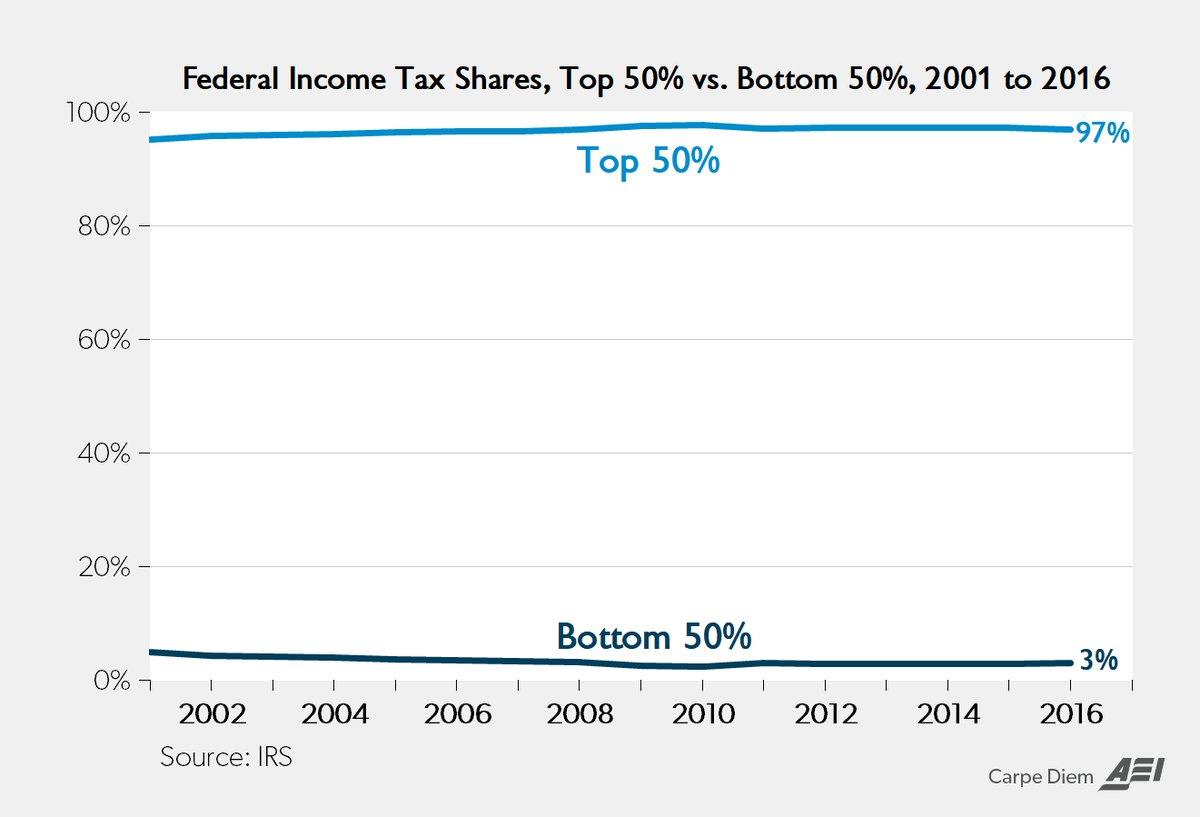
- The top 50 percent of all taxpayers paid 97 percent of total individual income taxes.
These numbers date back to 2016 but remain applicable in 2018.
These data show that the bottom 50 percent of US taxpayers paid just 3 percent of total income taxes in 2016, while the top 50 percent accounted for 97 percent.
Here is a wonderful visual representation of this dynamic, courtesy of Mark Perry of the American Enterprise Institute:
There is a clear correlation between economic freedom and prosperity, and tax climate is a key component of economic freedom.
Economist Dan Mitchell explains it best: Heavy taxation destroys entrepreneurship. The more money is taxed out of the private sector, the less is available for investment, development, and worker compensation (recall that after Trump’s tax bill was enacted, many businesses raised workers’ wages and offered bonuses).
Efforts to improve America’s tax climate are consistently and predictably derided as tax cuts for “the rich.” But, as the above diagram shows, it’s quite impossible to offer people a comparatively huge tax cut when they’re paying a comparatively tiny percentage of income taxes.
October 28, 2018
Newspapers today “are huddled amongst notional rivals in a tremulous infantry square, facing outward”
Colby Cosh wasn’t one of the “founders” of the National Post, but his byline showed up early in the newspaper’s history. Here is his contribution to the “how the hell have we survived the last 20 years?” issue of the paper:

On the 20th birthday of the National Post, we have assembled alumni and associates to celebrate the mistake that was its creation. In saying so, I speak of it strictly as a commercial proposition. The Post was created in a spirit of newspaper warfare — overbuilt for an imagined future that evaporated almost immediately. All newspapers, for most of the last 20 years, have seen their attention oriented to exterior non-newspaper predators. We are huddled amongst notional rivals in a tremulous infantry square, facing outward.
If you sent a time-travelling accountant back from 2018 to advise the founders of the Post on their new project, his advice could not possibly be “Yep, you guys have the right idea, do it exactly that way.” The advice might even be the one word “Don’t.” The financial story he would have to tell from the future is one of nearly continuous pain and frustration.
But, like many megaprojects gone awry, the Post has been glorious and useful, too. No intelligent reader can stand to imagine the last 20 years without the Post’s distinctive colour in the Canadian media palette. Rival outlets have recruited too many Posties to deny the value of its existence. Persons who will never set eyes on these words or touch a copy of the Post have benefited from its existence in a hundred ways. It’s a story of survival rather than triumph — of a creature born at the wrong moment, defying fate and having a worthwhile life despite everything.
When I was asked to write a column about the paper’s anniversary, I spent the next few days feeling subtly annoyed, without being sure why. Eventually I put my finger on it. I sensed that this anniversary would involve a certain quantity of National Post Day Oners telling fun stories of exotic news heroism from the early, lavishly funded months (weeks?) of the paper.
Some of us can only feel nausea at the sound of these anecdotes, having missed the grand, ultra-adventurous part of the war. I myself am a failed Day Oner. If I had managed to impress Terence Corcoran in our pre-launch job interview, I might not have retreated to Edmonton, where the cost of living is low and the competition for freelance work is less savage. It was probably fortunate that I failed the audition (as opposed to failing at the job), but failing it did leave me outside the band of Day One foxhole brethren.
Andrew Coyne (for once, not riding his electoral reform hobby horse):
With a lineup that included every prominent conservative columnist — a couple less reliably so — plus a desk full of nervy British editors who had been in a newspaper war all their lives, the Post flouted every convention of how a quality newspaper should act or look, broke every rule, and generally took hell to the Globe and Mail. I imagine pop-eyed Globe editors, sputtering incredulously: “What? They did what? They, they can’t do that — can they?”
I think we could have made a fair claim to being the best newspaper — certainly the best written — in the world. Every single day the paper was bursting with lively, mischievous pieces in a style that crossed the Daily Telegraph with the New York Observer (when that paper was still in print and still interesting). It had, someone said, the brains of a broadsheet and the loins of a tabloid, and though it took a staunchly, even rabidly conservative editorial line, it remained a guilty pleasure for many on the left. It was simply too much fun not to read.
It couldn’t last, of course, as we were informed more or less from the first day. And yet, improbably, it has. Our industry has declined into not-so-genteel poverty since then — in retrospect, the idea of launching a nationally distributed, ink-on-newsprint newspaper just as the internet was about to consume us all has an almost suicidal gallantry about it — but the Post carries on, if not surrounded by quite the same richesse then with the same culture: that bullish irreverence, that smile of amusement, that jaunty informality, relaxed and subversive at once.
The Post in a nutshell, for me, came on a Friday night in 2013 as I arrived at a friend’s cottage two-and-a-half hours north of Toronto. Looking at my phone, I found a wee joke I had made at Calgary’s expense had been widely misinterpreted as a sincere characterization of Edmontonians as “twitchy eyed, machete-wielding savages.” Half of Edmonton was calling for my head on a pike. The city’s mayor (!) was on the warpath against Postmedia. My phone rang. It was Steve Meurice, then the Post’s editor-in-chief. If I had worked for any other paper I’d have voided my bowels.
He was as baffled and amused as I was, and wished me a good weekend. He ordered me a “Twitchy-eyed, machete-wielding savages” t-shirt, which awaited me on my chair in Don Mills when I returned.
October 25, 2018
Every publication in Canada must have had lots of volunteers for this story
In the National Post, Marie-Danielle Smith gets high for science!

I just remembered I am supposed to be writing.
I am stoned on legal weed, which finally came into my hands this morning after six days of waiting. Thank you, government!
It is a different thing to get high alone — to get high alone for work reasons, right after question period. I’m sitting at my dining room table, drifting off every now and then to examine the patterns on my stuccoed walls or to focus, intensely, on the album I am listening to, the one that Kurt Vile and Courtney Barnett collaborated on. It would be a different thing to get high with the two of them.
The first thing you notice, after opening the cardboard box, which is just a little too large for your knapsack (backpack? knapsack? backpack?) … uh, you notice how much packaging there is. Tape. Crumpled-up papers. A box with government warnings and the logo of the licensed weed producer. A plastic bottle inside with a child lock cap that reminds you of Advil.
“She’s so easy,” sing Courtney and Kurt, repeatedly. Such a good album. This song has been on forever. Time stretches out. I’ve smoked a sativa-heavy hybrid strain called “Super Sonic,” which is supposed to make you feel creative rather than sleepy. On the Ontario Cannabis Store website, it’s described as having “a strong, earthy, sweet aroma, reminiscent of Quantum Kush.” I don’t know what Quantum Kush is but maybe our prime minister can explain it? (Remember that time? Anyway.)
Of course, not everyone is impressed:
I’m thinking of trying to write one sober, see how that goes https://t.co/woerC0verT
— Colby Cosh (@colbycosh) October 24, 2018
October 8, 2018
Debunking state education rankings
In the latest issue of Reason, Stan Liebowitz and Matthew L. Kelly explain why you should ignore those “authoritative” rankings published by U.S. News and World Report and others:
You probably think you know which states have the best and worst education systems in the country. If you regularly dip into rankings such as those published by U.S. News and World Report, you likely believe schools in the Northeast and Upper Midwest are thriving while schools in the Deep South lag. It’s an understandable conclusion to draw from those ubiquitous “Best Schools!” lists. It’s also wrong.
The general consensus on education, retold every few news cycles, is that fiscally conservative states are populated by cheapskates. In those necks of the woods, people are too ignorant to vote in favor of helping their illiterate and innumerate children. Intelligent people understand that high taxes and generous pensions for public school teachers are the recipe for an efficient and smoothly functioning education system. If skinflint voters would just lighten up, the story goes, they too could become erudite and sophisticated.
Paul Krugman rehashes this narrative regularly in his New York Times column, frequently bemoaning the country’s purportedly miserly education budgets. Increasingly, he perceives libertarian barbarians at the gates of state governments, brandishing axes for dreaded spending cuts. In April, he wrote that “we’re left with a nation in which teachers, the people we count on to prepare our children for the future, are starting to feel like members of the working poor.… One way to think about what’s currently happening in a number of states is that the anti-Obama backlash, combined with the growing tribalism of American politics, delivered a number of state governments into the hands of extreme right-wing ideologues. These ideologues really believed that they could usher in a low-tax, small-government, libertarian utopia.”
In Krugman’s view, which reflects the education establishment’s view as well, those attempting to keep the size of government in check are a danger to your child. To support this claim, education wonks and activists point to state rankings in U.S. News, Education Week, or WalletHub — outlets that grade states according to a few key measures, such as graduation rates, education spending, and test scores. When education is discussed in the news, these rankings are often cited to illustrate the havoc that restrained budget growth and right-to-work laws can wreak.
Indeed, such rankings do seem to show that the highest-quality state educational systems tend to be in big-spending states in the Northeast or Upper Midwest. These places apparently honor and respect teachers, while Southern states inexplicably abhor them. But the cheapskates in cheap states get their just deserts: Sophisticated northern jurisdictions grow ever smarter, while stingy conservative backwaters sink into ever-lower depths of ignorance. The solution is obvious: Pay up or your kids will suffer.
There’s just one problem with this narrative: Traditional rankings are riddled with methodological flaws.
October 3, 2018
QotD: The state of American journalism
Back in the day, reporters (they didn’t insist on being called “journalists” back then) were told that the way to frame their stories was to answer a series of questions which boiled down to:
- who
- what
- when
- where
- why
- how
The emphasis was on actual facts and objectivity. But now, with “advocacy journalism” having completely taken over the J-schools and pretty much every newsroom, the emphasis is on changing the world rather than reporting a story fairly and accurately. Especially now, when no less a paper than the New York Times announced before the election that Trump is so bad that objectivity should be thrown out. So the who, what, when, where, why, and how questions were changed into:
- who (can we quote to damage Trump)
- what (can we publish to damage Trump)
- when (should we run it maximize damage to Trump)
- where (do we get more material to damage Trump)
- why (Donald Trump’s presidency is an existential threat to America and to the world)
- how (can we write our stories so as to cause maximum damage to Trump)
Ladies and gentlemen, this is the state of journalism, 2018.
OregonMuse, “The Morning Rant”, Ace of Spades H.Q., 2018-09-12.
September 26, 2018
The New York Times on the minimum wage question
Jon Miltimore shares the key points of a New York Times editorial on the minimum wage:
The minimum wage is the Jason Vorhees of economics. It just won’t die.
No matter how many jobs the minimum wage destroys, no matter how many times you debunk it, it always comes back to wreak more havoc.
We’ve covered the issues at length at FEE, and quite effectively, if I do say so myself. But I have to admit that one of the greatest takedowns of the minimum wage you’ll ever find comes from an unlikely place: The New York Times.
There are many reasons people and politicians find the minimum wage attractive, of course. But the Times, in an editorial entitled “The Right Minimum Wage: 0.00,” skillfully rebuts each of these reasons in turn.
Noting that the federal minimum wage has been frozen for some six years, the Times admits that it’s no wonder that organized labor is pressuring politicians to increase the federal minimum wage to raise the standard of living for poorer working Americans.
“No wonder. But still a mistake,” the Times explains. “There’s a virtual consensus among economists that the minimum wage is an idea whose time has passed.”
But why has the idea “passed”? Why would raising the minimum wage not help the working poor?
“Raising the minimum wage by a substantial amount would price working poor people out of the job market,” the editors explain.
But wouldn’t the minimum wage increase the purchasing power of low-income Americans? Wouldn’t a meaningful increase allow a single breadwinner to support a family of three and actually be above the official U.S. poverty line?
Ideally, yes. But there are unseen problems, as the editors point out:
There are catches…[A higher minimum wage] would increase employers’ incentives to evade the law, expanding the underground economy. More important, it would increase unemployment: Raise the legal minimum price of labor above the productivity of the least skilled workers and fewer will be hired.
But if that’s true, why would progressives support such a law? What’s their rationale for supporting a minimum wage if it does more harm than good? Is it sheer political opportunism?
Not necessarily. The Times explains:
A higher minimum would undoubtedly raise the living standard of the majority of low-wage workers who could keep their jobs. That gain, it is argued, would justify the sacrifice of the minority who became unemployable.
There’s just one problem with this logic, the editors say:
The argument isn’t convincing. Those at greatest risk from a higher minimum would be young, poor workers, who already face formidable barriers to getting and keeping jobs. The idea of using a minimum wage to overcome poverty is old, honorable – and fundamentally flawed. It’s time to put this hoary debate behind us, and find a better way to improve the lives of people who work very hard for very little.
September 8, 2018
British tabloids try to stir up trouble with Argentina … again
Sir Humphrey tries to talk the tabloid press in off the ledge over some terrible reporting from the Falkland Islands:

River Class Patrol Vessel HMS Clyde is pictured exercising at sea. HMS Clyde patrols the territorial seas and monitors the airspace around the Falkland Islands whilst conducting routine visits and reassurance to the many small settlements found throughout the islands.
Photo via Wikimedia Commons.
This week it was revealed that an Argentine survey vessel had been reported near the Falkland Islands, and that the local patrol ship HMS Clyde had reportedly been sent to investigate. This simple story led to a barrage of negative news suggesting that the RN had ‘confronted’ the vessel which was apparently looking for oil.
One of the greatest success stories in the last few years for British foreign policy has been the way a formerly tense and difficult relationship with Argentina has so rapidly been reset to become a genuinely productive one. Under the Kirchner regime, which used foreign policy gripes as a means of distracting attention from domestic woes, the relationship between Argentina and the UK was far less productive and strong than it could, or should, have been.
[…]
It is therefore immensely depressing to see some utter rubbish being spouted in the newspapers about what may or may not have happened off the Falkland Islands. The reality is far more simple than is being reported – the vessel in question was a scientific research ship conducting operations near the Burwood bank. Extremely bad weather forced a course change, which brought the vessel closer than planned to the Falkland Islands. (Full source can be found HERE).
The UK and Argentina operate a sensible arrangement to notify each other of movements in certain areas to reduce concerns and maintain effective communications. This agreement means that both nations provide 48hrs notice when a naval vessel will be within 15nm of the others coast line (noting territorial waters usually extend out to 12nm). Usually vessel movements and operational plans are known well in advance, and it is possible to communicate this in a timely fashion. Sometimes though, this doesn’t always go to plan – for instance when a vessel is changing course unexpectedly due to the weather.
On this occasion, it appears to have been the case that the Argentine authorities notified the UK of the vessels course and presence as soon as they were aware of its situation. The vessel herself is not one that is normally covered by these notification arrangements anyway (being a civilian research vessel).
What may have happened is that the UK may have identified an unknown vessel in the local area that they were not expecting to see (noting these waters are reasonably quiet) and began the process of sending HMS Clyde to investigate. As soon as it was clear that in fact this was an entirely legitimate presence, she returned to her normal duties. It is not even clear that HMS Clyde sailed, let alone went close to the Argentine vessel. As the Argentines themselves made clear, no overflight or challenge was made, and normal business continued as the weather improved.
August 16, 2018
August 12, 2018
QotD: Journalism
Journalism is about covering important stories. With a pillow, until they stop moving.
David Burge (@iowahawkblog), Twitter, 2013-05-09.
August 5, 2018
On The Far Side
Today I Found Out
Published on 9 Jul 2018Check out my other channel TopTenz! https://www.youtube.com/user/toptenznet
Never run out of things to say at the water cooler with TodayIFoundOut! Brand new videos 7 days a week!
More from TodayIFoundOut
What Ever Happened to the Creator of Calvin and Hobbes?
In this video:
For 15 years, Gary Larson took millions of readers over to the Far Side. Using anamorphic animals, chubby teenagers, universal emotions, a simple drawing style and a really bizarre, morbid sense of humor, The Far Side became one of the most successful – and praised – comic strips of all time.
Want the text version?: http://www.todayifoundout.com/index.p…
July 24, 2018
A Farewell to Arms – Ernest Hemingway I WHO DID WHAT IN WW1?
The Great War
Published on 23 Jul 2018He is regarded as one of the greatest writers of the 20th century, but before that, he was an ambulance driver on the Italian Front in the Great War and also took part in the Spanish Civil War and World War Two.


