Quotulatiousness

November 24, 2025

Fairy tales for Canadian boomers – “we have the best healthcare system in the world”

Filed under: Books, Cancon, Government, Health, Media, Politics — Tags: , , , , , , — Nicholas @ 05:00

Older Canadians, especially the Baby Boom generation, have a huge blind spot when it comes to any discussion about healthcare … because they believe what they were told as children about Canada’s healthcare system being the “envy of the world” and other such comforting notions. (It’s not just Canada, as British belief in the quality of their National Health Service is very much at odds with the evidence.) This rose-coloured nostalgic faith makes it very difficult to address some of the very real problems that beset Canada’s hospitals and doctors. The media are understandably reluctant to publish anything that goes against this, as Peter Menzies explains:

Grok image from The Rewrite

About the same time as William Watson’s outstanding book Globalization and the Meaning of Canadian Life was being published in the late 1990s, the newspaper I worked for was sending a journalist to Europe to research a series of articles on how health care systems work in some of those countries.

I mention Bill’s book, which was runner-up for a public policy Donner Prize, because it exquisitely details many of the things Canadians believe about themselves that simply aren’t true. Which was the same reason why the Calgary Herald sent its health reporter (yes, there used to be such a thing), Robert Walker, to Europe — to expose its readers to the fact that there are more than two health care systems: our “defining” one and America’s, both of which are extremes. To the best of my knowledge, that remains the only time a Canadian news organization has taken on that task.

In every country examined in Walker’s reports, as is the case with almost every country in the world, public and private health care and insurance systems maintained a peaceful coexistence and the public’s needs were being met. Almost 30 years later, that remains the case. Also almost 30 years later, neither Bill’s book nor the Herald‘s reporting has had the slightest impact on the prevailing media narrative in Canada. It remains determined to perpetuate the fear that any move to increase the role of private health providers or even allow doctors to work in both systems (as was proposed this week by Alberta Premier Danielle Smith) is the first step on the slippery slope to “American-style” health care. This line has been successfully used for decades — often hyperbolically and occasionally hysterically — by public monopoly advocates for Canada’s increasingly expensive and difficult to access systems. We have known for 40 years that once Baby Boomers like your faithful servant turned bald and grey that the system would be unsustainable. But that single, terrifying “American-style” slur has halted reform at every turn.

The Tyee responded with a “Danielle Smith’s secret plan to Destroy Public Health Care” column while the Globe and Mail‘s Gary Mason, a Boomer, challenged my thesis here by suggesting it was time for open minds because “the reality is, the health care system in Canada is a mess”.

It is. And at least some of the blame — a lot, in my view — belongs at the door of Canadian news organizations that for decades have failed to fully inform readers by making them aware that there are a great many alternatives to just “ours” and “US-style”.

I was reminded of this in a recent Postmedia story concerning the perils of private health care provision. Referencing a study on MRIs, the story, right on cue, quotes the part of a study that states “It’s a quiet but rapid march toward U.S.-style health care”.

One would not want to suggest that those clinging to that parochial view should be denied a platform. But at the same time, readers have every right to demand that journalists push back and ask advocates for state monopolies simple questions such as “Why do you say that? Could it not be the first step towards UK-, German-, Dutch-, French-, Portugese- or Swedish-style health care?” and open the debate.

November 22, 2025

Why did the US Enter WW1?

The Great War
Published 11 Jul 2025

In early 1917, the United States was still neutral in the First World War. Meanwhile, German leaders were getting desperate — if they couldn’t find a way to break the war of attrition on the Western Front, the Allies would probably defeat them. The result was multiple gambles that staked everything on a quick victory with the risk of drawing the US into the war.
(more…)

November 21, 2025

The “spat” between China and Japan is far more important than western media are reporting

Filed under: China, Japan, Media, Military, Pacific, USA — Tags: , , , , , — Nicholas @ 03:00

Claire Berlinsky explains why we should be paying far more attention to what our media are treating as a minor diplomatic spat as Beijing reacts furiously to the new Japanese PM’s comments:

You need to see the Chinese media today to get a feel for this. Front pages of the relevant organs are devoted to frothing in fury at Japan. They’re rectifying bad thoughts like a house on fire.

Here’s why I’m worried by this. Both the Chinese- and Japanese-language press are treating this as a major diplomatic incident. (In English, it’s mostly being described as “a row” or “spat” — then back to Trump and Epstein.) Let me walk you through what it looks from Beijing and Tokyo, with help from ChatGPT on the translations.

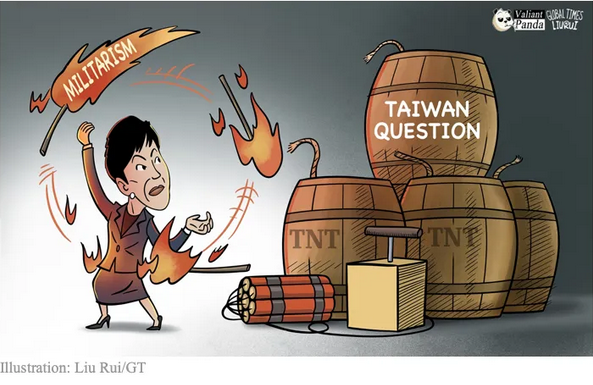
The trigger was a comment in by the new Japanese prime minister, Sanae Takaichi. She told a parliamentary committee that a Taiwan contingency involving the use of force might constitute a “sonritsu kiki jitai” (a “survival-threatening situation” — I think we’d use the phrase “existential threat”) for Japan under its 2015 security laws, and justify the exercise of collective self-defense, using Japan’s self-defense forces.

Beijing exploded. China summoned the Japanese ambassador in Beijing for a formal démarche, and it allowed the PRC consul general in Osaka, Xue Jian, to post a (now-deleted) tweet calling for her decapitation—”that dirty head that trespassed should be cut off, are you ready?” The Xue Jian post has, of course, become a media event of its own. Beijing issued a travel advisory urging Chinese citizens to avoid Japan, and told students to “carefully reconsider” study plans. It stepped up coast-guard activity near the Senkakus, and cancelled the Xi–Takaichi bilateral at the G20.

But this arid account doesn’t begin to convey the way the Chinese and Japanese media are talking about this. The Chinese coverage is nothing short of hysterical. To read the Party-line outlets, you’d think Takaichi had just ordered the immediate re-invasion of Manchuria. Her comment, they said, was an evidence of a “dangerous rightward turn” in Japanese politics. They’re calling it a “sky-collapsing opening“, accusing her of “reckless ranting” and tearing up the China-Japan relationship.

The headline in a widely circulated China Daily article:”If China and Japan go to war, Japan will be destroyed“. They found the inevitable panel of “peace-loving international friends” — including Okinawan peace activists and pro-PRC overseas Chinese — to denounce Takaichi as the reincarnation of “Japanese militarism”. The peace activists dutifully warned that the Japanese people would be “dragged into catastrophe” by their government. A CNR column accuses her of “brazen provocation”, and claims that “Taiwan compatriots are also outraged” at the prospect of Taiwan being turned into a battleground between China and a “militaristic” Japan.

The Party line: Taiwan is a “settled” internal issue; any talk of Japanese collective self-defense in the Strait is aggression and a “serious violation” of the post-1945 order. Takaichi represents “unrepentant militarism.” Chinese pieces quote her opponents at length to argue that “sober Japanese elites” are deploring her recklessness. Chinese-language coverage of the travel advisory is not treating it as a minor consular notice. They’re claiming it’s the first coercive step.

In Japan, this is front-page foreign policy news, not a minor gaffe. Mainichi ran an editorial saying, more or less, that Takaichi’s words were legally consistent with the 2015 security laws, but prime ministers should be more discrete about hypothetical military contingencies and show more prudence. Opposition figures are saying she “went too far” and threw the relationship into “a very grave state”. They called it “frivolous” for a commander-in-chief to talk so specifically about use-of-force scenarios.

On the other hand, there’s clearly a domestic constituency that sees this as long overdue. Some in her party see any hint of retraction as “weakness toward China”, and they’re praising her for drawing a firm line on Taiwan. (The coverage about whether to expel Xue Jian is divided: His post was a death threat, obviously, but the Foreign Ministry seems reluctant to escalate this further.)

TV explainers are reminding viewers that the 2015 security legislation already contemplated a Taiwan contingency — what’s new is that the prime minister has now said this out loud. And a prime minister with an openly revisionist profile — that’s definitely new.

So there’s a lot of signaling going on. Beijing is signaling to its own public: “We’ll never again let Japanese militarism threaten China. The Party is the bulwark against a repeat of the 1930s.” To Tokyo: “We’ll punish any step toward military involvement in the Strait, first with economic coercion — then worse. We are not kidding about this.” To the wider region and Washington: “Japan is a destabilizer — this woman isn’t right in the head. If things go wrong in the Taiwan Strait, blame Tokyo. Remember Pearl Harbor.”

Update, 23 November: Welcome, Instapundit readers! Please do have a look around at some of my other posts you may find of interest. I send out a daily summary of posts here through my Substackhttps://substack.com/@nicholasrusson that you can subscribe to if you’d like to be informed of new posts in the future.

November 17, 2025

Yet another example of the Liberal focus on symptoms rather than underlying problems

Filed under: Cancon, Government, Media, Politics — Tags: , , , , , , — Nicholas @ 03:00

The Liberals under both Justin Trudeau and Mark Carney have amply demonstrated that they care far more about appearances than achievements. The immigration crisis is merely the latest example of the government reaching for something that will look good on TV and in the newspapers rather than addressing the root cause of the problem:

Perhaps the most intractable policy disaster handed to Prime Minister Carney by the Trudeau government is the immigration file. The ugliest detail in that file is undoubtedly the astronomic increase in temporary residents (largely foreign workers, international students, and asylum seekers) – a population that expanded from 3.3% in 2018 to 7.5% in 2024. The Carney government’s solution is to limit the inflow of new temporary residents significantly, while at the same time giving permanent residency to many of the ones already on Canadian soil.

The base problem is far too many people entering the country, driving up demand for housing, overloading healthcare facilities, absorbing more and more government assistance at a time the government is running record deficits, and undercutting young Canadians for entry level jobs while youth unemployment is skyrocketing. But this “solution” will look like firm action as it will be presented by the tame media, so from the point of view of the government, it’s “mission accomplished”.

The Carney government’s first annual Immigration Levels Plan commits to “reducing Canada’s temporary population to less than 5% of the total population by the end of 2027”. To this end, Canada’s annual intake of new temporary residents will be cut from 673,650 in 2025 to 385,000 in 2026, and 370,000 in 2027 and 2028. This cut will hit international students the hardest, with annual new study permits cut in half from over 300,000 to 155,000 in 2026, and 150,000 in 2027 and 2028.

This major cut will ease the strain on Canada’s housing, healthcare, food banks, roads, and social services – a strain that is no longer denied by politicians, and is freely acknowledged across the political aisle. But, as is the case with many policies, the devil is the details. It turns out that one of the ways which the federal government intends to shrink the size of the temporary resident population is by making a large number of them permanent residents.

In the recently released 2025 Annual Report to Parliament on Immigration, Immigration Minister Lena Diab says the Carney government intends to “give priority for permanent residence to temporary residents already living and settled in Canada, further reducing the number of new arrivals”.

How many temporary residents will get permanent residency under this plan is unclear, but we can extrapolate from the data we have.

The Carney government’s Immigration Levels Plan sets the annual permanent resident rate at 380,000 for the next three years – or, a total of 1,140,000. The very last Immigration Levels Plan of the doomed Trudeau government – which committed to transitioning many temporary residents to permanent residency – predicted that temporary residents would account for “more than 40% of overall permanent resident admissions in 2025”.

If the Carney government is heralding the idea of transitioning more temporary residents as a way to slow down the catastrophic population growth Canada has experienced in recent years, we can safely assume that this proportion will be at least a little bit higher than the Trudeau government’s rate. A rate of 50%, say, would mean that 570,000 temporary residents will receive permanent residency over the next three years.

See, Canadians are telling the government that there are too many temporary immigrants, so by waving a magic wand and transforming the bulk of the temporary immigrants into permanent residents, the government can pretend they’ve solved the problem. And the sycophants, fluffers, and cheerleaders in the media will laud them to the skies for their brilliant solution.

November 12, 2025

The legacy media are still fanatically pushing the “Tories in disarray” line

It’s good to see that sometimes you get good value for your money. In this case, it’s the massive financial subsidies the federal government pay out to most of the Canadian legacy media outlets, so that the media ignores stories that the Liberals look bad but push the living bejesus out of anything that makes the Conservatives look bad … even if they have to distort the story almost out of recognition. Brian Lilley has the details:

I told you this would happen, the legacy media is trying to make this whole floor crossing thing into a PC versus Reform Party thing. As I broke down all of the background information that I could muster and tried to present it in a straightforward way, I said this would be a narrative of the MSM.

The reality is, the frustrations exist for a number of reasons but Pierre being too conservative is not the main issue here, it’s that they didn’t win in April. It all goes back to that and how different people interpret that loss and the leader’s response to the loss.

If you haven’t read that piece, it’s worth your time just to understand some of the nuance that you won’t find from other media.

There is no party divide …

The idea that there is still a schism on the modern Conservative Party between old PC voters or members and those that came from the Canadian Alliance or Reform side is not only false, those pushing it are showing their ignorance. The parties merged more than 20 years ago, they governed as the Conservatives for 10 years, anyone that left over this supposed divide left years ago, but the media can’t give this up and so they play into it with Chris d’Entremont on the weekend.

That was followed by Adam Chambers, the Conservative MP for Simcoe North in Ontario who pushed back against the idea that middle of the road Conservatives like him aren’t welcome in Pierre Poilievre’s party.

A hat tip to CBC Watcher on X who grabs so many of these clips and posts them.

Well done by Adam, not that it will help. This is a narrative some in the media are deciding to run with.

They will ignore that d’Entremont first ran under Andrew Scheer, hardly a Red Tory and in fact a so-con and d’Entremont was comfortable with that. Maybe because as a local French CBC outfit pointed out, d’Entremont is also on the pro-life side, the one the Liberals normally hate.

Oh … and another point on CBC’s reporting here. Remember the claim that a staffer was shoved out of the way … this is at the bottom of the CBC article that made the claim.

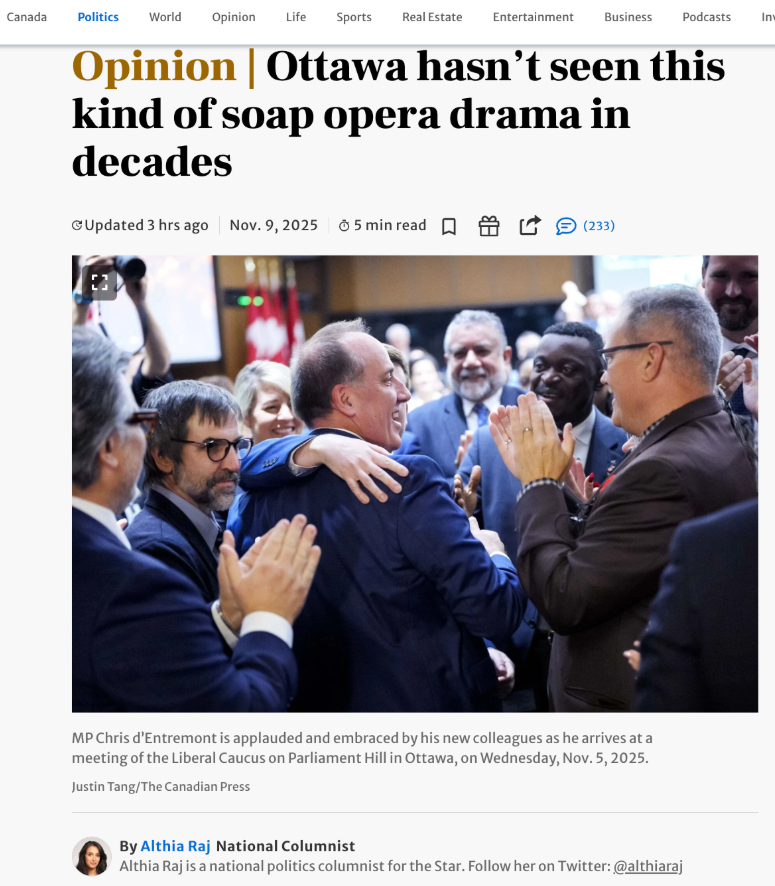
The Toronto Star will not be outdone …

This is a headline that I can’t believe the Toronto Star actually ran.

I’m pretty sure that columnist Althia Raj is old enough to remember all the way back to the morning of December 16, 2024. I know that was a REALLLLLLY long time ago, like, literally decades (please read that with a Valley girl upspeak).

If you don’t know that date, you will know what happened, because that is the day that Chrystia Freeland stabbed Justin Trudeau in the front, not the back. On the day that she was supposed to deliver the federal government’s fall economic statement, she issued a scathing resignation letter instead.

This of course also came after months of Liberal MPs pushing Trudeau to resign. A letter had even circulated among caucus members demanding he stepped down.

Liberal MPs couldn’t make Trudeau leave, Freeland’s resignation couldn’t make Trudeau leave, the 20 point lead the Conservatives then enjoyed couldn’t make Trudeau leave – it was Trump that did it.

All of that was wilder, had more drama than last week, but sure, tell people we haven’t seen this in decades. The column penned by Raj doesn’t mention Trudeau, it doesn’t mention Freeland, but it does want you to believe we haven’t seen this in like, FOREVER!

November 1, 2025

The Spanish-American War 1898

Filed under: Europe, History, Military, USA — Tags: , , , , , , , , — Nicholas @ 02:00

The Great War
Published 13 Jun 2025

In the last years of the 19th century, tension was building in the Caribbean. American newspapers were filled with grisly reports of Spanish atrocities against the people of Cuba struggling for independence. US businessmen and expansionist politicians also saw practical opportunities in Spain’s struggles: great power status and an empire for the United States. It’s the Spanish-American War.
(more…)

October 27, 2025

When announcing something is a substitute for doing something

Filed under: Cancon, Media, Politics — Tags: , , , , — Nicholas @ 03:00

The headline seems to be the most accurate way to describe the habits of the federal Liberals from the start of Justin Trudeau’s first government to Mark Carney’s most recent national media appearance. Peter Menzies describes the bought-and-paid-for national media’s coverage of the big non-event:

It has never been easier, thanks to the internet, for journalists to check if they are being played for fools. But due either to sloth, neglect, habit or servility — pick one — way too many lack the motivation to use a search engine.

Instead, they frequently accept the role of featherheads manipulated by politicians staging one of the oldest scams in the Machiavellian playbook, the recycled “news” announcement. I say “featherheads” (patsies was another option) because, for instance, Prime Minister Mark Carney can book news network time for a full half hour speech that is nothing more than a rehash of everything he’s been saying for the past 10 months and still lead newscasts and make the front pages.

Here, I must pause to credit the Toronto Star. It, like other news organizations, received an embargoed copy of Wednesday’s speech in advance. It read it, saw that it contained no news and did not put a report on its front page. Others such as National Post and the Globe and Mail tried desperately to find a fresh angle within the speech but put it on their front pages anyway. CBC threw everything it had into it and CTV also led with it and tried its best to make it sound like news had happened.

Now, I am a reasonable and fair-minded person, so I would not be reacting were it just this incident that captured my attention. The PM is speaking, everyone gets excited, you review and lock in your story lineup and, ya, I get it. Been there, done that. But this was part of a troubling pattern that has emerged.

For instance, the government’s “plan” to hire 1,000 more Canadian Border Services guards was first announced in the Liberal election platform last spring. It was then, according to Blacklock’s Reporter, re-announced “April 10, April 28, June 3 and August 12”.

That Blacklock’s report was published Oct. 14 and focused on Public Safety Minister Gary Anandasangaree’s insistence he was “not responsible” for the promised hiring that hadn’t happened yet. Two days later, Carney announced that the previously announced and re-announced plan would be announced again in the Nov. 4 budget. And the day after that — Oct. 17 — Anandasangaree announced his ministry would be doing what he said a few days previously wasn’t his responsibility and hiring 1,000 new border guards — over the next five years. A similar pattern of announcement and reannouncements took place regarding the government’s plan to hire 1,000 more RCMP officers, also not immediately but eventually. Then, last week, Finance Minister Francois-Philippe Champagne announced a financial crimes agency would be up and running by next June. This, too, was reported as a new initiative even though the government first committed to that agency in 2021.

While not all news organizations rise to the bait, this widely carried Canadian Press story is an example of how easily the public can be misinformed by reporting that lacks proper context. Re-announcements are presented as “news” despite there being no news other than “politicians repeat what they said before to keep their names in the news”. Media that go along with this pattern of manipulation allow themselves to be accused of defining news as anything the government wishes to present as news, something about which — now that media are subsidized by politicians — they should be more cautious.

The nation needs journalists to tell the whole story or, as Robert Maynard, founder of the Maynard Institute for Journalism Education, put it:

    The first thing about journalism is about accuracy and fairness, but that’s not enough. It has to be about context, it has to be about depth.

October 19, 2025

Reframing the loss of elite legitimacy as a “loss of faith in democracy”

On his Substack, Frank Furedi illustrates how the public’s declining trust in political elites across the western world is being reframed in the legacy media as declining faith in democracy itself:

No doubt you have come across commentators and legacy politicians whining about the public’s loss of trust in democracy and in the key institutions of society.

“France is not alone in its crisis of political faith – belief in a democratic world is vanishing” commented Simon Tisdall last week in The Guardian.1 He noted that “belief that democracy is the form of governance best suited to the modern world is dwindling, especially among younger people“.

The tendentious claim that the current era of political malaise is an outcome of a loss of commitment to democracy is regularly echoed by mainstream commentators. This was the message of a recent Politico headline that stated that “Europe’s democracies are in danger, warn Merz and Macron”.2 It cited the German Chancellor Friedrich Merz stating that these “threats dwarf anything seen since the Cold War”. He noted that “the radiance of what we in the West call liberal democracy is noticeably diminishing”, adding: “it is no longer a given that the world will orient itself towards us, that it will follow our values of liberal democracy”.

If anything, the French President Macron was even more pessimistic than Merz. He warns that Europe is undergoing a “degeneration of democracy due to attacks from without and from within”. He was particularly concerned about the loss of faith in democracy within France. “On the inside we are turning on ourselves; we doubt our own democracy”, he noted, before adding, “we see everywhere that something is happening to our democratic fabric. Democratic debate is turning into a debate of hatred.” This statement coming from a man, whose presidency lacks a genuine mandate and relies on bureaucratic maneuvering exposes the cynicism of his concern for the “degeneration of democracy”.

[…]

Loss of elite authority

In reality the crisis of democracy narrative serves to mystify the real issues at stake. This narrative offers a misdiagnosis of the very real loss of legitimacy of the ruling elites as a loss of belief in democracy. As far as this dominant narrative is concerned every time people vote against the representatives of the legacy political establishment democracy is in trouble. So long as they win elections and populists aspirations are confined to the margins of society democracy is represented as a big success. But the very minute people vote the “wrong way” the mainstream commentators craft alarmist accounts about democratic backsliding. That is why the Remainer lobby often represents the outcome of the Brexit Referendum as an expression of “democratic backsliding”.

In theory, the term democratic backsliding refers to the declining integrity of democratic values. In practice it means the estrangement of significant sections of the public from their political institutions. The term democratic backsliding serves to mystify a very significant development, which is the legitimacy crisis of the legacy political establishment. Once understood from this perspective it becomes evident that it is not democracy that people no longer trust but the people and the institutions that rule over society.

As it happens the narrative of “democracy is in trouble” smacks of pure hypocrisy. Those who communicate this narrative are not so much interested in the integrity of democracy but in ensuring that people vote the right way. From their perspective if people vote the wrong way than democracy becomes dispensable. That is why more and more we hear the refrain that there is “too much democracy”. “Democracy Works Better when there is less of it” warned Financial Times commentator, Janan Ganesh.3 As far he is concerned, “no global trend is better documented than the crisis of democracy”, by which he means that too often people vote against the advice of the elites.


  1. https://www.theguardian.com/commentisfree/2025/oct/12/france-crisis-political-faith-belief-democratic-world-vanishing
  2. https://www.politico.eu/article/europe-democracies-danger-warn-friedrich-merz-emmanuel-macron/
  3. https://www.ft.com/content/f68c13a4-1130-49d5-b3c6-2270711d819e

October 11, 2025

QotD: Riot control tips

Filed under: Media, Military, Politics, Quotations, USA — Tags: , , , , , , — Nicholas @ 01:00

1. The press is not only the enemy; they must be presumed to be an utterly unprincipled and dishonest enemy. Anything and everything the riot control force does will be filmed and, if necessary, edited, to present it in the worst possible light. Therefore, they must have their own camera teams recording everything to both clear themselves of wrongdoing or spurious charges of indiscipline, as well as to discredit the press which will have edited the truth heavily. NB: There is no real limit to how dishonest the modern press can be and will be in support of the leftist agenda. There is no placating them. There is no degree of righteous conduct they will not twist into wrongdoing. There is thus no sense in trying to placate them, in trying to be nice, in tightly limiting violence, etc.; because they will lie about you and all those who want to believe their lies will.

2. Riot Control Women. They’re rather preposterous, in the main, if employed on the riot control line. It’s one of the reasons why MPs have for long been useless at riot control; they’re simply too heavily laden with women, who almost universally lack the size, strength, and aggressiveness for hand to hand combat with stone age weapons. Indeed, while the infantry and other combat and combat support unit in the old 193rd were excellent at riot control, the MPs – yes, I have seen it – were useless. Worse, riot control is a perfect environment to cause what the Israeli’s found out when they mixed men and women in the same units in their War of Independence; men will abandon the mission to succor one of their own women. This is the fault of the men, by the way, and not of the women, but it is even more the fault of the dogmatic shitheads of the left who refuse to see men and women for what they are.

3. Rioting women. I don’t care if you have a warrant for their arrest for murder, arson, mayhem, and massacre, plus cellulite and bad makeup, do not arrest or detain them at the scene. Shoot them if their conduct (to include dress) warrants it, but otherwise just push them away or wound them slightly and push them away. Why? Because, though ill-disciplined rabble, for the most part, the rioters are also mostly male and will also rush to the defense of “their” women. There is no better substitute for the cohesion and moral fiber a mob usually lacks than going after the women in the mob. They can turn ferocious very quickly, indeed, if you do.

And that’s all good and maybe it will get us through the summer, should it turn out as badly as it might, but, America, I suspect that you and the president are ultimately still going to need a dedicated, well trained, highly mobile, professional force for riot suppression.

Tom Kratman, The social media site formerly known as Twitter, 2025-06-11.

Update, 12 October: Welcome, Instapundit readers! Please do have a look around at some of my other posts you may find of interest. I send out a daily summary of posts here through my Substackhttps://substack.com/@nicholasrusson that you can subscribe to if you’d like to be informed of new posts in the future.

October 8, 2025

QotD: Porn is always in the vanguard of new technologies

Filed under: Books, History, Humour, Quotations, Technology — Tags: , , — Nicholas @ 01:00

    I remember seeing something years ago that commented on how soon after the development of photography we got pictures of naked women.

5 Florins says after Gutenberg invented the printing press and mass printed the Bible, guys were buying presses and cranking out copies of Thee Hornee Shepard and Thee Shye But Readye Milkmaide. 😍

(“T’would say it be a bodice ripper, but we’ve not invented bodices yet” – Johannes of Cologne, Ye Cologne Courier Newspapere)

mmack, commenting on “Why the Internet Stinks Now”, Founding Questions, 2025-07-03.

Update, 9 October: Welcome, Instapundit readers! Please do have a look around at some of my other posts you may find of interest. I send out a daily summary of posts here through my Substackhttps://substack.com/@nicholasrusson that you can subscribe to if you’d like to be informed of new posts in the future.

October 7, 2025

Big management shake-up at Cracker Barrel’s corporate HQ

Filed under: Business, Media, Politics, USA — Tags: , , , , , — Nicholas @ 05:00

Back in August, the US chain restaurant field saw a corporation decide that doing what their customers wanted was actually a pretty good strategy … after they’d tried the opposite and nearly gone the way of Bud Light:

Last week was the Red Wedding for Cracker Barrel.

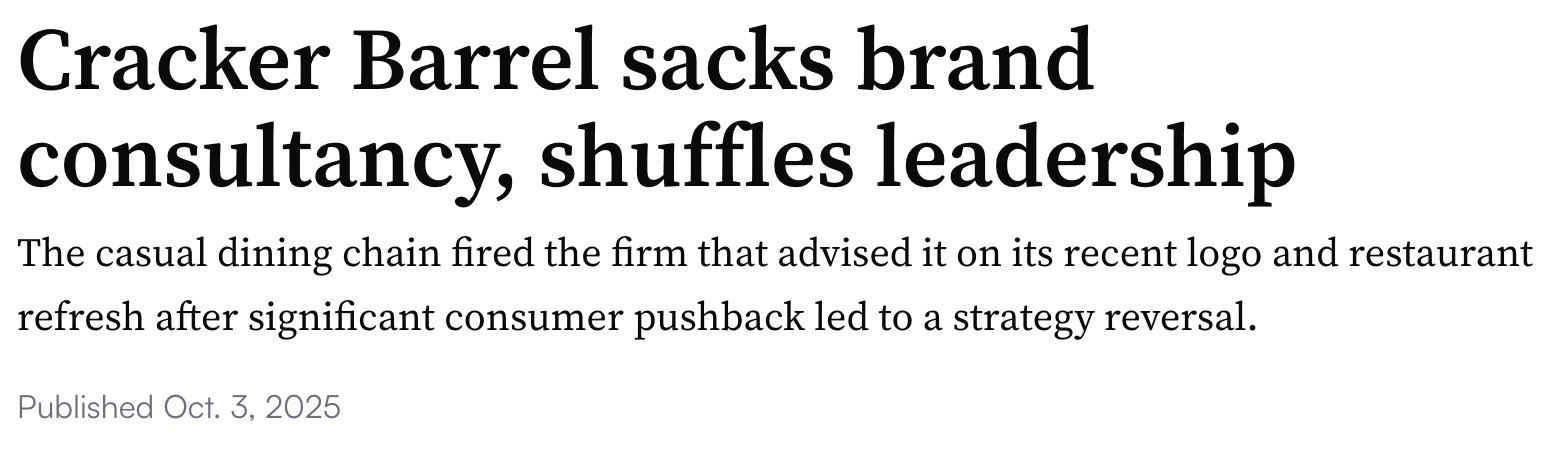
Some senior people who were in the headquarters office last Monday weren’t there anymore as the weekend drew near, some old managers from an earlier corporate culture came back to rewind the clock, and the branding consultant that advised on the now-fatally-wounded rebranding effort was sent packing. The new logo departed. The redesigned stores were acknowledged as a failure and an embarrassment.

[…]

See what they said about the redesign? “We won’t continue with it”. The whole thing collapsed, a $700 million rebrand that slammed into a concrete wall and exploded.

It remains to be seen how much the rebranding of the rebranding will matter, and this is what Cracker Barrel stock looks like in the last month:

Now, a reminder: The New York Times columnist David French explained, just over a month ago, that the controversy over Cracker Barrel’s rebranding was an absurd fake crisis ginned up by right-wing idiots who were just pretending that something had gone wrong at the company. Along with the Sydney Sweeney thing, he concluded that we were watching some “completely frivolous and meaningless cultural disputes,” examples of the way “right-wing media both mobilizes its base and bends political reality”. If you believed that the Cracker Barrel rebranding was poorly done and would alienate the company’s customers, you were falling for an invented reality that was completely meaningless and frivolous.

Then Cracker Barrel fired a bunch of managers and its rebranding consultant, abandoned the rebranding, and apologized profusely, while its stock plummeted.

If you listened to David French, if you trusted the op-ed pages of the New York Times to explain the world to you, your understanding of the most basic outline of factual reality was flipped over, turned precisely upside down. He was only wrong about literally every single detail, completely missing what was happening, what it meant, and what would happen in the near future as a result of it. To listen to this idiot is to abuse your own mind, trapping yourself in the confines of an absurd house of ideological mirrors. He is inevitably wrong, completely wrong, reliably wrong to the point of absolute and unyielding madness.

October 5, 2025

The New York Times finally decides that there’s a case for “splitting the Autism spectrum”

Filed under: Health, Media, Politics — Tags: , — Nicholas @ 03:00

Freddie deBoer on the stereotyped way that the “Gray Lady” — the New York Times — once again lets the independent media do all the serious work to investigate an issue before “the Grey Lady squats down on that issue and says ‘this is mine now'”:

You may groan! You may say, “Again?” You may roll your eyes. But I’m going to talk about this one more time, and then I think I’m done. But I’ve always been right about all of this, and it needs to be said.

The Times has once again parachuted into a conversation that has been going on for decades, planted its flag, and declared itself the discoverer of new territory. Yesterday they published a piece on autism, neurodiversity, RFK Jr., and whether the autism spectrum should be split up — split back up, that is, to reflect on the massive differences between those with profound autism and those for whom “neurodiversity” is mostly a social badge, a tidbit to be displayed on a Bumble profile. (The answer is yes, of course the spectrum should be split up again, for reasons I’ve written about at great length.) That issue, unusually raw, will bubble on, as it sits at a genuinely uncomfortable intersection of liberal identity norms, online culture, and the genuinely debilitating reality of severe autism. In terms of progressive discourse rules, the plight of the severely autistic and their loved ones is truly a problem from hell: those rules insist that you can’t ever question someone’s diagnosis, no matter how dubious; they demand that you acquiesce to claims made from a position of disability, no matter if they cut directly against the claims made by others from their own position of disability; they have long ago lost sight of any distinction between identity and disorder; and they’re governed by a selective and incoherent vision of standpoint theory that insists that only the autistic can speak out about autism – which perversely empowers the least-afflicted and silences the interests of the most-afflicted, as the most-afflicted literally cannot speak for themselves. You know my rap on all this.

In meta terms, though? This tendency of the NYT to helicopter in to long-simmering debates and bless them with the paper’s attention, and in so doing anoint those debates as worthy of attention by grownups, is only the latest example in an old, ugly dynamic. The little people in independent media ask difficult questions and engage in rancorous debates and stick their necks out in the service of ideas, which is what the media is supposed to do. Then, once the heavy lifting is done, the Grey Lady squats down on that issue and says “this is mine now”. The paper’s consolidation of both prestige and financial security — its status as both far and away the most prestigious publication in world media and maybe literally the only financially healthy newspaper left in the United States — has all manner of pernicious, perverse consequences in an industry that can only function when people within it are engaged in debates with real stakes and real hurt feelings. Again, nothing you haven’t already heard from me. But when there is only one endpoint for the ambitious to aspire to, there’s an inherent and unavoidable silence about that endpoint’s myriad failings. The Times, for its part, has walled off criticism within its own pages with its “we don’t do media criticism” rule, a profoundly self-interested and cynical policy that helps them evade ever having to justify their own widely-criticized practices. And for all manner of complex reasons, the broader world of stodgy old media, dying though it may be, still holds all the cards when it comes to defining debates that involve institutional stakeholders, as the debate about autism’s future certainly does.

I don’t begrudge any writer for wanting to weigh in on these issues — God knows they matter and need more attention — but what’s striking about the Times‘s coverage is how effortlessly it erases the long history of people already fighting these battles, and the richness of the debate that preceded them. Whole archives of independent writing, analysis, and advocacy disappear when the Paper of Record decides that a question now exists. Until then, the issue is marginal, unserious, relegated to the sidelines; afterward, it’s real, it’s official, it’s legitimate … and therefore too important to be left up to those of us in the cheap seats. This is the paradox, you see; no issue that independent media concerns itself with can be considered truly serious, and no issue that they (eventually) deign to be truly serious is something that they trust the independent media to engage with responsibly. Quite a little trap, there. And when the grownups in the room walk in, we’re meant to feel blessed by their presence, happy to have our pet issues taken seriously. Everyone else who’s been in the trenches for years is supposed to be grateful for their newfound recognition.

September 30, 2025

When your prime minister is addicted to photo ops

Filed under: Cancon, Government, Media, Politics — Tags: , , , , , — Nicholas @ 05:00

You might think, from my headline, that I’m referring to former prime minister Justin Trudeau — who really, really did love him some gushing media coverage accompanied by advertising-agency-quality visual effects. But it’s actually our current prime minister who has somehow managed to show even more love for the photogenic backdrop and the appealing props in media coverage:

Twice in four days, Prime Minister Mark Carney scheduled official photo ops in front of environments that weren’t entirely real.

During a Sept. 19 visit to Mexico, Carney led cameras through a railyard stocked with pallets of artfully arranged sacks decorated with a maple leaf and the words “product of Canada”.

The site was the Canadian Pacific Kansas City Ferrovalle train yard, located outside Mexico City.

The yard is indeed equipped to process incoming railcars of Canadian wheat, but that’s all done in bulk. Hopper cars are positioned over large tanks to disgorge their loads, multiple tonnes at a time.

If any sacks ever enter into the equation, it’s long after Canadian producers have exited the process.

“Canadian grain farmers haven’t shipped wheat in sacks for over a century!” read a reaction by Chris Warkentin, Conservative MP for the heavily wheat-growing riding of Grande Prairie, Alta.

Sylvain Charlebois, a food scientist at Dalhousie University, wrote in a column this week that “bagged wheat is a relic of less mechanized economies”.

“We are among the most efficient bulk grain exporters in the world, shipping millions of tonnes through rail networks and ocean vessels designed for efficiency, safety, and traceability,” he wrote.

But it was a housing announcement just outside Ottawa where Carney would run into more direct accusations of being deliberately deceptive with his photo backdrop.

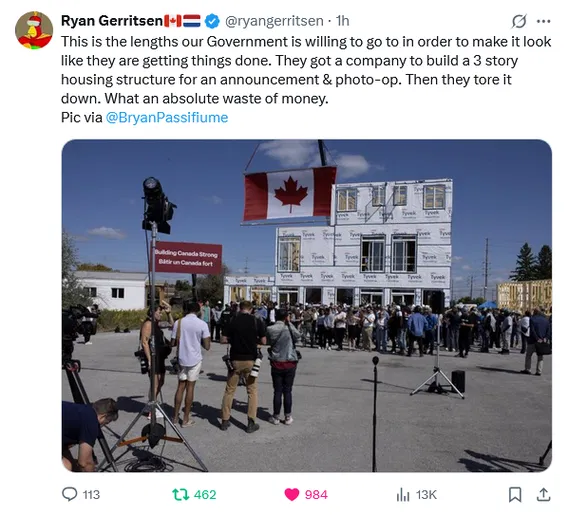
On Sept. 14, just before the opening of the fall session of Parliament, Carney stood in front of two under-construction homes in the Ottawa area and announced the official launch of Build Canada Homes, a new federal agency tasked with developing subdivisions of manufactured homes on federal land.

“The two sets of homes behind me were manufactured in two days, assembled on site in one,” Carney said to applause.

“We wanted to keep the townhouses open; we held back the workers from finishing it so you could see how things fit together,” he said, adding that one of the homes was being shipped “to Nunavut”.

Once the press conference was over, both homes were dismantled, and the site returned to what it had been before: A patch of fallow government land located near the Ottawa airport.

The land is a right-of-way for high-voltage power lines, which is why it currently doesn’t contain any development.

At The Rewrite, Peter Menzies congratulates Brian Passifume for being one of the only legacy media reporters to look past the literal Potemkin Village structure Carney had assembled for his photo op:

Our Orwellian theme continues but, this time, it’s to credit Brian Passifume of the Toronto Sun for his work digging into how our prime minister and his staff work to create fantasy settings for their announcements. Canadian Press and others were happy to play government propagandist by captioning a photo taken at Prime Minister Mark Carney’s Canada Builds launch by stating “Workers from Caivan Homes look on from a modular home under construction in Ottawa during Prime Minister Carney’s announcement for the new agency.”

Near as I can tell, most other media were happy to play along. Except Passifume who broke from the pack and pointed out the whole scene was, essentially, a movie set.

After one X user pointed out that the entire scene was fake, Passifume jumped in with “Dude I was there, that’s exactly what happened. It was a freshly-graded gravel lot with no utilities or services run. I was discussing this very topic with other reporters covering it — they didn’t even move the crane or remove the lifting apparatus, they just repurposed it to hold a gigantic Canadian flag.”

I expect some in the trade will say “hey, everyone does it” and no doubt that is true. But when people with power and those who crave it misrepresent reality, journalists are obliged to point that out. It doesn’t even have to be aggressive, just “Carney said in front of a set created for the announcement”.

Journalism isn’t actually that complicated. You just have to subscribe to its principles.

September 26, 2025

A ministry for “Heritage” should not be funding hate publications

Filed under: Cancon, Government, Media, Politics — Tags: , , , , — Nicholas @ 04:00

I’m with Dan Knight that the government shouldn’t be funding any private networks, magazines, or newspapers, but since it does provide a lot of funds through various programs, it should at the very least strive to avoid funding open hatred toward ordinary Canadians:

Steven Guilbeault at a happier stage of his life, before joining the Liberal cabinet.

In a fiery exchange at the Standing Committee on Canadian Heritage (CHPC), Conservative MP Rachel Thomas dismantled Liberal Minister Hon. Steven Guilbeault, P.C., M.P., Minister of Canadian Identity and Culture and Minister responsible for Official Languages, over taxpayer money funneled into groups publishing hate-laced screeds and smearing everyday Canadians.

Thomas zeroed in on Cult MTL, a publication receiving federal heritage funds. She read into the record a headline published the very day after reports of Charlie Kirk’s assassination attempt: “To Hell with Charlie Kirk”.

“Minister, do you think that is wrong? Taxpayer dollars are funding this group. Will you revoke their funding?” Thomas demanded.

Guilbeault looked blindsided. He admitted he had no idea the government was bankrolling a tabloid openly celebrating political violence. His answer:

    I have not been made aware of this. I will verify with the department and report back to you. Obviously, spreading hate has no place in Canada, and if this is the case, we will make the necessary verifications and take the necessary steps.

Thomas didn’t stop there. She turned to the Canadian Anti-Hate Network, which she said has already pocketed about $1 million from Guilbeault’s department. Documents show the group paid an “investigative journalist” to hunt down so-called “far-right” targets — defining the term so broadly it included Catholics and pro-life Canadians — before seeding the stories into mainstream news outlets.

[…]

Conservative MP Rachel Thomas quoted former CBC anchor Travis Dhanraj, who launched a human rights complaint this summer […]

    To be honest, this has been the hardest period of my life. What happened at CBC really broke me.

Then she put it directly to Guilbeault:

    Have you reached out to the CEO of the CBC regarding this situation and the toxic work environment that is being accused there?

Guilbeault’s answer? Bureaucratic shrugging:

    The government role is not to get mixed into the daily operations and management of the organization. That is the purview of the organization, in this case, the public broadcaster.

Translation: $1.4 billion of your money flows into CBC every year, but the minister says he can’t pick up the phone when staff say they’re being harassed.

September 22, 2025

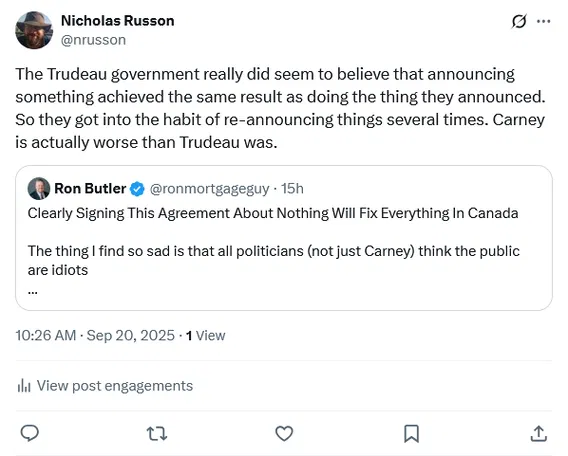
The Liberals fervently believe that saying something is the same as doing something

One of the most irritating aspects of Justin Trudeau’s long reign of error was his evident joy in making announcements about this or that topic. It got to the point that even the pro-Liberal media started to notice that the same policy would be announced several times over a few months but no actual progress was made (except where they could start setting up a new government program … they’d hire the staff very quickly, but little or nothing would get done beyond that). Mark Carney was supposed to be a clean break from the Trudeau years — even though most of his ministers were Trudeau retreads — but Carney may actually be worse than Trudeau in that he just loves photo ops with pretty props for the cameras. As Dr. Sylvain Charlebois notes, we need a lot fewer photogenic Potemkin Villages in how our federal government operates:

In recent weeks, we have witnessed politicians lean on powerful visuals to make their case on food and trade. But these staged moments rarely serve the public interest. Worse, they often deepen food illiteracy in a country where understanding how our system works is already fragile.

Take Ontario Premier Doug Ford’s stunt. Upset with Diageo’s decision to close its bottling plant in Ontario, he theatrically dumped a bottle of Crown Royal and urged Ontarians to boycott the brand. What he didn’t mention is that the bottle in question was made in Manitoba and bottled in Quebec by unionized Canadian workers — jobs unaffected by the Ontario closure. The Windsor facility mainly serviced the U.S. market, and Diageo’s decision was years in the making. Ironically, the boycott risks punishing Canadian workers who will continue producing Crown Royal for Canadians. And for future investors, the message is chilling: why put capital into Ontario if a government will trash your brand on television for a corporate restructuring decision?

The federal stage brought us another head-scratcher. During a trade visit to Mexico, Prime Minister Mark Carney posed with bags of Canadian wheat stamped with a maple leaf. The problem? Canada doesn’t export wheat in bags. We are among the most efficient bulk grain exporters in the world, shipping millions of tonnes through rail networks and ocean vessels designed for efficiency, safety, and traceability. Bagged wheat is a relic of less mechanized economies. For Canada to present itself this way trivializes our status as a modern agri-food powerhouse. Beyond being misleading, the image suggests to global partners that our system is less advanced than it truly is — a dangerous misrepresentation for a nation that depends on reputation as much as price.

Even I didn’t realize how bad it got until the feds paid contractors to put up a fake building site for Mark Carney to pose in front of, then tore it all down:

« Newer PostsOlder Posts »

Powered by WordPress