Quotulatiousness

January 13, 2011

USN considers decommissioning USS Enterprise

Filed under: Military, USA — Tags: , , , — Nicholas @ 07:57

In the new atmosphere of austerity, the US Navy is having to look at economies, including the possibility of retiring the USS Enterprise:

Meanwhile, the navy is facing budget cuts, and growing costs for new ships. The first of the new Ford-class (CVN-21) aircraft carriers will go for at least $14 billion (this includes R&D for the entire CVN-21 class). The current Nimitz-class carriers cost $4.5 billion each. Both classes also require an air wing (48-50 fighters, plus airborne early-warning planes, electronic warfare aircraft, and anti-submarine helicopters), which costs another $3.5 billion. Thus the thinking is that smaller carriers will be cheaper to build and operate (smaller crews) and carry the same number of warplanes (because most of them will be smaller UAVs).

Meanwhile, the cash crunch is getting serious. So the navy also wants to decommission its oldest aircraft carrier, the USS Enterprise (CVN 65) three years early, in 2012. Originally, the Enterprise was going to stay in service until the USS Ford was ready in 2015. But changes in aircraft weaponry, namely smart bombs and targeting pods, have reduced the need for eleven carriers. The navy believes ten will get the job done. Plus, the Enterprise, as the world’s first nuclear powered carrier, will also be the first to be decommissioned. That will mean removing eight nuclear reactors. Unlike later nuclear carriers, which had only two reactors, the Enterprise was designed so that one reactor replaced one of the steam boilers of a non-nuclear power plant. The navy has decommissioned nuclear powered surface ships before, having retired nine nuclear powered cruisers in the 1990s. This was done because these ships were more expensive to operate and upgrade. So the costs and savings are known.

The Enterprise was an expensive design, and only one was built (instead of a class of six). While a bit longer than the later Nimitz class, it was lighter (92,000 tons displacement, versus 100,000 tons). The Enterprise was commissioned in 1961, almost 40 years after the Langley entered service (1923).

January 10, 2011

Fighting pirates, privately

Filed under: Africa, Economics, Military — Tags: , , , — Nicholas @ 09:42

Strategy Page reports on a new initiative to combat the problem of piracy off the coast of Somalia:

A major British insurer (Jardine Lloyd Thompson) is organizing a private armed escort service for ships operating off Somalia. Called the Convoy Escort Programme (CEP), the 18 small patrol boats will offer armed escort through the Gulf of Aden, and reduce overall security and insurance costs for ships using the service. It’s all about money, as the insurance companies don’t like the spiraling ransom costs, and especially the unpredictability of the pirates. While the insurance companies can pass the costs onto those who buy their insurance, the pirates could rapidly increase the number of ships their steal, and force the insurance companies to incur losses, not to mention the risk of more ships foregoing insurance and using increased shipboard security and armed guards.

The CEP is not a done deal yet. A country has to sign on to allow the patrol boats to fly their flag (and thus provide a national legal system to operate under). The patrol boats will carry heavy machine-guns (12.7mm/.50 cal), armed crews (all former military) and small boats to check suspected pirates. CEP will coordinate with the anti-piracy patrol, and let the larger warships spend more time pursuing the pirates that are now operating much farther from the Somali coast.

This may not be the answer, but it shows that creativity isn’t dead in the insurance industry.

December 21, 2010

EMALs successfully launches aircraft

Filed under: Military, Technology, USA — Tags: , , — Nicholas @ 09:37

In what must be welcome news for naval aviators, the next-generation catapult for launching aircraft from carriers was successful in a land-based test:

The US Navy says it has successfully launched a jet fighter into flight using a radical new electromagnetically powered catapult. The feat is important for the Americans, whose next supercarrier will be a disastrous botch without the new tech: it is even more critical for the future of the Royal Navy.

The US Naval Air Systems Command (NAVAIR) announced the test success of its Electromagnetic Aircraft Launch System (EMALS) last night, saying that the shore-based trials catapult at Lakehurst, New Jersey, successfully launched a Navy F/A-18E Super Hornet on Saturday.

“I thought the launch went great,” said Lieutenant Daniel Radocaj, the test pilot who flew the Hornet off the electric mass-driver. “I got excited once I was on the catapult but I went through the same procedures as on a steam catapult. The catapult stroke felt similar to a steam catapult and EMALS met all of the expectations I had.”

The timing of the test is crucial for the US Navy’s next big warship:

The next US fleet carrier — CVN 78, aka USS Gerald R Ford — is now at an advanced stage of build, and was designed around the EMALS. If EMALS couldn’t be made to work, the US Navy would have found itself in possession of the world’s biggest helicopter carrier. There will be much celebration at NAVAIR following Saturday’s success.

December 15, 2010

Yet another railgun trial

Filed under: Military, Technology — Tags: , — Nicholas @ 12:19

You’ve probably heard about the US Navy’s recent successful railgun test, but it’s not the only game in town:

It’s all go in the world of hypervelocity railguns this week. Following Friday’s 33-megajoule test shot carried out at a US Navy laboratory, it has also been announced that a different railgun known as “Blitzer” has recently carried out firings which suggest that it is almost combat ready.

The Blitzer comes to us courtesy of famous radical-tech company General Atomics, well known to Reg readers for its development of robot warplanes and electromagnetic mass-driver catapults for aircraft carriers among other things.

Now, in a statement which is dated 7 December (but which didn’t appear on the firm’s website until yesterday*) General Atomics would like to inform the world that the Blitzer was carrying out highly interesting and “tactically relevant” shoots back in September, actually, while the johnny-come-lately test job at Naval Surface Warfare Centre Dahlgren hadn’t even got its boots on.

Railguns have been one of the preferred technologies of near-future SF writers for years, but the necessary real-world technology has not been easy to develop. SF versions are often postulated as replacements for rifles and machine guns, but the current technology will only be suitable for fixed installations or shipboard use (and not just any ship: the electrical requirements are huge).

This may be the most attractive facet for the remaining “big gun” advocates in the Navy:

In the nearish future, depending how accurate GA’s “tactically relevant” puffery turns out to be, warships equipped with Blitzer-type railgun turrets might offer far better air defences than Type 45 or Aegis vessels can today. Such defences might only be penetrable by bigger, heavier railguns firing from beyond the horizon — along the lines of the Dahlgren boffins’ desired 64-megajoule weapon. It would, of course, require a massive capital ship to carry such guns and power them for any serious rate of fire — such a future might see the big-gun (railgun) dreadnought battleship return to its lost dominion over the seas, ousting the parvenu aircraft carrier, missile cruiser etc.

December 3, 2010

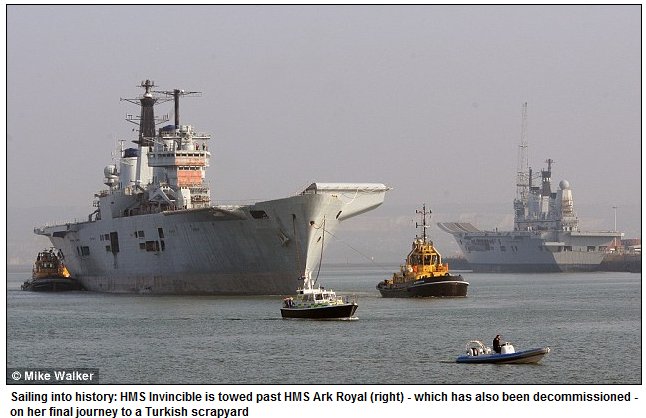
HMS Ark Royal arrives in Portsmouth to be decommissioned

Filed under: Britain, Military — Tags: , — Nicholas @ 11:06

Steven Morris was there as HMS Ark Royal arrived back at her home port for the final time:

The music was corny: a Royal Marines band was belting out a version of the Rod Stewart hit Sailing as HMS Ark Royal emerged from the freezing fog to tie up at her home port for the final time.

But the emotion was genuine enough. From the quarter deck to the frozen quayside, tough sailors gulped back tears at the end of a chapter in Britain’s proud naval history.

After a quarter of a century of service around the globe, the aircraft carrier is being decommissioned as part of the defence review. The former flagship’s future remains unclear. There has been talk that she could be turned into a museum, but that may be too expensive. It is more likely that she will be sold off or simply scrapped for parts.

“It’s very emotional,” said Leading Seaman Paul Stockell, one of those who had tears in his eyes — and not just because of the biting wind — as he helped bring the ship alongside in Portsmouth today.

December 1, 2010

Want to buy (the remains of) an aircraft carrier?

Filed under: Britain, Environment, Military — Tags: , , — Nicholas @ 09:47

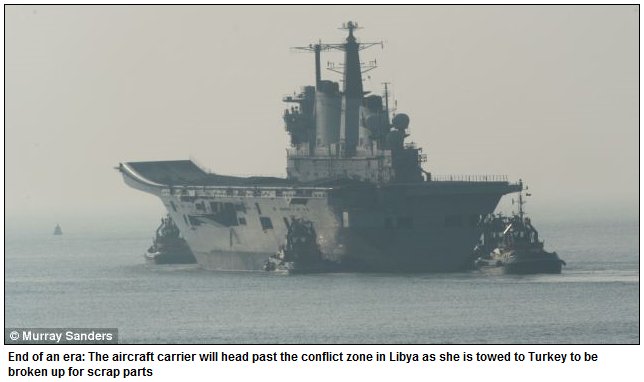
HMS Invincible is being disposed of:

Strategy Page has more:

Britain has put its decommissioned (in 2005) 20,000 ton aircraft carrier, HMS Invincible, up for auction at edisposals.com. Five years ago, the Royal Navy said that the ship would be held in reserve until September, 2010, for possible reactivation. That process would take 18 months. However, by last year, Invincible was in a sad state, with its many components removed, and tended to by a detachment of only four sailors. Thus the auction did not come as a big surprise, and the Royal Navy hopes to obtain at least $3 million for the old ship. The Invincible entered service in 1977, and normally carried 18 Sea Harrier vertical takeoff jets, four helicopters and a crew of 1,050. The Invincible underwent a refurbishment in 2004, but cuts in the navy budget forced retirement the next year. Invincible played a vital role in the 1982 Falklands campaign.

It’s not as easy as it used to be for navies to get rid of unwanted ships:

In the past, navies would send retired ships “to the breakers” and receive a portion of the value of the scrap metal obtained when the breakers (the firm the disassembles ships) finished their work. But this is no long profitable in many cases, because taking ships apart in an environmentally correct way costs too much. This has become a problem for navies, that have no easy way to get rid of old ships. The U.S. uses many old ships for target practice and lets them sink at sea. But even this practice is under attack because of potential environmental damage.

Update, 3 December: HMS Ark Royal has just arrived in Portsmouth to be paid off. It’s not clear if the British government will try to sell the ship or if she’s headed to the breaker’s yard.

November 29, 2010

“They’ve taken leave of their senses”

Filed under: Britain, Bureaucracy, Military — Tags: , , , — Nicholas @ 17:24

Con Coughlin was also aboard HMS Ark Royal for the final Harrier launch:

In many respects, it was an appropriate end to the glittering career of one of Britain’s most iconic warplanes. For none of the Royal Navy crewmen and women who braved the sub-zero temperatures were in much of a mood to celebrate the Harrier’s last appearance on the deck of a British aircraft carrier.

Most of them are still too shell-shocked over the Government’s decision to consign the entire Harrier fleet to the scrapheap, together with the Royal Navy flagship which has been the fighters’ proud host for nearly three decades.

“They’ve taken leave of their senses,” was one young rating’s verdict of the Government’s decision to scrap the Harriers and HMS Ark Royal. “You can’t get a better fighting combination than this, and yet they are sending us all to the scrapyard. They can find £7 billion to bail out Ireland, but they can’t find a few measly million to keep us going.”

I wonder what the bookies are offering for the British government to sell off the new carriers as they come off the launchways, rather than putting them into commission?

November 25, 2010

Video of the last Harrier flight from HMS Ark Royal

Filed under: Britain, Military — Tags: , , , — Nicholas @ 13:03

November 24, 2010

End of an era

Filed under: Britain, Military — Tags: , , , — Nicholas @ 18:49

The last Harrier takes off from HMS Ark Royal earlier today:

Lt. Cdr. James Blackmore was the last Harrier pilot to launch from HMS Ark Royal, noting that “this is truly a memorable day.” But as it is never a good idea to tell your bosses they are a bunch of idiots, he also adds that “we accept the decision to decommission both the Harrier and HMS Ark Royal; however, of course the final launch will be emotional.”

More information at Aviation Week.

RN’s Type 45 destroyer has even more trouble

Filed under: Britain, France, Military — Tags: , — Nicholas @ 12:54

Remember the Royal Navy’s latest destroyer, the Type 45? It’s the one without effective main armament. As if that wasn’t bad enough, the lead ship of the class, HMS Daring, broke down at sea recently:

The Royal Navy’s new Type 45 destroyers continue to suffer from technical mishaps, with first ship of the class HMS Daring arriving a week late in Portsmouth on Saturday following emergency propulsion repairs in Canada. The £1.1bn+ ship had previously broken down in mid-Atlantic.

The News of Portsmouth reported on the breakdown and the destroyer’s delayed return to its home port, noting that a similar propulsion problem had occurred just four months previously during an outing in the Solent for families of the ship’s company.

[. . .]

The Type 45s’ hulls and some of their kit — for instance the fire-control radar — are made in Britain but much of the colossal expense of the ships has gone on equipment from the US, Italy and France. Particularly well-known are their French-made Aster air-defence missiles, which have been delayed for several years following repeated failures in test-firings caused by a manufacturing fault.

The UK Public Accounts Committee went so far to describe the missile-system, named “Sea Viper” in British service, as “disgraceful” in 2009 … and that was before the most recent test failure. However the flaws in the Aster missiles are now reportedly rectified and successful firings have since taken place. The UK Ministry of Defence expects to declare its first Sea Viper system operational next year: until then, the Type 45 destroyers will continue to be almost unarmed, able to employ only basic guns and cannon.*

[. . .]

*Apart from Sea Viper, the only armament possessed by a Type 45 is a single 4.5-inch “Kryten” gun turret, primarily useful for bombarding targets ashore (within a few miles of deep water) and two light 30mm cannon for close-in work against pirate dhows or the like.

Sea Viper will not enhance the destroyers’ abilities against other ships or land targets when it becomes operational as it has no surface-to-surface mode. It is said to be superior to any other system against missiles and aircraft, perhaps even offering an effective defence against widely-feared shipkiller missiles of Russian manufacture which approach their target at supersonic speeds. However Aster/Sea Viper has never been tested against a supersonic target and there are no plans to do so, which means that any battle plan based on such a capability would be a gutsy call indeed.

As you can tell, Lewis Page isn’t a fan of the Type 45 destroyers . . .

China’s first aircraft carrier approaching completion?

Filed under: China, Military — Tags: , — Nicholas @ 08:08

In their growth from a small coastal protection flotilla to a blue water navy, the next milestone for China’s navy will be the completion of the Shi Lang:

Work is picking up on what appears to be China’s first aircraft carrier, the Shi Lang. For eight years now, China has been tinkering with a half finished Russian aircraft carrier. Two years ago, this ex-Russian aircraft carrier, Varyag, was renamed the Shi Lang (after the Chinese general who took possession of Taiwan in 1681, the first time China ever paid any attention to the island) and given the pennant number 83.

Until last year, progress was slow. But there has been a lot of work lately. Early in 2009, China moved the Shi Lang into dry dock, where work is now obviously underway to install engines and other heavy equipment. A year ago, the radar mast was completed, and now there is a Chinese radar system being installed. Officially, the Chinese say nothing. But the dockyard workers keep at it, and it’s possible to take photos from a distance. It appears that the Shi Lang is a year or so from going to sea.

November 12, 2010

Another call to keep the Harrier in operation

Filed under: Britain, Economics, Military — Tags: , , , , — Nicholas @ 08:33

The Economist sums up the arguments in favour of retaining the Harrier over the RAF’s preferred Tornado:

Francis Tusa of Defence Analysis, a newsletter, reckons that retiring the much more maintenance-heavy Tornados instead of the Harriers would have saved £4 billion-5 billion, while keeping Ark Royal going would cost only about £120m a year. He adds that getting out of the strike-carrier business for ten years means that critical skills will be lost. Others, including the letter’s authors, fear that the “carrier gap” will mean Britain loses the ability to carry out autonomous expeditionary missions. Among other things, that would, they say, leave the Falkland Islands (and their valuable oilfields) vulnerable to attack.

What appears to have changed the new (and inexperienced) National Security Council’s mind at the last moment was the air force’s claim that the Tornado was more effective than the Harrier in Afghanistan. It is odd that this was regarded as a clinching argument, as there are more than enough jets in Afghanistan. It is true that in terms of range, payload, speed and its ability to hit moving targets, the Tornado wins. On the other hand, the Harrier can operate from makeshift landing sites, is more flexible and reliable and could easily be equipped with the advanced Brimstone anti-tank missiles carried by the Tornado. And for five months of the year in Afghanistan, when the weather is hot, the Tornado can only take off with a similar weapons load to the Harrier.

The RAF’s enthusiasm for the Tornado is understandable. It does not have to share it with the navy (the Harrier is operated by a Joint Strike Wing) and it needs a lot more people to operate it (saving air-force jobs). Mr Tusa suggests a sensible compromise that would still save billions of pounds: get rid of half the Tornados, keeping 60 until they are not needed in Afghanistan; retain 20 Harriers for carrier duty until their replacements arrive in 2020; and accelerate the deployment of the strike version of the Typhoon. Time for a rethink.

November 11, 2010

In memorium

Filed under: Britain, History, Military, WW1, WW2 — Tags: , , — Nicholas @ 08:03

A simple recognition of some of our family members who served in the First and Second World Wars:

The Great War

  • Private William Penman, Scots Guards, died 1915 at Le Touret, age 25
    (Elizabeth’s great uncle)
  • Private David Buller, Highland Light Infantry, died 1915 at Loos, age 35
    (Elizabeth’s great grandfather)
  • Private Walter Porteous, Northumberland Fusiliers, died 1917 at Passchendaele, age 18
    (my great uncle)
  • Corporal John Mulholland, Royal Tank Corps, died 1918 at Harbonnieres, age 24
    (Elizabeth’s great uncle)

The Second World War

  • Flying Officer Richard Porteous, RAF, survived the defeat in Malaya and lived through the war
    (my uncle)
  • Able Seaman John Penman, RN, served in the Defensively Equipped Merchant fleet on the Murmansk Run (and other convoy routes), lived through the war
    (Elizabeth’s father)
  • Private Archie Black (commissioned after the war and retired as a Major), Gordon Highlanders, captured at Singapore (aged 15) and survived a Japanese POW camp
    (Elizabeth’s uncle)

In Flanders fields the poppies blow
Between the crosses row on row,
That mark our place; and in the sky
The larks, still bravely singing, fly
Scarce heard amid the guns below.

We are the Dead. Short days ago
We lived, felt dawn, saw sunset glow,
Loved and were loved, and now we lie
In Flanders fields.

Take up our quarrel with the foe:
To you from failing hands we throw
The torch; be yours to hold it high.
If ye break faith with us who die
We shall not sleep, though poppies grow
In Flanders fields.

Lieutenant Colonel John McCrae, MD (1872-1918)

November 10, 2010

Retired RN admirals warn of risks of scrapping Ark Royal and Harriers

Filed under: Britain, Military — Tags: , , , , , — Nicholas @ 09:08

As I mentioned a few weeks ago, the British government announced that they were giving up on being a country with a navy and just wanted a medium-sized coast guard retiring HMS Ark Royal and eliminating the Harrier VTOL aircraft from service. Even if the current Admiralty staff were willing to go along with this, some retired admirals point out that it’s a risky decision:

A group of former Royal Navy chiefs urged the government today to reverse its decision to scrap the aircraft carrier Ark Royal and the fleet of Harrier jets, which they described as “the most dangerous of the defence cuts” announced by the coalition.

In a letter to the Times, the former commanders said the cuts would leave the oil-rich Falkland Islands open to a fresh Argentinian attack “from which British prestige … might never recover”.

The signatories, who include former navy chief Lord West and admiral of the fleet Sir Julian Oswald also said they believed David Cameron had been badly advised before agreeing to the measures, which they said “practically invited” Argentina to attempt to inflict a national humiliation on the British on the scale of the loss of Singapore in 1942.

Of course, the administration of the Falkland Islands knows that any hint of agreement with the dissident admirals is likely to be punished by the government and is rushing to distance itself from any taint:

But a spokesman for the Falklands government said it was not concerned that defence cuts would leave the islands vulnerable to attack. “The Falkland Islands government is satisfied and grateful for the levels of defence on the islands which are suitable to maintain an effective deterrent,” a spokesman said.

Update: Lewis Page thoroughly agrees with Julian Thompson’s letter to the Times:

     Harrier could still use Kandahar runway if half of it were blocked by Taleban action; can use any make-shift landing site; has a response time of less than 10 minutes, as against 30 [for the Tornado]; performs better in hot weather; requires fewer ground crew; and has better availability.

     Harrier can deliver close air support of ground forces anywhere from the existing carriers … [it] has nearly twice as many airframes provided with precision-guided ground attack capability [as Tornado]; will not require a further £1.4 billion to re-engine in 2014; and can remain in service until 2023 without significant investment.

     The existing Tornado force will cost, over 10 years, seven times as much to keep in service as Harrier …

     The decision to axe the entire Harrier force is strategically and financially perverse.

The letter is signed by former Royal Marine major-general Julian Thompson, who should be the best-known of the signatories. Thompson commanded the UK’s Commando brigade, mostly made up of Marines (reinforced for the occasion by troops from the Parachute Regiment) during the Falklands campaign, when it acted as the primary unit in the victorious land fighting.

November 9, 2010

Submarines, and the things they run into, literally

Filed under: Britain, Military — Tags: , — Nicholas @ 12:49

It’s always a subject of uninformed joking, but submarines can and do have collisions with all sorts of things. HMS Astute is the most recent case of this, fortunately with only minor damage and no reported casualties. Strategy Page puts this and other incidents into perspective:

British media and politicians made much of the recent grounding of their new nuclear submarine HMS Astute. On October 22nd, the sub got snagged on a sand bank off Scotland for ten hours. This was during sea trials, and after it was freed, Astute collided with one of the tugs, causing more damage. Members of Parliament demanded to know, among other things, how often this sort of thing happened. They were told there had been seventeen collisions since 1988. One in that year, two in 1989, one in 1990, one in 1991, two in 1996, one in 1997, two in 2000, one in 2002, one in 2003, one in 2008 and two in 2009 and two, so far, this year. This made it clear that such collisions are not as rare as most people think.

This has to do with how the media deals with these events. For example, five years ago a U.S. SSN (nuclear attack sub) collided with an underwater mountain. The sub survived, but its sonar dome was smashed in, and one sailor died. This was big news, but most collisions are minor, and don’t make it to the media. The navies involved like to keep it that way, if only to keep secret where, and when, their submarines operate. Most of the American collisions involve snagging fishing nets of large fishing vessels, or other lines (towing, anchor) hanging from surface ships. There were also lots of bumping into piers or buoys. Bumping into other ships or subs was also common. Most of the time, damage was minor, making it easier to keep such incidents quiet.

After all, submarines don’t have windshields or portholes you can look out to see obstructions . . .

« Newer PostsOlder Posts »

Powered by WordPress