Quotulatiousness

May 25, 2011

How to cope with rapidly changing technology, Victorian style

Filed under: Britain, History, Military, Technology, Weapons — Tags: , , , — Nicholas @ 00:04

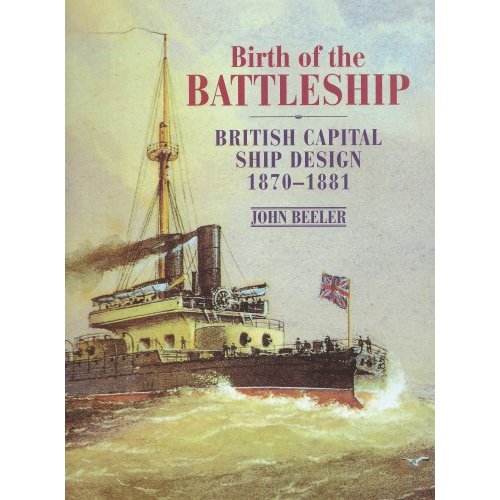
I just finished reading John Beeler’s Birth of the Battleship: British Capital Ship Design 1870-1881, which looks at a time where all the accepted norms of the previous three hundred years were all upset overnight.

In 1815, the Royal Navy was the unchallenged Mistress of the Seas: the most powerful navy in the world. France, the greatest threat to England and her trading empire, had just been destroyed as a military and naval power. The United States had survived the war, but had effectively been neutralized on the sea through much hard fighting. No other rival appeared close to challenging England’s primacy.

Fifty years later, the stasis is being broken technologically. Wind power is giving way to steam. Solid shell cannon are starting to give way to both larger and more complex weapons. Iron is starting to supplant oak as the material of choice for shipbuilding. The renowned duel between USS Monitor and CSS Virginia (formerly the USS Merrimac) sets all the major navies of the world busy considering how to protect their existing fleets and merchant vessels against the new threat of the ironclad.

The English government is suddenly faced with the stark reality that their entire fleet has become or is about to become obsolete. Neither Monitor nor Virginia are ocean-going ships, but the message is clear that no wooden vessel has a prayer of survival against the modern steam-powered ironclad. And even the greatest economic power in the world can’t replace an entire fleet overnight.

The Admiralty couldn’t depend on past experience for guidance, as everything they’d done for hundreds of years was now undecided: what kind of ships do you need to build? How will they be armed? How will they be armoured? How will they be propelled? Bureaucracies are, by nature, not well equipped to face challenges like this. The Royal Navy, from the late 1860’s until the late 1880’s struggled with finding the correct answer, or combination of answers, to meet the needs of the day.

I admit that my interest in British Imperial history fades very quickly after 1815 and only starts to pick up again in the 1870’s, and what little I’d retained of the reading I’d done left me with much disdain for the obvious pattern of muddle and stop-gap planning that clearly defined the Royal Navy’s approach to maintaining the fleet during that time period. I was very wrong in my assumptions, but I was far from alone.

To start with, I assumed that the retention of full sailing rig on steam-powered ships proved the raw incompetence of the Admiralty and their ship designers. What I failed to understand was that there were really two different navies operating under the same flag: the home fleet — close to home port with easy access to coal, drydock, and re-supply — and the colonial fleet which had none of those advantages. Merchant vessels of the 1850-1870 era could depend on refuelling at each end of their scheduled journeys (between fully equipped ports), while the Royal Navy could not. The steam engines of that time period were very inefficient and prone to breakdown: lose your engine in the Indian Ocean or the South Atlantic and you were almost certain to be lost. Sail was essential for Royal Navy ships outside home waters.

Iron as armour was a major step forward, but not without costs: it is far heavier than wood and because you needed it to protect the above-the-waterline essentials of the ship, it made it much harder to ensure that the ship would be stable and sufficiently buoyant in heavy seas (see the story of HMS Captain for an example of what could happen otherwise). It’s always been a rule of thumb in military affairs that you can’t protect everything: by trying to protect everything, you spread your forces (or your armour) too thin and you end up being too weak everywhere. This holds true especially for ship’s armour.

At the same time that you need to add armour to protect the ship, you also need to mount heavier, larger guns. Between placing your order with the shipyard for a new ship, the metallurgical wizards may have (and frequently did) come up with bigger, better guns that could defeat the armour on your not-yet-launched ship. Oh, and you now needed to revise the design of the ship to carry the newer, heavier guns, too.

The ship designers were in a race with the gun designers to see who could defeat the latest design by the other group. It’s no wonder that ships could become obsolete between ordering and coming into service: sometimes, they could become obsolete before launch.

The weapons themselves were undergoing change at a relatively unprecedented rate. As late at the mid-1870’s, a good case could be made for muzzle-loading cannon being mounted on warships: until the gas seal of the breech-loader could be made safe, muzzle-loaders had an advantage of not killing their own crews at distressingly high frequency. Once that technological handicap had been overcome, then the argument came down to the best way to mount the weapons: turrets or barbettes.

To the modern eye, the answer is obvious, but to the men responsible for making the decisions, it was far from obvious that the turret was the better answer. Turrets are heavier than barbettes and required clearer fields of fire (few masted-and-rigged ships could also carry turrets), and also generally required the turret to be mounted higher on the superstructure, which made the ship more top-heavy than an equivalent barbette vessel.

The other weapon controversy at the time was what the primary weapons of the battlefleet would be: gun, torpedo, or ram. The argument for the ram was the weakest, although CSS Virginia had done more damage to the Union fleet with her ram than with her guns. The torpedo was still in the transition stage from something that had to be physically pushed against an enemy ship (like a ram with an explosive charge) and the more modern notion of a self-propelled, unmanned weapon. Perhaps the argument was sealed by the accidental sinking of the HMS Victoria less than a decade later (a less-than-charitable interpretation of the event was fictionalized in Kind Hearts and Coronets in 1949).

In some ways it’s remarkable that the hidebound bureaucrats could keep up in the world’s first real arms race . . . and not only keep up, but stay (slightly) ahead. Each new class of battleship had to be equal to or better than the latest French, German, or Italian ships, yet also stay within fairly strict length, breadth, and displacement limits without going (too far) over budget. Oh, and also be capable of adaptation to whatever new naval gun had been introduced in the time between the ships being laid down and being brought into commission.

To the modern eye, even of someone who followed the general trend of naval technology, the Royal Navy of the early 1880’s looks like a random collection of misfit ships. What isn’t apparent is how much worse the picture could have been. Aside from the bombardment of Alexandria, the Royal Navy of Victoria’s reign exercised a policing rather than a strictly military role: they didn’t need to fight too often because they were clearly stronger than any potential adversaries.
May 20, 2011

Britain’s Type 45 destroyers finally get main armament

Filed under: Britain, Military, Weapons — Tags: , — Nicholas @ 14:29

Back in October, I linked to an article which told the sad story of the Royal Navy’s most expensive class of unarmed warships, the Type 45 destroyers. In November, I linked to another sad story about the £1.1bn+ lead ship of this class breaking down in mid-Atlantic and having to make an emergency stop in Halifax for repairs.

In the first bit of good news about the Type 45’s, they’re now finally getting their primary missile systems into service:

HMS Daring, first of the £1.1bn+ Type 45 destroyers now coming into service with the Royal Navy, has finally fired her primary (and only significant) armament, the Sea Viper missile system.

The glad news comes five years after the ship was launched, three years after she was accepted into the Royal Navy and well into the tenure of her third commanding officer.

It’s not all good news, however, as the Sea Viper may not be the wonder weapon it’s been implied to be:

Stripping away the hype, Sea Viper has never been tested against a supersonic target and there are no plans to do so — meaning that it would be a brave decision indeed to rely on it against supersonic threats in combat. (The system’s first four trials even against subsonics saw two failures.)

Sea Viper’s French-made Aster missiles can probably reach out to 75 miles, but the inescapable curvature of the Earth means that the Sampson masthead fire control radar can’t lock on to a low-flying target until it is within 20 miles or so. Various modern and indeed not-so-modern anti-shipping missiles (eg the “Klub”, “Sunburn” and “Brahmos”) are both low-flying and supersonic.

Then there are some serious gaps in the Sea Viper’s (and thus the Type 45s’) capabilities. The system cannot attack surface targets, meaning that the Royal Navy’s new and cripplingly expensive destroyers will be almost powerless against properly-equipped warships or even quite minor gunboats and the like.

May 15, 2011

US had prepared to fight Pakistan over Bin Laden raid

Filed under: Asia, Military, USA — Tags: , , , , , — Nicholas @ 12:16

Strategy Page reports that the US military had made contingency plans to cover Pakistani military intervention in the raid that killed Osama bin Laden:

On May 2nd, the United States was prepared to go to war with Pakistan. The American raid on that day, which killed Osama bin Laden and seized a huge mass of al Qaeda data from his Pakistani hideout, was carried out without informing Pakistan beforehand. Although Pakistan had years earlier agreed that the U.S. could enter Pakistani territory in hot pursuit of terrorists fleeing Afghanistan, or to grab high ranking al Qaeda leaders, it was always assumed that the U.S. would let the Pakistani military know what was coming. But because the Pakistani government was full of bin Laden fans, the U.S. did not inform Pakistan about the raid until it was underway. Apparently, that message included a reminder that if the U.S. troops in the bin Laden compound were attacked by Pakistani forces, there would be instant, and far-reaching, consequences.

The extent of those consequences have since been pieced together, from unclassified information. By May 2nd, the U.S. had assembled a huge naval and air force in the region, that was pointed at Pakistan. This force would attack any Pakistani troops or warplanes that went after the U.S. forces in the bin Laden compound, or who might be able to do so. The U.S. had assembled three aircraft carriers, hundreds of air force aircraft in Afghanistan and the Persian Gulf, and dozens of helicopters, and thousands of troops, in Afghanistan. Most of these troops didn’t know what they were alerted for. Such alerts happen all the time, often for no reason (as far as the troops are concerned.) But this time, as word of the bin Laden raid got out, it became obvious (at least to those who know how these things work) that the alerts throughout the region were to prepare for the possible need to quickly get the American raiders out, and destroy any Pakistani forces that sought to interfere.

May 14, 2011

The woes of the USS San Antonio

Filed under: Military, USA — Tags: , , , — Nicholas @ 09:54

What do you do when you buy a lemon? What if the lemon isn’t the anomaly, but the standard?

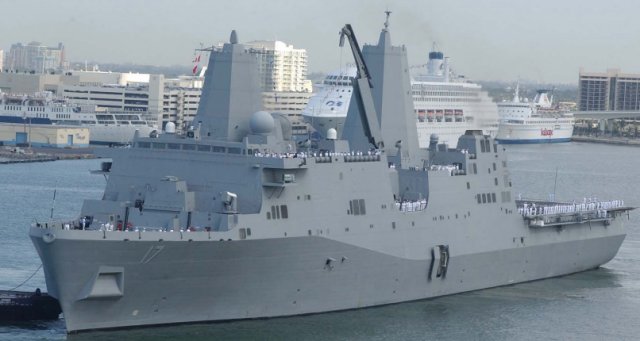
Some warships are cursed. They just don’t work right. When this happens to an automobile, you call it a lemon. But a defective warship is a more serious matter, and the U.S. Navy now fears it has an entire class of ships that is cursed. For the last five years, ever since the USS San Antonio, the first of the LPD 17 class amphibious ships entered service, there has been one problem after another. It began during sea trials, and there is no end in sight. Worse, all four subsequent LPD 17s to enter service exhibit similar problems. Most of the woes were created by poor workmanship and inadequate quality control by the builder. Contributing to these problems there are some poor design decisions and inadequate maintenance practices by the crew. But most of the problems occurred in the shipyard, while the ships were being built. The U.S. Navy sees this as symptomatic of what is wrong with the handful of yards that build most of American warships. This is especially embarrassing when compared to how well foreign shipyards produce similar warships.

Originally, the plan was for twelve LPD 17s to replace 41 smaller, older and worn out amphibious ships. Five LPD 17s have been built, four are under construction and another has been ordered. When the USS San Antonio entered service it was suddenly discovered that the builders had done a very shoddy job. It took the better part of a year to get the ship in shape. The second of the class, the USS New Orleans, was also riddled with defects that required several hundred million dollars to fix. This pattern of shoddy workmanship, incompetent management and outright lies (from the ship builders) continued, and resulted the order being cut to eleven ships. To add insult to injury, the last ship in the class is being named after politician John P. Murtha, who is generally hated by soldiers and marines for the way he politically exploited and defamed the troops who served in Iraq and Afghanistan. This is particularly painful because the LPD 17s carry marines into combat.

Many consider the San Antonio class as a poster child for all that’s wrong with American warship construction efforts. The ships are being delivered late, and hundreds of millions of dollars over budget. The list of problems with the ships is long, embarrassing and seemingly without end. Although the San Antonio did get into service, it was then brought in for more inspections and sea trials, and failed miserably. Repairs are still underway to catch all the shipyard errors.


Detail from original image at Wikimedia.org.

Even more information on the long list of issues with the lead ship of the class here. According to the official website, the ship is “currently under going engine maintenance at Earl Industries shipyard in Portsmouth, VA”.

April 28, 2011

Bill for Royal Navy’s new carriers continues to rise

Filed under: Britain, Military, Technology — Tags: , — Nicholas @ 11:26

In news that will surprise nobody who has any familiarity with military equipment purchases, the Royal Navy’s new aircraft carriers are now expected to cost at least another £1bn:

The cost of building two new aircraft carriers for the navy has soared again and could eventually total £7bn.

The latest increases follow a series of costly delays and are largely the result of a decision in last year’s defence review to equip HMS Prince of Wales with aircraft catapults and traps. It is the second of the carriers due to enter into service by 2020.

The first carrier, HMS Queen Elizabeth, will be mothballed when it is completed, leaving Britain without a carrier able to take aircraft for 10 years.

The carriers were officially estimated to cost less than £4bn when they were announced in 2007. The estimate rose to £5bn last year after the Ministry of Defence decided to delay the construction programme to put off costs. Short-term savings led to cost increases in the longer term.

It’d be absolutely normal for the British government to decide to delay the ships’ completion even longer, raising total costs but stretching the purchase out over more budget years. It’s a common false economy, and it’s one of the reasons that military equipment manufacturers have to build possible delay costs into their plans.

April 20, 2011

Railgun in the US Navy’s future?

Filed under: Military, Technology, Weapons — Tags: , — Nicholas @ 13:21

H/T to Cory Doctorow for the link.

April 10, 2011

Canada’s peaceful submarines

Filed under: Britain, Cancon, Military, Technology, Weapons — Tags: , , — Nicholas @ 11:02

Apparently, the navy’s purchase of used British submarines has still not been completed: the boats are in our hands, but they’re still unarmed:

The country’s stock of second-hand submarines — already beleaguered with repairs and upgrades — is incapable of firing the MK-48 torpedoes they currently own.

When Canada purchased its current fleet of four submarines from Britain in 1998, they were fitted for British torpedoes. At the time, Canada was heavily invested with the modern MK-48 torpedo system and did not want to abandon it.

Like any shopper trying to justify a second-hand purchase in the face of an obstacle, they figured it was still a good deal. They “Canadianized” the submarines, but, 13 year later, they still haven’t got around to the “weaponization” part.

“The Canadian Forces has always intended for the Victoria Class submarines to carry and fire the Mark 48 torpedo,” wrote Denise LaViolette, the director of navy public affairs, in an email. “Initial weapons certification will be progressed early in 2012 in HMCS Victoria for Pacific operations followed that year by HMCS Windsor for Atlantic operations.”

I noted the lack of torpedo armament on the Canadian sub fleet back in 2004. I had no clue that they’d still be unarmed in 2011!

Later that same year, I said:

As I’ve said in other posts, I’m not a former Navy person, so my knowledge of the situation is neither broad nor deep. I’m moderately well-read on naval mattters, but that’s the limit. On that basis, I thought the purchase of the Upholder subs was a brilliant solution for both the Canadian and Royal Navies: we got a heck of a deal and they got the subs off their inventory. It really did look like a win-win, and both sides thought they’d gotten the better of the bargain.

In the long run, this may still turn out to be true. I certainly hope so.

As several others have noted, until we find out exactly what happened on HMCS Chicoutimi, we can’t make any determination about whether the subs are going to be safe and effective vessels for our navy. And, as Bruce R. pointed out the other day, if we want to retain any claims of sovereignty over the coastal waters of this huge country, we need those subs in the water now.

Well, the subs have been in the water for several years, but without torpedoes, they’re not fully functional.

Update, 12 April: Strategy Page has a useful summary of the history of the Upholder/Victoria class submarines:

It all began in the 1990s, when Canada wanted to replace its 1960s era diesel-electric subs. This did not seem possible, because the cost of new boats would have been about half a billion dollars each. Britain, however, had four slightly used Upholder class diesel-electric subs that it was willing to part with for $188 million each. Britain had built these boats in the late 1980s, put them in service between 1990 and 1993, but then mothballed them shortly thereafter when it decided to go with an all-nuclear submarine fleet.

So the deal was made in 1998, with delivery of the Upholders to begin in 2000. Canada decommissioned its Oberons in 2000, then discovered that the British boats needed more work (fixing flaws, installing Canadian equipment) than anticipated. It wasn’t until 2004 that the subs were ready, and that one year one of them was damaged by fire, while at sea. This boat is to be back in service next year. By the end of this year, three boats should be back in service. Maybe.

[. . .]

The problem is that the subs were bought without a through enough examination. It was later found that most major systems had problems and defects that had to be fixed (at considerable expense). Thus these boats have spent most of their time, during the last decade, undergoing repairs or upgrades. The final fix will be to get the torpedo tubes working. In any event, a Canadian [submarine] has never fired a torpedo in combat, mainly because the Canadian Navy did not get subs until the 1960s. Lots of Canadian surface ships have fired torpedoes in combat, but the last time that happened was in 1945. The sole operational Victoria class boat is on patrol in the Pacific, listening for trouble which, if found, will be reported to the proper authorities.

April 9, 2011

Someone deserves a medal here

Filed under: Britain, Military — Tags: , — Nicholas @ 11:57

If this Guardian report is true, I hope that Royston Smith is on the next honours list:

Southampton city council leader, Royston Smith, was visiting the submarine with other dignitaries while it was berthed at the Eastern Docks on a five-day visit to the city.

He described how he “wrestled” the gunman to the ground in the submarine’s control room as he tried to stop him.

“Two shots were fired, straight after he entered the control room again and began shooting again,” Smith told the BBC.

“I ran towards him, I pushed him against the wall, we wrestled to take the gun from him. He fired again, I wrestled again to get the weapon from him. I pushed him to another wall, I wrestled him to the ground and managed to take the weapon away from him then others came to help to restrain him.”

He said a group of schoolchildren had left the submarine shortly before the attack.

That’s a civilian, charging a gunman armed with a battle rifle, and disarming him before the trained military personnel could intervene. There are very few people who could have reacted so quickly — and correctly — in that situation. That’s heroism.

April 7, 2011

Unmanned sub hunter

Filed under: Military, Technology, USA — Tags: , , , — Nicholas @ 10:25

Lewis Page looks at the Continuous Trail Unmanned Vessel (ACTUV):

No doubt regular readers will recall the US military’s cunning plan to develop unmanned submarine-hunting robotic frigates — warships which would prowl the oceans like automated Mary Celestes, remorselessly tracking enemy submarines regardless of how their pale, sweaty, malodorous captains might twist and turn.

The Anti-submarine warfare Continuous Trail Unmanned Vessel (ACTUV) project is intended to produce “an X-ship founded on the assumption that no person steps aboard at any point in its operating cycle”. The uncrewed frigate would have enough range and endurance for “global, months long deployments with no underway human maintenance”, being able to cross oceans and fight its battles largely without any human input — communications back to base would be “intermittent”, according to DARPA.

As you might imagine, there are lots of potential issues to sending an armed, unmanned ship out into the ocean, including how to handle interactions with other users of the sea lanes. It’d be worse than embarassing to the US Navy to have one of their fancy new ACTUV vessels get tangled up in a fishing net or get caught in the middle of a regatta.

Perhaps unsurprisingly, then, it has been decided that the best way to hammer out a set of tactics for ACTUVs is to develop a game-style simulation pitting ACTUV against submarine and get people to play it — so crowdsourcing the methods and tactical principles that will then be coded into the robo-frigates’ AIs.

The new game — from which these visuals are drawn — is called ACTUV Tactics. The game engine is used in various military sims and in the Dangerous Waters commercial release of 2005. [. . .]. In it, a player tries to find and track an enemy submarine while avoiding collisions with commercial vessels and the like. Various different proposed models of ACTUV robo-frigate are available: Gator, Remora, Seahorse, Shark and Triton.

March 29, 2011

RAF has only 69 qualified pilots for Typhoon fighters?

Filed under: Africa, Britain, Military — Tags: , , , — Nicholas @ 11:44

I’m not sure how an organization which recently performed brilliantly in their bureaucratic and political struggle against their arch-enemies in the Royal Navy can also be this stupid:

Since the conflict began, a squadron of 18 RAF Typhoon pilots has enforced the Libya no-fly zone from an air base in southern Italy. However, a shortage of qualified fighter pilots means the RAF may not have enough to replace all of them when the squadron has to rotate in a few weeks.

The situation is so serious that the RAF has halted the teaching of trainee Typhoon pilots so instructors can be drafted on to the front line, according to air force sources. The handful of pilots used for air shows will also be withdrawn from displays this summer.

The RAF put in a merciless performance in the recent defence review negotiations, eliminating three two aircraft carriers and downing all of the remaining Harrier jets. Perhaps their emphasis on bureaucratic and political in-fighting meant they had no time or energy to train pilots for their shiny new aircraft?

The Government’s decision to decommission HMS Ark Royal, Harrier jump jets and the Nimrod reconnaissance aircraft — all of which could have played a role in the Libya conflict — has exacerbated the problem. Serving RAF pilots contacted The Daily Telegraph to warn of the risks to the Libya operation. “We have a declining pool of pilots,” one said. “There’s less people to do twice as much work. If we are not training any more we are going to run out of personnel very soon.”

[. . .]

Out of 69 qualified RAF Typhoon pilots, including instructors, 18 are in southern Italy flying missions over Libya. Of the rest, 24 are committed to the Quick Reaction Alert protecting Britain’s air space and six are in the Falklands in a similar role. A further six are being used to train Saudi Arabian air force pilots. That leaves only 15 to replace those currently based in Italy.

Because of the intensity of flying on operations, pilots deploy for a maximum of two months at a time and the replacements for those currently enforcing the no-fly zone in Libya will be expected to deploy at the end of next month.

March 27, 2011

QotD: One-minute Imperialism

Filed under: Africa, Military, Quotations — Tags: , , , , — Nicholas @ 10:17

It is the height of recklessness, a kind of blasé barbarism, to start a war without knowing what the war is for. We are witnessing the transformation of Libya into a giant laboratory for a zany, unpredictable experiment to see what happens when you mix Tomahawk missiles with a volatile Arab uprising. It makes even the ill-considered debacles in Iraq and Afghanistan look like the height of rationality in comparison.

The made-up nature of the war, its speedy and brainless cobbling together by Western leaders keen to make a quick point by firing a few hundred missiles at Gaddafi, explains why the so-called Western alliance is so spectacularly flimsy. This must be the most shortlived alliance in human history. It lasted about 24 hours — at a push 36 hours — before Washington announced that it would ‘tone down’ its involvement and agitate for NATO to take over. Perhaps keen to satisfy the needs of the 24-hour rolling news agenda, America has just overseen the world’s first-ever outburst of 24-hour imperialism.

Brendan O’Neill, “The most shortlived alliance in human history”, Spiked!, 2011-03-22

March 25, 2011

Libya operations do not support UK’s recent defence decisions

Filed under: Africa, Britain, Military — Tags: , , , , , — Nicholas @ 12:15

Lewis Page is doing an analysis of the current British involvement in Libya. He points out that many of the recent decisions by the British government are not being proven by the actual pattern of combat:

Recent combat operations by British and allied forces in Libya are beginning to tell us a lot: not so much about the future of Libya, which remains up for grabs, but about the tools one actually needs for fighting real-world wars against real-world enemy armed forces.

The vast bulk of our own armed forces are set up, equipped and focused on this type of mission — rather than the hugely more common one of battling guerillas and insurgents, as seen in Afghanistan — so the Libyan operations of the last week are very important to us at a time of shrinking budgets and worldwide turbulence. Libya is telling us how well the Coalition government did in its recent Strategic Defence and Security Review — and bluntly, it is showing that the Review was a fiasco.

Mr. Page has not been a fan of the Eurofighter, and sees the initial stages of the Libyan campaign as proving the investment is so much wasted money:

. . . highly advanced specialist air-to-air combat capability has not been necessary here. The RAF has rushed Eurofighter Typhoons to Italy — they were the first British aircraft to arrive there, in fact — but they are pure air-to-air planes at the moment (the RAF doesn’t expect to have them properly ready for use as bombers until 2018). The odds are that they will not fire a shot — and if they do it will be to swat down some rusty old MiG flown by a suicidal pilot. For this job, much cheaper fighters would have been more than adequate: say American F-18s or F-16s, or even our previous embarrassing Tornado F3, now retired.

So, point one: buying the Eurofighter remains a stupid idea on our part.

Canada’s F-18 aircraft have seen more combat in Libyan airspace than the RAF’s Eurofighters, because the F-18 has a ground-attack capability.

On the other hand, Mr. Page rejoiced at the overdue decision to scrap the Nimrod, but the ancient-but-terribly-expensive aircraft appear to have a valid role to play in Libya:

Point two: electronic warfare and AWACS planes are useful, even against the minor regimes who we might genuinely fight in the real world. The decision to keep both in the recent UK Defence Review was sensible (the Nimrod R1 Elint planes were marked for the bin — and have been temporarily been reprieved for duty in the Libyan situation — but replacement “Rivet Joint” aircraft are on order).

The use of the Tornado aircraft for very long range attacks seems like a waste of time and resources:

We are told in official announcements that some 112 Tomahawk cruise missiles were used in the initial strike at the weekend, launched from US and British warships and submarines off the Libyan coast. We are also told that “a number” of Storm Shadow shorter-ranged cruise missiles were launched from Tornado bombers. The Tornadoes had flown 3,000 miles from Kent Norfolk to do so, requiring the aid of repeated air-to-air refuelling assistance both on the way out and on the way back.

We can be pretty sure what the unspecified number of Storm Shadows was, as the Tornado can carry only one Storm Shadow into combat and we are told that a total of four Tornadoes have been assigned to Operation ELLAMY, the British contribution to the Libyan fighting. Some accounts suggest that in fact only three Storm Shadows were fired in the initial long-range Tornado raid.

[. . .]

Our lesson from a shooting war against a national air force — the first we have fought since 1982 — is that you don’t suppress enemy air defences of the sort you actually meet in the real world with deep penetration bombers and clever air-launched weapons (far less with stealth planes). You do it with AWACS and Elint planes and Tomahawks launched from the sea.

And speaking of the sea . . . what about the Royal Navy contribution to the Libya campaign?

Don’t we just wish we had a carrier off Libya now? Shame we scrapped ours just months ago. Nice work, Mr Cameron

There can be little doubt that the Harrier would also have been better for Libya. The Harrier fleet actually had more aircraft modernised to drop the latest smart weaponry — it was a superior battlefield strike plane — and it was cheaper to run. Best of all, it could operate from our also-recently-axed pocket aircraft carriers right off the coast and thus reach the theatre of action in minutes rather than hours. France and the USA both have carriers operating off the Libyan coast right now, but our foolish decisions in the recent review have left us on the sidelines.

Mr. Page still thinks the Royal Navy got royally shafted by the RAF:

Point four: The decisions taken over many years to whittle down the Harrier force to the point where it was barely viable – and then finally axe it in the Review — were totally wrong. Instead the Tornado should have been scrapped. Our present-day fleet of more than 130 of these cripplingly expensive-to-run, slow, lumbering low-altitude jets, assisted by similarly costly tanker planes, has offered us an utterly pathetic capability to deliver three or four dodgy missiles into Libya and a minimalist air support capability thereafter.

Even by the time of the Review, when the Harrier fleet was down to an almost unviable 44 jets, it would have made more sense to keep them, scrap the Tornado and buy or lease some nice cheap F-18s from America to bulk up our strike forces somewhat. The RAF should be ashamed of itself for manipulating the Prime Minister into keeping Tornado; heads should roll.

Is it too late to save the Ark Royal and Invincible? Yes:

To make the situation even more pathetic:

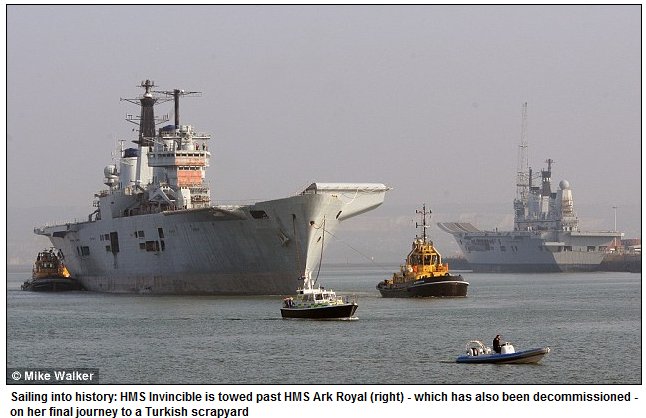
Once, this would have been a sight to strike fear into the hearts of any enemy fleet, a vivid portrait of the naval clout of this island nation.

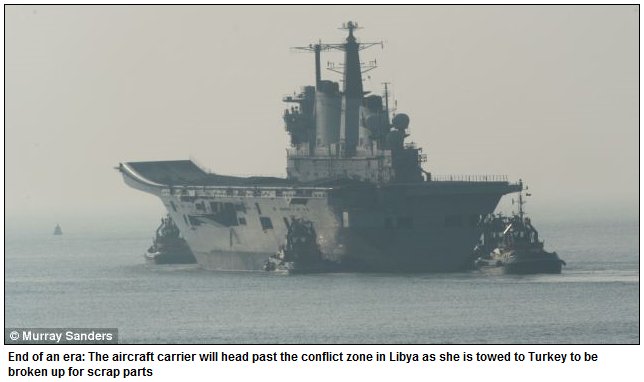
But, today, these are two ghost ships. This depressing photograph taken yesterday is merely a reminder of the current state of the Royal Navy. Until recently, Britain had three aircraft carriers. The latest round of defence cuts means we have just one carrier — HMS Illustrious — and no planes on board. It only does choppers these days.

Invincible is bound for the Middle East. But Colonel Gaddafi need have no fears about this gallant old warhorse. In a few days’ time she will be off the coast of Libya but she won’t be stopping. She’ll be pressing straight on for Turkey where she is due to be cut up — or ‘recycled’ as an MoD spokesman insisted yesterday.

Back to Mr. Page’s conclusions (not that there should be any surprises based on the examples I’ve included):

Summing up, the lesson of Libya is that the recent Defence Review was, indeed, a dismal failure. RAF empire-preservation saddled us with the useless Tornado at the cost of our carrier capability. The army insisted on preserving pointless tanks and big guns and as a result we are not pulling our weight in Helmand — a war we more or less unilaterally started in 2005 — and we have no option to intervene on the ground in Libya seriously.

The navy made no real effort to help matters. It might have managed to preserve a carrier capability by making concessions on its pointless frigate flotilla, but this it refused to do.

[. . .]

But the chance to change things is not gone yet. So badly fudged were the Strategic Defence and Security Review’s figures that more reorganisation remains on the cards; in effect, a review of the Review is now very likely. The chance is still there to scrap the cripplingly expensive Tornado and Eurofighter altogether and replace them with cheap, excellent F-18s — so getting our carrier capability back in just a few years, as well. When the F-35C actually becomes affordable at last around 2025 we can buy some — by that point its Stealth and other new technologies might actually be becoming relevant for wars that might really happen, along the lines of Libya.

March 23, 2011

Naming conventions, military style

Filed under: Africa, France, Military, USA — Tags: , , — Nicholas @ 12:44

Jon sent me this link on the highly inappropriate name given to the military actions against Libya:

As Jonah Goldberg wrote, the name approved by Barack Obama, Odyssey Dawn, sends a slightly different message than perhaps intended:

Odyssey, after all, is a term for a very long and involved adventure. If memory serves, Odysseus took a very long time to come home. Maybe it’s just a coincidence that the Pentagon came up with a label that basically says this is beginning of an extended, seemingly endless, journey.

I had the exact same thought — and shouldn’t a man with a classical Ivy League education have caught that reference? Even if Obama was not familiar with The Odyssey, the dictionary definition of “odyssey” should have raised a red flag:

Definition of ODYSSEY
1: a long wandering or voyage usually marked by many changes of fortune

For a mission that is supposed to be counted in “days, not weeks,” it looks like Obama’s choice of mission names is an epic failure.

I’d written, quite some time back, about the national differences in how Anglosphere nations named their military operations:

I often note with amusement the significant differences in naming conventions for military operations between the US and the rest of the “Anglosphere”. A typical US Army operation might be “Operation Devastating Earthshatterer”, while a British or Canadian equivalent might be “Operation Broken Teaspoon” or “Operation Goalie Glove”. (I’ll pass up on the urge to attribute something mockery-tinged to French codenames . . . but only because Babelfish didn’t give me a useful translation for “Operation Wet Knickers” or “Operation Big Girl’s Blouse”).

Not that there’s anything wrong with a dose of belligerant overkill in your naming conventions. . .

How quickly things change: the former “cheese-eating surrender monkeys” have become the leaders of the military coalition, while the Americans were on the verge of transforming into “burger-eating surrender monkeys”.

March 21, 2011

The nuclear power industry’s technological lock-in

Filed under: Economics, History, Science, Technology — Tags: , , , — Nicholas @ 09:20

Leon Neyfakh looks at how light water reactors became the “default” choice of the nuclear power industry:

Japan’s reactors are “light water” reactors, whose safety depends on an uninterrupted power supply to circulate water quickly around the hot core. A light water system is not the only way to design a nuclear reactor. But because of the way the commercial nuclear power industry developed in its early years, it’s virtually the only type of reactor used in nuclear power plants today. Even though there might be better technologies out there, light water is the one that utility companies know how to build, and that governments have historically been willing to fund.

Economists call this problem “technological lock-in”: The term refers to the process by which one new technology can prevail over another for no good reason other than circumstance and inertia. The best-known example of technological lock-in comes from the 1970s, when VHS and Betamax, two different kinds of videotape, competed in the market until VHS gained a slight lead and then leveraged it to total domination. Whether the VHS format was actually superior to Betamax didn’t matter. After the lock-in, consumers no longer had a choice.

Much more is at stake in nuclear power. Some reactor designs are safer than others in an accident; some are more efficient than others in their use of fuel and produce less nuclear waste. The fact that the industry settled on light water over any number of alternatives was determined in the years after World War II, when the US Atomic Energy Commission and Navy Admiral Hyman Rickover made a series of hasty decisions that irreversibly set the course for how nuclear power plants around the world are built today.

“There were lots and lots of ideas floating around, and they essentially lost when light water came to dominate,” said Robin Cowan, a professor at the University of Strasbourg and the University of Maastricht who wrote a 1990 paper in The Journal of Economic History about the nuclear industry’s technological stagnation. “The market tends to choose a dominant design before it’s optimal, and it tends to under-explore.”

February 11, 2011

Taming the US defence budget

Filed under: Bureaucracy, Economics, Military, USA — Tags: , , , , — Nicholas @ 07:29

The US government is in a financial bind — that’s not exactly news. What is new, however, is that the military may actually have to take cuts, not just smaller increases in the annual budget:

On one side of the argument are fiscal hawks like Rand Paul, newly elected senator from Kentucky, who fear that a national debt heading towards 100% of GDP by the end of the decade is in itself a menace to the nation and defence must take its share of the pain. The sheer size of America’s defence budget puts it in the crosshairs. At around $700 billion a year including war expenditures, it as big as those of the world’s next 20 highest military spenders combined. Last year American defence spending exceeded the average spent during the cold-war years by 50% (adjusted for inflation), while in the past 10 years it has grown by 67% in real terms.

[. . .]

Mr Gates, a canny operator whom Barack Obama retained after he took over from George Bush, began to sniff which way the wind was likely to turn in 2008. He calculated that if he took the initiative, he might stave off deeper and more unwelcome cuts. So he curbed or cancelled more than 30 weapons systems including the army’s Future Combat System, the F-22 Stealth fighter, two missile defence systems and the Zumwalt-class destroyer. Last year he went further, proposing the closure of the Joint Forces Command in Virginia and a 10% reduction in the budget for contract workers for each of the next three years. He asked the armed services to find at least $100 billion worth of “efficiency savings” over the next five years, which he promised to reinvest in other programmes.

[. . .]

Buck McKeon, the Republican who now leads the House Armed Services Committee, has responded with predictable fury to the Gates plan, saying it was “a dramatic shift for a nation at war and a dangerous signal from the commander-in-chief”. Mr Gates can take some comfort from the fact there has been at least as much “incoming” from critics who say he has not gone nearly far enough. They point out that what is being planned is not so much a cut as a small reduction on what the Pentagon had been planning to spend over the next four to five years. The budget will still creep up in real terms until it flattens off in 2015. Given his intention to retire from office later this year, Mr Gates may not have the stomach for attempting anything more radical on his watch.

« Newer PostsOlder Posts »

Powered by WordPress