Quotulatiousness

April 19, 2012

Pentagon sleuths foil Anglo-Canadian military plan

Filed under: Cancon, Humour, Military, USA — Tags: , — Nicholas @ 00:09

The story of Ensign Chuck Hord’s memorial portrait in the Pentagon, with both British and Canadian military angles:

In a Pentagon hallway hung an austere portrait of a Navy man lost at sea in 1908, with his brass buttons, blue-knit uniform and what looks like meticulously blow-dried hair.

Wait. Blow-dried hair?

The portrait of “Ensign Chuck Hord,” framed in the heavy gilt typical of government offices, may be the greatest — or perhaps only — prank in Pentagon art history. “Chuck Hord” can’t be found in Navy records of the day. It isn’t even a real painting. The textured, 30-year-old photo is actually of Capt. Eldridge Hord III, 53 years old, known to friends as “Tuck,” a military retiree with a beer belly and graying hair who lives in Burke, Va.

[. . .]

Capt. Hord at the time was director of the Multinational Interagency division, a new Pentagon office designed to coordinate military logistics between the U.S. and its closest allies.

Office colleagues say Capt. Hord developed close bonds with his British, Canadian and Australian counterparts. Their office boasted its own beer fridge.

Several of Capt. Hord’s work colleagues attended the 2004 party, including a British captain who smuggled the portrait into his car and put it on display at the office. Capt. Hord, amused, called it an act of “buffoonery.”

[. . .]

Back on the wall in the office, visitors often asked who it depicted. “They all looked at it and said, ‘Man, what year was that? It looks like the 1800s,'” said Canadian Lt. Col. Brook Bangsboll.

That was the light-bulb moment. On one of his last days at the Pentagon, Lt. Col. Bangsboll went to a jewelry shop to have a brass plaque engraved, egged on by colleagues and co-conspirators. “We didn’t know what to do so we said, ‘Let’s just lose him at sea,'” Lt. Col. Bangsboll said. “It makes it interesting and kind of mysterious.”

He kept the circumstances of the ensign’s death vague because he thought some nosy Navy historian would spot the ruse if the plaque cited a specific battle.

April 17, 2012

The US Navy’s next destroyer will be the USS Lyndon B. Johnson

Filed under: History, Military — Tags: , , , — Nicholas @ 10:00

I guess they’re happy they don’t have to use that particular name on an aircraft carrier:

Strike one against the U.S.S. Lyndon Johnson: the Gulf of Tonkin incident. A confusing episode off the Vietnamese coast on August 2, 1964 resulted in a brief maritime skirmish with the North Vietnamese. The destroyer U.S.S. Maddox got shot; one of its aircraft was damaged. It was unclear who fired first. (A claimed follow-on engagement two days later was ultimately determined to have been a fiction.) Johnson’s administration, seeking an excuse to escalate U.S. involvement in Vietnam, portrayed the incident to Congress as a clear-cut act of North Vietnamese aggression. A decade later, the futile Vietnam war had claimed 57,000 American lives.

Strike two: Lyndon Johnson’s Naval war record was similarly dubious. As Johnson’s magisterial biographer, Robert Caro, documented in Means of Ascent, Johnson’s Naval commission in World War II was the result of string-pulling. (Johnson was a sitting congressman at the time; he sought a commission to bolster his political career.) His military career consisted of a single combat flight over the Pacific for which he received a Silver Star. For the next two decades, Johnson repeatedly exaggerated his tall tale of defying a Japanese Zero.

Strike three: the U.S.S. Lyndon Johnson will be a Zumwalt-class destroyer — a class of ship singled out by good-government watchdogs as an unaffordable boondoggle.

April 16, 2012

India’s long, twisting path to nuclear submarine capabilities

Filed under: India, Military, Russia, Technology — Tags: , , , — Nicholas @ 08:51

India would like to run their own nuclear-powered submarines, but it’s taken longer for them to achieve that than they’d hoped:

On April 4th the new Russian Akula II SSN (nuclear attack submarine) Nerpa, that was supposed to be delivered to India (which is leasing it) two years ago, was finally turned over. It’s worse than it sounds. Three years ago, during sea trials there was an equipment failure on Nerpa that killed 20 sailors and shipyard workers. This delayed sea trials for many months and the Russians found more items that needed attention. These additional inspections and repairs continued until quite recently.

[. . .]

Indian money enabled Russia to complete construction on at least two Akulas that were less than half finished at the end of the Cold War. This was another aftereffect of the collapse of the Soviet Union. Several major shipbuilding projects were basically put on hold (which still cost a lot of money) in the hopes that something would turn up. In this case, it was Indians with lots of cash. But money could not overcome the construction problems and poor design decisions the Russians made. The single Akula II India was leasing was delayed again and again. The 8,100 ton Akula II has a crew of 73. The one leased by India has eight 533mm (21 inch) torpedo tubes and 40 torpedoes.

Meanwhile, in 2009, India launched its first nuclear submarine, the INS Arihant (Destroyer of Enemies). This came after over a decade of planning and construction. What was not revealed at the times was that the Arihant was launched without its nuclear reactor, which was not installed until 2011. Arihant is supposed to be ready for service later this year.

April 11, 2012

HMCS Windsor scheduled to return to the water today

Filed under: Cancon, Military — Tags: , , , — Nicholas @ 00:07

One of the Royal Canadian Navy’s four submarines, HMCS Windsor, is supposed to be getting wet again later today:

Good news, of a sort: One of Canada’s four Victoria-class submarines is set to achieve a major milestone Wednesday. It’s going to be in the water. Huzzah!

After years of extensive refit work, HMCS Windsor is set to be lowered — lowered “extremely slowly,” but lowered — into the Atlantic Ocean. Assuming it does not instantly sink, explode or simply dissolve like a giant, oddly shaped sugar cube, the Windsor will then begin a long series of tests at sea. It is hoped that the sub will be fully operational by early 2013. Fingers crossed. Canada should have submarines. They are a useful part of a modern navy’s arsenal, and Canada has an enormous coastline. Although the subs have had an uneven history, to say the very least, they finally seem to be getting to a state where they’ll be useful to us. There had been speculation before last month’s federal budget that they’d be scrapped, but at this late point, that would be wasteful. It’s cost a lot to get these incredibly complicated machines as operational as they are (again, fingers crossed).

[. . .]

Purchased second-hand from the British for the rock-bottom price of $750-million in 1998, they’ve fallen well short of expectations. They only entered Canadian service in 2003, and have proven glitchy and outright dangerous — HMCS Chicoutimi caught fire during its maiden voyage in 2004. Lt. Chris Saunders was killed fighting the blaze, and the sub has been out of service undergoing repairs ever since. It, too, is hoped to be back in service next year. All told, the subs have been at sea, collectively, only 900 days since 2003, and have cost billions of dollars to bring up to spec — money the cash-strapped navy didn’t really have. Costly, under-performing, sucking up needed resources … sound familiar?

April 10, 2012

The easy days of piracy are fading rapidly

Filed under: Africa, Middle East, Military — Tags: , , , , — Nicholas @ 09:05

Strategy Page has an update on the anti-piracy efforts off the Somalian coastline:

After two years of immense prosperity, the last year has been a disaster for the Somali pirates. For example, in the last eight months, only six ships have been captured, compared to 36 ships in the same eight month period a year ago. Pirate income is down 80 percent and expenses are up. Pirates have to spend more time at sea looking for a potential target, and when they find one, they either fail in their boarding efforts (because of armed guards, or better defense and more alert crews) or find anti-piracy patrol warships and armed helicopters showing up. Unlike in the past, the patrol now takes away the pirates weapons and equipment, sinks their mother ships and dumps the pirates back on a beach. The pirates claim that some members of the anti-piracy patrol simply kill pirates they encounter on the high seas (some nations have admitted doing this, at least once, in the past). But no one does this as official policy, and the rules are still basically “catch and release.” The big change is that the patrol has become much better at detecting pirates, on captured fishing ships, and shutting these pirates down. Often the pirates bring along the crew of the fishing ships, to help with the deception. But the patrol knows which fishing ships have “disappeared” and quickly identify those missing ships they encounter, and usually find pirates in charge. The anti-piracy patrol also has maritime reconnaissance aircraft that seek to spot mother ships as they leave pirate bases on the north Somali coast, and direct a warship to intercept and shut down those pirates. The pirates have been losing a lot of equipment, and time, and money needed to pay for it.

[. . .]

Pirates have responded by finding new targets (ships anchored off ports waiting for a berth) and using new tactics (using half a dozen or more speedboats for an attack.) The pirates still have a powerful incentive to take ships. In 2010, for example, pirates got paid over $200 million in ransom. The year before that it was $150 million. Most of that was taken by the pirate gang leaders, local warlords and the Persian Gulf negotiators who deal with the shipping companies. But for the pirates who took the ship, then helped guard it for months until the money was paid, the take was still huge. Pirates who actually boarded the ship tend to receive at least $150,000 each, which is ten times what the average Somali man makes over his entire lifetime. Even the lowest ranking member of the pirate gang gets a few thousand dollars per ransom. The general rule is that half the ransom goes to the financiers, the gang leaders and ransom negotiators. About a quarter of the money goes to the crew that took the ship, with a bonus for whoever got on board first. The pirates who guard the ship and look after the crew gets ten percent, and about ten percent goes to local clans and warlords, as protection money (or bribes).

[. . .]

For the last four years, Somali pirates have been operating as far east as the Seychelles, which are a group of 115 islands 1,500 kilometers from the African coast. The islands have a total population of 85,000 and no military power to speak of. They are defenseless against pirates. So are many of the ships moving north and south off the East Coast of Africa. While ships making the Gulf of Aden run know they must take measures to deal with pirate attacks (posting lookouts 24/7, training the crew to use fire hoses and other measures to repel boarders, hanging barbed wire on the railings and over the side to deter boarders), this is not so common for ships operating a thousand kilometers or more off the east coast of Africa. Ships in this area were warned last year that they were at risk. Now, the pirates are out in force, demonstrating that the risk is real.

April 4, 2012

Argentine government accuses Britain of “militarizing” the Falklands

Filed under: Americas, Britain, Military — Tags: , , — Nicholas @ 09:18

The latest bee in the Argentinian government’s bonnet is the deployment of HMS Dauntless on a “pre-planned” six-month tour of duty in the Falkland Islands:

HMS Dauntless, a Type 45 Destroyer, sailed from Portsmouth and was seen off by crowds of flag-waving well-wishers.

It will relieve HMS Montrose and carry out operations off the coast of west Africa and the wider South Atlantic, with planned port visits in both west and South Africa.

BBC defence correspondent Jonathan Beale said it was unlikely that there would be any visits to Argentina’s ports.

The Royal Navy said it was the first operational deployment for HMS Dauntless since it was commissioned in 2010.

In a sidebar, Jonathan Beale discusses the balance between provocation and bad planning:

Argentina has already accused Britain of behaving like a colonial power, by sending warships and royalty to the islands.

Though the MoD insists the timing is just “coincidence”, Argentina will view it as calculated. But it is probably more cock-up than conspiracy. The plans have been in the pipeline for some time. The Royal Navy always has a warship in the South Atlantic on a six-month rotation.

As discussed in a post back in 2010, the Type 45 class are very expensive ships with a not-yet-proven military value:

The Royal Navy’s new £1bn+ Type 45 destroyers, which have been in service for several years (the first is already on her second captain), have finally achieved a successful firing of their primary armament.

The Ministry of Defence (MoD) announced yesterday that HMS Dauntless, second of the class, has made the first firing from a Type 45 of the French-made Aster missiles with which the ships are armed. All previous trial shoots were carried out using a test barge at French facilities in the Mediterranean.

[. . .]

Our Type 45s will have no serious ability to strike targets ashore, and we will continue to have no capabilities against ballistic missiles. Most glaringly of all, the Type 45 will have no weapon other than its guns with which to fight enemy ships — Sea Viper has no surface-to-surface mode.

You might feel that preservation of British high-tech jobs in some way justifies such horrific overspending for such lamentable amounts of capability, but in fact the relatively few Brit workers concerned have now mostly been fired anyway.

April 2, 2012

EUNAVFOR to get more aggressive against pirates

Filed under: Africa, Europe, Military — Tags: , , , , — Nicholas @ 08:18

Strategy Page explains why the pirates in Puntland are being targeted:

The EU (European Union) agreed, on March 23rd, to allow its anti-piracy force off Somalia (EUNAVFOR) to attack coastal targets and coordinate military operations with the Somali TNG (Transitional National Government). This means that EUNAVFOR ships and aircraft can attack pirate targets on land. Most of the pirate bases (coastal towns and villages) are in Puntland, a self-declared state in northern Somalia. While less violent and chaotic than southern Somalia, Puntland officials are bribed and intimidated (by the superior firepower of the pirate gangs) into inaction. Technically, Puntland is opposed to the pirates, so the EU is hoping that Puntland won’t make a stink when EU forces begin shooting at pirates on the coast.

The EU plan apparently involves going after pirate logistics and fuel supplies in their coastal havens. This could be tricky, as the pirates are well aware of how the Western media works and could easily put many of these targets in residential neighborhoods. The EU could respond by blockading the pirate bases, and attacking pirate attempts to truck in fuel and other supplies. Pirates could put civilians on trucks, or even captured sailors from ships held for ransom. There is no easy solution to the Somali pirates.

April 1, 2012

“Off the Somali coast, everyone is looking for a big payday”

Filed under: Africa, Law, Military — Tags: , , , , , — Nicholas @ 11:54

Strategy Page on recent developments in the anti-piracy campaign off the Somali coast:

To get around laws, in many ports, forbidding weapons aboard merchant ships, security companies operating off the Somali coast have equipped small ships to serve as floating arsenals. The security guards boards, in port, the merchant ships they are guarding, then meet up with the gun ship in international waters so the guards can get their weapons and ammo. The process is reversed when the merchant ships approach their destinations or leave pirate infested waters (and put the armed guards off onto the gun ship.) Maritime lawyers fret that there are no proper laws to regulate these floating armories, or that if there are applicable laws, everyone is not following them. It’s also feared that some enterprising lawyers will seek to represent the families of pirates shot by these armed guards. Off the Somali coast, everyone is looking for a big payday.

In the last three years, more and more merchant ships, despite the high expense, have hired armed guards when travelling near the “Pirate Coast” of Somalia. It began when France put detachments of troops on tuna boats operating in the Indian Ocean, and Belgium then supplied detachments of soldiers for Belgium ships that must move near the Somali coast. These armed guards are not cheap, with detachments costing up to $200,000 a week. There are now over a dozen private security companies offering such services. What makes the armed guards so attractive is the fact that no ship carrying them has ever been captured by pirates. That may eventually change, but for the moment, the pirates avoid ships carrying armed guards and seek less well-defended prey.

March 22, 2012

GAO latest to attempt to shoot down the F-35

Filed under: Australia, Cancon, Japan, Military, Technology — Tags: , , , — Nicholas @ 12:08

The situation is looking grimmer for all potential purchasers of the F-35, not just the RCAF:

The F-35 Joint Strike Fighter, the supposed backbone of the Pentagon’s future air arsenal, could need additional years of work and billions of dollars in unplanned fixes, the Air Force and the Government Accountability Office revealed on Tuesday. Congressional testimony by Air Force and Navy leaders, plus a new report by the GAO, heaped bad news on a program that was already almost a decade late, hundreds of billions of dollars over its original budget and vexed by mismanagement, safety woes and rigged test results.

At an estimated $1 trillion to develop, purchase and support through 2050, the Lockheed Martin-built F-35 was already the most expensive conventional weapons program ever even before Tuesday’s bulletins. The Air Force, Navy and Marine Corps are counting on buying as many as 2,500 F-35s to replace almost every tactical jet in their current inventories. More than a dozen foreign countries are lined up to acquire the stealthy, single-engine fighter, as well.

[. . .]

If cuts do occur, the U.S. will be in good company. Australia, Canada and Japan have already begun backing away from the troubled JSF as the new plane has gradually exceeded their budgets. For these countries, alternatives include the Super Hornet and an upgraded F-15 from Boeing, Lockheed’s new F-16V and the European Typhoon, Rafale and Gripen fighters. But so far the U.S. military prefers the F-35, even if the stealthy jet is more than a decade late, twice as expensive as originally projected and available in fewer numbers. “We will remain committed to the long-term success of the F-35 program,” Air Combat Command asserted.

Update, 23 March: The summary of the GAO report with a link to the PDF version for download.

March 20, 2012

UK naval strategy needed

Filed under: Britain, Military — Tags: , — Nicholas @ 10:15

Writing in the Telegraph, Chris Parry says that it’s not going to be possible to resolve the debate over the proper size and shape of the Royal Navy without deciding on the strategy first:

Vigorous debate about the role, size and shape of the Royal Navy is all the rage at the moment. Numerous broadsides are being exchanged over whether the Navy is equipped to defend the Falklands; the affordability and configuration of future aircraft carriers; the appropriate numbers of destroyers and frigates; and the introduction of new uniforms that wouldn’t look out of place in a fast food outlet.

Lord West, the former First Sea Lord and a Falklands veteran, suggests it is “bonkers” that the Royal Navy has only 19 frigates and destroyers. But such is the culture of intellectual and strategic relativism in which these arguments take place that neither politicians nor the public have any idea whether 19 or 25 or 30 frigates and destroyers is the right number. All of these issues tinker around the edges of the real problem — the fact that no one is prepared to define what Britain wants the Royal Navy to do as part of a coherent maritime strategy.

The essence of military strategy lies in reconciling ends (what the public and politicians want), means (what they can afford) and ways (the ability of the military to deliver, in practical and technological terms). When these elements are out of balance — or one or more of them is inadequate — then defence programmes and spending tend to be incoherent and wasteful. On operations, an imbalance leads to mission failure and in some cases can be fatal, as was seen in Afghanistan, where it is doubtful whether at the start there were adequate levels of political direction, resources or military delivery.

It’s especially important that Britain and other NATO countries get their naval houses in order, as the US Navy is facing its own “east of Suez” crisis right now. The bedrock of NATO naval planning has always been the strength of the US Navy: every other NATO country could skimp a bit, here and there (or, as Canada did in the 1970s and 1980s, everywhere), and the Americans could always scrape up a spare carrier task force or submarine patrol to fill the gap. That won’t be true soon, and may already not be true now — the US Navy is at or approaching maximum strategic stretch … and will be retiring more ships soon.

March 19, 2012

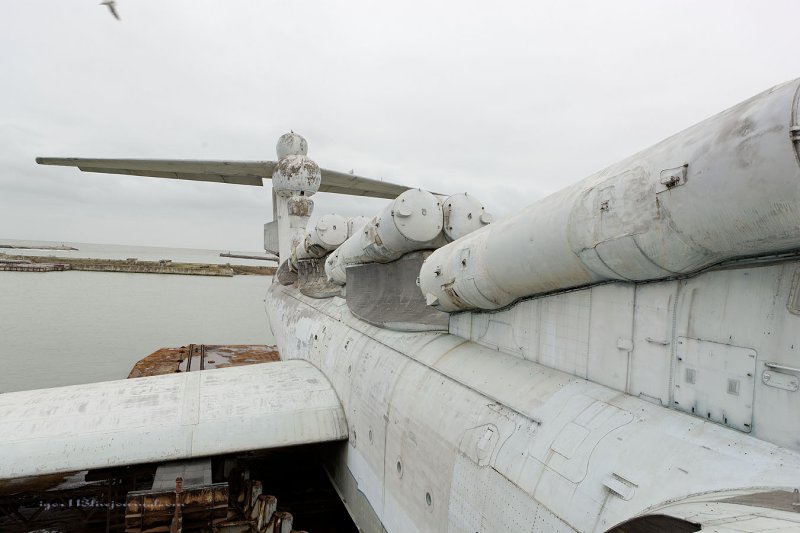
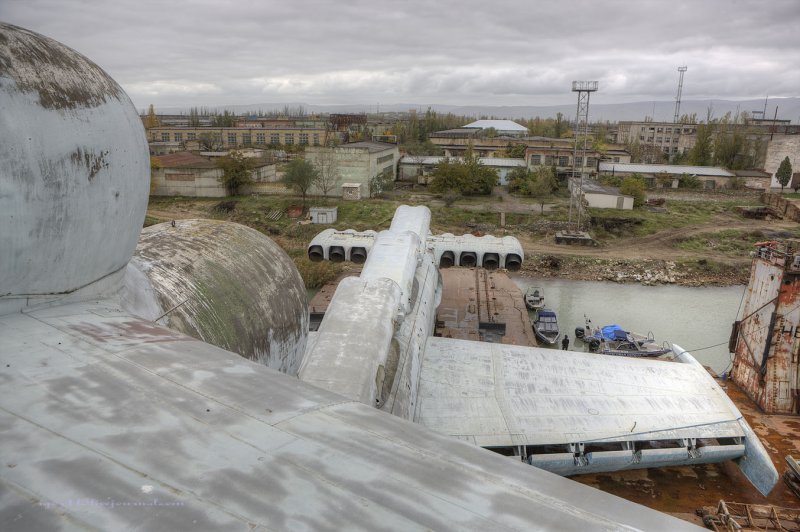
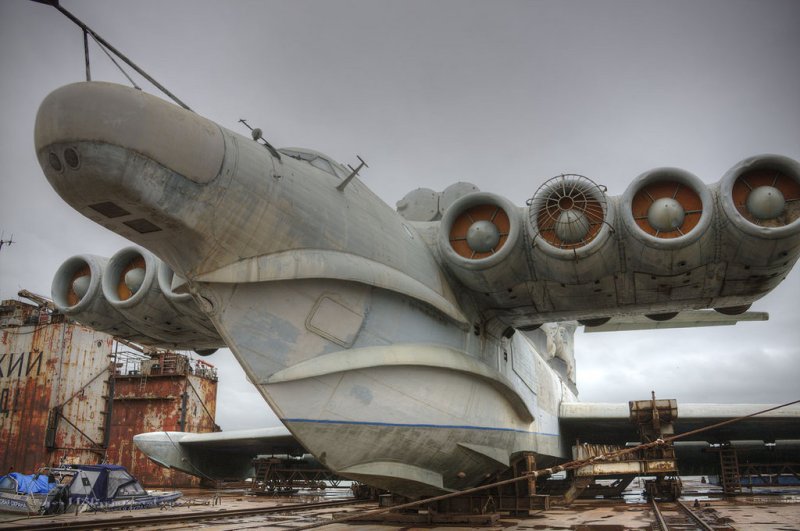
The beached corpse of a Caspian Sea Monster

Filed under: History, Technology — Tags: , , , , — Nicholas @ 09:22

A LiveJournal post by Igor113 has lots of photos (and text in Russian) of a visit to the resting place of one of the most fascinating technological relics of the Soviet era — an Ekranoplan:

Google translate offers this as the introduction to Igor’s post:

Here are my hands and came up ekranoplana. Ya break a story about it for 3 or 4 parts: a winged-outside (1 or 2 parts), 2-winged inside the 3-winged dock.

In 1987 the water came, “Lun” the first ship of a series of missile-carrying combat WIG weighing 400 tons was the chief designer V.Kirillovyh. The ship was armed with three pairs of cruise missile 3M80 or 80M “Mosquito” (NATO membership designation SS-N-22 Sunburn). The second “Lun” is also being laid as a missile, but the outbreak of the conversion brought about changes, and planned to finish a rescue.

LTH:
Modification of the Lun
Wingspan, m 44.00
Length, m 73.80
Height, m ​​19.20
Wing area, m2 550.00
Weight, kg
Empty 243 000
maximum take-off 380 000
8 turbojet engine type NC-87
Thrust, kg 8 x 13 000
Maximum speed, km / h 500
Operational range, km 2000
The height of the flight on the screen, 5.1 m
Seaworthiness, 6.5 points
Crew 10
Armament: 6 IP ASM ZM-80 Mosquito

Wikipedia has more. In spite of the apparent derelict condition of the Lun, Wikipedia mentions plans to resume development in 2012.

Update: Charles Stross sent a tweet with a link to this satellite shot of the Lun in dry dock: http://mapper.acme.com/?ll=42.88184,47.65690&z=19&t=H

March 18, 2012

The ever-expanding role for women in the military

Filed under: Bureaucracy, Economics, Education, History, Military, Technology — Tags: , , , , — Nicholas @ 11:22

An interesting article at Strategy Page:

The growing number of women in the military is largely driven by the need for people with scarce skills. Since most (over 80 percent) of military jobs have little, or nothing, to do with combat, if you can’t find enough qualified men, you can recruit women. This is especially true in the West, where females tend to be better educated than males. Thus women comprise about ten percent of the troops in Western armed forces. In the United States this is 15 percent for active duty troops, and 18 percent for the reserves. Civilian contractors, who are taking back some of the military jobs they performed for thousands of years, have an even higher percentage of females.

All this reflects growing female participation in the post-agricultural economy. We tend to forget that as recently as the 19th century, 90 percent of humanity were engaged in agriculture. It had been that way for thousands of years. With industrialization, women began to stay at home with the kids, and no longer work the same jobs (as they did in agriculture) with their husbands. But in the last sixty years, women have returned to their traditional place in the economy.

[. . .]

This current trend in using women and contractors are actually a return to the past, when many of the “non-combat” troops were civilians. Another problem is the shrinking proportion of troops who actually fight. A century ago, most armies comprised over 80 percent fighters and the rest “camp followers (support troops) in uniform.” Today the ratio is reversed, and therein resides a major problem. Way back in the day, the support troops were called “camp followers,” and they took care of supply, support, medical care, maintenance and “entertainment” (that’s where the term “camp follower” got a bad name). The majority of these people were men, and some of them were armed, mainly for defending the camp if the combat troops got beat real bad and needed somewhere to retreat to.

[. . .]

One of the great revolutions in military operations in this century has been in the enormous increase in support troops. This came after a sharp drop in the proportion of camp followers in the 18th and 19th centuries. Before that it was common for an army on the march to consist of 10-20 percent soldiers and the rest camp followers. There was a reason for this. Armies “in the field” were camping out and living rough could be unhealthy and arduous if you didn’t have a lot of servants along to take care of the camping equipment and help out with the chores. Generals usually had to allow a lot of camp followers in order to get the soldiers to go along with the idea of campaigning.

Only the most disciplined armies could do away with all those camp followers and get the troops to do their own housekeeping. The Romans had such an army, with less than half the “troops” being camp followers. But the Romans system was not re-invented until the 18th century, when many European armies trained their troops to do their own chores in the field, just as the Romans had. In the 19th century, steamships and railroads came along and made supplying the troops even less labor intensive, and more dependent on civilian support “troops.” The widespread introduction of conscription in the 19th century also made it possible to get your “camp followers” cheap by drafting them and putting them in uniform.

March 16, 2012

HMCS Victoria successfully test fired a torpedo

Filed under: Cancon, Military — Tags: , , — Nicholas @ 12:51

After all these years, we apparently will soon have torpedo-armed subs in the Royal Canadian Navy:

These torpedo firings are part of the technical and operational tests of Victoria‘s weapons systems and additional weapons system trials are scheduled for the spring of 2012. In the exercise version of the torpedo, the warhead module is replaced with electronics for gathering test data.

Victoria also participated in training with a naval task group while off the west coast of Vancouver Island, focussing on coordinated anti-submarine warfare tactics. Equipment and crew trials will continue throughout March as part of Victoria‘s program to being declared fully operational later this summer.

The submarine fleet will achieve steady state in 2013; at which point Canada will have three of four submarines continuously available for operations. As part of the ongoing submarine operational cycle, the fourth submarine will be with industry, undergoing necessary deep maintenance. Submarines are an essential component of a modern, first-class Navy with a balanced set of capabilities that can act in defence of Canada and Canadian interests above and below the sea.

Recent stories about the Victoria class submarines here and here.

March 9, 2012

The US Navy’s “east of Suez” moment

Filed under: Economics, Military, Technology, USA — Tags: , , , — Nicholas @ 00:01

“Sir Humphrey” on the looming crisis of the United States Navy:

There has been a lot of attention paid in some quarters this week to the allegations that the UK may shift back to STOVL rather than CTOL F-35. Humphrey has no intention on commenting on these particular reports — to his mind they are part of the wider PR12 process, which has seen, and will doubtless continue to see, a plethora of leaks of selected texts designed to push one case, denigrate another and continue the endless routine of tribal warfare between the services and their capbadges. All will be revealed in late March, so there is little point in speculating much before this point.

What has been of more interest though has been the reporting on the F-35 and also the wider perception that the US Navy is about to take a very significant hit in surface fleet numbers over the next 2-3 years. According to documents released there will be the loss of roughly 20 escorts from cruisers to frigates, paid off into reserve. This represents almost 20% of the USN, and is likely to see the reduction in size to barely 80 escorts within the next 2-3 years.

This is a very significant reduction — it’s effectively the paying off of the equivalent of the entire RN surface flotilla without replacement. On current plans by 2015, then USN is going to have barely 60 Arleigh Burke class destroyers, and around 20 Ticonderoga class cruisers — both designs which date back to the late 1970s – early 1980s in concept, even if the interiors have been significantly updated in equipment since then.

[. . .]

The USN is now struggling to keep pace with the fact that its escort fleet is aging, that it has multiple carriers which require replacement at some point in the near future, and that its SSN fleet is also going to need updating soon as well. This must also be set against the reality that hundreds of billions of dollars’ worth of cuts are inbound to the US defence budget, and that all three services have old and obsolescent equipment requiring replacement. It is hard to see how the US will be able to maintain its three services in their current levels of capability for much longer, and the worry is that a lot will have to give.

Humphrey is increasingly of the opinion that we are witnessing the USA’s ‘east of Suez moment’ at which the US is faced with the same strategic challenges that all empires are faced with. The legions will be recalled from Europe soon, and this is going to leave a major series of security and other challenges that need to be filled. A future blog article is planned to look at the impact of the USN cuts, and what the impact may be on the RN and other navies.

For those unfamiliar with the phrase in the title, it was in 1968 that the British government under Harold Wilson formally accepted that Britain could no longer maintain its military establishments in the furthest-flung corners of the former empire and announced the withdrawal of almost all forces from “east of Suez”. That was when the military (and economic) overstretch could no longer be maintained.

March 2, 2012

At least one politician thinks we should keep the Victoria class submarines

Filed under: Cancon, Military — Tags: , , — Nicholas @ 11:41

In the National Post, Senator Pamela Wallin offers a counter-argument to John Ivison’s suggestion that the submarine fleet is a net drain on Canada’s military resources (linked from this post):

I’m with Vice-Admiral Maddison, who said, “For a G8 nation, a NATO country like Canada, a country that continues to lead internationally and aspires to lead even more, I would consider that [cancellation of the program] to be a critical loss of a fundamental capability and a very difficult one to regenerate at a future date.” Submarines provide Canada the ability to add to our knowledge of what’s happening at sea, a way of moving around without being noticed and, if fighting breaks out, a unique strike capability in support of Canadian or allied forces.

Most importantly, Canada has the longest coastline in the world. We need to be able patrol it and to guard our three enormous ocean approaches — quietly and unseen. As well, 90% of the world’s trade moves on ships. Canada is heavily reliant on maritime trade, especially through sensitive narrow waterways like the Straits of Hormuz and Malacca. Some of that trade is threatened by piracy, a growing concern for all trading nations, especially off Africa’s east coast where pirates now range all the way east to India. These are not the charmingly rakish pirates that Hollywood portrays — they are brutal, ruthless criminals. Canada, as a maritime nation, needs to know what’s going on in all domains, including underwater, and to be able to fight back.


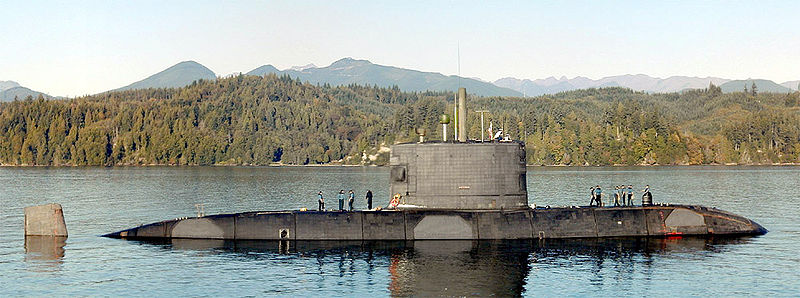
HMCS Victoria near Bangor. (Image from Wikimedia).

In spite of the tone of my comments in the earlier post (generally agreeing with Ivison’s criticisms), I’m pro-RCN and very much pro-submarine as part of our navy. But what we need are submarines that can perform the duties required, and ever since we acquired the Victoria class, they’ve signally failed to do this. Anyone who’s ever watched a WWII film or newsreel knows that submarines fire torpedoes — except the Victoria class, which still do not have effective torpedo armament. We bought these submarines in 1998. HMCS Victoria has been in commission since 2000 and we’re only just getting around to test-firing a torpedo later this year? This is insane.

Of course, it’s not fair to blame the RCN for all the problems: the government of the day bought the subs on the cheap and then didn’t fully fund the necessary repairs to bring the boats back into operation in a timely fashion (but the military may not have done proper due diligence before recommending the purchase, either). Today’s government may cut funding as part of the austerity budget we’re rumoured to be facing soon. If so, we can expect fewer days when any of our submarines are in the water, operational, and fully crewed.

« Newer PostsOlder Posts »

Powered by WordPress