Quotulatiousness

March 4, 2013

Are we approaching the end of the aircraft carrier era?

Filed under: Europe, Italy, Military — Tags: , , — Nicholas @ 10:31

At the Thin Pinstriped Line, “Sir Humphrey” looks at Spain’s all-but-certain exit from the ranks of carrier-equipped navies:

In Spain for instance the veteran carrier Principe De Asturias (PDA) has finally been paid off after some 25 years service as part of budget cuts. It is perhaps ironic to consider that she was originally conceived in the early 1980s as a cheap ‘Sea Control Ship’ solution originally looked at by the US Navy to provide cheaper carriers. Intended to put ASW helicopters to sea as a replacement for the Delado, she represented the closest any nation has perhaps come to a truly ‘austere’ carrier, with minimal support facilities for the airwing. Optimised in the first for ASW, with a very limited fixed wing capability using the Harrier (although never to the same level of development as the UK with the mixed FA2 / GR7 airwing), the PDA was an example in the 1980s of how smaller ‘harrier carriers’ could be built for emerging middle tier navies, providing them with airpower at relatively small cost. In reality she remained the sole of her class built around the world, with the closest other example being a Thai vessel optimised for EEZ protection and to act as a Royal Yacht.

Although the Spanish have built a large LPH, with carrier facilities (the Juan Carlos) as a second platform relatively recently, she is not an aircraft carrier in the conventional sense, and with the Spanish economic crisis deepening, it seems likely that PDA will not be directly replaced by another ‘proper’ aircraft carrier.

Similarly, with the emphasis on Juan Carlos as an assault ship, it seems likely that the small fleet of Spanish harriers (less than 15 airframes) will be increasingly vulnerable to defence cuts in an economy which is desperately struggling. The chances of seeing a credible Spanish fixed wing aviation capability beyond the next few years seem slim, and at a time when they are struggling to afford sustaining a relatively small buy of Eurofighters, it seems hard to envisage introduction of the JSF too.

So, Spain is perhaps the first carrier casualty of the economic crisis, although Italy is also looking increasingly vulnerable. The Guissepe Garibaldi is now nearly 30 years old, and again is unlikely to be directly replaced. Mindful of the recent cuts to the Italian Navy which will see a near 20% cull in manpower, and significant loss of hulls across the fleet, it again seems less and less likely that a credible carrier aviation capability can be sustained in a single hull (the Cavour). Having seen both these nations enter the ‘Carrier Club’ in the 1980s, one cannot help but wonder if they will be leaving it as full time members in the not too distant future?
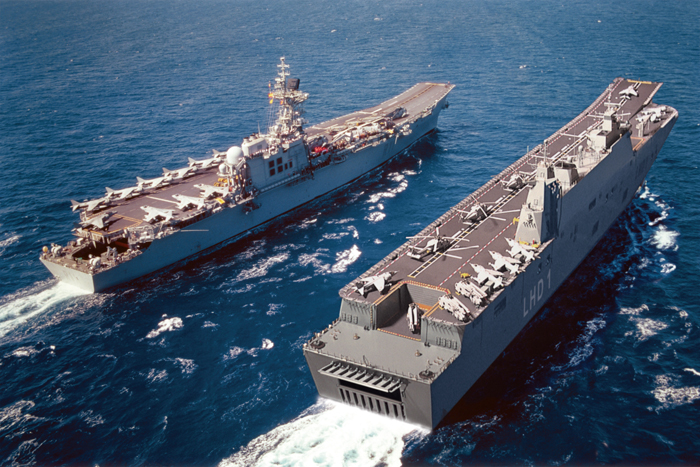
Spanish navy's Juan Carlos and Principe de Asturias
Juan Carlos and Principe De Asturias

Update: BBC News is reporting that the US Navy is planning a new class of UAV carriers:

The new project has been dubbed Tern (Tactically Exploited Reconnaissance Node) after a sea-bird known for its endurance.

Darpa programme manager Daniel Patt, said: “Enabling small ships to launch and retrieve long-endurance UAVs on demand would greatly expand our situational awareness and our ability to quickly and flexibly engage in hotspots over land or water.”

He added: “It is like having a falcon return to the arm of any person equipped to receive it, instead of to the same static perch every time.”

February 27, 2013

Sequestration and the defence budget

Filed under: Military, Politics, USA — Tags: , , , — Nicholas @ 09:10

At the Cato At Liberty blog, Christopher Preble graphically refutes the notion that sequestration will automatically weaken the US military:

Click to see full-size infographic at the Cato Institute blog.

Click to see full-size infographic at Cato At Liberty.

Military spending will remain at roughly 2006 levels — $603 billion, higher than peak U.S. spending during the Cold War. Meanwhile, we live in a safer world. The Soviet Union has been dead for more than two decades; no other nation, or combination of nations, has emerged since that can pose a comparable threat. We should have a defense budget that reflects this reality.

To be clear, sequestration was no one’s first choice. But the alternative — ever-increasing military spending detached from a legitimate debate over strategy — is worse. We should have had such a debate, one over the roles and missions of the U.S. military, long before this day of reckoning. And politicians could have pursued serious proposals to prudently reduce military spending. Instead, they chose the easy way out, avoiding difficult decisions that would have allowed for smarter cuts.

Update: Nick Gillespie explains why you shouldn’t worry too much about the sequester:

Update, the second: Putting the actual numbers in perspective:

February 23, 2013

“The sequester’s ‘meat-cleaver approach’ of ‘severe,’ ‘arbitrary’ and ‘brutal’ cuts will ‘eviscerate’ education, energy and medical research spending”

Filed under: Bureaucracy, Economics, Government, USA — Tags: , , , , , — Nicholas @ 10:19

Head for the hills! The sequester is coming!

As in: Batten down the hatches — the sequester will cut $85 billion from this year’s $3.6 trillion budget! Or: Head for the storm cellar — spending will be cut 2.3 percent! Or: Washington chain-saw massacre — we must scrape by on 97.7 percent of current spending! Or: Chaos is coming because the sequester will cut a sum $25 billion larger than was just shoveled out the door (supposedly, but not actually) for victims of Hurricane Sandy! Or: Heaven forfend, the sequester will cut 47 percent as much as was spent on the AIG bailout! Or: Famine, pestilence and locusts will come when the sequester causes federal spending over 10 years to plummet from $46 trillion all the way down to $44.8 trillion! Or: Grass will grow in the streets of America’s cities if the domestic agencies whose budgets have increased 17 percent under President Obama must endure a 5 percent cut!

The sequester has forced liberals to clarify their conviction that whatever the government’s size is at any moment, it is the bare minimum necessary to forestall intolerable suffering. At his unintentionally hilarious hysteria session Tuesday, Obama said: The sequester’s “meat-cleaver approach” of “severe,” “arbitrary” and “brutal” cuts will “eviscerate” education, energy and medical research spending. “And already, the threat of these cuts has forced the Navy to delay an aircraft carrier that was supposed to deploy to the Persian Gulf.”

“Forced”? The Navy did indeed cite the sequester when delaying deployment of the USS Truman. In the high-stakes pressure campaign against Iran’s nuclear weapons program, U.S. policy has been to have two carriers in nearby waters. Yet the Navy is saying it cannot find cuts to programs or deployments less essential than the Truman deployment. The Navy’s participation in the political campaign to pressure Congress into unraveling the sequester is crude, obvious and shameful, and it should earn the Navy’s budget especially skeptical scrutiny by Congress.

The Defense Department’s civilian employment has grown 17 percent since 2002. In 2012, defense spending on civilian personnel was 21 percent higher than in 2002. And the Truman must stay in Norfolk? This is, strictly speaking, unbelievable.

February 21, 2013

From the sublime to the ridiculous, warship edition

Filed under: Humour, Media, Military, Russia — Tags: , , — Nicholas @ 09:56

One of the most influential propaganda films of all time meets one of the least. BATTLESHIP POTEMKIN: a mashup trailer created by Josh Nelson.

H/T to Mary Ann Johanson, via John Scalzi.

February 5, 2013

Japan lodges formal protest after Chinese ship targets Japanese ship near Senkaku/Diaoyu islands

Filed under: China, Japan, Military — Tags: , , — Nicholas @ 09:13

The BBC has the details:

“On 30 January, something like fire-control radar was directed at a Japan Self-Defence Maritime escort ship in the East China Sea,” Mr Onodera told reporters on Tuesday.

The minister said Japan’s Yuudachi vessel and the Chinese frigate were about 3km (one mile) [ed: conversion error here, 3km is about 2 miles] apart at the time, Japan’s Kyodo News reports.

Asked about the delay in filing the protest, Mr Onodera said it took the ministry until Tuesday to determine that a fire-control radar had indeed locked on the Japanese ship.

He added that a Japanese military helicopter was also targeted with a similar type of radar by another Chinese frigate on 19 January.

“Directing such radar is very abnormal. We recognise it would create a very dangerous situation if a single misstep occurred,” he said.

Senkaku/Diaoyu Islands

February 1, 2013

USS Guardian to be dismantled in place after grounding on coral reef

Filed under: Environment, Military, Pacific, USA — Tags: , , , , — Nicholas @ 00:01

The US Navy has decided that the best course of action is to break up the minesweeper USS Guardian after it ran solidly aground on a coral reef in the Sulu Sea:

USS Guardian aground in the Sulu Sea January 2013

“We’re working very closely with the Philippine coast guard, with their navy and their government personnel. We’ve been grateful for their support as we all work together to remove Guardian and minimize further damage to the reef,” James said.

It’s expected to take over a month to dismantle the Guardian, which ran aground before dawn on Jan. 17.

Crews have already removed 15,000 gallons of fuel from the ship. They’ve also taken off hundreds of gallons of lubricating oil and paint. They’ll be removing human wastewater and other materials that could harm the environment, James said.

The U.S. Navy is hiring floating cranes to help with the removal. A contractor in Singapore is sending the cranes, which should arrive on site in a few days.

The Navy originally said the Guardian would be lifted by crane onto a barge and taken to a shipyard. But now the Navy says the ship is “beyond economical repair.”

No one was injured when the ship ran aground at the reef in the Tubbataha National Marine Park. The park is a World Heritage Site in the Sulu Sea, about 400 miles southwest of Manila.

Update, 8 February: A bit more information about the salvage operations which are supposed to have started on February 4th.

January 24, 2013

Pirate attacks down off Somali coast, but rising in the Gulf of Guinea

Filed under: Africa, Military — Tags: , , , , — Nicholas @ 09:23

Strategy Page counts the number of attacks by pirates in two hotspots around Africa:

Piracy attacks were down last year, returning to 2007 levels. The greatest reductions occurred off Somalia, where more effective anti-pirate patrols and escort operations made it very difficult for the pirates to even get close to merchant ships. When pirates did close in, the crews were better equipped and trained to get away. Many ships now carry some armed guards when off Somalia, who can shoot back (much more accurately) if the pirates get too close. No ship with armed guards has been taken.

Last year there were 75 pirate attacks on large ships off Somalia, compared to 237 in 2011. Last year pirates took 14 ships, compared to 28 in 2011. It’s been more than six months since pirates have taken a ship off Somalia and several large pirate gangs have simply gone out of business. Others have switched to smuggling people from Africa to Yemen. That business is booming.

There has been more piracy off the west coast of Africa, where there were 58 incidents last year. Most of this has been taking place in the Gulf of Guinea where the pirates have become bolder and are hijacking ships (which they mainly take only long enough to steal the cargo). This is not a new trend (it has long been common in Asia) but it is new for West Africa.

January 23, 2013

Retired Argentinian destroyer ARA Santísima Trinidad sinks at naval base

Filed under: Americas, Military — Tags: , , — Nicholas @ 09:34

The Argentinian defence minister was sure to include the possibility that the ARA Santísima Trinidad was sunk by enemy action:

Arturo Puricelli, the defence minister, said the loss of the Holy Trinity was due to “negligence in the best-case scenario, or an attack” aimed at making the government look bad. He did not go into detail.

The destroyer, which was retired from active service in 2004, took on water at the Puerto Belgrano naval base after a six-inch pipe burst, the navy said.

The minister later said, however, that he was surprised that the ship sank quickly while it was moored at the port.

First it started listing, he said. “So the breakdown must have been major, or someone opened a value to sink it,” he said.

The ARA Santísima Trinidad was the warship that landed the first military forces — 84 marines and a team of divers — to start the Falklands War of 1982.

Update: I wonder if Colby is freelancing for the Sun now:

The_Sun_(Gotcha)

UK considering alternatives to Trident

Filed under: Britain, Military — Tags: , , , , — Nicholas @ 09:15

The Royal Navy operates four Vanguard-class ballistic missile submarines equipped with the Trident nuclear missile. The coalition government is internally divided over the decision to order replacement submarines to come online when the current subs reach their designed end-of-life. The Tories (at least for public consumption) are in favour of a replacement on a one-for-one basis, while the Liberal Democrats would prefer to eliminate nuclear missiles from the British arsenal.

In the Telegraph, Peter Dominiczak explains why the one-for-one replacement is the least likely outcome:

Mr Alexander, the Chief secretary to the Treasury, dismissed Tory demands for a new continuous at-sea nuclear deterrent and warned that the Treasury does not have “a magic pot of money” to pay for a new generation of submarines.

In an interview with the Guardian he insisted that there are “potential alternatives” to Trident.

The Liberal Democrats have repeatedly clashed with Conservatives who are calling for an upgrade to the fleet of Trident submarines.

The Lib Dems insisted on an official review into Trident, which is due to report in June, as part of the Coalition agreement in 2010.

[. . .]

“Is it right in the 21st century that we still need to have submarines at sea, 24 hours a day, seven days a week, 12 months of the year? All those things are ripe for being reviewed and considered, and alternatives presented.”

Philip Hammond, the Defence Secretary, last year said that upgrading Trident would probably be cheaper than any alternative nuclear deterrent proposed by the Lib Dems.

He said the Trident missiles and warheads have “many, many years of life in them” and will only need new submarines to carry them by 2028.

Any attempt to create a whole new nuclear deterrent system is unlikely to be economic, he said.

Ballistic missile submarines are very expensive to design and build (and to operate), and shifting to a smaller number of hulls would save very little money. As I put it back in 2010, “Army, RN, RAF, and Trident replacement: pick any three“. Trident is nearly as expensive as an entire arm of the military all on its own, and it’s no surprise that the Liberal Democrats would love to eliminate it if they could get away with it.

January 15, 2013

HMCS Athabaskan finally makes port

Filed under: Cancon, Military — Tags: , , , , , — Nicholas @ 10:04

As reported more than a week ago, HMCS Athabaskan has been having issues getting back home to Halifax. She had been refitting at Seaway Marine and Industrial Inc. in Welland, Ontario, but the work had been extended longer than planned due to issues discovered while the work was underway. Instead of being back in service by the end of the year, the ship had to be towed back to Halifax with the work incomplete.

On the way, the tow line broke and HMCS Athabaskan drifted for several hours off Scatarie Island. At some point, the ship took additional damage (the darkened areas around the hull number below):

HMCS Athabaskan under tow in Halifax
(Screencap image detail from Halifax Shipping News)

January 13, 2013

Britain considering reinforcements for Falkland Islands

Filed under: Americas, Britain, Military — Tags: , , , — Nicholas @ 12:54

If nothing else, the heated rhetoric from Argentina is encouraging the British government to think about sending more military resources to the Falklands:

Britain is prepared to send additional military backup to the South Atlantic as a ‘show of force’ to Argentina over the Falkland Islands.

It is understood an extra warship, another RAF Tycoon [sic] combat aircraft and further troops could be dispatched to the region ahead of the March referendum over whether the islands remain part of the UK.

According to the Sunday Telegraph, the options being proposed by planners at the Permanent Joint Headquarters in Northwood, London, include conducting naval exercises in the region.

Alternatives include sending elements of the Army’s 16 Air Assault Brigade — the airborne task force which includes members of the Parachute Regiment — which has just completed a series of demanding exercises in Spain preparing for ‘general war’.

Islanders will vote on March 11 on whether they wish to remain an overseas territory of the UK.

It is expected there will be a 100 per cent ‘yes’ vote, which intelligence officials have warned the Prime Minister could lead to an aggressive ‘stunt’ by Argentina, such as planting the country’s flag on the island.

January 4, 2013

HMCS Athabaskan damaged while under tow

Filed under: Cancon, Military — Tags: , , , , , — Nicholas @ 00:01

One of the Royal Canadian Navy’s destroyers was supposed to have finished a refitting back in November, but due to delays in the work had to be towed back to Halifax. On the way, further problems arose:

A navy destroyer moored in Cape Breton has been damaged and was set adrift while under tow after problems arose with repair work carried out at an Ontario dockyard, the military said Thursday.

HMCS Athabaskan drifted for several hours off Scatarie Island on Friday after the tow line broke, said Capt. Doug Kierstead of the Royal Canadian Navy in Halifax.

Kierstead said there is damage to the hull behind the ship’s identifying numbers, though he declined to say what the damage was and how it came about.

“At this point all I can say is that we are aware that there is damage visible,” Kierstead said in an interview.

He said the vessel was supposed to have undergone a routine refit by the end of November last year and was expected to be capable of sailing after that work was completed at Seaway Marine and Industrial Inc. in Welland, Ont.

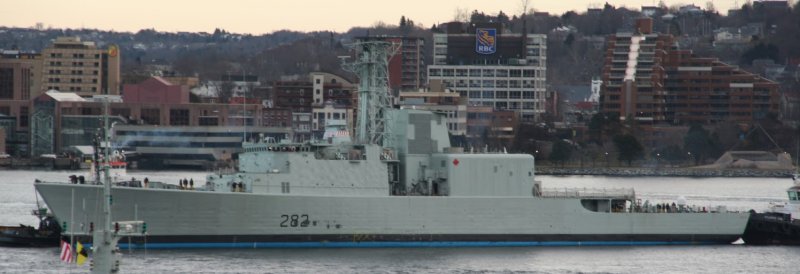
HMCS Athabaskan 282
Photo from Wikimedia

December 27, 2012

Captives in longest hijack freed after nearly three years

Filed under: Africa, Military — Tags: , , , , , — Nicholas @ 10:27

The crew of the Iceberg 1 are now free, after enduring the longest pirate kidnapping in modern history:

How’s this for a seasonal tale to warm the hearts? After almost three years in captivity, the crew of the Iceberg 1, a cargo ship hijacked by Somali pirates, are home after finally being rescued.

For the benefit of those who haven’t followed the story — and there are probably plenty, as it’s had only scant coverage — the Iceberg 1 was captured back in March 2010, and has languished in pirate custody ever since.

As we reported back in the summer, the ship essentially fell between two stools. Its Dubai-based owner, who appears not to have been insured, refused to pay a ransom for it and simply went to ground, ignoring pleas for help from the hostages’ families.

Meanwhile, the governments representing the different sailors on board — six Indians, nine Yemenis, four Ghanaians, two Sudanese, two Pakistanis and one Filipino — were either unable or unwilling to mount a rescue attempt. So, too,was the multinational anti-piracy force, which generally prefers hijacked ships to be freed by ransom, on the basis that freeing sailors by force carries too much risk of casualties.

December 19, 2012

ARA Libertad finally free to sail home from Ghana

Filed under: Africa, Americas, Government, Military — Tags: , , , , , — Nicholas @ 15:05

If you’ve been following the debt-related travails of the Argentine navy’s flagship, you’ll recall that the ship was impounded on a visit to Ghana back in October. The BBC is now reporting that the ship has been released, and Argentinian sailors will be able to take the frigate home after a UN court decision:

The Libertad set sail from Ghana’s main port of Tema after a United Nations court last week ordered its release.

Argentina sent almost 100 navy personnel to man the three-masted training ship.

It was impounded after a financial fund said it was owed money by Argentina’s government as a result of a debt default a decade ago.

[. . .]

In November, sailors on board the Libertad reportedly pulled guns on Ghanaian officials when they tried to board the vessel to move it to another berth.

The lengthy diplomatic row began when the ship was prevented from leaving Ghana on 2 October, after a local court ruled in favour of financial fund NML Capital. The fund is a subsidiary of US hedge fund Elliot Capital Management which is one of Argentina’s former creditors.

Initial report on the seizure here and here.

Not all submarines are equal

Filed under: Military, Technology, USA — Tags: , , , — Nicholas @ 09:02

Strategy Page on the US Navy’s need to work with — and even consider buying — modern diesel-electric submarines:

The U.S. Navy continues to debate the issue of just how effective non-nuclear submarines would be in wartime, and whether the U.S. should buy some of these non-nuclear boats itself. This radical proposal is based on two compelling factors. First, the U.S. Navy may not get enough money to maintain a force of 40-50 SSNs (attack subs.) Second, the quietness of modern diesel-electric boats puts nuclear subs at a serious disadvantage, especially in coastal waters. With modern passive sensors, a submerged diesel-electric sub is often the best weapon for finding and destroying other diesel-electric boats. While the nuclear sub is the most effective high seas vessel, especially if you have worldwide responsibilities and these nukes would have to quickly move long distances to get to the troubled waters, the diesel electric boat, operating on batteries in coastal waters, is quieter and harder to find.

[. . .]

For much of the past decade the U.S. Navy has been trying to get an idea of just how bad the threat it. Thus from 2005 to 2007 the United States leased a Swedish sub (Sweden only has five subs in service), and its crew, to help American anti-submarine forces get a better idea of what they were up against. This Swedish boat was a “worst case” scenario, an approach that is preferred for training. The Gotland class Swedish subs involved are small (1,500 tons, 64.5 meters/200 feet long) and have a crew of only 25. The Gotland was based in San Diego, along with three dozen civilian technicians to help with maintenance.

For many years before the Gotland arrived, the U.S. Navy had trained against Australian diesel-electric subs, and often came out second. The Gotland has one advantage over the Australian boats, because of its AIP system (which allows it to stay under water, silently, for several weeks at a time). Thus the Gotland is something of a worst case in terms of what American surface ships and submarines might have to face in a future naval war. None of America’s most likely naval opponents (China, North Korea or Iran), have AIP boats yet, but they do have plenty of diesel-electric subs which, in the hands of skilled crews, can be pretty deadly.

« Newer PostsOlder Posts »

Powered by WordPress