Quotulatiousness

April 3, 2018

HMS Cockchafer: The Epic Voyages, 1915-1949

Filed under: Britain, History, Military, WW1, WW2 — Tags: — Nicholas @ 02:00

Thersites the Historian
Published on 12 Feb 2018

Recently, I stumbled across the existence of the most oddly named ship that I have ever encountered and I decided to dig into its history. The following is a brief history of a British gunboat which saw action in many of Britain’s most noteworthy military actions during the early 20th Century.

Wikipedia entry on HMS Cockchafer.

March 27, 2018

History Buffs: Tora! Tora! Tora!

Filed under: History, Japan, Media, Military, Pacific, USA, WW2 — Tags: , , , — Nicholas @ 02:00

History Buffs
Published on 21 Jun 2017

Tora! Tora! Tora! is a 1970 Japanese-American historical war film that dramatizes the Japanese attack on Pearl Harbor in 1941. The film was directed by Richard Fleischer, Toshio Masuda and Kinji Fukasaku and stars an ensemble cast, including Martin Balsam, Joseph Cotten, Sō Yamamura, E. G. Marshall, James Whitmore and Jason Robards. The title is the Japanese codeword used to indicate that complete surprise had been achieved. “Tora” means “tiger” in Japanese.

Cynical Historian: Pearl Harbor review – https://www.youtube.com/watch?v=oUlwDDeAQNE

March 7, 2018

USS Lexington‘s final resting place discovered by Paul Allen’s RV Petrel

Filed under: Australia, History, Military, Pacific, USA, WW2 — Tags: , , — Nicholas @ 03:00

As reported by News Corp Australia:

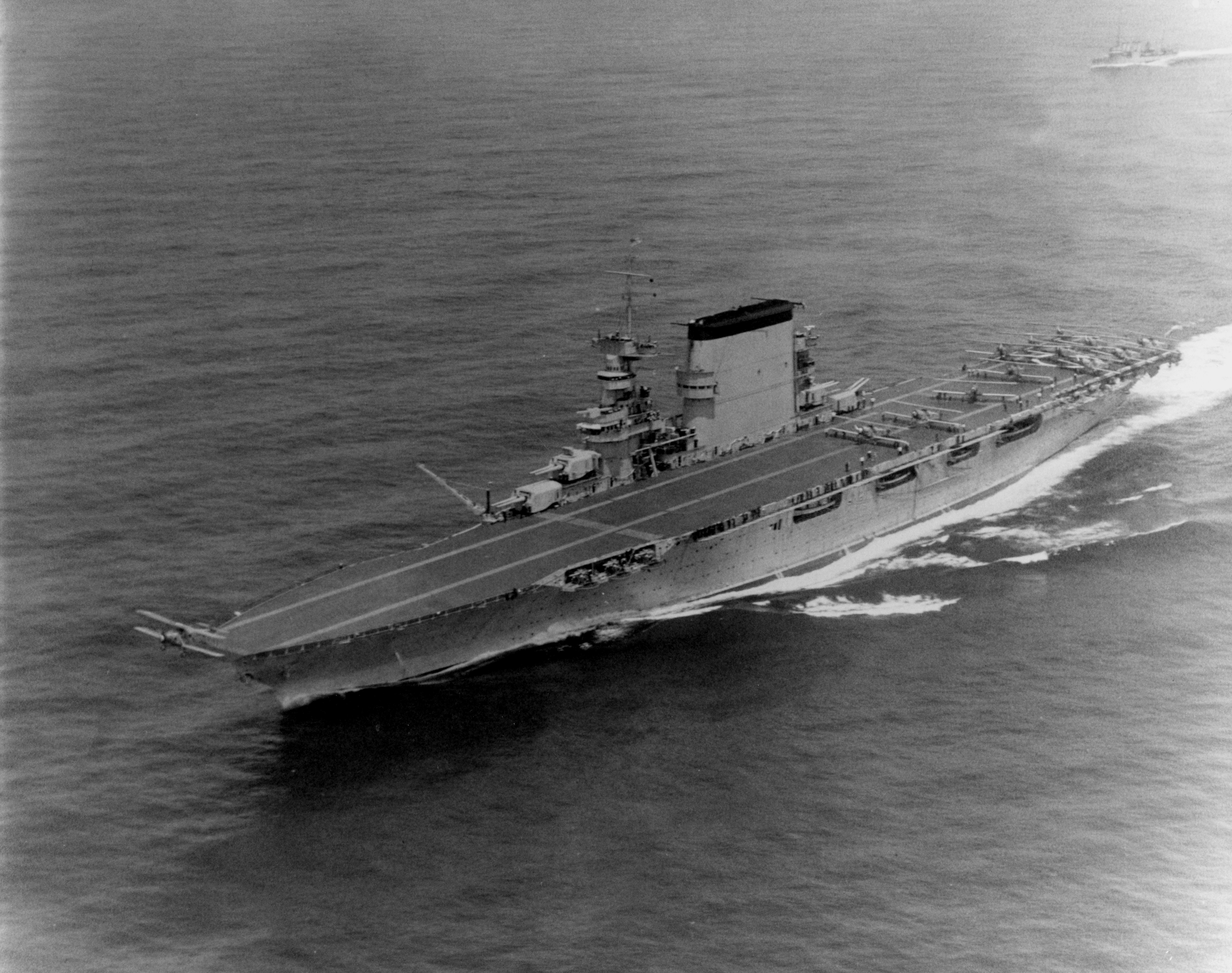
U.S. Navy Martin T4M-1 aircraft of Torpedo Squadron 1B (VT-1B) are launching from the deck of the aircraft carrier USS Lexington (CV-2) in 1931. Note the “four-stacker” (Clemson/Wickes-class destroyer) in the upper right corner.
US Navy photo via Wikimedia.

Now, 76 years after it settled to the bottom, it’s been found.

It’s the latest find by billionaire Paul Allen.

And it’s in a remarkably well preserved condition.

Soon-to-be US ambassador to Australia, US Pacific Commander Admiral Harry Harris says he is elated at the find.

“As the son of a survivor of the USS Lexington, I offer my congratulations to Paul Allen and the expedition crew of Research Vessel Petrel for locating the ‘Lady Lex’,” he said in a tweet.

[…]

Paul Allen’s research vessel Petrel located the wreck of the USS Lexington yesterday.

According to a post on the philanthropist’s website, it rests some 800km off the coast of Queensland at a depth of about 3km.

The find was the result of a six month project.

Photos so far returned by RV Petrel’s submersible show several aircraft that have tumbled out of the carrier and on to the ocean’s floor. Their original markings and paintwork remain remarkably clear.

The ship itself, while showing heavy scarring from the battle and the stresses of diving 3km to the sea floor, is also well preserved. Gun mounts and other fittings show only little sign of corrosion and deterioration.

Vulcan Inc.
Published on 5 Mar 2018

Wreckage from the USS Lexington was discovered on March 4, 2018 by the expedition crew of Paul G. Allen’s Research Vessel (R/V) Petrel. The aircraft carrier, “Lady Lex” was found more than 3,000 meters below the surface, resting on the floor of the Coral Sea more than 500 miles off the eastern coast of Australia.

March 3, 2018

China’s growing presence in the Indian Ocean

Filed under: China, India, Military — Tags: , , — Nicholas @ 05:00

At Strategy Page, a useful primer on recent Chinese moves to set up another facility in India’s sphere of influence, this time in the Maldives:

The Maldive Islands in relation to southern India and Sri Lanka
Image from Google Maps.

China and India are threatening each other over who should do what in Maldive Islands just south of India. This conflict heated up at the end of 2017 when China and the Maldives signed an agreement that allowed China to build and operate a “Joint Ocean Observation Station”. This monitoring station would be built on an atoll that is the closest part of the Maldives to India. Opposition politicians in the Maldives claim China has already taken possession of sixteen small islands and that China has been investing heavily in the Maldives economy and influential politicians.

This agreement was apparently obtained by Chinese bribes and assurances that there would be more Chinese investments. Meanwhile the Maldives government is in chaos over elected officials and the Supreme Court judges disagreeing about who should actually be in charge. The tiny (248 square kilometers spread over 1,192 coral atolls spread over 90,000 square kilometers of water off the southern coast of India) nation has a mostly Moslem (98 percent) population of 430,000 plus 100,000 foreign workers (a third of them illegals). Most of the population is concentrated on about 15 percent of the islands. The per capita income is about $10,000 and most of it is based on tourism followed by fishing. Many young men have been attracted to Islamic terrorism but there is not much religious violence in the Maldives. While a democracy the religious parties and military have kept the government in turmoil by asserting decidedly non-democratic powers.

Over the last decade India has become alarmed at growing Chinese investment in neighboring countries (like Sri Lanka, Maldives and Bangladesh). Chinese firms are more experienced and effective at arranging these foreign investments and India’s smaller neighbors feel more comfortable with investment from distant China rather than neighbor (and sometimes big bully) India. The Chinese economic investments often have military implications, like China building satellite ground stations in Sri Lanka, a major port in Pakistan and now an “Ocean Observation Station” in the Maldives.

China had earlier persuaded the Maldives to join its OBOR (One Belt, One Road) project. The Maldives would be part of the “maritime road” going from Chia, through the newly annexed South China Sea and into the Indian Ocean and sea routes to the Persian Gulf the Suez Canal and East Africa and beyond. The Maldives government has always been unstable and Islamic radicalism is still an issue there. Islamic terrorists were never able to establish themselves in the Maldives, although they tried. In 2007 three men were sentenced to 15 years in prison for carrying out a terror bombing attack three months earlier that wounded a dozen tourists. The Islamic radicals were intent on destroying the tourist industry, which is the main source of income in the Maldives, because they saw it as un-Islamic. Most people on the Maldives did not agree with that, and justice was swift. However, ten Islamic radicals responsible for planning the bombings fled the country the day before the attack and are being sought in Pakistan.

February 25, 2018

Feature History – Russo-Japanese War

Filed under: China, History, Japan, Military, Russia — Tags: , , , — Nicholas @ 02:00

Feature History
Published on 28 May 2017

Hello and welcome to Feature History, featuring a Russian and Japanese disagreement, and why you don’t record when sick.

February 15, 2018

HMS Sutherland to conduct Freedom of Navigation exercise (FONOPS) in the South China Sea

Filed under: Britain, China, Military — Tags: , — Nicholas @ 05:00

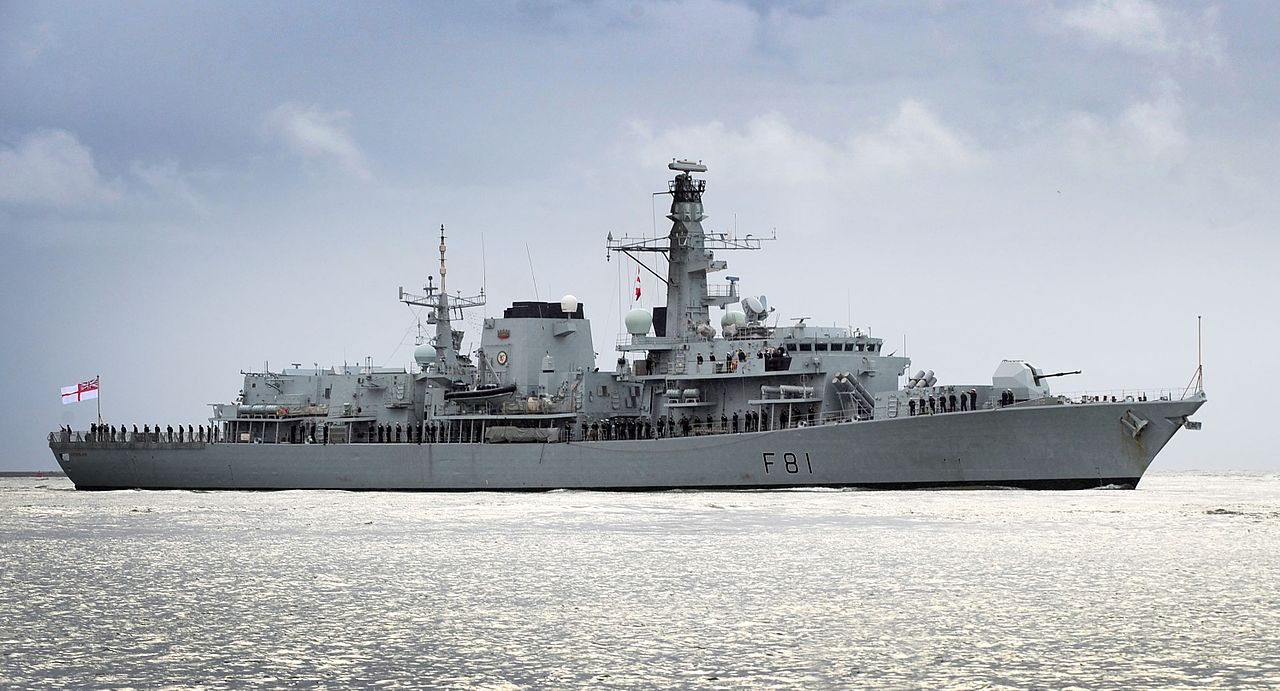
Gareth Corfield on the current voyage of the Royal Navy frigate HMS Sutherland (F81):

HMS Sutherland (F81), a Type 23 frigate of the Royal Navy
Photo by Vicki Benwell, RN and released by the Ministry of Defence.

A British warship has set sail for the South China Sea, paving the way for aircraft carrier HMS Queen Elizabeth to do the same thing in three years’ time.

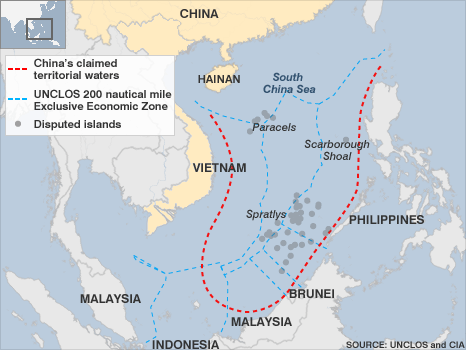
HMS Sutherland, a Type 23 frigate, will sail through the disputed region on her way home from Australia, as much to fly the flag in foreign climes as to carry out a dry run ahead of the nation’s flagship doing the same thing in 2021.

The South China Sea is one of the world’s naval choke points. Very high values of trade (the total value was estimated by the Daily Telegraph as £3.8tn) either originates in or passes through the sea. The region is under dispute chiefly because of China, which is trying to extend its territorial limits (and thus the area it can directly control) by building artificial islands to embiggen its borders.

Sutherland will be carrying out a freedom of navigation exercise, which is where a warship sails through a disputed bit of sea to send the message “you can’t stop us doing this”. The idea is to reinforce the notion that international waters, where anyone has right of free passage, can’t be unilaterally claimed by one country.

February 6, 2018

Hit and Run – Motor Torpedo Boats in World War 1 I THE GREAT WAR Special

Filed under: Britain, Europe, History, Italy, Military, WW1 — Tags: , , , — Nicholas @ 04:00

The Great War
Published on 5 Feb 2018

The Naval arms race of the early 20th century certainly meant that battleships got ever bigger and more powerful. But there is a David to every Goliath and so Motor Torpedo Boats were developed and used for “hit and run” style operations by both the British and the Italian Navy. Especially, the Italians used their Motoscafo armato silurante (MAS) with great success against the Austro-Hungarian Navy.

February 2, 2018

Battle: Taranto Raid – Italian Pearl Harbor

Filed under: Britain, Europe, History, Italy, Military, WW2 — Tags: , — Nicholas @ 02:00

Military History Visualized
Published on 20 Jan 2017

The British Raid on the Italian Harbor of Taranto in 1940 had a crucial influence on the Japanese Attack on Pearl Harbor. Similarly, it managed to damage several battleships, yet with a far lower strike force. Additionally, the attack was launched during the night.

Military History Visualized provides a series of short narrative and visual presentations like documentaries based on academic literature or sometimes primary sources. Videos are intended as introduction to military history, but also contain a lot of details for history buffs. Since the aim is to keep the episodes short and comprehensive some details are often cut.

January 29, 2018

Cheng I Sao – Pirate Queen – Extra History

Filed under: China, History — Tags: , , — Nicholas @ 04:00

Extra Credits
Published on 27 Jan 2018

She was the most ferocious pirate China had ever known. She was a powerful fleet commander, a sharp businesswoman, and a consummate strategist. She was Cheng I Sao, leader of the Pirate Confederation, and she lived her life on her terms.

January 16, 2018

Yet another money squeeze for Britain’s military

Filed under: Britain, Government, Military — Tags: , , , , — Nicholas @ 03:00

At the Thin Pinstriped Line, Sir Humphrey outlines the difficult financial position the British Ministry of Defence (MOD) finds itself in and the very limited options available for the decision makers to choose among:

The Times has broken details of the planned cuts put forward by the MOD to meet the likely scale of budget cuts needed under the ongoing national Security Review being conducted in the Cabinet Office. The planned cuts as leaked to the Times highlight the sheer scale of the challenge facing the MOD at the moment, and seem to resort to many of the ‘greatest hits’ intended to arouse strong opposition, such as ‘merging the Parachute Regiment and Royal Marines’ option.

It is indicated that the Prime Minister has opposed the measures put forward, and that this in turn will lead to a full blown Strategic Defence and Security Review [SDSR], which will look again at force structures and outputs, and hopefully deliver a more balanced force in due course. The challenge is doing this against a budget which reportedly is £20bn in debt, with no meaningful way to find savings without serious pain.

[…]

The difficulty then for Defence is conducting an SDSR in a world where politicians seem unsure as to what their ambition is for the UK in the next 5-10 years, and whether they want to find the money to do this or not. There is probably strong political support for the idea of maritime and air power, both of which can easily be deployed (and recovered) discretely and with no long-term entanglements. It is reasonable to assume that the RN and RAF have a compelling case that they should receive the lions share of investment in the review.

By contrast the Army will find itself facing a difficult time – it is telling that all three options presented in the Times focused on a major loss of Army manpower, and capability reduction. What is also likely is the wider impact of further delays in procurement and reduction of exercises, training and other tools essential to keeping the Army credible. As its vehicle fleet ages, and with almost all of its primary weapon systems verging on becoming near obsolete, politicians face a difficult choice – do they continue to direct funding into high end high capability ground equipment, or do they take the ‘UOR [Urgent Operational Requirement] it on the day’ option of reducing the size of the Army and hope that come the next long-term ground operation, there is enough time to sort a round of UOR purchases out to equip people to the right standard.

At its heart though is the difficulty that the UK seems pathologically incapable of taking and sticking to credible long-term plans on defence and seeing them through to fruition. Strategic now seems to mean ‘two-year horizon’ at best, and there is a real sense that for all the glossy PowerPoint slides and publications, it is a department in a perpetual state of crisis as it struggles to afford the equipment needed to do the tasks asked of it.

This cycle of unaffordability is not new, in fact it seems never ending. There is an occasional period of a few years when things seem a bit better, but then another thing goes wrong and the Department is back to square one. Part of this problem lies in an eternally optimistic set of planning assumptions, coupled with such regular turn over of staff that no one ever has to see through the impact of their work.

The other problem is that rather than bite the bullet, take some incredibly tough decisions and wholesale withdrawal from commitments and capability, the Department lurches on, occasionally being bailed out by some deal that finds a few extra quid to just about see it through. What isn’t happening is systematic and thorough reforms to really grip and address the problems that the Department has got to stop them cropping up time and time again.

At some point the UK must have a serious policy discussion about what it really wants from its defence and national security capability. Does it want to seriously fund it, at a time of economic challenge and government austerity, or does it want to scale back ambition in order to find funding for other national projects? This conversation will not happen though in any meaningful sense, and instead the debate will be shallow, superficial and focus on numbers not outputs and leaked papers warning of an inability to defend the UK if something is cut.

It is all very well having an SDSR again (the third in 8 years), but unless there is a real change in behaviours, there will simply be another one in a couple of years’ time when the new plan proves unaffordable and unworkable. We cannot go on like this indefinitely.

January 10, 2018

QotD: Winston Churchill as First Lord of the Admiralty

Filed under: Britain, Government, Military, Quotations — Tags: , — Nicholas @ 01:00

It did not take me very long to find out that Mr. Churchill was very apt to express strong opinions upon purely technical matters. Moreover, not being satisfied with expressing opinions, he tried to force his views upon the Board [of the Admiralty]. His fatal error was his entire inability to realize his own limitations as a civilian. I admired very much his wonderful argumentative powers. He surpassed the ablest of lawyers and would make a weak case appear exceedingly strong. While this gift was of great use to the Admiralty when we wanted the naval case put well before the government, it became a positive danger when the First Lord started to exercise his powers of argument on his colleagues on the Board. Naval officers are not brought up to argue a case and few of them can make a good show in this direction.

Vice-Admiral Sir John Jellicoe, Second Sea Lord of the Admiralty 1912-14, quoted by Robert K. Massie, in Castles of Steel.

January 9, 2018

The ongoing financial catastrophe that is the National Shipbuilding Procurement Strategy

Ted Campbell rounds up recent discussions of the Canadian government’s farcical National Shipbuilding Procurement Strategy (NSPS):

There is a somewhat biased but still very useful look at the successes of the National Shipbuilding Procurement Strategy (NSPS) in the Ottawa Citizen by Howie Smith who is the Past President of the Naval Association of Canada. Mr Smith is a retired Canadian naval officer who has provided consultancy services to several firms pursuing opportunities within the projects of the National Shipbuilding Strategy, which is why his article is somewhat biased. Mr Smith is responding to a recent report by Professor Michael Byers of the University of British Columbia, who is also a biased commentator on defence issues, which said that the NSPS “was flawed from the outset” and “According to Byers, the Liberal government should open-up the non-contractually-binding umbrella agreements with Irving and Seaspan, then cancel and restart the Canadian Surface Combatant and the Joint Support Ship procurement programs with fixed-price competitions involving completely ‘off the shelf’ designs.”

It is important, I believe, to understand why Canada needed something like the NSPS in the first place. The notion came in about the middle of the Harper government’s term in office – in around 2010. I think that two problems confronted the government:

  • The Canadian shipbuilding industry was, once again, “on the ropes;” Davie, Canada’s largest shipyard was in bankruptcy and the other yards were too reliant on government contracts; and
  • Both of the major federal fleets (the Royal Canadian Navy and the Canadian Coast Guard) were approaching “rust out,” again.

The solution to the first problem was to modernize the yards and make them internationally competitive … but that would cost money and private investment money is scarce ~ especially for shipbuilding, plus under the international trade rules to which Canada has agreed direct government subsidies to commercial shipyards are prohibited. The solution to shipyards that are too reliant on government contracts was ~ wait for it ~ another big government contract that would allow them to modernize themselves.

That indirect government subsidy is perfectly legal if the contracts are for navy and coast guard ships because “national security” is a big loophole in international trade law.

Both Professor Byers and Mr Smith have some good points … but neither is 100% correct. The NSPS was and remains a sound idea … the costs, which is the real crux of Professor Byers’ complaint, are not relevant because the defence and coast guard budgets are being (mis)used for industrial development ~ those are not the real costs of warships: they are the real costs of warships PLUS the cost of yard modernization.

The new surface combatant project is, as Mr Smith says, the biggest and costliest peacetime military procurement ever … and the NSPS is working just about a well as any “system” would at bringing it to fruition. At some point in the future a government will have to decide if Canada gets fewer ships than it needs or spends more more money than it wants … or, most likely, both.

That last sentence has always been the most likely outcome: the RCN will get fewer ships than it needs, and those ships will be significantly more expensive per hull than they need to be. The need for modern naval vessels isn’t the top priority … it’s probably not even in the top three priorities as far as the government is concerned (directing money to the “right” recipients, pandering to provincial sensibilities, lots of photo ops, and then maybe the actual needs of the RCN and CCG).

Update: Of course, it’s not like Canada is unique in the problems we have in military procurement … Australia is also struggling in a similar way:

The [Royal Australian] Navy’s program to replace the Collins Class submarines is known as SEA 1000. It involves modification of a French Barracuda Class submarine from nuclear to diesel-electric propulsion, plus other changes specific to Australia.

The 12 new submarines, to be known as Shortfin Barracudas, are intended to begin entering service in the early 2030s with construction extending to 2050. The program is estimated to cost $50 billion and will be the largest and most complex defence acquisition project in Australian history.

[…]

Then there’s the decision to build them in Australia. The Abbott government’s 2016 Defence White Paper only committed to building them in Australia if it could be done without compromising capability, cost or project schedule. That changed because of South Australian politics, and the new submarines could now be more appropriately described as the Xenophon class.

Even if all goes well, the cost of building warships in Australia will be 30 to 40 per cent more than if they were built overseas. However, the plan to build them in Adelaide at the Australian Submarine Corporation, the same group currently building the Air Warfare Destroyer, years late and a billion dollars over budget, adds to a sense of foreboding.

This follows the prize fiasco of the Collins Class submarine project. Their construction by the Australian Submarine Corporation ran years behind schedule, many millions over budget, and finally delivered a platform that the Navy has struggled to even keep operational.

And then there is the question of whether the new submarines will arrive before the Collins Class subs are retired, scheduled for 2026 to 2033. Even if delivery occurs on schedule, the first will not enter service until 2033. At best there will be one new submarine in service and a nine year gap between the retirement of the Collins Class and the introduction into service of the first six of the twelve new submarines.

Given this, the government has apparently committed an additional $15 billion to keep the 30 year old Collins submarines bobbing in the water. It’s like refurbishing a World War 2 German U-Boat for the mid-1990s.

The elements are all there for the submarine replacement program to become the procurement scandal of the century. Our Shortfin Barracudas will probably be the most expensive submarines ever built anywhere in the world.

For a lot less money, we could achieve a far more potent submarine capability. For example, off-the-shelf Japanese Soryu submarines cost only US$540 million. Modified to meet additional Navy requirements, they were quoted as costing A$750 million. If we simply bought twelve of those, the total cost to the taxpayer would be less than A$10 billion.

Equally, the existing nuclear Barracudas only cost $2 billion each, so we could get twelve of those for $24 billion.

For such an important defence capability, the government’s failure to guarantee Australia is protected by submarines is nothing less than gross negligence.

January 4, 2018

HMS Ocean to be sold to Brazil

Filed under: Americas, Britain, Military — Tags: , , , — Nicholas @ 03:00

In The Register, Gareth Corfield sums up reports on the disposition of the Royal Navy’s current flagship after a 20-year service life:

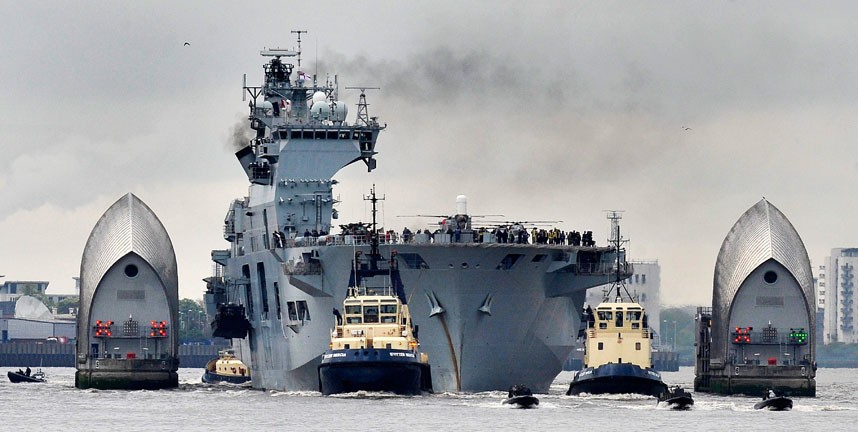
HMS Ocean at the Thames Barrier in 2012, being moved into position to support the Olympic Games in London.

The 22,000-tonne helicopter carrier, which returned from her last British deployment to the Caribbean just weeks ago, will be formally decommissioned from the RN in spring this year.

Although it was well known that Ocean was up for sale and that Brazil (as well as Turkey) were interested in buying the 20-year-old warship, confirmation of the deal and the purchase price were all “known unknowns” until now.

The news was broken by defence blog UK Defence Journal, citing a Brazilian journalist.

The Brazilian Navy’s end-of-year roundup statement, published on Christmas Eve 2017, also included the line: “Minister Raul Jungmann and the Brazilian Navy Commander Eduardo Bacellar Leal Ferreira took the opportunity to announce the purchase of the Royal Navy’s HMS Ocean multifunction vessel, valued at £84m sterling.”

A British Ministry of Defence spokesman told El Reg: “Discussions with Brazil over the long-planned sale of HMS Ocean are at an advanced stage, but no final decisions have been made. HMS Ocean has served admirably with us since 1998 and the revenue she generates will be reinvested in defence as we bolster our Royal Navy with two types of brand new frigates and two huge aircraft carriers.”

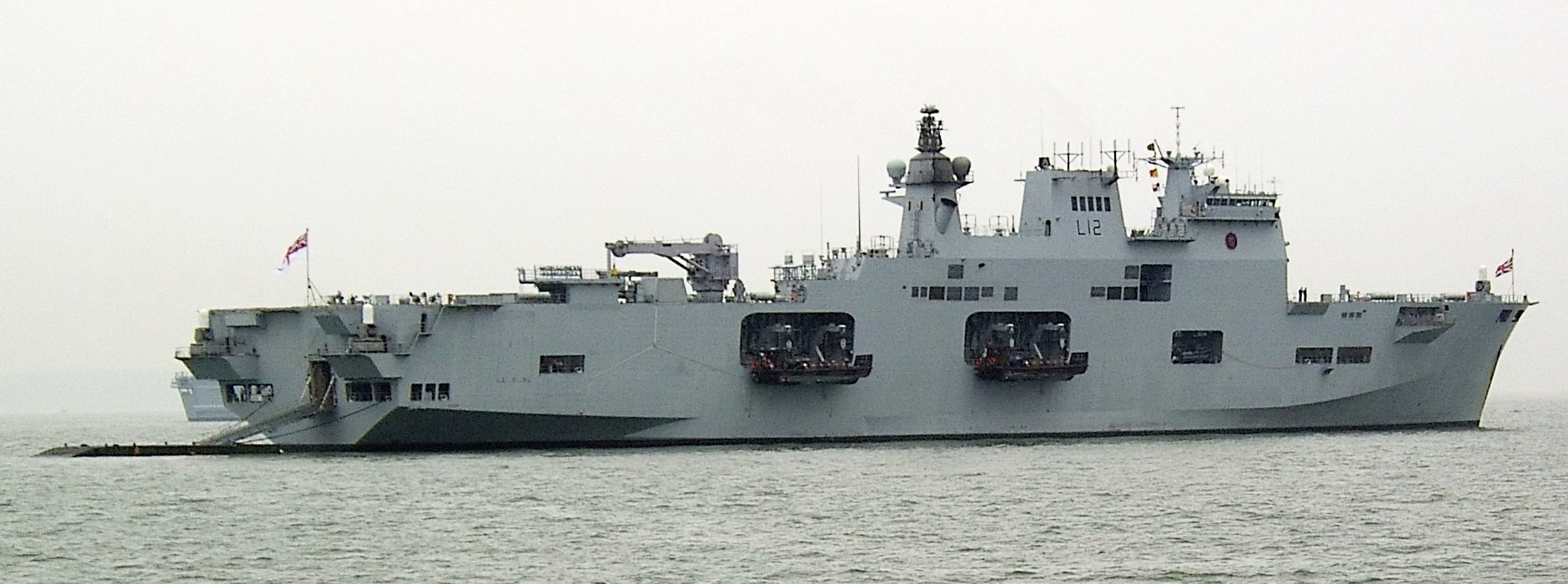
HMS Ocean at the 2005 International Fleet Review, showing Landing Craft on davits and Stern Ramp deployed.
Photo via Wikimedia.

At the Thin Pinstriped Line, Sir Humphrey explains why selling the ship now makes sense for the Royal Navy:

The big change to this requirement came in 2015, when the SDSR [Strategic Defence and Security Review]confirmed that the RN would keep both carriers in active service, and that neither would be CTOL [conventional take-off and landing]. Suddenly the RN found itself planning for a future where it would have two CVF available [the Queen Elizabeth class carriers], both of which would need to have manpower available to crew them. It also meant that the RN could make modifications to the ships to ensure that either of them could operate as an LPH [Landing Platform Helicopter] and carry helicopters and troops as well as a fixed wing airgroup.

This decision has had major ramifications for Ocean – suddenly the need for her to remain in service was gone. The LPH role that she would have done would now be filled by two newer and vastly more capable ships – the UK wasn’t losing capability but gaining it. In practical terms the RN actually would have more chance of an LPH being available without Ocean as CVF availability will be higher, both can role as an LPH (rather than CTOL which would not do this task) and with both platforms active, there is far less chance of the nightmare situation of both the CTOL carrier and the old LPH being stuck in refit at the same time.

From a capability perspective, the move to CVF makes a lot of sense. There are issues to be resolved (arguably the littoral manoeuvre capability offered by her landing craft, the vehicle issue and the question of what to do about afloat 1&2* command platforms and where to put them), but Ocean paying off is not going to remove the LPH capability from the UK toolkit.

The second problem has been that even if the RN wanted to run Ocean on, it has run out of manpower to do so. This year will see Queen Elizabeth at sea doing complex trials, drawing heavily on the Fleet Air Arm personnel to do so. As Prince of Wales (POW) stands up, more and more crew (usually very specialised engineers and the like) will be needed to bring her out of build. On the old plan this wouldn’t have been an issue – one would have gone straight into reserve. Now, the RN has to bring both carriers into service at roughly the same time (a helpful reminder of RN capability here is that it is the only navy in the world currently introducing two supercarriers into service at roughly the same time).

Ocean requires a lot of specialist crew who will be needed on QE and POW, and more importantly so will their reliefs. The manpower planners have not been working on the assumption of three carriers available and at sea (something the RN arguably has not done consistently for many years), and so the manpower structure is not designed to provide this. It could be changed, but would need many years to produce the right numbers of people in the right slots to deliver it without breaking manpower and causing retention challenges.

December 14, 2017

The US Navy and Their Hilariously Inept Search for Dorothy and Her Friends

Filed under: Military, USA — Tags: , , , — Nicholas @ 02:00

Today I Found Out
Published on 2 Dec 2017

In this video:

While the Ancient Greeks had their celebrated Sacred Band of Thebes, a legendarily successful fighting force made up of all male lovers, in more modern times the various branches of the United States military have not been so accepting of such individuals, which brings us to the topic of today- that time in the 1980s when the Naval Intelligence Service invested significant resources into trying to locate a mysterious woman identified only as “Dorothy” who seemed to have links to countless gay seamen. The plan was to find her and then “convince” her to finger these individuals so the military could give them the boot.

Want the text version?: http://www.todayifoundout.com/index.php/2017/01/u-s-navy-hilarious-multi-million-dollar-fruitless-search-wizard-ozs-dorothy-friends/

December 7, 2017

The battleships of Pearl Harbour

Filed under: History, Japan, Military, USA, WW2 — Tags: , — Nicholas @ 06:00

Last month Naval Gazing ran a three-part series on the US Navy battleships at Pearl Harbour on the morning of 7 December, 1941, their post-attack fates, and later careers in World War 2. Part 1 was about the initial Japanese attack:

In Pearl Harbor on December 7th were eight battleships: Nevada, Oklahoma, Pennsylvania, Arizona, Tennessee, California, West Virginia and Maryland. All of them were of First World War vintage, representatives of what was known as the Standard Type. These were ships commissioned between 1914 and 1923, all of broadly the same size, and the first ships designed for long-range combat using an all-or-nothing armor scheme. All had four turrets, and all but West Virginia and Maryland mounting 14” guns. (They had 16” guns instead.)

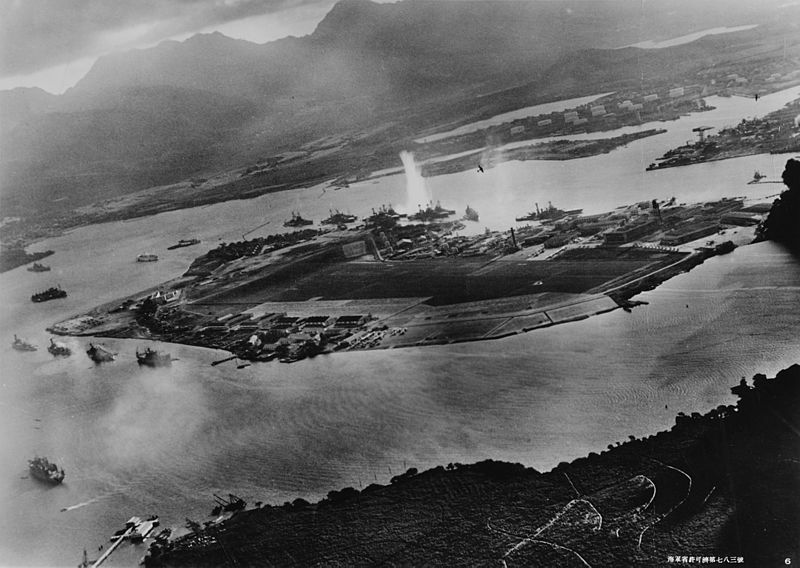
Pearl Harbour at the beginning of the attack, Battleship Row at the top (the waterspout is the first torpedo hit on the USS West Virginia)

All of the ships except Pennsylvania (which was in drydock) were moored along Ford Island in the famous ‘battleship row’. I’m going to focus on the stories of the individual ships during the attack, moving north to south. The attack began at 0748 on Sunday, December 7th, and a total of 353 Japanese aircraft were involved, in two waves.

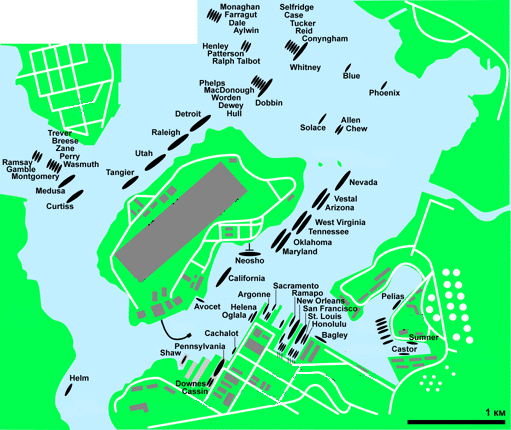
A map of Pearl Harbour before the attack

The second post in the series covered the salvage of the damaged US Navy battleships:

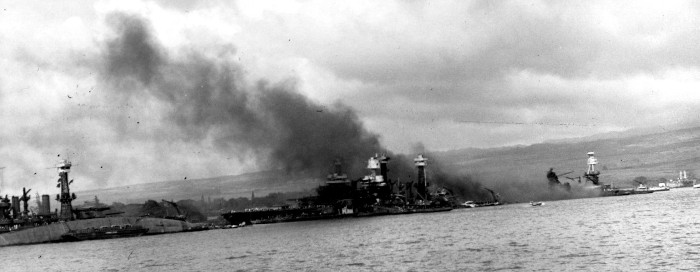
When we left Pearl Harbor, it was the evening of December 7th, and most of Battle Force was on the bottom of the harbor. But what happened to the ships afterwards? We’ll go through the ships in the order which they returned to service (if they did) and then look more broadly at the use of the survivors during the war.

Battleship Row, 8 December 1941. Left-to-right: Maryland, Oklahoma, Tennesee, West Virginia, Arizona.

Maryland was the first ship ready to go to sea again, albeit with some damage. Tennessee was slightly behind her, as she was wedged by the West Virginia. Both ships were sent to Puget Sound at the end of the year, and repairs were completed in February. Pennsylvania was sent to San Francisco at the same time, returning to duty in March. All three ships (along with Colorado, New Mexico, Mississippi, and Idaho) served as part of TF 1, the backup to the carrier fleet until after Midway. Tennessee and Pennsylvania were sent to the states for comprehensive refit, running 8/42-5/43 and 10/42-2/43 respectively. Both received the standard upgrade, a reconstructed superstructure resembling those on the fast battleships (although there was less work done on Pennsylvania than the others), 5”/38 secondary guns in place of the former mixed secondary battery and upgraded fire control. Tennessee was also blistered against torpedoes, restricting her to the Pacific or a long journey around South America. Maryland was never refitted.

Part 3 discussed the Pearl Harbour survivors at the battle of Leyte Gulf:

The invasion began on Leyte Island in October of 1944, and triggered the largest naval battle in history, the battle of Leyte Gulf. The Japanese, who had long planned for the ‘Decisive Battle’ between their battleships and those of the US, planned a counterattack on the US landings in three main groups. Their carriers would come in from the north and draw off the US carriers covering the invasion, while two groups of battleships would sneak up on the invasion fleet from the east, passing through the Philippines and pincering the US transports from the north and south.

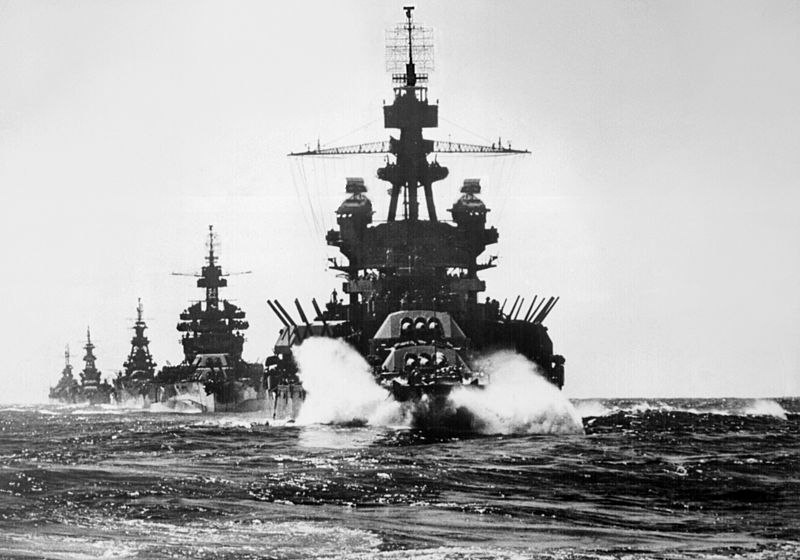
USS Pennsylvania leads a column of battleships into Lingayen Gulf.

The northern group (basically without planes after severe losses in June during the Battle of the Philippine Sea) managed to draw off Admiral Halsey. He’s often criticized for this, but in fairness, he was tasked with destroying the Japanese fleet, and the US didn’t realize how badly the carrier air groups had been hammered. The center group (with the faster battleships) had been detected, and appeared to have turned back after Musashi, Yamato’s sister ship, was sunk. They in fact resumed their course, and their encounter with escort carrier group Taffy 3 is the stuff of legend, but also a matter for another time.

« Newer PostsOlder Posts »

Powered by WordPress