Quotulatiousness

January 30, 2020

Upgrading NORAD’s capabilities with AN/SPY-7(V)1 radar (aka “Aegis Ashore”)

Filed under: Cancon, Military, Technology, USA — Tags: , , , , — Nicholas @ 05:00

Ted Campbell on the need to upgrade NORAD radar installations as part of a general refurbishment of the alliance’s capabilities:

Lockheed Martin’s Solid State Radar has been designated as AN/SPY-7(V)1 by the US government.
Image from Lockheed Martin/PRNewsfoto.

One of the elements which might be considered in modernizing and enhancing the North American Aerospace Defence Command (NORAD) surveillance, warning and control system is a new radar and some people have suggested that the AN/SPY-7(V)1 radar, sometimes called Aegis Ashore, might be a useful (and proven, it is in use, on land, in Japan, and will be fitted on Canada’s new Type 26 (destroyer-frigate) combat ships) solution. This radar is eminently suitable to be part of an enhanced (conventional) NORAD and of a CANUS continental ballistic missile defence system.

There are many technical (and logistical) advantages to using that radar on both our, Canadian, warships and in a land-based role, too.

The AN/SPY-7(V)1 radar produces a lot more information than do the current AN/FPS-117 and AN/FPS-124 radars which are used in the NORAD role, today, and were built in the 1980s using 1960s and ’70s technology.

(Please don’t worry about the AN/*** designations. They are part of a very sensible American system which was designed to make it simpler to identify both Army and Navy systems (hence the AN/ at the beginning). The three letters following the AN/ describe the system:

  • The first letter describes the installation. F means Fixed, on the ground (land) and S means on a ship;
  • The second letter means the type of equipment, and P means radar; and
  • The third letter means purpose. S means search (detection and locating) and Y surveillance and control.

Thus the SPY-7 is a shipborne surveillance radar and the FPS-117 is fixed (land-based) search radar. The numbers just differentiate one system from another.)

If Canada chooses an advanced radar, like the SPY-7, two engineering problems will need to be addressed:

  • First, these things use a lot more power than do the existing radars; and
  • Second, they produce much, much more information which needs to be “transported” instantly, to control centres in places like Canadian Forces Base North Bay, where all the data from all the radars is analyzed and used to effect NORAD’s mission. If the radar sites are located below (about) 72°N, as would be the case for coastal radars in BC, NS and NL, this is not a huge problem because the station is within the “footprint” of the big, high bandwidth satellites in geostationary orbit. But if the radar site is too far North then a terrestrial (possibly microwave, maybe tropospheric scatter) network (in which each station needs electrical power, too) will have to be installed to move the data to a satellite ground station. (Or a non-geostationary, high bandwidth, satellite system will have to be deployed.)


January 20, 2020

The reasons HMS Queen Elizabeth has two islands – Russia copied the twin island design

Filed under: Britain, Military, Technology, Weapons — Tags: , , , — Nicholas @ 04:00

Military TV
Published 5 Jan 2020

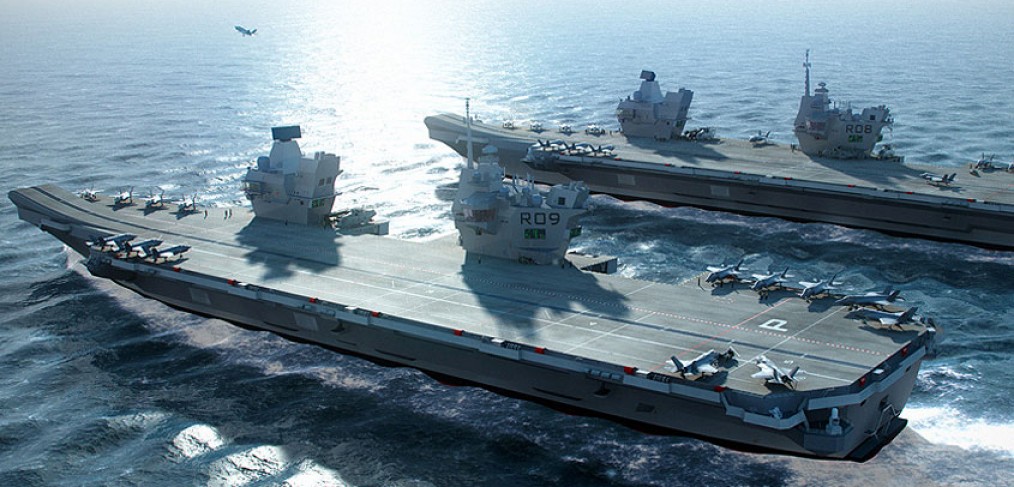
Many have wondered why HMS Queen Elizabeth has two “islands”. Here we consider why she is the first aircraft carrier in the world to adopt this unique arrangement and the benefits it brings.

REDUNDANCY AND SEPARATION CAN BE GOOD
In a moment of inspiration back in 2001, an Royal Navy officer serving with the Thales CVF design team developing initial concepts for what became the Queen Elizabeth class, hit upon the idea of separate islands. There are several advantages to this design but the most compelling reason for the twin islands is to space out the funnels, allowing greater separation between the engines below. Queen Elizabeth class has duplicated main and secondary machinery in two complexes with independent uptakes and downtakes in each of the two islands. The separation provides a measure of redundancy, it increases the chances one propulsion system will remain operational in the event of action damage to the other. Gas turbine engines (situated in the sponsons directly below each island of the Queen Elizabeth class) by their nature require larger funnels and downtakes than the diesel engines (in the bottom of the ship). The twin island design helps minimise their impact on the internal layout.

In a conventional single-island carrier design, either you have to have a very long island (like the Invincible class) which reduces flight deck space or, the exhaust trunkings have to be channelled up into a smaller space. There are limits to the angles this pipework may take which can affect the space available for the hangar. The uptakes can also create vulnerabilities, the third HMS Ark Royal was lost to a single torpedo hit in 1941, partly due to progressive engine room flooding through funnel uptakes.

The twin island design has several other benefits. Wind tunnel testing has proved that the air turbulence over the flight deck caused by the wind and the ship’s movement, is reduced by having two islands instead of one large one. Turbulent air is a hindrance to flight operations and aircraft carrier designers always have to contend with this problem. Twin islands allow greater flight deck area because the combined footprint of the two small islands is less than that of a single larger one. By having two smaller islands it allowed each to be constructed as a single block and then shipped to Rosyth to be lifted onto the hull. The forward island was built in Portsmouth and the aft island built in Glasgow.

This arrangement solves another problem by providing good separation for the main radars. The Type 1046 long range air surveillance radar is mounted forward while the Type 997 Artisan 3D medium range radar is aft. Powerful radars, even operating on different frequencies, can cause mutual interference or blind spots if the aerials are mounted too close together. Apart from a slim communications mast, both the Artisan and 1046 have clear, unobstructed arcs.

Lanchester MkI: Britain’s First Emergency SMG

Filed under: Britain, History, Military, Weapons, WW2 — Tags: , , , — Nicholas @ 02:00

Forgotten Weapons
Published 5 Sep 2017

Sold for $16,100 (transferrable).

The Lanchester MkI was the first British effort to produce a domestic submachine gun during World War II. The British military had rejected these types of arms as “gangster guns” prior to the war, and did not see them as useful in a military context. Well, that opinion changed rather quickly as they watched the German blitzkrieg sail through continental Europe.

The very first solution was to purchase Thompson SMGs from the United States, but these were extremely expensive weapons, and not a suitable long term plan. The next solution was to reverse engineer a pair of German MP28 SMGs captured in Ethiopia. This was done by a Sterling company engineer named George Lanchester, and it was a successful project. Both the Royal Navy and Royal Air Force purchased the guns (although the RAF would cancel its order later, and the guns would pretty much all go to the Royal Navy).

Mechanically, the Lanchester is a very close copy of the MP28, with a few stylistic changes. These include the use of an SMLE pattern stock, the addition of a bayonet lug for a 1907 pattern bayonet, and the use of brass or bronze for the magazine housing instead of steel. The original MkI Lanchesters were select-fire, with a lever to allow semi or full-auto fire. This was removed with the simplified MkI* pattern, however.

The Lanchester would be quickly followed by the Sten gun, which offered much cheaper and faster manufacture, and the British Army would use huge numbers of Stens. The Lanchester would stay in service for decades after the war, though, serving on many naval vessels in British service and with other nations when British ships were sold as surplus.

http://www.patreon.com/ForgottenWeapons

Cool Forgotten Weapons merch! http://shop.bbtv.com/collections/forg…

If you enjoy Forgotten Weapons, check out its sister channel, InRangeTV! http://www.youtube.com/InRangeTVShow

January 11, 2020

QotD: “Don’t ask, don’t tell”

Filed under: Government, History, Military, Politics, Quotations, USA — Tags: , , , , , , — Nicholas @ 01:00

As all right-thinking people know, Don’t Ask, Don’t Tell was a right-wing atrocity against gays, hatched in the pernicious seventy-two degree corners of the doubleplusungood and evilwickedbadnaughty Pentagon, fought against nearly to the death by progressives …

That’s not remotely what happened. Rather, the Uniform Code of Military Justice, as enacted by Congress, has long deemed Sodomy, which covered more than just homosexual conduct, as a criminal offense potentially carrying severe penalties. Moreover, the procedure for entering into service demanded that prospective recruits deny or admit to homosexual leanings, in writing, which admissions would usually bar the man or woman from service. Of course, back when the shame of being publicly homosexual was very great, people who wanted to join the armed forces simply lied about it and then, as a general rule, hid it while in service.

Liberal Democratic President Bill Clinton, acting in his capacity as Commander in Chief of the armed forces, simply ordered that prospective recruits were not to be asked if they were gay or had homosexual leanings, and were not to volunteer the information. That, young Millennial, is where DADT came from; it came from a liberal, liberally motivated, and pandering to his liberal base.

Did you know that? No? Well, then; ask yourself, WHY didn’t you know?

What the loss of history does to you, dear Millennial, is that it robs you of the ability to reason your way to cause and effect. Never mind the crappy to the point of idiotic decisions and programs this might lead you to support, consider what it does to you as a person. What, after all, is the effect of shielding people from contrary opinions by designating and maintaining, under color of law or regulation, “safe spaces” for this or that minority? Does it make them stronger? Better able to deal with a harsh world? Does it change that objective world to something less harsh? No and no and no; it does none of that. Do you gain grit in a safe space? Ha. Do you learn endurance in a safe space? Oh, please.

Tom Kratman, “It’s Up to You, Millennials. Deflect or Be Doomed”, Milo, 2017-12-06.

January 4, 2020

The Rise and Fall of the Japanese Zero

Filed under: History, Japan, Military, Pacific, Technology, USA, WW2 — Tags: , , , — Nicholas @ 06:00

Real Engineering
Published 31 Aug 2018

Patreon:
https://www.patreon.com/user?u=282505…
Instagram:
https://www.instagram.com/brianjamesm…
Twitter:
https://twitter.com/thebrianmcmanus
Discord:
https://discord.gg/s8BhkmN

Thank you to AP Archive for providing footage: https://www.youtube.com/channel/UCHTK…

Get your Real Engineering shirts at: https://standard.tv/collections/real-…

References:
[1] https://www.thoughtco.com/world-war-i…
[2] http://rwebs.net/avhistory/history/ze…
[3] http://aboutjapan.japansociety.org/im…
[4] https://www.history.com/news/the-akut…
[5] https://www.japanpowered.com/history/…
[6] https://www.warbirdforum.com/sakai.htm

Credits:
Narrator/Director: Brian McManus
Co-Director: Mike Ridolfi (https://www.moboxgraphics.com/)
3D Animations: Eli Prenten (http://eliprenten.com/)
Research: Stephanie Sammann (https://www.stephanie-sammann.com/)
Sound: Graham Haerther (https://haerther.net/)

December 27, 2019

The Puckle Gun: Repeating Firepower in 1718

Filed under: Britain, History, Military, Weapons — Tags: , , , , — Nicholas @ 02:00

Forgotten Weapons
Published 25 Dec 2016

Want a sweet Puckle Gun shirt? Check out the new Forgotten Weapons merch store:

http://shop.bbtv.com/collections/forg…

http://www.patreon.com/ForgottenWeapons

If you enjoy Forgotten Weapons, check out its sister channel, InRangeTV! http://www.youtube.com/InRangeTVShow

The Puckle Gun is probably best known as that thing that had round bullets for Christians and square bullets for Turks, but there is much more to it than just that (and in addition, the square bullet version was never actually built). James Puckle designed it in 1718 as a naval defensive weapon to help British vessels fight back against Ottoman pirates using fast and nimble small boats that could not be effectively engaged with large cannon. Puckle’s gun was a 9-shot repeater of about 1.25″ bore on a flexible swiveling mount which could easily track the fastest marauder.

The Puckle is basically a manual revolver, but its firing mechanism incorporates some clever functionality to allow a fast and smooth rate of fire. The gun was demonstrated in public in 1721 (after being turned down by the Royal Navy) and fired 63 shots in 7 minutes — quite the feat at that time! The only sale appears to have been a private purchase of two guns for an expedition to the West Indies, however.

Thanks to the Institute of Military Technology for allowing me to have access to this magnificent piece and bring it to you! Check them out at:

http://www.instmiltech.com

December 19, 2019

Sir Humphrey’s rebuttal to Sir Max on the Queen Elizabeth-class carriers

Filed under: Britain, History, Military — Tags: , — Nicholas @ 05:00

In the Times last weekend, Sir Max Hastings spent some time and effort to disparage the Royal Navy for commissioning the two Queen Elizabeth-class aircraft carriers and trotting out arguments against carriers that echo the criticisms of the cancelled CVA-01 program of the 1960s. Sir Humphrey characterizes Sir Max’s article as “ranting angrily about how the UK is an irrelevance now and how we don’t actually have any military power.”

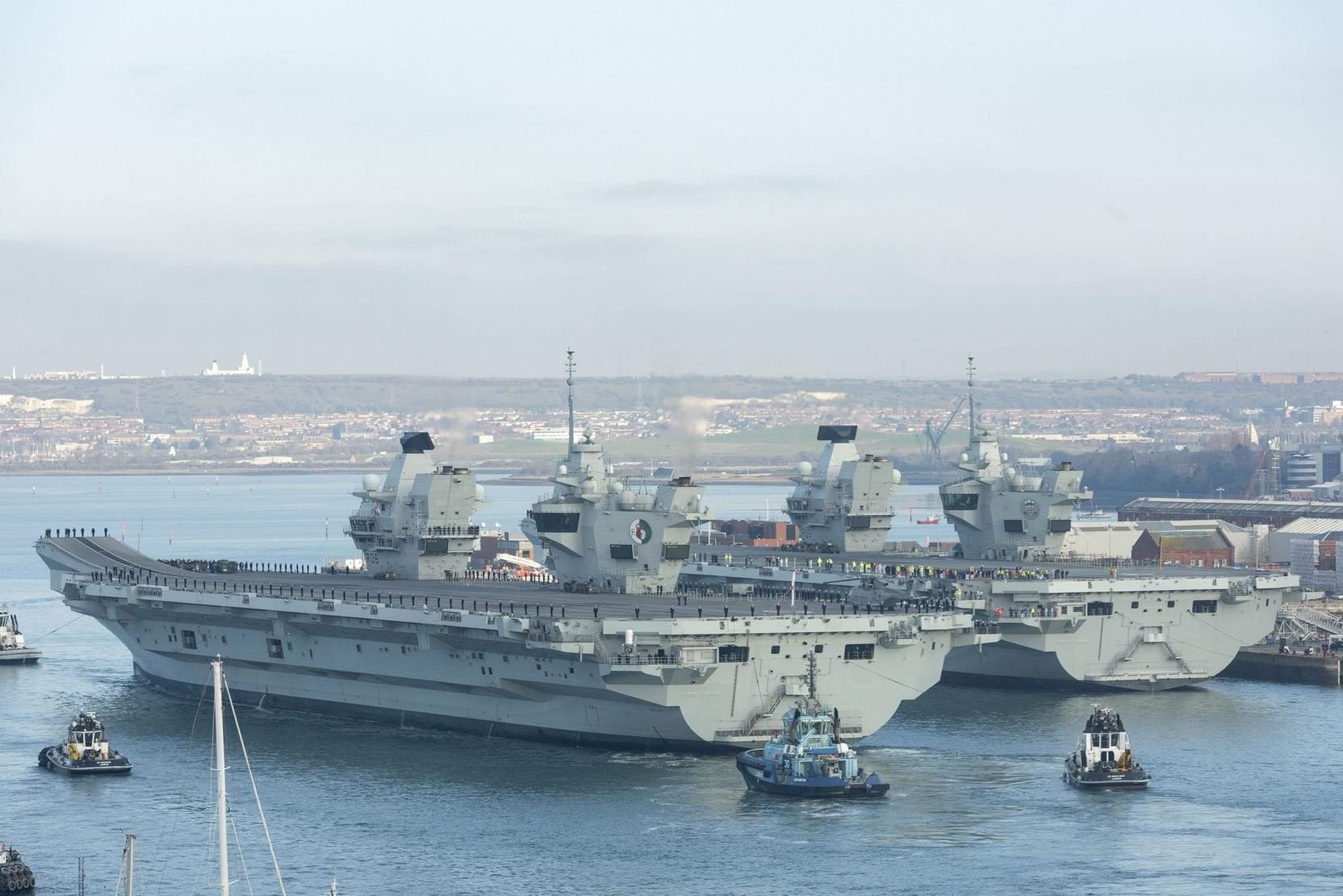
HMS Queen Elizabeth (R08) and HMS Prince of Wales (R09) at Portsmouth in December 2019.

Maybe it’s a generational thing and the fact that for the few remaining, and increasingly less relevant commentators of Sir Max’s elderly generation of OAPs, perhaps memories of their childhood and a sense of national malaise in the late 1940s and 50s has shaped their perception of the world today. The problem is that their view is utterly disconnected from reality, and their approach seems to be best characterised as to answer any question as “the UK is irrelevant, whats the question again”?

It is set against this backdrop of this article that it is worth reviewing why the Carrier force remains so relevant, and why the UK, despite the wishes of Sir Max remains relevant and credible globally. Carriers matter in simple terms because they allow the UK to embark an airwing, and military force, that can sail around the world on a self-sustaining basis and arrive ready to operate at a time and place of the British Governments choosing.

[…]

We like to permanently beat ourselves up as if we’re somehow failures, yet when push comes to shove, we seem to be remarkably good at not being failures. There is always a UK capability or asset that we can help with or support. Only this week the RAF sent an A400M to conduct search and rescue operations in Chile, while at the other end of the world, it finished providing air defence to Iceland with a Typhoon detachment. When disasters occur globally, the UK is always ready to send aid and assist, while in a crisis there is usually a UK military asset nearby that can help.

This reach is in part due to the fact that the UK has invested heavily in jointery and “fusion” bringing together departments and assets to work in a far more coherent and joined up way than most nations. As a nation we enjoy considerably more influence, reach and access than we think, and are usually at the cutting edge of efforts to improve capabilities too.

It is particularly frustrating then to see attacks on the existence of the carrier force in a way that treats this priceless national asset as if it is some kind of toy for the Royal Navy. It smacks of a total lack of understanding about how defence works in support of wider national security, and how joined up things really are these days.

The carrier is a national investment designed to provide a wide plethora of capabilities to support and defend the nation, and its allies, for decades to come. To see it purely through the prism of a myopic lens and an overt and tedious hatred of the Royal Navy for reasons more probably linked to events of the 1980s than any fact is fairly sad to observe.

To be honest this piece seems to mark yet another part of the opening of hostilities in the SDSR campaign. It seems intended to cause debate about the value of carriers and gently reinforce the message that somehow money should go elsewhere – ignoring the fact that this money has now been spent.

Its hard to understand what the thinking is here, but at its heart it feels like this is a piece intended to condition the public into thinking “the Navy and to a lesser extent the RAF has had lots of money wasted on it, lets go be nice to the Army for a change”. Such a view though is utterly removed from the reality of how defence works, but it feels as if it is intended to reinforce stereotypes that wouldn’t hold up to any scrutiny.

December 18, 2019

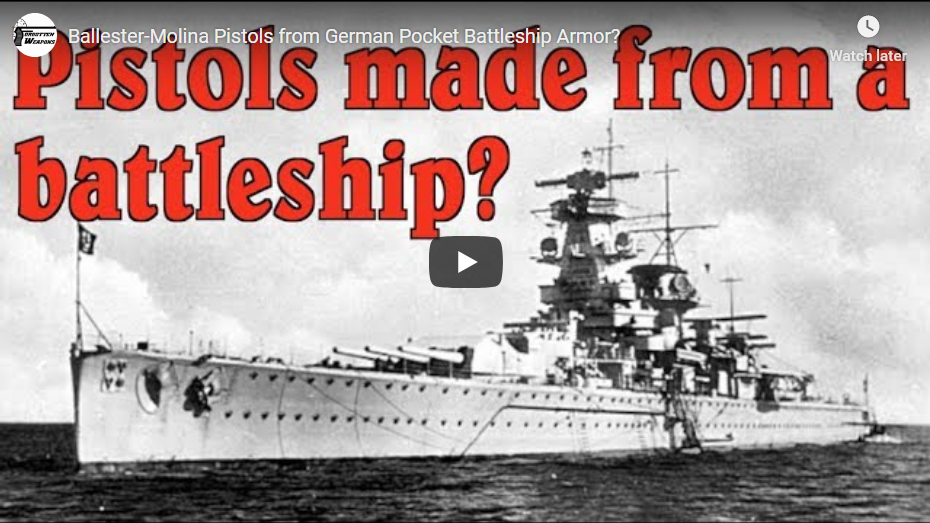
Ballester-Molina Pistols from German Pocket Battleship Armor?

Forgotten Weapons
Published 17 Dec 2019

http://www.patreon.com/ForgottenWeapons

Cool Forgotten Weapons merch! http://shop.bbtv.com/collections/forg…

There is an old gun shop tale that Argentine Ballester-Molina pistols were made form the salvaged armor plate of the pocket battleship Admiral Graf Spee. The Graf Spee was scuttled in the Rio de la Plata estuary in December 1939, only a few miles from the HAFDASA factory in Buenos Aires, and Argentina did not have the domestic steel reserves to make enough pistols…

See Michael Parker’s full article on this, including the exact results of his metallurgical analysis, here:

https://www.americanrifleman.org/arti…

Contact:
Forgotten Weapons
6281 N. Oracle #36270
Tucson, AZ 85704

December 7, 2019

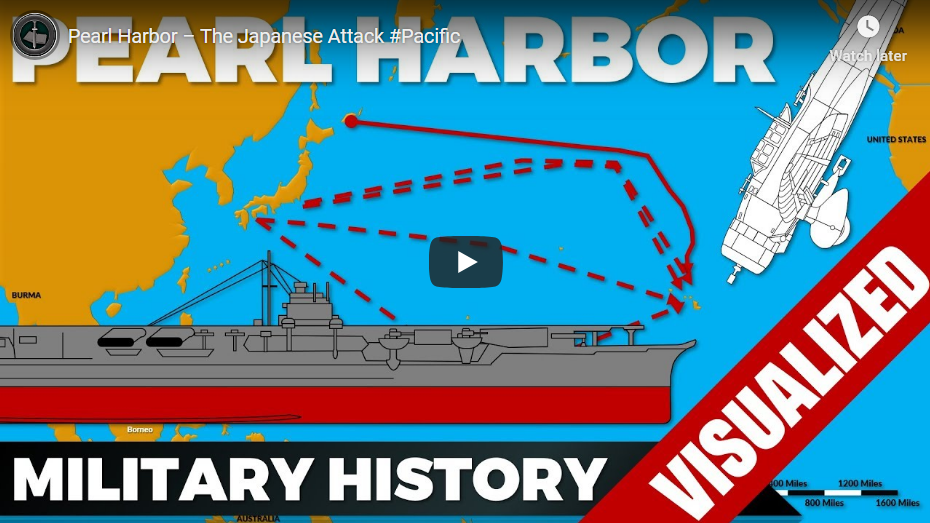
Pearl Harbor – The Japanese Attack

Filed under: History, Japan, Military, Pacific, USA, WW2 — Tags: , , , — Nicholas @ 04:00

Military History Visualized
Published 29 Nov 2016

» HOW YOU CAN SUPPORT MILITARY HISTORY VISUALIZED «
(A) You can support my channel on Patreon: https://www.patreon.com/mhv

(B) Alternatively, you can also buy “Spoils of War” (merchandise) in my online shop: https://www.redbubble.com/people/mhvi…

(C) If you want to buy books that I use or recommend, here is the link to the Amazon Store: http://astore.amazon.com/ytmh-20 which has the same price for you and gives a small commission to me, thus it is a win/win.

» SOURCES & LINKS «

Kuehn, John T.: “The war in the Pacific, 1941-1945”; in: Cambridge History of the Second World War, Volume 1
Amazon.com (affiliate): http://amzn.to/2g82o9a

Dull, Paul S.: The Battle History of the Imperial Japanese Navy.
Amazon.com (affiliate): http://amzn.to/2gPBxhJ

Germany & The Second World War – Volume VI
Amazon.com (affiliate): http://amzn.to/2g85hqt

Das Deutsche Reich und der Zweite Weltkrieg, Band 6.
Amazon.de (affiliate) http://amzn.to/2gc49Ra

Zimm, Alan D. The Pearl Harbor Myth
http://www.historynet.com/pearl-harbor

Zimm, Alan D. Attack on Pearl Harbor: Strategy, Combat, Myths, Deceptions.
Amazon.com (affiliate): http://amzn.to/2gc0LWk

» ADDITIONAL LINKS «
Maps
http://pacificwarbirds.com/pearl-harb…

https://spotlights.fold3.com/2011/12/…

Verifying the Submarine loss
https://www.history.navy.mil/research…

http://www.combinedfleet.com/I-70.htm

Bonus Link (not used): Original Damage Reports
https://archive.org/download/WorldWar…

» CREDITS & SPECIAL THX «
Song: Ethan Meixsell – “Demilitarized Zone”

» DISCLAIMER «
Amazon Associates Program: “Bernhard Kast is a participant in the Amazon Services LLC Associates Program, an affiliate advertising program designed to provide a means for sites to earn advertising fees by advertising and linking to amazon.com.”

Bernhard Kast ist Teilnehmer des Partnerprogramms von Amazon Europe S.à.r.l. und Partner des Werbeprogramms, das zur Bereitstellung eines Mediums für Websites konzipiert wurde, mittels dessen durch die Platzierung von Werbeanzeigen und Links zu amazon.de Werbekostenerstattung verdient werden können.

December 6, 2019

QotD: The British army

Filed under: Britain, History, Military, Quotations — Tags: , — Nicholas @ 01:00

[The British army] occupies a curious place in both the emotional heart of the nation and the head of policy makers. The public if asked are usually aware of an organisation steeped in regimental tradition, know of units like the SAS, Guards and Parachute Regiment and may know a little bit about the equipment such as tanks (noting that all APCs are tanks to the layman’s eye…). They recognise it from state ceremonial, where it is an integral part of the national fabric and identity, and are proud of the perception of “our boys” serving overseas in warzones. There is often a deeper rooted, but baseless suspicion of the senior echelons, dating back to the tired cliché of “lions led by donkeys” and fed by a generation of misguided historians trying to rewrite WW1 as not the greatest victory in the history of the British army, but instead four years of class war and turgid poetry.

To policy makers the army is an institution which is central to the survival of the nation, and which carries out many vital roles to meet defence and security policy objectives, but which is also extremely good at champing at the bit to get involved in operations overseas, even when it is not necessarily in the national interest to do so.

A cursory examination of history suggests that the British army is not by itself a war winning organisation. It does not go to war alone with peer rivals and expect to win – UK policy instead for centuries has been to maintain a small (but professional) army able to either conduct colonial policing, or work as part of a larger coalition force to achieve victory. This is not to do down the efforts of the army, but to accept the reality that as an island nation, the UK has relied on the navy as the ultimate guarantor of its security.

Sir Humphrey, “How Do You Solve a Problem Like a Deployable Division?”, Thin Pinstriped Line, 2017-08-06.

December 2, 2019

China Rules the Seas – The Invention of the Junk l HISTORY OF CHINA

Filed under: China, History, Japan, Military, Technology — Tags: , , , , — Nicholas @ 02:00

IT’S HISTORY
Published 19 Aug 2015

Imperial China was a great seafaring nation. With the invention of the junks — massive, nearly unsinkable ships — it is safe to say that by the 14th century China had the best sea vessels in the world. The invention of the compass made navigation trustworthy as never before and Admiral Zheng He’s treasure fleet eagerly explored the Seven Seas. The first Chinese navy also depended on the mighty junk for their fighting tactics. But not all emperors were convinced of seafare and so the Chinese maritime power ended somewhat abruptly, giving the rest of the world time to catch up. Learn all about China on the water on IT’S HISTORY.

» The Complete PLAYLIST: http://bit.ly/HistoryOfChina

» SOURCES
Videos: British Pathé (https://www.youtube.com/user/britishp…)
Pictures: mainly Picture Alliance
Content:
“Hadingham, Evan (2001): Ancient Chinese Explorers: http://www.pbs.org/wgbh/nova/ancient/…
Needham, Joseph (1986): Science and Civilization in China, Volume 4, Physics and Physical Technology, Part 3, Civil Engineering and Nautics. Taipei”

» ABOUT US
IT’S HISTORY is a ride through history – Join us discovering the world’s most important eras in IN TIME, BIOGRAPHIES of the GREATEST MINDS and the most important INVENTIONS.

» CREDITS
Presented by: Guy Kiddey
Script by: Martin Haldenmair
Translated by: Guy Kiddey
Directed by: Daniel Czepelczauer
Director of Photography: Markus Kretzschmar
Music: Markus Kretzschmar
Sound Design: Bojan Novic
Editing: Markus Kretzschmar

A Mediakraft Networks original channel
Based on a concept by Florian Wittig and Daniel Czepelczauer
Executive Producers: Astrid Deinhard-Olsson, Spartacus Olsson
Head of Production: Michael Wendt
Producer: Daniel Czepelczauer
Social Media Manager: Laura Pagan and Florian Wittig

Contains material licensed from British Pathé
All rights reserved – © Mediakraft Networks GmbH, 2015

November 28, 2019

It’s time for the ever-popular Game of Budget Leaksmanship for the British military

Filed under: Britain, Government, Military — Tags: , , , — Nicholas @ 05:00

Sir Humphrey wants to encourage all defence-minded readers not to panic unduly at the all-too-predictable tactics used by all sides in the next round of British government defence planning:

It’s that time again, a period theoretically seen every five years or so, but occasionally more recently than that. A group of people who it seems cordially loathe each other spend months leaking, shouting, briefing and making grandiose pledges that don’t always get fulfilled. This whole, and at times, unedifying, process is, of course, the latest iteration in a Strategic Defence Review.

The Sunday Times leads with a story today that the Army is facing cuts to its manpower, and that in return they want the Navy to be forced to lease or mothball one of the two Queen Elizabeth class carriers. The article talks about a range of debates going on, and the latest news about what may or may not be scrapped or cut in any future budget settlement. Is this something to worry about, or is it merely the opening salvos in what is likely to be a long and painful campaign of attrition?

Defence reviews are driven from the very centre of Government – they occur usually with the Prime Minister of the day’s blessing, and they are now run centrally – usually via the Cabinet Office, and not by the MOD. This reflects the fact that modern national security requirements means the need to bring all departments together in a consensus and not isolated pockets doing their own thing.

He also provides a helpful list of the specific “the-sky-is-falling!” predictions you can expect to see through all stages of any given defence review process:

What is clear is that the new season of “Game of Planning Rounds” has begun. We can expect plenty more leaks like this to a variety of sources and papers which will be intended to achieve effect. If past performance is anything to go by, you can expect to see a “greatest hits” collection of some variants of the following options leaked in the next 12-18 months:

a. Parachute regiment to merge with Royal Marines
b. White elephant carriers are all to blame
c. The nasty MOD civil service did it …
d. SAS to merge with SBS
e. RAF to take control of all F35 and scrap FAA
f. Army has more horses than tanks
g. Army to no longer have enough troops to deploy a Division
h. Cranwell, Sandhurst and Dartmouth to close / merge in one location
i. RN to scrap X number of frigates or other ships
j. Naval Infantry Division to return …
k. Army to scrap Y number of tanks
l. RAF to dispose of Z aircraft fleets

All of these have appeared in the past, but how many of them actually happened or were true? The above links are just a snapshot in time (based on a quick google) but demonstrate that in the build up to a review, we’ll see a lot more articles like this one (which predicted cuts, many of which never happened) and a lot of rumours, angst and predictions.

Humphreys honest advice is simple – DON’T PANIC! Until the review is finalised, and has gone to the Prime Minister of the day for approval, nothing is set in stone. There will be leaks aplenty, rumours aplenty and very little in the way of actionable outcomes. Until the final package of measures is approved, everything is to play for, and anything can happen. It is just not worth getting worked up about because unless you are on the inside track as part of the Review team, you don’t know what is going on.

November 27, 2019

John Browning vs Hiram Maxim: Patent Fight!

Forgotten Weapons
Published on 25 Sep 2019

http://www.patreon.com/ForgottenWeapons

Cool Forgotten Weapons merch! http://shop.bbtv.com/collections/forg…

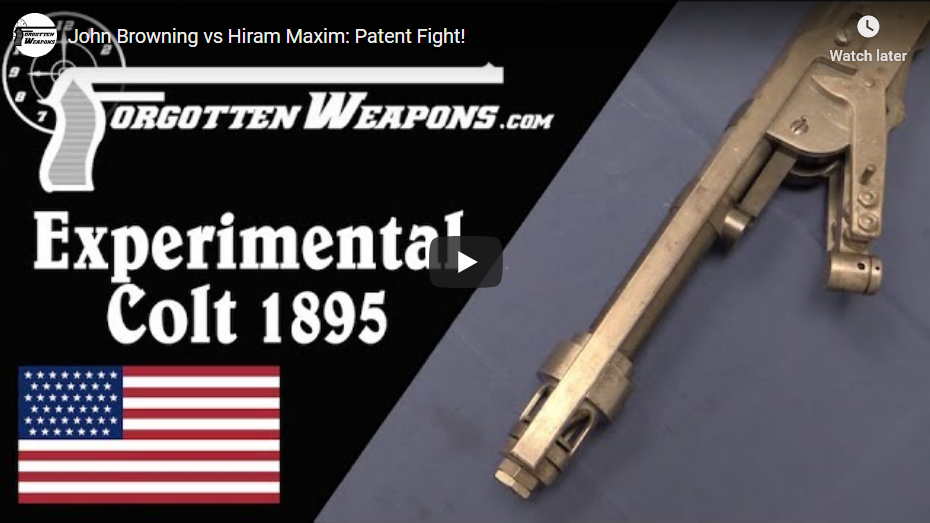
When John Browning designed his Model 1895 machine gun with its rotary-lever gas operation system, Hiram Maxim filed suit claiming patent infringement. Maxim had filed quite broad patents covering gas pistons operation, but specifically in a linear format. Browning and Colt (who had the license to manufacture the Model 1895 machine gun) countered that the swinging lever was a different system, and thus not covered by Maxim’s patents. More to the point, they claimed that the gun would work without using a gas piston at all – and built this experimental model using a gas trap or muzzle cap system instead to prove the point.

Ultimately, the genesis of the fight was moot (the Maxim did not run well in 6mm Lee Navy, and would not have won a US Navy contract regardless of the Colt/Browning gun), and the court ultimately decided in favor of Colt and Browning. But this gun remains from the incident…

Contact:
Forgotten Weapons
6281 N. Oracle #36270
Tucson, AZ 85704

November 22, 2019

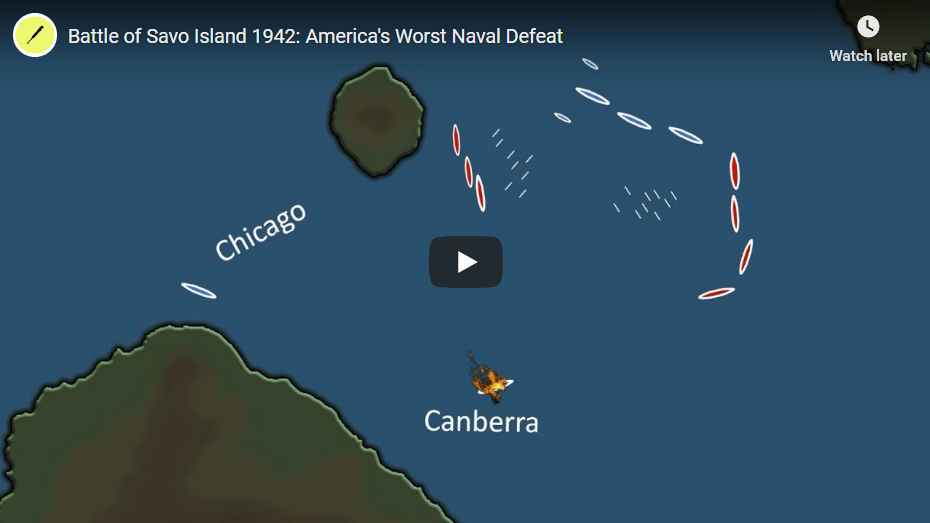
Battle of Savo Island 1942: America’s Worst Naval Defeat

Filed under: Australia, History, Japan, Military, Pacific, USA, WW2 — Tags: , , — Nicholas @ 02:00

Montemayor
Published 26 Aug 2017

(Animated Map) – WARNING: lower the volume if you are using headphones. sorry for the audio.

I do not own the rights to the songs or images. This video is purely for educational purposes.

No copyright intended, all image rights go to:

-Wikipedia Commons
https://commons.wikimedia.org/wiki/Ba…

-Naval History Heritage and Command
https://www.history.navy.mil/

-Portrait of Richmond K. Turner
https://www.ibiblio.org/hyperwar/Onli…

USS Jarvis
http://www.navsource.org/

Images contained on this site that are donated from private sources are © copyrighted by the respective owner. Images credited to the National Archives (NA, NARA); Naval History & Heritage Command (NHHC), formerly Naval Historical Center (NHC); and U.S. Navy (USN) are believed to be in the public domain. Some images credited to the United States Naval Institute (USNI) are from © copyrighted collections, the rest are believed to be in the public domain.

All songs by Ross Budgen https://www.youtube.com/channel/UCQKG…
-“Welcome to Chaos”
-“House Lannister Theme” – Game of Thrones Season 4 (Original composition)
-“Run”
-“Parallel”

Sources-

Hammel, E. (2017, March 6). “First Battle of Savo Island: The U.S. Navy’s Worst Defeat”. Retrieved August 25, 2017, from http://warfarehistorynetwork.com/dail…

Hornfischer, J. D. (2011). Neptunes Inferno: the U.S. Navy at Guadalcanal. New York: Bantam Books.

Newcomb, R. F., & Newcomb, R. F. (2002). The Battle of Savo Island. New York: H. Holt.

Stille, M. (2013). The Naval Battles for Guadalcanal 1942 (Vol. 225). Oxford, UK: Osprey Publishing.

Toll, I. W. (2016). The Conquering Tide: war in the Pacific Islands, 1942-1944. New York: W.W. Norton & Company.

USMC Casualty list taken from:
https://www.ibiblio.org/hyperwar/USMC…

November 20, 2019

The Sinking of the Royal Oak

Filed under: Britain, Germany, History, Military, WW2 — Tags: , , , — Nicholas @ 06:00

Eoin MacFreeman
Published 19 Sep 2014

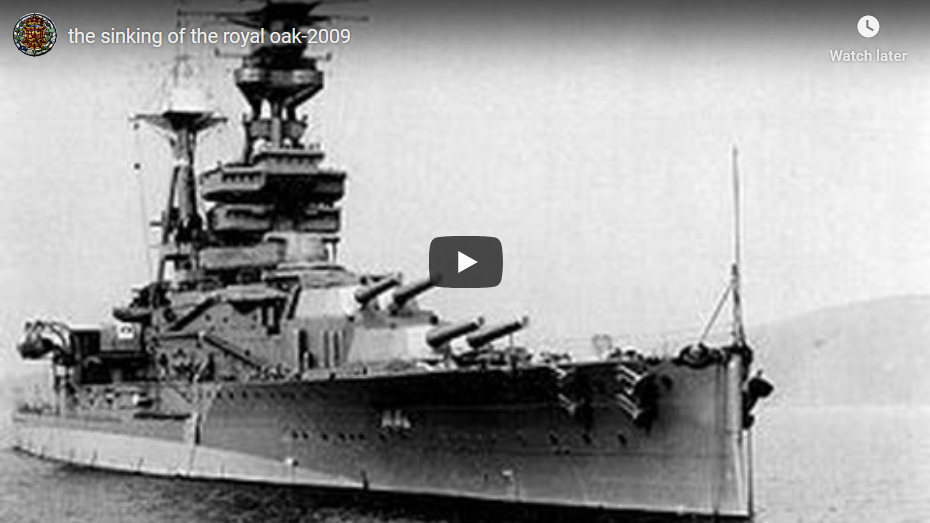
STV and History channel documentary to coincide with the 70th anniversary of the sinking of HMS Royal Oak at Scapa Flow in Scotland. With harrowing eye witness accounts from survivors. Narrated by oor Alex Norton. We will remember them.

On 14 October 1939, Royal Oak was anchored at Scapa Flow in the Orkney Islands, Scotland, when she was torpedoed by the German submarine U-47. Of Royal Oak‘s complement of 1,234 men and boys, 833 were killed that night or died later of their wounds. The loss of the old ship – the first of the five Royal Navy battleships and battlecruisers sunk in the Second World War – did little to affect the numerical superiority enjoyed by the British navy and its allies, but the sinking had considerable effect on wartime morale. The raid made an immediate celebrity and war hero out of the U-boat commander, Günther Prien, who became the first German submarine officer to be awarded the Knight’s Cross of the Iron Cross. Before the sinking of Royal Oak, the Royal Navy had considered the naval base at Scapa Flow impregnable to submarine attack, and U-47‘s raid demonstrated that the German navy was capable of bringing the war to British home waters. The shock resulted in rapid changes to dockland security and the construction of the Churchill Barriers around Scapa Flow.

« Newer PostsOlder Posts »

Powered by WordPress