Polyus Studios
Published 4 Dec 2020Don’t forget to like the video and subscribe to my channel!
Support me on Patreon – https://www.patreon.com/polyusstudiosIn its day the Argus was the most formidable anti-submarine warfare platform fielded by any NATO country. Canadair adapted the Bristol Britannia into a highly effective low and slow sub hunter. This gave Maritime Air Command the edge in the North Atlantic. It served on the front-line of the Cold War and kept the Soviet submarine threat in check for almost 25 years.
(more…)
July 29, 2022
Nightmare Fuel For Soviet Submarines; the story of the Canadair CP-107 Argus
July 24, 2022
QotD: British armour from BAOR to the first Gulf War
During the Cold War there was a clear threat in the form of the Soviet 3rd Shock Army, which was lined up, facing off against BAOR [British Army of the Rhine] units. It made an enormous amount of sense to contribute to a NATO operation to deter Moscow from chancing their luck, and ensure that they could not force the border and take over Western Germany.
To that end generations of British soldiers were stationed there training for a war that they hoped would never come. To this day there are still serving Cold War veterans who even into the late 1980s knew where they would deploy to, and the likely exact spot in the field or woods where they would dig their trenches and realistically be killed.
This force though was essentially a static one, designed to operate defensively and underpinned by an enormous static logistical and support network stretching from the Inner German Border all the way back to Antwerp and then the UK. The British Army was able to sustain armour in large numbers in part because it had the threat to face, the space to operate and the support network in place to enable this to occur. To this day the subject of how well supported BAOR was through the extensive rear communications zone efforts, and the widespread workshops (such as in Belgium) designed to repair and support UK units is not widely known or told, but deserves much greater recognition.
This matters because when people look back to the size of the British Army in 1990 and look at how many tanks we had then compared to now, they forget that the Army’s MBT capability was essentially a static garrison force waiting to conduct a defensive campaign against a peer threat where it expected to take heavy losses and probably operate very quickly in an NBC environment. It was not intended to be a deployable force capable of operating across the planet on an enduring basis.
This is why when people talk about how many tanks were deployed in 1991 to the Gulf War (some 220 Challenger 1’s were deployed) they forget that this was the first time since Suez that the UK had operated heavy armour overseas. It took many months to get this force into place, and it came at the cost of gutting the operational capability of the remaining BAOR units, who found their logistical support chains hammered in order to support the forces assigned to GRANBY.
The harsh, and perhaps slightly uncomfortable reality for the UK is that OP GRANBY required nearly 6 months of build up at the cost of gutting wider armoured warfare capability – proving that away from home, having 900 tanks is irrelevant if you are operating outside normal parameters and are having to effectively cannibalise or mothball most of them to keep 220 in the Gulf.
By contrast OP TELIC saw over 100 tanks deployed, but a significantly shorter lead in time for the deployment – testament to the significant investments made in the intervening period in logistical capabilities.
Sir Humphrey, “Tanks for nothing — Why it does not matter if the British Army has fewer tanks than Cambodia”, Thin Pinstriped Line, 2019-04-24.
June 27, 2022
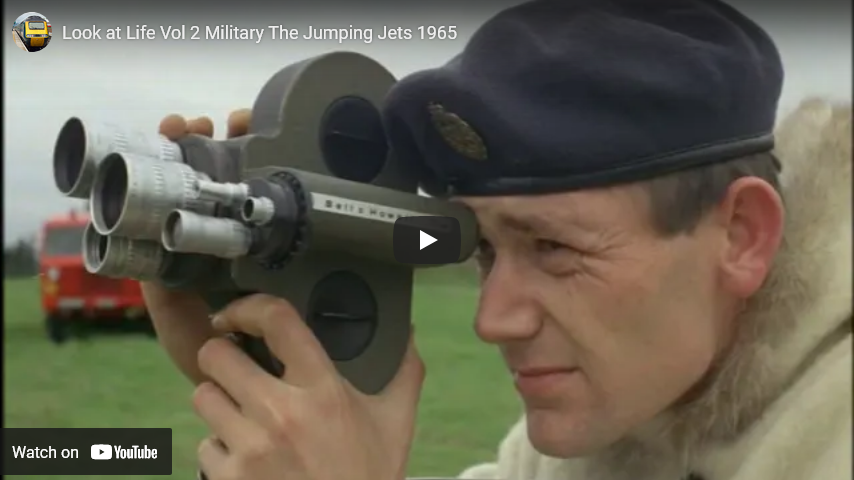
Look at Life — The Jumping Jets (1965)
PauliosVids
Published 20 Nov 2018The revolutionary vertical take-off capacity of the RAF Kestrel.
[Wikipedia: “The Hawker P.1127 and the Hawker Siddeley Kestrel FGA.1 are the British experimental and development aircraft that led to the Hawker Siddeley Harrier, the first vertical and/or short take-off and landing (V/STOL) jet fighter-bomber.
“Development began in 1957, taking advantage of the Bristol Engine Company’s choice to invest in the creation of the Pegasus vectored-thrust engine. Testing began in July 1960 and by the end of the year the aircraft had achieved both vertical take-off and horizontal flight. The test program also explored the possibility of use upon aircraft carriers, landing on HMS Ark Royal in 1963. The first three aircraft crashed during testing, one at the 1963 Paris Air Show.
“Improvements to future development aircraft, such as swept wings and more powerful Pegasus engines, led to the development of the Kestrel. The Kestrel was evaluated by the Tri-partite Evaluation Squadron, made up of military pilots from the United Kingdom, the United States, and West Germany. Later flights were conducted by the U.S. military and NASA.
“Related work on a supersonic aircraft, the Hawker Siddeley P.1154, was cancelled in 1965. As a result, the P.1127 (RAF), a variant more closely based on the Kestrel, was ordered into production that year, and named Harrier – the name originally intended for the P.1154 – in 1967. The Harrier served with the UK and several nations, often as a carrier-based aircraft.”]
June 13, 2022
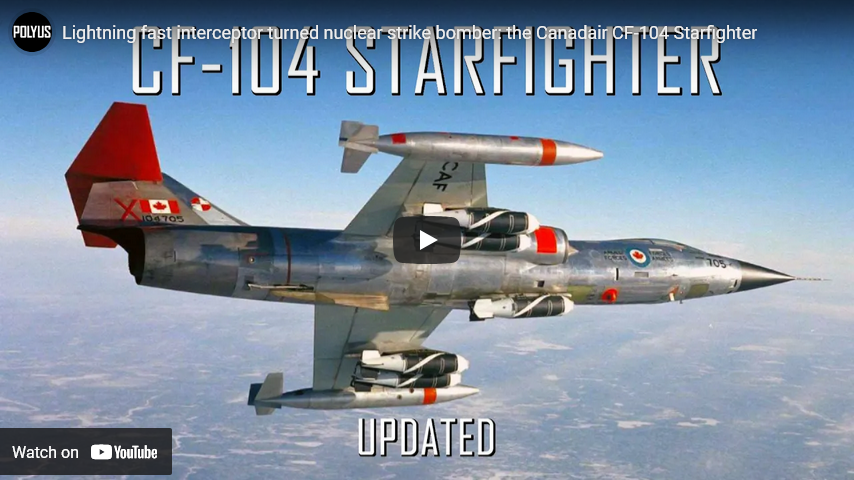
Lightning fast interceptor turned nuclear strike bomber: the Canadair CF-104 Starfighter
Polyus Studios
Published 29 Sep 2020Don’t forget to like the video and subscribe to my channel!
Support me on Patreon – https://www.patreon.com/polyusstudiosThis is an UPDATED version of the video. It includes many changes and corrections to the original video. Many thanks to Gary Watson for all his contributions!
Starting in 1959 Canadair began building Canada’s fastest jet at their plant in Montreal. It was designed as a sleek high altitude and high speed interceptor, but was adapted for low level ground strike missions with conventional and nuclear weapons. It was the Canadair CF-104 Starfighter, Canada’s missile with a man in it.
0:00 Introduction
0:33 Historical Context
2:01 Design Choice
4:15 Canadair’s Production Run
6:50 Configuration and Specifications
11:04 Nuclear Strike Role
12:13 Operational History
16:06 Conventional Role
17:53 Retirement and Replacement
19:28 Accidents, Controversy and Legacy
22:56 ConclusionMusic:
“Denmark” – Portland Cello ProjectResearch Sources:
Canadair CF-104 Starfighter by Harold A. Skaarup (http://silverhawkauthor.com/canadian-…)
Canadair CF-104 Starfighter by Canadian Starfighter Association (http://canadianstarfighterassociation…)
CF-104 Flight Operations by Air Force Museum of Alberta (https://www.rcaf.museum/history/rcaf-…)
Story of the F-104 Starfighter in Norwegian Service by Bjorn Hafsten (http://starfighter.no/hist-en3.html)
Starfighters with Turkey by Joe Baugher (http://www.joebaugher.com/usaf_fighte…)
ASN Aviation Safety Database by Aviation Safety Network (http://aviation-safety.net/wikibase/d…)
Starfighter by David L. Bashow (Fortress Publication, 1990, ISBN: 0-919195-12-1)
Photography credit 6mins10sec: Gary WatsonFootage Sources:
Personal Footage – Gary Watson
Cold War Fighter Pilot – Ken Castle, CD, Flight-Lieutenant (ret’d) – Canada Aviation and Space Museum (https://youtu.be/sEUOFyPLL94)
CF 104 Baden Soellingen 1965 – Gordon Price (https://youtu.be/4UZ9PE58Eq0)
CF104 Germany 1983/4 441 Squadron CAF – Tom Hammond (https://youtu.be/xrqjAKHflCo)
Great Planes Lockheed F-104 Starfighter – Discovery Channel (1996)
Avro Canada CF 100 Canuck – Avro (1956)#Starfighter #CanadianAerospace #PolyusStudios
May 20, 2022
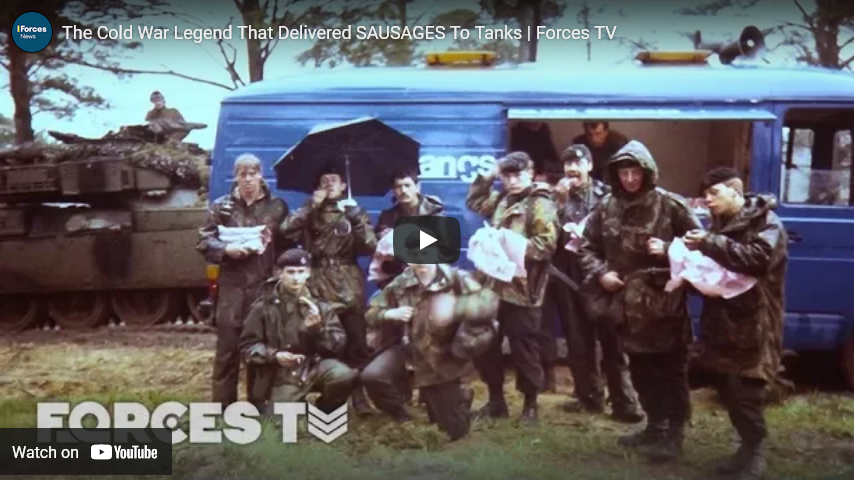
The Cold War Legend That Delivered SAUSAGES To Tanks | Forces TV
Forces News
Published 26 Apr 2018To British troops based in north Germany in the last two decades of the Cold War, he was a legend. But this was no commando or member of the special forces.
Check out our website: http://forces.net
Twitter: https://twitter.com/ForcesNews
April 20, 2022
The Unbreakable ROCKEX: Canada’s answer to the Enigma machine
Polyus Studios
Published 30 Dec 2021Well before digital encryption and VPNs there was Rockex, Canada’s unbreakable cipher machine that rivaled the German Enigma in its day. Although completely hidden from the public, Canada has played a noticeable role in the history of espionage. During the Cold War Canadian cipher machines worked alongside those of her allies to keep communications secure and helped to preserve the peace.
Check out cryptomuseum.com for more information about Rockex and to find the source of most of the pictures of the device I used.
March 18, 2022
Jean Charest tries to position himself as the pro-military Conservative leadership candidate
Canadian politicians — generally speaking — are unwilling to tread too far into discussions of the Canadian Armed Forces and the utter disaster that is our federal government’s procurement “process”. There are lots of good, electoral reasons for this: Canadians have been propagandized over the last two generations to see Canada as a country with no real enemies and having no need of military force except for overseas peacekeeping and disaster relief. Any identified need for new equipment or even just updated replacements for existing capabilities is always a politically dangerous discussion, as it’s remarkably easy to get public support for almost any non-military spending instead of anything even vaguely warlike. Worse, on those few occasions when the government of the day bites the bullet to buy new ships/tanks/planes/helicopters/etc., the top priority isn’t military effectiveness or even lowest-price but where the money will be spent. Bidders for Canadian military contracts can’t just crank off a few extra units of the weapon or vehicle on existing production lines (which in almost every case would be both militarily better and economically cheaper): the government almost always demands new, expensive production facilities be constructed in Canada or for the foreign supplier to “partner” with an existing Canadian company to produce as much in Canada as possible.
This procurement charade usually means the Canadian Forces end up with far fewer weapons or vehicles because the increased costs of partial or complete production in Canada gobble up far more of the allocated budget. For example, back in 2017, we purchased a batch of new machineguns. It was the same model already in use with the Canadian army and with many of our NATO allies. If we’d just bought from one of the foreign manufacturers who already had production lines and tooling set up, each gun would have cost between US$6,000 and US$9,000 depending on configuration. But because we insisted on having Colt Canada set up a new production line, each weapon ended up costing C$28,000!
Multiply this across the entire range of equipment needed by the Canadian Army, the Royal Canadian Navy, and the Royal Canadian Air Force, and it’s quickly obvious that we’re running one of the least efficient military procurement systems in human history. And even on a domestic spin-off/job creation/vote buying spectrum, it’s insanely expensive and wasteful.
All of that out of the way, here’s Conservative leadership hopeful Jean Charest deliberately touching one of the “third rails” of Canadian politics by proposing an increase in funding for the military:
Our military procurement system is broken. For years experts have been warning about our incompetence at making major defence purchases. The past few weeks have shown us the price of our inaction.
While our allies, the United States, the United Kingdom and Australia, have entered into a new security pact to counter China in the Pacific, Canada wasn’t even invited to the table.
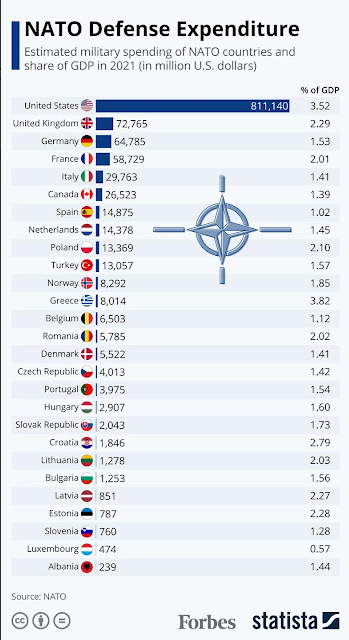
Germany, Sweden, and other NATO allies promise to increase their military spending to prepare for the uncertain times ahead. Canada has a moral responsibility to act. Now is the time.
If elected as the leader, my Conservative government will make significant changes and upgrades to our nation’s military capabilities. I will move quickly to ramp up Canadian defence spending to two percent of GDP, increase personnel to 100,000 and equip our forces for the challenging times ahead. I will modernize our cyber security infrastructure to prepare for future risks. And I will fix our embarrassing procurement system to ensure we get the equipment we desperately need.
The current conflict has also driven home the need to assert our sovereignty, especially in our North. As major sea lanes, essential to global trade and export of our natural resources, open within our arctic territory, we must be on high alert to Russian and Chinese encroachment. Neither recognizes our sovereignty there. In fact, no one really recognizes our sovereignty there and the imbalance in our military investments compared to our allies explains why that’s the case.
The war in Ukraine is a cruel reminder of why we cannot ignore these threats. Russia has a modern military base in the arctic — another area where indecision and delay could be extremely costly unless addressed.
A proud Canada must assert its sovereignty in the North and generate military support through major investments in equipment and coordination with our NATO allies. We need to get our act together.
The threats remain real and demand immediate attention from leaders willing to act in the best interests of their respective nations.
Canadians need experience and expertise overseeing our military. We need a government that supports our military.
March 6, 2022
March 4, 2022
Germany is finally being forced to adapt to 21st century realities
In The Line, Matt Gurney outlines German history since the end of WW2 and why German governments have allowed the Bundeswehr to shrivel to almost Canadian Armed Forces status and why they have also been eager to scrap local power options in favour of imported Russian oil and gas:

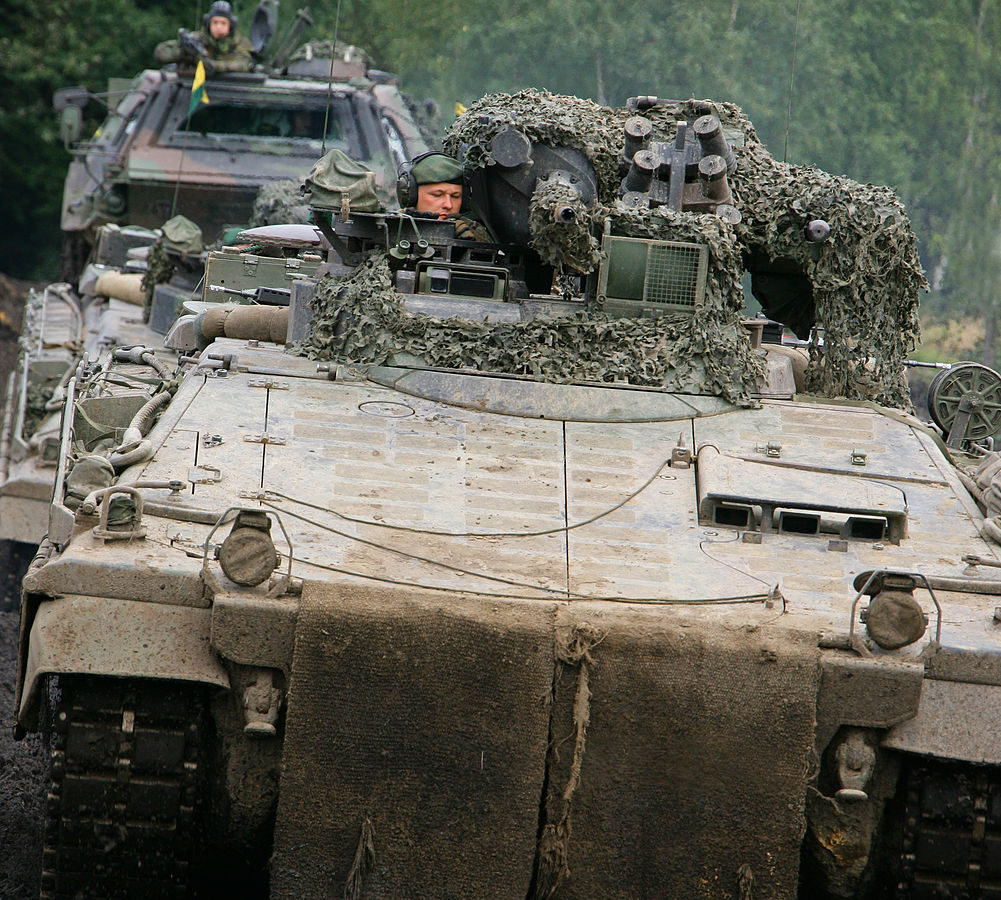
A Bundeswehr Marder 1A3 Infantry Fighting Vehicle during an exercise at the Munster Training Centre, 1 September, 2010.
Photo by Bundeswehr-Fotos via Wikimedia Commons.
After 1990, the newly combined German military largely evaporated. Manpower levels plummeted; huge quantities of equipment were mothballed or sold off. German military spending fell well below that of other large European NATO allies. Indeed, despite their military history and economic clout, Germany, on a per capita basis, is more a Canada to NATO than a France or Britain.
And not by accident. Germany’s partial demilitarization was driven by a series of considerations, all of which reflected deliberate choices. Germany is still haunted by its Nazi-era history, and even its peacekeeping contribution to Afghanistan was controversial, marking the country’s first major foreign mission since 1945. A smaller, little-used military is a balm to the nation’s wounded psyche. Further, a small German military, and a Germany broadly and overtly uninterested in military affairs, did much to ease concerns of wary allies with living memories of life under the Luftwaffe and Wehrmacht.
And, well, yeah: the Germans also cut their force levels like crazy because, as noted in my recent column here, it saved them a ton of money.
It’s important to understand, though, that it’s not just about the German military, though that’s perhaps the most stark symbol. The country has emerged as a leading force for European unity and liberal-democratic values. Not for nothing was recently retired chancellor Angela Merkel touted as a leader of the free world during the rocky Trump presidency in Washington. Under Merkel, the country tried to live the ideal of the modern Europe, including by letting in a million refugees fleeing fighting in the Middle East, a decision that has opened up political fissures in Germany that remain a problem today.
Much has also been made of the country’s decision to shut down its nuclear plants and rely instead on imports of Russian natural gas for energy. Dismissed by many as foolhardy — and it was foolhardy — it’s also not hard to read a whiff of almost pathetic desperation into the move. If we are just nice enough, if we buy enough Russian gas, if we perfectly model the new amiable European ideal, maybe, just maybe, could Germany cast off some of its historical taint?
If that was the plan, it hasn’t worked, and gosh, it hasn’t worked with a vengeance. Since the Cold War ended — paused? changed? — the Germans have remained minimally armed and resolutely affable and committed to European unity. The country did increase military spending after Putin’s 2014 annexation of Crimea, but it almost had to — the German military had fallen into a state of neglect and non-functionality that any Canadian would find instantly recognizable. Hundreds of billions of Euros were budgeted, and tens of thousands of new enlistments authorized, in the first expansion of German military power since reunification. Even while embarking on this effort, though, Germany continued to shut down its nuclear plants and increase its use of Russian energy imports.
That’s over. Deader than East Germany, as much as a relic as the bits of the Berlin Wall that tourists now collect (I have a fragment myself somewhere in a file in my office, though damned if I could find it when I went searching today while procrastinating on this column). On top of the many billions of Euros already pledged to military modernization, Chancellor Olaf Scholz has committed a supplemental fund of a further €100 billion for immediate shoring up of military capabilities, and has also committed to substantially raise Germany’s baseline defence spending to the two per cent NATO target — an effectively permanent annual boost of roughly a third over the already higher level achieved since 2015.
February 4, 2022
Canada’s delusionary approach to the question of providing military support to Ukraine
In The Line, “Tommy Conway” explains why it makes no sense to take Canadian government and military leaders’ talking points on the situation in Ukraine seriously:
Canada has not done these things. We say we’re not sending weapons because “diplomacy is the solution”, but the reality is we can’t send anything meaningful. Any small arms we send would likely be on a NATO standard, and thus not very useful for Ukrainian forces who use Soviet calibers. As for the stuff the Kyiv really needs — the anti-tank and anti-air systems that the Americans, British, and Balts are sending — we are not sending them because we barely have any. Our anti-tank capability is mostly theoretical. Because we have not replaced older, worn-out systems, we have less anti-tank capability now than we did during the “decade of darkness” in the 1990s. We’ve known for decades that we need to equip the infantry with highly-portable, effective guided missiles like the U.S. Javelin, but we haven’t bothered, save for a few Spike missile systems for our special forces. Maybe our regular ground forces will get something similar by 2033. We have literally no air defence capability besides shooting machine guns in the air and hoping for the best, so we have no air defence missiles to send. Besides the fact that we can’t support Ukraine with weapons, we can’t really support NATO allies with reinforcements either because our units, on a modern battlefield, would lack the ability to defend themselves. We might be welcome as a political gesture, but we might also just be in the way.
Our deficiencies go deeper than weapons. CAF is well below strength. But instead of doubling down on core capabilities, CAF leadership insists on putting more people and resources into newer, faddish capabilities like cyber and information warfare, when we already have an entire government agency that does cyber. Our brigades — the core of the Canadian Army’s fighting power, are under-strength, and the army’s recent “Force 2025” concept concedes that the army should hope to field small, combat team elements as the core of any near-future operational deployment. To put this in perspective, a combat team makes up part of a battlegroup, which makes up part of a brigade. The Russians have 50 battlegroup equivalents on the Ukrainian border, and roughly 16 in the Kaliningrad exclave bordering Poland and Lithuania.
A Canadian deployment of a few combat teams would be too small a force even to help manage a large number of refugees in an active combat zone. We might be able to scrape together a battlegroup, but it would be vulnerable to air and tanks — in other words, not very useful. Once it was destroyed, that would probably be the majority of the Canadian Army’s combat power gone, with no hope of reconstituting it.
It would be one thing if the army sold this reorganization as a necessary evil in lean times, but this sort of hollowing-out is instead presented as allowing the army to “remain[…] ready to operate not only in the land domain, but pan-domain in a joint environment beyond simply reinforcing its existing capabilities.” Strip away the jargon, and it should be obvious that this phrasing is the victim of too much powerpoint and too little thinking. Junior NCOs and junior officers alike are instructed to build a “priority of work” into their plans for even small, simple operations. Given that we don’t have realistic “current capabilities”, reinforcing our shell of an army should obviously be on the top of the list before we commit resources to new things. At the very least we should be open and honest about what we can and can’t do.
If you ask most talking heads in the Canadian “defence space”, battlegroups that can’t battle aren’t a big deal. The idea that modern war will be won on social media or through “integration” and digital technologies, thus making the old ground-pounders outdated, is a common staple among civilian defence academics. It’s also present in the government’s defence policy, which goes on at length about space and cyberwar and climate change and “ungoverned spaces”, but little about building a realistic fighting force. This hopeful language about an army that can operate in a chaotic world without much messy stuff like hurting people or breaking things is obviously nonsense, but novelty and wishful thinking are pretty standard fare for academics and politicians. It’s much more concerning to see supposedly practical military people hold reality in such low regard.
The officer class’ shoddy thinking comes from decades of misguided pseudo-intellectual development. After the Somalia Affair in the 1990s, the CAF turned to liberal arts education as a way to buy credibility. There was nothing wrong with the idea of intellectual broadening in theory — the officer corps obviously needed reform. But the reforms were rushed and packaged, so they replaced one set of intellectual deficiencies with another.
December 21, 2021
Tank Chat #136 | Schützenpanzer | The Tank Museum
The Tank Museum
Published 3 Sep 2021David Willey is back with another Tank Chat! This week’s episode is all about the Schützenpanzer. A West German infantry fighting vehicle developed from 1956 to 1958.
(more…)
November 26, 2021
Look at Life — Air Umbrella (1961)
PauliosVids
Published 20 Nov 2018A look at NATO’s international squadrons, with footage of the F104 Starfighter.
November 21, 2021
SA80 History: XL60 Series in 4.85mm
Forgotten Weapons
Published 10 May 2017Armament Research Services (ARES) is a specialist technical intelligence consultancy, offering expertise and analysis to a range of government and non-government entities in the arms and munitions field. For detailed photos of the guns in this video, don’t miss the ARES companion blog post:
http://armamentresearch.com/british-e…
Once the basic configuration of the new British rifle was determined, the next step was to build a series of prototypes. The design that took form was basically a bullpup copy of the Armalite AR-18. The design team at Enfield were mostly senior draftsmen, with virtually no firearms experience among them. To make things worse, most of the design team was regularly rotated onto other projects, preventing them from developing any project experience on the rifle.
Several prototype batches were made (typically of a dozen guns each, both IWs and LSWs), all in the unique British 4.85x49mm cartridge, with a variety of different feature sets. Through the different patterns, configurations would change on the safety (push button vs lever) fire selector (push button vs lever), and magazine catch (straight-in side lever vs rock-in side lever vs rock-in rear paddle). At this time, plans still existed to make both left- and right-handed versions of the final gun, so prototypes of both were manufactured.
Because cost-cutting measures had not yet been forced on the project, these XL-60 series guns were generally reliable, at least in normal conditions. They are quite comfortable to fire, with a cartridge very similar to the 5.56mm NATO in practical terms. There is nothing particularly wrong with that cartridge, but it would be dropped when it lost NATO trials to the Belgian SS109 … but we will address that in the next episode of the SA80 history.
http://www.patreon.com/ForgottenWeapons
Cool Forgotten Weapons merch! http://shop.bbtv.com/collections/forg…
If you enjoy Forgotten Weapons, check out its sister channel, InRangeTV! http://www.youtube.com/InRangeTVShow
October 25, 2021
P90: FN’s Bullpup PDW
Forgotten Weapons
Published 2 Jul 2021http://www.patreon.com/ForgottenWeapons
https://www.floatplane.com/channel/Fo…
Cool Forgotten Weapons merch! http://shop.forgottenweapons.com
FN began developing the P90 in the late 1980s, actually preceding the NATO requirement that it would eventually compete for. The idea of the P90 was to develop a weapon for secondary troops to replace 9mm pistols and SMGs. There was an anticipated threat of Russian paratroops wearing armor that could defeat 9mm ball. The P90 was intended to be a light and handy weapon that was easily controllable without a tremendous about of training, and could defeat that sort of body armor.
The result was the 5.7x28mm cartridge, firing a 31 grain armor-piercing bullet at 2350 fps. This was combined with a simple blowback action and a Hall-style 50-round magazine in a fully ambidextrous, bullpup layout. The gun was introduced onto the market in 1990, and has been widely purchased by security and special operations organizations. In its original intended role for support troops, it has only been adopted by Belgium.
Contact:
Forgotten Weapons
6281 N. Oracle 36270
Tucson, AZ 85740
August 13, 2021
[Military 101] NATO Unit Counters – Niehorster Dialect
Military History Visualized
Published 26 Jul 2016» HOW YOU CAN SUPPORT MILITARY HISTORY VISUALIZED «
(A) You can support my channel on Patreon: https://www.patreon.com/join/mhv(B) You can also buy “Spoils of War” (merchandise) in the online shop: https://www.redbubble.com/people/mhvi…
» SOCIAL MEDIA LINKS «
twitter: https://twitter.com/MilHiVisualized
tumblr: http://militaryhistoryvisualized.tumb…Script & Further Information: http://militaryhistoryvisualized.com/…
—Sources—
–Websites & Links–Niehorster – Military Organization Symbols Key
http://niehorster.org/000_admin/009_s…https://en.wikipedia.org/wiki/NATO_Jo…
—Credits & Special Thanks—
The Counter-Design is heavily inspired by Black ICE Mod for the game Hearts of Iron 3 by Paradox Interactive
https://forum.paradoxplaza.com/forum/…—Song—-
Ethan Meixsell – “Demilitarized Zone” (the Irony :D)