Quotulatiousness

August 7, 2021

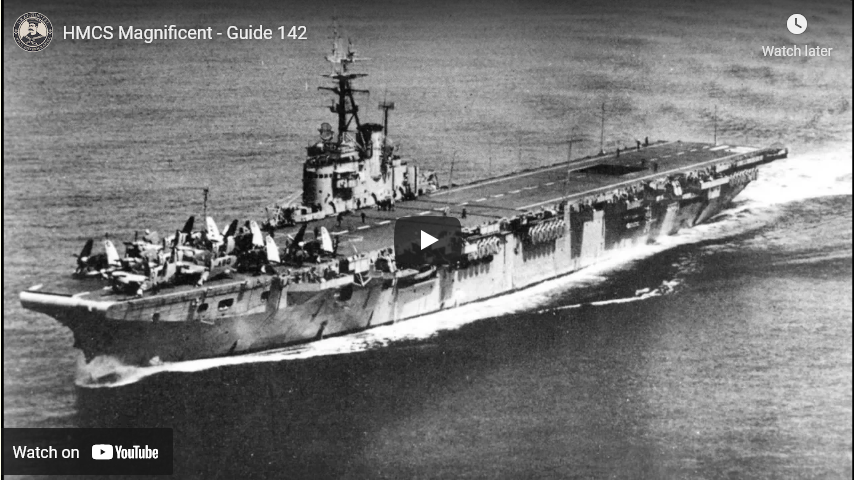
HMCS Magnificent – Guide 142

Filed under: Britain, Cancon, History, Military — Tags: , , , , , — Nicholas @ 02:00

Drachinifel
Published 14 Sep 2019

The first ship of “Canada Month”, HMCS Magnificent, is the subject of today:

Want to support the channel? – https://www.patreon.com/Drachinifel

Want a shirt/mug/hoodie – https://shop.spreadshirt.com/drachini…​

Want a medal? – https://www.etsy.com/uk/shop/Drachinifel​

Want to talk about ships? https://discord.gg/TYu88mt

Want to get some books? www.amazon.co.uk/shop/drachinifel

Drydock Episodes in podcast format – https://soundcloud.com/user-21912004

August 6, 2021

Avro Canada CF-100 Canuck: Canada’s only domestically produced all-weather interceptor

Filed under: Cancon, Europe, History, Military, Technology, Weapons — Tags: , , , , , , , — Nicholas @ 02:00

Polyus Studios
Published 3 Oct 2017

Support me on Patreon – https://www.patreon.com/polyusstudios​

**I realize a few of you are having trouble with the way I talk and how I’ve done the sound mixing. Please note that this was my first video and I tried to get everything right as I learned to do it. That said, I obviously made some mistakes. I am just one guy making these things and I’m learning as I go. Feel free to check out my more recent videos where I have tried to correct the sound issues.**

The CF-100 is Canada’s only domestically designed jet fighter to reach service and to be built directly to RCAF specifications. In its day it was a competitive all-weather interceptor. The Canuck protected Canadian airspace from the threat of nuclear armed Soviet bombers for over a decade. This is the story of its development and deployment.

Aircraft mentioned:
Vampire F.3
CL-13 Sabre
CF-100 Canuck
CF-101 Voodoo
CF-105 Arrow

Research sources:
http://www.cmp-cpm.forces.gc.ca/dhh-d…​
https://www.bombercommandmuseum.ca/aircraft/cf-100/
http://www.canadianflight.org/content/avro-canada-cf-100-canuck
http://www.avroland.ca/al-cf100.html​
http://www.aviastar.org/air/canada/canada_canuck.php
http://www.rwrwalker.ca/caf_canucks.html​
http://image-bank.techno-science.ca/d…​
NORAD and the Soviet Nuclear Threat: Canada’s Secret Electronic Air War By Gordon A.A. Wilson

0:00​ Introduction
1:08​ Initial Development
2:38​ CF-100 Mk 1 and Mk 2
4:26​ CF-100 Mk 3
6:51​ CF-103 and Transonic Speeds
7:36​ CF-100 Mk 4
11:33​ CF-100 Mk 5
13:14​ Velvet Glove and Future Proposals
14:28​ Operational History
20:02​ Conclusion

#CF100​ #CanadianAerospace​ #PolyusStudios

March 27, 2021

SA80 History: The First L85 Mockups (Sterling and Stoner)

Filed under: Britain, History, Military, Weapons — Tags: , , , , , — Nicholas @ 02:00

Forgotten Weapons
Published 5 May 2017

Armament Research Services (ARES) is a specialist technical intelligence consultancy, offering expertise and analysis to a range of government and non-government entities in the arms and munitions field. For detailed photos of the guns in this video, don’t miss the ARES companion blog post:

http://armamentresearch.com/british-e…

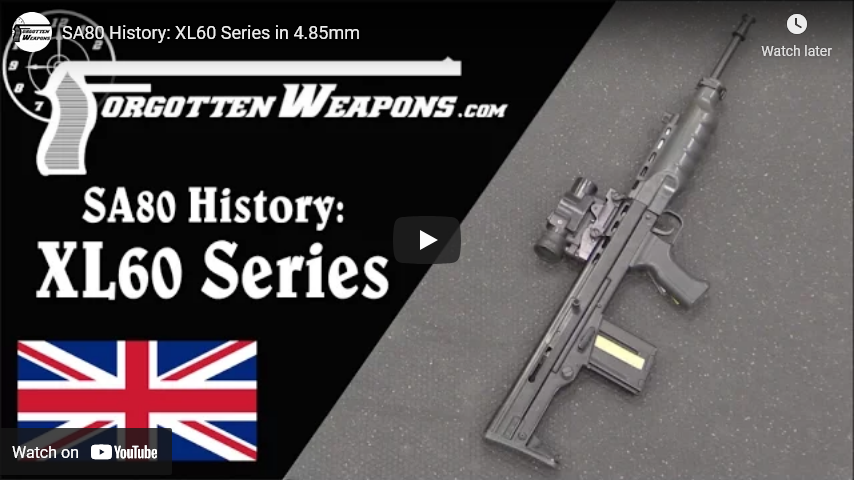
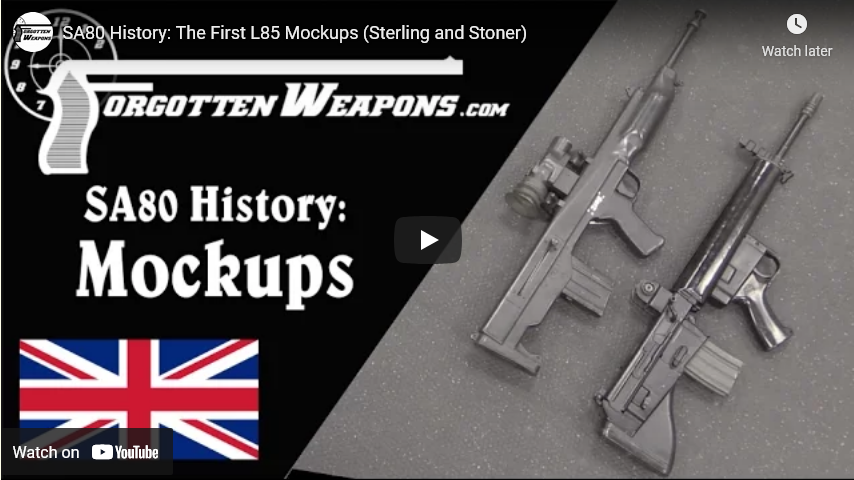
The British military had been working towards a reduced-power cartridge since the end of World War 2, and the ultimate adoption of the FAL/SLR in 7.62x51mm NATO did not end their interest in the concept. It would not be long before the roots of SA80 would take hold, and today we are looking at the very first mockups of the concept that would become the L85A1 and L86A1.

As part of a preliminary study to decide the basic layout and capabilities of a future new individual weapon and light support weapon, five wooden and metal mockups were produced in conventional and bullpup layouts, and also with/without “dropped” stocks to facilitate sighting. The favored mockup was the bullpup seen here, which gave rise to the whole Enfield Weapon System/SA80 family. It is relevant to note that the concept included a universal standard optical sight from the very outset, as this was a cutting edge concept at the time. In addition, note the small features like safety, sling swivels, and magazine catch, as these would vary back and forth through the development program.

After the wooden guns, two functional (or mostly functional) guns were produced. These were standard off-the-shelf rifles converted into bullpup configuration – one Stoner 63 and one Sterling AR18. Neither company was contacted for licensing or technical assistance.

http://www.patreon.com/ForgottenWeapons

Cool Forgotten Weapons merch! http://shop.bbtv.com/collections/forg…

If you enjoy Forgotten Weapons, check out its sister channel, InRangeTV! http://www.youtube.com/InRangeTVShow

March 17, 2021

Rebuilding the Royal Canadian Navy

Filed under: Cancon, Military — Tags: , , , , , — Nicholas @ 05:00

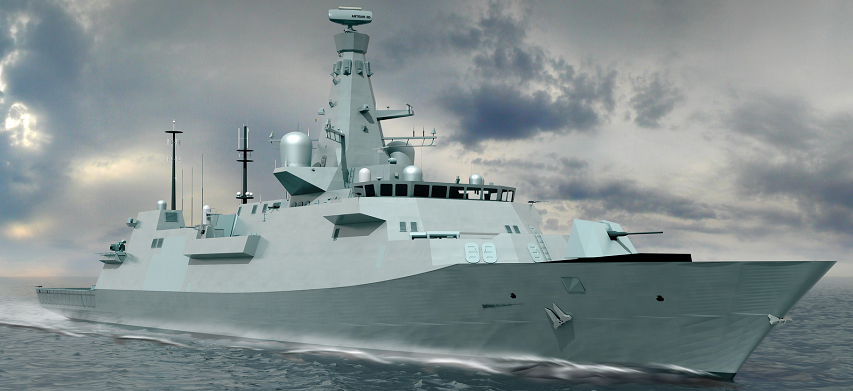
I somehow missed this article by Sir Humphrey when he posted it a few weeks back. He’s looking at the Australian and Canadian governments’ respective decisions to use the British Type 26 design to replace their current anti-submarine fleets and considering some of the economic and military concerns that led to the decision.

In both cases there have been media articles in the last week over the programmes and concerns. In Canada, the challenge has been that the cost has grown to a total of $77bn for 15 escorts. There has been cost growth from an originally scheduled $14bn many years ago, and the first of class will not now be delivered until 2031. This has led to suggestions in some media quarters that Canada could do things faster and more cheaply if it simply bought an off the shelf foreign design now and got on with things.

An artist’s rendition of BAE’s Type 26 Global Combat Ship, which was selected as the Canadian Surface Combatant design in 2019, the most recent “largest single expenditure in Canadian government history” (as all major weapon systems purchases tend to be).
(BAE Systems, via Flickr)

[…]

The issue now is that Canada will need to establish, almost from scratch, a frigate construction programme and workforce for a finite period of time without a clear plan of what follows on when the last hull is completed. At the same time it will need to run on ships that are becoming increasingly elderly – it is likely that most of the Halifax class will see more than 40 years of service, and some may approach their 50th birthdays before being replaced – something that will pose an increasing maintenance and resource challenge.

Could things be done more cheaply or quickly? Almost certainly yes, but only if you are willing to make massive compromises. It could be possible, for example, to look to licence build an existing design that is already in service. There are plenty of designs out there that could be licence built and brought into service in the next few years — probably at less cost than the T26 programme.

But while this may sound easy, its also a recipe for disaster. It’s easy to look at country X and say “they’re buying this ship for that much” and assume that Canada is getting a bad deal. But Country X is likely to have a very different set of requirements, and their design will reflect it.

For example, Canada needs a ship able to operate with NATO and 5 EYES as a fully integrated player – this adds cost to fit specific systems and equipment that is compatible. Canada will also want to fit bespoke systems to meet national needs – again this will require design changes, that come at a price. Bolting on all manner of different requirements that Canada needs to meet the unique operational circumstances adds price and complexity to the design.

While you probably could take an off the shelf design and build it now, it would be just that, an off the shelf design. It wouldn’t be optimised for local needs, and it wouldn’t have the right equipment, comms, meet local design standards, or be certified for use with national equipment.

You are then faced with two choices – either bring a cheap ship into service that is entirely unsuitable and not designed for your needs, but is a lot cheaper, or spend an enormous amount of money shifting the design to better reflect your needs. If you choose the latter, then suddenly you are adding cost and time in, and the 2031 date will slip even further.

If you choose the former, then you have to accept that the design is “as it comes” and will have minimal Canadian input – so limited industrial offsets, very little economic benefit, and the long-term support solutions will firmly be tied into the country of origin and not Canada. In other words, Canadian taxpayer dollars will be spent to support a foreign economy.

That last point is really the key. Canadian governments, in my lifetime at least, never look at the military requirement as the top priority and sometimes not even the second or third priority. The economic spin-offs, especially in those cases where the benefits can be allocated to marginal parliamentary constituencies, will be the top priority. As is always a talking point in the case of any major military hardware acquisition, this is going to be the “single largest expenditure in Canadian government history”. Just as the replacement of the RCAF’s aged CF-18 fighters will be the largest expenditure in its turn.

January 31, 2021

M37: The Ultimate Improved Browning 1919

Filed under: History, Military, USA, Weapons — Tags: , , , , , , — Nicholas @ 02:00

Forgotten Weapons
Published 8 Mar 2019

http://www.patreon.com/ForgottenWeapons

Cool Forgotten Weapons merch! http://shop.bbtv.com/collections/forg…

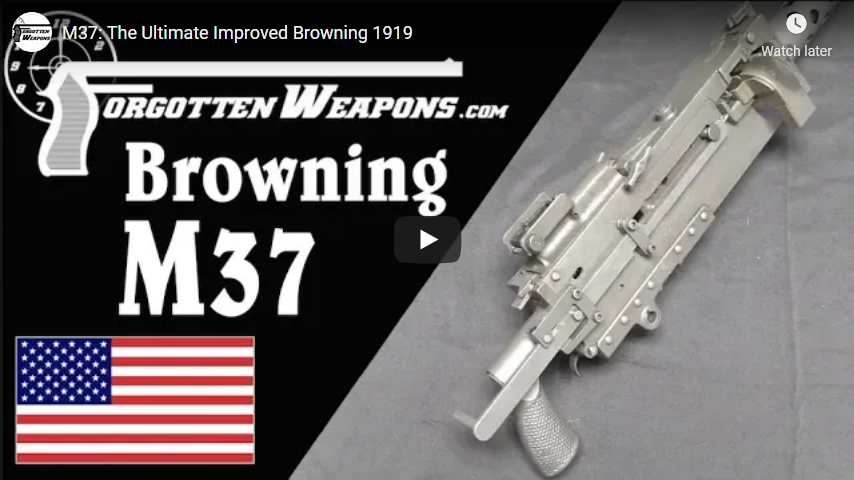
In November of 1950, the US Ordnance Department requested an improved version of the Browning 1919 air-cooled machine gun for use in tanks. The new version was to be able to feed from either the left or right, a feature which was unimportant for an infantry gun but much more relevant when mounting guns into the tight spaces of an armored vehicle. An interim conversion of existing guns to the M1919A4E1 pattern came first, followed by manufacture of all-new guns by the Rock Island Arsenal and Saco-Lowell company from 1955 until 1957.

The design of the gun fell to Bob Hillberg at High Standard. He came up with a clever set of reversible plugs to change the bolt between left and right hand feed, as well as a captive recoil spring, manual safety, improved top cover and rear cover latches, and several other strengthened parts. He also incorporated a charging handle extension with integral manual hold open and a link ejection chute that could be mounted to either side of the gun. His T153 design was formally adopted as the M37, in caliber .30-06. A 7.62mm NATO version (the M37E1) followed as well. The M37 would serve into the late 1960s on the M48 and M60 tanks as well as several helicopters.

Contact:
Forgotten Weapons
PO Box 87647
Tucson, AZ 85754

January 26, 2021

Tank Chats #92 | Challenger 2: Part 2 | The Tank Museum

Filed under: Britain, History, Military, Weapons — Tags: , , , , , — Nicholas @ 02:00

The Tank Museum
Published 17 Jan 2020

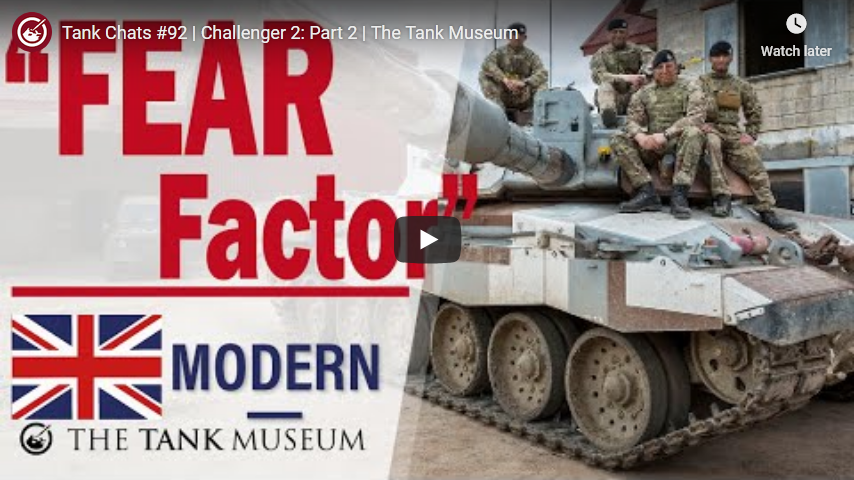
Part 2 of a two-part episode on Challenger 2 [part 1 was posted here]. As David Willey had so much to say about this British in-service vehicle, it has been split into two parts. The second part examines the Challenger 2 in service. David talks to soldiers currently serving on the Challenger 2, looks at where it has seen service and some of the tank’s features. With thanks to the British Army for their assistance.

Support the work of The Tank Museum on Patreon: ► https://www.patreon.com/tankmuseum

Visit The Tank Museum SHOP: ►tankmuseumshop.org

Twitter: ► https://twitter.com/TankMuseum
Instagram: ► https://www.instagram.com/tankmuseum/
Tiger Tank Blog: ► http://blog.tiger-tank.com/
Tank 100 First World War Centenary Blog: ► http://tank100.com/
#tankmuseum #tanks #challenger2 #britisharmy #davidwilleytankchat #davidwilleychallenger2

January 20, 2021

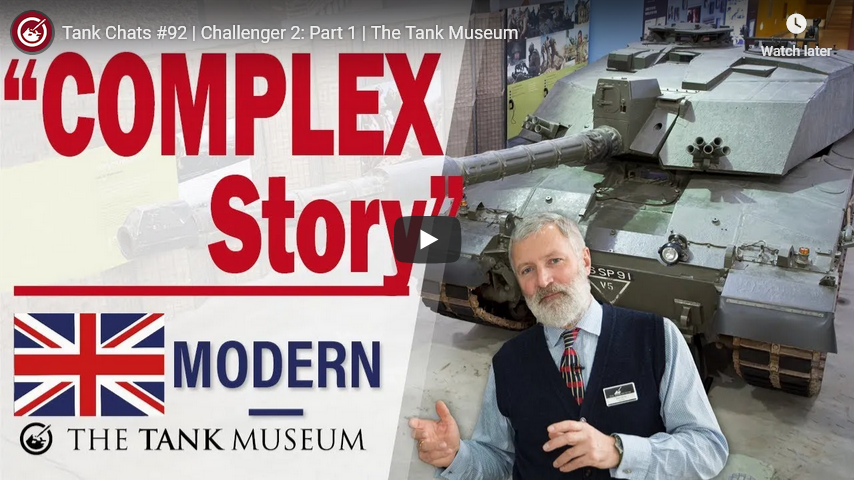
Tank Chats #92 | Challenger 2: Part 1 | The Tank Museum

Filed under: Britain, History, Military, Weapons — Tags: , , , , , — Nicholas @ 02:00

The Tank Museum
Published 20 Dec 2019

Part 1 of a two-part episode on Challenger 2. As David Willey had so much to say about this British in-service vehicle, it has been split into two parts. This first part looks at the design and development of Challenger 2. With thanks to the British Army for their assistance.

Challenger 1 video: https://www.youtube.com/watch?v=Lwcx7…

Support the work of The Tank Museum on Patreon: ► https://www.patreon.com/tankmuseum

Visit The Tank Museum SHOP: ►tankmuseumshop.org

Twitter: ► https://twitter.com/TankMuseum
Instagram: ► https://www.instagram.com/tankmuseum/
Tiger Tank Blog: ► http://blog.tiger-tank.com/
Tank 100 First World War Centenary Blog: ► http://tank100.com/
#tankmuseum #tanks

November 2, 2020

L1A1 SLR good and bad points

Filed under: Britain, History, Military, Weapons — Tags: , , , — Nicholas @ 04:00

Bloke on the Range
Published 19 Oct 2017

Sometimes Enfield does things right. Normally when they’re just polishing up an existing design. Like the L1A1 SLR, the British version of the FN FAL.

Patreon: https://www.patreon.com/BlokeOnTheRange

October 19, 2020

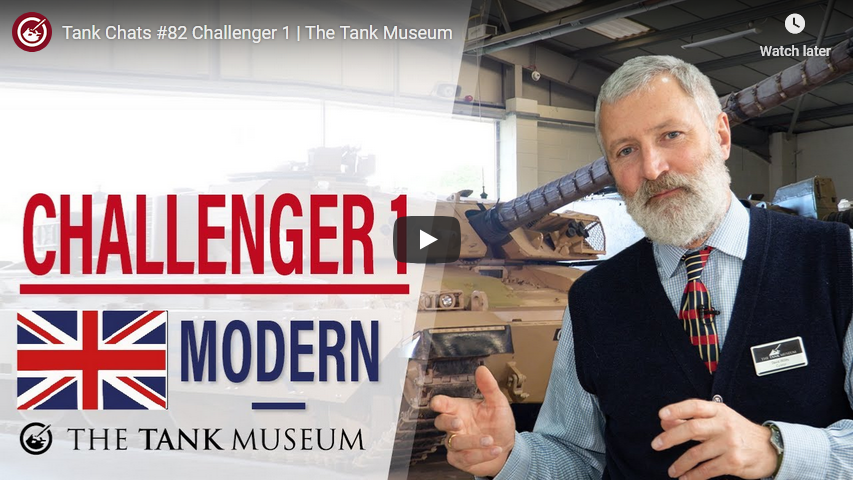
Tank Chats #82 Challenger 1 | The Tank Museum

Filed under: Britain, History, Middle East, Military, Weapons — Tags: , , , , , , — Nicholas @ 02:00

The Tank Museum
Published 9 Aug 2019

David Willey, The Tank Museum Curator, discusses the development and deployment of the UK’s Main Battle Tank from 1983 – 2001, the Challenger 1.

Challenger 1 was in service with the British Army and saw action during the First Gulf War. It remains in service with the Jordanian Army.

Support the work of The Tank Museum on Patreon: ► https://www.patreon.com/tankmuseum

Visit The Tank Museum SHOP: ► https://tankmuseumshop.org/

Twitter: ► https://twitter.com/TankMuseum
Instagram: ► https://www.instagram.com/tankmuseum/
Tiger Tank Blog: ► http://blog.tiger-tank.com/
Tank 100 First World War Centenary Blog: ► http://tank100.com/

October 10, 2020

A century on, Greece and Turkey are back at daggers drawn

Filed under: Europe, Greece, History, Military — Tags: , , , , , , — Nicholas @ 03:00

John Psaropoulos on the ever-more-heightened tension in the Aegean Sea as Turkey looks to muscle in on Greek-claimed waters in search of natural gas (or a fight):

The Aegean Sea
Map via Wikimedia Commons

Last summer, Greece and Turkey came closer to war than they have done since 1974, when Turkey invaded Cyprus. The drama began to unfold on 21 July, when Turkey announced it was sending a seismic survey ship, the Oruc Reis, to look for oil and gas in areas the UN Law of the Sea awards to Greece.

Within hours, the Greek and Turkish navies had deployed throughout the Aegean and east of Crete. They remained so for two months. Greek helicopters pinned down Turkish submarines off the island of Evia. Frigates shadowed each other so closely, that on 12 August two of them collided when a Turkish frigate performed a manoeuvre across the bows of a Greek one. Greek and Turkish F-16s intercepted each other between Crete and Cyprus. Greece came close to invoking the European Union’s mutual defence clause.

On 13 September, Turkey withdrew the Oruc Reis, ostensibly for maintenance, and redeployed its navy. In the coming days, Greece and Turkey are to resume talks abandoned four and a half years ago on carving out their continental shelves – vast swathes of the east Mediterranean where they may exercise exclusive commercial rights to exploit undersea resources.

For now, there is de-escalation, but expectations for the outcome of these talks are low.

“Right now, Turkey doesn’t consider itself an extension of the West. It doesn’t consider that it has commitments and responsibilities towards the West,” says Konstantinos Filis, who directs the Institute of International Relations in Athens. “It believes it is an autonomous power in the region, that it is very potent, and that all its neighbours should respect it. The Turkish leadership doesn’t appear to be prepared for compromises with neighbours it considers inferior.”

The east Mediterranean is where the world’s most significant natural gas discoveries have occurred since the turn of the millennium. Israel and Egypt are now energy independent. Cyprus soon hopes to be. But Greece potentially dwarfs them all.

Seismic explorations it conducted six years ago suggest that Greece has natural gas reserves of 70-90 trillion cubic feet – as much as Israel, Egypt and Cyprus have discovered combined, with a pre-Covid-19 market value of about $200 billion. Assuming gas is viable for the next 25 years, Greece’s reserves, if proven, would cover its energy needs and turn gas into a lucrative export to the European Union. As much as a third of the value of the gas would go to the Greek state in taxes and royalties, allowing it to pay off a fifth of its external debt, now approaching twice its GDP.

This is clearly a future Turkey, with eight times Greece’s population and four times its economy, would rather claim for itself. Legally, it cannot do so. Under the rules of the UN’s Law of the Sea (UNCLOS), the lion’s share of east Mediterranean waters goes to Greece and Cyprus. Recep Tayyip Erdogan, Turkey’s leader for the past 18 years, feels that the Greeks are hemming him in.

Turkish research vessel MTA Oruç Reis, operated by the General Directorate of Mineral Research and Exploration for shallow water petroleum and natural gas survey work.
Photo from https://balkaneu.com/greece-oruc-reis-within-the-greek-continental-shelf-mitsotakis-contacts-michel-and-stoltenberg/

July 14, 2020

British EM-2: The Best Cold War Battle Rifle that Never Was

Filed under: Britain, History, Military, Weapons — Tags: , , , , , — Nicholas @ 02:00

Forgotten Weapons
Published 12 Jul 2017

Armament Research Services (ARES) is a specialist technical intelligence consultancy, offering expertise and analysis to a range of government and non-government entities in the arms and munitions field. For detailed photos of the guns in this video, don’t miss the ARES companion blog post:

http://armamentresearch.com/british-j…

The EM-2 was the rifle that the British pushed for NATO trials in 1950. It was a rifle well ahead of its time in several areas — as a select-fire bullpup rifle, it was intended to replace both the infantry rifle and the submachine gun. Its .280 caliber cartridge was designed with combat ranges of 600 yards and less, acknowledging the reality that engagements beyond even 300 yards were extremely rare, and not important enough to base rifle design on. It was also designed to use primarily optical sights, long before this concept would be embraced elsewhere. Unfortunately, the potential of the EM-2 was lost to the political decision that compatibility with American ordnance choices was a more significant benefit than an improved infantry rifle.

Mechanically, the EM-2 is heavily based on the German G43 flapper-locking system. It uses a long stroke gas piston in place of the G43’s short stroke one, though. To help account for the slower handling of a bullpup configuration, the EM-2 would both lock open when its magazine was empty and also automatically close the bolt and chamber a round when a fresh magazine was inserted. The safety was much like that of the M1 Garand, and the selector lever was of the push-through type like on the German Sturmgewehr.

The optic on the EM-2 is quite tiny, and offers no magnification. Its purpose is to reduce the two-element sight picture of traditional iron sights to a single plane that can be more quickly and easily placed on the target.

In total, only 55 EM-2 rifles were manufactured, including the paratrooper model in this video and a number of 7.62mm NATO examples made as a last ditch effort to remain competitive in NATO trials. Where most failed prototype rifles were rejected for very legitimate technical shortcomings, the EM-2 is (I believe) a prime example of an outstanding weapon that fell victim to politics unrelated to its actually qualities.

http://www.patreon.com/ForgottenWeapons

Cool Forgotten Weapons merch! http://shop.bbtv.com/collections/forg…

If you enjoy Forgotten Weapons, check out its sister channel, InRangeTV! http://www.youtube.com/InRangeTVShow

July 11, 2020

H&K G3: The Very First Import (3/62)

Filed under: Germany, History, Military, Weapons — Tags: , , , , — Nicholas @ 02:00

Forgotten Weapons
Published 6 Mar 2016

http://www.patreon.com/ForgottenWeapons

Sold for $32,200.

We have all seen plenty of sporter CETME rifles and civilian HK-91s, but when the G3 was new to the Germany military, there was already an interest in bringing semiauto versions into the US. The Golden State Arms Corporation was the first to do so, with three batches of imports in 1962 (just 3 years after the G3 was adopted). The first of these came into the US in March, and was basically identical to the military G3 except with a two-position semiauto-only fire control pack.

Later imports had to be made more and more distinct from the military G3s, which leaves these 3/62 guns as the closest thing to the real G3 available to the non-NFA US shooter.

Video on the development of the roller-delayed blowback system:

https://www.youtube.com/watch?v=WEPwm…

June 25, 2020

USA Starts the Atomic Arms Race | The Cuban Missile Crisis I Prelude 1

TimeGhost History
Published 24 Jun 2020

When WW2 ends the former Allies find themselves at odds with each other over ideological and economic world domination. In an atmosphere of increasing escalation, the US pulls ahead in the nuclear arms race. While the Soviet Union tries to catch up, they are far behind, and yet humanity soon faces potential destruction many times over.

Join us on Patreon: https://www.patreon.com/TimeGhostHistory

Hosted by: Indy Neidell
Written by: Spartacus Olsson
Director: Astrid Deinhard
Producers: Astrid Deinhard and Spartacus Olsson
Executive Producers: Astrid Deinhard, Indy Neidell, Spartacus Olsson, Bodo Rittenauer
Creative Producer: Joram Appel
Post-Production Director: Wieke Kapteijns
Research by: Spartacus Olsson
Edited by: Daniel Weiss
Sound design: Marek Kaminski

Colorizations:
– Daniel Weiss

Sources:
– Bundesarchiv_Bild_183-30562-0001,
– Color by Klimbim

Soundtracks from Epidemic Sound:
– “Cold Eyes” – Elliot Holmes
– “Juvenile Delinquent” – Elliot Holmes
– “Nightclub Standoff” – Elliot Holmes
– “Scope” – Got Happy
– “Zoot Suit” – Elliot Holmes
– “Car Chase in Virginia” – White Bones
– “When They Fell” – Wendel Scherer
– “Kissed by Thunder” – Elliot Holmes

Archive by Screenocean/Reuters https://www.screenocean.com.

A TimeGhost chronological documentary produced by OnLion Entertainment GmbH.

From the comments:

TimeGhost History
1 day ago
This is the first of two preludes before we will cover the Cuban Missile Crisis day-by-day in 13 episodes. Our hardcore fans might recognise this series, as these are a remake of the very first series that we ever did on this YouTube channel. Not only did we improve the set and the audio and video quality, also did we gain access to a lot more unique archive material. These episodes were also edited by dedicated editors (back then Spartacus had to edit them) and we have the help of Ryan who makes graphics and our coloriziation squad who bring history to life. We have come a long way since the old version of this was first published. We thank everyone for sticking around but especially those who joined the TimeGhost Army at www.patreon.com/timeghosthistory or https://timeghost.tv. We wouldn’t be here without them!
Cheers,
Joram

May 2, 2020

After The Berlin Wall: Making Germany’s Armed Forces (Bundeswehr 1991 Documentary)

Filed under: Europe, Germany, History, Military — Tags: , , , , , , — Nicholas @ 02:00

Forces TV
Published 5 Jan 2018

It’s more than 27 years since German reunification, when East and West Germany came together again after the fall of the Berlin Wall. This documentary looks at the challenges facing the West German Army as they took over the East German National People’s Army.

Read more: http://www.forces.net/news/comment-bu…
Subscribe to Forces TV: http://bit.ly/1OraazC
Check out our website: http://forces.net
Twitter: https://twitter.com/ForcesNews

How things change … back in 1991, the Bundeswehr had a vast over-supply of military vehicles between the mass of Soviet-era equipment inherited from the DDR and the excess due to planned down-sizing of Germany’s overall military expenditure (the “peace dividend”). Earlier this year, Bild reported that German soldiers are being advised to take personal vehicles during military training exercises, due to a lack of infantry fighting vehicles and other military transport.

March 17, 2020

Tank Chats #64 Leopard 1 | The Tank Museum

Filed under: Germany, History, Military, Weapons — Tags: , , , — Nicholas @ 02:00

The Tank Museum
Published 11 Jan 2019

The Leopard 1 Main Battle Tank was built on Germany’s lessons from the Second World War. It entered service in 1965 and has since been exported worldwide.

Tank Museum Curator David Willey talks through this Cold War vehicle.

Support the work of The Tank Museum on Patreon: ► https://www.patreon.com/tankmuseum

Visit The Tank Museum SHOP: ► https://tankmuseumshop.org/
Twitter: ► https://twitter.com/TankMuseum
Tiger Tank Blog: ► http://blog.tiger-tank.com/
Tank 100 First World War Centenary Blog: ► http://tank100.com/ #tankmuseum #tanks #tankchats

« Newer PostsOlder Posts »

Powered by WordPress