
It’s odd the world still cares about European royals, whose primary contribution to history has been wars, repression and poverty for ordinary people so that a handful of twits could live in extreme excess, admiring themselves in the mirror. Not just the British ruling houses — the Hapsburgs, Romanovs, Hohenzollerns and other royal lines mainly brought misery to their subjects, and this was so even if Thomas Hobbes was right about corrupt aristocracy being preferable to bedlam. ALIQUATENUS MELIOR CHAOS should have been on every medieval royal family crest. That’s Latin for “We Are Somewhat Better Than Chaos,” at least according to the Google universal translator.
Perhaps anachronistic royalty draws crowds and media gushing because society adores celebrity, which the House of Windsor continues to possess. But through no effort of its own: The glamour, money and position of the Windsor crowd is inherited, not earned. Society’s admiration should go to those who attain their positions via merit.
Yet there is continuing enthusiasm for anachronistic monarchs of several nations: During the baby countdown outside Clarence House, crowds showed up in Brussels to cheer for new King Philippe, who may be the most irrelevant human being ever to don a purple sash. Fantasy may explain this. Mired in quiet desperation, people like to imagine being born into wealth and glory, treated as special and chosen. Fantasies about sports, sex or money help men and women get through their day, and getting through the day is important.
But let us not forget that kings, queens, princes, princesses, dukes, duchesses and the rest have had an almost entirely negative impact on the human family. Billions of people across the centuries would have lived better lives if the curse of royalty had not arisen. As for empire — whether British or in any other form, it is a hateful, destructive concept used by the few to bleed dry the many. Britons shouldn’t feel nostalgia for their lost empire, they should feel shame an empire once was held. Americans ought to join Indians, Pakistanis, Kenyans, Egyptians, Chinese, Afghans, Boers, Burmese and others in contempt for the memory of the British Empire.
Gregg Easterbrook, “Tuesday Morning Quarterback: NFL could set a better safety example”, ESPN, 2013-08-20
August 21, 2013
QotD: Empires
August 20, 2013
QotD: Queen Victoria’s Tipple
1/2 tumbler red wine
ScotchI have it on the authority of Colm Brogan that the Great Queen was “violently opposed to teetotalism, consenting to have one cleric promoted to a deanery only if he promised to stop advocating the pernicious heresy,” and that the above was her dinner-table drink, “a concoction that startled Gladstone” — as I can well believe.
The original recipe calls for claret, but anything better than the merely tolerable will be wasted. The quantity of Scotch is up to you, but I recommend stopping a good deal short of the top of the tumbler. Worth trying once.
Scholars will visualize, pouring in the whisky, the hand of John Brown, the Queen’s Highland servant, confidant and possibly more besides; and I for one, if I listen carefully can hear him muttering, “Och, Your Majesty, dinna mak’ yoursel’ unweel wi’ a’ yon parleyvoo moothwash — ha’e a wee dram o’ guid malt forbye.” Or words to that effect.
Kingsley Amis, Everyday Drinking: The Distilled Kingsley Amis, 2008.
July 30, 2013
Was Caligula the victim of a historical smear campaign?
I confess, my views on Emperor Caligula (formally Gaius Julius Caesar Augustus Germanicus) were almost completely informed by the character in the novels I, Claudius and Claudius the God by Robert Graves. BBC News Magazine‘s Mary Beard thinks Caligula got a fearful load of bad press:
Of course, there had been some very nasty monarchs and despots before Caligula. But, so far as we know, none of his predecessors had ever ticked all the boxes of a fully fledged tyrant, in the modern sense.
There was his (Imelda Marcos-style) passion for shoes, his megalomania, sadism and sexual perversion (including incest, it was said, with all three of his sisters), to a decidedly odd relationship with his pets. One of his bright ideas was supposed to have been to make his favourite horse a consul — the chief magistrate of Rome.
Roman writers went on and on about his appalling behaviour, and he became so much the touchstone of tyranny for them that one unpopular emperor, half a century later, was nicknamed “the bald Caligula”.
But how many of their lurid stories are true is very hard to know. Did he really force men to watch the execution of their sons, then invite them to a jolly dinner, where they were expected to laugh and joke? Did he actually go into the Temple of the gods Castor and Pollux in the Roman Forum and wait for people to turn up and worship him?
It is probably too sceptical to mistrust everything that we are told. Against all expectations, one Cambridge archaeologist thinks he may have found traces of the vast bridge that Caligula was supposed to have built between his own palace and the Temple of Jupiter — so it was easier for him to go and have a chat with the god, when he wanted.
So the idea that Caligula was a nice young man who has simply had a very bad press doesn’t sound very plausible.
All the same, the evidence for Caligula’s monstrosity isn’t quite as clear-cut as it looks at first sight. There are a few eyewitness accounts of parts of his reign, and none of them mention any of the worst stories.
No revisionist slant on Caligula is complete without a few nasty cracks directed towards kindly old Uncle Claudius:
More topical though is the question of what, or who, came next. Caligula was assassinated in the name of freedom. And for a few hours the ancient Romans do seem to have flirted with overthrowing one-man rule entirely, and reinstating democracy.
But then the palace guard found Caligula’s uncle Claudius hiding behind a curtain and hailed him emperor instead. Thanks to Robert Graves, Claudius has had a good press, as a rather sympathetic, slightly bumbling, bookish ruler.
But the ancient writers tell a different story — of an autocrat who was just as bad as the man he had replaced. The Romans thought they were getting freedom, but got more of the same.
Considering what happened then, it’s hard not to think of the excitements and disappointments of the Arab Spring.
July 24, 2013
Colby Cosh on the constitutional monarchy
I suspect Colby will be getting lots of hate mail from republicans after this column:
The secret of constitutional monarchies is not that they indulge the dynastic impulse, but that they have found a means of circumscribing it without losing the advantages. Chief amongst these, I think, is a sense of historical continuity: we still so clearly remember the new prince’s gin- and horse-loving great-great-grandmother, born in the reign of Victoria, and now comes R.B. himself, unlikely to warm the chair of St. Edward until even the youngest of you reading this are pensioners (if you’re lucky, and if “pensions” are still a thing). It provides a natural, almost enforced occasion for a species of “long now” panoramic, intergenerational thinking that various nerds and hucksters like to profit from.
It’s true that a domestic Canadian dynasty would do that job about as well, and this is the source for much of the odium in which our system is held by republicans. Dammit, Royal Baby isn’t even Canadian Royal Baby! Barring the overthrow of our Constitution, we are never likely to have a “Canadian” head of state who has grown up entirely amongst us. When you are finished having a cry about that, I would suggest reflecting upon the possible benefits: an indigenous Canadian head of state would have to be some particular person, wedded to one of our regions and official languages and political tribes and social classes and, indeed, component nations. Surely there is some merit in having ultimate last-resort legitimacy — an important plus of monarchy, as the Second World War taught — vested in an outsider. Maybe every country should have a king or queen from somewhere else, someone extremely intimate with its constitutional traditions and language but otherwise neutral; rooted, for safety, in other soil.
Or maybe that is the dumbest idea you’ve ever heard. But republicans do need to take the “particularity” factor into account in weighing their long-term chances. Until the debate over the fundamental Constitution gets serious, the choice is “imaginary elected president from my personal fantasies, perhaps a genetic cross between Barack Obama and Justin Timberlake” versus “actual living family that has had various difficulties and embarrassments.” This is inherently good ground for anti-monarchists to fight on, but only when there is no actual fight.
If we had an Australian-style referendum on the monarchy, the republicans would not only have to present an actual alternative system for criticism — which is what befouled the hopes of Australian republicans — undecideds would also be obliged to start imagining a world in which the personal fountainhead of political legitimacy might end up being Don Cherry or Rob Ford or George Stroumboulopoulos. I personally will take my chances with little R.B. God save the Queen.
July 23, 2013
Future monarchs and present-day “republicans”
As you may have noticed, I haven’t devoted any space on the blog to coverage of the Duke and Duchess of Cambridge and their son. It’s not that I’m a rabid republican — I’m as much of a mild monarchist as a libertarian can be. What I have found even more tedious than the celebrity pregnancy coverage of the royal baby is the spitting and moaning coming from the “republican” side. Brendan O’Neill (a noted republican) points out that the moaners don’t actually represent real republicans:
So, the royal baby is finally here, and across Blighty the little people will have made themselves virtually bald through frenzied forelock-tugging, or perhaps busted their backs by bowing and scraping before their mewling future king. At least, that’s the impression that has been given by a certain breed of observer, the ironically public-allergic republicans who seem to hate the monarchy primarily because of the behaviour and emotions it induces in the plebs. Once, being a republican meant trusting the public (the clue was in the name) and believing it had the capacity to think and act rationally. Today, if the ostentatious chattering-class wailing about the mob hysteria over Kate’s baby is anything to go by, it means the opposite — it means despairing of the public and shaking a snobby head over its Stepford-like enthralment to all things monarchical.
As soon as it was announced that Kate was expecting, these shallow republicans started bemoaning the mass hysteria that would ensue. Britain will once again become ‘a nation of forelock-tuggers’, clever broadsheet people warned. Apparently, ‘forelock-tugging is all the rage’ in this supposedly modern nation, where the daft blob formerly known as the public is being kept non-angry about the recession and other horror stories through being dripfed info about Kate, Wills and their baby. In the words of the Mirror’s poetic Brian Reade, ‘Our austere country need not grieve, for Wills’ missus can conceive’. That has been the central message of most of the apparently rad commentary on Kate — that the plebs are easily bought off with photos of a pregnant princess and smiling prince. One columnist wrote of the ‘ready-to-whoop peasants’ waiting for news of Kate’s babe. A writer for the Independent said of Kate’s pregnancy, ‘Everyone laps it up… it makes plebs of us all’.
[…]
There are two annoying things about all this. The first is that it’s plain wrong to depict today’s media and public interest in Kate’s baby as a resuscitation of old-world royalist sentiment. Most of the public relates to Kate in the way they relate to celebs — not as a godly bearer of a babe whom we will one day bow before, but as another preggers celeb in nice clothes we can read about in our spare time; a posher Kim Kardashian, if you will. The House of Windsor has self-consciously cultivated a celebrity image for itself in recent years, sensing that its old imperial, mysterious, God-derived powers and so-called right to rule are on the wane in this era of profound crisis for traditionalism, and that celebrity is now a far more powerful source of authority than kingliness. Indeed, the popularity of Kate as just another celeb, albeit a super-A-list one, speaks to the moral diminution of monarchism as it was once understood, to the emptying-out of its alleged magic and power, not to its rehabilitation.
And secondly, this pleb-mauling republicanism is not republicanism at all. It is very often fuelled by an anachronistic desire to protect Kate from the prying eyes of the princess-hungry throng. We are putting poor Kate in a ‘gilded cage’, lefty columnists fret. Others claim we are hounding her — we have clearly ‘learned nothing since Princess Diana’. It’s a very odd republicanism which feels empathy for individual members of the royal family and disdain for the public. For me, editor of the uber-republican spiked, republicanism is not about sneering, but rather is about engagement, taking ourselves and the public seriously, talking about how society should be run, and by whom. And as the American revolutionary John Adams said, pursuing such republicanism means believing the public can be ‘sufficiently enlightened to disabuse themselves of artifice, imposture, hypocrisy and superstition’. Sadly, too few British republicans believe that these days.
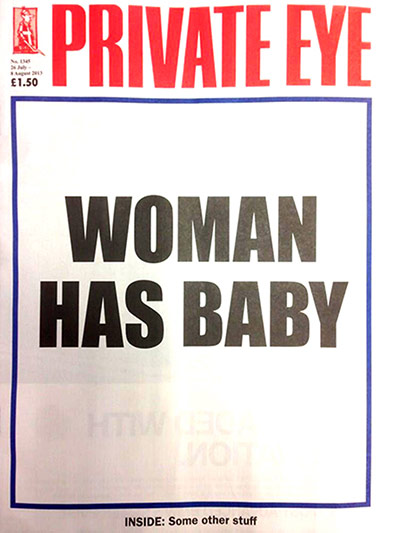
Full points to Private Eye for their royal baby cover:
Update: Charles Stross — another republican — has an almost sympathetic view of the new prince’s future:
The kid is not going to have anything remotely approaching a normal life. For one thing, under current UK law, he isn’t eligible to vote. His ultimate career path is already known and if he doesn’t want to put up with it, tough: the pressure to conform to expectations is enormous — he was born under a life sentence. When he ends up in that final occupation he won’t even be eligible for a passport (for long and complex constitutional reasons). He’s going to be the subject of paparazzi attention for the rest of his life. He’s almost certainly going to be sent to a private boarding school of some variety (probably Eton, as with his father), to ensure that he’s exposed to normal people (for “public schoolboy” values of normality); this is normal for the royal family, and it’s worked on previous generations. The usual recipe is for it to be followed by university, then officer training in one of the branches of the military, before joining the Old Firm and learning the onerous duties of public ceremonies and diplomatic receptions. The royals get a particularly brutal work-out in return for their privileges: what other family business would expect an 87 year old great-grandmother to make over 400 public appearances per year?
But those are the traditional parameters of a crown prince’s upbringing. This prince is going to find things a little different because he’s going to be the first designated future British monarch to grow up in a hothouse panopticon, with ubiquitous surveillance and life-logging …
I expect there to be Facebook account-hacking attacks on his friends, teachers, and associates — and that’s just in the near term. He’s going to be the first royal in the line of succession to grow up with the internet: his father, Prince William, was born in 1982 and, judging by his A-level coursework, is unlikely to have had much to do with computer networking in the late 1990s. This kid is going to grow up surrounded by smartphones, smart glasses (think in terms of the ten-years-hence descendants of Google Glass), and everything he does in public can be expected to go viral despite the best efforts of the House of Windsor’s spin doctors.
April 13, 2013
This from the country that invented hypersentimentality?
BBC America has what they call a list of 10 things about America that Brits will never understand. A few of them seem likely to be true, but this one is just not right:
6. Compulsive sentimentality
Gushing public displays are usually meant well but give Brits the creeps. For instance, my husband and I recently checked out of a B&B after a two-night stay. Instead of bidding us farewell with a firm handshake and a receipt, the owner — a man in his 50s — latched on to me, then my man, for a prolonged hug. Just when we thought it was over, he announced, “I’ll miss you guys!” No, actually. You won’t.
I can refute the notion that Americans are more embarrassingly sentimental with two words: Princess Diana. Did any country ever show more ridiculous sentimentality than Britain in their “grief” over a former royal person? The old notion of British reserve may still be true in some parts of the country, but most Brits these days seem to take extreme joy in wallowing in sentimentality.
February 26, 2013
Why did Machiavelli write The Prince?
In History Today, Alexander Lee discusses the situation in Florence leading up to the time when Niccolò Machiavelli wrote his (in)famous work:
In 1512, however, everything fell apart. After a series of military defeats, Soderini was forced from office. With the help of Pope Julius II, Giuliano di Lorenzo de’ Medici was installed as the de facto ruler of Florence. The Republic collapsed.
Immediately, Giuliano purged the government and instituted a city-wide witch-hunt. As a prominent republican, Machiavelli was summarily dismissed from his positions in late 1512, and in 1513, a warrant was issued for his arrest. Accused of plotting against the Medici, he was tortured using a cruel technique known as the ‘strappado’ — which left his shoulders dislocated, and his whole body in excruciating pain — before being released and exiled to his country estate.
It was at this point that Machiavelli penned The Prince. Broken, depressed, and penniless, he saw it as his best chance of getting into the Medici’s good books, and of recouping his losses. Dedicating the book first to Giuliano di Lorenzo de’ Medici — the very man who had destroyed his life — and, after Giuliano’s death, to his nephew, Lorenzo, Machiavelli set out to provide not just a guide to princely government, but a positive justification of all of the terrible things to which he had fallen victim. Much like a fallen Politburo members at a Soviet show trial, Machiavelli defended his persecution in the hope of securing favour. Only later did he feel safe enough to express his republican sympathies more openly.
February 16, 2013
February 2, 2013
Hidden under Britain’s defence HQ: Henry VIII’s wine cellar
It’s not open to the general public — and given what’s built on top of it, that’s probably no surprise:
Like the Pentagon, its better-known counterpart in the United States, Britain’s Ministry of Defence building is a fairly mundane, if gigantic, office block camouflaging a much more exciting subterranean realm of secret tunnels, bunkers, and — at least in the MoD’s case — a perfectly preserved Tudor wine cellar.
IMAGE: Henry VIII’s wine cellar, photograph by Nicola Twilley. The cellar is apparently occasionally used to host Ministry of Defence dinners and receptions, but is otherwise off-limits to the public other than by special request.
This stone-ribbed, brick-vaulted undercroft was built in the early 1500s by Cardinal Wolsey, as part of a suite of lavish improvements to York Place, the Westminster residence of the archbishops of York since the thirteenth century. The additions, which also included a gallery, presence chamber, and armoury, were intended to make York Place into a palace splendid enough to host the King. They succeeded well beyond Wolsey’s intentions: when Wolsey fell from favour, due to his inability to secure the papal annulment Henry VIII needed in order to marry Anne Boleyn, the King decided to move in.
[. . .]
York Place became the Palace of Whitehall, the principal residence of the English monarchy in London for nearly two hundred years, and Wolsey’s expansive cellar (he apparently received the first delivery of Champagne ever exported to England) became King Henry VIII’s Wine Cellar, the name by which it is still known today.
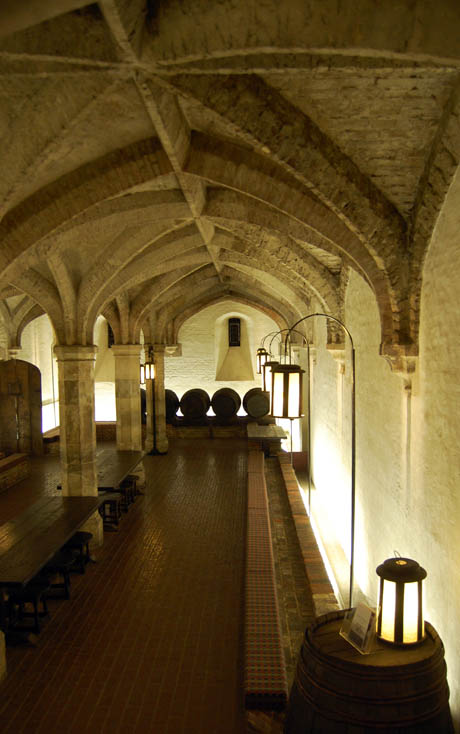
In Tudor times, the wine was stored in barrels, which presented a certain problem for service: “The barrels are historical reconstructions to represent how wine was stored in Tudor times. Henry VIII’s court consumed something like 300 barrels of wine each year, mostly exported from France and delivered to the palace by river. Interestingly, the wine was drunk very young by today’s standards — an August harvest might be on the table by November — and it was carefully blended with water, honey, and spices to mask its increasing sourness, as half-drunk casks allowed air into contact with the wine, which gradually oxidised into vinegar.”
January 25, 2013
Canada and the First Nations — separate nations, separate worlds
In the Globe and Mail, Tom Flanagan explains why the Idle No More protestors insisted on negotiating with the Governor-General:
Actually, native leaders’ focus on the governor-general as the representative of the Crown is based not on a lack of information about the Constitution but on a different understanding of it. They know perfectly well that the prime minister and government of the day are installed by the political process of the nation of Canada, but they don’t see themselves as part of that process and that nation. They see themselves as separate nations, dealing with Canada on a “nation to nation” basis. They see the Crown as a governmental structure above Canada – and therefore the authority with whom they should deal.
Sovereign nations do not legislate for each other; they voluntarily agree to sign treaties after negotiations. The radical conclusion from this premise is that Parliament has no right to legislate for aboriginal people without first getting their consent. Hence the hue and cry about consultation and the demand to repeal those parts of the government’s Budget Implementation acts that allegedly impinge on aboriginal and treaty rights. Today’s claim is that Parliament had no right to amend the Indian Act and the Navigable Waters Protection Act before consulting with (read: getting the approval of) first nations. But the same claim could be made regarding any legislation, for all laws made by Parliament affect native people. Enforcement of the Criminal Code arguably affects aboriginal rights by putting large numbers of aboriginal people in jail, and so on.
This indigenist ideology is not new. It started to appear in the 1970s, as a reaction to Jean Chrétien’s 1969 White Paper, which proposed repealing treaties and abolishing the special legal status of Indians. In its usual well-meaning but sometimes witless way, the Canadian political class thought it could deal with the reaffirmation of indigenism through word magic. Adopt the vocabulary of the radicals. Start calling Indian bands “first nations.” Pretend to recognize their “inherent right of self-government” or even “sovereignty.”
January 22, 2013
The obscure, unremembered — but bloodiest — battle in England
Unless you paid very close attention to British history, you may not even have heard of the bloodiest battle in England:
Consider, for example, Towton — the bloodiest battle on English soil, in which most of our nobility and their retainers took part and in which 28,000 people are said to have died. Since the population of the time was not much more than three million, that’s the equivalent of a battle today costing the lives of half a million.
If you were on the wrong side, that was it: curtains. Even if you survived the fighting you faced the greater horror of being ‘attainted’. This meant being hanged, drawn and quartered, while your goods were confiscated and your heirs disinherited in perpetuity. Such was the fate of 60 Lancastrian knights and gentlemen (including 25 MPs — so it wasn’t all bad…) after Towton.
As with the Norman Conquest and the first world war, the war’s victims numbered disproportionately among the English upper classes. ‘Out of 70 adult peers during this period, over 50 are known to have fought in battles they had to win if they wanted to stay alive,’ notes Desmond Seward, in his superb The Wars Of The Roses. Entire noble families were exterminated. In one campaign alone — 1460 to 1461 — 12 noblemen were killed and six beheaded, over a third of the English peerage.
And there was no way of opting out. If you were one of the 50 or 60 great families, you were too prominent politically and socially, and your private army was too valuable, to permit your remaining neutral. This, in turn, meant that your myriad kinsmen, retainers, and hangers-on had to follow you into battle, whether they liked it or not. As a government spokesman told the House of Commons in 1475, ‘None [of us] hath escaped.’
Update: Colby Cosh sent along a link to this Economist article from 2010:
Towton is a nondescript village in northern England, between the cities of York and Leeds. Many Britons have never heard of it: school history tends to skip the 400-or-so years between 1066 and the start of the Tudor era. Visitors have to look hard to spot the small roadside cross that marks the site of perhaps the bloodiest battle ever fought in England. Yet the clash was a turning point in the Wars of the Roses. And, almost 550 years later, the site is changing our understanding of medieval battle.
In Shakespeare’s cycle of eight plays, the story of the Wars of the Roses is told as an epic drama. In reality it was a messy series of civil wars — an on-again, off-again conflict pitting supporters of the ruling Lancastrian monarchy against backers of the house of York. According to Helen Castor, a historian at Sidney Sussex College, Cambridge, the wars arose from the slow breakdown of English government under Henry VI, a man who was prone to bouts of mental illness and “curiously incapable” even when well. As decision-making under Henry drifted, factions formed and enmities deepened. These spiralling conflicts eventually drove Richard Plantagenet, Duke of York, to assert his own claim to the throne. York was named Henry’s heir, but he was killed in December 1460. His 18-year-old son, Edward, proclaimed himself king just before the battle of Towton.
That set the stage for a vicious fight. Edward had his father and brother to avenge. After killing him, Lancastrian forces had impaled York’s head on a lance and adorned it with a paper crown. Following years of skirmishes others had scores to settle, too. In previous encounters, efforts had been made to spare rank-and-file soldiers. At Towton, orders went out that no quarter be given. This was to be winner-takes-all, a brutal fight to the death.
The result was a crushing victory for the Yorkists and for the young king. Edward IV went on to rule, with a brief interruption, until his death 22 years later — a death that triggered the final stage of the conflict and the rise of a new dynasty under Henry Tudor. The recorded death toll at Towton may well have been inflated to burnish the legend of Edward’s ascent to the crown. Yet there can be little doubt it was an unusually large confrontation.
The archaeological details of the battlefield excavations are quite interesting. Gruesome, but interesting.
January 20, 2013
A petition for Richard III to be reburied at York Minster
Elizabeth linked to this petition which might be of interest to Ricardians:
Joe Ann Ricca, Founder and Chief Executive of The Richard III Foundation, Inc., said: “Richard obviously had no choice after he was killed as to where his remains were taken, but today we have the opportunity to right the many wrongs that have been done to this unjustly maligned king, by correcting the distorted picture that has been painted of Richard over the centuries, and by bringing his remains home to Yorkshire, and to York Minster as he wanted.”
Richard, who was the last Plantagenet king, and the last English monarch to die in battle, had strong connections with the City of York and the County of Yorkshire. He spent much of his youth at Middleham Castle and for 12 years he ruled the North of England on behalf of his elder brother, King Edward IV, earning a widespread reputation for fair-mindedness and justice. After becoming king, he visited York several times and was showered with gifts each time. His son, Edward, was crowned Prince of Wales whilst in York.
Although entitled to be buried at Westminster Abbey alongside other kings and queens of England, Richard III announced his intention to be buried at York, and in 1483 set in motion plans for a new chantry chapel at York Minster. Indeed, so strongly was Richard linked to York that the City authorities greeted the news of his death at the Battle of Bosworth with these words: “King Richard, late mercifully reigning over us, was, through great treason, piteously slain and murdered, to the great heaviness of this city.”
December 16, 2012
Queen Victoria: not a model mother
A BBC documentary will shed some light on the domestic life of Queen Victoria and Prince Albert:
Helen Rappaport, author of Magnificent Obsession and a contributor to the three part series, said Queen Victoria and Prince Albert were “pretty awful parents” to their four sons and five daughters.
“She hated being pregnant. She had prenatal and postnatal depression. She didn’t breastfeed her children who she thought were horrible dribbling little things. She was not in the least bit maternal.
“Queen Victoria liked sex, but she didn’t like the result.”
[. . .]
Queen Victoria’s relationship with Prince Albert was a tempestuous one, punctuated with rows.
Prince Albert, who chided Queen Victoria in a letter. “It is a pity you find no consolation in the company of your children.
“The trouble lies in the mistaken notion the function of a mother is to be always correcting, scolding and ordering them about” he wrote.
November 26, 2012
“[W]e must rewrite the history distorted by that, ahem, writer from Stratford”
More on the project to determine if the remains discovered in Leicester are those of Richard III:
Whether the bones prove to be Richard’s or not, the discovery in September has already set academic journals, websites, university lecture circuits and the mainstream media abuzz across Britain, sparking intense and occasionally impolite exchanges. On the floor of the House of Commons, members of Parliament are eloquently clashing, with representatives from York — for whom Richard was the last hope against rival Lancastrians in the War of the Roses — demanding the restoration of his tarnished image. One organization of die-hard Richard III supporters (there are at least two) is running a national ad campaign to clear the king’s name.
There are even calls for a state funeral, giving the medieval king a send-off steeped in the pomp and circumstance of contemporary Britain.
“I suppose we won’t dash off to the Folger Library in Washington and destroy the First Folio, but we must rewrite the history distorted by that, ahem, writer from Stratford,” Hugh Bayley, a member of Parliament from York, said with tongue only partly planted in cheek. “The fact that a Mr. Shakespeare decided to write some play about a hunchback shouldn’t blacken the name of a fine, upstanding defender of country.”
Yet if the remains are indeed those of the long-lost sovereign — something archaeologists call extremely likely — it also raises a conundrum: Where to bury one of England’s most demonized characters?
Under Church of England protocol, the bones, should they prove to be Richard’s, appear destined to end up in the cathedral at Leicester, the city where the remains were found. But many insist they should instead go to the Anglican cathedral in York, the city where history suggests that he wanted to rest. Still others question whether burial should be in an Anglican cathedral at all, as he died a Roman Catholic, reigning by the grace of God and the pope.
November 5, 2012
Remember, Remember the Fifth of November
Today is the anniversary of the Gunpowder Plot:
Everyone knows what the Gunpowder Plotters looked like. Thanks to one of the best-known etchings of the seventeenth century we see them ‘plotting’, broad brims of their hats over their noses, cloaks on their shoulders, mustachios and beards bristling — the archetypical band of desperados. Almost as well known are the broad outlines of the discovery of the ‘plot’: the mysterious warning sent to Lord Monteagle on October 26th, 1605, the investigation of the cellars under the Palace of Westminster on November 4th, the discovery of the gunpowder and Guy Fawkes, the flight of the other conspirators, the shoot-out at Holbeach in Staffordshire on November 8th in which four (Robert Catesby, Thomas Percy and the brothers Christopher and John Wright) were killed, and then the trial and execution of Fawkes and seven others in January 1606.
However, there was a more obscure sequel. Also implicated were the 9th Earl of Northumberland, three other peers (Viscount Montague and Lords Stourton and Mordaunt) and three members of the Society of Jesus. Two of the Jesuits, Fr Oswald Tesimond and Fr John Gerard, were able to escape abroad, but the third, the superior of the order in England, Fr Henry Garnet, was arrested just before the main trial. Garnet was tried separately on March 28th, 1606 and executed in May. The peers were tried in the court of Star Chamber: three were merely fined, but Northumberland was imprisoned in the Tower at pleasure and not released until 1621.
[. . .]
Thanks to the fact that nothing actually happened, it is not surprising that the plot has been the subject of running dispute since November 5th, 1605. James I’s privy council appears to have been genuinely unable to make any sense of it. The Attorney-General, Sir Edward Coke, observed at the trial that succeeding generations would wonder whether it was fact or fiction. There were claims from the start that the plot was a put-up job — if not a complete fabrication, then at least exaggerated for his own devious ends by Robert Cecil, Earl of Salisbury, James’s secretary of state. The government’s presentation of the case against the plotters had its awkward aspects, caused in part by the desire to shield Monteagle, now a national hero, from the exposure of his earlier association with them. The two official accounts published in 1606 were patently spins. One, The Discourse of the Manner, was intended to give James a more commanding role in the uncovering of the plot than he deserved. The other, A True and Perfect Relation, was intended to lay the blame on Garnet.
But Catesby had form. He and several of the plotters as well as Lord Monteagle had been implicated in the Earl of Essex’s rebellion in 1601. Subsequently he and the others (including Monteagle) had approached Philip III of Spain to support a rebellion to prevent James I’s accession. This raises the central question of what the plot was about. Was it the product of Catholic discontent with James I or was it the last episode in what the late Hugh Trevor-Roper and Professor John Bossy have termed ‘Elizabethan extremism’?


