“What Wilberforce vanquished was something even worse than slavery,” says [Eric] Metaxas [in Amazing Grace], “something that was much more fundamental and can hardly be seen from where we stand today: he vanquished the very mindset that made slavery acceptable and allowed it to survive and thrive for millennia. He destroyed an entire way of seeing the world, one that had held sway from the beginning of history, and he replaced it with another way of seeing the world.” Ownership of existing slaves continued in the British West Indies for another quarter-century, and in the United States for another 60 years, and slave trading continued in Turkey until Atatürk abolished it in the Twenties and in Saudi Arabia until it was (officially) banned in the Sixties, and it persists in Africa and other pockets of the world to this day. But not as a broadly accepted “human good”.
There was some hard-muscle enforcement that accompanied the new law: the Royal Navy announced that it would regard all slave ships as pirates, and thus they were liable to sinking and their crews to execution. There had been some important court decisions: in the reign of William and Mary, Justice Holt had ruled that “one may be a villeyn in England, but not a slave,” and in 1803 William Osgoode, Chief Justice of Lower Canada, ruled that the institution was not compatible with the principles of British law. But what was decisive was the way Wilberforce “murdered” (in Metaxas’ word) the old acceptance of slavery by the wider society. As he wrote in 1787, “God almighty has set before me two great objects: the suppression of the slave trade and the reformation of manners”.
The latter goal we would now formulate as “changing the culture” — which is what he did. The film of Amazing Grace shows the Duke of Clarence and other effete toffs reeling under a lot of lame bromides hurled by Wilberforce on behalf of “the people”. But, in fact, “the people” were a large part of the problem. Then as now, citizens of advanced democracies are easily distracted. The 18th-century Church of England preached “a tepid kind of moralism” disconnected both from any serious faith and from the great questions facing the nation. It was a sensualist culture amusing itself to death: Wilberforce goes to a performance of Don Juan, is shocked by a provocative dance, and is then further shocked to discover the rest of the audience is too blasé even to be shocked. The Paris Hilton of the age, the Prince of Wales, was celebrated for having bedded 7,000 women and snipped from each a keepsake hair. Twenty-five per cent of all unmarried females in London were whores; the average age of a prostitute was 16; and many brothels prided themselves on offering only girls under the age of 14. Many of these features — weedy faint-hearted mainstream churches, skanky celebs, weary provocations for jaded debauchees — will strike a chord in our own time.
“There is a great deal of ruin in a nation,” remarked Adam Smith. England survived the 18th century, and maybe we will survive the 21st. But the life of William Wilberforce and the bicentennial of his extraordinary achievement remind us that great men don’t shirk things because the focus-group numbers look unpromising. What we think of as “the Victorian era” was, in large part, an invention of Wilberforce which he succeeded in selling to his compatriots. We, children of the 20th century, mock our 19th-century forebears as uptight prudes, moralists and do-gooders. If they were, it’s because of Wilberforce. His legacy includes the very notion of a “social conscience”: in the 1790s, a good man could stroll past an 11-year-old prostitute on a London street without feeling a twinge of disgust or outrage; he accepted her as merely a feature of the landscape, like an ugly hill. By the 1890s, there were still child prostitutes, but there were also charities and improvement societies and orphanages. It is amazing to read a letter from Wilberforce and realize that he is, in fact, articulating precisely 220 years ago what New Yorkers came to know in the Nineties as the “broken windows” theory: “The most effectual way to prevent greater crimes is by punishing the smaller.”
Mark Steyn, The [Un]documented Mark Steyn, 2014.
July 19, 2025
QotD: William Wilberforce and the anti-slavery movement
July 3, 2025
Nicolas Romero, the inventor who introduced “Spag Bol” to England
In the latest Age of Invention newsletter, Anton Howes describes the career of a most inventive man, Signior Nicolas Romero originally of Naples … maybe:
The British interpretation of Spaghetti Bolognese — widely known as “spag bol” — is a pasta dish with a meat and tomato sauce.
The person who tried to bring these coal balls or briquettes to London was one Nicolas Romero — a name that has been almost entirely and undeservedly forgotten. Indeed, the one other historian to have ever noticed a handful of his achievements was unable to find his first name. And so I get the pleasure of being able to give a few glimpses of his remarkable story for the first time in over four hundred years.
Nicolas Romero seems to have originally hailed from the Spanish Habsburg possessions in Italy, most probably Naples. He was personally acquainted with Cardinal Granvelle, who was the regent in Naples from 1570 to 1575, and may have been involved in the Spanish attack on Tunis in 1573-4, where he picked up some siege techniques used by the Ottoman Turks. Romero then moved to Spanish-ruled Milan, where he was apparently the close confidant of one “Dr Sirnige” or “Dr Siring” (as it sounded to an English ear), who received a hefty reward for discovering a “defensative” or preventative treatment against a plague that killed some 15% of the city’s population in 1576-8. Then, Romero appears to have gone to the Low Countries, much of which was in outright revolt against Spain, where he picked up the details of how coal balls were made at Liège.
Then, astonishingly, he suddenly switched sides. Perhaps having fallen afoul of the Inquisition, or perhaps having converted to Protestantism, from some point in the 1580s he was only ever involved with the manifold enemies of Spain. He moved to England, even partaking — and I suspect investing — in its unsuccessful invasion of Spanish-ruled Portugal in 1589, where he was captured and held in “a very cruel prison” for ten months until managing to escape.
Somehow making his way back to London, Romero there befriended the barrister, alchemy enthusiast, and wannabe inventor Hugh Plat. It was via Plat, who plied all of his acquaintances for their technological know-how, and recorded his sources in his manuscripts, that Romero introduced various innovations to England.
Romero told him of how mere bags of linen or canvas, when filled with whatever dirt or sand was to hand, could be used to instantly create a “musket-proof” trench — in essence, the modern sandbag — which had been used by the Turkish army in their successful siege of La Goleta near Tunis. Plat saw a wider potential too, hoping to use these sandbags in reclaiming land from both marsh and sea.
In 1593, when a deadly plague gripped London, Romero gave Plat the recipe of Dr Sirnige’s defensative pills, as used in Milan, and together with the apothecary John Clarke they produced and distributed hundreds of them, including to Queen Elizabeth I and her entire Privy Council, apparently with great success. Clarke published their case notes under the boastful title The Trumpet of Apollo Sounding out the Sweet Blast of Recovery in 1602, though it was a little premature. Just a year later plague returned to London with a vengeance.
Most enduringly of all, Romero told Plat the details of making pasta, which Plat then made and marketed as a cheap and long-lasting food for the English armed forces. What Plat called his “macaroni” even won plaudits from Sir Francis Drake, and in 1594 he published the first known depiction of a pasta extruder. To Nicolas Romero, then — a name never mentioned by even specialist historians — belongs the considerable distinction of introducing the English to pasta. He is the patron saint of “Spag Bol” (if you are Italian, and do not wish to suffer a heart-attack, under no circumstances should you look up this term).
Romero was full of other ideas too. Romero gave Plat his methods for preserving wine, chestnuts, butter, turnips, and quince. He revealed to him the principle behind the diving bell; how to make a metal rotisserie oven; how to catch crayfish; how to engrave glass; how to make vellum paper translucent; how to keep snow from melting over the course of a year by storing it underground; and how few drops of sulphuric acid might be added to a ship’s water supply to keep it fresh for longer. Along with various recipes for Italian salads, and how to make smoke grenades, he even told him how to raise water using atmospheric pressure — perhaps the earliest record in England of what would eventually be developed into the steam engine. In papers seized by the government from the soldier Sir Thomas Arundel, who was arrested for being a Catholic in 1597, are mentions of not just of Romero’s sandbag “trench”, but “also his bridge, his boat to go without wind or sail, and his device against horsemen” — which according to Plat’s manuscripts was a kind of rest for muskets that could also serve as a pike.
Throughout the 1590s, Plat tried to commercialise some of Romero’s inventions, including a method to replace the expensive copper vessels for boiling water for home-brewing with a supposedly more efficient tub made of treated wood; some kind of light, portable water pump; and the Liège-style coal balls or briquettes. But with little success. By 1594 Romero was running low on money and had given up on trying to make it in England, having apparently passed up various opportunities to serve some German princes. So he left Plat in London to keep trying to sell his inventions, while he himself went to Holland to become an engineer in the service of Count Maurice of Nassau, who was fighting to free the Netherlands from Spanish rule.
While in the Netherlands Romero patented his water pump and the wooden boiling tub — an invention apparently “very much needed in the present time of cities under siege”, for whom fuel supplies were scarce. And having gained Count Maurice’s trust and backing, he wrote to one of Elizabeth I’s favourites, the Earl of Essex, in a fresh bid to get the two inventions, along with the coal balls, patented in England. Naturally, Hugh Plat served as his go-between.
Despite such allies, however, they once again failed. Romero would patent more inventions in the Netherlands in 1598 — a means of reducing the friction on the axles of carts and carriages, and a winch for more easily lifting heavy items like anchors and cannon — but he wasn’t to get a patent in England until ten years later in 1608. Just months before Plat’s death, Romero, with one James Jackson, presumably an investor, was finally granted an English patent for some kind of universally-applicable method of saving fuel. Unfortunately, the wording of the patent gives no indication whatsoever of what it involved.
I’ve traced no further record of Romero — if anyone is familiar with German, Dutch, Italian or Spanish sources and has ever come across the name, please do get in touch
April 25, 2025
What Were Georgian Attitudes Towards Sex? | Georgian Pleasures
History Hit
Published 12 Sept 2024Historian Dr Kate Lister removes Bridgerton‘s rose-tinted glasses, unlaces the corsets and unbuttons the breaches of the Georgians. Join Kate as she investigates how s*x and the world of celebrity were a big thing long before the 20th century.
The fabulous wealthy elite of Bridgerton look perfectly preened, their teeth, hair, make up, even their sex scenes are all filled with opulent glamour! But in reality a lot of people in Georgian society, including the wealthy, were dealing with a myriad of issues, from syphilis, teeth decay and scandals to laudanum and gin addictions. All of this would have been rife and incredibly visible on the big city streets during the booming industrial revolution.
Kate uncovers what went on betwixt the Georgian sheets: who’s doing what, where, how and with whom. Along the way she’ll explore extraordinary guides to s*x work in London and Edinburgh and unwrap the world of 18th century condoms, syphilis and even high profile and hidden sex clubs. All of this will help to unearth the real lives of the people stomping the streets, pubs and back alleys of these lavish Georgian cities. No stone is left unturned in the quest to reveal the real lives of Georgian society!
(more…)
April 2, 2025
Eating in a London Blitz Bomb Shelter
Tasting History with Max Miller
Published 19 Nov 2024Hearty, if mushy, vegetable soup with honey biscuits and a cup of tea
City/Region: London
Time Period: 1940If you were taking shelter underground during the Blitz, a period in WWII when German planes bombed British cities, the food options were somewhat limited. You could bring snacks with you, but there were also canteens from which workers sold things like tea, cocoa, soup, biscuits, and chocolate.
This soup, fittingly named Blitz Soup, is mainly composed of fresh vegetables that many would have had access to from their victory gardens. While it’s surprisingly flavorful and delicious, if you cut down the cooking time to about 30 minutes, the vegetables wouldn’t be as mushy. Though either way, a thermos of this soup would have been a comforting meal while taking shelter.
Instead of the historical recipe, which is very basic, here’s the poem that accompanied it.
When down to your shelter you flitz,
It may not be quite like the Ritz.
If you drink something warm,
You’ll come to no harm,
And the best soup to drink is the “Blitz”.
(P.S.- Any vegetables can be used, and you’ll find this a very useful soup to take to the shelter if you have to take cover. We hope you don’t.)
— Gert and Daisy’s Wartime Cookery Book, 1940
February 21, 2025
QotD: Why does it cost so much to build modern infrastructure?
Now, obviously, there are reasons why building infrastructure is expensive. One is that politicians have taken unto themselves the power to decide what infrastructure should be built how and where. Therefore infrastructure is built by fuckwits, obvious, innit? We’ve also allowed far too many people to dip their ladle in the gravy — that £300 million planning inquiry into a tunnel under the Thames. And did I say fuckwits already — that £100 million bat tunnel.
But one reason all these things are so expensive is because we’re not doing them on terra nullius. If we start with a bare field a ground source heat pump might well not be that bad an idea. Communal heating systems into an entirely new development, maybe.
But putting ground heat pumps into central London? Can’t do that ‘ere mate, someone’s already built central London right where you want to dig up. HS2 goes right through some of the most expensive — and inhabited by the highly vocal — countryside in the nation. Edinburgh, minor though it is, still has that central London problem.
This also explains why Mercury Comms employed the ferrets. The tubes already existed and fibreoptic could be stuffed down them. They didn’t have to dig up central London, see?
Agreed, this isn’t one of the world’s truly great insights but it is something to keep in mind. The reason building the infrastructure for the next level of civilisation costs so much is because we already have a civilisation. The existence of which gets in the way of the building men …
Tim Worstall, “Why Is Infrastructure So Damn F’n Expensive?”, It’s all obvious or trivial except …, 2024-11-18.
February 11, 2025
Mapping the Tube 1863-2023: Treasures of the Tube Map
Jago Hazzard
Published 27 Oct 2024Mapping the Tube: 1863-2023 at The Map House is a captivating selling exhibition showcasing rare maps and materials spanning over 160 years of London’s transport history. It features the largest collection of Harry Beck manuscripts ever offered for sale, alongside early cartographic works and striking posters by 20th-century artists.
(more…)
January 31, 2025
I Spent Over 12 Hours on an Amtrak Train (on purpose)
Not Just Bikes
Published 6 Oct 2024Chapters
0:00 Intro
1:24 Leaving New York
3:04 On the train
4:03 The views
4:38 Freight trains & delays
5:37 The train is so much more comfortable
7:09 The border crossing
8:17 The Canadian side
9:24 Should you take this train?
10:20 Comparisons to Europe & Japan
11:20 We need more high-speed rail
12:02 VIA Rail is bad … and getting worse
12:58 VIA Rail is expensive!
14:11 The new VIA Rail baggage policy 🤦♂️
15:49 Better train service is important!
17:14 Concluding thoughts
(more…)
January 13, 2025
January 2, 2025
Why Germany Lost the Battle of Britain
Real Time History
Published 2 Aug 2024Summer 1940. The United Kingdom is gripped by the fear of a German invasion. Even if the Luftwaffe secures the sky over Britain, could Germany’s Operation Sea Lion ever really work?
(more…)
November 14, 2024
QotD: The tragedy of the commons in North London
Despite this being North London we’re not talking about common people here and the tragedy of their entering the precincts of the progressives. Rather, the tragedy of common resources.
One fact about those bathing ponds on the Heath:
Honesty boxes for bathers to pay to swim were introduced in 2005. There were plans for a compulsory charge in 2012, but they came to nothing.
We have open access to a resource, Marxian access. We also have one other fact:
It was once a well-kept secret. Now the bathing ponds on Hampstead Heath are among the most crowded parts of London on a hot summer’s day.
We have – by one measure at least – excessive use of that resource, use that needs to be limited in some manner.
This is a problem that has been noted before, it’s called the Tragedy of the Commons. As Garrett Hardin points out there are only two ways of restricting such access, capitalist – charge for it – or socialist – regulate.
The third option, Elinor Ostrom’s, does not work with this number of people. That communal agreement tops out at about 3,000 peeps, not 10 million.
Which of the two solutions works depends upon the specific circumstance and isn’t the point to be made here. Rather, the lesson to learn is that Marxian access just doesn’t work when demand is at or above capacity. A useful thing to think about when contemplating other areas of the economy.
Tim Worstall, “Hampstead Heath Ponds And The Tragedy Of The Commons”, Continental Telegraph, 2020-01-19.
October 16, 2024
Many of the posh pro-trans activists are objectively anti-gay
It’s starting to be a true wedge issue in the LGBT community, as the logic of the pro-trans activists leads quite directly to the suppression of the gay and lesbian parts of that community:
It was hardly a plague of locusts, but it was disruptive nonetheless. During the annual LGB Alliance conference at the Queen Elizabeth II centre in Westminster on Friday afternoon, teenage activists unleashed thousands of crickets into the auditorium. The inconvenience was only temporary. The crowd simply relocated to another room and the event went on as before.
As those responsible were apprehended, many people were struck by just how young and posh they were. By this point, it should surprise precisely no-one that anti-gay activism in its current form is a predominately bourgeois pursuit. The symbolism of the crickets was, of course, deliberate. It was an attempt to dehumanise those in attendance, to suggest that they were akin to parasites, vermin, spreaders of disease, a common trope of those who seek to demonise minorities.
The perpetrators were children, and so it would be unwise to speculate too much on their motives. It is likely they were being manipulated by the group that has claimed responsibility, calling itself “Trans Kids Deserve Better”. As Bev Jackson, co-founder of LGB Alliance said on my show last night:
Trans kids do deserve better. They deserve better than to be told lies that that they might have been born in the wrong body. They deserve better than to be told that these hormones and surgeries that they are clambering for will somehow solve all their problems. Many are on the autism spectrum. Many are struggling with their sexual orientation. We know that. They deserve better than to be told that we hate them. And they deserve better than to be labelled trans when they’re going through all the turbulence of adolescence, when your feelings about yourself are in constant flux.
Irrespective of the intentions of the teenagers involved, this was anti-gay activism. To attack a group of lesbian, gay and bisexual people who have assembled to discuss the ongoing threats to their civil rights could hardly be defined in any other way. Likewise, to refer to groups such as LGB Alliance as “anti-trans”, “transphobic” or “hateful” – as activist media outlets such as the Metro and the Guardian have been known to do — is also an anti-gay strategy. In order to address a problem, one needs to label it accurately.
Gender identity ideologues are, by definition, anti-gay. They are campaigning to force their pseudo-religious belief-system onto the rest of society, one that claims that same-sex attraction is a myth, and that a mysterious spiritual sense of “gender” is the defining feature of homosexuality. Even if they have convinced themselves that they are “pro-trans” and “compassionate” and “progressive”, the implementation of their demands would result directly in the demolition of gay rights. And so “anti-gay activism” is not only an accurate description, it also cuts to the heart of what is at stake.
September 27, 2024
So much “modern art” ages like milk
Most of Andrew Doyle’s latest column is behind the paywall, but I found myself nodding along to the first portion about the descent of modern art:
The works on display at New York’s Museum of Modern Art (MOMA) have been curated with care. On my recent visit I began on the fifth floor, where you can admire art from the 1880s until the 1940s. On the fourth floor you will find works from the 1950s to the 1970s, and then two floors below are the collections from the 1980s until the present day. I wonder whether this arrangement is deliberate; the literal descent of the visitor from one floor to the next reflecting the figurative descent of artistic quality through the century.
And so while on the upper floor you can admire the melting clocks of Salvador Dalí’s most famous and haunting work, The Persistence of Memory (1931), and René Magritte’s The Lovers (1928), a curious meditation on romanticised desire, by the time you reach the second floor there are some cuddly toys glued together into clumps which are dangling from the ceiling. I didn’t bother to check who was responsible for this nonsense.
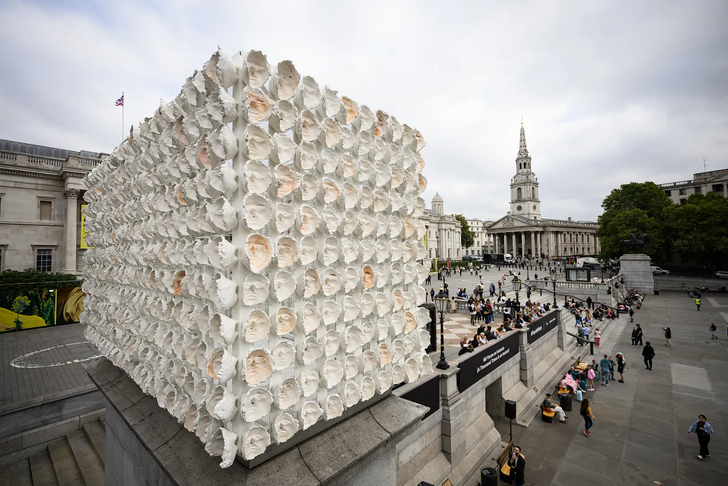
I have often tried to defend some of the more intriguing efforts at modern conceptual art, but I also recognise that we must be able to admit when art is simply bad. I felt the same when I saw the most recent sculpture to grace the fourth plinth in Trafalgar Square. It is a piece by Mexican artist Teresa Margolles entitled Mil Veces un Instante. It consists of over seven-hundred death masks of trans, non-binary and gender non-conforming people arranged into a cuboid. The faces are meant to represent those who have been the victims of violence, including the artist’s friend Karla who was murdered in Juárez in December 2015.
I don’t doubt the sincerity of the passion behind the project, or how the tragedy of this death informed the vision of the piece, but as a work of art it is banal. Like many conceptual pieces inspired by voguish identity politics, it is propagandistic and uninspiring. The Pink News has claimed that those who dislike the piece are “bigots”. I would say they simply have good taste.
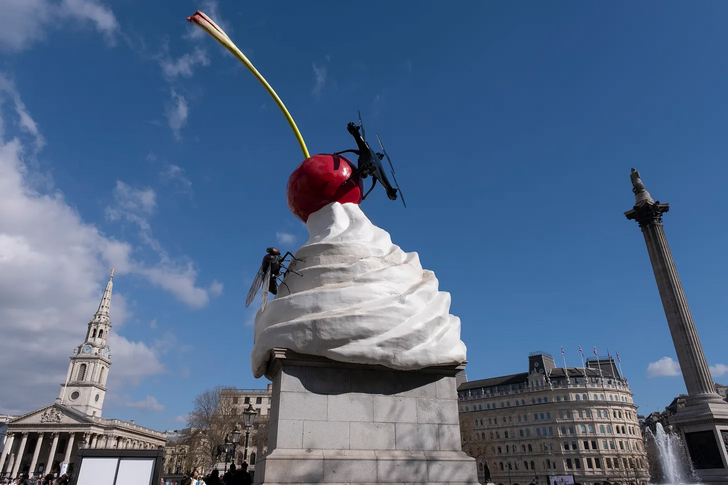
I suppose it is an improvement on Heather Phillipson’s godawful “The End”, a sculpture of a dollop of whipped cream with a cherry, a drone and a fly on the top which was finally taken down from the fourth plinth in 2022. I doubt that anyone except the artist and her close family members were disappointed to see it gone. While I understand the subjectivity of such matters, surely we should be aspiring to higher standards when it comes to art in public spaces?
August 28, 2024
1974 – Britain’s nadir
In the second part of Ed West‘s appreciation of Dominic Sandbrook’s Seasons in the Sun, Britain was described as “sliding, sinking, shabby, dirty, lazy, inefficient, dangerous, in its death throes, worn out, clapped out, occasionally lashing out” by Margaret Drabble in her 1977 novel The Ice Age, and it certainly seems to fit the bill quite well:
The Times reported in October of that year that London’s West End was in a “sorry state”, with parts of Shaftesbury Avenue and Charing Cross Road “in the sort of condition that, in Birmingham or Manchester, would qualify them for wholesale slum clearance”.
Journalist Clive Irving wrote that London had become “a semi-derelict slum”, a city blighted by “tacky porno shops, skin movies, pinball arcades, and toxic hamburger joints” while “behind neon facades the buildings are flaking and unkempt”.
The capital had lost a million and a half people since its peak in 1939, and would continue its decline for another decade. Whitehall Mandarin Ronald McIntosh declared that “London is evidently losing population quite heavily [and] services are steadily deteriorating, and nobody seems to have the least idea of how to deal with it”.
The country as a whole was haemorrhaging people, and in 1975 its population fell for the first time since records began. In the spring of 1974 applications for emigration to Canada went up 65 per cent, while New Zealand even felt compelled to put restrictions on people fleeing the old country.
Doctors in particular were leaving in droves, and recruitment agency Robert Lee International estimated that the number of professionals wanting to move abroad rose by 35% in just six months, from January and July 1975. Interest was keenest among engineers, accountants, scientists and teachers.
Many high earners were fleeing excessive tax rates, so punitive that even the Bond producer Albert R Broccoli left to make the iconic British movies elsewhere, and Moonraker would be filmed in France.
Gone were the days of the Swinging Sixties; instead, the London of George Smiley was “the city of the Sex Pistols and The Sweeney, not the Beatles and The Avengers; a city of tramps and hooligans, hustlers and muggers, the downtrodden and the disappointed, haunted by the deadly figure of the IRA bomber”.
Britain’s second city was in an even worse state. During Wilson’s first term Birmingham had been hailed as “the most go-ahead city in Europe”. Now the Times admitted it looked like a “large and chaotic building site”.
Travel writer Jonathan Raban described Southampton’s Millbrook estate as “a vast, cheap storage unit for nearly 20,000 people”. The country’s increasing problem with crime, hooliganism, graffiti and drug addiction meant that residents wouldn’t even hang their clothes in communal areas, for fear of theft.
The great architectural feats of the post-war era were beginning to look like a miserable failure, and none more so than the utopian social housing schemes, which had often entailed destroying closely-knit and organic communities in overcrowded and run-down – but rescuable – terraced housing.
Christopher Brooker visited Keeling House in Bethnal Green and found “its concrete cracked and discolouring, the metal reinforcement rusting through the surface, every available inch covered with graffiti”. Here was the story of modern Britain, “the bright, anticipated dream followed by a seedy, nightmarish reality”.
The National Theatre’s Peter Hall visited the New York Juilliard School and upon return home “found it depressing to compare it with our own already run-down, ill-maintained South Bank building”.
“The English apparently no longer care enough about material surroundings,” he wrote: “They even seem to take a positive pleasure in defiling them.”
August 25, 2024
QotD: P.G. Wodehouse’s unique way to get letters delivered
In previous columns […] I wrote about Homage to PG Wodehouse, a 1973 tribute edited by Thelma Cazalet-Keir, sister-in-law of Wodehouse’s beloved stepdaughter Leonora. My final extracts begin with an account by the American Guy Bolton (1884-1979), who collaborated with the Master on no fewer than 21 musical comedies for the stage and became his lifelong friend. In one of my favourite anecdotes, he describes how he called on Wodehouse in London in the mid-1920s.
“He was living in bachelor quarters in a tall, old-fashioned building in Queen’s Gate. His flat was on the fifth floor. There was no lift. I was travel tired and I toiled up the long staircase, pausing on the landings to pant. I found his door ajar and, entering, I found him writing a letter. He greeted me with a cheery ‘Hurrah, you’re here!’ and added, ‘Just a tick and I’ll get this letter off.’
“He shoved the letter in an envelope, stuck a stamp on it, then went over to the half-open window and tossed it out. ‘What on earth?’ I asked. ‘Has the joy of seeing me brought on some sort of mental lapse? That was your letter you just threw out of the window.’ ‘I know that. I can’t be bothered to go toiling down five flights every time I write a letter.’ ‘You depend on someone picking it up and posting it for you?’ ‘Isn’t that what you would do if you found a letter stamped and addressed lying on the pavement? All I can say is it works.’ ‘Well I wish you’d write me a letter while I’m here in London. I’d like to show it round in America – a bit of a score for good old England’.”
Bolton goes on: “It was the second day after moving into a fourth-floor flat in South Audley Street when my doorbell rang and I opened it to a rather stout individual somewhat out of breath. ‘Are you Mr Bolton? I have a letter for you.’ The envelope was in Plum’s handwriting.
“He said he was a taxi driver but refused a tip, accepting instead a bottle of Guinness. While he was drinking it, I phoned Plum. ‘I have your letter,’ I said. ‘What?’ said Plum in a slightly awed voice. ‘I only threw it out of the window 20 minutes ago.’ ‘You were right,’ I said. ‘It’s by far the quickest way to send a letter to a friend in London.’ ‘Yes, indeed. The GPO had better look to their laurels and keep an eye on their laburnums’.”
Of his friend, Bolton says: “He has one quality that is rare in our age. It is innocence. It carries with it a trusting belief in the goodness of heart of his fellow men. Suspicion and distrust have no place in his nature. The characters in his books share in it – even his villains are likely to succumb before a finger shaken by one of those bright-eyed, no-nonsense Wodehouse heroines.”
Alan Ashworth, “That reminds me: A final homage to Wodehouse”, The Conservative Woman, 2024-05-21.
July 31, 2024
The History of the British Rail Symbol
Jago Hazzard
Published Apr 21, 2024Moving forward or indecision?