
The word “liberal” began to encounter a well-known crisis starting in about 1980. Liberalism had become equated with feeble criminal justice, Cold War slackness, large public deficits, high taxes, squirrelly currency … the mix of outrages varied from place to place and from time to time, but the common theme was weakness. To be a liberal was to be spongy and soft-headed about Darwinian imperatives of life, foreign policy and economics.
Our federal Liberal party has, given time, addressed some of these perceptions head-on and simply outlasted others. The capital-L Liberal brand has benefited from a whole range of phenomena, from Paul Martin’s curtailment of the federal public service to Justin Trudeau beating the crap out of a Conservative senator on television and looking good doing it. Trudeau took pains to stress the presence of “liberty” in the name “Liberal,” which had become almost a forgotten secret, a coincidence of etymology. That deprived the Conservatives of some of the energy that socially liberal and libertarian fellow-travellers might have brought to the contest.
Perhaps the secret of recent history in the provinces is that conservatives are not addressing psycho-semantic problems with the term “conservative.” How many times have you heard someone say, “I’m a social liberal but a conservative on economics”? This is the default political position of most adults now, is it not? Liberalism, which is to say pluralism, has won the argument in the “social” realm of government. What once was liberalism in economics, the dirigisme that my generation was taught to think of as the “mixed economy,” has largely lost; but the people who call themselves Liberals have succeeded at extricating themselves from the reputational burden.
Colby Cosh, “Is conservatism on the way out?”, National Post, 2015-11-10.
October 9, 2017
QotD: The fall and rise of the “liberal” label in Canada
May 10, 2017
BC Greens the biggest winners in provincial election
Jay Currie explains why, even though they didn’t “win” the election, the BC Green Party is the biggest winner from yesterday’s general election in the province:
There are two losers tonight: the Liberals and the NDP. And there is one winner: the Greens. They managed to split the NDP vote and likely cost the NDP a majority government.
However, where the NDP and the Liberals have no obvious room to grow their electorate, the Greens have a very good shot at expanding theirs. The fact is that the people who shop at Whole Foods, send their kids to “French Immersion” if they can’t afford private (not for racist reasons of course) and think recycling is an act of benediction are legion. They used to vote NDP, now they have an alternative.
Andrew Weaver may be a lousy climate scientist but he is not an unintelligent man. He can count (so long as it does not involve climate change time series) and there are six ridings where the Greens came second. A rational, non-coalition, support of the Liberals would let him pass legislation of greater consequence than a ban on mandatory high heels for women in serving jobs. The Liberals, who will likely be reduced to a rural rump despite having likely won the most seats, are basically being elected by BC’s version of “deplorables”. Nice people think they are a bit, well, common.
Dr. Weaver, well educated, Oak Bay resident and articulate guy that he is should be able to target those nice, white, very liberal people and peel them away from both the Liberals and the NDP. Plus, Weaver has the children who have grown up on Green ideology masquerading as education.
One winner tonight: the Greens.
March 24, 2017
Kathleen Wynne … the Ontario Liberal Party’s saviour?
Chris Selley tries to position Ontario Premier Kathleen Wynne as being the greatest asset of the Liberal Party:
The question of Kathleen Wynne’s future as leader of the Ontario Liberal Party made its way to the public airwaves this week in the form a panel discussion on TVO’s The Agenda. Host Steve Paikin asked former Liberal MP Greg Sorbara what advice he would offer the premier, and his response caused a bit of a stir.
“It is extremely unlikely that you’ll win the next election. The facts are the facts,” he said he would tell her. “I have not seen a party in the last year of its mandate turn (poll) numbers around when they are as bad as (the Liberals’) are.” And he noted the numbers are “particularly bad” for Wynne personally.
The latest Mainstreet Research/Postmedia poll, released last week, had the Liberals at 22-per-cent support, 10 points behind the Tories. Forum Research last measured Wynne’s approval rating at 11 per cent, and her disapproval rating at 77 per cent. Just nine per cent said she would make the best premier of the three party leaders.
Okay, so where does Wynn come off as the Liberals’ best hope?
If Liberals are worried “it’s all over,” as Sorbara put it, I would submit it’s in large part because, on election day 2018, they’ll have been in power for 15 and a half not very impressive years. That’s the longest streak in Ontario in three decades. No party has managed it federally since St. Laurent took over from Mackenzie King.
Stuff builds up.
Stuff like, you know, Dalton McGuinty promising in writing not to raise taxes, then instituting a “health premium,” which he claimed wasn’t a tax, and then admitting under duress that it was a tax; like lottery retailers defrauding players to the tune of $100 million, and casinos managing to lose money; like allowing Ornge to spin out of control into corruption, mismanagement and overspending; like the electronic health records debacle; like turning a blind eye while native protesters illegally occupied Caledonia; like flushing a billion dollars or so down the john to cancel gas plants sooner than risk voters’ ire, then claiming there’s “no wrong time to make the right decision;” like various apparatchiks winding up arrested for little things like bribery and conspiring to delete government emails; like taking hundreds of thousands of dollars from companies that benefit from government largesse, shamelessly demanding cash for access to ministers, and only changing the rules when it finally became politically untenable; like a debt-to-GDP ratio that grew 40 per cent, from third-lowest among the provinces to fourth-highest; and like astronomical hydro bills born to a significant degree of bad political decisions.
All of that, and yet Wynne somehow managed to get a majority government last time around. Ontario’s masochistic voters clearly do deserve to get it, as Mencken said, “good and hard”.
February 4, 2017
Trudeau’s promise to reform the election system: “It had ‘face-melting political blowback’ written all over it”
My headline distorts Chris Selley‘s message a bit, but he does correctly point out that Justin Trudeau’s promise was a cynical ploy to attact NDP votes to Liberal candidates, not a genuine commitment to move away from FPTP in our federal election system:
So far as I can tell, the publicly stated evidence that senior members of the Liberal party had any interest in changing the electoral system amounted to Justin Trudeau’s single expression of interest in ranked ballots. There was no evidence at all to suggest any senior party members thought FPTP was the worst electoral system imaginable for Canada — the only interpretation of the platform promise. That being the case, the promise was far too conveniently enticing to New Democrat voters to take at face value.
As to referendums: ample Canadian precedent holds that electoral reform is contingent upon them. And a cursory glance at public opinion made plain that nothing justified breaking that precedent. An Abacus Data poll for the Broadbent Institute, published shortly after the 2015 election, asked respondents to rank their preferences among the current system, mixed-member PR (MMP), pure PR and ranked ballots. The most popular first choice by far, at 43 per cent, was the current system; it was also the second-most popular second choice. The most popular alternative, MMP, was the first choice of only 27 per cent.
No consultative process could fashion a referendum-free consensus from that. It had “face-melting political blowback” written all over it.
December 19, 2016
Justin Trudeau’s actual role in the Trudeau Foundation
Ted Campbell finds an oddly charitable way to describe the Prime Minister’s efforts on behalf of the Trudeau Foundation, and a contrast with Hillary Clinton’s role in the Clinton Foundation’s work:
Let me be very, very clear: I do not doubt Prime Minister Trudeau’s personal honesty; nor so I actually think he is smart enough, devious enough to manage a “cash for access” scheme. The “cash for access” scandal is, as Professor Tom Flanagan says, something that all parties, Conservatives, too, both nationally and provincially, have always done. Prime Minister Trudeau is, rightfully, being hammered not for schmoozing with the wealthy, but, rather, for his own person hypocrisy about the issue. But the Trudeau foundation is a bit different and a bit more dangerous. I think the Trudeau Foundation was set up, using $125 Million of Canadian public (taxpayers’) money “donated” by then Prime Minister Jean Chrétien, as a mechanism to perpetuate a Liberal icon and to provide a sinecure for Justin Trudeau and, thereby, to help him shelter some of his substantial family wealth from zealous tax collectors; and he is rather like an employee … something akin to a Disneyland Princess who gets trotted out to pose with the paying customers. But the warnings from Candice Malcolm and Tony Keller are valid and Prime Minister Trudeau should pay heed. Americans forgave Donald Trump for his great wealth and tax evasion and a hundred other faults because he spoke to them about their own fears. They did not forgive Mrs Clinton because, I think, she talked at them, not with them, and she talked about people and issues that working class Americans thought had already received enough attention and even special treatment.
Justin Trudeau is perceived, already, as a pampered, privileged “trust fund kid” who, despite the rhetoric, doesn’t really understand middle class, much less working class Canadians. Prime Minister Trudeau won, in 2015, in large measure because Canadian were tired of Prime Minister Harper, and because he is genuinely “nice,” but not because Canadians think he is, in any way, “one of them.” He could lose, as Hillary Clinton lost, if Canadians decide that he is using his high office to feather his own already substantial nest with “dirty” foreign money while he sells out Canadians’ interests. It may be unfair but the media have this bit between their teeth and they are not likely to just let it go away.
May 2, 2016
QotD: Laurier’s liberalism
The original and proper meaning of liberal is a defender of individual liberty, a fierce opponent to big and intrusive government. That was the liberalism of George Brown, Alexander Mackenzie, Edward Blake and Sir Wilfrid Laurier. It is not the liberalism of the Trudeau Family or their cronies. Very much the opposite.
Yet modern pseudo-liberals love to invoke the name of Laurier. It links them with one of the country’s nation builders. A century later they’re borrowing the glory of his accomplishments to hide their own shabby schemes for power. Pierre Trudeau even hung a picture of Laurier in his office, as if the man who spoke of “freedom is our nationality” was looking down and endorsing the most anti-freedom administration in Canadian history.
Richard Anderson, “The Sunny Ways of Justin Trudeau”, Gods of the Copybook Headings, 2015-10-22.
October 19, 2015
QotD: Justin Trudeau
At the next election a young political huckster, who happens to be the son of the late Pierre Trudeau, and enjoys something of his father’s winning ways with the women, and a matching cynicism, is likely to win. Young Justin Trudeau is unlike his father, however, in having little in the way of an agenda, beyond power and prestige for himself. Like Obama, he is not an ideologue, only a typical product of our public universities: a mind half-baked with “progressive” platitudes and clichés. He has no discernible discernment, and there is still a chance that the electorate will see him for what he is. Nevertheless, he can already count on the protection and support of our liberal media, which, like musk-oxen detecting a threat, instinctively form a stomping circle around the little fellow, knowing he will be unable to defend himself.
(The situation is complicated by the existence of a socialist party, which itself displaced the Liberals in opposition at the last general election, thanks to a demagogue at their head, who knew how to pander to Quebec. This man has since died, but the party may still be attractive enough to split the opposition vote. In the past, Harper has been rather good at playing the two parties slightly to his left against each other, but after years of isolation in the prime minister’s office, he may have lost his edge.)
David Warren, “Ottawa in the news”, Essays in Idleness, 2014-10-23.
September 24, 2015
Ontario takes baby steps toward liberalizing the beer market
At the Toronto Beer Blog, a less-than-enthused look at the latest changes to minimally change the just-barely-beyond-prohibition-era rules for selling beer in Ontario:
This has been a noisy day in the wonderful world of beer sales in Ontario. The Liberal government released the details of the new 195 page master agreement between The Beer Store, the Province (LCBO), and the new kids on the block, grocery stores.
Much of the information is what we heard when they announced it with the budget. Some more details have come out. If you read my thoughts in April, you will remember I was not happy. I’m still not.
The good from today’s news is there are some clear definitions of what constitutes a grocery store (10 000 sq/feet dedicated to groceries, not primarily identified as a pharmacy); that the 20% craft shelf space is for both grocery stores and The Beer Store, and that there cannot be a fee to get listed (though we all know how effectively the province enforces pay-to-play in bars around the province); and that they have some novel system to divide sales licenses between both huge chains and independent grocers.
The old news about shared shipping for smaller breweries and no volume limit for a second on-site retail location are accurate, and very good news.
But here’s the thing: This is just more Ontario political craziness.
This is to “level the field”, apparently for small brewers, who nobody would suggest get a fair shake in the current system.
But what could have been an actual leveling of the playing field, turned out to be more insanity and government control and meddling. And remember, I’m saying that as a sworn lefty nutjob, who generally thinks having controls and regulations is a good thing.
Remember, these are not the ravings of a far-right-wing free-enterprise-maniac … these are the regrets of a self-described “sworn lefty nutjob”:
A level playing field would be one where anybody could apply for a license to sell beer, and do it. A brewery can pick and choose who they sell to, as a retailer can choose who they do business with. Nobody would need to guarantee a percentage of shelf space, because the market would control what products were successful and got shelf space.
This isn’t a level playing field, it’s just a bunch of new rules to try to counter how horrible we’ve allowed our playing field to get. Yes, it will be more convenient for people who shop at one of the 450 stores that have a license. But the agreement still favours The Beer Store heavily (for instance, grocers are limited in the volume they can sell. They can exceed the limit, but then have to pay a fine to the LCBO who distribute it to, you guessed it, the breweries who own The Beer Store to offset their lost sales. Seriously).
February 4, 2015
Justin Trudeau – future prime minister or future punchline?
At Gods of the Copybook Headings, Richard Anderson takes a somewhat jaded look at Justin Trudeau and the Liberal Party of Canada:
Like the fella said Stephen Harper ain’t much of a conservative but he’s what we got at the moment. In fairness the NDP isn’t doing much better. Since the Apotheosis of Jack the Canadian Left has been terrifically annoyed at Thomas Mulcair. Just as we on the Right complain about the Tories’ Leftward drift, so the Left complains about Angry Tom’s Rightward drift. Jean Charest’s former Minister of the Environment is easily the most conservative figure ever to lead the NDP. I suspect that there isn’t that much real ideological difference between Stephen and Tom. Had the political winds been blowing a bit differently in the 1980s both men might have wound up caucus colleagues in the federal Liberal Party. There but by the grace of Pierre Trudeau go them.
Speaking of entitled sons of privilege we move onto the Liberal Party as it is today. Having been boldly lead into the political basement in 2011 by Lord Iggy of Harvard, so much for the value of a good education, in desperation the Party looked for a Messiah. Luckily he’d spent the last decade kinda just bumming around waiting for the right moment. Or perhaps he was just bumming around. Always hard to tell with the Eldest Son of Pierre and Margaret. Whatever you think of him Justin, or his entourage, he matters. At least for now.
Silly though it sounds these are the ballot questions in 2015: Is the undeniably adorable but quite likely stupid Justin Trudeau fit to be Prime Minister? If not then do we elect the angry guy with the beard or the less angry guy without the beard?
Monetary policy? Deficits? Terrorism? Health Care? Pensions? Just boring stuff. No need to concern yourself with such trivia. Wait! Is there a bouncing baby on the way? Yes!
So what are we to make of Justin? The man, the myth and the pending disaster. The short version, occasionally I do short versions, Justin is essentially a stalking horse for the Canadian far Left, much like his own father was half a century ago. Pierre Le Grande was elected to save Canada from Quebec independence. He did that and en passant remade the country along the fashionable Leftist lines of the era.
Today Quebec independence is an economic, demographic and political dead letter. Canada faces no serious existential threats. This makes it hard for Leftists to find a political hook. Thus the need for Justin’s luscious locks to distract people’s attention. A straight forward statist pitch would fall flat. The old political tag team of the NDP and the Liberals no longer works. The Dippers demand some crazy socialist scheme, the Liberals sensibly propose a less crazy socialist scheme and Tories follow along after some perfunctory remarks about the needs of business and international competition. This is how the Left advanced it’s agenda for decades. It doesn’t work anymore because the Liberal Party doesn’t work anymore. The dirty secret of the modern Liberal Party is that there is no there there.
[…]
Stephen Harper has proven that a majority government can be formed without Quebec. The West is now big enough that it can do a deal with Ontario. Despite the paranoid ranting of downtown Toronto Leftists most Ontarians actually like the West. The Redneck slanders that emanate from Trinity-Upon-the-Spadina-St. Paul are directed at pretty much anyone west of Etobicoke. Since the rise of Rob Ford they also include Etobicoke. The Toronto Sprawlands have a lot in common with the sprawlands of Calgary-Edmonton. We don’t agree on everything but enough so that we can do business.
The Rise of the West makes the Liberal Party obsolete. That doesn’t necessarily mean it’s dead. Public schools have been obsolete for some time. They’re not going anywhere. Baring a political miracle neither are the Grits. If they can no longer be the Quebec Party that everyone else can tolerate, they’ll be the party of Hype and Hope. The political train wreck that was the Martin-Dion-Iggy Years was the product of the Liberal Party no longer making sense. To question the absurdity of the career of Justin Trudeau misses the greater absurdity that is the party he leads.
July 29, 2014
Will Alberta lead the way on legalization?
In Maclean’s, Paul Wells discusses the (rather amazing) fact that support for marijuana legalization in Alberta just went over 50%:
Prime Minister Stephen Harper has been hitting hard at Liberal Leader Justin Trudeau’s advocacy of marijuana legalization for about a year now. Really hard: I don’t think the extent of the radio, TV and paper campaign against Trudeau and pot has yet been tallied. Here’s one early effort of mine to provide a partial accounting. The Conservative case against today’s Liberals, in fact, can be summed up as a general argument that they lack judgment and their leader lacks more than most; and a specific case that he’s high and wants to get your children high, too.
My own hunch, discussed at length in this column from last September, was that Harper was onto something. Advocates of pot legalization are a loud and self-impressed bunch, I wrote, but they’re balanced by other people in other parts of the country who still greatly fear the demon weed — and outnumbered by many others who don’t care about the disposition of the law and won’t vote for a party just because of its views on pot.
But views change. One suggestion that they’re changing in Canada comes from Faron Ellis at Lethbridge College, who’s done several waves of public-opinion polling in Alberta on social issues. In 2013, for the first time, Ellis and his colleagues found majority support [PDF] in Alberta for decriminalization of marijuana for recreational use. Support for liberalized laws on recreational pot had grown by more than 10 points in only two years. In Alberta.
[…]
I’m not sure how marijuana will play in a general election, or whether it’s salient enough to make any real difference. A year’s polling on political party preferences suggests it hasn’t exactly been a magic bullet against the Trudeau Liberals. Opposition to same-sex marriage was a strong incentive to form a united Conservative party more than a decade ago and, now, that issue has just about vanished as a differentiator among political parties. That sort of thing could happen again on another issue, and Harper must worry that it is.
I’m suspecting that marijuana will turn out to be a big issue in the next federal election — if only because Harper isn’t likely to give up what he thinks is a great weapon against Justin Trudeau. However, if the trend in popular opinion toward legalization continues, that weapon might well turn in his hand.
As Colby Cosh said a few weeks back:
The consciously libertarian vote in this country is not large, but there is a larger, less intellectually coherent “leave me alone” vote — a fraction of the public that is equally tired of drug laws, overpriced cheese, green boondoggles, housing-market fiddling and all the other familiar species of unkillable state intervention. Feeding and watering the Ron Paul-ish voters would be light work for Conservatives if they weren’t so strategically devoted to exploiting soccer-mom fear of drug dealers and other baddies. Paul himself spent 30 years as a tolerated totem, almost a sort of licensed royal jester, within the Republican party.
When Liberal Leader Justin Trudeau announced his party’s backing for marijuana legalization, we were told by newspapermen, almost with one voice, that he would rue his radicalism. The pundits all know he is in the right on pot, but they do not trust him to articulate the right position. This might be fair, but his espousal of legalization doesn’t seem to have hurt him in the polls yet. It’s a self-fulfilling prophecy that is taking an awfully long while to fulfill itself.
I’m not all that pleased to see the rise of Justin Trudeau: I suspect his actual policy positions should he become PM would be informed by the “we know better than you” nanny-staters, do-gooders, and earnest interventionists. His sensible position on marijuana may indicate a latent libertarian streak, but is more likely to be a variant of the stopped-clock phenomenon.
July 14, 2014
“Canada’s true sesquicentennial is happening right now”
In the Winnipeg Free Press, Allan Levine reminds us that not only is Canada’s 150th birthday coming up in 2017, but that the meetings that led to Confederation were being held 150 years ago and much of the success was due to a “forgotten father of Confederation”:
BOLSTERED by generous federal funding, the 150th anniversary of Confederation will be celebrated on July 1, 2017 with the great hoopla the birth of this country deserves.
Yet the hard work, political compromises, backroom negotiations and constitutional debates that made Confederation — a more remarkable development than we appreciate today — possible occurred during a five-month period from June to October in 1864.
In short, Canada’s true sesquicentennial is happening right now.
The two most notable events of 1864 were conferences in Charlottetown, in early September, followed by a more extensive one held in Quebec City for much of October. At the gathering in Charlottetown, delegates from the Province of Canada — divided into two regions, Canada West (Ontario) and Canada East (Quebec) — led by John A. Macdonald and George-Étienne Cartier, respectively, convinced politicians from the Maritimes a federation of all of British North America made sense. The fundamentals of this new constitutional entity were then hammered out in Quebec City, producing a comprehensive plan for a new country outlined in the 72 Resolutions, which became the basis for the British North America Act proclaimed on July 1, 1867.
Apart from Macdonald and Cartier, the other key political personality in Charlottetown and Quebec City involved in making Confederation a reality was George Brown, the publisher of the Toronto Globe. Born in Scotland, Brown had arrived in Toronto via New York City at the age of 24 in 1843 and a year later established the Globe. A large man, he was over six feet tall and powerfully built. Brown was hard and dogmatic, but also an energetic and passionate man with strong convictions about free speech, civil liberties and the separation of church and state.
Brown became a leader of the Reform movement in Canada West and rallied around him left-leaning Reformers in Toronto and western farmers he dubbed “Clear Grits” (this faction only wanted men of true grit). He was eventually elected to the Province of Canada assembly in 1851, the beginning of a journey that would culminate with his role as a leading Father of Confederation and a founder of the Liberal party.
Update, 15 July. Richard Anderson has more on George Brown, and neatly explains why of all the Fathers of Confederation, only Sir John A. sticks in anyone’s memory. Poor George founded the Liberal party, but wouldn’t recognize the party in its modern incarnation.
George Brown certainly founded the Liberal Party, The Globe and Canada as a viable nation state. The Liberal Party, however, would prefer if you not remember all that stuff. Like an unpleasant uncle whose Thanksgiving Day antics you have suppressed from conscious memory, Brown is an embarrassment to modern Grits. To understand that you only have to give glancing attention to the man himself.
Brown of the Globe was a classical liberal, or to put it another way he was real liberal, one who understood very well the root meaning of the word: Liberty. He denounced crony capitalism (see the Grand Trunk Railway), fought for the separation of church and state (see his attacks upon ultramonte Catholicism) and advocated for free trade. This fierce tempered, no-nonsense Scots-Presbyterian would have made mince-meat out of Pierre Trudeau and his dimwitted spawn. When the Liberal Party of Canada stopped believing in liberty they had no use for Canadian classical liberalism’s greatest exponent.
George Brown is more than forgotten, he is an orphan in our statist politics. We are much the poorer for it.
July 13, 2014
Trudeau Junior’s personal popularity lifting Grit fortunes
He may be just a pretty face with great hair, but he has the Harper Conservatives very worried:
Nationally, Stephen Harper’s Conservatives have been running second to Justin Trudeau’s Liberals in all but seven of 63 polls published by several different firms in the last 15 months.
The most recent one, published last week by Abacus Data, found the Tories trailing the Grits by three points. Abacus also reported this remarkable statistic: 13% — or better than one in ten — of the 5.8 million Canadians who cast a ballot towards a Harper majority government in 2011 would now cast a ballot for one of Trudeau’s Liberal candidates. (The news is even worse for the New Democrats as nearly one in four of the 4.5 million who voted for Jack Layton would now vote for Trudeau.)
In the nine by-elections since Trudeau won the leadership of his party last summer, the federal Conservatives have held four of the five seats in which they were the incumbent — the only loss was to Trudeau’s candidate — but their share of the popular vote has dropped precipitously in many cases while the share of the Liberal vote has risen in every contest, even in a riding like Scarborough-Agincourt that always and forever votes Liberal.
So more and more Canadians are voting for Trudeau when they get the chance and more and more are telling pollsters they’d vote for Trudeau if they had the chance.
This, despite the fact that the Conservative Party of Canada spent $1.5 million on radio and TV ads — mostly TV — in the last year to encourage Canadians to adopt the same low opinion of Trudeau that Conservative HQ has of him.
The net effect? We turn again to this month’s Abacus Poll to find that 37 per cent of Canadians have a positive impression of Trudeau and that number is up, not down, since Abacus last asked the question in March.
The Abacus poll showed some improvement in the last few months in federal Conservative fortunes in B.C. and in Ontario but that is thin gruel for the blue team.
Could this be Harper’s nemesis?
WASHINGTON, DC – OCTOBER 24: Canadian Parliament Liberal Party member Justin Trudeau (L) and former Secretary of State Madeleine Albright participate in a panel discussion during a conference commemorating the 10th anniversary of the Center for American Progress in the Astor Ballroom of the St. Regis Hotel October 24, 2013 in Washington, DC. Co-founded by former Clinton Administration Chief of Staff John Podesta, the liberal public policy research and advocacy organization is a think tank that rivals conservative policy groups, such as the Heritage Foundation and the American Enterprise Institute. (Photo by Chip Somodevilla/Getty Images)
March 19, 2014
Running a Canadian political campaign
At Gods of the Copybook Headings, Richard Anderson explains the nuts and bolts of setting up and running a federal political campaign (in this particular example, he’s discussing the Liberal Party of Canada):
In order to run a political campaign you need many people. You need a leader, who is the public face of the party and all around political Messiah. You’ll also need lots of overpaid and over credentialed back office strategists. If you’re wondering what a “strategist” does it depends on the individual and the party. Some fetch coffee and others drink that coffee. It’s an open question as to which of these two groups is the least valuable to a political campaign. My bet is on the coffee drinkers.
Beyond the Messiah and his coffee fetching / drinking entourage there are some actual technical people. There are pollsters who know something about math, admittedly just statistics rather than anything with letters and weird Greek looking symbols, but stats is a type of math so we’ll give them a pass. Then there are the IT people who design the website. There are also the communications people. In days gone by these were writers, as in people who loved and respected the English language. Today writers have been replaced by “communications specialists.” This latter group treats the English language the way a sailor treats a Marseilles whore.
The above groups are paid political operatives. Their salaries are quite pricey, since bull shitting is apparently a highly marketable skill set in modern Canada. But to run a big political campaign you need a lot more people. Someone has got to knock on doors, nail in signs, man phone banks and get insulted by angry voters. To pay all these people is beyond the resources of a Canadian political party whose annual budgets are rounding errors in most US Senatorial races. That’s why you need volunteers.
[…]
So why would an otherwise semi-rational person volunteer for a political campaign? Well there are the idealists fighting for a better world. God Bless Them. No one else will. This explains a significant portion of those who volunteer for the Conservatives and the NDP. The Liberal Party hasn’t had any principles since they buried Laurier, both figuratively and literally. A sane person no more joins the Liberal Party out of idealism than a man visits a prostitute in search of true love.
That’s two whore jokes in almost as many paragraphs. That’s quality writing people. Appreciate it.
The Grits are the party of political operatives. There are the actual paid political operatives and then there are the interns, otherwise known as volunteers. You volunteer for the Liberal Party largely because you believe that one day, should the political stars align, you too will have someone else fetch the coffee. Besides it looks good on the law school application.
March 5, 2014
Interesting times in Quebec
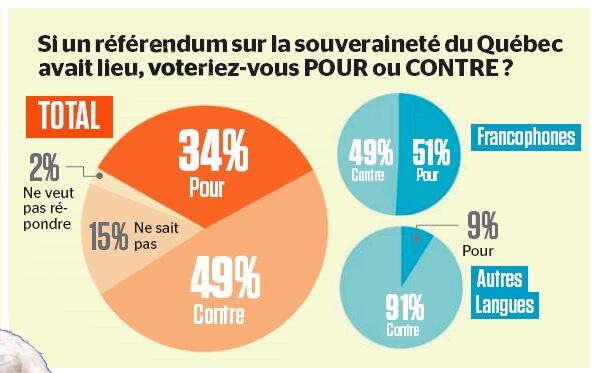
Paul Wells points out some interesting facts about the political situation in Quebec and sums it up as “and then a referendum ate them all”:
2. In 2007 the PQ ran on a relatively mild version of its traditional calling card, nationalism, and a now-vanished party, the ADQ, ran on what might politely be termed populist nativism. Together they held Jean Charest’s Liberals to a minority, but if a single party could combine nationalism and nativism, it might box the Liberals in more completely than two could. That’s the calculation Jean-François Lisée made, and first as Marois’s counsellor and then as a rookie MNA and senior cabinet minister, he has encouraged the PQ’s transformation into a party with much of the appeal those two parties had in 2007. The rest of Quebec politics, and especially, the Liberals, have had 8 years to prepare for the play the Marois-Lisée PQ is making, without much success. All elections are unpredictable and Quebec has been surprising in many ways lately, but I’d bet a loonie (though not a penny more) that the PQ wins a majority.
[…]
4. Will she hold a secession referendum? If I were Lisée, I would tell her this: PQ premiers who didn’t hold referendums are not remembered fondly today. Pierre Marc Johnson, Bouchard, Landry. The two who did are heroes of the movement, even though they lost: René Lévesque and Parizeau. To which group would Marois rather belong?
5. In a referendum, political Canada would be represented by a No committee leader, Couillard, who would have just lost an election; a federal prime minister, Stephen Harper, whose party is far less popular in Quebec than Jean Chrétien’s Liberals ever were; and by a reasonably impressive B team (Thomas Mulcair and Justin Trudeau) whose members cannot conceivably work effectively with one another.
Update: David Akin says “That’s some franco/non-franco split on the referendum question:”
February 24, 2014
Paul Wells on Justin’s speech, plus Harper in Zombieland
In Maclean’s, Paul Wells says that as a result of Justin Trudeau’s leadership of the Liberal Party, Canadian politics just got interesting:
“It is a fundamental economic responsibility for the Prime Minister of Canada to help get our resources to global markets,” Trudeau said. “More and more, the way to do that is with a robust environmental policy that gives assurances to our trading partners that those resources are being developed responsibly.”
That bland excerpt drew one of several long standing ovations. I’ve seen earlier Liberal crowds, for longer than I would ever have thought possible, haul themselves to their feet for jarring, overly laboured, awkward or barely comprehensible lines delivered by a succession of over-credentialed stumblebums. This was different. This enthusiasm came more naturally to this audience.
In interviews on my book tour I’ve used a gruesome analogy to explain Stephen Harper’s success at keeping his Conservative base long after Brian Mulroney and Joe Clark started to lose theirs (in Mulroney’s case, through the spectacular defection of thousands of militants and millions of voters to the upstart Reform Party). To people who spend their lives calling themselves conservatives, Clark and Mulroney weren’t conservative. In an early episode of the TV show Walking Dead, post-apocalyptic humans realize that if they smell like zombies they can walk among them. Stephen Harper smells like a conservative to Conservatives. They trust him and will go far with him, even when the direction seems uncertain or confusing.
Justin Trudeau is the first Liberal leader since Jean Chrétien who smells like a Liberal to Liberals. And in the most intriguing part of the speech, he set about doing to Harper what Harper has been so energetically doing to one Liberal leader after another: peeling the party base off the leader.
“Many Canadians who voted Conservative last time are beginning to cast a weary eye on this government,” he said.
“I say this to the grassroots Conservatives out there, in communities across this country. We might not agree all the time on everything. We might disagree about a great many things, but I know we can agree on this: Negativity cannot be this country’s lifeblood. It may be the way of the Conservative Party’s of Canada current leadership, but it is not the way of those Canadians who voted Conservative.”


