
Quotulatiousness

November 26, 2012

WW1 slang that became part of everyday English

Filed under: Britain, France, Germany, History, Military, WW1 — Tags: , — Nicholas @ 09:47

Jasper Copping lists a surprising number of words that entered the civilian language thanks to the linguistic creativity of soldiers in the trenches during the First World War:

If you’re feeling washed out, fed up or downright lousy, World War One is to blame.

New research has shown how the conflict meant that hundreds of words and phrases came into common parlance thanks to the trenches.

Among the list of everyday terms found to have originated or spread from the conflict are cushy, snapshot, bloke, wash out, conk out, blind spot, binge drink and pushing up daisies.

The research has been conducted by Peter Doyle, a military historian, and Julian Walker, an etymologist, who have analysed thousands of documents from the period — including letters from the front, trench newspapers, diaries, books and official military records — to trace how language changed during the four years of the war.

They found that the war brought military slang into the mainstream, imported French and even German words to English and saw words from local dialects become part of national conversation.

It was a “world” war, so the linguistic additions came from further afield than Belgium or France:

Several Hindi terms, picked up from Indian Army soldiers and already circulating in the regular, professional army, were also disseminated widely.

One of those most used at the front was “cushy” — from khush (‘pleasure’).

Soldiers would describe cushy, or comfortable billets, as well as cushy trenches, in quiet sectors.

The most well known term derived from Hindi though was “Blighty”, from bilati, meaning “foreign”, which, when applied by Indians to Britons, came to be perceived by Indian Army servicemen as the term “British”.

Words even entered the lexicon from the trenches opposite. “Strafe” became an English word, from the German “to punish”, via a prominent slogan used by the enemy: “Gott Strafe England”, while prisoners of war returned with term “erzatz”, literally “replacement”, but used in English to mean “cheap substitute” and spelled ersatz.

November 14, 2012

OED plumps for “omnishambles” over “mummy-porn”

Filed under: Books, Britain, Humour, Media — Tags: , , — Nicholas @ 00:01

Anna Leach explains just how exciting life can be when you’re working on the Oxford University Press staff:

The UK’s new word of 2012 is “omnishambles”, according to the Oxford English Dictionary’s compilers.

Selected from a list of several new words added to the gold-standard dictionary this year, omnishambles was chosen by lexicographers at Oxford University Press because it best reflects the mood of the past 12 months. It was first used by the character Malcolm Tucker in series three of the BBC satire The Thick of It and subsequently repeated by the Coalition government’s political opponents.

[. . .]

The OED now defines it as:

A situation that has been comprehensively mismanaged, characterised by a string of blunders and miscalculations.

Other contenders were “mummy porn” (a description of the genre inspired by smack’n’tickle ebook bonkbuster 50 Shades of Grey), “green-on-blue” (to describe attacks by Afghan police or troops on NATO servicemen), the verb “medal” (from the Olympics), “eurogeddon” (from Eurozone crisis) and the acronym “YOLO” (contraction of the trite phrase “You Only Live Once”, mostly used as a justification after someone does something stupid on the internet).

November 8, 2012

Bless their hearts

Filed under: Humour, USA — Tags: , , — Nicholas @ 10:18

I used to work for a company that had offices in Tallahassee, Florida. Over several years, both on the phone and during on-site visits, I think I heard at least half of these phrases used in earnest.

H/T to Radley Balko for the link.

October 23, 2012

Bilingualism and multiculturalism, “the Siamese twins of Canadian social policy”

Filed under: Cancon, History — Tags: , , , — Nicholas @ 09:34

In Maclean’s, Heather Scoffield wonders if the twin keystones of “official” Canadian identity (as defined by the Liberal party in 1969) are actually in opposition to one another:

Have the two forces that have defined Canadian culture for the past 40 years — multiculturalism and bilingualism — turned on each other?

The final release of 2011 census data this week will offer Canadians some insight into the answer.

On Wednesday, Statistics Canada will publish language data showing how many people speak English, how many speak French, and how many speak a myriad of other languages — a consequence of increasingly diverse immigration.

In the last census, in 2006, the number of people who called French their mother tongue was almost — but not quite — on par with the number of people who identify other languages as their first.

If the trend lines continue, as the experts expect they will, they could cross come Wednesday. Measured in terms of percentage of the total population in Canada, French is expected to continue its long, slow decline as a mother tongue and “other” languages will continue their ascent, with the number of allophones — those with a mother tongue other than Canada’s two official languages — surpassing their francophone counterparts.

So have we reached the point where the twin forces unleashed during the 1970s are now competing forces, with multiculturalism drowning out bilingualism?

October 22, 2012

Want to learn a new language? How about proto-Elamite?

Filed under: History, Middle East, Science — Tags: , , , — Nicholas @ 09:10

If you have the ability to decode the world’s oldest undeciphered texts, you can be our first proto-Elamite scholar:

“I think we are finally on the point of making a breakthrough,” says Jacob Dahl, fellow of Wolfson College, Oxford and director of the Ancient World Research Cluster.

Dr Dahl’s secret weapon is being able to see this writing more clearly than ever before.

In a room high up in the Ashmolean Museum in Oxford, above the Egyptian mummies and fragments of early civilisations, a big black dome is clicking away and flashing out light.

This device, part sci-fi, part-DIY, is providing the most detailed and high quality images ever taken of these elusive symbols cut into clay tablets. This is Indiana Jones with software.

It’s being used to help decode a writing system called proto-Elamite, used between around 3200BC and 2900BC in a region now in the south west of modern Iran.

And the Oxford team think that they could be on the brink of understanding this last great remaining cache of undeciphered texts from the ancient world.

September 6, 2012

Esperanto: the easiest way to introduce a second language to children

Filed under: Education, Randomness — Tags: , — Nicholas @ 08:58

I got interested in learning Esperanto in my early 20’s … and even though I never needed to speak the language in ordinary life, it was a very positive experience and I would recommend it to anyone as an easy way to limber up the brain for other learning tasks. It’s easy to learn, and success in learning helps to make the next learning experience a bit easier and more enjoyable.

August 16, 2012

Kheiriddin: Quebec xenophobia on display in election campaign

Filed under: Cancon, Liberty, Politics — Tags: , , , , , , — Nicholas @ 07:56

In her National Post column, Tasha Kheiriddin discusses the topic that most of the Canadian media is being ultra-careful about:

Racist or not? When it comes to the Quebec election campaign, remarks made this week by a variety of politicians provided considerable fodder for debate, and considerable distraction from the real issues — health, taxes and corruption — that voters actually want their elected officials to talk about.

First, Coalition Avenir Québec leader François Legault lambasted young Quebecers for being interested in living “the good life,” unlike children in Asia whose parents all want them to become engineers, and have to stop them from studying lest they make themselves sick. When he was attacked for this remarks, he retorted that the fault lies with Quebec parents, and that they should review the values they are transmitting to their children.

[. . .]

His remarks pale in comparison, however, to the xenophobic tone of those made by Parti Québécois ledaer Pauline Marois, and worse yet, the mayor of Saguenay, Jean Tremblay.

On Tuesday, Ms. Marois unveiled her party’s desire to implement a “Secular Charter” which would ban the wearing of any religious symbols by government employees. With, as my colleague Chris Selley tartly notes on these pages, one notable exception: Symbols of Christian faith, such as the cross which hangs over the Speakers’ Chair in the National Assembly. In other words, a crucifix necklace, good: hijabs and yarmulkes, bad.

[. . .]

Then on Wednesday, Mr. Tremblay took xenophobia one step further, when he launched a tirade against Djemila Benhabib, the Parti Québécois candidate in Trois Rivières. On a popular radio show, Mr. Tremblay let loose: “I am shocked that we, the softies, the French Canadians, will be told how to behave, how to respect our culture by a person who comes from Algeria, and we can’t even pronounce her name.”

Update: Convenient timing suspects Don Macpherson.

https://twitter.com/MacphersonGaz/statuses/236059349817122816

August 13, 2012

PQ promises to “strengthen” language laws in Quebec

Filed under: Cancon, Law, Liberty — Tags: , , , , , — Nicholas @ 14:31

It’s mind-blowing that a minority in Canada are legally oppressed by their provincial government, but in Quebec, it’s just language business as usual. The opposition Parti Quebecois, who brought in the language law in question, are promising to make it even more oppressive to non-French-speaking Quebecers:

It’s an easy political move for Marois. It will appeal to her separatist base and thoroughly annoy the anglophones … which will also appeal to the base. And given that the stated intention of her party is to go pick fights with Ottawa and drive a wedge between Quebec and the Rest of Canada, it’s a good plan. Language politics are always hot-button issues in Quebec, and Marois is pushing those buttons gleefully.

But it is interesting to note her position on the issue. Marois holds that the Liberals, under Premier Jean Charest, have not done enough to promote the French language in Quebec. From the perspective of the PQ, that’s almost certainly true. But Bill 101 is a creation of the Parti Quebecois. The provincial Liberals have certainly left it intact and haven’t dared to try and strengthen it, but fundamentally, Bill 101 is a PQ law. If it isn’t working, that’s not Premier Charest’s fault.

The bigger issue, of course, is that such a law already exists. Uninformed citizens in the Rest of Canada would be rightly horrified to learn that such a bizarre, anti-democratic law exists in their country at all. Bill 101′s intrusions into the private interactions of businesses and the decisions of individual families are justified as being necessary by Quebec nationalists to preserve the primacy of French in Quebec, but to anyone who is not a language warrior, seem more like a cross between a French tutor and a Orwellian nightmare.

Of course, tougher laws will still not accomplish the intended task: forcing everyone in Quebec to speak French at all times.

August 6, 2012

Admiral Fisher: an excitable sort of man

Filed under: Britain, Germany, History, Humour, WW1 — Tags: , , , — Nicholas @ 10:41

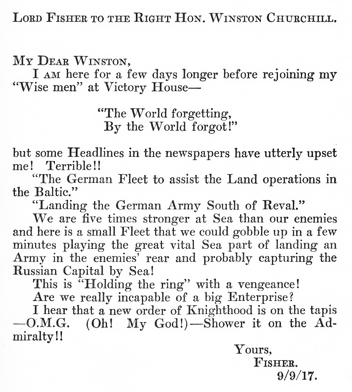
Admiral “Jackie” Fisher was a major historical figure in the Royal Navy, advocate of the modern dreadnought battleship and a tad high-strung (“…and on one occasion, the king asked him to stop shaking his fist in his face”). His relationship with Winston Churchill at the Admiralty must have been something to observe, as two of the most influential men in London worked together (for a while). After leaving the Admiralty for the last time, he still kept in touch with Churchill. Here is an example of his communication style:

This is believed to be the first documented use of the now familiar “OMG”.

H/T to Shaun Usher.

August 4, 2012

British quirks, in brief

Filed under: Britain, History, Humour, WW2 — Tags: , — Nicholas @ 09:19

To provide assistance to all the benighted foreigners visiting Britain for the Olympics, BBC News Magazine solicited helpful bits of advice and information from their audience. Here are a few of the responses, explaining some of the odd and illogical quirks of Britons:

Avoiding terms of address

British speakers of English try to avoid addressing each other by any sort of title. While speakers of French politely address strangers as “monsieur” or “madame”, the British are tongue-tied at the point of interaction, hoping that simple proximity will indicate to whom they are talking. These days, it’s considered condescending to use “sir” or “madam”, unless the speaker is in a clearly-defined “service” role. To fill this gap, the locals have developed various colloquial circumlocutions. In London, for example, “guv[nor]”, “mate” and “squire” are employed by males (according to complex rules) to address unknown males, with “darling” or “love” (rather questionably) filling the gap for males speaking to females. Further north, “petal” is a possible variant on “love”, while in western Scotland “pal” is used to address unknown males. In south Hampshire, the guv/pal equivalent is the linguistically intriguing “moosh”. What the British never, ever do is follow the American tradition and address those driving taxis as “driver”, those serving at table as “waiter” or those working the hotel switchboard as “operator”. To our ears, this is the height of condescension, verging on rudeness, and will ensure that the cab stops on the wrong side of the road, drinks orders are unfilled and the call is misrouted. Y’all remember that now.

Nick Stevenson, London

[. . .]

Saying sorry

Visitors should be wary of the word sorry — it has endless nuances. For instance, if I inadvertently step on your toe we should both immediately say sorry. I’m sorry for having stepped on your toe — you say sorry to imply it was your fault really, or at least no one is quite sure, so both should say sorry. It also means no hard feelings. But when I say “sorry to bother you, but…” I’m not really apologising, just prefacing a request for some trivial favour, or bit of information. Such as: “Sorry to bother you, but do you have the time?” However, if you hear “sorry?” as a question you’re most likely being asked to repeat something not quite heard or understood. But don’t get carried away with your new knowledge. If someone pronounces sorry a “so-ree” with a strong emphasis on both syllables then that is bad news. They are not sorry at all, just being sarcastic. Maybe someone has mildly offended them — perhaps by accusing them of the unforgivable sin of queue-jumping. Their “so-ree” then means “shut it mate”. But occasionally, very occasionally, sorry really does mean sorry. If someone says: “I’m so sorry to hear your mother has died” they probably are sorry. Not always, but probably.

Mike Pollak, Birmingham

[. . .]

The War

The War — always meaning World War II — is as alive in the collective British consciousness as if it only ended five years ago. A melange of manic cheerfulness, stiff upper lips, atrocious food, doodlebugs, and muddling through. Equally evocative are the sounds of the time — big band dance numbers, and the warbling note of the air raid siren — and ladies’ fashions — severe, economically cut, but with a certain dour style, and neat, off-the-shoulder hairdos, topped (in my mother’s case) with a jaunty WAAF forage cap. It is an awful example of how propaganda can take hold and become history. History is laid down by the survivors – the images we all remember so well were composed with a good deal of thought by the powers that be — the Ministry of Information and the BBC — with a definite end in mind; to endure, to tough it out, to hang on until things got better. Something very similar was attempted during the Cold War, but met with far less success — the Cold War was nasty but theoretical, whereas WWII was nasty but actually happened. As a Baby Boomer, I just remember the post-war atmosphere — grey, tatty, somewhat regimented. We ate baked cod, mashed potatoes and boiled carrots off plates that did not match.

Luce Gilmore, Cambridge

July 24, 2012

Quebec continues to strive to exclude Anglophones

Filed under: Bureaucracy, Cancon, Health — Tags: , , , — Nicholas @ 13:54

A real head-scratcher in the Montreal Gazette: telephone staff at the Régie de l’assurance maladie du Québec (the Quebec health insurance board) are now required to assess callers’ language skills to determine if they actually require service in English.

Where before callers were given the option of service in English or French by way of a simple touch of the telephone keypad, it has now become more complicated. Now some people who would prefer to have the information given in English could be denied the service on the basis of a subjective judgment of their ability to speak French.

The way it works now is that calls to RAMQ are answered automatically in French, and callers are told that the agency first communicates with its clientele in French. Only after half a minute of silence is it mentioned that service in English is available by pressing 9. But wait: that doesn’t automatically get you service in English.

What it gets you is another recorded message, this time in English, informing you once more that the board prefers to deal with customers in French. The agents who subsequently come on the line do not speak English right away, even though the language of service chosen is English. No, the agents proceed in French, and are then required by the new policy to “use their judgment” to determine whether the caller speaks French well enough to be able to hold a conversation about health in French rather than English. Only if the caller fails that test will service in English be forthcoming.

July 1, 2012

H.L. Mencken’s New Dictionary turns 70

Filed under: Books, History, Humour, Media, Quotations, USA — Tags: , , , , — Nicholas @ 10:52

Terry Teachout celebrates the 70th anniversary of the original publication of H.L. Mencken’s New Dictionary of Quotations on Historical Principles From Ancient and Modern Sources:

The “New Dictionary” was a byproduct of its prolific editor’s fanatically industrious journalistic career. For years Mencken maintained a card file of quotations “that, for one reason or another, interested me and seemed worth remembering, but that, also for one reason or another, were not in the existing quotation-books.” In 1932 he decided to turn it into a book. When the “New Dictionary” finally saw print a decade later, Time praised it as “one of the rare books that deserve the well-worn phrase ‘Here at last.'”

Painstakingly organized and cross-referenced by subject, with each entry arranged in chronological order by date of original publication, the “New Dictionary” is formidably wide-ranging. Indeed, the only major writer missing from its index is Mencken himself. (“I thought it would be unseemly to quote myself,” he told a curious reporter. “I leave that to the intelligence of posterity.”) Its 1,347 pages abound with such innocent-sounding rubrics as “Civilization,” “Flag, American,” “Hell,” “Hypocrisy,” “Old and New” and “Science and Religion.” At first glance you might mistake it for a cornucopia of the world’s wisdom—but don’t let appearances fool you. The fathomlessly cynical Mencken wisely warned his readers in the preface that the “New Dictionary” was aimed at “readers whose general tastes and ideas approximate my own…. The Congressman hunting for platitudes to embellish his eulogy upon a fallen colleague will find relatively little to his purpose.”

He wasn’t kidding. Look up “Evolution,” for example, and you’ll find this 1925 statement by the Bible-thumping evangelist Billy Sunday: “If a minister believes and teaches evolution, he is a stinking skunk, a hypocrite, and a liar.” Look up “Critic” and you’ll be confronted with a rich catalog of ripe insults, among them this passage from Samuel Coleridge’s “Modern Critics”: “All enmity, all envy, they disclaim, / Disinterested thieves of our good name: / Cool, sober murderers of their neighbor’s fame.” Or check out “Irish,” under which can be found no less than a page of invidious comments, including a sideswipe from, of all people, Gerard Manley Hopkins: “The ambition of the Irish is to say a thing as everybody says it, only louder.”

Teachout is the author of a brilliant biography of Mencken: The Sceptic: A Life of H.L. Mencken, which I happen to be re-reading at the moment. For more on Mencken himself, the wikipedia entry is here.

June 14, 2012

The “victim” mindset among Quebec protestors

Filed under: Cancon, History, Liberty — Tags: , , , , — Nicholas @ 10:13

Dan Delmar on some of the long-standing grievances being channelled by Quebec’s most recent protestors:

“White Niggers of America:” That’s how author Pierre Vallières famously described the Québécois people in his 1968 book, which the former Quebec Liberation Front (FLQ) terrorist leader wrote from his prison cell.

Vallières argued that the struggles of French settlers in British North America were similar to those of pre-segregation era blacks in America, and the lingering effects of English repression were reason enough to issue a call to arms in the late 1960s. FLQ members then kidnapped and murdered Pierre Laporte, who was Quebec’s deputy premier, and sparked a national crisis that ended in martial law.

Vallières and the FLQ may be dead, but the notion that Quebecers are an oppressed people lives on.

[. . .]

Although the “N Word” hasn’t made a noticeable comeback just yet, it’s only a matter of time before fringe elements search for new and more shocking tactics to attract attention to their cause which, at least legislatively, has hit a dead end.

Upon seeing the salute images, many jumped to the conclusion that protesters were racists or that Neo-Nazism was on the rise in Montreal; neither is true. They aren’t racist – at least not intentionally. There is a genuine belief, as Vallière expressed, that Quebecers are in the midst of an epic battle to save democracy and break away from the shackles imposed on them by their Anglo overlords.

[. . .]

In many ways, he [Amir Khadir] embodies the Quebecois victim mentality. At a press conference last week, he compared his struggle with those of Martin Luther King Jr. and Gandhi. He turned to a CTV News reporter, a black woman, and said that “Law 78 is as unacceptable as segregation of blacks was in the 60s.” And he said that in all sincerity, with a straight face.

The culture of victimization runs deep. Some Quebec laws are based on the concept that Francophone culture is under attack, and restricting the use of other languages, as is the case with Bill 101, is an important weapon in the war against Americanization. And make no mistake: This is a war, ideologically speaking. Political elites, particularly within the separatist movement and the opposition Parti Québécois, believe the mere existence of the English language in this province is an assault on French.

May 29, 2012

QotD: London slang of the 1930s

Filed under: Britain, History, Quotations — Tags: , , — Nicholas @ 00:02

London slang and dialect seem to change very rapidly. The old London accent described by Dickens and Surtees, with v for w and w for v and so forth, has now vanished utterly. The Cockney accent as we know it seems to have come up in the ‘forties (it is first mentioned in an American book, Herman Melville’s White Jacket), and Cockney is already changing; there are few people now who say ‘fice’ for ‘face’, ‘nawce’ for ‘nice’ and so forth as consistently as they did twenty years ago. The slang changes together with the accent. Twenty-five or thirty years ago, for instance, the ‘rhyming slang’ was all the rage in London. In the ‘rhyming slang’ everything was named by something rhyming with it — a ‘hit or miss’ for a kiss, ‘plates of meat’ for feet, etc. It was so common that it was even reproduced in novels; now it is almost extinct1. Perhaps all the words I have mentioned above will have vanished in another twenty years.

The swear words also change — or, at any rate, they are subject to fashions. For example, twenty years ago the London working classes habitually used the word ‘bloody’. Now they have abandoned it utterly, though novelists still represent them as using it. No born Londoner (it is different with people of Scotch or Irish origin) now says ‘bloody’, unless he is a man of some education. The word has, in fact, moved up in the social scale and ceased to be a swear word for the purposes of the working classes. The current London adjective, now tacked on to every noun, is ‘fucking’. No doubt in time ‘fucking’, like ‘bloody’, will find its way into the drawing-room and be replaced by some other word.

1. It survives in certain abbreviations, such as ‘use your twopenny’ or ‘use your head.’ ‘Twopenny’ is arrived at like this: head — loaf of bread — twopenny loaf — twopenny

George Orwell, Down and Out in Paris and London, 1933.

April 17, 2012

Chateauguay Magazine: a clear and present danger to the integrity of the French language in Quebec

Filed under: Cancon, Law, Liberty, Media — Tags: , , , — Nicholas @ 13:45

Because it publishes with both French and English contents, the Quebec government’s language police have launched an investigation:

A monthly newsletter in the city of Chateauguay, Quebec, has caused a stir and it has nothing to do with its content. A resident complained there was too much English in the newsletter and now, Quebec’s language watchdog has launched an investigation.

The Office Quebecois de La Langue Francaise is looking into why the newsletter, called the “Chateauguay magazine,” is written in both French and English. The office says that’s a clear violation of the Charter of the French language, or Bill 101.

The office wants to ensure that the all the city’s communication with citizens is done only in the official language of French.

The folks in Chateauguay are apparently being oppressed because the magazine includes content addressed to the 26% of the population that speaks English.

« Newer PostsOlder Posts »

Powered by WordPress

