
Anyone with family or friends in the civil service hears about the hours wasted on bureaucratic wrestling with the guy who spends his energy crafting strategies to get you to do his work. My favorite came from a doctor in a prestigious department at a state hospital whose secretary threw out most of his mail, including all of the invitations, because answering it was too much work. He ended up getting his wife to come into the office and act as his unpaid secretary, because firing or replacing the secretary was way too much trouble.
I am not slamming all civil servants as lazy lackwits; these stories come from good civil servants who are endlessly frustrated by the obstructive and destructive minority. Turkeys in government are like prizes on Wheel of Fortune: Once you win one, it’s yours to keep. They can’t be fired, and they rarely quit; the best you can do is wait for a chance to transfer them somewhere else.
Because of the Universal Law of Turkey Accretion, the quality and effectiveness of a government agency’s personnel are likely to peak very shortly after that agency is established. HHS has been around for a long time, and so has its IT staff. Which means it has more than a few turkeys. Or, as David Cutler put it in a 2010 memo to Larry Summers, “The agency is demoralized, the best people have left, IT services are antiquated, and there are fewer employees than in 1981, despite a much larger burden.”
Megan McArdle, “Get Rid of Obamacare’s Turkeys”, Bloomberg.com, 2013-11-04
November 5, 2013
QotD: Accumulated bureaucratic turkeys
November 2, 2013
ENDA as political theatre
Walter Olson explains why the proposed federal Employment Non-Discrimination Act (ENDA), even if passed, would not do much to help the people it’s supposedly designed to protect:
The U.S. Senate is expected to vote Monday on the Employment Non-Discrimination Act (ENDA), a bill to “prohibit employment discrimination on the basis of sexual orientation or gender identity” that’s been proposed in one form or another for nearly 40 years. It will be a symbolic vote at many different levels. First, the bill stands little chance of passage in the GOP-controlled House; the point of giving it prolonged attention now is more to inflict political damage on Republicans for resisting a popular measure than to get a bill on President Obama’s desk. Second, it seeks to ratify (and take political credit for) a social change that has already occurred through nearly all the country, including even very conservative locales. Most larger employers are now on record with policies against discriminating against gay employees, and even smaller employers without formal policies mostly hew to the same path in practice, for many good reasons that include not wanting to lose the talents of employees from any demographic.
ENDA is a less salient bill than it looks in a second way as well; statistics from the many states and municipalities that have passed similar bills (“mini-ENDAs”) indicate that they do not serve in practice as a basis for litigation as often as one might expect. This may arise from the simple circumstance that most employees with other options prefer to move on rather than sue when an employment relationship turns unsatisfactory, all the more so if suing might require rehashing details of their personal life in a grueling, protracted, and public process. The forbidden group categories that tend more to drive HR managers crazy are things like age, disability, and criminal record consideration, where the law regularly tries to forbid behavior that in fact is perfectly rational for employers to engage in.
On a level of sheer entertainment, the bill has certainly furnished more than one way for some conservatives and Republicans to make themselves appear ridiculous. Some GOP supporters in Congress, for example, seem to be tempted by ENDA as an “easy,” crowd-pleasing vote to show they’re not always on the anti-gay side. But consider the implication: lawmakers who take this path come across as willing to sacrifice the freedom of private actors — as libertarians recognize, every expansion of laws against private discrimination shrinks the freedom of association of the governed — even as they go to the mat to preserve disparate treatment by the government itself in the recognition of family relationships. Sorry, but that’s upside-down. A classical liberal stance can reasonably ask the government itself to behave neutrally among different citizens with their differing values and aspirations, but should not attempt to enforce neutrality on private citizens themselves.
October 26, 2013
Another theory on gender wage gaps
A guest-post at the Freakonomics blog by John List and Uri Gneezy looks at an experiment they conducted to test their theory about the gender wage gap:
Scholars have long theorized about the reasons why women haven’t made faster progress in breaking through the glass ceiling. Personally, we think that much of it boils down to this: men and women have different preferences for competitiveness, and at least part of the wage gaps we see are a result of men and women responding differently to incentives.
Being experimentalists, we understood that without actual evidence, this was just a conjecture. Determined to test our idea in the field we launched a large-scale field experiment on Craigslist where we posted ads for an administrative assistant gig we needed to fill. The experiment was conducted with Jeff Flory and Andreas Leibbrandt as coauthors. We received responses from nearly 7,000 interested job seekers from cities all over the U.S.
After a job seeker touched base with us, we gave them more details on the way they’d be compensated. Then we asked them to provide some basic information if they wanted to be considered for the position. Half the job seekers were told that the job paid a flat $15 per hour. The other half were told they would be paid $12 an hour but they would compete with a co-worker for a $6 per hour bonus (so that both ads would pay workers an average of $15 per hour).
What’d we find? Women were 70% less likely than men to go after the job if it had the competitive pay scale.
The blog post is called “A Unified Theory of Why Women Earn Less”, but I don’t think it actually qualifies — if the experiment was repeated in different markets, it might well explain some of the difference, but I suspect that women’s choices of jobs that provide greater flexibility in hours and the specific fields that draw more female than male workers are probably greater influences on the overall employment and compensation picture.
October 16, 2013
US wages and personal mobility
Coyote Blog looks at the widely touted flattening of income growth in the United States and wonders how much mobility (people moving from one state to another) might play a part in the overall picture:
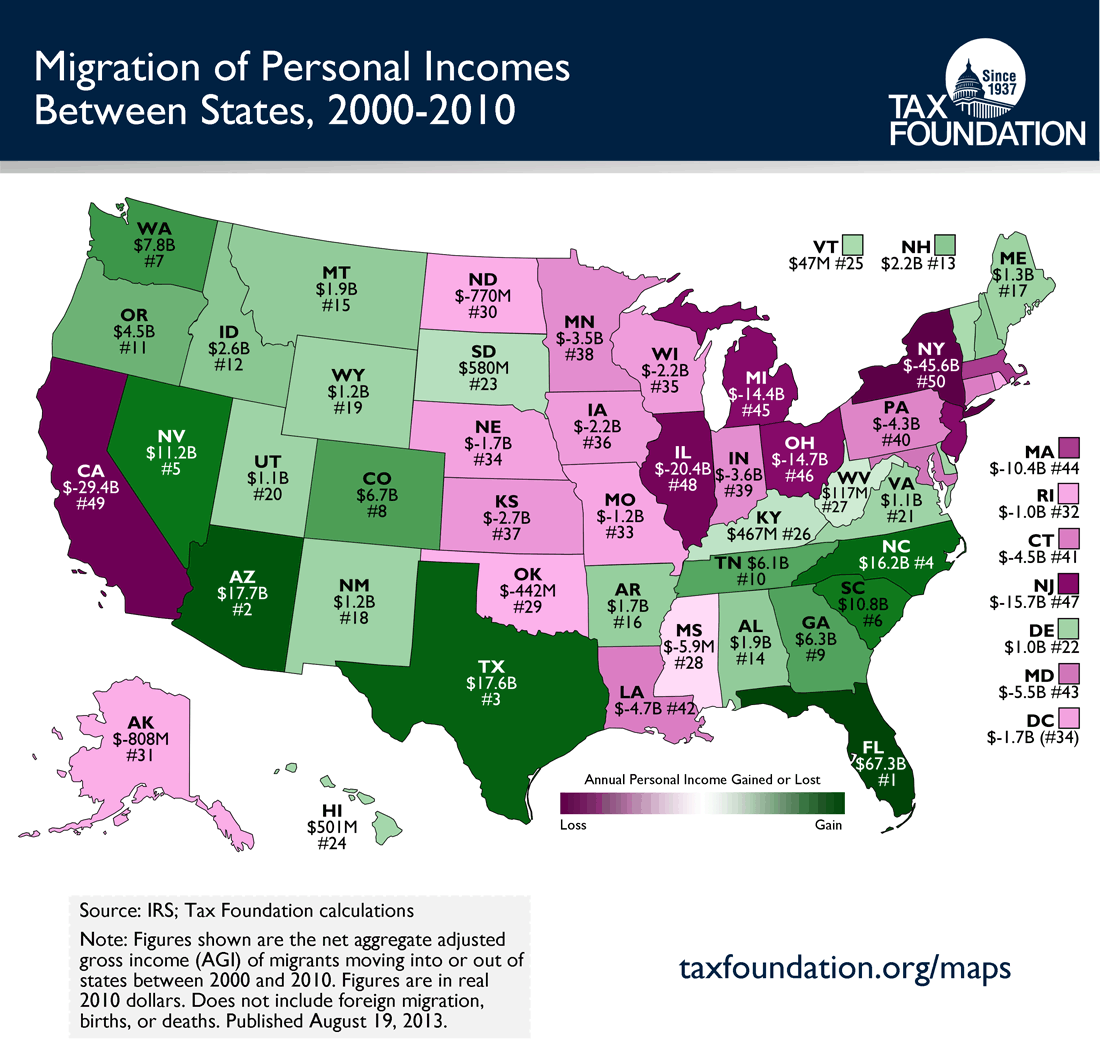
All of this is a long introduction to some thinking I have been doing on all the “Average is Over” discussion talking about the flattening of growth in median wages. I begin with this chart:
Click to see full-sized image
There is a lot of interstate migration going on. And much of it seems to be out of what I think of as higher cost states like CA, IL, and NY and into lower cost states like AZ, TX, FL, and NC. One of the facts of life about the CPI and other inflation adjustments of income numbers is that the US essentially maintains one average CPI. Further, median income numbers and poverty numbers tend to assume one single average cost of living number. But everyone understands that the income required to maintain lifestyle X on the east side of Manhattan is very different than the income required to maintain lifestyle X in Dallas or Knoxville or Jackson, MS.
Could it be that even with a flat average median wage, that demographic shifts to lower cost-of-living states actually result in individuals being better off and living better?
For some items one buys, of course, there is no improvement by moving. For example, my guess is that an iPhone with a monthly service plan costs about the same anywhere you go in the US. But if you take something like housing, the differences can be enormous.
Let’s compare San Francisco and Houston. At first glance, San Francisco seems far wealthier. The median income in San Francisco is $78,840 while the median income in Houston in $55,910. Moving from a median wage job in San Francisco to a media wage job in Houston seems to represent a huge step down. If you and a bunch of your friends made this move, the US median income number would drop. It would look like people were worse off.
But something else happens when you take this nominal pay cut to move to Houston. You also can suddenly afford a much nicer, larger house, even at the lower nominal pay. In San Francisco, your admittedly higher nominal pay would only afford you the ability to buy only 14% of the homes on the market. And the median home, which you could not afford, has only about 1000 square feet of space. In Houston, on the other hand, your lower nominal pay would allow you to buy 56% of the homes. And that median home, which you can now afford, will have on average 1858 square feet of space.
October 4, 2013
QotD: Depression-era thinking
Everybody wants everything now. I caution persons slightly younger than me that life was not always as rosy as it has been for the last 20 or 25 years, at least for the most part. There was a time when it was very difficult for a hardworking family to get by, and you jumped on any work situation that promised even a modicum of stability. With both feet. You’d accept work situations that would look like indentured servitude now, more or less. You never ever ever quit your job before you had another one. Never. And it took real nerve to buy a rundown building like this and turn it into something.
My elders warned me about the Depression. It led them to certain habits which seem like madness now — overreaction and paranoia. When you hear about honest people hoarding cash outside of banks, saving newspaper and cardboard and scraps of this and that, never throwing anything away, always afraid that all prosperity is ephemeral — that’s the Depression talking.
Twice in my working life, unemployment in the construction business has exceeded 25% for a substantial stretch. That might be news to you civilians, but the reason you can’t find anyone to do anything for you that involves heavy lifting, hammers, and speaking English, is that everyone but the hardiest souls and people with nothing but a strong back were driven out of the sector for sunnier economic climes. Everybody bailed out if they could manage it.
Sippican Cottage, “I Know That Smell”, Sippican Cottage, 2013-10-03 (originally posted in 2006)
September 19, 2013
After smartphones, genius machines?
In the Daily Beast, Robert Herritt reviews the latest book by Tyler Cowen, Average Is Over: Powering America Beyond the Age of the Great Stagnation.
Cowen’s main background assumption is that in the not-too-distant future various kinds of “genius machines” will be everywhere. In the workplace, business negotiations and client introductions “will be recorded, processed, and analyzed [and] … [e]ach party to the communications might receive a real-time report on when the other people are likely lying …” At the supermarket, “[y]our shopping cart will use GPS to track your moves through the store, including which aisles you visit most often.” As for our personal lives, “[a] woman might consult a pocket device in the ladies’ room during a date that tells her how much she really likes the guy. The machine could register her pulse, breathing, tone of voice … or whichever biological features prove to have predictive power.”
Even a few years ago, this forecast would have sounded silly, but that was before many of us trusted Match.com algorithms to suggest potential spouses and smartphones came with fingerprint scanners. Cowen’s not talking about flying cars (that futurist mainstay that always seems both just out of reach and comically unnecessary), but rather slightly more sophisticated versions of the technologies that many of us already use.
The bad news, he tells us, is that the rise of the machines will only worsen the wage polarization we are seeing today. Cowen predicts a situation where 10 percent to 15 percent of Americans are “extremely wealthy” with “fantastically comfortable and stimulating lives.” Most of the rest will see stagnant or falling wages but will benefit from plenty of “cheap fun and also cheap education.” For those wondering, this vanishing middle ground is where the book gets its catch-phrase title.
What will determine whether you end up a high earner or a low-wage left-behind will be, in large part, your answer to some variation on the following questions: “Are you good at working with intelligent machines or not? Are your skills a complement to the skills of the computer, or is the computer doing better without you?”
September 15, 2013
Sippican Cottage and the start of his welding career
All I can assume is that my RSS reader needs a good, swift kick every now and again because this post from Labour Day just showed up in my reader now …
I needed a job, bad, in LA, 1980-ish. I moved there with next to no money and no plan. I was only old enough to drink because they hadn’t changed the law yet. I’d had a dozen jobs or more already. No one was hiring nobody for nothing nohow. If I see another person compare today’s economy to the Depression I’m going to show them a picture of 1979. When a mortgage on a house reaches 17%, unemployment is right around 30% in the construction industry, and inflation looks like it’s going to touch 20, you get back to me. Car companies did more than just talk about going bankrupt back then.
I was sleeping on the couch in an apartment shared by two girls, neither of which I knew then or know now. You can distill painful shyness into a kind of brazenness if you try real hard.
The only job opening I could find was a classified for a welder. I had welded under a microscope before, so I was prepared to say I was qualified. A ship in a bottle is still a ship, right?
I drove 66 miles dead east from LA to get there. Outside the place looked like Ingsoc owned it, and inside it looked like Beelzebub was renting it. Medieval. A metal corrugated roof in the desert. The concrete block walls could just barely hold in the amount of crazy required to be a welder in there.
It was a terrible job and the pay was about the same as begging in Calcutta or maybe a dental assistant in England. There were — I remember because they told me — 135 people there that day applying for the job. There was a person sitting on every horizontal surface you could see making out an application. I was the only one wearing a suit and holding a resume. They took me out of the scrum, up the stairs, gave me the man what are you doing here act.
I lied. I lied like a politician. I lied like an infomercial. I lied like four hundred sermons played backwards. You bet I can weld your thermocouples. They sent 135 people away that very minute.
(to be continued)
I switched the Sippican Cottage RSS feed to NewsBlur instead and this story really does continue…
You couldn’t get an apartment in LA without a bank account and a job. You couldn’t get a bank account without a fixed address. I couldn’t get a job without an apartment. I can’t remember who was governor of California at the time. It might have been Jerry Brown or maybe George Deukmejian. At any rate, Franz Kafka was actually running the place. I picked a day, and simultaneously told the apartment landlady I had the job, told the bank I had the apartment, and told the job I could TIG weld thermocouples all the live-long day, baby. The Million Pound Bank Note is just a short story to you; it’s an instruction manual to me. You guys should read less Rand and more Twain if you want to get on in this world. By “less Rand,” I mean “no Rand,” and “all Twain,” actually.
September 10, 2013
Generational change is the Achilles heel of government secrecy
Bruce Schneier explains why we should expect more whistleblowers in coming years:
Big-government secrets require a lot of secret-keepers. As of October 2012, almost 5m people in the US have security clearances, with 1.4m at the top-secret level or higher, according to the Office of the Director of National Intelligence.
Most of these people do not have access to as much information as Edward Snowden, the former National Security Agency contractor turned leaker, or even Chelsea Manning, the former US army soldier previously known as Bradley who was convicted for giving material to WikiLeaks. But a lot of them do — and that may prove the Achilles heel of government. Keeping secrets is an act of loyalty as much as anything else, and that sort of loyalty is becoming harder to find in the younger generations. If the NSA and other intelligence bodies are going to survive in their present form, they are going to have to figure out how to reduce the number of secrets.
As the writer Charles Stross has explained, the old way of keeping intelligence secrets was to make it part of a life-long culture. The intelligence world would recruit people early in their careers and give them jobs for life. It was a private club, one filled with code words and secret knowledge.
[…]
Whistleblowing is the civil disobedience of the information age. It is a way that someone without power can make a difference. And in the information age — the fact that everything is stored on computers and potentially accessible with a few keystrokes and mouse clicks — whistleblowing is easier than ever.
Mr Snowden is 30 years old; Manning 25. They are members of the generation we taught not to expect anything long-term from their employers. As such, employers should not expect anything long-term from them. It is still hard to be a whistleblower, but for this generation it is a whole lot easier.
QotD: Law-making
One might have expected that whether they observed the implication of these domestic failures, or whether they contemplated in every newspaper the indications of a social life too vast, too varied, too involved to be even vaguely pictured in thought, men would have entered on the business of law-making with the greatest hesitation. yet in this more than anything else do they show a confident readiness. Nowhere is there so astounding a contrast between the difficulty of the task and the unpreparedness of those who undertake it. Unquestionably among monstrous beliefs one of the most monstrous is that while for a simple handicraft, such as shoe-making, a long apprenticeship is needful, the sole thing which needs no apprenticeship is making a nation’s laws.
Herbert Spencer, The Man Versus the State, 1884.
September 2, 2013
Slate on the gender wage gap
Hanna Rosin debunks the meme that “women only get paid 77 cents for every dollar earned by men doing the same job”:
The official Bureau of Labor Department statistics show that the median earnings of full-time female workers is 77 percent of the median earnings of full-time male workers. But that is very different than “77 cents on the dollar for doing the same work as men.” The latter gives the impression that a man and a woman standing next to each other doing the same job for the same number of hours get paid different salaries. That’s not at all the case. “Full time” officially means 35 hours, but men work more hours than women. That’s the first problem: We could be comparing men working 40 hours to women working 35.
How to get a more accurate measure? First, instead of comparing annual wages, start by comparing average weekly wages. This is considered a slightly more accurate measure because it eliminates variables like time off during the year or annual bonuses (and yes, men get higher bonuses, but let’s shelve that for a moment in our quest for a pure wage gap number). By this measure, women earn 81 percent of what men earn, although it varies widely by race. African-American women, for example, earn 94 percent of what African-American men earn in a typical week. Then, when you restrict the comparison to men and women working 40 hours a week, the gap narrows to 87 percent.
[…]
Goldin and Lawrence Katz have done about as close to an apples-to-apples comparison of men’s and women’s wages as exists. (They talk about it here in a Freakonomics discussion.) They tracked male and female MBAs graduating from the University of Chicago from 1990 to 2006. First they controlled for previous job experience, GPA, chosen profession, business-school course and job title. Right out of school, they found only a tiny differential in salary between men and women, which might be because of a little bit of lingering discrimination or because women are worse at negotiating starting salaries. But 10 to 15 years later, the gap widens to 40 percent, almost all of which is due to career interruptions and fewer hours. The gap is even wider for women business school graduates who marry very high earners. (Note: Never marry a rich man).
I’ve posted similar articles on this topic before: August, 2012, June 2012, and July 2010.
August 18, 2013
The real problem facing the NSA and other intelligence organizations
Charles Stross points out that there’s been a vast change in the working world that the NSA and other acronyms didn’t see coming and haven’t prepared themselves to face:
The big government/civil service agencies are old. They’re products of the 20th century, and they are used to running their human resources and internal security processes as if they’re still living in the days of the “job for life” culture; potential spooks-to-be were tapped early (often while at school or university), vetted, then given a safe sinecure along with regular monitoring to ensure they stayed on the straight-and-narrow all the way to the gold watch and pension. Because that’s how we all used to work, at least if we were civil servants or white collar paper pushers back in the 1950s.
[…]
Here’s the problem: they’re now running into outside contractors who grew up in Generation X or Generation Y.
Let’s leave aside the prognostications of sociologists about over-broad cultural traits of an entire generation. The key facts are: Generation X’s parents expected a job for life, but with few exceptions Gen Xers never had that — they’re used to nomadic employment, hire-and-fire, right-to-work laws, the whole nine yards of organized-labour deracination. Gen Y’s parents are Gen X. Gen Y has never thought of jobs as permanent things. Gen Y will stare at you blankly if you talk about loyalty to their employer; the old feudal arrangement (“we’ll give you a job for life and look after you as long as you look out for the Organization”) is something their grandparents maybe ranted about, but it’s about as real as the divine right of kings. Employers are alien hive-mind colony intelligences who will fuck you over for the bottom line on the quarterly balance sheet. They’ll give you a laptop and tell you to hot-desk or work at home so that they can save money on office floorspace and furniture. They’ll dangle the offer of a permanent job over your head but keep you on a zero-hours contract for as long as is convenient. This is the world they grew up in: this is the world that defines their expectations.
To Gen X, a job for life with the NSA was a probably-impossible dream — it’s what their parents told them to expect, but few of their number achieved. To Gen Y the idea of a job for life is ludicrous and/or impossible.
This means the NSA and their fellow swimmers in the acronym soup of the intelligence-industrial complex are increasingly reliant on nomadic contractor employees, and increasingly subject to staff churn. There is an emerging need to security-clear vast numbers of temporary/transient workers … and workers with no intrinsic sense of loyalty to the organization. For the time being, security clearance is carried out by other contractor organizations that specialize in human resource management, but even they are subject to the same problem: Quis custodiet ipsos custodes?
July 21, 2013
Reason.tv – Detroit’s Tragedy and How to Fix It
The key things about Detroit’s bankruptcy are that it didn’t happen overnight – and it didn’t have to happen at all.
Detroit’s long, sad slide started in 1950, when the Motor City’s population peaked at nearly 2 million people. Now it’s around 700,000.
The hollowing out of the city was on gut-wrenching display in two recent exhibits at the National Building Museum, featuring photographs by Camilo Jose Vergara and Andrew Moore.
In fat times and lean, the city’s pols and power-brokers chose to focus their energy, and the residents’ tax dollars on gigantic, big-ticket development scams while ignoring the basics that let cities thrive — or at least survive.
Detroit’s leaders poured money into a never-ending assembly line of sad-sack projects such as the Renaissance Center, the Fox Theater, Comerica Park, Poletown, the People Mover, and Ford Field.
But unlike Pompei and other cities crushed by Nature’s wrath or God’s wrath, Detroit’s destruction is completely man-made and thus can be reversed. The city that midwifed the Model T and the Cadillac, Bob Seger and Eminem, Ted Nugent and the Insane Clown Posse, still has tremendous assets in terms of infrastructure, location, and people.
Like Buffalo, Cleveland, St. Louis, and other dead cities scattered across the map of the industrial Midwest like so many cigarette burns, Detroit can stage its own comeback by reducing crime and picking up garbage; by freeing kids, parents, and property values from an abysmal school system; and getting the government out of everything that isn’t essential.
In other words, Detroit’s leaders only need to do what they should have been doing for the past 50 years. And the city’s dwindling supply of residents needs to keep them honest this time.
Because Detroit is finally out of next times.
Produced by Jim Epstein. Written and narrated by Nick Gillespie. Additional camera by Meredith Bragg.
July 18, 2013
Foodstamps as a form of corporate welfare
Mike Krieger explains how the US foodstamp program can be seen as a form of corporate welfare:
This ridiculously condescending budget put out by McDonald’s in partnership with Visa has been making the rounds today. I’ll allow excerpts from the Gothamist article on it and their corresponding video do most of the explaining, but the key point I want to hammer into people is that food stamps are corporate welfare. They actually are not welfare for the workers themselves, who undoubtably don’t have wonderful lives. What ends up happening is that because the government comes in and supplements egregiously low wages with benefits like food stamps, the companies don’t have to pay living wages. So in effect, your tax money is being used to support corporate margins. Even better, many of these folks who get the food stamp benefits then turn around and spend them at the very companies which refuse to pay them decent wages. Who benefits? CEOs and shareholders. Who loses? Society.
From the Gothamist post by Nell Casey:
Let’s take a look at what else McDonald’s imagines its employees’ expenditures should look like. First off, the site sets employees’ mortgage/rent at $600, which even if we didn’t live in an outrageously expensive city is still a laughably small figure. Next, the site tallies health insurance at a mere $20 per month. Where is this magical land of nearly free independent healthcare? We want Obama’s unicorn to fly us there! Also as a McDonald’s employee, your cable and phone bills should only come to $100 a month (HA!), your electric bill should hover around $90 (for serious?) and apparently if you work at a fast food chain there’s absolutely no need to ever buy any food ever. Maybe they offer employees a lifetime supply of fries?
So tallying up all of these totally realistic expenses, a McDonald’s employee would need to net $2,060 per month to make this budget work. Broken down, that would mean working at least 40 hours per week and making at least $15 an hour pre-taxes to earn the necessary $12.86 an hour. Currently, McDonald’s workers earn an average of $8.25 per hour, barring any funny business.
Update: A couple of comments have been logged on this post, and Megan McArdle’s first Bloomberg column also addresses the McDonalds/Visa budget thingy:
Speaking of food, a sample budget put together by Visa Inc. and McDonald’s Corp. is rocketing around the Internet. Most of the commentary suggests that McDonald’s is heartless, and gauche, to suggest how its employees might live on the embarrassingly paltry wages that they are paid. (According to the Census Bureau’s American Community Survey of 2009-11, median earnings for a fast-food worker were $18,564 a year.) The budget is based on two jobs, which has aroused special ire: Is McDonald’s telling its employees to get a second job so they don’t have to pay them anything?
[…]
Keep in mind that most McDonald’s workers don’t live close to New York City or Washington, the sources of much of the commentary I’ve seen. These are, respectively, the first- and fourth-most-expensive cities in the country. In many areas, the median after-tax household income is not that far from that on the McDonald’s worksheet, and it’s pretty easy to rent a room in a friend’s house for less than $600 a month. Memphis, Tenn., for example, has a median household income of $35,000, which, according to Paycheckcity.com’s take-home calculator, would give a single person about $2,300 a month after taxes. And that’s the median — 50 percent of the city is below that. You should not develop a theory of household finance that declares that the city of Memphis does not exist.
Survival on such a lean budget is possible because people who do it are not trying to live the atomized life of an upper-middle-class college graduate. They band together, sharing rent, cars and cash when needed, handing down clothes and generally spreading fixed costs over as many people as possible.
Should McDonald’s pay enough to support a thrifty-but-not-too-difficult independent lifestyle? Is that now the minimum decent standard for society? Obviously, a lot of people think that they should. Washington’s City Council just passed a “living wage” law directly targeted at Wal-Mart Stores Inc. that aims to force the retailer to pay its workers $12.50 an hour.
What would that look like nationwide? Let’s set the floor a little above the amount in the budget — about $27,500 after taxes, which will allow them to enjoy the full McDonald’s budget, plus health insurance on an exchange. That’s a minimum wage of $13.75 an hour for a full-time worker, almost double the current minimum; obviously, everyone else would also have to be paid more. The minimum that a two-earner household could bring in would be $55,000 a year — not that far from the current median income for a two-earner household.
Even if it were possible to mandate that everyone in the country make almost the median income, this would come with a cost; I’d guess that most economists would agree that such a hike in the minimum wage would cause fairly significant job losses.
July 11, 2013
Who will background-check the watchers?
Apparently, the folks who have been doing background checks for US government agencies have special abilities, including psychic powers:
The fallout from Ed Snowden’s leaks has taken many forms, one of which is the NSA taking a long look at its contractors’ hiring processes. Snowden claims to have taken the job solely to gathering damning info. This revelation, combined with some inconsistencies in his educational history, have placed the companies who perform background and credit checks under the microscope.
What these agencies are now discovering can’t be making them happy, including the news that one contractor’s investigative work apparently involved a seance.
Anthony J. Domico, a former contractor hired to check the backgrounds of U.S. government workers, filed a 2006 report with the results of an investigation.
There was just one snag: A person he claimed to have interviewed had been dead for more than a decade. Domico, who had worked for contractors CACI International Inc. (CACI) and Systems Application & Technologies Inc., found himself the subject of a federal probe.
It’s not as if Domico’s case is an anomaly.
Domico is among 20 investigators who have pleaded guilty or have been convicted of falsifying such reports since 2006. Half of them worked for companies such as Altegrity Inc., which performed a background check on national-security contractor Edward Snowden. The cases may represent a fraction of the fabrications in a government vetting process with little oversight, according to lawmakers and U.S. watchdog officials.
Who watches the watchers’ watchers? It appears as if that crucial link in the chain has been ignored. Give any number of people a job to do and, no matter how important that position is, a certain percentage will cut so many corners their cubicles will start resembling spheres.
These are the people entrusted to help ensure our nation’s harvested data remains in safe hands, or at least, less abusive ones. Those defending the NSA claim this data is well-protected and surrounded by safeguards against abuse. Those claims were always a tad hollow, but this information shows them to be complete artifice. The NSA, along with several other government agencies, cannot positively say that they have taken the proper steps vetting their personnel.
July 3, 2013
Kathy Shaidle’s “Dispatch from Canada”
Kathy will be writing a weekly column for our American friends, updating them with whatever’s up here in the Great White North. Given how little actually ever happens in Canada, it might be just a weather report or the latest style change for Justin Trudeau’s hair. However, to start it off, yesterday’s column attempted to correct a few common notions about Canada:
Because a lot of what you think you know about Canada is probably decades out of date.
As investment bigwig and journalist Theo Caldwell recently noted:
But Canada is far from American stereotypes of socialism, centralization and obeisance, at least in relative terms. By almost any measure, Canada is a freer country than the U.S.A.
Economically, the contrast is stark, for those who care to see. While folks reflexively state that Canadian taxes are higher than those of the United States, corporate and personal rates are lower up north.
How much lower are those corporate taxes? Canada ranks 6th lowest out of 185 nations. America came in at a shocking 69th place.
Believe it or not, Canada’s average household net worth is higher than America’s.
We also have lower unemployment, and our economy is holding steady, thanks in part to our ingenious refusal to give mortgages to welfare bums.
We have fewer divorces, fewer traffic fatalities, and way fewer tornadoes.
We’re skinnier, too. (Seriously: your restaurant portions are freakishly huge.)
But what about “the American Dream”?
According to one (Canadian) economist, “a son born to a poor father in the U.S. is twice as likely to remain poor throughout his life than if he had been born in Canada.”
[. . .]
We’ve got our flaws too, of course.
We literally have no abortion law, which means it’s easier to get one than a gun, even at the nine-month mark.
There’s no death penalty. And try getting an MRI, unless you’re a cat.
Our cops are increasingly corrupt, if not downright fascist. (Don’t be fooled by the propaganda about the noble, virtuous Mountie…)
We have this unelected Senate thing (long story) and a dorky constitution, especially compared to yours.
And don’t get me started on Quebec.


