
Welcome to the Canadian Internet, where extreme concentration in telecoms and a weak, lame regulator have given rise to a nation where your Internet access is metered in small, ungenerous dribs, and where ranging too far afield during your network use results in your ISP breaking into your browsing session to tell you that you’re close to being cut off from the net.
The incumbent telcos have successfully petitioned for “usage based billing,” wherein their customers only get so much bandwidth every month (they’ve also long practiced, and lied about, furtive throttling and filtering, slowing down downloads, streams, and voice-over-IP traffic). This will effectively make it cheaper to use their second-rate voice-over-IP and video-on-demand service than it is to use the superior services the rest of the developed world enjoys.
If you were a Canadian entrepreneur or innovator looking to start your own networked business, this would be terminal. How can an innovative service take hold in Canada if Canadians know that every click eats away at their monthly bandwidth allotment? I can think of no better way to kill Canadians’ natural willingness to experiment with new services that can improve their lives and connect them with their neighbours and the wide world than to make them reconsider every click before they make it.
Cory Doctorow, “Welcome to the Canadian Internet, now stop using it”, BoingBoing, 2011-02-02
February 2, 2011
QotD: “Welcome to the Canadian Internet. Now stop using it.”
February 1, 2011
Egypt still offline in advance of “million-man march”
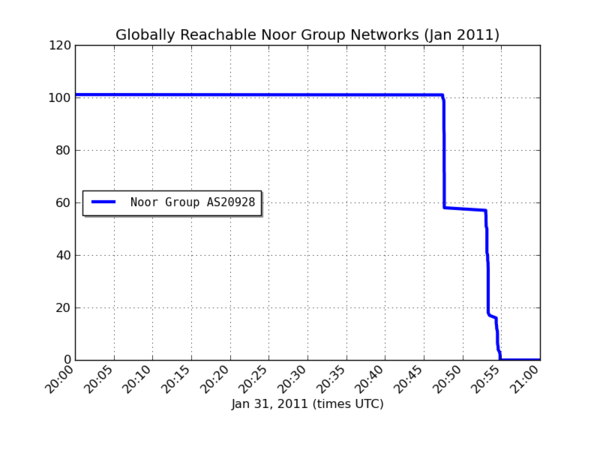
Renesys is still reporting almost no internet connectivity to or from known Egyptian sites:
As we observed last week, Egypt took the unprecedented step of withdrawing from the Internet. The government didn’t simply block Twitter and Facebook (an increasingly common tactic of regimes under fire), but rather they apparently ordered most major Egyptian providers to cease service via their international providers, effectively removing Egyptian IP space from the global Internet and cutting off essentially all access to the outside world via this medium. The only way out now would be via traditional phone calls, assuming they left that system up, or via satellite. We thought the Internet ban would be temporary, but much to our surprise, the situation has not changed. One of the few Egyptian providers reachable today, four days after the start of the crisis, is The Noor Group. In this blog, we’ll take a quick look at them and some of the businesses they serve.
Now roiling the hoi-polloi: bit-by-bit billing
The internet is about to become a political topic . . . not the internet itself, but the prices Canadians will have to pay to get online:
Industry Minister Tony Clement says he is looking closely at the “usage-based billing” decision issued last week by the CRTC that has consumers, businesses and citizen groups’ decrying what they see as a price hike for Canadian Internet services that could clamp down on innovative technologies.
“I can assure that, as with any ruling, this decision will be studied carefully to ensure that competition, innovation and consumers were all fairly considered,” Mr. Clement said in a statement obtained by The Globe and Mail.
The decision will allow large Internet service providers (ISPs), such as Bell Canada and Rogers Communications, to charge smaller ISPs that lease space on their networks on a volume basis. Executives at smaller providers have already begun phasing out popular “unlimited” Internet packages because it has become economically unfeasible to continue offering them.
I wondered how long the current situation would last: Bell and Rogers used to tout their “unlimited” internet access, but if you read the fine print, it wasn’t really “unlimited”. Like any resource that is “free”, some will use far more of it. In the early days of broadband, that didn’t matter, as there were not enough users to consume all the bandwidth anyway. Now that there are many more subscribers, the heavier bandwidth users are causing problems.
In addition to the sheer number of broadband customers, another change that was not fully foreseen was the way those customers use their internet connections has changed. When Bell and Rogers got into this market, there were far fewer options for using the internet. You could visit websites all day long, read email, listen to cheesy renditions of popular music, and (for some) download pirated movies for hours on end.
Now that TV and movie viewers have better viewing options through their internet connections than they get over-the-air or through cable or satellite TV, the nature of internet traffic has been revolutionized, and not in a way that Bell and Rogers were anticipating.
Update: Michael Geist thinks I’ve been taken in by the big guys’ propaganda:
[. . .] arguments in support of UBB are frequently accompanied by the claim that the approach is like any other service — you pay for what you use. Yet Bell’s UBB plan approved by the CRTC does not function like this at all. Its plan features a 60 GB cap with an overage charge for the next 20 GB. After 80 GB, there is no further cap until the user hits 300 GB. In other words, using 80 GB and 300 GB costs the same thing. This suggests that the plan has nothing to do with pay-what-you-use but is rather designed to compete with similar cable ISP bandwidth caps. In fact, Primus has gone further, stating “It’s an economic disincentive for internet use. It’s not meant to recover costs. In fact these charges that Bell has levied are many, many, many times what it costs to actually deliver it.”
He also points out that the Canadian market is very tightly controlled by a oligopoly of key players:
While the CRTC’s UBB decision provides the immediate impetus for public concern, the reality is that the bandwidth cap issue in Canada is far bigger than just this decision. The large Canadian ISPs control 96% of the market, meaning the independent ISPs are tiny players in the market. Even if the CRTC denied Bell’s application for wholesale UBB, it would still only constitute a tiny segment of the overall Canadian Internet market.
As virtually every Canadian Internet user knows, the Canadian market is almost uniformly subject to bandwidth caps — the OECD reports that Canada stands virtually alone with near universal use of caps. The scale of the Canadian caps are particularly noteworthy — while Comcast in the U.S. imposes a 250 GB cap, Canadian ISPs offer a fraction of that number:
- Videotron starts at 3 GB for Basic Internet, 40 GB for its next plan and tops at 200 GB for very fast speeds at $149/month
- Rogers Lite service caps at 15 GB, it fastest service stops at 175 GB
- Bell’s Essential Plus service offers a 2 GB per month cap, climbing to 75 GB for its fastest service
The caps are already having a consumer impact as Bell admits that about 10% of its subscribers exceed their monthly cap (a figure that is sure to increase over time). Moreover, the effect extends far beyond consumers paying more for Internet access. As many others have pointed out, there is a real negative effect on the Canadian digital economy, harming innovation and keeping new business models out of the country. Simply put, Canada is not competitive when compared to most other countries and the strict bandwidth caps make us less attractive for new businesses and stifle innovative services.
January 31, 2011
Showing their true colours?
To mark the Egyptian government’s shutdown of cellphone and internet access to their angry citizenry, the US government wants to have the power to do the same. Subtle, eh?
Legislation granting the president internet-killing powers is to be re-introduced soon to a Senate committee, the proposal’s chief sponsor told Wired.com on Friday.
The resurgence of the so-called “kill switch” legislation came the same day Egyptians faced an internet blackout designed to counter massive demonstrations in that country.
The bill, which has bipartisan support, is being floated by Sen. Susan Collins, the Republican ranking member on the Homeland Security and Governmental Affairs Committee. The proposed legislation, which Collins said would not give the president the same power Egypt’s Hosni Mubarak is exercising to quell dissent, sailed through the Homeland Security Committee in December but expired with the new Congress weeks later.
The bill is designed to protect against “significant” cyber threats before they cause damage, Collins said.
Got to admire the balls of brass required to introduce legislation to do something in America at exactly the same time the US government is demanding that Egypt restore their citizens’ internet access. Breathtaking hypocrisy.
Update: By way of American Digest, a most appropriate image:

January 29, 2011
Wired How-to: Get back on the internet after a government shut-down
A post at the Wired How-to wiki on getting back online after your government attempts to shut down internet access:
Scenario: Your government is displeased with the communication going on in your location and pulls the plug on your internet access, most likely by telling the major ISPs to turn off service.
This is what happened in Egypt January 25 prompted by citizen protests, with sources estimating that the Egyptian government has cut off approximately 88 percent of the country’s internet access. What do you do without Internet? Step 1: Stop crying in the corner. Then start taking steps to reconnect with your network. Here’s a list of things you can do to keep the communication flowing.
This article is part of a wiki anyone can edit. If you have advice to add, please log in and contribute.
January 28, 2011
Egypt goes dark, shuts down DNS servers
Updates added to the bottom of this post
The Egyptian government is attempting to foil protests by eliminating internet traffic. Renesys reports:
Confirming what a few have reported this evening: in an action unprecedented in Internet history, the Egyptian government appears to have ordered service providers to shut down all international connections to the Internet. Critical European-Asian fiber-optic routes through Egypt appear to be unaffected for now. But every Egyptian provider, every business, bank, Internet cafe, website, school, embassy, and government office that relied on the big four Egyptian ISPs for their Internet connectivity is now cut off from the rest of the world. Link Egypt, Vodafone/Raya, Telecom Egypt, Etisalat Misr, and all their customers and partners are, for the moment, off the air.
At 22:34 UTC (00:34am local time), Renesys observed the virtually simultaneous withdrawal of all routes to Egyptian networks in the Internet’s global routing table. Approximately 3,500 individual BGP routes were withdrawn, leaving no valid paths by which the rest of the world could continue to exchange Internet traffic with Egypt’s service providers. Virtually all of Egypt’s Internet addresses are now unreachable, worldwide.
I have seen very little traffic coming to this site from Egypt before the DNS server shutdown (under 40 unique visitors last year, according to FlagCounter), so the following information isn’t likely to be of direct assistance to Egyptians, but hopefully some can be filtered onwards.
The first suggestion (from Shereef Abbas) is to use Google’s Public DNS 2 to change “your DNS ‘switchboard’ operator from your ISP to Google Public DNS”.
John Perry Barlow suggests “more tools to access blocked websites and maintain anonymity”: http://jan25.in/how-to-access-blocked-websites-by-government and https://www.torproject.org/download/download.html.en.
Update: Vice President Joe Biden appears to be missing a wonderful opportunity to shut up.
Biden urged non-violence from both protesters and the government and said: “We’re encouraging the protesters to – as they assemble, do it peacefully. And we’re encouraging the government to act responsibly and – and to try to engage in a discussion as to what the legitimate claims being made are, if they are, and try to work them out.” He also said: “I think that what we should continue to do is to encourage reasonable… accommodation and discussion to try to resolve peacefully and amicably the concerns and claims made by those who have taken to the street. And those that are legitimate should be responded to because the economic well-being and the stability of Egypt rests upon that middle class buying into the future of Egypt.”
Egypt’s protesters, if they’re paying attention to Biden at all, will certainly be wondering which of their demands thus far have been illegitimate.
Update, the second: Live blogging the protests at the Guardian. And several sources are recommending the coverage streamed online from Al Jazeera’s English-language site.
Update, the third: The effectiveness of Egypt’s internet blackout shows why giving the American president (or any national leader) an internet “kill switch” is such a bad idea. To most of us, anyway. I’m sure that to some people it’s an argument in favour.
Update, the fourth: National Post has a graphic showing the locations of the reported activity:

January 26, 2011
Be careful with your old, tired URLs
The very first domain name I registered ended up getting hijacked: the ISP I was using got taken over by someone else, and they arbitrarily changed all the contact info for my domain to point to them instead. The domain expired (no notice to me), the grace period for renewal expired (again, no word to me), and suddenly the historical society’s domain name is now a porn site (slightly longer original story here).
That’s why I have some sympathy for this British MP who linked to a site promoting a local concern, which then became a German porn site:
Red-faced Tory MP Francis Maude last night denied all responsibility for the content of a German SmutSite — and then quietly removed a link to it from his own personal front page.
The embarrassment seems to have arisen after Francis Maude, the member for Horsham, and Henry Smith, MP for neighbouring Crawley, got together to sponsor a campaign for an acute hospital to be built in the Pease Pottage area of Sussex. The campaign registered and made use of a domain — c4pph.org (NSFW) — which certainly appears at one time to have been a perfectly respectable site campaigning on this issue.
However, as an official spokeswoman for Francis Maude told us last night: “The campaign … no longer owns or operates the c4pph.org web address and hasn’t done so since last year. We understand the domain name is now under new ownership with no connection to the campaign.”
January 23, 2011
John Scalzi on Facebook
John Scalzi has been online for a long time. He even “handrolled his own html code and then uploaded it using UNIX commands because he was excited to have his own Web site, and back in 1993 that’s how you did it.” He’s not excited about Facebook. Not at all:
A friend of mine noted recently that I seemed a little antagonistic about Facebook recently — mostly on my Facebook account, which is some irony for you — and wanted to know what I had against it. The answer is simple enough: Facebook is what happens to the Web when you hit it with the stupid stick. It’s a dumbed-down version of the functionality the Web already had, just not all in one place at one time.
Facebook has made substandard versions of everything on the Web, bundled it together and somehow found itself being lauded for it, as if AOL, Friendster and MySpace had never managed the same slightly embarrassing trick. Facebook had the advantage of not being saddled with AOL’s last-gen baggage, Friendster’s too-early-for-its-moment-ness, or MySpace’s aggressive ugliness, and it had the largely accidental advantage of being upmarket first — it was originally limited to college students and gaining some cachet therein — before it let in the rabble. But the idea that it’s doing something better, new or innovative is largely PR and faffery. Zuckerberg is in fact not a genius; he’s an ambitious nerd who was in the right place at the right time, and was apparently willing to be a ruthless dick when he had to be. Now he has billions because of it. Good for him. It doesn’t make me like his monstrosity any better.
[. . .]
I look at Facebook and what I mostly see are a bunch of seemingly arbitrary and annoying functionality choices. A mail system that doesn’t have a Bcc function doesn’t belong in the 21st Century. Facebook shouldn’t be telling me how many “friends” I should have, especially when there’s clearly no technological impetus for it. Its grasping attempts to get its hooks into every single thing I do feels like being groped by an overly obnoxious salesman. Its general ethos that I need to get over the concept of privacy makes me want to shove a camera lens up Zuckerberg’s left nostril 24 hours a day and ask him if he’d like for his company to rethink that position. Basically there’s very little Facebook does, either as a technological platform or as a company, that doesn’t remind me that “banal mediocrity” is apparently the highest accolade one can aspire to at that particular organization.
I have a Facebook account, but only really check it every few days. Twitter, on the other hand I’ve found to be an excellent tool for a blogger: lots and lots of interesting stuff has come to my attention first through a Twitter update from journalists, bloggers, celebrities, and just ordinary folks. And it doesn’t try to worm its way into everything I do.
Some folks felt John was being too harsh on Facebook users, rather than the site itself, so he posted an update later that day:
* In comments here and elsewhere there was interpretation of me saying that Facebook wasn’t for someone like me, but it was for normal people as a) a way to signal that I am awesome and smart and also awesome, and b) normal people are stupid and suck, and that’s why they use Facebook. Yeah, no. It’s not for me because the functionality doesn’t map well for what I want to do or have for my online experience, and “normal” in this case doesn’t mean “stupid people who suck,” it means “people who don’t want to make the time/energy commitment to run their own site.”
It’s always a problem with written work . . . some people will misunderstand or misinterpret what you’re saying — deliberately or otherwise — and it’s difficult to make something so clear that it can’t be twisted. Did I say difficult? I should have said impossible.
January 21, 2011
If you are finding Firefox to be much slower lately, uninstall the Skype toolbar
I’ve been using Firefox as my main browser for a few years, and it generally works well for me. In the last month or so, however, I’ve noticed it being much slower. Some of that problem may have been caused by the Skype toolbar:
Mozilla has blocked a Skype toolbar add-on for its Firefox browser, after blaming the extension for causing 40,000 crashes last week.
The open source outfit said it vastly slowed down webpage-loading times.
The crash-prone add-on downed Firefox 3.6.13 — which is the current stable version of the browser — far too much, grumbled Mozilla.
“Additionally, depending on the version of the Skype Toolbar you’re using, the methods it uses to detect and re-render phone numbers can make DOM [document object model] manipulation up to 300 times slower, which drastically affects the page rendering times of a large percentage of web content served today (plain English: to the user, it appears that Firefox is slow loading web pages),” it said.
I started using Firefox as my default browser around the time they introduced tabbed pages (which every browser has offered for years now). I also use Opera, Chrome, and (unwillingly) IE for specific purposes. If the Firefox performance issues aren’t resolved when they release the new version 4.0 next month, I’ll consider switching to Chrome as my primary browser instead.
January 17, 2011
QotD: The impermanence of “The Cloud”
We adopt many web services because they’re convenient (and free!), but it’s only after becoming dependent on those services that we recognize why they were provided for free in the first place: after all, it’s only by eliminating the inconvenience of paying users that startups can snag attention and secure the freedom to alter, downgrade, or cancel their services at will. By then, of course, we’re trapped in an unstable relationship, and our only means of recourse is to wail as loudly as possible, “You broke my heart!”
The big lesson that should have come out of the Tumbleocalypse was that we trust too easily. Did any of us listen? Nah. Instead, we’re signing our friends up to Dropbox to score 250 megs of bonus storage space and sending our most important documents to “the cloud.” We trust Dropbox because we trust others who use Dropbox: web designers, tech writers and professionals who, we believe, would never gamble with an unproven, flaky, or suspect service. Without this kind of trust-by-proxy, free web services couldn’t survive at all. Can you imagine anybody in their right mind signing up for a Facebook account today without a good friend by the sidelines whispering, “Don’t mind all that privacy whaffle. I know these guys mean well.”
Cloud storage is convenient, of course — ask anybody who’s experienced the horrors of manually synching PC to iPhone — but we downplay the risks involved in outsourcing control of the data we own. We so badly want to live in the future that we’ve lost the ability to question what living in the future might actually mean.
[. . .]
Those who believe that “the cloud” can act as a storage platform for our collective memories believe that everything that was available to us yesterday will be just as available to us tomorrow. Where exactly does this conviction come from?
The web is like any other sprawling city, and maybe worse: it’s so damn rickety it’s a minor miracle it hasn’t collapsed entirely. When you link, you do so trusting that the data to which you direct your readers won’t just up and disappear into the virtual ether. Except that, inevitably, it will — the short history of the web has established that much. We live somewhere, we leave, it becomes forgotten, and then we come back years later to find our old haunts brutally 404’d.
Connor O’Brien, “Link Rot”, The Bygone Bureau, 2011-01-17
January 15, 2011
What do you do when you find something cool on the Internet?
If you’re cool, you do something like this:
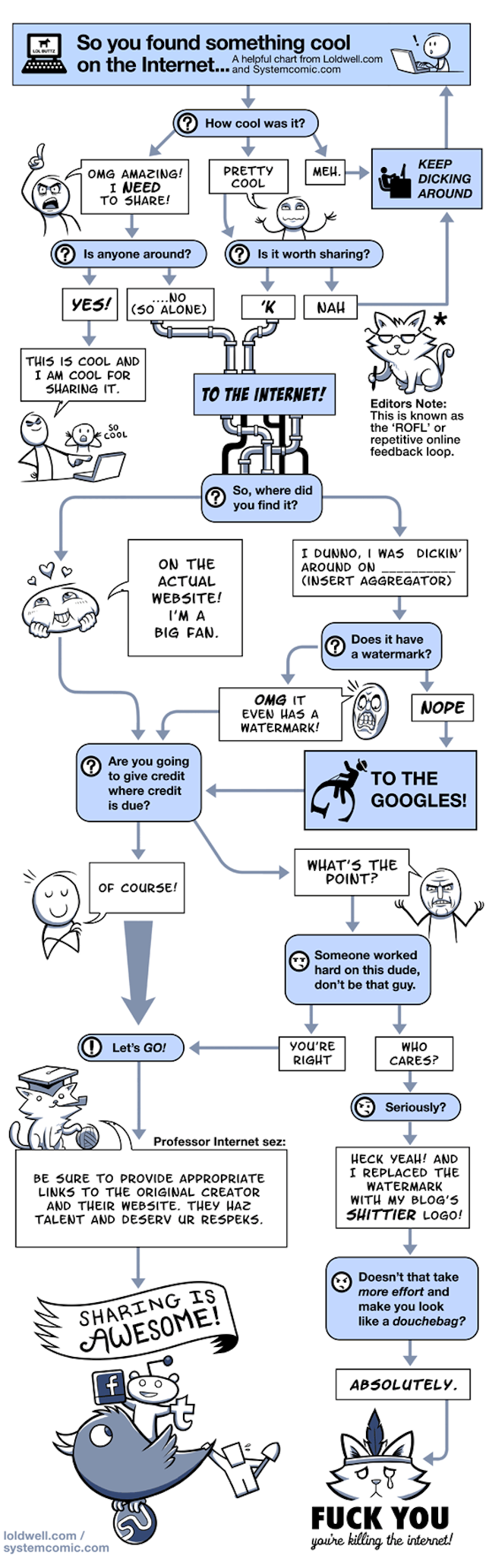
Original work by Caldy and Rosscott. H/T to Royce McDaniels for bringing it to my attention.
Remember, kids, everytime you re-use someone’s creative work on the Internet without giving credit, God (or your Deity of choice) kills a kitten. Don’t make God (or your Deity of choice) kill any more kittens!
January 13, 2011
Adobe finally gets the message
Ever wanted to delete all the tracking cookies that your browser collects? Most browsers provide ways to do that for ordinary cookies, but did nothing for the Flash cookies. Adobe seems to have heard the demands to fix this:
Adobe has finally fixed a privacy weakness that threatened users of its ubiquitous Flash Player: the software’s storing of cookie-like files that many websites used to track visitors’ behavior against their wishes.
So-called LSOs, or local shared objects, are useful for storing user preferences, such as the preferred sound volume when visiting YouTube, but the Flash feature comes with a dark side. Unscrupulous websites can use them to restore tracking cookies even after a user deliberately deletes them. Files that do this have come to be known as Flash cookies.
Now, developers at Adobe have worked with their counterparts at Mozilla and Google on a programming interface that allows LSOs to be deleted from within the settings panel of compliant browsers. The API, known as NPAPI ClearSiteData, has already been approved for implementation in Firefox. It will soon appear on the Google Chrome dev channel.
January 10, 2011
QotD: Geeks and Hackers defined
One of the interesting things about being a participant-observer anthropologist, as I am, is that you often develop implicit knowledge that doesn’t become explicit until someone challenges you on it. The seed of this post was on a recent comment thread where I was challenged to specify the difference between a geek and a hacker. And I found that I knew the answer. Geeks are consumers of culture; hackers are producers.
Thus, one doesn’t expect a “gaming geek” or a “computer geek” or a “physics geek” to actually produce games or software or original physics — but a “computer hacker” is expected to produce software, or (less commonly) hardware customizations or homebrewing. I cannot attest to the use of the terms “gaming hacker” or “physics hacker”, but I am as certain as of what I had for breakfast that computer hackers would expect a person so labeled to originate games or physics rather than merely being a connoisseur of such things.
[. . .]
All hackers are, almost by definition, geeks — but the reverse is not true.
Eric S. Raymond, “Geeks, hackers, nerds, and crackers: on language boundaries”, Armed and Dangerous, 2011-01-09
Facebook has a repeat of their earlier boob
Facebook apparently has something against breasts — specifically those used to feed babies:
Facebook had one of its nipple-related related brainstorms last week, banning, unbanning, then re-banning breastfeeding support group, The Leaky Boob.
The Leaky Boob group allows almost 11,000 mothers to share their experiences on breastfeeding — as well as providing casual visitors with a treasure trove of advice and tips. Well, it would do, if Facebook didn’t keep deleting it — as they did the previous weekend.
This provoked an angry reaction from the tens of thousands of women who use the page for information and support.
Breastfeeding supporters responded swiftly, creating two pages on Facebook, Bring Back the Leaky Boob and TLB Support, which gained the best part of 10,000 fans in just two days.
On Tuesday, according to group founder Jessica Martin-Weber, the page was back up.
On Wednesday it was gone again.
Then, later in the day, it returned and is still up today.
It’s easy to see how the content of TLB might be offensive to closed-minded people, and if the banning mechanism Facebook uses is mostly automated, it’d explain the way in which the group was originally banned. If all it takes is a complaint, and the (I assume automated) follow-up to the complaint only checks for certain things, the first shutdown is explained. The fact that the group has been through this process before shows a weakness in Facebook’s administrative tracking policies.
January 1, 2011
QotD: The end of nerd subculture
That was the year the final issue of Watchmen came out, in October. After that, it seemed like everything that was part of my otaku world was out in the open and up for grabs, if only out of context. I wasn’t seeing the hard line between “nerds” and “normals” anymore. It was the last year that a T-shirt or music preference or pastime (Dungeons & Dragons had long since lost its dangerous, Satanic, suicide-inducing street cred) could set you apart from the surface dwellers. Pretty soon, being the only person who was into something didn’t make you outcast; it made you ahead of the curve and someone people were quicker to befriend than shun. Ironically, surface dwellers began repurposing the symbols and phrases and tokens of the erstwhile outcast underground.
Fast-forward to now: Boba Fett’s helmet emblazoned on sleeveless T-shirts worn by gym douches hefting dumbbells. The Glee kids performing the songs from The Rocky Horror Picture Show. And Toad the Wet Sprocket, a band that took its name from a Monty Python riff, joining the permanent soundtrack of a night out at Bennigan’s. Our below-the-topsoil passions have been rudely dug up and displayed in the noonday sun. The Lord of the Rings used to be ours and only ours simply because of the sheer goddamn thickness of the books. Twenty years later, the entire cast and crew would be trooping onstage at the Oscars to collect their statuettes, and replicas of the One Ring would be sold as bling.
The topsoil has been scraped away, forever, in 2010. In fact, it’s been dug up, thrown into the air, and allowed to rain down and coat everyone in a thin gray-brown mist called the Internet. Everyone considers themselves otaku about something — whether it’s the mythology of Lost or the minor intrigues of Top Chef. American Idol inspires — if not in depth, at least in length and passion — the same number of conversations as does The Wire. There are no more hidden thought-palaces — they’re easily accessed websites, or Facebook pages with thousands of fans. And I’m not going to bore you with the step-by-step specifics of how it happened. In the timeline of the upheaval, part of the graph should be interrupted by the words the Internet. And now here we are.
Patton Oswalt, “Wake Up, Geek Culture. Time to Die”, Wired, 2010-12-27


