Quotulatiousness

September 16, 2020

The Canadian echo chamber on American political issues

Filed under: Cancon, Media, Politics, USA, Weapons — Tags: , , , , , — Nicholas @ 05:00

Ben Woodfinden’s latest for The Dominion looks at the weird effects political passions in the United States have on political stances in Canada:

Restricted and prohibited weapons seized by Toronto police in a 2012 operation. None of the people from whom these weapons were taken was legally allowed to possess them.
Screen capture from a CTV News report.

Participatory media increasingly defines and shapes our discourse. It submerges us in a broader reality but only does so by filtering it into a digital reality that offers a distorted reflection rather than picture of the real world. This has been going on for at least a decade now, but the pandemic has accelerated this transformation of our discourse and politics. By locking us in our homes the pandemic forces us to view the world through a digital lens even more than we already did, and in a world where we’re all viewing everything through our screens that digital reality becomes closer and closer to our primary reality.

One of the specific, and most pernicious effects of this, as I lamented in The Critic is that it turns us all into online Americans participating in their politics through the digital medium, rendering us virtual participants and not just foreign observers. I won’t repeat myself too much, I’d recommend just reading the piece [link], but the online realm is American, and what digital politics does is make politics everywhere more American. We participate in it as a game and a form of entertainment. This bleeds back into our own politics.

Americanized Discourse

Gun politics is one particular political issue where Americanized discourse is most pronounced. It captures perfectly how Americanization plays out. Every time there is some sort of tragic shooting or discussion of gun violence in Canada the debates play out in depressingly predictable ways. Progressives and Liberals paint a picture in which Canada suffers from the kind of rampant gun violence and mass proliferation of firearms as in America. This is the framing used to justify often highly symbolic or ineffective new gun laws and restrictions that, while often not all that effective, make the Liberals and progressives seem like the party for gun control in the face of this rampant violence. But only if you pretend we live in America.

And it’s not just the Liberals and progressives who play this game. Listen to some of the more vocal advocates of “gun rights” in Canada and you’d think we have a second amendment in the Charter. One side wants to make it seem like Canadians are walking around with and easily able to acquire assault weapons, the other side wishes it were so! The reality of course lies somewhere in between. Gun possession is heavily regulated, but lawful citizens can still buy firearms if they want to, and there is no explicit right in the Charter that prevents the government from regulating and restricting firearms. Talking about gun “rights” in Canada is itself quite a foreign and imported concept. At the same time we don’t have an epidemic of gun violence, and while we have experienced some horrific mass shootings, like the recent Nova Scotia tragedy, gun violence in Canada pales in comparison to the United States.

But because both sides are essentially happy to help paint a phantasmic picture of gun violence and/or gun regulations in Canada, we end up with a surreal politics around guns. Sensible debates around guns are made harder by this because debates take place on top of a framing and narrative that draws explicitly on American political culture more than it does Canada’s. Both sides want to take on American roles and are happy to contribute to this framing.

Gun politics is just one example, and there are so many others. Our discourse is so often built around framings that make it seem as if the issues and political cleavages here are indistinguishable from American ones, but it only happens because we import American framing and narratives into our own discourse and then build are arguments around these phantasms. We, like many other countries around the world, are in the middle of a moment of racial reckoning, or whatever you want to call it, because of something that happened in Minneapolis, not in Canada.

Racism is a real thing in Canada, no honest person should deny this, because there is racism in absolutely every country and society. But in the wake of George Floyd’s killing we ended up having a conversation about racism that reflected the particular ways racism works in America.

September 11, 2020

Canadian government heading toward “the worst of all worlds on Internet regulation”

Filed under: Business, Cancon, Government, Media — Tags: , , , , — Nicholas @ 05:00

Michael Geist on the bull-headed determination of the Canadian federal government — and specifically Heritage Minister Steven Guilbeault — to “solve” a problem by introducing savagely anti-consumer internet regulations:

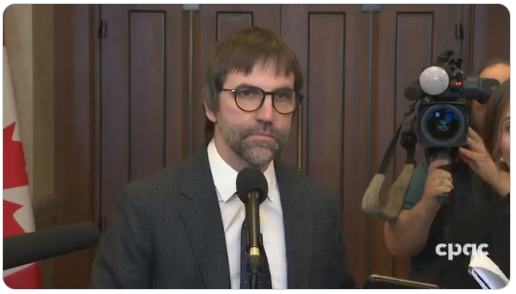
Canadian Heritage Minister Steven Guilbeault, 3 February 2020.
Screencapure from CPAC video.

The harm that will come from these policy choices is difficult to overstate. By focusing the tax burden on sales taxes rather than technology company revenues, consumer costs will go up and the company profits will be left untouched. The CRTC powers will lead to years of hearings and follow-on litigation, yielding few tangible benefits for creators. The mandated Cancon contributions will spark trade wars and make Canada a less attractive market for new services leading to fewer choices and less competition, while the link licensing requirement will result in blocked sharing of news articles on social media sites that hurts both Canadians and media organizations. All the while, the issues that really matter – privacy, anti-competitive behaviour, online hate, misinformation, a fair share of tech corporate profits – are left largely untouched.

How did the government end up with the worst of all worlds on Internet regulation?

The starting point was the 2015 election in which it committed to no new Netflix taxes (prompted by a Conservative pledge on the issue) and subsequent consultations on everything from copyright to digital cultural policy. The result was then-Heritage Minister Melanie Joly struggling to honour the no-tax commitment, while satisfying increasingly vocal demands from some stakeholders for one. Those calls increased after the results of her cultural policy consultation were released, which largely focused on a rejection of new Internet taxes and support for net neutrality.

In the aftermath of the Cambridge Analytica scandal, worries about Russian election interference, and Christchurch massacre broadcast live online, the policy winds shifted and the government was clearly looking to become more active on the Internet regulation file. That led to Election Act provisions that were generally viewed as successful. It also paved the way for a 2019 election platform that was far aggressive on social media and the Internet, with commitments to address everything from privacy to hate speech online.

[…]

If the government were to address the real concerns, there would be long-overdue privacy reforms, a more aggressive approach on competition issues, measures to address online hate and misinformation, and pursuit of a global agreement on fair taxation of technology company revenues. If it wants to support increased film production from indigenous groups or help the news sector, it can make those policy choices and use general tax revenues without creating a massive regulatory infrastructure.

Instead, it is turning to the harmful policies noted above that raise consumer costs (digital sales taxes), regulate online Cancon with mandated spending requirements (even though the industry has record production led by Netflix), dispense with any pretense of maintaining net neutrality, lead to blocked sharing of news articles (mandated licence for social media sites merely for linking to news content), and result in services avoiding the Canadian market (market interference in payments from services such as Spotify). Much of this will be overseen by the newly empowered CRTC, leading to lengthy hearings that primarily benefit lawyers. After having badly mishandled Canadian digital policy, the government now seems content to take a pass on the important issues and leave the controversial non-issues to the regulator and the courts.

August 6, 2020

Congress legislating on high tech is like your Grampa telling you how to play your favourite online game

Brad Polumbo on the notion that the politicians in Washington (or Ottawa, or London, or Canberra, …) are in any way capable of sensibly regulating the high tech sector:

While many principled small-government conservatives, such as Sen. Rand Paul, still back a free-market approach to tech policy issues, Hawley is not an outlier by any means.

Indeed, President Trump has also backed the regulation of social media companies to combat perceived anti-conservative bias. And the most popular conservative media personality in the country, Fox News host Tucker Carlson, regularly rails against Big Tech — even agreeing with progressive proposals to use the heavy hand of government antitrust regulation to break up companies such as Facebook and Google.

So, if major figures from both parties can agree on regulating Big Tech, it must be a good idea, right? Not so fast.

From left to right, the intentions behind these regulatory proposals are often good. After all, most reasonable people would likely share Democrats’ desire to see Big Tech better handle misinformation, “fake news,” and foreign election interference, while conservative Republicans’ calls for political neutrality online are no doubt appealing in the abstract.

Unfortunately, in their haphazard rush to score political points through government action, would-be regulators from both parties are forgetting the inevitable “knowledge problem” that plagues any central planners who try to dictate the minutiae of complicated industries from the halls of Washington, DC.

Economic philosopher Friedrich A. Hayek diagnosed this fatal flaw of government control in his seminal work “The Use of Knowledge in Society.”

    If we can agree that the economic problem of society is mainly one of rapid adaptation to changes in the particular circumstances of time and place,” Hayek wrote. “It would seem to follow that the ultimate decisions must be left to the people who are familiar with these circumstances, who know directly of the relevant changes and of the resources immediately available to meet them.”

    We cannot expect that this problem will be solved by first communicating all this knowledge to a central board which, after integrating all knowledge, issues its orders,” he continued. “We must solve it by some form of decentralization. But this answers only part of our problem. We need decentralization because only thus can we insure that the knowledge of the particular circumstances of time and place will be promptly used.

July 27, 2020

QotD: People on social media are the worst!

Filed under: Media, Quotations, Technology — Tags: , , , — Nicholas @ 01:00

This article asked many internet pioneers about how they think it’s all turned out. They’re not happy.

No one asked me, he said with a petulant sniff. I think it’s turned out well for those who regard it as a personal publishing platform, and don’t regard social media as an equivalent or replacement for the real world. It is a shadow realm full of tricksters and devils and angels and blokes and sheilas. It’s Second Life except it seems real because it contains Kardashians, who are the most important and fascinating people on earth.

Anyway, it’s mostly lamented now because A) Trump, and B) People are jerks.

    Rich Kyanka: Social media was supposed to be about, “Hey, Grandma. How are you?” Now it’s like, “Oh my God, did you see what she wore yesterday? What a f**ing cow that bitch is.” Everything is toxic — and that has to do with the internet itself. It was founded to connect people all over the world. But now you can meet people all over the world and then murder them in virtual reality and rape their pets.

Everything is toxic — and that has to do with the internet itself. I don’t think so. I think it has to do with people on the internet. People who otherwise wouldn’t say boo to you as you passed on the street, but feel as if it is their duty to yell at everything on Twitter, because there are no consequences. If you got into the elevator at work every day and acted rude to everyone in the car, eventually it would have consequences. The Internet is a hellish version of an elevator car — everyone is looking at everyone else and talking at the same time about everyone else and themselves.

James Lileks, The Bleat, 2018-05-02.

July 8, 2020

Harry Potter fandom, Millennials, and the continued decline of traditional religious beliefs

Filed under: Books, Britain, Religion, USA — Tags: , , , , , , , , — Nicholas @ 05:00

In The Critic, Oliver Wiseman talks to Tara Isabella Burton about her book Strange Rites:

J.K. Rowling’s Harry Potter books have been pivotal for many Millennials in encouraging them to move away from traditional religious beliefs.

I want to start with Harry Potter, which is — perhaps surprisingly — central to the argument you make in the book, so, as an introduction to your broader thesis, what does Harry Potter have to do with America’s new religions?

It’s funny. When Harry Potter first came out in the nineties, there was a flurry American Christian voices saying “This book promotes witchcraft. There’s going to be a whole new religious movement devoted to Harry Potter books.” In the way they meant it, that was absolutely not true. But I think that there was something to it in terms of an inadvertent change to the religious landscape.

What Harry Potter did, or, more accurately, what it was the canary in the coal mine for, was a transformation, linked to the rise of at-home internet access, in how we talk about cultural properties andhow we relate to cultural properties. The transition to an internet space defined by user-generated content and what is often called participatory culture coincided with the publication of the Harry Potter books.

Between the first Harry Potter book’s release in 1997 and the fourth book’s publication in 2000 we went from 19 million Americans with internet access to more than 100 million. It’s that backdrop that really explains the shift. You did have fan cultures before. There were Star Wars conventions, for example, but there was quite a high bar to entry. You had to get on the right mailing list and it was done via post. It was quite a lot of work. You couldn’t just log on and enter a community, which is really what could happen with Harry Potter fandom.

J.K. Rowling was also one of the first major writers to openly accept and embrace fan fiction. So what you ended up seeing was something that started with Harry Potter fandom that then became an element of fandom online more broadly which in turn, I would argue, shaped millennial-and-younger culture. It was this idea that you weren’t just a reader of consumer of texts. It wasn’t just a top down hierarchical thing. Instead, mediated through the anonymity of the internet, you a kind of tribalism from talking to people in different geographical areas as well as things like fan fiction and later meme culture that meant you could change, shift, reimagine a text in your own way. And what’s so interesting about that is that sensibility — the sensibility that we have not only the right but the responsibility, the authority as consumers to also be creators, to rework ideas outside of existing texts — has spilled over into all aspects of our political life and of our religious life. And that is really something that is the product of user generated content and the internet.

To bring this to religion more specifically, 36 per cent of Americans born after 1985 are religiously unaffiliated, compared to about 23 per cent of the national average. That’s a huge generational shift in religious affiliation and organisation. That is not the same thing as saying that these are atheists or that these people are not religious. Some 72 per cent of them say they believe in some sort of higher power. About 17 per cent say they believe in the Judaeo-Christian God.

We’re in a religious or spiritual landscape that privileges mixing and matching, and unbundling — a bit of tarot here, a bit of meditation there. And a resistance to institutional and authoritative declarations in terms of how religion should be practised is very much something that has its roots in internet culture, of which Harry Potter was a forerunner.

QotD: Telecommuting in the post-Wuhan Coronavirus era

Filed under: Business, Economics, Health, Quotations, Technology, USA — Tags: , , , , — Nicholas @ 01:00

People are being stampeded into telecommuting. The thing is, dear media, once that happens, you can’t put it back in the bottle.

For two decades now, telecommuting and distance learning have been perfectly possible and even, frankly, beneficial. What has held it back is managers afraid they don’t know how to manage at a distance, corporations who think mega cubicle farms are a great way to be “important” and a general sense that only us, ne’er do wells, work in our pajamas on the sofa (I’ll have you know I’m wearing a sweatshirt and yoga pants. Never mind.)

If the panic lasts even two months (and the press will ensure it does before it collapses under its own weight) that reluctance to telecommute is going to be blown to hell. For one, once workers taste of THAT fruit, just anecdotally, 90% of them LOVE it. (The other 10% have very annoying children or spouses.)

And in the wake of the financial panic and wobbles, corporations are going to notice that they spend a lot less money when most of the workers work from home. At some point, they’ll also realize that they need much smaller facilities if they need facilities at all. And hey, money.

This will cause all sorts of other things, which I think will lead within two years to an exodus from the big cities everyone has crammed into because it’s where the jobs are. I think in turn this will lead to a world the social engineers really don’t like.

Sarah Hoyt, “Unintended Consequences”, According to Hoyt, 2020-03-12.

July 3, 2020

QotD: Pop music

Filed under: Economics, Media, Quotations — Tags: , , , — Nicholas @ 01:00

The thing I always hated hearing from my grandfather was how modern music was terrible and not fit for civilized people. He was a man of his age and class, so he used colorful euphemisms to describe popular music. Even as a kid, I understood that every generation has their soundtrack. Maybe never having known anything but a world where pop culture dominated, this came naturally to me, while my grandfather still recalled an age before everyone had a radio and television. Maybe he knew things I couldn’t know.

Either way, I’ve always just assumed that once I passed my mid-20’s, pop music was no longer for me. Some stuff would be appealing, but most would be aimed at kids and strike me as simplistic and repetitive. There were some good bands in the 90’s that I liked, but most of it was not my thing. By the 2000’s, I was unable to name popular groups or the songs at the top of the charts. Today, I have not heard a single note from any song on the current top-40. On the other hand, I’m sure I’ve heard some version of all of it.

That may be why music sales have collapsed. A 15-year old can go on YouTube or Spotify and find fifty versions of the current pop hits, going back before their parents were born. They can also find stuff from previous eras that was remarkably well done and performed by people with real talent. Justin Timberlake may be very talented as a singer, but no one is confusing him with Frank Sinatra. It’s simply a lot easier for young people to see that pop music is just manufactured pap from Acme Global Corp.

“The Z Man”, “The Soundtrack Of This Age”, The Z Blog, 2018-03-15.

June 24, 2020

Trudeau government wants to introduce an Internet “link tax”

Filed under: Business, Cancon, Government, Technology — Tags: , , , — Nicholas @ 03:00

Michael Geist on the Trudeau government’s latest indications of support for a tax grab to benefit certain favoured groups and organizations:

Canadian Heritage Minister Steven Guilbeault, 3 February 2020.
Screencapure from CPAC video.

Last week, Canadian Heritage Minister Steven Guilbeault called into question his own government’s policies on supporting news media, suggesting that those programs should be replaced by copyright rules that would open the door to payments from internet companies such as Google and Facebook. Mr. Guilbeault indicated that a legislative package was being prepared for the fall that would include new powers for Canada’s communications regulator and what are commonly referred to as Netflix taxes and internet linking taxes.

My Globe and Mail op-ed notes the government’s support for new internet taxes should not come as a surprise. There were strong signals that the spring budget – postponed indefinitely due to the current public health crisis – was going to include expanding sales taxes to capture digital sales such as Netflix or Spotify subscriptions.

[…]

It is Mr. Guilbeault’s plans for a link tax that should spark the most concern, however. The government has long promoted its policies designed to support the Canadian media sector, including direct funding for local journalism as well as labour and subscription tax credits. The taxpayer cost runs into the hundreds of millions of dollars, but is justified on the grounds that journalism is an essential service that requires public support.

Yet Mr. Guilbeault now says that government should not be funding media, characterizing the policies as short term measures aimed at mitigating a media emergency. Instead, Mr. Guilbeault supports a controversial copyright reform measure that would establish a news publisher’s right to demand payment for services that link to their content.

This payment – effectively a tax on linking – raises a host of concerns, not the least of which is that the proposal was not recommended by the government’s own copyright review last year. Copyright reform in Canada is always complicated, particularly given that responsibility for it is shared with Innovation, Science and Economic Development Minister Navdeep Bains, but delving into reforms that sparked protests in Europe could be politically risky for a minority government.

News organizations already benefit from large platforms linking to their content since the links generate visitors that increase advertising revenues and paying subscribers. Organizations that do not want the links can easily opt-out of appearing in services such as Google News or Facebook. In fact, after Google shut down its Google News service in Spain, studies found publisher website traffic dropped by 10 per cent.

June 11, 2020

In 1929, the warning sign was getting stock tips from shoeshine boys and elevator operators

Filed under: Business, Economics, History — Tags: , , , , — Nicholas @ 05:00

In 2020, as Jay Currie suggests, the warning sign might be robinhood.com:

“Jay Gould’s Private Bowling Alley.” Financier and stock speculator Jay Gould is depicted on Wall Street, using bowling balls titled “trickery,” “false reports,” “private press” and “general unscrupulousness” to knock down bowling pins labeled as “operator,” “broker,” “banker,” “inexperienced investor,” etc. A slate shows Gould’s controlling holdings in various corporations, including Western Union, Missouri Pacific Railroad, and the Wabash Railroad.
From the cover of Puck magazine Vol. XI, No 264 via Wikimedia Commons.

In the winter of 1928 Joe Kennedy, father of JFK and major stock market player, stopped to get his shoes shined. The shoeshine boy leaned in and said, “Buy Hindenburg”. Kennedy began unwinding his positions saying, “You know it’s time to sell when shoeshine boys give you stock tips. This bull market is over.”

I had a similar experience in late 1999 when a friend took out a mortgage on her condo to buy shares in the billion dollar online copy paper empire. She had a perfectly good job in retail garden supplies. Remembering Kennedy, I advised another friend that her Nortel was looking a bit overbought. As it happened she sold quite near the peak.

The 2020 equivalent of the shoeshine boy is the perfect storm is the free trading platform, robinhood.com. This is a nicely designed site where you can trade shares on your computer or phone. It has become very, very popular with younger, new investors. My late 1990’s day trading pals would have killed for this sort of interface and no brokers fees. It has spawned a whole host of reddit chats, twitter streams and countless YouTube videos on the excitement of swing trading. (One fun spot to watch Robinhood is the https://robintrack.net/leaderboard which shows which stocks the people on Robinhood are buying. It is a bit slow and buggy but a great front row seat.)

What is striking about the robinhood.com world is that it revolves around trading rather than any sort of “investing”. You hop into APPL in the morning, see if you can make a couple of bucks by noon and move onto the next thing. And Apple is a real, solvent, company.

Robinhood has been in the news recently because the herd has charged into the shares of a number of companies which are either in or near bankruptcy. Hertz Rent-a-Car dropped from $20 to $0.50 in three months as the market realized that with no travelers there would be no car rentals. Interestingly, we learn from robintrack.net that at $20 there were a little over 1000 users holding, as Hertz crashed the Robinhood users piled in, at $0.55 there were 44,000 and there are now 158,000. And many will have made money, lots of money, trading the gyrating price from $0.50 to back up to $5.00.

In the run up to the crash of October 1929, long after Joe Kennedy had pulled his money from the market, retail traders were coining it trading the “swings” on margin accounts. It didn’t matter what the company actually did, it was going up. The same “irrational exuberance” was a big feature in the dot com bubble.

The “Fearless Girl” statue faces the Arturo Di Modica “Charging Bull” on Wall Street (Wikipedia)

The lessons of the 1929 crash and the 2000 dot com bust were simple – get out early and be in no hurry to get back in. Right now the dinosaurs like Buffet and Ichan are sitting on stacks of cash. Just like Joe Kennedy was when Wall Street swan dived in October 1929. They got that cash by selling their shares to shoeshine boys and the bright lights at Robinhood.

May 19, 2020

Some changes to the working world … when the world gets back to working

Filed under: Britain, Business, Economics — Tags: , , , , , , — Nicholas @ 05:00

Sean Gabb has some thoughts on the post-lockdown return so … well, not normal, but as the economy reaches toward a new working equilibrium:

Kensington High Street at the intersection with Kensington Church Street. Kensington, London, England.
Photo by Ghouston via Wikimedia Commons.

The Coronavirus and its aftermath of lingering paranoia are the perfect excuse. Decentralisation and homeworking must be done. They must be done for the duration. They must be continued after that to maintain social distancing. No one will think ill of Barclays and WPP for taking the leap. No one will blame them for taking the leap in a way that involves a few deviations from course and a less than elegant landing. A year from now, these organisations will be making measurably larger profits than they would be otherwise. The mistakes will have been ignored.

And other organisations will follow. Whether the present crash will bring on a depression shaped like a V or an L, there is no doubt that, even if slowly at first, the wheels of commerce will continue turning. But they will be turning on different rails. As with any change of course, there will be winners and losers. I have already discussed how I can expect to be among the winners. I will leave that as said for the other winners — these being anyone who can find a market for doing from home what was previously required by custom and lack of imagination to be done somewhere else. I will instead mention the losers.

Most obvious among these will be anyone involved in commercial property. Landlords will find themselves with many more square feet to fill than prospective tenants want to fill. Rental and freehold values will crumble. Bearing in mind how much debt is carried by commercial landlords, there will be some interesting business failures in the next few years. Then there are the ancillary sectors — property management companies, commercial estate agents, maintenance companies. These employ swarms of architects and surveyors and lawyers and negotiators, of builders, plumbers, electricians, of drivers and cleaners. If the humbler workers will eventually find other markets, many with degrees and professional qualifications can look to a future of straitened circumstances.

The lush residential estates in and about Central London will follow. I think particularly of the aristocratic residential holdings in Kensington. Houses here go for tens of thousands a week to senior bank workers from abroad. If the City and Canary Wharf are emptied out, who needs to live in a place like Kensington? It has poor Underground connections. It is close by places like Grenfell Tower. Its residents keep predators at bay only by heavy investment of their own in security and by suspecting every knock on the door and every sound in the night. Many of the shops and eateries that make its High Street an enjoyable place to be will not reopen. Those that do reopen will be hobbled by continuing formal and informal rules on social distancing.

As a result, restaurants and pubs and coffee bars will begin to disappear. All but a few of these were barely making normal profit before they were closed last month. So few are in liquidation as yet only because so few petitions have been lodged in the courts. Most of them will now be surplus to requirement. The same can be said of hotels. Speaking for myself, I used to visit Cambridge twice a year on examinations business. I was always put up there for a couple of nights. I shall now do from home all that I did in Cambridge. I doubt I am alone. Zoom will destroy business travel. In the same way, bigger televisions plus continued social distancing will finish off the theatres and cinemas — also in decline before last month.

May 9, 2020

QotD: Networks don’t work that way with humans

Filed under: Quotations, Technology, USA — Tags: , — Nicholas @ 01:00

When I came here [to Silicon Valley] I encountered tremendous arrogance. A kind of “resistance is futile” mentality that of course our apps will take over the world, and when they do, when everybody is connected, that’ll be awesome! There will be one global community and everything will be great. And my response to that was: That’s insane. That’s historically completely implausible. We’ve run experiments with really large-scale social networks before. We didn’t have the Internet, but that didn’t matter. You could do it with a printing press. You could even do it just with the written word. And the result is never to produce a single homogenous cluster of happy-clappy individuals in a global community. That never happens.

Niall Ferguson, quoted by @bigthinkagain, 2018-02-17.

April 27, 2020

The NFL may have a problem … everyone seems to have liked the virtual draft better than the “real” thing

Filed under: Business, Football, Media, Technology — Tags: , , , — Nicholas @ 05:00

It is usually difficult to muster much sympathy for the National Football League, but the record-setting popularity of the 2020 draft is a huge surprise:

The unique presentation of the 2020 NFL Draft established new all-time highs for media consumption in every category. With over 600 camera feeds from homes across the United States, all telecasts of the 2020 NFL Draft reached more than 55 million total viewers across Nielsen-measured channels over the three-day event, up +16% vs. 2019. An average audience of over 8.4 million viewers watched all three days of the 2020 NFL Draft across ABC, ESPN, NFL Network, ESPN Deportes, and digital channels easily breaking the previous high of 6.2 million viewers in 2019 (+35%).

Each day of the 2020 NFL Draft established new highs as an average audience of over 15.6 million viewers watched Round 1 on Thursday (+37% vs. 2019), over 8.2 million viewers watched Rounds 2 & 3 on Friday (+40% vs. 2019), and over 4.2 million viewers watched Rounds 4-7 on Saturday (+32% vs. 2019).

All seven rounds of the 2020 NFL Draft were presented across ABC, ESPN, and NFL Network – the second straight year that The Walt Disney Company partnered with the National Football League to offer a multi-network presentation of the entire Draft.

“I couldn’t be more proud of the efforts and collaboration of our clubs, league personnel, and our partners to conduct an efficient Draft and share an unforgettable experience with millions of fans during these uncertain times,” said NFL Commissioner Roger Goodell. “This Draft is the latest chapter in the NFL’s storied history of lifting the spirit of America and unifying people. In addition to celebrating the accomplishments of so many talented young men, we were pleased that this unique Draft helped shine a light on today’s true heroes – the healthcare workers, first responders, and countless others on the front lines in the battle against COVID-19. We are also grateful to all those who contributed to the NFL family’s fundraising efforts.”

“This year’s NFL Draft clearly took on a much greater meaning and it’s especially gratifying for ESPN to have played a role in presenting this unique event to a record number of NFL fans while supporting the league’s efforts to give back,” said ESPN President Jimmy Pitaro. “The success of this year’s Draft is a testament to the unprecedented collaboration across the NFL, ESPN, and The Walt Disney Co. in the midst of such a challenging time.”

The unique situation of having the vast majority of televised sports activities suspended clearly made a big difference — when you’re the only game in town, you can expect a wider audience — but the online draft seems to have been popular even among people who normally would have tuned in for the event anyway.

March 31, 2020

QotD: How the old “mainstream media” fell for fake news

Filed under: Economics, Media, Quotations, Technology — Tags: , , , — Nicholas @ 01:00

One of the important side effects of the communications revolution is the proliferation of grifters, con men and hustlers. Things that were impossible thirty years ago, like e-mail scams, remain a constant problem. The internet has made it easy for even the crudest hustlers to reach a broad audience. As a result, the number of hustlers has increased and the types of hustles have also increased. The twitter troll, for example, is an entirely new type of hustle, made possible by the internet.

One reason for this is that the internet has turned into a big stage where anyone can try out their act on the public. In the old days, a carny bimbo would have been confined to a traveling carnival, Hollywood, New York or community theater. Maybe she would have ended up in pornography. It was not an easy way to make a living. Today, she can have a twitter account where she flashes photo-shopped pics of herself. Thirsty losers send her money through PayPal or super chats on her YouTube channel.

The low barrier to entry means every female with a desire for the carny life can get on stage from the privacy of her studio apartment. It’s not just females working the new rackets. In a prior age, Mike Cernovich would have been traveling from town to town selling his monkey mind juice to gullible townies at state fairs. Alex Jones would have been mailing people his mimeographed newsletter, where he explained how space aliens control the Federal Reserve Bank.

Most likely, it is the communications revolution that has caused the news media to commit suicide. In the old days, when the audience was fixed, the focus was on maintaining the facade of objectivity. No one was under any illusions about growing the audience, so they focused on keeping the audience. The internet promised a global market and unlimited market share. A relentless drive for eyeballs gave rise to the clickbait journalists turning the media into fake news.

The Z Man, “Carny Town”, The Z Blog, 2019-12-29.

February 12, 2020

“… perhaps the biggest Internet cash grab in the OECD with mandated payments and levies on thousands of Internet services with Canadian users”

Filed under: Bureaucracy, Business, Cancon, Government, Media — Tags: , , , , , — Nicholas @ 03:00

Michael Geist refutes the claim that the recent Broadcast and Telecommunications Legislative Review Panel report does not recommend a “Netflix tax”:

The reference to a Netflix tax in the overview is the only such reference in the 235 page report. It was likely included in the overview in the hope that media coverage would jump on the claim and seek to re-assure Canadians that there was no Netflix tax or higher prices likely for consumers as a result of the report’s recommendations.

Yet the reality for anyone that reads beyond the overview is that the panel’s report not only recommends what would widely be considered a Netflix tax but proposes perhaps the biggest Internet cash grab in the OECD with mandated payments and levies on thousands of Internet services with Canadian users. This includes online streaming services, social media companies, news aggregators, and online communications services such as Skype, WhatApp, and Viber. In the view of the panel, any service or site with Canadian users is part of the “Canadian system” and should be expected to contribute to the development of Canadian content, Canadian news organizations, or building broadband connectivity. Note that all of this is above and beyond sales taxes, which the panel also recommends should be implemented with respect to foreign services.

Some of the panel’s plans are admittedly somewhat confusing. For example, the panel states:

Media curation undertakings brought under the regime – including Netflix and other online streaming services – would be required to devote a portion of their program budgets to Canadian programs.

That statement, along with chair Janet Yale’s comment at the opening press conference that there was no need for Netflix to spend additional money on Cancon but rather merely divert existing on foreign location and service production spending in Canada, has been interpreted by some to mean that Netflix would not have to increase its Canadian programming budget. But that is apparently not what the panel means. I spoke with Yale who confirmed that the panel expects the CRTC to establish a minimum Cancon spend requirement on Netflix based on its Canadian revenues. In other words, the requirement has nothing to do with its existing spending on production in Canada. For Netflix, that could certainly represent an increase in spending costs in Canada with those costs likely passed along to consumers.

Yet the panel’s plan extends far beyond just online streaming services such as Netflix. It also envisions mandatory levies against social media services and news aggregators that would be used to fund Canadian news services. It similarly targets a myriad of communications services that would pay into funds to support broadband development.

February 4, 2020

“Who could oppose such an obviously sound idea?”

A few pithy comments from Twitter on the Trudeau government’s apparent surprise that a few Canadians don’t think their regulate-the-internet plan is brilliant:

Fellow Rush fan Matt Gurney finds the perfect lyrics for the occasion:

Rush in concert, Milan 2004.
Photo by Enrico Frangi, via Wikimedia Commons

« Newer PostsOlder Posts »

Powered by WordPress