Quotulatiousness

January 28, 2021

GameStop in a very different kind of game

In the NP Platformed newsletter, Colby Cosh looks at the fascinating gyrations of GameStop’s share price in the grip of an unexpected group of players in the market:

“GameStop” by JeepersMedia is licensed under CC BY 2.0

GameStop has long been seen by institutional investors as following down the road of Blockbuster Video: it’s a bricks-and-mortar retailer whose main product is downloadable from your sofa. For that reason, it is heavily shorted by professional funds who normally eschew short-selling, which does have the risky feature of potentially infinite negative downside.

Enter Reddit, the website for special-interest user forums of all kinds. A Reddit “Wall Street bets” board uncovered evidence in regulatory filings that some hedge funds had legitimately dangerous large short positions representing bets against GameStop’s flaccid share price. A few hobby investors began to buy GameStop out of a sense of adventure and perhaps nostalgic loyalty. More importantly, they began to preach the gospel to others.

This is explicit “market manipulation,” but done in the open; it is surely as legal as any other conversation. GameStop’s price (NYSE symbol: GME) surged upward as word spread amongst day traders and other amateur investors. And as the random-looking rise in price got noticed, the whole scheme, itself rather reminiscent of a video game, went viral.

As of Jan. 12, GME was below $20, which is about where most analysts thought it belonged on merit, or lack thereof. The price as I type this particular sentence is $328.81. The backs of some funds with heavy short positions have been broken.

High finance seems somewhat terrified, as amateur investing websites — ones pioneered by the financial industry itself — begin to throw roadblocks in front of late-arriving GME buyers. For itself, Wall Street will invest billions replacing copper wire with fiber optics to gain microsecond arbitrage advantages in the market; for you and I, the good old portfolio can get conveniently 404ed for an afternoon.

This suggests that Wall Street may not have reckoned with the full possibilities of a world of proletarian shareholders. The stock market has proverbially been a playground of “animal spirits” since long before John Maynard Keynes used that phrase in 1936. What happens to an ecosystem when new animals show up? One can surely count on at least a minimum of chaos; maybe the surprise is that it took so long to take this game-like, combative form.

December 20, 2020

QotD: Online literacy

Filed under: Education, Media, Quotations, Technology — Tags: , — Nicholas @ 01:00

In the various fora and social media circles in which I run, there’s a self-selecting bias toward literacy. Thoughts tend to be expressed in complete sentences with reasonably correct grammar and punctuation.

But sometimes I’ll find myself looking at the posts of a Facebook friend-of-a-friend-of-a-friend and I see these random aggregations of misspelled words. They have the occasional capital letter or punctuation mark thrown in, as though the writer knew they were supposed to include those, but not how or why.

And I find myself wondering “What’s it like inside their head?” I mean, you’d probably be going through life slightly angry, thinking everybody was secretly laughing at you behind their hands, that there was some arcane code of keyboard use you were violating. The whole internet would be like one of those fancy restaurants with too much silverware and you never know which implement to use to eat which dish.

Tamara Keel, “I’ve always wondered…”, view from the porch, 2018-08-24.

December 2, 2020

Bill C-10, An Act to amend the Broadcasting Act hijack the internet

Filed under: Bureaucracy, Cancon, Media, Technology — Tags: , , , , — Nicholas @ 03:00

At The Line, Josh Dehass outlines the benign-sounding claimed intent of Bill C-10 and the malign reality if it is implemented as written:

Bill C-10 would expand the term “broadcasters” to include online content creators. This means that after decades of a mostly regulation-free Internet, the CRTC will soon have a say in what content you can and can’t see on services like Netflix, Amazon Video and Spotify. The bill says these “broadcasters” will be required to “serve the needs and interests of all Canadians — including Canadians from racialized communities and Canadians of diverse ethnocultural backgrounds, socio-economic statuses, abilities and disabilities, sexual orientations, gender identities and expressions, and ages — and reflect their circumstances and aspirations, including equal rights, the linguistic duality and multicultural and multiracial nature of Canadian society and the special place of Indigenous peoples within that society.”

In the Globe and Mail Guilbeault helpfully translated from Newspeak: broadcasters now must create “Indigenous programming,” and possibly other forms of mandatory content by and for minority groups. Guilbeault said that the mandatory Indigenous programs are necessary to correct the “historical mistake” that Canada made when it denied Indigenous people their cultural expression. That historical mistake apparently cannot corrected solely by forcing Canadians to fund APTN and non-stop Indigenous content at CBC. Only when every private company is co-opted in the mission will the mistake be corrected.

It’s bad enough that this new law will require Canadians to pay for shows and podcasts that they’re unlikely watch. What’s really disturbing is that this new law means any large company that wants to produce artistic and cultural content online in Canada will no longer be permitted to devote their time and money exclusively to expressing the ideas that they wish [to] express. Instead, they will be forced to also express the ideas the government wishes them to express. This is compelled speech, which is the term lawyers use when the government forces you to mouth its message. This is contrary the spirit of free expression rights that the Charter of Rights and Freedoms guarantees.

The new policy might strike you as old-fashioned broadcast regulation. It isn’t. The theory behind the original Broadcast Act was that the airwaves were a finite resource, requiring the government to act as referee. Otherwise, we could end up consuming nothing but low-brow American cultural products rather than high-brow CanCon like Family Feud Canada and Hedley. This was an elitist argument, since it assumed that individual consumers weren’t capable of determining what content is in their own interests, but at least it made a little sense, because it was theoretically possible for important programming like news to get completely crowded out. The Internet, on the other hand, is effectively infinite. There’s room for everyone’s content in the online marketplace of ideas. So far, it’s worked wonderfully. Virtual nobodies can find huge audiences without big money to get started. There’s really no reason for the government to interfere.

November 21, 2020

“Ah, and so it begins. The problematization of Substack”

Filed under: Media, Politics — Tags: , , — Nicholas @ 05:00

Writing — appropriately — on Substack, Jen Gerson outlines her transition from full-time journalist to journalist-subsisting-on-the-crumbs-of-direct-reader-support at The Line:

True story: an ambitious young man with an idea for a startup gave me a ring on the phone. He wanted to start a new platform for writers and journalists; what would it take to encourage a writer like me to abandon the mainstream media and go fully independent? I explained the sort of site that might entice me — a clean and painless user interface, basic word processor, and something to take care of IT and payment back end. I then hung up the phone and thought to myself: “Nice guy. Too bad that idea isn’t going anywhere.”

After all, why would I abandon paying gigs in mainstream journalism for the uncertainty of direct reader support? It was a crazy idea.

Years passed.

Well, this gentleman went off to form a company called, uh, Substack, and after Andrew Sullivan left New York Magazine to reconstitute the Daily Dish under the aegis on this very platform, I was forced to dredge up this gentleman’s email and offer to eat my hat.

Because by then, mainstream media was in a state of financial and moral disarray and it was time for me to do what I would have done three years earlier if I had possessed the foresight — start The Line. In any case, the founder of Substack was very kind and even managed to schedule a call with me, at which point I said: “OK, you were right.”

This was one of the conversations that eventually led to my co-founding this fine newsletter that you are reading now, but in the course of this chat I had to ask another question: “You know they’re going to come after you, right? Are you ready for that?”

He said Substack is, indeed, committed to serving its community of writers — provided they aren’t spreading hate or disinformation, of course — but I suspect the company is only beginning to gain a glimpse of the test ahead.

When I read the Columbia Journalism Review‘s piece “The Substackerati“, released this week, my first response was: “Ah, and so it begins. The problematization of Substack.”

About that “Canadian content crisis” the feds are trying to “fix” with Bill C-10

Filed under: Cancon, Government, Law, Media — Tags: , , , , , — Nicholas @ 03:00

Michael Geist begins a series of posts on the ongoing blunder that is the federal government’s “get money from the web giants” proposed legislation:

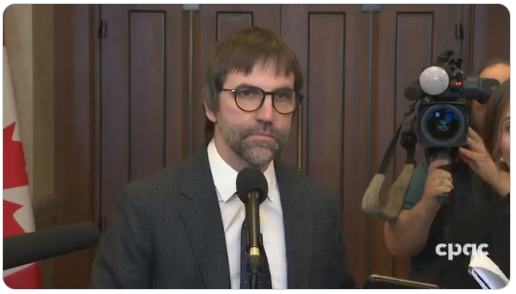
Canadian Heritage Minister Steven Guilbeault, 3 February 2020.
Screencapure from CPAC video.

Canadian Heritage Minister Steven Guilbeault rose in the House of Commons yesterday for the second reading of Bill C-10, his Internet regulation bill that reforms the Broadcasting Act. Guilbeault told the House that the bill would level the playing field, that it would establish a high revenue threshold before applying to Internet streamers, would not impact consumer choice, or raise consumer costs. He argued that even if you don’t believe in cultural sovereignty, you should still support his bill for the economic benefits it will bring, warning that Canadian producers will miss out on a billion dollars by 2023 if the legislation isn’t enacted. He painted a picture of Internet companies (invariably called “web giants”) that have millions of Canadian subscribers but do not contribute to the Canadian economy.

Guilbeault is wrong. He is wrong in his description of the bill (it does not contain thresholds), wrong about its impact on consumers (it is virtually certain to both decrease choice and increase costs), wrong about the contributions of Internet streamers (who have been described as the biggest contributor to Canadian production), wrong about level playing field claims (incumbent broadcasters enjoy a host of regulatory benefits not enjoyed by streamers), wrong about the economic impact of the bill (it is likely to decrease investment in the short term), and wrong about cultural sovereignty (it surrenders cultural sovereignty rather than protect it).

With the bill starting its Parliamentary review, this is the first in a new series of posts on why a careful examination of the data and the bill itself reveals multiple blunders. There are good arguments for addressing the sector, including tax reform, privacy upgrades, and competition law enforcement. There are also benefits to updating the Broadcasting Act, but in an effort to cater to a handful of vocal lobby groups over the interests of the broader Canadian public, Guilbeault’s bill will cause more harm than good. The series will run each weekday for the next month, first addressing the weak policy foundation that underlies Bill C-10, then a series a posts on the uncertainty the bill creates, a review of the trade threats it invites, and an assessment of its likely impact on consumers and the broader public.

The series begins with a post on the fictional Canadian content “crisis.” Canadians can be forgiven for thinking that the shift to digital and Internet streaming services has created a crisis on creating Canadian content. Canadian cultural lobby groups regularly claim that there is one (Artisti, CDCE) and Guilbeault tells the House of Commons that billions of dollars for the sector is at risk. Yet the reality is that spending on film and television production in Canada is at record highs. This includes both certified Canadian content and so-called foreign location and service production in which the production takes place in Canada (thereby facilitating significant economic benefits) but does not meet the narrow criteria to qualify as “Canadian.” I have written before about the need to revisit the Canadian content qualification rules which enable productions with little connection to Canada to receive certification and some that directly meet the goal of “telling Canadian stories” that fail to do so.

November 18, 2020

The Consumer Privacy Protection Act

Filed under: Business, Cancon, Government, Law, Technology — Tags: , , , — Nicholas @ 05:00

Michael Geist looks at Bill C-11, which was introduced by Navdeep Bains on Tuesday:

Parliament Hill in Ottawa.
Photo by S Nameirakpam via Wikimedia Commons.

Canada’s privacy sector privacy law was born in the late 1990s at a time when e-commerce was largely a curiosity and companies such as Facebook did not exist. For years, the privacy community has argued that Canada’s law was no longer fit for purpose and that a major overhaul was needed. The pace of reform has been frustrating slow, but today Innovation, Science and Industry Minister Navdeep Bains introduced the Consumer Privacy Protection Act (technically Bill C-11, the Digital Charter Implementation Act), which represents a dramatic change in how Canada will enforce privacy law. The bill repeals the privacy provisions of the current Personal Information Protection and Electronic Documents Act (PIPEDA) and will require considerable study to fully understand the implications of the new rules.

This post covers six of the biggest issues in the bill: the new privacy law structure, stronger enforcement, new privacy rights on data portability, de-identification, and algorithmic transparency, standards of consent, bringing back PIPEDA privacy requirements, and codes of practice. These represent significant reforms that attempt to modernize Canadian law, though some issues addressed elsewhere such as the right to be forgotten are left for another day. Given the changes – particularly on new enforcement and rights – there will undoubtedly be considerable lobbying on the bill with efforts to water down some of the provisions. Moreover, some of the new rules require accompanying regulations, which, if the battle over anti-spam laws are a model, could take years to finalize after lengthy consultations and (more) lobbying.

Trudeau’s internet policy — cash grab or power grab? Embrace the healing power of “and” (TM Instapundit)

Filed under: Business, Cancon, Government, Media, Technology — Tags: , , , , , , — Nicholas @ 03:00

The Canadian government is taking advantage of the ongoing economic and social disruption of the Wuhan Coronavirus to widen their existing regulation of both broadcasting and internet entertainment. It’s not just a bit of maple-flavoured cultural imperialism, but it’s also a blatant cash grab:

Canadian Heritage Minister Steven Guilbeault, 3 February 2020.
Screencapture from CPAC video.

I see, in the Globe and Mail, that Justin Trudeau and Steven Guilbeault want to further regulate the broadcasting services in Canada. Their goals seem to be, in part, a cash grab ~ online streaming services, like Netflix, are offering Canadians, for a price, what they want, while the CBC offers Canadians, thanks to a $1+ Billion annual subsidy from taxpayers like you and me, what we, pretty clearly, do not want to watch and the Liberals want a share of that money ~ and also an appeal to those who play identity politics.

I think we need to look at the “products” of broadcasting ~ information (news and “public affairs” and documentary programmes) and entertainment, including sports, as “consumable products,” rather like food and, say, soft drinks.

We do allow, even demand that governments exercise some important regulatory functions in regard to food and soft drinks: we want to make sure that they are safe to consume and Canadians want to know what is in the food we consume.

The Canadian Radio-television and Telecommunications Commission (CRTC) was, originally, conceived to solve a fairly simple problem: allocating broadcast licences. Government engineers calculated how many radio channels could be used in any given place but they didn’t want to have to decide who should get to use them. Politicians didn’t want to do it, either, because while the successful applicant was (usually) happy the more numerous unsuccessful ones were disappointed and politicians hate to disappoint people. Thus they created an arms length agency to make the tough decisions for them. Licence allocation is still an important job for the CRTC. But the CRTC’s mandate was expanded with the birth of cable TV. Companies, like Rogers, built cable systems ~ and they received both direct and indirect government support to reach more and more Canadians ~ and then “sold” access to consumers. In the normal course of events one might have thought that the government would attach some business conditions to its loans, grants and tax deductions, but there was an ever-growing demand, from the Canadian cultural community ~ based almost entirely in Montreal and Toronto ~ to regulate the fledgling cable and “pay TV” market to ensure that Canadian programmes were not shut out but, in fact, could have privileged positions in the cable lineup, which led to the government, in the 1960s, telling the CRTC to regulate how companies like Famous Players, Maclean Hunter and Rogers configured the private product they sold to individual consumers.

The initial government argument was “we regulate all kinds of things for the common good: that’s why we all drive on the right, for example, and the delivery of broadcasting by cable is like that.” “No it’s not,” the cable operators replied, “you build and maintain the roads, using taxpayers’ dollars, so you’re allowed to regulate how they’re used, plus it’s a safety issue. Cable service and ‘pay TV’ are private, commercial transactions between us, the companies who built and operate the systems, and the individual consumer who wants to subscribe to what we offer. You don’t presume to regulate, beyond the laws against libel and pornography, what people can read in MacLean’s magazine or the Globe and Mail, why is ‘pay TV’ and cable different?” It’s still a good question. But the cable operators surrendered gracefully and the CRTC has been, broadly, for the last half-century, protective of the rights of incumbents in the infotainment markets. In return the cable and internet operators have agreed to “tiers” of programming which means that if you want to watch, say, BBC World Service or Deutsche Welle or Fox News, you must also pay for CBC News Network and CTV News Channel and, no matter who you are and what your individual preferences might be, when you subscribe to a cable/internet service you must also support a number of French stations/channels; it’s the law. And now Minister Guilbault wants to ensure that you pay for the output of indigenous producers, writers, actors and so on, on both indigenous networks ~ to which you must already subscribe if you have a “basic” Canadian cable or satellite TV package ~ and, it appears to me, in programmes produced by Canadians and even by Netflix.

November 14, 2020

“… we all know that Wrong Opinions Are No Longer Allowed On The Internet”

Filed under: Health, Media, Politics — Tags: , , , , , , — Nicholas @ 05:00

Jen Gerson has some Wrong Opinions that she shared On The Internet, so Dr. Bradley Mitchelmore, BSc. (Pharm), ACPR, PharmD, RPh has has taken it upon himself to try to get her cancelled:

Firstly, to explain how this little gem fell into my lap, some context is required. While I was avoiding the interminably dull task of invoicing our fine writers of The Line the other day, I threw out a position that some might find controversial.

That is, I find the trend towards identifying women by terms like “birthing people,” “menstruators,” “front-hole possessors” and “uterus bearers,” to be both reductive and offensive. I have no objection to finding more inclusive language for circumstances in which we want to acknowledge trans and non-binary people (ie; a phrase like “pregnant people” seems clunky, but inoffensive to me); but to date, all of this new language reduces the class of “women” to either a biological function or a bodily part.

Pregnancy is a particularly sensitive topic for a lot of women because, for most of us, the process is terrifying. To go through childbirth is the most profound loss of bodily autonomy imaginable and many women I know struggle with the after effects of feeling as if we’ve been treated like interchangeable breeding sows by some doctors and nurses. If a doctor started calling me a “birther” or a “uterus-bearer” while stretching my cervix apart knuckles-deep with two fingers, my response would not be welcoming.

I also don’t think it’s a coincidence that linguistic shifts that re-frame an entire biological sex class as “breeders” only ever seems to target one sex. Very few well-intentioned and committed activists are waging war online over the definition of “men.”

A lot of this is misogyny gilded in progressive language. And very few women want to stand up to the misogyny on the “pro-woman” team, nor suffer the consequences of pissing that team off. So most stay silent until they see a tweet like the one above, at which point they flood my DMs with private statements of support and relief. I’m happy to serve as a psychological outlet in that regard, but I’ll show you in a moment why they’re so afraid to say what they think.

Anyway, this is all just my opinion. I’m not married to it. If the trend comes around to allowing us to call all “male-bodied” people “dicks,” I might reconsider the position entirely. But we all know that Wrong Opinions Are No Longer Allowed On The Internet and therefore a doctor jumped in with one of the most delightfully fatuous replies I’ve ever received.

November 13, 2020

Oddly, the Canadian media evince no interest whatsoever in the Trudeau government’s malign plans for the Internet

Filed under: Business, Cancon, Government, Media — Tags: , , , , , , — Nicholas @ 03:00

In The Line, Peter Menzies shows how little the mainstream media outlets in Canada care about the power grab the feds are attempting with their proposed “get money from web giants” shakedown:

Canadian Heritage Minister Steven Guilbeault, 3 February 2020.
Screencapure from CPAC video.

In order to understand where media and public attention has been the past couple of weeks, all you had to do was listen in on Monday morning’s Ottawa news conference.

Six days after Heritage Minister Steven Guilbeault had introduced ground-breaking legislation to regulate content online, Prime Minister Justin Trudeau announced more cash to bring better Internet to rural and remote communities. There were also some COVID-19 updates and something about help for agriculture.

And, of course, the questions asked by the media were about the U.S. election. What else could possibly be of interest?

Eventually there were a few inquiries about Telesat and low-Earth-orbit satellites, but you get the point: things that matter to people’s daily lives such as cable bills, data plans, Netflix, cellular service, crappy WiFi and slow Internet connections haven’t been of much interest to Canadian media lately.

So there has been a dearth of chatter about Guilbeault’s controversial plan to (my words, not his): restrict consumer choice, tax Netflix to finance certified Canadian content (Cancon) and bring to an end the greatest period of prosperity in the history of the Canadian film and television industry. Did I mention stifling innovation, increasing streaming subscription costs and scaring away investment? No? My bad. Those too.

Guilbeault has decided that the agency dedicated to defining the nation’s TV and radio diet — the Canadian Radio-television and Telecommunications Commission (CRTC) — is now going to be in charge of what you are allowed to dine on online as well. No longer will you be able to manage your preferences. No more popcorn and candy for you. Going forward, Cancon spinach and broccoli will be on your plate every evening. Breathtakingly, Guilbeault has “modernized” communications legislation by giving authority over the Internet to something called a “radio-television” commission by using something still called the “broadcasting” act.

November 2, 2020

Federal government to web giants: “BOHICA!”

Filed under: Bureaucracy, Business, Cancon, Government, Media — Tags: , , , , — Nicholas @ 03:00

Michael Geist provides an unauthorized backgrounder on the Canadian government’s quixotic attempt to shakedown the likes of Netflix for money to give to “struggling” Canadian media companies:

Canadian Heritage Minister Steven Guilbeault, 3 February 2020.
Screencapure from CPAC video.

Canadian Heritage Minister Steven Guilbeault is set to introduce his “Get Money from Web Giants” Internet regulation bill on Monday. Based on his previous public comments, the bill is expected to grant the CRTC extensive new powers to regulate Internet-based video streaming services. In particular, expect the government to mandate payments to support Canadian content production for the streaming services and establish new “discoverability” requirements that will require online services to override user preferences by promoting Canadian content. The government is likely to issue a policy direction to the CRTC that identifies its specific priorities, but the much-discussed link licensing requirement for social media companies that Guilbeault has supported will not be part of this legislative package.

These reforms mark the culmination of a dramatic reversal in government digital policy. After then-Heritage Minister Melanie Joly unveiled her 2017 digital cancon strategy that focused on market-based solutions and emphasized exports of Canadian culture, extensive lobbying gradually let to a major policy flip flop. The CRTC reversed its prior position on Internet streaming regulation in 2018 with a regulate-everything approach, the deeply flawed Yale report released earlier this year provided the blueprint for CRTC-led regulation, and Guilbeault jumped on board with a declaration that his top legislative priority was to “get money from web giants.”

On Monday, the government will undoubtedly line up the lobby groups that supported the reform to provide positive quotes, suggest reforms will lead to billions in new revenues, and claim the bill ensures regulatory fairness by requiring that everyone contribute. Yet much of the policy is based on fictions: that this levels the playing field, that there is a Cancon crisis, that discoverability requirements respond to a serious concern, that this will result in quick payments to the industry, that this is consistent with net neutrality, or that consumers will not bear the costs of reform.

None of this is true. But beyond those issues – each discussed in further detail below – this most notably represents a significant new source of speech regulation. We do not require government authorization to publish newspapers, blog posts, or to simply voice our views in a public forum. That we require governmental authorization in the form of licensing for broadcasters was largely justified in furtherance of cultural policies on the grounds of limited access to scarce spectrum. That justification simply does not apply to the Internet, no matter how many times Guilbeault refers to the inclusion of Internet companies within the “broadcast system.” This is not a matter of Internet exceptionalism. Laws and regulations such as taxation, competition, privacy, and consumer protection are all among the rules that apply regardless of whether the service is offline or online. But speech regulation by the CRTC should require a far better justification than the lure of “free money” from Internet companies.

October 15, 2020

Twitter will now helpfully prevent you from committing thoughtcrime, citizen!

Filed under: Liberty, Media, Politics, USA — Tags: , , , , — Nicholas @ 05:00

When you appoint yourself the guardian of speech, you quickly become the gatekeeper of all speech:

QotD: What the GDP is failing to show (even though it’s there)

Filed under: Economics, Quotations, Technology — Tags: , , , , , — Nicholas @ 01:00

There simply isn’t a technology that has come anywhere close to arriving in the hands of actual users as fast as the smartphone and mobile internet. The next closest competitor is the mobile phone itself. All others running distant third and behind.

Our problem is that we know technological revolutions produce growth. Yet economic growth is limp at best, meagre perhaps a better description. So, there’s something wrong here. Either our basic understandings about how growth occurs are wrong and we [are] loathe to agree to that. Not because too much is bound up in that understanding but because too much of it makes sense. The other explanation is that we’re counting wrong.

[…]

We know that we’ve not quite got new products and their falling prices in our estimates of inflation quite correctly. They tend to enter the inflation indices after their first major price falls, meaning that inflation is always overstated. Given that the number we really look at is real growth – nominal growth minus inflation – this means we are consistently underestimating real growth.

[…]

The more we dig into this the more convinced I am that our only real economic problem at present is counting. Everything makes sense if we are counting output and inflation incorrectly, under-estimating the first, over- the second. If we are doing that – and we know that we are, only not quite to what extent – then all other economic numbers make sense. We’re in the midst of a large technological change, we’ve full employment by any reasonable measure, wages and productivity should be rising strongly. If we’re mismeasuring as above then those two are rising strongly, we’re just not capturing it. Oh, and if that’s also true then inequality is lower than currently estimated too.

The thing is, the more we study the details of these questions the more it becomes clear that we are mismeasuring, and mismeasuring enough that all of the claimed problems, the low growth, low productivity rises, low wage growth, simply aren’t there in the first place. And if they ain’t then nothing needs to be done about them, does it? Except, perhaps, count properly.

Tim Worstall, “Where’s All The Economic Growth? Goldman Sachs Blames Apple’s iPhone”, Continental Telegraph, 2018-07-03.

October 1, 2020

Far from being in trouble, Canadian film and TV investment has nearly doubled in the last 10 years

Filed under: Business, Cancon, Government, Media — Tags: , , , , , , , — Nicholas @ 03:00

The Canadian government — particularly Canadian Heritage minister Steven Guilbeault — is eager to pass legislation to “get money from the web giants” and their primary justification is the claim that Canadian TV and movie funding has been shrinking. As Michael Geist explains, that’s a pants-on-fire lie:

CMPA Profile – Financing, Sources: CMPA Profile 2019, 2016, 2013

Canadian Heritage Minister Steven Guilbeault has said that his top legislative priority is to “get money from web giants.” While much of the attention has focused on his ill-advised plan to require Facebook to obtain licences for linking to news articles, his first legislative step is likely to target Internet streamers such as Netflix, Amazon and Disney with new requirements to fund Canadian content and to increase its “discoverability” by making it more prominent for subscribers. Based on his comments at several town halls, Guilbeault is likely to also create new incentives for supporting indigenous and persons of colour in the sector with a bonus for those investments (potentially treating $1 of investment as $1.50 for the purposes of meeting Cancon spending requirements). Much of the actual implementation will fall to the CRTC, which will be granted significant new regulatory powers and targeted with a policy direction.

Guilbeault’s case for establishing new mandated payments is premised on the claim that support for the film and television sector is declining due to the emergence of Internet streaming services, which have resulted in decreased revenues for the conventional broadcast sector and therefore lower contributions to Cancon creation. In fact, Guilbeault recently told Le Devoir that without taking action there would be a billion dollar deficit in support in the next three years. He says that his objective is to actually generate a few hundred million more per year in local production by the Internet streamers. In other words, he’s expecting roughly $2 billion in new investment over three years in Cancon from U.S. entities due to his planned regulations (moving from a billion dollar deficit to a billion dollars in extra spending).

While Guilbeault frames these regulatory requirements as a matter of fairness and “rebalancing”, industry data over the past decade tell a much different story. Indeed, there has been record setting film and television production in recent years, much of it supported by companies such as Netflix. CRTC chair Ian Scott last year said that Netflix is “probably the biggest single contributor to the [Canadian] production sector today.” While that is not entirely true – the data suggests that Canadian taxpayers are the biggest contributor with federal and provincial tax credits consistently the largest source of financing – the claim that there is a billion dollar deficit coming or that foreign streamers do not contribute to film and television production in Canada without a regulatory requirement is simply false.

September 23, 2020

Federal minister admits the Libranos’ plan is a shakedown to “get money from web giants”

Filed under: Cancon, Government, Media, Politics, Technology — Tags: , , , , — Nicholas @ 03:00

Michael Geist on a rare moment of honesty from Canadian Heritage Minister Steven Guilbeault on the federal government’s atrocity of an internet regulation plan:

Canadian Heritage Minister Steven Guilbeault, 3 February 2020.
Screencapture from CPAC video.

As Canadian Heritage Minister Steven Guilbeault prepares an Internet regulation plan that features the prospect of licences for linking, undermining net neutrality, and trade sanctions, he has typically argued that “it’s about fairness”, suggesting that foreign companies unfairly benefit from the Canadian market at the expense of domestic companies. Yet when Guilbeault appeared at a production sector town hall last week, he was far more candid. Guilbeault told the sector that in a minority government situation, his department had to choose between a massive bill changing “everything under the sun” or to slice it up into smaller pieces. Having chosen the piecemeal approach, Guilbeault pointed to his top priority: get money from the foreign Internet companies (his exact words at 47:58 were “the most pressing thing we needed to do was to get oxygen into the system, which is money. And go and get that money where that money is. Which is web giants.”)

In certain respects, the acknowledgement that this amounts to little more than a shakedown makes sense. CRTC Chair Ian Scott has said that Netflix is now probably the largest contributor to film and television production in Canada and the sector enjoyed record production numbers pre-COVID-19, so the data simply does not support claims that the streamers are hurting the industry. As for the news sector, the Minister has failed to deliver millions in promised tax credits and seemingly now wants an alternative that involves creating a licensing regime for linking to content.

Yet if the goal is simply a matter of wanting more money from Internet companies that can be used to support Canadian cultural policies, it is not clear why this is a matter for the Heritage Minister. Everyone wants more money from the Internet companies and countries around the world have a credible argument that the huge global Internet revenues should be more equitably apportioned among them. In other words, the way to “get money from web giants” is for Finance Minister Chrystia Freeland to tax them on their revenues. Those tax revenues would go into general tax revenues and can be spent in an transparent manner without the need for specialized subsidy programs. This isn’t easy. The U.S. unsurprisingly objects to a potential reduction in its tax revenues, which means that Canada must find allies with other countries in seeking global solutions on tax. Further, Guilbeault candidly recently told a publisher town hall that changes to the tax code is far more difficult than direct program spending.

The problem with Guilbeault’s preference for direct program spending subsidized by Internet companies is that it raises a host of complications and negative effects. For example, mandated Canadian content spending for companies such as Netflix could require the companies to pay into a fund that supports Canadian content production. However, the current rules make it challenging for those same companies to access those funds for their own productions. That leads to either a trade challenge (and the possibility of tariffs against key Canadian sectors such as dairy and steel) for being forced to pay into a system that is inaccessible to foreign providers or a reform to the system that would open things up to foreign providers and in the process undermine the competitiveness of domestic producers and broadcasters who are more reliant on tax credits and funding programs.

September 19, 2020

QotD: Dictatorship of the Cancel Culture proletariat

Filed under: Cancon, Media, Politics, Quotations, Sports, USA — Tags: , , , , — Nicholas @ 01:00

This sort of thing is, to put it mildly, not good. There are at least three major problems with cancel culture. First, almost anyone could be cancelled, on the basis of the (claimed) standards prevalent on the modern “social justice” left. Secondly, cancellation tends in practice to be a non-random process targeted at political and ideological opponents, rather than a genuine attempt at a new moral standard. Finally, and most importantly, the declaration by wokesters that many conversations are now simply off-limits prevents the communication of important information that would make it possible for citizens better to judge the arguments of movements like Black Lives Matter.

While not the most important, the first of these points is the most relevant on a day-to-day basis. Without endorsing these behaviours, the plain fact is that the huge majority of people have probably at some point told an ethnic or regional joke, sent a pornographic or un-PC snap, had sex while intoxicated, used a slur tied to sexual orientation / race / gender online or in the lockerroom, worn a St Paddy’s Day or Cinco de Mayo outfit they would really prefer a mulligan on, or committed other Cardinal Sins against Wokeness. As a result of this, many young people are intently aware that Twitter and Facebook wars involving the unearthing of old content generally end with egg on the face of everyone involved. Caucasian NBA point guard Donte DeVincenzo was humiliated in late 2018 by the revelation that – at age 14 – he had described his hoops handle as “ballin’ on these nig*as like I’m Derrick Rose”. He ended up deleting his entire social-media presence. The point of monitoring this sort of thing, for the many people and organisations that do so, is not punishing the tiny minority of real racists and abusers out there so much as keeping normal citizens too terrified by the potential unearthing of past indiscretions to comment lustily on the issues of the day.

The fact that virtually anyone could in fact “legitimately” be cancelled leads into extreme partisan hypocrisy. While anyone who attended church as a lad might correctly suspect that the hard right is capable of similar behaviour, cancellers today are overwhelmingly concentrated on the “social justice” left – and they are, at least occasionally, reluctant to eat their own. This often results in remarkable and hilarious double standards. In February 2018, for example, liberal Virginia governor Ralph Northam – nicknamed “Coonman” – escaped any serious censure after he was revealed to have apparently appeared in a mid-1980s high-school yearbook photo wearing shoe-polish blackface.

To be fully fair to Northam, the same photo included a student dressed in full white robes as a Ku Klux Klansman, and CNN has noted that Northam has never actually said “whether he was wearing the Ku Klux Klan outfit or [the] blackface”. Oh, fair enough. At any rate, he serves as governor of Virginia today. Not to be outdone by any of his neighbors to the south, Canadian prime minister Justin Trudeau was revealed that same year to have worn black- and brown-face several times, and as late as 2001, once apparently painting his entire body to appear in costume as Aladdin at an Arabian Nights revue! He, too, remains solidly entrenched in office today.

Wilfred Reilly, “They can’t cancel all of us”, Spiked, 2020-06-17.

« Newer PostsOlder Posts »

Powered by WordPress