Forgotten Weapons
Published 22 Jul 2017In 1940, Switzerland began a series of trials to replace their Luger service pistols with something equally high quality, but more economical. They had squeezed as much simplification out of the Luger as they could in 1929, and by this time the guns just needed to be replaced. The first 1940 trial had only two entrants (a Petter prototype from SIG and an Astra 900), but a second trial in 1941 included a large assortment of modern handguns, including a French 1935A, a Polish Vis-35, and prototypes from both SIG and W+F Bern.
One of the most tenacious competitors (aside form the winning SIG/Petter design) was the Bern factory’s series of Browning High Power copies. In this video, we will be looking at three progressive versions of this gun as they were modified through the course of the trials (which would last until 1949). While they are all mechanically very similar to the High Power, they will get progressively less visually similar as the trials progressed. In addition, we will see features like the slide lock, manual safety, and magazine release evolve and change.
(more…)
November 22, 2022
W+F Bern P43: A Swiss Take on the Browning High Power
November 7, 2022
Ask Ian: Single Feed vs Double Feed Pistols
Forgotten Weapons
Published 5 Jul 2022Asked by Tyler on Patreon: “Why are there so few double stack/double feed handguns? I can only think of a couple off the top of my head. It makes the worst part of handgun shooting (loading the magazines) a complete non-issue.”
There are a series of interacting considerations when choosing between single feed and double feed.
Single Feed:
– Magazines are less reliable; constricting from two columns to one adds friction (this is magnified as capacity increases)
– Firearms are easier to design; the cartridge is always presented in the same place
– Pistol slides may be slightly narrowerDouble Feed:
– Magazines are more reliable (also less susceptible to a bit of dirt fouling them)
– Guns are harder to design; must accommodate two different feed positions
– Guns must be a bit wider (immaterial in rifles)These elements taken together lead to predominantly single feed magazines in pistols and double feed magazines in rifles, although exceptions exist to both.
(more…)
November 3, 2022
Is the AutoMag Curse Over? The New Auto Mag 180-D
Forgotten Weapons
Published 1 Jul 2022Historically speaking, the AutoMag 180 pistol has been a reaper of investors. Between 1971 and 1982, no fewer than six different companies went bankrupt trying to make a profit building Auto Mags. However, we may have finally reached the end of that streak …
In 2015, all the existing tools, parts, and IP related to the Auto Mag was sold to a new company (Auto Mag Ltd). Similar to the previous companies lured in by the glamour of this massive handgun, these new owners saw the list of existing parts (including several hundred frames) and figured they could assemble and sell a few hundred guns and make a nice return. Also similar to previous companies, they completed the deal and then discovered that those existing parts had major problems. Fundamentally, the Model 180 was simply not a mature design.
Where the new company has taken a new path is that they have spent the past 7 years reengineering the whole gun to fix its shortcomings. They have made a couple dozen design changes, although without changing anything fundamental in the appearance or operating principles of the gun. They have done things like lighten the firing pin, strengthen the locking lugs, tweak the magazine geometry, and so on — the changes that should have been make back in 1971 before the first example was ever shipped.
I came into this review with pretty low expectations — so many people have tried and failed to make a proper Automag that I really didn’t think Auto Mag Ltd would be able to pull it off. And yet to my happy surprise, it seems that they actually have. The gun ran flawlessly for me and was actually a lot of fun to shoot.
(more…)
October 29, 2022
The Canadian government, despite committing billions to replace old equipment, is still not serious about the Canadian Armed Forces
In The Line, Matt Gurney explains why — despite big-ticket items getting a few headlines — the Canadian Armed Forces need far more than what any government has been willing to provide since the start of the Cold War:

Objectively speaking, there has been progress. Canada has committed billions to replacing the CF-18 fighter jets with F-35s — 88 of them. (That’s still way too small an air fleet for a country our literal size — it’s not a lot of planes for such a big place, folks — but it’s something.) Billions more have been committed to modernizing NORAD’s early warning systems. And, miracle of miracles, we finally got around to replacing the goddamned Second World War-era pistols!
These are real, tangible things. These things matter. They will leave the Canadian Armed Forces better off, our soldiers better protected and our continent more secure. This is good news.
It’s also the bare minimum.
Even these big spending announcements, and even the itty bitty pistol one, don’t actually add capabilities to the Canadian military. They replace existing ones. They maintain our capabilities. Sure, we can quibble about “maintain” or “replace” — the F-35 will give Canada a stealth capacity it has never had before, and all that jazz. Fine. Fair. But it isn’t really adding to the overall list of missions we are capable of conducting. It’s fleshing out capabilities that, due to advanced age and wear-and-tear for our critical equipment, were starting to exist only on paper. The government deserves credit for this, but only a really small amount of credit. Getting the urgently necessary basics done, many years after they should have been handled, is good, but it’s not worth a pat on the back. It is the bare minimum the country deserved and that the military needed to function, so that’s how far I’ll go in my praise: congratulations, Liberals, on responding to a massive change in our geopolitical order by accomplishing the bare minimum that was already overdue.
If that sounds scathing, here’s the worst part: that’s me being sincere. Thanks for the bare minimum! I wasn’t sure we’d get even that
So yeah. Good, but … you see the problem here, no? In a new era of global instability and geopolitical turmoil, the Canadian response, thus far, has been to get caught up to where we should have been 10 years ago. At the latest. And it’s far from clear that, if not for Russia kicking off the largest conflict we’ve seen in Europe since 1945, we’d have even bothered to do these necessary, long-overdue things.
And this is all shaping up to be just the latest iteration of a little game both Liberals and Conservatives like to play with the Canadian Armed Forces (and, come to think of it, most policy files). They’ll point to specific investments or particular accomplishments when defending their record. And the investment and accomplishment may well be excellent indeed! But they won’t speak to the full, broader picture. And the full, broader picture of the Canadian Armed Forces is grim, and some new F-35s and 9mm pistols isn’t going to change that.
There was a little story last month you might have seen. After Hurricane Fiona wrecked big parts of several Atlantic provinces, the feds sent in the military. This is right and proper. The troops would have made a welcome sight in those communities, of course. What you might not have noticed, though, was that Nova Scotia had to go public with its desire for more troops. It asked for a thousand. It got 500. It kept asking for more. It got the 500. And most of those 500 were troops already stationed in Nova Scotia; only about 200 were actually sent in from elsewhere. The government never really commented on this, but it’s not hard to suss out the problem: the military couldn’t scrape together any more troops.
October 27, 2022
Tamara Keel reviews the new FN High Power pistol
These days, thanks to both financial and legal limitations, there’s no chance I’ll ever own either an original Browning Hi Power or the new FN High Power, but I can still dream about ’em:
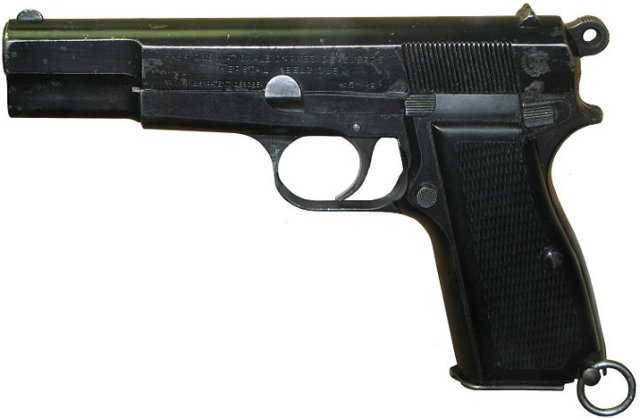
Browning High Power 9mm, the standard side-arm of the Canadian army from WW2 until its replacements start to arrive some time in 2023.
Let me state this up front: I’m a proud American. I love baseball and apple pie. If you cut me, I bleed red, white and blue. Whichever Detroit automaker you think is best, I think they are, too. And, therefore, I am a loyal fan of John Moses Browning’s M1911.
But, with that out of the way, it pains me to admit that the 1911 wasn’t Browning’s most important or influential pistol design. The 1911 is largely an American obsession, and when the rest of the world thinks about JMB’s martial handguns, the one that springs to mind is the Fabrique Nationale GP35, better known as the FN Hi Power.
Actually the result of a collaboration between Browning and his successor at FN, the great Dieudonné Saive, the Hi Power is one of the most prolific service pistols ever created, being used by the militaries of half a hundred countries.
Though it had some features that made it cheaper and easier to produce than the M1911, such as the fixed, under-barrel cam that replaced the swinging link on the older design, the Hi Power was still expensive to produce compared to newer designs. Even the change to a simpler external extractor in the 1960s wasn’t enough to keep it competitive, cost-wise, for budget-conscious militaries, and its double-stack, 13-round mag — a revelation in the 1930s — was by now commonplace.
Browning (an FN subsidiary) finally ended production a few years ago, but it turned out that demand for the Hi Power still existed.
EAA began selling a Turkish-made clone recently, and Springfield Armory upped the ante with the SA-35, which offered some minor tweaks to the original design.
Early this year, though, FN America went nuclear on the Hi Power market by offering the all-new, American-made High Power.
Note the spelling change, because this isn’t your granddad’s Hi Power.
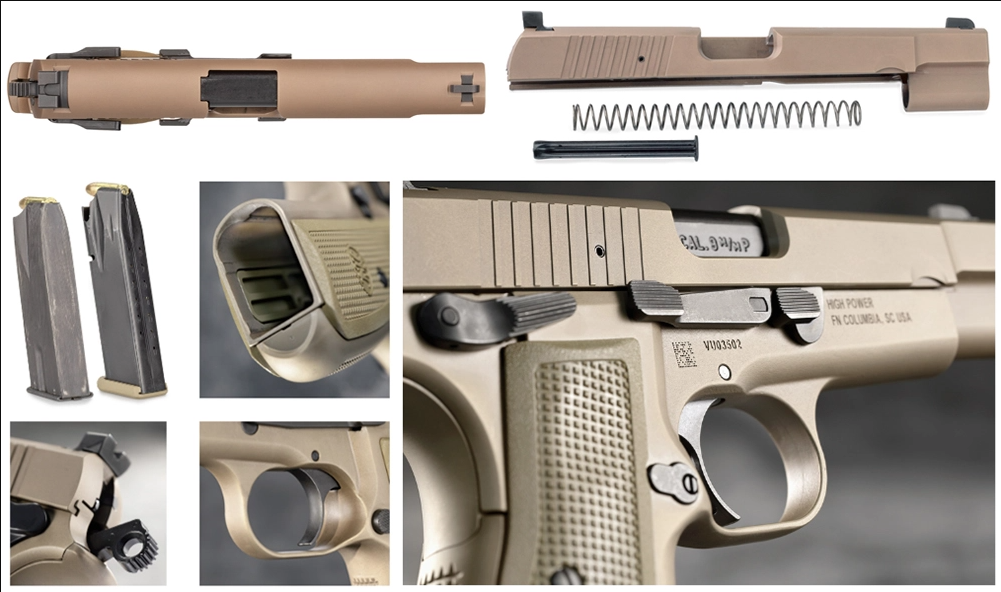
“Controls are ambidextrous. A thumb-safety lever and a slide-stop lever can be found on either side of the new High Power, and the magazine release is reversible • While not interchangeable with the older unit on the left, the new magazines are more capacious • The mag well is expectedly wide and promotes fast reloads • The topstrap is smooth, but the semi-matte PVD finish prevents glare • The trigger is a great improvement over the original, thanks in part to the absence of a magazine-disconnect safety • Removing the slide is simple, but you have to control it against the tension of the recoil spring.”
Photos from Shooting Illustrated, most likely by Tamara Keel.
October 12, 2022
Walther P38 Development
Forgotten Weapons
Published 13 Apr 2016The Walther P38 was adopted by Germany in 1938 as a replacement for the P08 Luger — not because the Luger was a bad pistol, but because it was an expensive pistol. Walther began development of its replacement in 1932 with two different development tracks — one was a scaled-up Model PP blowback in 9x19mm and the other was the locked-breech design that would become the P38.
The initial prototypes look externally quite similar to the final P38, although the locking system went through several changes and the controls did as well. Several of the early developmental models used shrouded hammers.
In this video I will take a look at both initial “MP” pistols (the blowback and the locked breech), then the Armee Pistole (aka the AP) in its standard configuration and also a long barreled model with a shoulder stock, then the second Model MP, and finally the HP which was the commercial model of the final P38. In addition, I will check out a sheet metal prototype of the locked breech model form the very beginning of the development program.
(more…)
September 27, 2022
Arex Delta Gen2: How Gun Designs Iterate and Improve
Forgotten Weapons
Published 25 May 2022In firearms, as in really all technology, the market iterates and improves concepts over time. A novel new system — like the polymer-framed, striker-fired semiauto pistol — will never be perfect on its first introduction. Over time, as users and manufacturers gain more insight into the details of using and building the system, changes are made to improve it. At the same time, the cost of production comes down (especially after applicable patents have expired).
The Arex Delta Gen2 pistol is a really good example of this, I think. While offering no fundamental innovation, it is markedly better in all sorts of ways than similar pistols that preceded it. It has great handling, safe disassembly, near-universal optics compatibility, slim lines, light weight, and a good trigger. And it does this for a remarkably low price.
I am looking forward to really putting one through the wringer at Slovenian Brutality this June!
(more…)
September 24, 2022
Business Intrigue Gone Wrong: High Powers for Oman
Forgotten Weapons
Published 16 May 2022The story of the Browning High Power pistols with Omani national crests is an interesting one. It begins with a man named Paul Van Hee brokering a contract for Cadillac-Gage “Commando” armored cars for the Omani government in the late 1960s. These were to be equipped with FN MAG machine guns, and it came to Van Hee’s attention that Oman might also be interested in High Power pistols. He wasn’t an FN agent, but figured he could make that deal happen (and presumably make a nice profit on it).
Van Hee imported 36 new High Powers into the US, and then had them engraved with Omani crests (although the first 9 were accidentally engraved backwards). Around the time he was showing the guns to the Omani delegation, though, the deal fell apart. FN got wind of it and arranged the sale themselves, eventually shipping 5,000 pistols to Oman (without any special markings).
The demonstration guns remained in the US, and were sold off onto the collector market having never actually seen Oman. Interestingly, they are exempted from the NFA when fitted with original Belgian shoulder stocks, like this one is.
(more…)
September 21, 2022
Radom’s Vis 35: Poland’s Excellent Automatic Pistol
Forgotten Weapons
Published 9 Feb 2016In the 1920s Poland began looking for a new standard military pistol, and tested a variety of compact .380s. The representative from FN brought along an early iteration of the High Power (along with their other entry) even though it was much too large and heavy to meet the Polish requirements. After a couple iterations of testing, it became clear to the Polish Ordnance officers that the High Power was a much more effective service pistol than the compact guns they had been instructed to look for.
Lo and behold, the ultimate choice was a domestic design based largely on the High Power (a direct deal with FN was not an option after Poland’s relationship with FN had suffered through problems with the wz.28 version of the BAR). Toss in a delay to redesign the early decocking mechanism to satisfy the Cavalry (who didn’t realize that the decocker wasn’t actually meant to be used, but rather to just add another claim to the patent), and by 1935 the pistol was finished and formally adopted.
The Vis 35 is one of the best automatic pistols of WWII in terms of both handling and quality. In total 46,000 were made pre-war for Poland’s military, and German occupation forces built another 300,000+ during the war.
(more…)
September 15, 2022
Lahti L-35: Finland’s First Domestic Service Automatic Pistol
Forgotten Weapons
Published 23 Apr 2018When Finland decided to replace the Luger as its service handgun, they turned to Finland’s most famous arms designer, Aimo Lahti. After a few iterations, Lahti devised a short recoil semiautomatic pistol with a vertically traveling locking block, not too different from a Bergmann 1910 or Type 94 Nambu. It was adopted in 1935, but production did not really begin in earnest until 1939 at the VKT rifle factory. Several variations were made as elements of the gun were simplified to speed up production, and the design was also licensed to the Swedish Husqvarna company, which manufactured nearly 10 times as many of the pistols as VKT eventually did.
In today’s video we will look at each of the variations, including one with an original shoulder stock and the early and late military guns as well as the post-war commercial guns marked Valmet instead of VKT.
(more…)
June 8, 2022
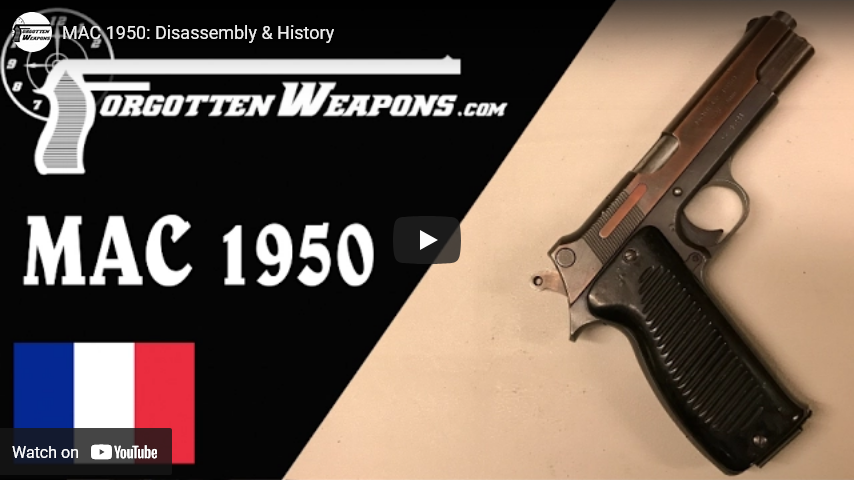
MAC 1950: Disassembly & History
Forgotten Weapons
Published 27 Feb 2017Shooting the MAC 1950: https://www.youtube.com/watch?v=sduZ4…
The PA MAC 1950 (Pistolet Automatique Modele 1950) was the result of a 1946 French effort to standardize on a single military pistol. By the end of WWII, the French military had accumulated a mess of different pistols of French, Spanish, American, and German origin; officially using the Luger, P38, Mauser HSc, 1911 (and A1), 1935A, 1935S, Star, Ruby, and Model 1892 revolver.
Trials were held in 1950, although the outcome was predetermined — this pistol, designed by St Etienne and largely derived from the Model 1935S, was to be the next French military sidearm. A design from the SACM company was also tested, as was a commercially purchased SIG SP47/8, but this was for comparison sake only. In fact, the SIG was the best performer in the testing, with the St Etienne design suffering from cracked parts and durability problems. It would be improved, however, and deemed suitable for adoption by early 1951.
Production began in 1953 at the Chatellerault arsenal (hence the “MAC” name used in the US). All of 221,900 were made by Chatellerault until it was shut down in 1963, when production transferred to St Etienne, where another 120,000 would be made by 1978.
Mechanically, the gun is largely taken form the Browning 1911, with a few improvements. The recoil spring is of a captive design, and the fire control group is all built into a single easily replaced unit (similar to the Tokarev and the 1935S). It is single action only, with hammer-block and magazine safeties and a 9-round magazine of standard 9x19mm ammunition. It is still in French service, having proven to be a reliable and dependable weapon, if outdated by today’s standards.
http://www.patreon.com/ForgottenWeapons
Cool Forgotten Weapons merch! http://shop.bbtv.com/collections/forg…
If you enjoy Forgotten Weapons, check out its sister channel, InRangeTV! http://www.youtube.com/InRangeTVShow
June 1, 2022
Trudeau’s new gun control plans will do nothing to reduce criminal use of firearms … and he doesn’t care
The proposed new rules will impose costs on legal gun owners and restrict their access to certain firearms, and almost certainly do nothing at all to reduce the headline-grabbing crimes that supposedly prompted the new rules in the first place:
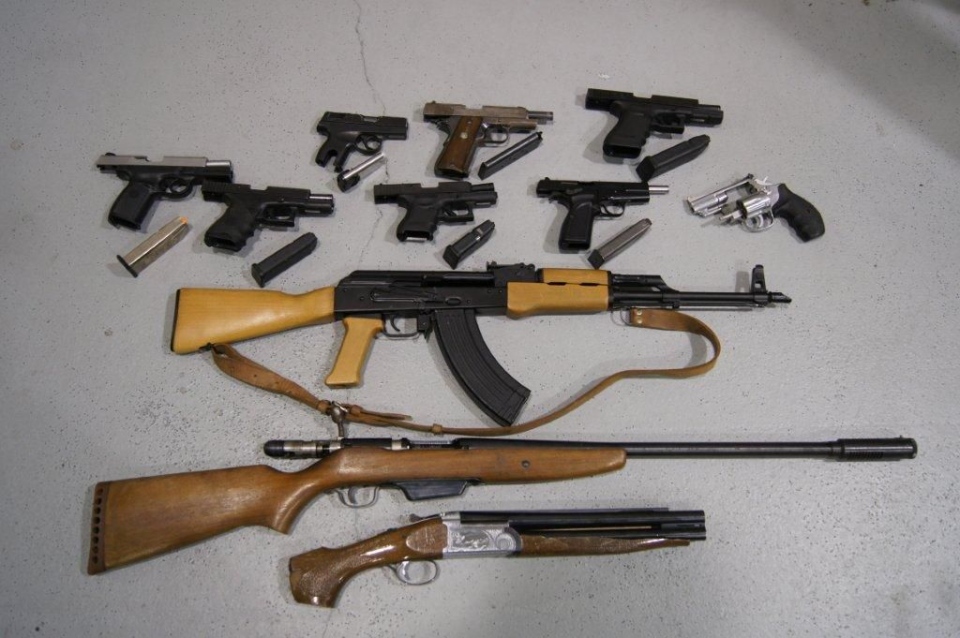
A 2018 Toronto Police Services publicity photo of guns seized in a recent operation.
In my 15 years or so of writing about firearms policy, here’s been a constant problem: gun policy is complicated, the broader public doesn’t know much about it, and it’s hard (impossible?) to make any coherent arguments without laying out the context, both of the specific proposals and the broader background. Working through what was announced yesterday, and how this clarifies a worrying shift in how the Liberals approach gun control, is going to be a bit of a process.
Get comfy.
As of Tuesday morning, we are short a lot of details, because the Liberals chose to make their high-publicity announcement before they provided any technical briefings. (We’ll come back to that later.) At first glance, it seems that lot of what the Liberals announced is stuff they’d either already committed to do or, in fact, already exists. (The Liberals?! Re-announcing stuff? Well, I never!) There is currently confusion about the ammunition magazine capacity limit — most non-gunnies won’t know the difference between an internal magazine and a detachable one, but it’s a huge difference, and the proposed legislation is unhelpfully vague. So stay tuned. But the actual centrepiece of the proposal, I have to admit, made me burst out laughing. On Twitter, I called it “peak Liberal”. It really is a pretty perfect example of what’s wrong with how the Liberals govern, but why they’re great at politics.
One of the jokes about Justin Trudeau when he entered politics was that he’d be much better suited to playing the role of political leader on TV than he would in real life. Several years later, the joke is on the Canadian voter because that’s turned out to be exactly the case: Trudeau loves posturing and pontificating for the cameras, and early in his first term as prime minister he became notorious for “unplanned” photo ops (despite being constantly accompanied by at least one staff photographer/videographer everywhere he went). I think this is one of the reasons the Liberals have been justly mocked for constantly re-announcing policies and programs — it looks good on camera.
The big reveal was a “freeze” on handgun sales in Canada, and their importation. Existing owners can keep theirs. It’s not clear exactly when this will go in effect, so I imagine gun stores across the land are going to set sales records in the next few days. Once in place, the sale or transfer of a handgun — from either a store to an individual or between individuals — will be eliminated. Again, “frozen”, as the Liberals call it.
At the most basic level, new government policies are intended to solve a problem: you see something that’s wrong with the status quo, and you try to enact a policy to improve it. Parties tend to wrap their policies in lots of rhetorical flourishes, but if you tune out what the politicians are saying and look at what they’re doing, you can get a decent sense of what their actual goal is. And there’s been an interesting shift in what the Liberals have been doing with gun control these last few years. Monday’s announcement is perhaps the ultimate example of this yet, the purest form of the new normal we’ve yet seen.
The Liberals are making a series of announcements that won’t actually change, at all, how safe Canadians are from gun violence. The announcements do get a lot of attention, though. Because, clearly, getting the attention is itself the goal. The public-safety talking points are just the PR frosting on top of what is an entirely political exercise. Why else make the announcement before you give the press the technical briefings? The sequence tells you all you need to know.
Trudeau’s general governing style might best be described as “provocatively performative”. If you think of him just portraying what he thinks a Prime Minister should look like, much of his performance makes more sense. As I joked on social media the other day “It’s about time Trudeau took decisive steps to crush these MAGA-hatted, gun-toting, pickup-truck-driving rednecks who keep coming into Toronto and gunning down innocent drug dealers, pimps, and aspiring rap artists who were just turning their lives around! ” It’s a theatrical performance on the political stage … but unfortunately ordinary Canadians are going to be forced to put up with his playing up to the urban and suburban voting galleries.
Note that while the government is puffing its collective chest for this “tough on guns” announcement, they are also pushing a bill in Parliament that would reduce or eliminate many “mandatory minimum penalties” for things like smuggling firearms into the country. This is apparently intended to address the “overincarceration rate” of First Nations and other “marginalized Canadians”. So, on the one hand, they’re planning to penalize legal gun owners and on the other hand, they’ll reduce the penalties that can be imposed on criminals who smuggle illegal weapons into the country. That only makes sense if it’s all a theatrical performance.
April 8, 2022
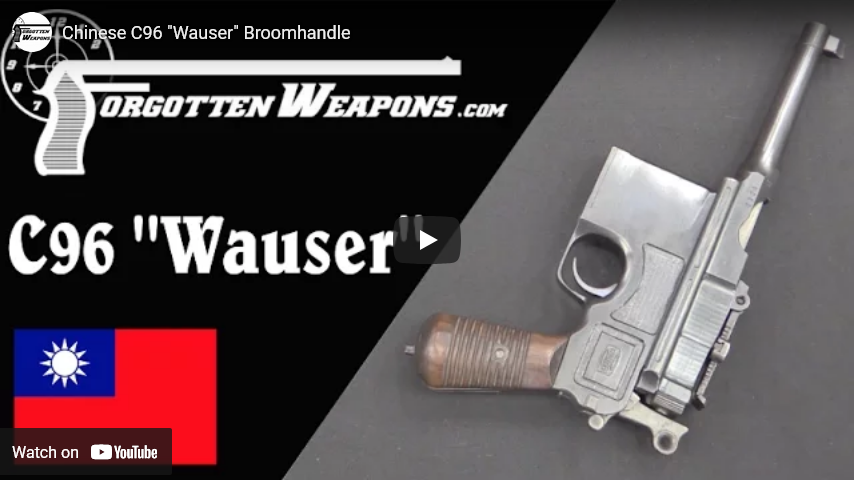
Chinese C96 “Wauser” Broomhandle
Forgotten Weapons
Published 10 Nov 2016Cool Forgotten Weapons Merch! http://shop.bbtv.com/collections/forg…
The C96 Mauser was a very popular handgun in China in the 1920s and 30s, which naturally led to a substantial number of domestically-produced copies of it. These ran the full range of quality, from dangerous to excellent. This particular example falls into the middle, appearing to be a pretty fair mechanical copy of the C96 action. However, it does exhibit classic Chinese misspelled markings — the workers who made these guns often did not actually read English (or German), and made best-guess attempts at copying the markings on authentic firearms. The result was sometimes something like the Wauser.
March 15, 2022
For military procurement blunders, “no nation has mastered the ability to step on every bloody rake quite as well as Canada”
Germany has announced that they will be purchasing US F-35 stealth fighters as part of their re-armament program. My favourite headline on this was over at Blazing Cat Fur: “Germany To Buy 35 Lockheed F-35 Fighter Jets From U.S. Amid Ukraine Crisis … Canada Will Buy Cool ‘Fighter Jet Stickers’ With Eco-Friendly Adhesive”
On a more serious tone — but with sadly the same basic message — Mitch Heimpel looks at the multi-generational rolling catastrophe that is Canadian military procurement since the unification of the forces in 1968:
Browning High Power 9mm, the standard side-arm of the Canadian army since WW2. When I was in the reserves, we were told this was due for replacement in a few years. I was in the reserves from 1976-1980. It still hasn’t been replaced.
To say we have a checkered history with military procurement, fails to capture exactly how bad it is. Our political leadership has failed us continually over the course of half a century. No party has done it well. Some have done it better than others. But no one can claim any kind of bragging rights.
Fighter jet procurement in this country is so fraught it once caused the birth of a new political party. Trying to buy helicopters helped bring down a government. We only successfully bought those helicopters after they [the old helicopters] became a greater danger to the personnel manning them than they were to any potential adversary. We have been running a procurement for the next generation of fighter jets for an entire generation. Even Yes, Minister writers would have given up on something that absurd.
Our submarine fleet seems to be almost permanently in dry dock. Our most recent ship procurement resulted in the absolutely monstrous prosecution of one of the country’s most accomplished military leaders.
And we just issued a revised bid to finally replace our Second World War-era pistols … last week.
Just cataloguing that level of incompetence is exhausting. No leader or party looks good. The civil service, as the one constant through all these cartoonish blunders, surely has to wear some of this, too. The fact that we seem to repeat the same mistakes can, at least in part, be attributed to a significant institutional memory failure on the part of the people trusted with having the institutional memory.
Now, it is worth noting in fairness that no nation has an easy time with large scale military procurement. Ask the Americans about the development of the V-22 sometime. But, still, no nation has mastered the ability to step on every bloody rake quite as well as Canada.
I’m not a hardware expert. I can’t tell you which pistol we should buy. There’s also genuine policy questions here that need to be settled — I don’t know whether we should focus on the navy because we’re an Arctic nation, or the air force because it allows us to participate more readily in allied force projection exercises — like, say, no-fly zones? The necessary mix for Canada is no doubt some of both, and it’s fine to have disagreements between parties on what the right mix is.
But setting that aside, I want to talk about what it would take politically, to get us to start taking procurement seriously — just a few basic rules that any government would need to follow to procure anything that they chose was important for Canada to have.
March 12, 2022
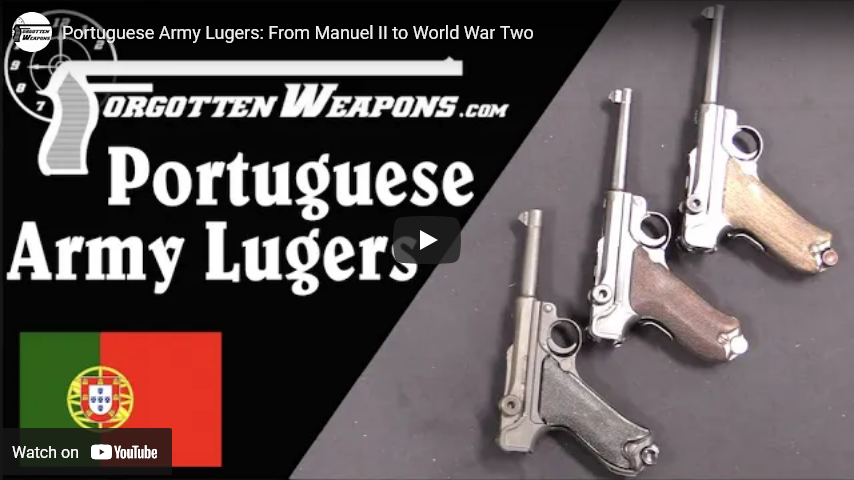
Portuguese Army Lugers: From Manuel II to World War Two
Forgotten Weapons
Published 10 Nov 2021http://www.patreon.com/ForgottenWeapons
https://www.floatplane.com/channel/Fo…
Cool Forgotten Weapons merch! http://shop.forgottenweapons.com
Portugal first tested the Luger pistol in 1901, and its commission on self-loading pistols recommended the design for adoption in 1904. No money was available at the time, but a second commission again recommended the Luger in 1907, and it was formally adopted and purchased in 1908. The initial batch was 5,000 pistols chambered for the 7.65mm Parabellum cartridge with 120mm (4.75″) barrels and “M2” crests for then-king Manuel II. They were designated m/908, and numbered from 1 to 5000.
These pistol would satisfy Portuguese Army needs until 1935, then the Guarda National Republicana ordered another 564 pistols in the same configuration. These came from Mauser at this point, and had “GNR” crests. These were taken from Mauser commercial production, and have serial numbers between 1900v and 2500v.
The final purchase of Portuguese Army Lugers came in 1943, another 4,578 guns from Mauser. Of course, Germany was deep into the Second World War by this time, and there was no option for Portugal to order its specific configuration. Instead, the Portuguese m/943 pattern was identical to the German standard P08, with the Portuguese guns coming right off the same production line — Waffenamt markings and all. They are numbered between 150m and 5330m.
Contact:
Forgotten Weapons
6281 N. Oracle 36270
Tucson, AZ 85740