
Published on 24 Sep 2016
Sitting in the Chair of Temporary Insanity, Indy talks about Galicia’s big role in war on Location, if Pilots were issued guns, and a story from a viewers great grandpa.
September 25, 2016
Galicia’s role in WWI (Live from Lviv) – Handguns for Pilots – Fight or run I OUT OF THE TRENCHES
Comments Off on Galicia’s role in WWI (Live from Lviv) – Handguns for Pilots – Fight or run I OUT OF THE TRENCHES
September 5, 2016
QotD: Critical gun safety tips for when the police arrive at the crime scene
There were other stories, and commercial breaks, and about thirty minutes later came an update to the shot burglar story: The newscaster now said that it was apparent that the police had shot the homewowner and more details would be forthcoming.
I said to Bobbi: “Dude thinks there’s a robber with a gun outside his house, calls the cops, goes outside with a gun his ownself. Then cops show up, the light on the homeowner’s ‘I’m A Good Guy’ IFF beacon is burnt out, the cops yell ‘Drop the gun, Buddy!’, he thinks ‘Surely they don’t mean me!’, turns toward them, and gets hisself popped.”
Looking at the TV station’s freshly-updated webpage, it looks like that’s more or less what happened […]
Lessons:
- Once the cops have been called, you don’t need to be running around outside with a gun in your hand. The chances for a blue-on-blue shooting skyrocket in incidences like that. Plainclothes officers get shot all the damn time in similar circumstances. It’s easy to tell who the responding officers are because they show up in a car with blinking lights and they’re all dressed the same. You want to not be on the playing field wearing the other team’s uniform when they show up.
- If you are on the playing field when they show up and you hear “Drop the gun!” then you need to drop the gun. Seriously. Like it just turned white-hot. (This is a good reason to carry drop-safe pistols, BTW. I realize that carrying that 1904 Ruritanian army surplus Schnellblitzenselbstlader in 8.3mm semi-rimmed is really cool, but aren’t you going to feel funny getting shot twice when you drop it: Once in the junk by your own gun when it hits the ground ass-end first, and again in the gut by the responding officer because he’s startled by the gunshot?)
Tamara Keel, “Breaking News…”, View From The Porch, 2016-08-23.
Comments Off on QotD: Critical gun safety tips for when the police arrive at the crime scene
September 3, 2016
Advice for people who regularly carry guns
Tamara Keel says that if you carry a gun, you should get into the habit of carrying it all the time:
[…] It’s a safety thing, too. If you just put the gun on in the morning and leave it there all day, it eliminates a lot of unnecessary administrative gun-handling, and as anybody who’s ever looked around the walls of the sally ports, locker rooms, and restrooms of the local cop shop can tell you, unnecessary administrative gun handling is when most of the unnecessary loud noises happen.
Comments Off on Advice for people who regularly carry guns
August 16, 2016
Austro-Hungarian Pistols of WW1 I THE GREAT WAR Special feat. C&Rsenal
Published on 15 Aug 2016
Check out Othais channel C&Rsenal to learn all about the history of WW1 firearms: https://www.youtube.com/c/candrsenal
We partnered with Othais again a few months ago for a livestream showing the Austro-Hungarian weapons of WW1. This is the 2nd episode about the surprising variety of pistols.
Comments Off on Austro-Hungarian Pistols of WW1 I THE GREAT WAR Special feat. C&Rsenal
January 13, 2016
The death of the duel
ESR has a theory on the rapid decline of the duelling culture that had lasted hundreds of years until the mid-19th century:
I’ve read all the scholarship on the history of dueling I can find in English. There isn’t much, and what there is mostly doesn’t seem to me to be very good. I’ve also read primary sources like dueling codes, and paid a historian’s attention to period literature.
I’m bringing this up now because I want to put a stake in the ground. I have a personal theory about why Europo-American dueling largely (though not entirely) died out between 1850 and 1900 that I think is at least as well justified as the conventional account, and I want to put it on record.
First, the undisputed facts: dueling began a steep decline in the early 1840s and was effectively extinct in English-speaking countries by 1870, with a partial exception for American frontier regions where it lasted two decades longer. Elsewhere in Europe the code duello retained some social force until World War I.
This was actually a rather swift end for a body of custom that had emerged in its modern form around 1500 but had roots in the judicial duels of the Dark Ages a thousand years before. The conventional accounts attribute it to a mix of two causes: (a) a broad change in moral sentiments about violence and civilized behavior, and (b) increasing assertion of a state monopoly on legal violence.
I don’t think these factors were entirely negligible, but I think there was something else going on that was at least as important, if not more so, and has been entirely missed by (other) historians. I first got to it when I noticed that the date of the early-Victorian law forbidding dueling by British military officers – 1844 – almost coincided with (following by perhaps a year or two) the general availability of percussion-cap pistols.
The dominant weapons of the “modern” duel of honor, as it emerged in the Renaissance from judicial and chivalric dueling, had always been swords and pistols. To get why percussion-cap pistols were a big deal, you have to understand that loose-powder pistols were terribly unreliable in damp weather and had a serious charge-containment problem that limited the amount of oomph they could put behind the ball.
This is why early-modern swashbucklers carried both swords and pistols; your danged pistol might very well simply not fire after exposure to damp northern European weather. It’s also why percussion-cap pistols, which seal the powder charge inside a brass casing, were first developed for naval use, the prototype being Sea Service pistols of the Napoleonic era. But there was a serious cost issue with those: each cap had to be made by hand at eye-watering expense.
Then, in the early 1840s, enterprising gunsmiths figured out how to mass-produce percussion caps with machines. And this, I believe, is what actually killed the duel. Here’s how it happened…
Comments Off on The death of the duel
December 30, 2015
German Pistols of World War 1 feat. Othais from C&Rsenal I THE GREAT WAR Special
Published on 28 Dec 2015
In the second part of our German weapons special, Othais introduces us to pistols. Among them are oddities like the Reichsrevolver but also iconic pieces of German engineering like the Luger including the rare Trommelmagazin.
Comments Off on German Pistols of World War 1 feat. Othais from C&Rsenal I THE GREAT WAR Special
September 1, 2015
French Pistols of World War 1 featuring Othais from C&RSENAL I THE GREAT WAR – Special
Published on 31 Aug 2015
The next live event will be on September 3 6pm CET. Othais will introduce us to German rifles and pistols. You can already find a few episodes about them online on his channel: http://bit.ly/OthaisChannel
This is the 2nd part of our special episodes on French small arms of WW1 and how they were used in battle. Othais explains the problems of manufacturing pistols like the Ruby Mle 1915 on a big scale. The French “Lebel revolver” also known as Model 1892 has a few interesting features like being a single action and a double action revolver at the same time. Particularly, the unusual reloading mechanism has a fascinating military history.
Comments Off on French Pistols of World War 1 featuring Othais from C&RSENAL I THE GREAT WAR – Special
March 17, 2015
The Gabbet Fairfax MARS Semi-Automatic Pistol
I think I first heard of this rather imposing handgun in L. Neil Smith’s SF novel The Probability Broach (another character in his novels champions the Dardick 1500, also a weird and wonderful handgun). Last week, Robert Farago had a post about a fantastic collection of Luger pistols that also included an example of the MARS:


This rare and monstrous handgun once had bragging rights as “the most powerful handgun in the world.” Considering it was only produced from 1898-1907 and would not lose that title until the 1970s, that’s quite an accomplishment. That small production time, of course, resulted in a very limited run of these guns. Approximately 80 were ever produced in all their proprietary configurations (8.5mm, .36 (9mm), .45 Long, and .45 Short). The example shown above is an extremely early version (c. 1898-1900) and stamped with the serial number 4. It also has the fine blued finish and wonderful checkered walnut grips. It remains in its all-original and unaltered condition.
The pistols were very well-made with all hand-fitted parts, and extremely powerful, but ultimately they were not to be. Why? A few reasons existed and they all had to deal with the gun’s rather complex design. First of all, complex designs historically tend to not render themselves well to life in military service. Complex devices have more parts to foul and are difficult to repair/clean in the field.
Second, this complex device, utilizing a long-action recoil, had such horrendous recoil that it was prone to feeding problems. The recoil was partially due to the powerful cartridges, but also because of the long travel of the moving parts. It also suffered from a heavy trigger pull. All these gripes led to the MARS being passed over for military contracts, the sole hope of its designer, Hugh Gabbet-Fairfax. There were never any issues with its “man-stopping” ability, but its recoil was its ultimate undoing. Fortunately, it left us with some rather entertaining quotes such as, “No one who fired once with the pistol wished to shoot it again,” and “singularly unpleasant and alarming.” Even without military contracts or commercial sales, this rare curio remains a supremely desirable collectible.
Comments Off on The Gabbet Fairfax MARS Semi-Automatic Pistol
February 21, 2015
Don’t learn firearms “rules” from the big screen
Robert Farago learned a lot from watching TV and movies. Luckily, it didn’t kill him:
My main squeeze had never watched High Noon. Thanks to Netflix, I rectified that omission. I hadn’t seen Gary Cooper’s darting eyes in a good forty years. Watching the Marshal fail to marshal the townspeople to defend themselves against a quartet of outlaws, it all came flooding back. How a good man sometimes has to stand alone. How fine Grace Kelly looked in a skin-tight bodice (not an observation I shared with my SO). How a single shot can make a man fall down dead in an instant. Wait. What? Yup. Here are three really stupid lessons I learned from watching cowboy movies as a kid …
1. Handguns kill instantly
What I learned …
Thanks to Saturday matinée westerns on UHF TV, I grew-up believing bad guys died when you shot them. They did so without hesitation, deviation or repetition. One bullet was more than enough to shuffle a bad guy off this mortal coil. I also learned that the good guy never dies from a gunshot wound, although he sometimes seems to. And if a bad guy’s bullet does take out a good guy — usually a supporting player — he’s got more than enough time to say something heroic and stoic first.
Truth be told …
With modern medical care and internal combustion-powered hospital transportation, most people who get shot live. No matter what caliber ammo you use, it’s really hard to stop someone in their tracks with a handgun round. Even if you hit the bad guy center mass, perforating his heart or severing a major artery, they’ve got at least 30 seconds to drag your ass into the afterlife with them.
Comments Off on Don’t learn firearms “rules” from the big screen
January 29, 2015
Browning’s solution to the handgun problem
Last week, Tam saluted John Moses Browning on the occasion of his birthday, and celebrated the problem he solved:
So, the problem with a self-loading pistol is keeping the action closed until the bullet has left the muzzle and pressure in the chamber has dropped low enough that the brass case will be ejected neatly, as opposed to being transformed into a spray of shrapnel in the shooter’s face.
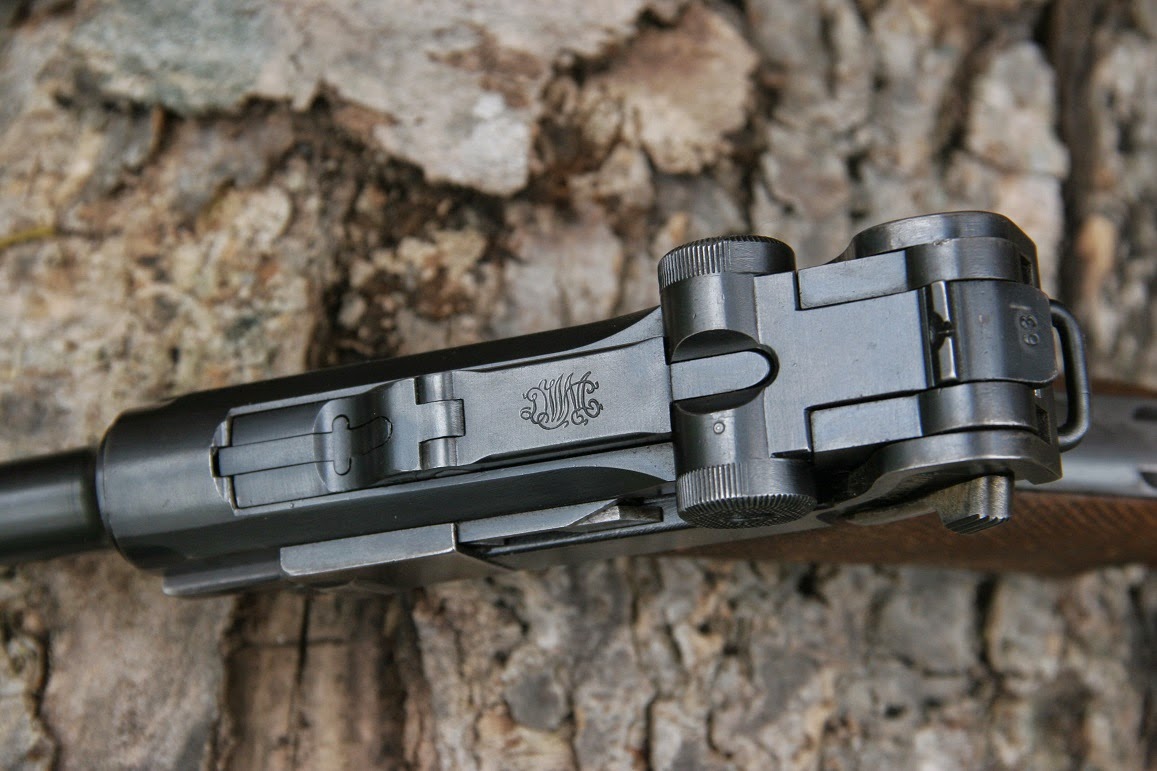
Early autopistols relied on complex mechanical setups, like the well-known Borchardt/Luger mechanism derived from Maxim’s toggle joint, to provide mechanical disadvantage against which the recoil had to work.
It would not shock me to learn that the two main parts of that toggle required more separate machining steps than an entire modern pistol slide. Further, the entire works were exposed to the great outdoors. Friend Marko once jokingly called it “The perfect handgun for a gunfight in a computer clean room.”
So, what are our choices to hold the breech closed for that crucial fraction of a second? Well, there’s spring pressure, but you can only add so much of that before the action can’t be worked by human hands. You can also add weight to the breechblock.
Comments Off on Browning’s solution to the handgun problem
July 16, 2014
Rolling Stone is your top source for reliable, informative gun news
The folks at Rolling Stone are concerned for your safety, so they’ve helpfully put together a primer on the five “most dangerous” guns in America. Because they love you, America:
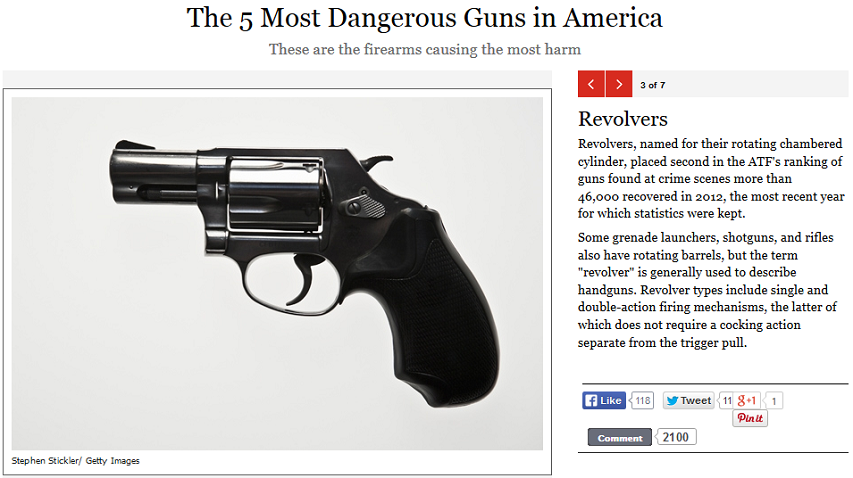
Yes, we’re apparently talking about grenade launchers here. I didn’t even know grenade launchers were available to civilians. Awesome!
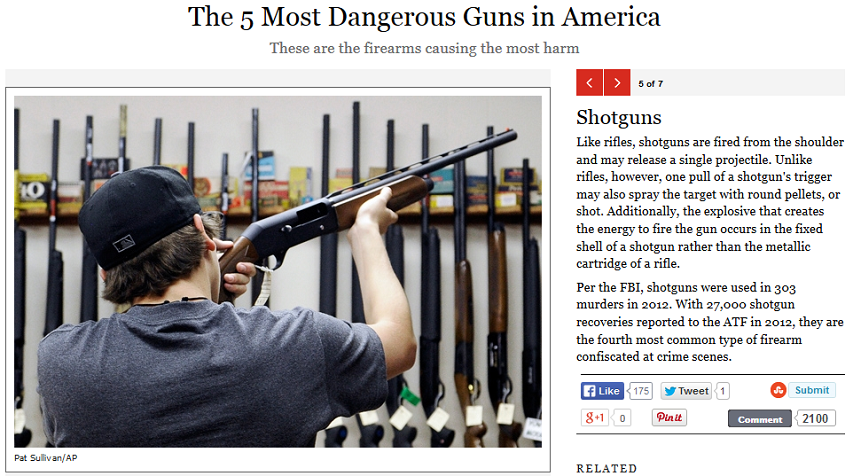
Wait, “the explosive that creates the energy to fire the gun occurs in the fixed shell of a shotgun rather than the metallic cartridge of a rifle”. Why would I expect the charge that propels the shot out of a shotgun to be ignited in a rifle cartridge? Is this some sort of magic that allows you to fire a different weapon than the one you’re holding? No wonder Rolling Stone thinks this is such a dangerous weapon!
H/T to Charles C. W. Cooke for the link.
Comments Off on Rolling Stone is your top source for reliable, informative gun news
May 11, 2013
The “Liberator” isn’t really a gun … it’s a political theatre prop
In The Register, Lewis Page points out that the 3D printed “Liberator” isn’t actually much of a gun at all:
People are missing one important point about the “Liberator” 3D-printed “plastic gun”: it isn’t any more a gun than any other very short piece of plastic pipe is a “gun”.
You can take my Liberator … and shove it
Seriously. That’s all a Liberator is: a particularly crappy pipe, because it is made of lots of laminated layers in a 3D printer. Attached to the back of the pipe is a needlessly bulky and complicated mechanism allowing you to bang a lump of plastic with a nail in it against the end of the pipe.
An actual gun barrel is a strong, high quality pipe — almost always made of steel or something equally good — capable of containing high pressure gas. It has rifling down the inside, making it narrow enough that the hard, tough lands actually cut into the soft bullet jacket (too small for the bullet to actually move along, unless it is rammed with massive force). At the back end there is a smooth-walled section, slightly larger, into which a cartridge can be easily slipped.
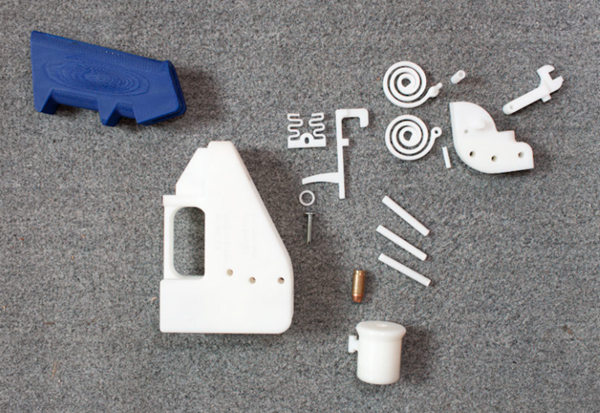
It’s not much of a gun at all. But as with the old saying about the dancing bear, it’s not how well it dances but that it dances at all. After some 100,000 downloads, the company was requested to take the files offline on Thursday:
#DEFCAD has gone dark at the request of the Department of Defense Trade Controls. Take it up with the Secretary of State.
— Defense Distributed (@DefDist) May 9, 2013
January 11, 2013
British forces to replace venerable Browning 9mm with new Glocks
Lewis Page on the recently announced retirement of the Browning 9mm from British military service:
The new pistol is the Glock 17 Gen4, which fires the same NATO standard 9x19mm cartridge as its illustrious predecessor. However the Glock holds 17 rounds as opposed to the Browning’s 13 — and even more crucially the new weapon can be carried with a round in the chamber ready to shoot at a moment’s notice due to its modern safety mechanisms, a practice which was normally forbidden with the Browning.
[. . .]
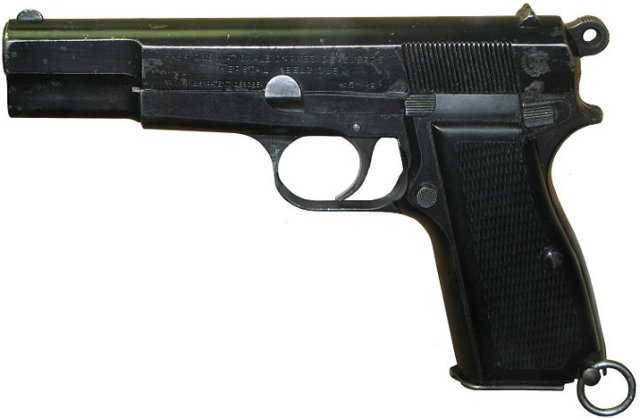
The now superseded weapon was designed way back in the 1920s by the legendary weapons engineer John Browning and first manufactured by Fabrique Nationale of Belgium in 1935. It was known commercially as the “Browning Hi-Power”. It was first issued to British forces during World War II, and gradually replaced all other pistols then in service to become the UK’s standard military sidearm. In its day it was a great weapon, and pistol design has evolved only incrementally since then, but today’s handguns are measurably superior and it was surely time for a change — the more so as the existing Brownings must have been pretty worn out by now.
The wars in Iraq and Afghanistan have enabled the British forces to slowly and belatedly sort out their dire personal-weapons situation of the 1990s. The crappy Royal Ordnance/BAE Systems SA80 (L85A1) rifle was rebuilt in German factories so that it is now a good weapon, and proper belt-fed light machine guns and 40mm grenade launchers were procured. Other popular pieces of kit such as the L115A1 sniper rifle (from the famous Portsmouth firm Accuracy International, perhaps better known under its commercial name Arctic Warfare Super Magnum), the new combat shotgun and the new 7.62mm Sharpshooter rifle have also appeared in response to battlefield needs. Now with the new Glocks, at last, pretty much all the personal weapons carried by British troops today can be said to be first-class.
The Browning 9mm was first handgun I ever fired, and is still one of my favourites:
Comments Off on British forces to replace venerable Browning 9mm with new Glocks
October 6, 2010
Gun hobbyist’s dream
L. Neil Smith, in an ideal world (that is, after the Libertarian revolution), would like to do some serious gunsmithing:
I have some interest in reclaiming good technology that has been abandoned by our civilization, usually for the most stupid of reasons. Living in a free country would mean that I could return to a dream I’ve had for years, of becoming a weapons-manufacturer. For example, as a gunsmith, I don’t believe that history and humanity are quite through with the design known as the “Broomhandle Mauser”, the first commercially successful semiautomtic pistol. The Broomhandle is so different in conception and execution from the Browning-invented weapons we’re all used to, as to seem like the product of an alien mind.
If you’re not familiar with the Broomhandle Mauser, here’s a picture from http://www.g6csy.net/c96/database.html:
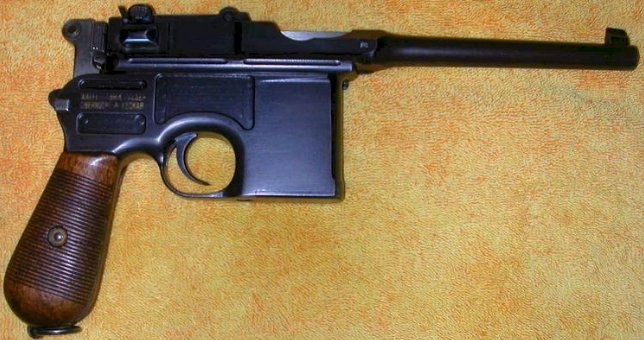
Some folks don’t like the Mauser’s grip, which I find perfectly comfortable, and seem to forget that we almost never shoot a revolver today with handles shaped like its frame. I love neoprene grips like the Pachmayr “Presentation” model, myself. They make shooting magnums pleasant. Others don’t like magazines situated in front of the trigger, rather than inside the handle, but they’re happy with sport-utility rifles like the AR-15 and the AK-47 built exactly the same way.
What killed the “Broomie” was the inadequate cartridge, 7.63x25mm, it was made for. By the time a more effective offerng was available — 9mm Mauser Export, which rivaled the .357 Magnum — it was too late. Browning designs and their imitators had taken the field over. But with modern steels and production techniques, in effective calibers — like .40 S&W, 10mm, or .45 ACP — there is still a place for the Mauser design. I’d even like to make a miniature that shoots .22 Long Rifle.
Make no mistake, I absolutely venerate St. John Moses Browning’s 1911, and his P35 Browning High Power is also “of the best” — or at least it would be if it could be made for a worthwhile cartridge without messing up its marvelous handling qualities, as I find the .40 caliber version does. I have some fresh ideas in this area, beginning with a 145-grain .375 bullet loaded into a modified 8mm Nambu parent case.
The Browning 9mm was first handgun I ever fired, and is still one of my favourites:
At the same time, however, I would bring the Dardick pistol back, an absolutely revolutionary design that combines the best qualities of automatics and revolvers, without any of the drawbacks of either. Critics at the time of its introduction said it looked too weird — rather like an oldtime Weller soldering gun — but how do you suppose the Broomhandle, the Luger, and the 1911 looked to generations of revolver-shooters? Aesthetics are arbitrary, and shooters would get used to the Dardick as they did to other weapons, if it served them well.
The Dardick was indeed an odd-looking weapon:
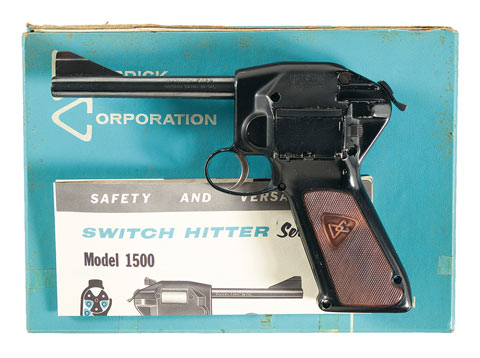
The Dardick used special plastic-cased cartridges with a roundly triangular, or trochoidal, cross-section, loaded with a .38 caliber bullet. It was pretty clearly aimed at the police market, where the standard at the time (the late 1950s) was the wildly-successful Smith & Wesson Model 10, of which it is said more than six million were produced.
There’s no reason that the Dardick concept couldn’t be mated with much better calibers than it was offered in. With its double-action works, and an astonishing magazine capacity (in 1958) of fifteen “trounds”, it might well have nudged the Model 10. But it fell victim, not to the market, but to a corporate boardroom dispute, and history lost one of the most effective devices for personal defense ever invented.
As Neil pointed out in one of his books, the Dardick was the answer to a bad crime writer’s prayers: it was literally an automatic revolver. (For those following along at home, an “automatic” has a magazine holding the bullets which are fed into the chamber to be fired by the action of the weapon: fire a bullet, the action cycles, clearing the expended cartridge and pushing a new one into place, cocking the weapon to fire again. A “revolver” holds bullets in the cylinder, rotating the cylinder when the gun is fired to put a new bullet in line with the barrel to be fired. The Dardick is the only example I know of that combines both in one gun.)
It’s probably a good thing that I live in Canada, where owning handguns is a legal marathon, otherwise I’d probably have another expensive collecting hobby . . .
Comments Off on Gun hobbyist’s dream


