
Forgotten Weapons
Published on 29 Sep 2018http://www.patreon.com/ForgottenWeapons
The Webley Model 1911 is a single-shot, self-ejecting target pistol made only for a few years. It was fitted with a long barrel to increase sight radius and also a detachable shoulder stock for those who wanted a bit more stability when shooting. Mechanically, the piece must be loaded manually, and it will then open the slide and eject the empty case automatically when fired, leaving the slide open for the shooter to load the next round. These were manufactured until 1914, with the final batch of pistols sold in 1919 from remaining parts stocks.
I am at the range with this example on Malta, thanks to the Association of Maltese Arms Collectors and Shooters. I thought it would be interesting to compare shooting with and without the stock, although my biggest takeaway was that I need more practice time on the range!
If you enjoy Forgotten Weapons, check out its sister channel, InRangeTV! http://www.youtube.com/InRangeTVShow
Contact:
Forgotten Weapons
PO Box 87647
Tucson, AZ 85754
October 19, 2018
Webley Model 1911 Stocked .22 Single-Shot Target Pistol
September 10, 2018
American Handguns of World War 1 I THE GREAT WAR Special feat. C&Rsenal
The Great War
Published on 8 Sep 2018Check out Othais’ channel: youtube.com/candrsenal
Indy and Othais take a look at the US service pistols of World War 1.
August 6, 2018
OSS “Stinger” Covert Cigarette Guns
Forgotten Weapons
Published on 16 Jul 2018http://www.patreon.com/ForgottenWeapons
During World War Two, the OSS (Office of Strategic Services) was the primary US clandestine operations organization. It was responsible for making all sorts of unique weapons, including these “Stinger” cigarette guns. They were single shot disposable .22 Short pistols.
The first pattern was contracted and manufactured entirely by the OSS, and 25,000 of them were manufactured early in the war. They proved to have a myriad of minor to moderate problems, though, including failures to fire and burst barrels. A second version was produced by the Ordnance Department in 1944, with a strengthened and improved design, and 25,500 of those were made.
I have not found any documentation of these being actually used, but then again not much documentation exists on the use of any OSS weapons. These sorts of things were often provided to infiltration agents who might never be heard from again, or dropped to partisan or resistance groups who weren’t exactly writing field reports on their gear.
Many thanks to the collector who provided me access to these!
If you enjoy Forgotten Weapons, check out its sister channel, InRangeTV! http://www.youtube.com/InRangeTVShow
July 27, 2018
Toronto’s proposed handgun ban is a feelgood/do nothing distraction
Every time there’s a tragedy, there are calls from the local media for politicians to “do something”. Politicians are hard-wired to want to “do something” even without prompting. They want (and need, for electoral purposes) to be seen to be “doing something”, if only to divert any blamecasting away from themselves. The most recent tragedy was a senseless shooting on Toronto’s Danforth in the Greektown district. The shooter, who was either killed by police or committed suicide shortly after the attack, was apparently not a legal gun owner, and under current gun laws would not have been able to obtain a handgun. So, in the wake of the tragic deaths and injuries, Toronto city council jumped into action to be seen “doing something”. Chris Selley explains why the proposed ban of handgun and ammunition sales in the city will not make a difference, except to punish non-criminals:
The whiz-bang solution on everyone’s lips — from Mayor Tory to city councillors to the Toronto Star’s and Globe and Mail’s editorial boards and the usual activists — is to ban handguns. Tory admits there is no “magic wand” that will solve Toronto’s gun problem. But still he asks: “Why does anyone in this city need to have a gun at all?”
The idea has a very superficial appeal. We all wish the Danforth shooter hadn’t managed to get a hold of a gun. Toronto is having a bad year for shootings — not much worse than last year, but at the wrong end of a distinct and steady five-year-trend. (At this point in 2014 there had been 101 shootings and 127 fatalities; so far in 2018 there have been 228 shootings and 308 fatalities.) It is understandable (if not entirely creditable) that the Danforth shooting would have rapidly intensified demands for something to be done: the victim count was high, and it happened in a wealthy part of town where it would have been easy to pretend there wasn’t a problem at all.
Still, the limitations of a “handgun ban” are both many and obvious. When Canadian police forces occasionally report on the sources of crime guns, they often find the vast majority have been smuggled across the border. In Toronto nowadays, the number is reportedly more like 50 per cent; the rest of the supply comes from licensed handgun owners who sell them on illegally — a spectacularly risky thing to do, as any used in crimes would be instantly traced back to the registered owner, but apparently worth it to some.
But we all know how permeable the Canada-U.S. border is. If we made it impossible to own a handgun legally in Canada, is there any reason to suspect the cross-border flow couldn’t regain its market share? Furthermore, CTV reported Wednesday that the Danforth shooter’s handgun was prohibited — i.e., it could never have been licensed in Canada — and that he had obtained it from some gang associates. If true, his carnage illustrates the limitations of handgun bans better than it does their efficacy.
February 14, 2018
Russian Pistols of World War 1 I THE GREAT WAR Special feat. C&Rsenal
The Great War
Published on 13 Feb 2018Watch C&Rsenal: http://youtube.com/candrsenal
Indy talks to our weapons expert Othais about the Russian Pistols of World War 1.
February 12, 2018
The Browning High Power pistol finally ends production after 82 years
Kyle Mizokami reported on this last week:
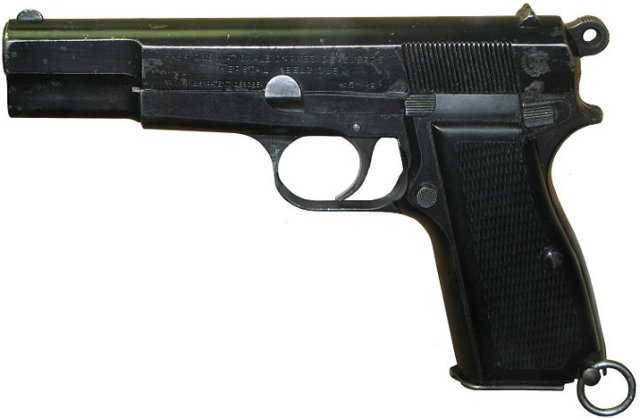
Small arms manufacturer Browning has ended production of the Browning Hi Power semiautomatic handgun. The legendary pistol served in armies worldwide, from Nationalist China to the British Special Air Service and was one of the first high capacity pistols ever invented. An invention of prolific arms designer John Moses Browning, the Hi Power was the inventor’s last pistol design.
As noticed by The Firearm Blog, the pistol‘s product page was quietly changed to include the words, “no longer in production” and the prices were removed. The Hi Power pistol was in continuous production for 82 years.
The Hi Power was the brainchild of American small arms legend John Moses Browning, a prolific inventor who also created the M2 .50 caliber machine gun, still in use with U.S. military forces today. He also invented the M1911 handgun, the U.S. military’s standard sidearm for nearly 70 years, and literally dozens of other pistols, shotguns, rifles, machine guns, and even a cannon. Browning was working on the Hi Power when he died in 1926, and the gun was eventually finished and sold by his manufacturing partners in Belgium in 1935.
The Hi Power had little in the form of commercial success before World War II, but was used by both sides during the war. Belgium’s surrender to Nazi Germany saw plans for the gun smuggled out of the country to Canada, where they were built for Nationalist Chinese forces and British and Canadian paratroopers and special forces. The tooling left behind in occupied Belgium went on to produce handguns for German military forces, particularly paratroopers and the Waffen SS. After the war the gun was sold to civilians and armed forces, particularly those belonging to NATO, and eventually more than 50 armies and 93 nations adopted the Hi Power as their standard sidearm. More than a million Hi Powers were eventually produced.
January 23, 2018
British Pistols of World War 1 I THE GREAT WAR Special feat. C&Rsenal
The Great War
Published on 22 Jan 2018Check out Othais’ YouTube channel: https://www.youtube.com/candrsenal
Othais introduces the standard British pistols and revolvers to Indy, including the iconic Webley series.
January 6, 2018
THE GREAT WAR and C&RSENAL Special Hangout – Russian Rifles and Pistols of WW1
The Great War
Streamed live 6 hours agoCheck out C&RSENAL: http://youtube.com/candrsenal
Ask questions here: https://www.reddit.com/r/TheGreatWarC…
December 9, 2017
History of the Gun Part-11: Semi-Auto Pistols
RugerFirearms
Published on 7 Apr 2010The “History of the Gun” online video series produced by Ruger is a unique look at the progression of firearms technology throughout the years, hosted by Senior Editor of Guns & Ammo Garry James. Part 11 examines semi-automatic pistols.
December 8, 2017
History of the Gun Part-10: Revolvers
RugerFirearms
Published on 24 Mar 2010The “History of the Gun” online video series produced by Ruger is a unique look at the progression of firearms technology throughout the years, hosted by Senior Editor of Guns & Ammo Garry James. Part 10 examines revolvers.
November 19, 2017
Unique Ross Experimental A2 Pistol Prototype
Forgotten Weapons
Published on 13 Mar 2017This is a very rare Ross automatic pistol, patented in 1903 by Charles Ross, of the Ross Rifle Company in Quebec. It is a short recoil, toggle locked design, made for the .45 Ross proprietary cartridge (although efforts were made, unsuccessfully, to make a .45 ACP version for the US 1907 pistol trials).
August 15, 2017
Italian Pistols of World War 1 I THE GREAT WAR Special feat. C&Rsenal
Published on 14 Aug 2017
Italian Gisenti 1910 Pistol in detail: https://www.youtube.com/watch?v=M7eLhcNRwps
In this edition of our live stream episodes with C&Rsenal we take a look at the Italian pistols of World War 1.
June 21, 2017
Greek Rifles and Pistols of World War 1 I THE GREAT WAR Special feat. C&Rsenal
Published on 20 Jun 2017
If you want to learn more about the firearms of World War 1, subscribe to C&Rsenal: http://youtube.com/candrsenal
Othais explains the rifles and pistols that Greece fielded in the First World War, among them the legendary Mannlicher–Schönauer M1903 and the Greek Gras M1874.
May 15, 2017
“The handgun industry uses the word ‘extreme’ like it’s on sale if bought by the dozen”
A post by Tamara Keel that may be of interest to my American friends, where getting legal permission to carry a handgun is still theoretically possible (unlike here in Soviet Canuckistan):
Extreme conditions! Extreme weather! The handgun industry uses the word “extreme” like it’s on sale if bought by the dozen. It gets used to tout the reliability of various handguns in advertising and in debates at gun store counters and internet forums: “The Blastomatic 2000 meets and exceeds MIL-STD-810G for blowing sand and dust…”
“We went down by the beaver pond and dunked my Sheepdog Sidearms Mk. III completely in the mud and it still fired a whole clip without jamming.”
“I read on a blog that the East Slobovian Army tested the Infidel Defense Crusader by freezing it in a block of ice and running it over with a tank!”
This is all well and good, but it has next to nothing to do with day-to-day concealed carry by the average American armed citizen. If someone were to come up with a relevant test to replicate the conditions faced by the typical concealed carry gun, it would probably involve gently bouncing the holstered gun up and down in a heated container full of pocket lint and dead skin cells for six months until all the lube evaporates or congeals — whichever comes first.
Neglect is probably the greatest enemy of the concealed self-defense handgun. In my experience, it’s a rare one that gets fired and lubricated very frequently. On one end of the spectrum are the people who might only own the one pistol and hardly ever get to the range with it, and on the other end are people who might have dedicated practice or training guns to spare their actual lifesaving tool the wear and tear.
February 4, 2017
QotD: The US Army’s new pistol
It has set off the usual round of pontificating and second-guessing on forums and in blog posts as everybody asserts reasons why their own particular snowflake gun should have been picked. Expect flurries of comments about bore axis and “But plastic!” and grip angle from people who don’t shoot, except for the no doubt thousands of flawless rounds their Taurus or whatever has fired. (I’ll wager the couple of boxes they tell you it’s fired when they’re trying to sell it are a lot closer to the true round count than the thousands they claim when arguing on the internet. Logbook or GTFO, Sparky.)
Yeah, I carry a Glock. I’ve carried an M&P, and I’ll probably switch to a P320 in the next couple years when I get bored of working with Glocks. They’re pretty much interchangeable and, unlike a lot of other pistols I’ve sampled over the years, have all been largely trouble-free.
Personally, I think the MHS contest could have been as satisfactorily resolved by throwing a P320, an M&P, and a Glock 17 into a sack, spinning it around a few times, and reaching in and pulling one out. They all work fine, and if there’s a less crucial weapon in modern warfare than the pistol, it probably attaches to bayonet lugs.
Tamara Keel, “So…”, View from the porch, 2017-01-25.


