
World War Two
Published 3 Jan 2026July starts with ever more violence in the streets of Germany, which Chancellor von Papen uses as an excuse to take state control of Prussia, the largest German state. All this comes ahead of the July elections, in which the Nazi Party is the big winner, now the largest party in Germany and Party Leader Adolf Hitler someone that no one in politics can any longer ignore, including President Hindenburg. This summer really is a summer of drama and intrigue.
(more…)
January 4, 2026
The Nazis Win Big at the Polls! – Rise of Hitler 25, July-September 1932
Comments Off on The Nazis Win Big at the Polls! – Rise of Hitler 25, July-September 1932
December 21, 2025
The Fall of Chancellor Bruning – Rise of Hitler 24, April-June 1932
World War Two
Published 20 Dec 2025The runoff elections for German President give Paul von Hindenburg a strong victory over Adolf Hitler, and convince the Bruning government to try to reign in the Nazis by banning the SA and SS. However, Kurt von Schleicher has managed to convince Hindenburg that Bruning is a liability and by the end of May, Bruning is out and Schleicher has maneuvered Franz von Papen into the post of Chancellor. The Reichstag is dissolved, the ban is lifted, and who knows where Germany is headed!
(more…)
Comments Off on The Fall of Chancellor Bruning – Rise of Hitler 24, April-June 1932
December 14, 2025
Hitler becomes a German – Rise of Hitler 23, January-March 1932
World War Two
Published 13 Dec 2025The big news this winter is the German Presidential elections, held now in March for the first time since 1932, which pit current President Paul von Hindenburg against Nazi Party leader Adolf Hitler. Hitler, though, must become a German citizen before he can run; he been stateless since he gave up his Austrian citizenship seven years ago. The campaigns are quite different, but both effective, and the German people head for the polls.
(more…)
Comments Off on Hitler becomes a German – Rise of Hitler 23, January-March 1932
December 7, 2025
Can Hitler Be Tamed? – Rise of Hitler 22, October-December 1931
World War Two
Published 6 Dec 2025The so-called “Boxheim Papers” are leaked to the public this fall. These outline what the Nazi Party would do should there be a Communist coup; it involves a lot of people being shot or starved, and paints a rather haunting picture of what Nazi rule may be like in general. The Nazi Party, though, continues to grow in popularity, and President Hindenburg even meets with Adolf Hitler for the first time, indicating to the country and the army that Hitler is no longer an upstart, but a legitimate political force.
(more…)
Comments Off on Can Hitler Be Tamed? – Rise of Hitler 22, October-December 1931
November 12, 2025
Volksturm VG-5, aka VK-98
Forgotten Weapons
Published 15 Sept 2015By the beginning of 1945, the Nazi government in Germany was looking to find cheaper ways to equip the Volksturm, and solicited bids and designs from several major arms manufacturers. The Steyr company created a crude but effective version of the Mauser 98 which was dubbed the VK-98 or VG-5. Mechanically it is identical to a K98k, but has much less attention paid to aesthetic finish and many simplified parts.
In total, 10,000 of these Steyr rifles were made. Despite commonly held notions of them having totally random parts, there are actually a relatively small number of discreet variations in the production sequence and the rifles have definitely class characteristics — which I will examine in the video.
Comments Off on Volksturm VG-5, aka VK-98
October 30, 2025
Javier Milei’s party does well in mid-term elections
J.D. Tuccille on the results of Argentina’s recent elections which returned significantly more of Javier Milei’s allies than pre-election polls predicted:
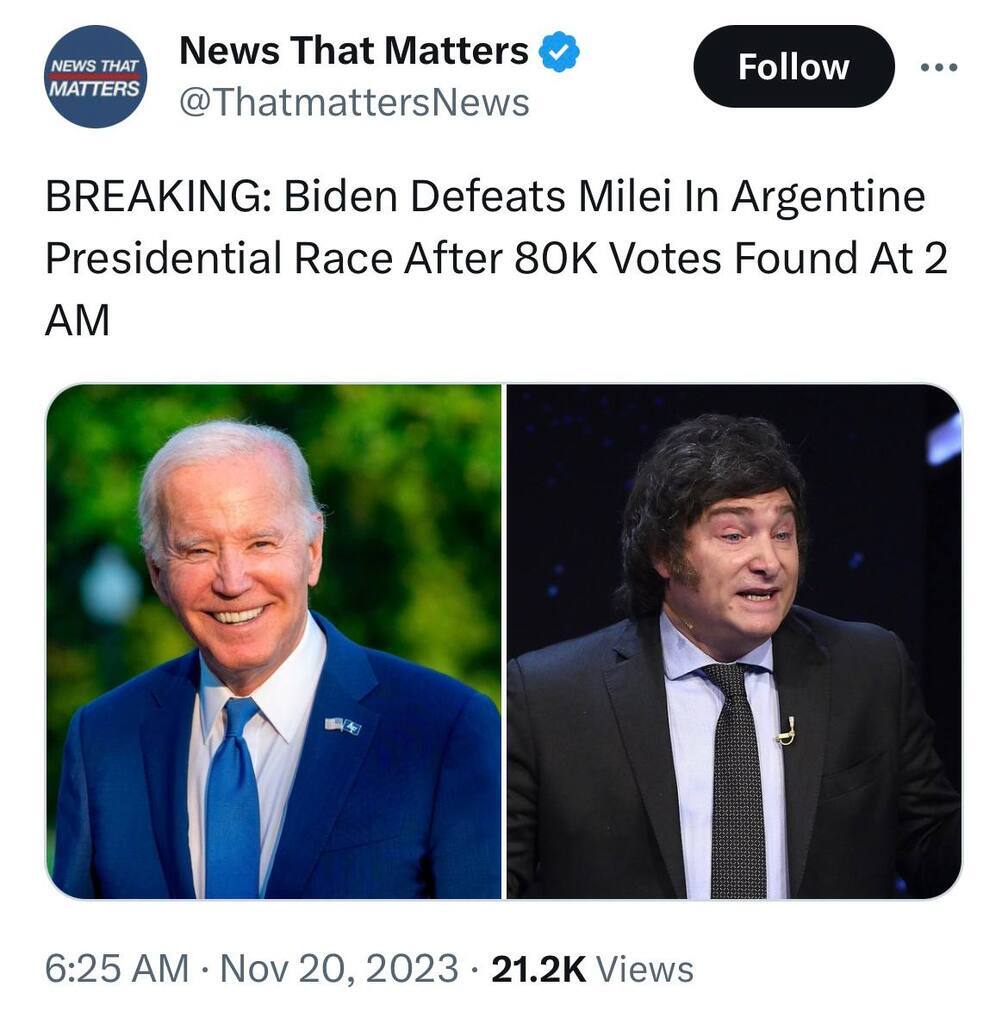
And things were going so well before 2am …
Argentina’s libertarian President Javier Milei won an important election victory on Sunday when his coalition, La Libertad Avanza (LLA), received a plurality of votes in the country’s legislative elections. With about half of the seats in the lower house up for grabs and a third of the Senate, LLA didn’t gain a majority, but it dramatically increased its share enough to block repeals of presidential decrees by lawmakers from other parties and to support presidential vetoes.
As Reason‘s César Báez commented, the results give Milei and his allies crucial time to continue needed free-market reforms and, hopefully, restore the fortunes of a country once held up as a model of prosperity, but which has been driven into poverty by decades of statist misrule.
In what it calls “a shocking electoral victory”, La Nacion reports that LLA pulled 40.66 percent of the vote. That’s well ahead of the opposition Peronists, who have long dominated the country and drew 31.7 percent of votes. Importantly, LLA won the populous province of Buenos Aires (home to 40 percent of voters), a Peronist stronghold where Milei’s allies were recently trounced in local elections.
From Wealth to Poverty Under Government Economic Meddling
This is good news for anybody who hopes for the advance of freedom, of course. But it’s especially encouraging for Argentines who, over the course of generations, have seen their country reduced from one of the wealthiest in the world to an impoverished basket case.
“At the end of the 19th century, economists agreed: Argentina, the ‘land of silver’, had a golden future ahead of it,” Deutsche Welle noted in 2020. “‘Rich like an Argentine’ was a common phrase at the time.”
The German broadcaster added, “in an unprecedented fall, Argentina went from ranking among the world’s top economies to one at the very bottom of the list. Today, economists simply roll their eyes at the fate of Argentina, which is now a developing country.”
The reason is simple enough: Argentines handed their political fates to a man named Juan Peron. In the 1930s, Peron served as a military observer in Europe, traveling to countries including Germany, Italy, and the Soviet Union. He was deeply impressed by some of the worst ideas to ever motivate a government and blended them into his own “justicialist” ideology. Through decades of political dominance, first Peron and then successor justicialists demonstrated that, in practice, there’s no real difference between fascism and socialism and that statist economics by any name are destructive.
To illustrate just how destructive Peron’s legacy has been, it’s worth pointing out that after Sunday’s election, The Wall Street Journal reported that Milei’s free-market, smaller-government policies “have restored some credibility to Latin America’s third-largest economy, but about one in three people still live in poverty”. One-third of the population living in poverty is horrifying, but what’s remarkable is that this is an improvement over what went before. At the end of the preceding Kirchner presidency, poverty stood at 41.7 percent and then briefly rose to 52.9 percent before falling to its current level.
In Spiked, Hugo Timms points out that the success of La Libertad Avanza is almost diametrically opposed to what most mainstream media reports were saying in the days leading up to the elections:

Argentine president Javier Milei has won a significant victory in Argentina’s midterm elections, held on Sunday. His libertarian party, La Libertad Avanza (Liberty Advances), claimed more than 40 per cent of the vote, effectively doubling its share of seats in the senate and lower house to 37 (out of 72) and 64 (out of 257) respectively.
The result came as a bitter shock to much of the mainstream Western press. Milei’s assault on established economic orthodoxies since his election in December 2023 led many “experts” to take it for granted that Milei’s party was in for a hiding.
In a primer for the election published last weekend, the Observer had already begun salivating over the prospect of Milei’s defeat. “Argentina is counting the cost of its turn to Javier Milei”, wrote economics editor Heather Stewart. Glum portraits of Nigel Farage and Donald Trump behind Milei loomed above the article. “Politicians around the world are closely watching what happens when populist economic prescriptions collide with reality”.
This was a comparatively soft take compared with what the Guardian published earlier in October. “Farage, Trump, Musk: your boy Javier Milei just took one hell of a beating. Why so quiet?”, blared the headline when Milei’s party was defeated in a provincial election in the capital Buenos Aires. The Guardian said Milei’s “hard right” administration was “melting away”, along with his “once-packed international throng of cheerleaders and wolf-whistlers”.
Unsurprisingly, the BBC struggled to get to grips with Milei’s victory on Sunday, even though its only job was to convey the results impartially. Apparently, the president made gains despite Argentina “hurtling towards an economic collapse”, it editorialised. It said the voter turnout of 68 per cent reflected “widespread apathy”. This might be lower than past midterm elections in Argentina, but it was still higher than turnouts at last year’s US presidential election (65 per cent) and the most recent UK General Election (60 per cent).
None of this should come as a shock. Since Milei’s rise to power in 2023, most of the commentariat has been eager to see him fail. His promises to radically cut public spending and deregulate key industries were seen in the eyes of many economic experts to only mean one thing: the dreaded return of Thatcherite “neoliberalism”, from which, they claim, Britain and America have never truly recovered.
The antipathy is mutual. In a speech to the World Economic Forum in January 2024, Milei famously referred to the world’s political classes as “parasites who live off the state”. That his speech was shared approvingly by Elon Musk on X confirmed, in the eyes of the Western establishment, Milei’s status as a dangerous insurrectionist.
Comments Off on Javier Milei’s party does well in mid-term elections
October 20, 2025
From Hitler’s Rockets to America’s Arsenal – W2W 049
TimeGhost History
Published 19 Oct 2025From the ashes of Nazi Germany to the launch pads of the American desert, the story of the nation’s first ballistic missile is one filled with contradiction. A man who once served the SS soon became a celebrated figure in the United States, and his weapon of war was transformed into a symbol of progress. Here, we will explore how this unlikely journey unfolded and what it reveals about science, power, and morality in the modern age.
(more…)
Comments Off on From Hitler’s Rockets to America’s Arsenal – W2W 049
October 6, 2025
Fatherland: Alternate History with a Point
Feral Historian
Published 11 Oct 2024The 1992 novel by Robert Harris is a great example of the otherwise generally mediocre “Germany won WWII” alternate history premise. By removing the regime from its current almost mythologized status as a unique and singular evil, instead portraying it as merely a repressive state in a Cold War, Fatherland illustrates an uncomfortable truth about realpolitik and atrocities.
00:00 Intro
00:55 The Case
02:20 Out of Myth, into the Mundane
06:13 Detente and Bureaucracy
09:11 HBO’s Adaptation
10:01 Ignoring Inconvenient TruthsCORRECTION: Somehow I put up a picture of Bormann when I was talking about Buhler.
🔹 Patreon | patreon.com/FeralHistorian
🔹 Ko-Fi | ko-fi.com/feralhistorianAnd my own book, not alternate history, Ninti’s Gate is available on kindle and in paperback,
🔹 https://www.amazon.com/dp/B0CYXH9BWD
Comments Off on Fatherland: Alternate History with a Point
September 30, 2025
How Tyrants Rise — and How to Stop Them – W2W 46
TimeGhost History
Published 28 Sept 2025Tyrants don’t just appear overnight — they rise through propaganda, fear, and control. In this episode of War 2 War, we explore how authoritarian leaders consolidated power in the 20th century, from the ruins of World War Two to the opening battles of the Cold War. How do tyrants gain control, how can you recognize the warning signs, and what can societies do to resist them? Drawing on lessons from Hitler, Stalin, and beyond, we break down the patterns of dictatorship and what history can teach us about confronting them.
(more…)
Comments Off on How Tyrants Rise — and How to Stop Them – W2W 46
September 29, 2025
The Galactic Empire and a (Revised) Generic Model of “Fascism”
Feral Historian
Published 29 Sept 2023While we can classify significantly different regimes as “communist” based on their key similarities, we don’t have the same taxonomy for “fascism” as a political category. The term is either used so broadly it becomes meaningless, or defined so narrowly that it’s only relevant to Mussolini’s Italian Fascism.
But we can identify three key factors that, when all are present together, result in a system we can define as “fascist” in a sense that’s both historically based and general enough to be useful for analysis. In addition to laying out a simple model defining fascism, this video also dives into some history of Fascism and National Socialism, mixed with the kind of sci-fi analysis you’ve come to expect here.
00:00 Intro
00:35 Palp, Dolf, and Communists
04:05 Old Republic vs Weimar Republic
04:55 Party and State
08:57 Three-Point “Fascist Minimum”
09:24 “Third Way” Economics
15:12 Totalitarianism
19:19 Unifying Myth
22:53 Umberto Eco
24:46 Franco
26:25 Closing Miscellany🔹 Patreon | patreon.com/FeralHistorian
🔹 Ko-Fi | ko-fi.com/feralhistorian
Comments Off on The Galactic Empire and a (Revised) Generic Model of “Fascism”
September 14, 2025
September 10, 2025
Space Nazis! Evil Empires and Historical Memory
Feral Historian
Published 30 Jun 2022A brief look at the echo of Nazi Germany and its impact on American sci-fi, with a focus on Star Wars because it’s endured for nearly half a century.
Comments Off on Space Nazis! Evil Empires and Historical Memory
September 4, 2025
Mussolini’s Blunder: Greece and North Africa 1940
Real Time History
Published 4 Apr 2025Hitler’s victories in 1940 present a historic opportunity to Italian dictator Benito Mussolini to expand the Italian Empire. Instead, Italy suffers a series of humiliating disasters in Greece and North Africa. So why did Mussolini declare war on the Allies at this moment, and could Germany be ultimately responsible for the Italian fiasco?
(more…)
Comments Off on Mussolini’s Blunder: Greece and North Africa 1940
August 20, 2025
QotD: Most “mass movements” really do need that “vanguard” to start moving
Let us stipulate that Socialism’s appeal to the proles is “I offer you a good time”. Orwell takes this as read, but it also follows from the premises laid out earlier in the essay. Orwell equates “ease, security and avoidance of pain” with “comfort, safety, short working-hours, hygiene, birth-control and, in general, common sense”. The Commies explicitly promise the proles those things; he could’ve lifted that phrase straight from the Webbs’ most doe-eyed propaganda leaflet.
And yet, as Orwell knows better than anyone, the proles can’t do it on their own. You really do need a vanguard of the proletariat. As Orwell himself notes, Hitler was backed by the big industrialists, and if you really want to needle the eggheads in your life, point out how quickly and thoroughly the German professors knuckled under […] They couldn’t wait to lick his jackboots, any more than his British and American colleagues could wait to kiss Stalin’s ass. They called themselves a “workers’ party”, but in the early days [German fascists] were almost exclusively found among the dueling fraternities – and professors! — of the German university system.
In other words, maybe the proles don’t need nothin’ but a good time, like the old song says, but though the proles are the “mass” of “mass movement”, the “movement” part gets started considerably higher up the social ladder … that is, with guys like Orwell. Guys who know, deep in their bones, that there’s more to life than hygiene, short working hours, birth control, etc. Because he’s one of the great prose stylists, it’s not as apparent in Orwell, but in lesser hands than his you can smell the contempt dripping off every sentence an egghead writes about the proles …
It’s not that the proles want hygiene, birth control, etc. It’s what they need. What they deserve, when you come right down to it, because that’s what you do with livestock — keep ’em clean and well fed, and of course control their breeding. You could take the most purple passage of “animal rights” eco-lunacy and set it side by side with the Webbs’ Soviet Communism: A New Civilization, and see no difference at all. Sure, every aspect of our lives is managed for us by Our Betters, but at least we’re free range!
Severian, “Bonfire of the Vanities II”, Founding Questions, 2021-12-29.
Comments Off on QotD: Most “mass movements” really do need that “vanguard” to start moving


