Quotulatiousness

July 21, 2020

Enfield L85A1: Perhaps the Worst Modern Military Rifle

Filed under: Britain, History, Military, Weapons — Tags: , , , , , — Nicholas @ 02:00

Forgotten Weapons
Published 29 Dec 2016

http://www.patreon.com/ForgottenWeapons

Cool Forgotten Weapons merch! http://shop.bbtv.com/collections/forg…

If you enjoy Forgotten Weapons, check out its sister channel, InRangeTV! http://www.youtube.com/InRangeTVShow

The L85A1 (part of the SA80 small arms family) was adopted by the British military in 1985 as a new generation of small arms to replace the L1A1 FAL (one quick note, where “A1” indicates a revision in American designations, it is simply the first iteration in British ones — there was no “L85”). As a bullpup rifle, the L85A1 was intended to replace both the FAL and Sterling SMG, similar to the French replacing the MAS 49/56 and MAT 49 with the FAMAS.

Unfortunately, the L85A1 had massive problems of both reliability and durability. They were kept pretty much hidden until Desert Storm, when it became unavoidably clear that the weapon was seriously flawed. The UK government denied the problems for several years, until finally contracting with H&K (then owned by Royal Ordnance) to redesign and rebuild the rifles. The result, after changes to virtually every part of the rifle, was the L85A2 — a much better rifle that will be tainted with its predecessor’s reputation regardless.

Mechanically, the L85A1 and A2 are basically copies of the Armalite AR-180, with a multi-lug rotating bolt and a short stroke gas piston. It feeds from STANAG magazines, and it universally fitted with the heavy but rugged SUSAT optical sight.

Thanks to the Institute of Military Technology for allowing me to have access to this rifle (which is extremely rare in the US) and bring it to you! Check them out at:

http://www.instmiltech.com

July 20, 2020

The “epic failure” of the RCMP during the Nova Scotia killing spree

Filed under: Cancon, Law — Tags: , , , , , — Nicholas @ 03:00

In the Halifax Examiner, Paul Palango reconstructs the (known) series of events during the April pursuit of the killer at large in Nova Scotia:

The RCMP has claimed it did its best in trying to deal with the Nova Scotia mass killer on the weekend of April 18 and 19, but a reconstruction of events by the Halifax Examiner strongly suggests that the police force made no attempt to save lives by confronting the gunman or stopping his spree at any point.

“Public safety and preservation of life are the primary duties of any peace officer,” said a former high ranking RCMP executive officer who asked for anonymity out of fear of retaliation by current and former law enforcement officials who are vigilant about any criticism of policing by those in the field. “As far as I can tell, the RCMP did nothing in Nova Scotia to save a life. They weren’t ready. It is embarrassing to me. The entire thing was an epic failure.”

Based upon interviews with other current and former police officers, witnesses, and law enforcement, and on emergency services transcripts, it seems clear that there was a collapse of the policing function on that weekend.

At no point in the two-day rampage did the RCMP get in front of the killer, who the Examiner identifies as GW. It also seems apparent that some Mounties, many of whom were called in from distant locales, were stunningly unaware of the geography and landmarks in the general area as the RCMP tried to keep up with GW.

Sources within the RCMP say a major problem was that communications between various RCMP units was never co-ordinated. “Everyone was on their own channels,” the source said. “Nothing was synchronized. They could have gone to a single channel and brought in the municipal cops as well, but for some reason they didn’t. It was like no one was in charge.”

This incident is revealing:

Several RCMP and law enforcement sources say that a corporal from a nearby detachment who was the initial supervisor on the scene froze in place to the distress of other Mounties. The corporal later ran into nearby woods and turned off their flashlight and hid. That officer continues to be off work on stress leave.

Some veteran Mounties say that there were likely a number of factors which caused the first Mounties on the scene to hesitate.

“It could have been inexperience. Maybe there was no backup. And then there’s always that Canada Labour Code thing,” said one long time Mountie.

The “Canada Labour Code thing” is an interesting insight, although it doesn’t excuse the RCMP’s disorganization and lack of effective leadership over the two days.

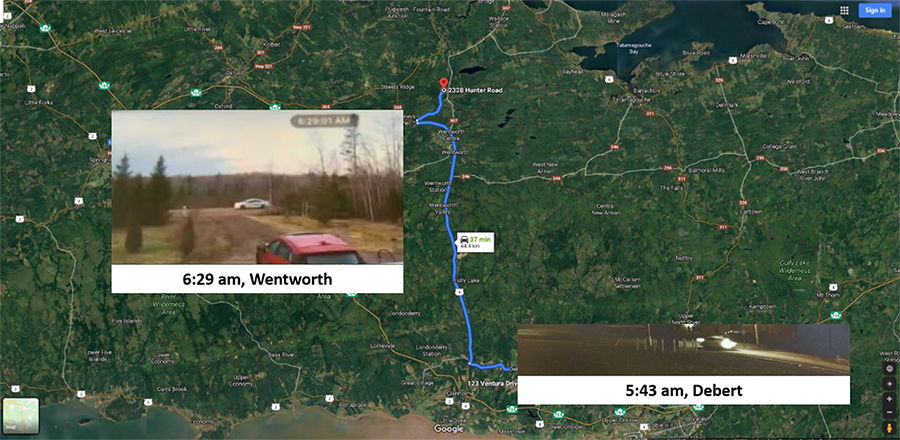
An annotated RCMP map shows the killer’s route from 123 Ventura Drive in Debert to 2328 Hunter Road in Wentworth. Insets of still images taken from different videos show the killer’s replica police car at 5:43am in Debert and passing a driveway on Hunter Road in Wentworth at 6:29am.

As they say, “read the whole thing“, as the events unfold with what seems like an endless series of missed opportunities on the part of the RCMP to stop the killings.

H/T to Colby Cosh for the link.

June 21, 2020

Paul Wells – “Everyone agrees!” [on the need to fully investigate the Nova Scotia massacre] … “But so far there is no inquiry”

Filed under: Cancon, Law — Tags: , , , , , , — Nicholas @ 05:00

Paul Wells in Maclean’s:

We are faced, perhaps only temporarily, with a familiar Canadian paradox: everyone says they want something to happen, but it isn’t happening.

The “something” is a rigorous public inquiry into a horrible shooting spree that spanned two days and killed 22 people in Nova Scotia in mid-April. It was the worst mass murder in Canadian history. It was lurid in its weirdness. The gunman, Gabriel Wortman, spent two days driving around in a convincing replica RCMP vehicle, shooting at whim, while the force he was imitating and dodging failed to send out a more comprehensive emergency alert than their Twitter warnings, one that might have saved more lives. In the midst of the carnage, two actual RCMP officers apparently fired their weapons into the walls of a firehall in Onslow for reasons that remain unknown.

New reporting for Maclean’s by Shannon Gormley, Stephen Maher and Paul Palango raises troubling new questions about Wortman’s possible ties to organized crime and, especially, to the RCMP itself. This reporting is attracting a lot of attention and, here and there, vigorous online debate. This Twitter thread, for instance, asks hard questions about our latest story.

The questions raised by our investigative team including Paul Palango, author of three best-selling books (here, here and here) about the troubling history of the RCMP, are backed by a solid and growing network of well-informed sources. But past a certain point, even superb reporting can’t provide authoritative answers. That work is properly left to duly mandated public authorities, usually wearing judges’ robes. Some people, reading the most recent Maclean’s reporting, have said the RCMP has a lot of questions to answer. Unfortunately there is no reason to take any answer from the RCMP on faith. It’s time for a full judicial inquiry.

Everyone agrees! From Nova Scotia premier Stephen McNeil to the latest embattled RCMP commissioner to three Trudeau-appointed Nova Scotia senators to anguished families of the murdered to, I mean sort of, the Prime Minister. But so far there is no inquiry.

May 28, 2020

Wuhan Coronavirus versus Canadian government planning and implementation

As Chris Selley illustrates, this was a clear failure for the various levels of government:

When Ontarians look back on the COVID-19 pandemic as the moment when their government finally ponied up the big bucks and fixed the province’s long-term care system, they will likely also wonder what the hell took so long. As appalled as everyone quite rightly is by the Canadian Forces’ report into the state of five long-term care homes that were in dire enough shape to require military intervention, we really shouldn’t be shocked. As the Ottawa Citizen in particular has reported in recent years, the system’s staffing levels were designed for a much less old, much less sick and much less Alzheimer’s-afflicted population than lives in them today — and it led to some terrible outcomes in normal times.

Perhaps it was easy to blame such incidents on individual villains: Ottawa support worker Jie Xiao, who was caught on video punching 89-year-old Georges Karam 11 times in the face; or Elizabeth Wettlaufer, one of Canada’s most prolific and yet somehow least-famous serial killers, who murdered at least eight senior citizens in long-term care homes during her red flag-festooned nursing career. Perhaps tales of society’s most vulnerable being forced to wallow in their own filth, or even just left alone in confusion and misery, are too much for the human mind to contemplate at length.

In any event, it only stood to reason that a virus as potent as the one that causes COVID-19 would exploit weak points in a long-term care system. Between wandering patients, fans circulating air throughout facilities and a lack of basic sterilization control, you would almost think these five facilities wanted the virus to spread. It’s a wretched understatement to say we can do better.

We shouldn’t fool ourselves, though: Long-term care homes will always be uniquely vulnerable. And as the economy reopens, it’s essential we keep focusing on them. It’s essential that we focus, period.

There is a tendency among media in Central Canada to treat “Canada’s COVID-19” outbreak as a single thing affecting all of society. It clearly isn’t. The numbers are all over the map. Quebec has reported by far the most cases and deaths: 5,655 and 480 per million population, respectively. Ontario is at roughly one-third of that: 1,778 cases per million and 144 deaths per million. At 1,569 cases per million, Alberta has a comparable number of cases to Ontario — but far fewer deaths, at just 31 per million. British Columbia has the same death rate as Alberta, but with only one-third as many cases. Saskatchewan, Manitoba, Newfoundland and New Brunswick have reported just 18 deaths between them. Quebec has nearly 30,000 active cases; Ontario has just over 6,000; Manitoba has 16.

May 27, 2020

Comprehensive planning and communication failures are the hallmark of Canada’s response to the Wuhan coronavirus epidemic

Filed under: Bureaucracy, Cancon, Government, Health — Tags: , , , , , — Nicholas @ 05:00

Chris Selley understands why the internet shaming community is dunking on the apparently large number of people who crowded into Toronto’s Trinity-Bellwoods park over the weekend but doesn’t feel the need to join them:

Screencap from a CBC report on unorganized social distancing civil disobedience at Toronto’s Trinity-Bellwoods Park on Saturday.

Human beings need to get outside and socialize. They have breaking points, and many are very understandably at them. (An aside: I can’t help noticing how many people venting fury on social media have also treated their followers to images of their back-patio office setups, or updates on their new vegetable gardens.) There is also no surplus of parkland in downtown Toronto. Photographic evidence suggests other neighbourhood greenspaces were very busy as well, though not to the same extent.

In other words, this was always going to happen. So the time is long past when politicians like Ontario Premier Doug Ford or Toronto Mayor John Tory should be able to cluck their tongues or stamp their feet at such people and expect their constituents to nod along in solidarity.

Jurisdictions facing significant COVID-19 outbreaks had one finite period of time in which to try to knock this bastard virus down. After that period of time, the socioeconomic costs of the shutdown would become unsustainable and the economy would have to reopen. We’re seeing that happen all over the world right now: in essence, countries are rolling the dice. If they did well in the allotted time, fewer people will have to die in the name of getting back to normal.

The federal, Ontario and Toronto governments have not done well — certainly not to any extent that justifies their leaders’ soaring approval ratings.

The feds have been abysmal since even before Day One, with Chief Public Health Officer Theresa Tam actively downplaying the threat. We shipped 16 tonnes of personal protective equipment to China with no viable plan to replace it. Whatever you think of travel bans as an anti-pandemic measure, the government undermined its own credibility by insisting they don’t work, then changing course 180 degrees over the course of a weekend. Most astonishingly, the feds at first utterly failed to communicate the most basic advice to returning travellers — advice such as “don’t stop for groceries or at the pharmacy on your way home.”

And Tam’s initial ludicrous “masks don’t work” narrative has grudgingly evolved to support the use of non-medical masks “where social distancing is not possible.” But the federal government’s official advice on “safe shopping” — indeed the entire web page titled “COVID-19 and food safety” — still doesn’t mention masks, even as the berth shoppers give each other seems to narrow by the day. This anti-mask stance seems to be ideological, bred in the bone.

May 23, 2020

Failed Assassinations — History Hijinks

Overly Sarcastic Productions
Published 22 May 2020

If videogames have taught me anything, it’s that an assassin can solve a lot of problems. But sometimes plans fall apart, and sometimes it’s for the absolute DUMBEST reasons.

SOURCES & Further Reading: A History of Venice by Norwich, Rebellion by Ackroyd, The Poison King by Mayor.

This video was edited by Sophia Ricciardi AKA “Indigo”. https://www.sophiakricci.com/
Our content is intended for teenage audiences and up.

PATREON: https://www.Patreon.com/OSP

DISCORD: https://discord.gg/h3AqJPe

MERCH LINKS: https://www.redbubble.com/people/OSPY…

OUR WEBSITE: https://www.OverlySarcasticProductions.com
Find us on Twitter https://www.Twitter.com/OSPYouTube
Find us on Reddit https://www.Reddit.com/r/OSP/

April 28, 2020

ESR on “Lassie errors” in software

Filed under: Technology — Tags: , , , — Nicholas @ 03:00

I’d never heard this term before, but it’s an excellent description of the problem:

“Interactive UNIX Booting” by mrbill is licensed under CC BY 2.0

Lassie was a fictional dog. In all her literary, film, and TV adaptations the most recurring plot device was some character getting in trouble (in the print original, two brothers lost in a snowstorm; in popular memory “Little Timmy fell in a well”, though this never actually happened in the movies or TV series) and Lassie running home to bark at other humans to get them to follow her to the rescue.

In software, “Lassie error” is a diagnostic message that barks “error” while being comprehensively unhelpful about what is actually going on. The term seems to have first surfaced on Twitter in early 2020; there is evidence in the thread of at least two independent inventions, and I would be unsurprised to learn of others.

In the Unix world, a particularly notorious Lassie error is what the ancient line-oriented Unix editor “ed” does on a command error. It says “?” and waits for another command – which is especially confusing since ed doesn’t have a command prompt. Ken Thompson had an almost unique excuse for extreme terseness, as ed was written in 1973 to run on a computer orders of magnitude less capable than the embedded processor in your keyboard.

Herewith the burden of my rant: You are not Ken Thompson, 1973 is a long time gone, and all the cost gradients around error reporting have changed. If you ever hear this term used about one of your error messages, you have screwed up. You should immediately apologize to the person who used it and correct your mistake.

Part of your responsibility as a software engineer, if you take your craft seriously, is to minimize the costs that your own mistakes or failures to anticipate exceptional conditions inflict on others. Users have enough friction costs when software works perfectly; when it fails, you are piling insult on that injury if your Lassie error leaves them without a clue about how to recover.

April 25, 2020

Professor Neil Ferguson – “I wrote the code (thousands of lines of undocumented C) 13+ years ago to model flu pandemics…”

Filed under: Britain, Government, Health — Tags: , , , — Nicholas @ 03:00

An anonymous guest post at Hector Drummond’s blog pivots on the disturbing quote in the headline from one of the key advisors to the British government on the Wuhan Coronavirus epidemic:

To say I was gobsmacked at his admission is an understatement. He’s one of the experts advising the government about the Covid-19 pandemic, and was consulted in previous health crises such as Foot & Mouth disease. Like the approach to combating that, we’re seeing a kind of scorched earth approach to containing another transmissible disease.

Even though the “C” programming language that Ferguson used is nearly 50 years old, the language chosen isn’t the problem. Undocumented means that modules and other code fragments are not commented, so their purpose may be unclear to someone unfamiliar with the code. In the worst case it means that modules and variables don’t have self-documenting names. For example, an accounting program could have the variables BalanceBroughtForward and BalanceCarriedForward, but a sloppy programmer might call them B1 and B2 instead – a sure recipe for confusion.

The “C” language is good to work with but has some inherent issues which can lead to subtle bugs affecting the output without causing an error. A common problem is the conditional which uses two equals signs rather than one.

To compare variables A and B for equality you would write this: if (A == B). However, it’s easy to accidentally write this: if (A = B). The latter always returns true and assigns the value of variable B to A. I have no idea whether Ferguson’s code contains any bugs, this is just one minor example of the need for strict testing.

The reason for commenting code extensively and properly is so that the programmer himself, and anyone else who maintains it, can understand what it does and how it works, reduce the chance of mistakes and avoid unnecessary effort. During my IT career I would have terminated the contract of any contractor working for me who wrote thousands of lines of undocumented code. Not only is such code a nightmare for others to work on, it can be difficult for the original programmer to maintain if coming back to it after a long time. Sloppiness in the coding raises the worry of a concomitant lack of rigour in testing, although that’s not to assert Ferguson’s code isn’t working as intended and/or wasn’t tested.

April 12, 2020

Tank Chats #67 Covenanter | The Tank Museum

Filed under: Britain, History, Military, Weapons, WW2 — Tags: , , , — Nicholas @ 02:00

The Tank Museum
Published 22 Feb 2019

Historian David Fletcher MBE talks through the Second World War British Cruiser tank, the Covenanter. Otherwise known as Tank Cruiser Mark V** A13.

Support the work of The Tank Museum on Patreon: ► https://www.patreon.com/tankmuseum

Visit The Tank Museum SHOP: ► https://tankmuseumshop.org/
Twitter: ► https://twitter.com/TankMuseum
Tiger Tank Blog: ► http://blog.tiger-tank.com/
Tank 100 First World War Centenary Blog: ► http://tank100.com/ #tankmuseum #tanks #tankchats

April 10, 2020

A French Air Force Rafale-B flight that could have ended even worse for all concerned

Filed under: France, Military — Tags: , , — Nicholas @ 03:00

I’m guessing from what is revealed in this report, the Armée de l’air will be far more reluctant to allow unqualified individuals to get into their fighter aircraft in future:

The Rafale-B that was damaged during the accidental passenger ejection in March 2019.
Image from Bureau enquêtes accidents pour la sécurité de l’aéronautique d’État, BEA-A.

An elderly and reluctant Frenchman was ejected from a French Air Force fighter during a retirement day jolly – and narrowly missed taking the pilot with him, an investigation report littered with unintentional howlers has revealed.

The unnamed 64-year-old was éjecté from the two-seat Rafale-B in March from a height of 2,500ft in March last year after grabbing his ejection seat handle to steady himself, France’s BEA-E aviation investigator concluded.

Although the BEA’s full report is in French [PDF], aviation news website Aerotime Hub translated and summarised its contents, revealing the full comedy of errors triggered by a group of enthusiastic colleagues hoping to give their workmate a send-off to remember.

[…] a mechanic gave them both a cursory check, strapped a Go-Pro to an approved bulkhead mounting point so the hapless passenger’s gurning would be preserved for all time, and nodded to the pilot to close the transparent cockpit canopies.

Things got worse when the pilot took off from northeastern France’s Saint-Dizier Robinson airbase. Rather than the gentle ascent at 10°-15° that airline passengers experience, the Frenchman at the Rafale’s controls carried out a typical fighter jet departure and “climbed at 47°, generating a load factor of around +4G. Then, as he levelled off, he subjected his passenger to a negative load factor of about -0.6G”.

Forces exerted by Britain’s most G-force-intensive roller coaster, Alton Towers’ Rita, max out at +4.7G – or four times the normal force of gravity.

Our pensioner, loose in his straps, not really wanting to be there and totally unused to being flung around like a rag doll, reached out to grab something and hang on for dear life. He picked the worst possible handhold: the trigger handle for the ejection seat. After the customary loud bang and whoosh he ceased to be part of the jet’s payload, with the force of the ejection tearing his unsecured helmet and mask from his face.

The Rafale-B’s command ejection system is meant to fire both seats if one of the crew pulls the handle. A very confused pilot, however, was still sitting in his newly canopy-free Rafale wondering what the hell had just happened. He returned to land, conscious all the time that the seat could fire at any moment without warning. Luckily, it didn’t go off.

Approximate reconstruction of the path of the Rafale-B leading up to and following the accidental ejection.
Image from Bureau enquêtes accidents pour la sécurité de l’aéronautique d’État, BEA-A.

Char 2C – The World’s Biggest Operational Tank

Filed under: France, History, Military, Weapons, WW1, WW2 — Tags: , , — Nicholas @ 02:00

Mark Felton Productions
Published 15 Nov 2019

Find out the unbelievable story of the biggest operational tanks in history – the French Char 2C, and their peculiar fate.

Help support my channel:
https://www.paypal.me/markfeltonprodu…
https://www.patreon.com/markfeltonpro…

Disclaimer: All opinions and comments expressed in the ‘Comments’ section do not reflect the opinions of Mark Felton Productions. All opinions and comments should contribute to the dialogue. Mark Felton Productions does not condone written attacks, insults, racism, sexism, extremism, violence or otherwise questionable comments or material in the ‘Comments’ section, and reserves the right to delete any comment violating this rule or to block any poster from the channel.

Credits: YouTube Creative Commons; WikiCommons; Google Commons; Mark Felton Productions
Music: “Pursuit” and “Dogma” licenced to iMovie by Apple, Inc.

H/T to @AnonymousFred514 for the link.

April 9, 2020

The (former) captain of USS Theodore Roosevelt

Filed under: Media, Military, USA — Tags: , , , , , — Nicholas @ 05:00

Another example of how civilians interpret an action in a radically different way than the military does (and must):

The Nimitz-class aircraft carrier USS Theodore Roosevelt (CVN 71) underway in the Persian Gulf, 3 December 2005.
U.S. Navy photo by Photographer’s Mate 2nd Class Matthew Bash via Wikimedia Commons.

Okay, about this USS Teddy Roosevelt captain …

No, he’s not some sort of rebel hero who fought the power for his sailors and stuff because only he gave a damn about them. That’s crap, and […] I am not happy to see him get canned. I was an O6 myself, and I would prefer O6s, as a rule, not end up fired. But that was the only course of action available to the SecNav. The guy screwed up, big time.

To believe this CAPT Crozier guy is a hero, you have to believe stupid and wrong things which you should not believe due to their stupidness and wrongness.

You have to believe that the Navy “didn’t care” about sick sailors. Libs take this further to imply that the Navy “didn’t care” about sick sailors because that would have made Trump angry.

This is, as I said, stupid and wrong.

The Navy brass has several things to think about, and there is an order of priority among those things. The priority order is 1) the mission and then 2) the sailors. Notice the order? One of the unique aspects of the military is that it is one of the very few institutions where the lives of its members are expressly and deliberately subordinated to the mission. An aircraft carrier is a major strategic asset, almost incalculably major. And this captain wanted to take it offline. Now, that could have been the decision. Command is about making tough decisions, but it was not his decision. Once he gave his input to his bosses, what he thought meant nothing.

Nothing.

We elect a commander-in-chief to make those decisions. He delegates them in a clear order of precedence to his subordinates. So, CAPT Crozier was not defying admirals or even Trump when he decided he should make the decision. He was defying you and me.

The chain of command is a thing, as he found out when he got his walking papers. And it did not stop being a thing when he did not like the orders it gave him.

If your sailors are your number one priority, you frankly have no business being in command. The mission is the number one priority. That’s hard, and no fun, but [it’s] true. And that’s not an excuse to abuse or neglect your men — far from it. But it is a recognition that you have a mission and that is your priority.

Corzier was the captain of the carrier. There was an admiral down the hall — literally — who was his boss as task force commander. Why did he not go to the admiral? Or maybe he did go to the admiral and didn’t like the answer he got. Your commander disagreed with you? Gee, welcome to military service. Salute and drive on.

There’s no scenario where he’s right on this.

March 25, 2020

QotD: The broken feedback mechanism that brought down the chain bookstores

Filed under: Books, Business, Quotations — Tags: , , , , — Nicholas @ 01:00

… the push-model of book sales. Long before there was an Amazon, chain bookstores had cozy deals with publishers that sent most indie bookstores (now beloved in effigy by the left) out of business.

And then the left dominated publishing establishment had a brilliant idea. For decades they’d been trying to forecast failure and success, and failings. Books they pushed out the wazzoo (A river in Sundon’tshine) died on the vine when bookstores refused to stock them because the owners had read them. The books they had designated as to be ignored caught someone’s fancy, and suddenly were all over.

This was inefficient. It caused way too much printing that never got distributed, and much last minute rushed reprinting. (Even leaving aside how often people chose to read the WRONG things, something that started to matter more and more in the last two decades.)

So they came up with the push model. It was, from a certain perspective, brilliant.

That perspective is the one where the real world doesn’t really exist, so you don’t need to hear from it.

Because the managers of the big corporate bookstores ALSO didn’t read, they took instruction beautifully. So the publishers could say “you’ll take 100 of x and 2 of y” and they DID.

For a little while it worked beautifully, in the sense that there were no surprise bestsellers, (and publishing houses hated those. I know someone who unexpectedly sold out her print run in a week. The publishing house took the book out of print. No, seriously.) and the books that got seen and talked about were picked by the publisher. (BTW this wasn’t even always or primarily political. Sure, that existed too sometimes, but mostly it was the crazy fads that publishing convinced itself of. For instance, sometime in the mid two thousands they convinced themselves no one wanted historical mysteries — they weren’t selling, true, probably because they were on NO shelves — but everyone wanted “chick-lit mysteries” that had covers with lots of shoes and dresses and whose plots were “Sex in the City with murder.” I remember trying to find something to read, giving up and going to the used bookstore (then a hundred miles away in Denver) for my mystery fix.)

Of course, they sold less. In fact, as time went on and people got out of the habit of going to the bookstore, because there was never anything they could find to read. I mean, I remember being chased from Science Fiction to Mystery to finally History, to at last the sort of “utility” book you find in the discount bins you know “a chart of history” type of thing just to find something to buy on our bookstore night.

Then we gave up.

Eventually the broken feedback mechanism gave us the demise of Borders — and B & N is not feeling so good itself — and a yawning, desperate chasm in customers’ need for books that meant the way was wide open for Indie and Amazon. Even the early badly proofed indie books were like a breath of fresh air because for the first time I could read outside the trends being pushed.

Sarah Hoyt, “Breaking the Gears”, According to Hoyt, 2018-01-03.

March 22, 2020

“Basically, CBC ended itself. It almost beggars belief”

Filed under: Business, Cancon, Media — Tags: , , , , — Nicholas @ 03:00

Chris Selley notes the abject failure of Canada’s “national broadcaster” to rise to the occasion during the Wuhan Coronavirus epidemic:

I scuttled into National Post headquarters Wednesday night to liberate some things from my desk before Postmedia’s meatspace newsrooms officially locked their doors “until further notice.” (I and my housebound colleagues remain at your service in the meantime.) Among my correspondence was a copy of David Taras’ and Christopher Waddell’s new book, The End of the CBC? It argues that Canada’s public broadcaster must rapidly and quite savagely reinvent itself or risk “oblivion.” And it is nothing if not timely reading.

On Wednesday, in a moment history may well note as Mother Corp’s rock bottom, CBC announced it was scuppering all its local television newscasts. Instead it would feed us all Canadians a mixture of national and local news from the same Toronto-based spigot.

Basically, CBC ended itself. It almost beggars belief.

Brodie Fenlon, editor-in-chief of CBC News, took to his blog to explain the decision — but didn’t, really. He talked of “staffing challenges” stemming from employees self-isolating and working from home. “Television is especially resource-intensive, and many jobs are difficult to do at home,” Fenlon wrote. “Our systems are overtaxed.”

[…]

This coronavirus has turned a harsh, bright light on several defects in Canadian society that we’ve been happy enough to ignore. We should be keeping a list of those things, and vowing to address them comprehensively once we’ve beaten COVID-19 back. A full-on top-to-bottom mandate review for the Canadian Broadcasting Corporation, especially its English TV operations, ought to be on that list — and the status quo must not be an option.

March 4, 2020

England’s Secret Weapon: The Two Million Ton Megacarrier Made of Ice

Filed under: Britain, History, Military, Technology, WW2 — Tags: , , , , — Nicholas @ 02:00

Today I Found Out
Published 16 Feb 2018

If you happen to like our videos and have a few bucks to spare to support our efforts, check out our Patreon page where we’ve got a variety of perks for our Patrons, including Simon’s voice on your GPS and the ever requested Simon Whistler whistling package: https://www.patreon.com/TodayIFoundOut

This video is sponsored by World of Warships

In this video:

Britain was taking a beating from the German ships and submarines and were looking for something to build a ship out of that couldn’t be destroyed by torpedoes, or at least could take a major pounding without incurring a fatal amount of damage. With steel and aluminum in short supply, Allied scientists and engineers were encouraged to come up with alternative materials and weapons.

Want the text version?: http://www.todayifoundout.com/index.p…

« Newer PostsOlder Posts »

Powered by WordPress