
Quotulatiousness

July 5, 2011

When (not if) Greece defaults

Filed under: Economics, Europe, Government, Greece — Tags: , , — Nicholas @ 09:30

John Lanchester explains why default is inevitable, and that the only question remaining is how it will happen:

The economic crisis in Greece is the most important thing to have happened in Europe since the Balkan wars. That isn’t because Greece is economically central to the European order: at barely 3 per cent of Eurozone GDP, the Greek economy could vanish without trace and scarcely be missed by anyone else. The dangers posed by the imminent Greek default are all to do with how it happens.

I speak of the Greek default as a sure thing because it is: the markets are pricing Greek government debt as if it has already defaulted. This in itself is a huge deal, because the euro was built on the assumption that no country in it would ever default, and as a result there is no precedent and, more important still, no mechanism for what is about to happen. The prospective default could come in any one of several different flavours. From everybody’s perspective, the best of them would be what is known as a ‘voluntary rollover’. In that scenario, the institutions that are owed money by the Greek government will swallow heavily and, when their loan is due to be repaid, will permit their borrowings to be rolled over into another long loan. There is a gun-to-the-side-of-the-head aspect to this ‘voluntary’ deal, since the relevant institutions are under enormous governmental pressure to comply and are also faced with the fact that if they say no, they will have triggered a proper default, which means their loans will plummet in value and they’ll end up worse off. The deal on offer is: lend us more money, or lose most of the money you’ve already lent.

This is, at the moment, the best-case scenario and the current plan A. It reflects the failure of the original plan A, which involved lending the government of George Papandreou €110 billion in May last year in return for a promise to cut government spending and increase tax revenue, both by unprecedented amounts. The joint European Central Bank-EU-IMF loan was necessary because, in the aftermath of the financial crisis of 2008, Greece was exposed as having an economy based on phoney data and cheap credit. The cheap credit had now dried up, and Greece was faced by the simplest and worst economic predicament of any government: it couldn’t pay its debts.

June 29, 2011

The real reason for the Greek bailout

Filed under: Economics, Europe, Government, Greece — Tags: , , , , , — Nicholas @ 15:03

Eric S. Raymond explains why all the politicians and apparatchiks of the world’s bureaucracies are lining up to pump for a Greek bailout:

Lost in the eye-glazing babble about maturity extensions, haircuts, and which acronymic organization is going to funnel the money into place is the real magnitude of the stakes here. It’s not just the Greeks’ opera-bouffé parody of the modern redistributionist state that is circling the structural-insolvency drain; what really terrifies our political class is the prospect that, very soon, the investors simply won’t buy government bonds anymore — and massive borrowing through bond issues is the only thing keeping the redistributionist state afloat.

As I have documented many times on this blog, the entitlement-spending commitments of the U.S. Federal government, most U.S. state governments, most European governments, and indeed most national governments everywhere exceed the capacity of their economies to generate wealth. And demographic trends are making the imbalance worse over time, not better.

This is why raising taxes won’t help. The amount of private wealth available to be taxed is insufficient, even if taxation could be raised to 100% without suppressing all economic activity. In practice, raising taxes leads to increases in spending which more than consume the increased revenue (by a ratio of 1.17:1 in the U.S. since the 1940s).

[. . .]

That is the assumption that is now under threat. Greece must be bailed out in order to preserve the illusion that the borrowing can continue indefinitely, that the bill will somehow never come due. When the political class speaks of “contagion”, what they’re really worried about isn’t the solvency of German banks holding Greek paper, it’s a general flight of investors from the sovereign-debt markets.

June 27, 2011

The Economist calls for Greek debt restructuring

Filed under: Economics, Europe, Government, Greece — Tags: , , , — Nicholas @ 10:23

A Greek default. It’s stopped being a possibility, moved into being a probability, and it’s starting to look inevitable:

There is an alternative, for which this newspaper has long argued: an orderly restructuring of Greece’s debts, halving their value to around 80% of GDP. It would hardly be a shock to the markets, which have long expected a default (an important difference from Lehman). The banks that still hold a big chunk of the bonds are in better shape to absorb losses today than they were last year. Even if Greece’s debts were cut in half, the net loss would still represent an absorbable proportion of most European banks’ capital.

An orderly restructuring would be risky. Doing it now would crystallise losses for banks and taxpayers across Europe. Nor would it, by itself, right Greece. The country’s economy is in deep recession and it is running a primary budget deficit (ie, before interest payments). Even if Greece restructures its debt and embraces the reforms demanded by the EU and IMF, it will need outside support for some years. That is bound to bring more fiscal-policy control from Brussels, turning the euro zone into a more politically integrated club. Even if that need not mean a superstate with its own finance ministry, the EU’s leaders have not started to explain the likely ramifications of all this to voters. But at least Greece and the markets would have a plan with a chance of working.

No matter what fictions they concoct this week, the euro zone’s leaders will sooner or later face a choice between three options: massive transfers to Greece that would infuriate other Europeans; a disorderly default that destabilises markets and threatens the European project; or an orderly debt restructuring. This last option would entail a long period of external support for Greece, greater political union and a debate about the institutions Europe would then need. But it is the best way out for Greece and the euro. That option will not be available for much longer. Europe’s leaders must grab it while they can.

June 21, 2011

The Athens protests as a theatre for projection

Filed under: Economics, Europe, Government, Greece, Media — Tags: , , , — Nicholas @ 09:45

Whatever may really be behind the protests, reporters are having a wonderful time using it as a blank canvas to project their own notions:

Some seriously overblown claims are being made about the anti-government, anti-EU, anti-IMF protests in Athens. ‘Syntagma Square has become the frontline of the battle against European austerity’, said one giddy British reporter, referring to the square where for the past three weeks Greek citizens, calling themselves ‘indignados’, have been protesting against the IMF/EU demand for further austerity measures before Greece can receive more aid. In truth, the most striking thing about the protests is their incoherence, even their childishness. Far from being the frontline of any kind of solid movement, the Syntagma camp-in is a confused, depoliticised, borderline petulant response to the economic crisis.

Some European journalists and activists have become so enamoured by the physicality of the protests that they seem not to have noticed the gaping political hole at the heart of them. BBC reporters, who normally spend most of their time in stuffy, smokeless offices, have written with undisguised glee of their sweaty experiences in Athens, where the ‘teargas hits us without warning’ and ‘we crush together, shoulder to shoulder’. A Guardian reporter describes being ‘jammed up against the railings’ in a ‘raucous’ atmosphere that is like ‘an open-air concert’. Hacks more used to writing about Vince Cable’s latest pronouncement on business law have leapt upon the opportunity to get stuck into a seemingly more thrilling economic story, in the process presenting the Syntagma stand-off as way more profound than it actually is.

Likewise, many amongst the European left are busily projecting their aspirations on to Athens. This is the ‘start of the European workers’ fightback’, they claim, describing the protests as the ‘beginning’ of an uprising against austerity that they knew would come. It is a feeling of profound disarray and disconnection amongst European left groups, their sensitivity to the political stasis that has largely greeted the economic crisis, which leads them to make excitable claims about Greece. Motivated by a determination to avoid having hard debates at home about the crisis, far less try to come up with any strategies for resolving it, they content themselves instead with celebrating the rowdy ‘indignation’ of Greek protesters and imagining that it represents the first stirrings of the return of traditional class politics.

June 13, 2011

British carbon tax may spark de-industrialization

Filed under: Britain, Economics, Europe — Tags: , , , , — Nicholas @ 08:51

The current British government’s global warming/climate change programs, combined with the European Union’s policies, may have triggered a race to the exits by British industry:

Now, the CBI and Britain’s leading chemical firms have warned that the proposed “carbon floor” tax (also unique in the world) will make our industry so uncompetitive that, unless the policy is changed, it will lead inevitably to mass plant closures and job losses. Similarly, the European Metals Association warned last week that the EU’s various “anti-carbon” policies are becoming so costly that they are already forcing steel, aluminium and other producers in their energy-intensive industry to relocate outside Europe, losing hundreds of thousands more jobs.

At one end of the scale, then, whole industries are protesting that the soaring costs of “climate change” measures will amount, in effect, to a colossal economic suicide note. At the other, we begin to see how the obsession with “climate change” will push our own household energy bills through the roof, driving millions more people into “fuel poverty”. Apart from anything else, by 2020 our Government expects us to pay £100 billion for a further 10,000 useless, subsidised windmills, plus £40 billion to connect them to the National Grid. These costs alone would almost double our present electricity bills.

Furthermore, we are all unwittingly having to pay billions for the EU’s Emissions Trading Scheme, the Carbon Reduction scheme, higher airline taxes, higher vehicle duties, highly paid “low-carbon officers” in our council offices, and heaven knows what else besides. With the new carbon floor tax soon due to raise our energy bills by further billions, we can see why the Government’s own forecast — that the Climate Change Act will cost us up to £18 billion annually until 2050 — might well be an underestimate.

Most terrifying of all, however, is the extent to which our politicians remain firmly locked in their little green bubble, oblivious to the practical implications of the measures they have set in train. As for what purpose it all serves, we may note last week’s report that China, already the world’s biggest CO2 emitter, is now also the world’s largest energy user. Each year it increases the world’s CO2 emissions by more than the total that Britain emits annually.

June 9, 2011

Those ungrateful peasants

Filed under: Europe, Germany, Government, Humour — Tags: , , , — Nicholas @ 09:09

I had wondered about the origins of that bit of verse:

I asked if people were perhaps not tricked, but legitimately voting against the left because they objected to socialist policies such a massive spending and multiculturalism.

He responded that these issues were indeed difficult for ‘common people’ to comprehend, and therefore for the right to take advantage of. He reiterated however that the problem was not with the policies, it was that people did not ‘understand’.

This was a revealing statement, for it is a typical line of thinking across the left-wing political spectrum, from the most hardened communist to the most moderate social-democrat. While all leftists claim to be for the ‘people’, at the same time they have utter contempt for the people.

They believe they know what is best for the people, and if the people — uppity ungrateful peasants — object, then the people be damned.

Bertolt Brecht — ironically himself a dedicated Marxist — poked fun at this leftist mentality in a now famous poem, Die Lösung (The Solution), following a workers uprising against the Communist East German government in 1956.

    After the uprising of the 17th of June
    The Secretary of the Writers Union
    Had leaflets distributed in the Stalinallee
    Stating that the people
    Had forfeited the confidence of the government
    And could win it back only
    By redoubled efforts. Would it not be easier
    In that case for the government
    To dissolve the people
    And elect another?

May 29, 2011

More on the Anglo-Danish Marmite affair

Filed under: Britain, Bureaucracy, Europe, Food, Health — Tags: , , , , — Nicholas @ 10:34

Colby Cosh rounds up the details on the Marmite affair:

Nothing stirs the blood of the British like a nice slapfight over European regulation, and this goes double when food is involved. The UK press has found its latest excuse for tut-tutting and finger-waggling in the unlikeliest of places: at the bottom of the squat, distinctive little jar in which the vile breakfast spread Marmite is sold. This week, English-language journals in Denmark reported that the Scandinavian kingdom’s food regulator was having the dark brown yeast extract cleared from the shelves of shops which serve Brit expatriates.

The British reared up as one, displaying a spirit of indignant unity. “What have the Danes ever done for global cuisine?” thundered the Belfast Telegraph, breaking Godwin’s Law into splinters over its knurled Ultonian knee. (Unfortunately, a good answer might be “Not given it Marmite, at any rate.”) Fans of the quasi-foodstuff gathered on Facebook to form a “Marmite army”. Social campaigners used the ban to call attention to dubious patches in Denmark’s record on human rights and environmentalism.

As he points out, nobody at the Danish food nanny office suddenly issued a ban: technically Marmite had never been cleared for import at all. So it’s just a matter of filling in a form or two and Bob’s your uncle? Not quite:

Marmite’s status as a “fortified food” has apparently only just been noticed, and the DVFA says that “it has not received an application for marketing in Denmark of Marmite or similar products with added vitamins or minerals.” A glance at the DVFA’s procedure for obtaining approval to market these foods reveals why brand owner Unilever might not be in such a hurry to file. (And it also reveals that free-trade fanatics like me should probably rein in their admiration for the EU’s trade barriers just a little.) The agency not only requires compliance with EU-wide regulations, but insists that each product pass an “individual risk assessment” performed using a made-in-Denmark scientific procedure.

May 16, 2011

Christian holidays? Down the EU memory hole!

Filed under: Bureaucracy, Europe, Religion — Tags: , , , , — Nicholas @ 12:34

It could hardly be an oversight that the EU “forgot” to include any traditional Christian holidays in their run of 3 million school diaries produced for students:

A year ago the European Commission (EC) printed more than three million school diaries for distribution to students. They are lovely diaries which, true to the EU’s multicultural ethos, helpfully note all the Sikh, Hindu, Muslim and Chinese festivals. The diary also highlights Europe Day, which falls on 9 May. But the diary is not without some very big gaps. For example, it makes no reference to Christmas — or Easter or indeed to any Christian holidays.

However, the importance of 25 December is not entirely ignored. At the bottom of the page for that day, schoolchildren are enlightened with the platitude: ‘A true friend is someone who shares your concern and doubles your joy.’

Not surprisingly, many Europeans are not exactly delighted by the conspicuous absence of Christian festivals from a diary produced for children. In January, an Irish priest complained to the ombudsman of the EC and demanded an apology for the omission of Christian holidays and the recall of the diaries. A month later, the commission apologised for its ‘regrettable’ blunder. However, the ombudsman dismissed the demand to recall the diaries, arguing that a one-page correction sent to schools had rectified the error.

I suspect, had the complaint been from a religious leader in a non-Christian faith, they’d not have let a month elapse before springing to address the error in that faith’s holy days . . .

April 18, 2011

True Finn party surges to 39 seats in Finnish election

Filed under: Europe, Politics — Tags: , , , , — Nicholas @ 15:53

From nowhere to third-largest party:

The True Finns finished just behind the conservative NCP and the Social Democrats on around 19%.

While the Social Democrats have called for changes on EU bail-outs, including the planned Portuguese rescue, True Finns opposes the plans altogether.

A hostile Finnish government could theoretically veto the package.

Unlike other eurozone countries, Finland’s parliament can vote on whether to approve the measures.

Correspondents say the increased sway of Euro-sceptics in Finland’s parliament could hold up any further bail-out deals.

As the biggest party, the NCP is tipped to lead the next government with former Finance Minister Jyrki Katainen likely to become prime minister of whatever coalition emerges, replacing Mari Kiviniemi of the Centre Party.

Gavin Hewitt called it a “tremor” with an “epicentre” in Finland:

A few years ago the True Finns were a fringe party, that received almost no attention. So what happened? The vote was not just about the bailout. There was anxiety about unemployment and fears of a jobless economic recovery. Reductions in pensions had angered many workers. The party also tapped into fears about immigration.

What makes this election so significant is that it follows a pattern across Europe. Establishment and incumbent parties are being rejected. Nationalist parties are gaining influence.

In the Netherlands, the anti-Islam MP Geert Wilders leads the country’s third largest party. In Italy the Northern League — hostile to immigration and wary of the EU — is increasingly powerful. In France, Marine Le Pen — who wants to abandon the euro — is showing strong support in the polls.

Recently, writing in the Financial Times, Peter Spiegel questioned whether we were seeing the emergence of a European Tea Party. Certainly there is a strong sense of alienation and dissatisfaction. Immigration is a key factor. It is shaking governments. There are more than 24 million people without work in the EU and there is no appetite to welcome new arrivals. That is why the migrants from Tunisia are sparking such tension between Italy and France.

As important as immigration is unemployment. In countries like Italy and Spain there is talk of a “lost generation” that cannot find work. There is a growing awareness that Europe may be a low-growth area.

H/T to Elizabeth, who reminded me that I had an obligation to report the final results after having posted links to the election race twice before.

April 17, 2011

This is why the Finnish election matters to Portugal

Filed under: Economics, Europe, Politics — Tags: , , , — Nicholas @ 09:00

Unlike most other EU states, Finland has an option of putting the bailout to a vote:

Opinion polls suggest the True Finns have nearly quadrupled in popularity since the last election though they are unlikely to enter government.

Analysts see mainstream parties taking a harder line on the EU as a result.

Unlike other eurozone states, Finland can put requests for bail-out funds to a majority vote in parliament.

Since any bail-out must be approved unanimously by all 17 eurozone members, a hostile Finnish government could theoretically veto it.

The outcome of Sunday’s election may affect EU plans to shore up Portugal as well as impacting on stability in debt markets.

April 8, 2011

Monty’s daily dose of DOOM!

Filed under: Economics, Europe — Tags: , , , — Nicholas @ 11:12

People suffering from over-cheerful attitudes about the future of the European Union could just read Monty’s chock-full-of-DOOM postings at Ace of Spades HQ for a quick depressant:

Let’s begin abroad by explaining why Spain is boned. Spain suffers from the same disease as the rest of the continent generally — socialism, postmodernism, an ossified job market, an unsustainable welfare state — but in more concentrated form. Spain is so boned that their main export these days is young ‘uns (h/t Andy).

If you look at the countries currently in the midst of insolvency in Europe — Ireland, Greece, Portugal, and (shortly) Spain — it’s obvious that they are different entities altogether from their more prosperous European peers. For one, most of them are recent entrants onto the first-world stage. Spain languished under Franco until the mid 1970’s; Ireland only emerged from decades of civil strife (both amongst themselves and against England) in the early 1990’s; and Portugal was (and still is) a third-world nation glued to the continenet almost as an afterthought. Portugal is more properly thought of as a North African developing country than a first-world European country, whatever the maps say (h/t rdbrewer).

The Euro project hid those problems…for a while. Cheap credit allowed the dysfunctional European countries to borrow enough money to pretend to a first-world standard of living for more than a decade. There was real growth in the various economies — particularly in Ireland — but much of the “growth” was mainly borrowed money with little attendant economic or social reform.

The Great Downturn of 2008 did not cause the problem; it simply exposed what a sham the whole thing had been all along.

England is watching the drama play out on the Continent, and thanking $DEITY that they never signed on to the Euro. England still has serious problems, but they also have options that the other European nations do not have because they control their own currency.

As usual, the original post has lots of links to follow to increase the dosage of DOOM. Adjust intake to adequately suppress your optimism.

March 20, 2011

Stilton cheese

Filed under: Britain, Bureaucracy, Europe, Food, Law — Tags: , — Nicholas @ 11:48

In the comments to a post at BoingBoing about something called a shooter’s sandwich (which itself sounds remarkably edible) was a link to Huntsman cheese. I’ve actually had Huntsman cheese, although I didn’t know it had a formal name: it’s Stilton and Double Gloucester cheeses in alternating layers (very tasty).

Having already made myself hungry — I got up late this morning and still haven’t had breakfast — I followed the link for Stilton cheese to discover the following little bit of EU nomenclature inanity:

Stilton is a type of English cheese, known for its characteristic strong smell and taste. It is produced in two varieties: the well-known blue and the lesser-known white. Both have been granted the status of a protected designation of origin by the European Commission, together one of only seventeen British products to have such a designation. Only cheese produced in the three English counties of Derbyshire, Leicestershire, and Nottinghamshire — and made according to a strict code — may be called “Stilton”. This means that cheese produced in Stilton, the village in Cambridgeshire for which the cheese is named, would not legally be allowed to be called Stilton Cheese.

Absurd, right? Well, for a change, there is actually a good reason for the restriction:

It is commonly believed that the pioneer of blue Stilton was Cooper Thornhill, owner of the Bell Inn on the Great North Road, in the village of Stilton, Huntingdonshire. Traditional legend has it that in 1730, Thornhill discovered a distinctive blue cheese while visiting a small farm near Melton Mowbray in rural Leicestershire — possibly in Wymondham. He fell in love with the cheese and made a business arrangement that granted the Bell Inn exclusive marketing rights to blue Stilton. Soon thereafter, wagon loads of cheese were being delivered to the inn. Since the main stagecoach routes from London to Northern England passed through the village of Stilton he was able to promote the sale of this cheese and the fame of Stilton rapidly spread. However, the first known written reference to Stilton cheese was in William Stukeley’s Itinerarium Curiosum, letter V, dated October 1722, and in his 1724 work A tour thro’ the Whole Island of Great Britain Daniel Defoe describes Stilton cheese as “famous”.

So the cheese called “Stilton” isn’t actually made in Stilton. However, the Bell Inn is still there, and you can indeed get a meal with Stilton cheese in the building that helped to make it famous. I’d dig out my photos of the building, but I was there in the pre-digital photography age, so I’m not at all certain where they are . . .

February 23, 2011

Now you can’t have “Cornish Pasties” unless they’re from Cornwall

Filed under: Britain, Bureaucracy, Europe, Food — Tags: , , — Nicholas @ 09:16

Apparently the poor bakers of Cornwall have been driven to the edge by unfair competition. They’ve been fighting the tide of so called “Cornish Pasties” that have never been within hundreds of miles of Cornwall. Now, thanks to the intrepid bureaucrats of Brussels, the Cornish Pasty now has the same kind of name protection as Champagne:

Aficionados of the Cornish pasty will in future be assured that their pasty is the real deal, following a European Commission ruling that only pasties prepared in Cornwall in the traditonal way can be labelled “Cornish”.

Cornish maiden bearing platter of genuine Cornish pasties. Photo: Cornish Pasty AssociationThe announcement that the pasty has been granted “protected geographical indication” (PGI) marks a great day for the Cornish Pasty Association, which for nine years has battled to protect its product from pretenders pumping out non-traditional imitations “inferior in both quality and taste”.

I’ve always been a big fan of “Cornish Pasties”, but I now discover that I’ve apparently been cheated all these years: I’ve never actually eaten a “real” Cornish Pasty in my entire life! (And given that I’ve never been to Cornwall, I may never try one . . .)

February 10, 2011

The Netherlands go nuke, downplay wind power

Filed under: Economics, Environment, Europe, Technology — Tags: , , , , — Nicholas @ 09:50

Of all the EU states, the last one you’d expect to give up on wind power would be the one that everyone associates with windmills:

In a radical change of policy, the Netherlands is reducing its targets for renewable energy and slashing the subsidies for wind and solar power. It’s also given the green light for the country’s first new nuclear power plants for almost 40 years.

Why the change? Wind and solar subsidies are too expensive, the Financial Times Deutschland, reports.

Holland thus becomes the first country to abandon the EU-wide target of producing 20 per cent of its domestic power from renewables. This is a remarkable turnaround from a state that took the Kyoto Agreement seriously and chivvied other EU members into adopting renewable energy strategies. The FT reports that instead of the €4bn annual subsidy, it will be slashed to €1.5bn.

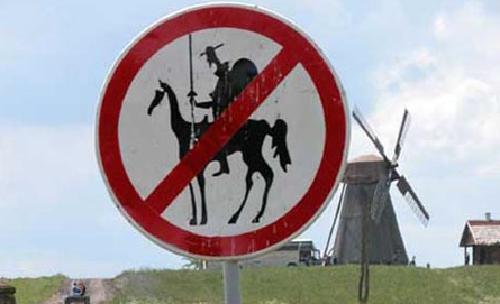
I did a quick Google image search for a typical Dutch windmill image, and decided that this one was too amusing to pass up:

December 3, 2010

Reactions to the Irish financial crisis

Filed under: Economics, Europe — Tags: , , , , , — Nicholas @ 09:09

Kevin O’Rourke sees it as almost a kind of bereavement:

It is one thing to know that someone you love is terminally ill; their death still comes as a shock.

I certainly don’t want to compare the arrival of the EU-IMF team in Dublin last week to a bereavement. But I was surprised at how upsetting I found it, given that it came as no surprise. It had been clear for a long time that the blanket guarantee given to the liabilities of Ireland’s rotten banks, in September 2008, had saddled the State with a debt that was too big for it to handle. Ten successive quarters of declining real GNP, and one attempt too many to draw a line under the losses of our banks, made our exclusion from international capital markets inevitable. But to know something is one thing; to see it actually happen is something entirely different.

I am not alone in feeling this way, it seems. The economics editor of the Irish Times, Dan O’Brien, wrote that

“nothing quite symbolised this State’s loss of sovereignty than the press conference at which the ECB man spoke along with two IMF men and a European Commission official. It was held in the Government press centre beneath the Taoiseach’s office. I am a xenophile and cosmopolitan by nature, but to see foreign technocrats take over the very heart of the apparatus of this State to tell the media how the State will be run into the foreseeable future caused a sickening feeling in the pit of my stomach.

This is not to say that we would be happy to have our country’s affairs managed by the current, disgraced, government. I yield to no-one in my loathing of the men and women who have done this to my country. What has been the intellectual low-point of the last couple of years? Was it the cash-for-clunkers stimulus package (Ireland does not produce any cars)? Or the statement by our Finance Minister that Ireland need not fear a bank run, since Ireland is an island? Or the biggest Irish joke of them all, which underpinned the bank guarantee in the first place: that if we wanted investors to retain confidence in the creditworthiness of the Irish State, we needed to make sure that nobody who invested in our (private sector) banks ever lost a penny?”

H/T to Tim Harford for the link.

« Newer PostsOlder Posts »

Powered by WordPress


