Military History Visualized
Published 15 Nov 2016A comprehensive view that compares submarine warfare in the First and Second World Wars. Due to the lack of a submarine warfare in the Pacific in World War 1, the Pacific isn’t covered at all, but there will be an episode on it in the future.
Military History Visualized provides a series of short narrative and visual presentations like documentaries based on academic literature or sometimes primary sources. Videos are intended as introduction to military history, but also contain a lot of details for history buffs. Since the aim is to keep the episodes short and comprehensive some details are often cut.
» HOW YOU CAN SUPPORT MILITARY HISTORY VISUALIZED «
(A) You can support my channel on Patreon: https://www.patreon.com/join/mhv(B) Alternatively, you can also buy “Spoils of War” (merchandise) in my online shop: https://www.redbubble.com/people/mhvi…
» SOURCES & LINKS «
Milner, Marc: “The Atlantic War, 1939-1945”; in: Cambridge History of the Second World War, Volume 1
Blair, Clay: Hitler’s U-Boat War – The Hunters 1939-1942
Owen, David: Anti-Submarine Warfare – An Illustrated History
Germany & The Second World War – Volume VI
Germany & The Second World War – Volume II
Breemer, Jan S.: “Defeating the U-boat. Inventing Antisubmarine Warfare”. Naval War College Newport Papers 36
https://www.usnwc.edu/getattachment/e…Das Deutsche Reich und der Zweite Weltkrieg – Band VI.
Das Deutsche Reich und der Zweite Weltkrieg – Band II.
Rahn, Werner: “Die Deutsche Seekriegsfürung 1943 bis 1945”; in: Das Deutsche Reich & der Zweite Weltkrieg, Band X/1, S. 3-276
Erster Weltkrieg – Zweiter Weltkrieg: Ein Vergleich.
U-boat losses by cause
https://web.archive.org/web/201006112…Differences German U-Boat Design WW1 vs. WW2
https://www.reddit.com/r/AskHistorian…» CREDITS & SPECIAL THX «
Song: Ethan Meixsell – “Demilitarized Zone”
February 5, 2020
Submarine Warfare WW1 vs WW2 – Differences & Commonalities
July 8, 2019
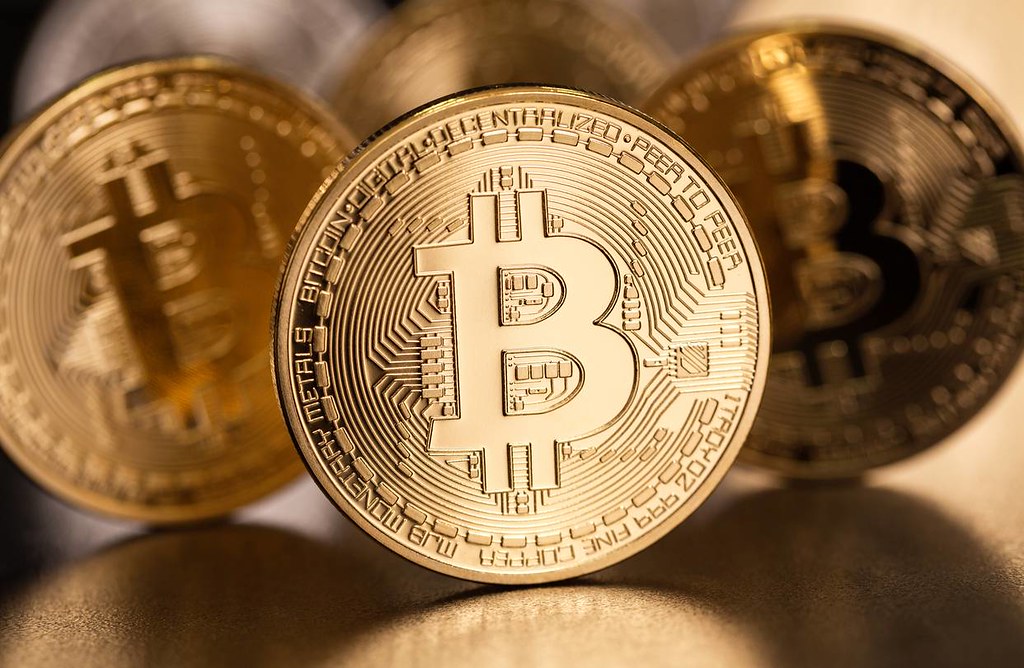
Bitcoin and its successors lack one thing that Libra has
Andrew Coyne on cryptocurrencies:

“Bitcoin – from WSJ”by MarkGregory007 is licensed under CC BY-NC-SA 2.0
Sign of the times: the convenience store in my block of mid-town Toronto has installed, in addition to the usual fare of milk, cigarettes and magazines, an ATM dispensing bitcoins. Customers insert their debit cards and buy bitcoin, which they can then use to … to …
To do what, exactly, that they could not do with regular money? Bitcoin, the original cryptocurrency — there are now dozens of competitors — has always struck me as a solution in search of a problem. Its chief selling point, the anonymity made possible by its system of ultra-encrypted peer-to-peer transactions, unmediated by the banking system and beyond reach of the regulators, would seem of most appeal to two groups: crooks and cranks.
Oh, and a third: speculators. The price of cryptocurrencies has tended to fluctuate wildly — having fallen to a third of its peak against the U.S. dollar last year, Bitcoin has tripled in value so far in 2019. Cryptocurrencies are unlikely to achieve widespread use as mediums of exchange so long as they fail to fulfil one of money’s other primary functions, as stores of value.
The Wild West reputation the privately issued currencies have acquired — one of the most popular, Dogecoin, was invented by a 26-year-old Australian in 2013 as a joke — will be one of the early hurdles confronting Facebook’s recent entry into the field. The company hopes its 2.4 billion users will soon be buying goods and services from each other with Libra, as the proposed digital currency is called, wherever on earth either party may happen to be.
And yet Libra differs from Bitcoin and its ilk in several important ways. One, while it makes use of the same blockchain encryption technology as Bitcoin to ensure the security of payments, it is not based on the same anarchic premise.
In contrast to Bitcoin’s unsupervised, massively distributed, “permissionless” network, Libra will operate, at least initially, via Facebook’s Messenger and WhatsApp platforms, which are very much subject to its control. The company, and the others it has recruited as partners — names like Visa, Mastercard, and PayPal — are likewise highly visible targets of regulatory oversight, and indeed have signalled they intend to work with national banking regulators.
June 30, 2019
Hitler ❤️ Paris – WW2 – 044 – June 29 1940
World War Two
Published on 29 Jun 2019Hitler goes to Paris, while Stalin occupies more territory… but something is on Stalin’s mind. News of the sudden success of the Wehrmacht in the West is not what he had hoped for. Churchill also looks to the West for help while a German invasion of the British Isles seems imminent. Far East the Japanese are on the advance.
Join us on Patreon: https://www.patreon.com/TimeGhostHistory
Or join The TimeGhost Army directly at: https://timeghost.tvFollow WW2 day by day on Instagram @World_war_two_realtime https://www.instagram.com/world_war_t…
Join our Discord Server: https://discord.gg/D6D2aYN.
Between 2 Wars: https://www.youtube.com/playlist?list…
Source list: http://bit.ly/WW2sourcesWritten and Hosted by: Indy Neidell
Produced and Directed by: Spartacus Olsson and Astrid Deinhard
Executive Producers: Bodo Rittenauer, Astrid Deinhard, Indy Neidell, Spartacus Olsson
Creative Producer: Joram Appel
Post Production Director: Wieke Kapteijns
Research by: Indy Neidell
Edited by: Iryna Dulka
Map animations: EastoryColorisations by Norman Stewart and Julius Jääskeläinen https://www.facebook.com/JJcolorization/
Eastory’s channel: https://www.youtube.com/channel/UCEly…
Archive by Screenocean/Reuters https://www.screenocean.com.A TimeGhost chronological documentary produced by OnLion Entertainment GmbH.
From the comments:
World War Two
2 days ago
We have been experimenting with some “catchier” titles in the last couple of weeks. At the moment, YouTube mainly looks at two things when deciding how often to recommend our videos. The first is average watch time. We’re doing great there. The second is called “click through rate”, which means the percentage of recommended videos getting clicked. That puts a huge emphasis on titles and thumbnails. So, we’ve been doing this and it has been quite successful in terms of viewer and subscriber growth. This has caused a great rise of comments as well, and as we still want to read everything and answer most of you, we have asked some community members to help us out. We are using software allowing to review, assign and share comments. This does mean that not all comments are made by someone you know (although Spartacus and Joram are still commenting a lot). We might later decide to have everyone commenting use their own name or a pseudonym, so you know who did the commenting. Just wanted to share that.Cheers,
Joram
April 21, 2019
The Scramble For Norway – WW2 – 034 – April 20 1940
World War Two
Published on 20 Apr 2019The German Invasion of Norway is still very much in full swing. The German Wehrmacht is moving north from Oslo, where a Norwegian force is trying to halt them in anticipation of Allied reinforcements. The British do land in Norway, but don’t necessarily rush to relief the Norwegian army. Meanwhile, Norwegian “traitor” and “failure” Vidkun Quisling rises to be the new leader of Norway – only to get rejected by Hitler again. Numerous powers are now trying to grab, restore or consolidate military or political power in Norway. It’s a mess.
Join us on Patreon: https://www.patreon.com/TimeGhostHistory
Or join The TimeGhost Army directly at: https://timeghost.tvFollow WW2 day by day on Instagram @World_war_two_realtime https://www.instagram.com/world_war_t…
Join our Discord Server: https://discord.gg/D6D2aYN.
Between 2 Wars: https://www.youtube.com/playlist?list…
Source list: http://bit.ly/WW2sourcesWritten and Hosted by: Indy Neidell
Produced and Directed by: Spartacus Olsson and Astrid Deinhard
Executive Producers: Bodo Rittenauer, Astrid Deinhard, Indy Neidell, Spartacus Olsson
Creative Producer: Joram Appel
Research by: Indy Neidell
Edited by: Iryna Dulka
Map animations: EastoryColorisations by Norman Stewart and JuliusJaa (https://www.flickr.com/photos/juliusjaa/)
Eastory’s channel: https://www.youtube.com/channel/UCEly…
Archive by Screenocean/Reuters https://www.screenocean.comSources:
© IWM (N 159)
© IWM (HU 104676)
© IWM (HU 104684)A TimeGhost chronological documentary produced by OnLion Entertainment GmbH.
January 27, 2019
The Enigma of Germany’s Wartime Economy – WW2 – 022 – January 26 1940
World War Two
Published on 26 Jan 2019This week shows the Allies first attempts to break the German Enigma code. Meanwhile, the German war economy shows some flaws and the Soviets are massing artillery in an effort to break the Finnish defences.
As the Winter War rolls on the only help the Finns are getting are from volunteers. The Western Allies still have their thoughts on Norway, little do they know that the Phoney War almost ends this week…
Follow WW2 day by day on Instagram @World_war_two_realtime https://www.instagram.com/world_war_t…
Join us on Patreon: https://www.patreon.com/TimeGhostHistory
Or join The TimeGhost Army directly at: https://timeghost.tvBetween 2 Wars: https://www.youtube.com/playlist?list…
Written and Hosted by: Indy Neidell
Produced and Directed by: Spartacus Olsson and Astrid Deinhard
Executive Producers: Bodo Rittenauer, Astrid Deinhard, Indy Neidell, Spartacus Olsson
Creative Producer: Joram Appel
Research by: Indy Neidell
Edited by: Iryna Dulka
Map animations: EastoryColorizations by Norman Stewart.
Photos of the Winter War are mostly from the Finnish Wartime Photograph Archive (SA-Kuva).
Eastory’s channel: https://www.youtube.com/channel/UCEly…
Archive by Screenocean/Reuters https://www.screenocean.comA TimeGhost chronological documentary produced by OnLion Entertainment GmbH.
December 7, 2018
July 22, 2018
Austro-Hungarian Artillery – Choctaw Code Talkers I OUT OF THE TRENCHES
The Great War
Published on 21 Jul 2018
July 20, 2018
Fiat currency and the impact of cryptocurrencies
At Catallaxy Files, Sinclair Davidson explains some of the advantages and disadvantages of both fiat (government-issued) and private currency:
As George Selgin, Larry White and others have shown, many historical societies had systems of private money — free banking — where the institution of money was provided by the market.
But for the most part, private monies have been displaced by fiat currencies, and live on as a historical curiosity.
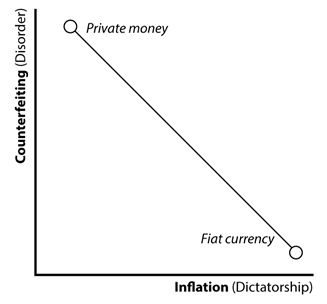
We can explain this with an ‘institutional possibility frontier’; a framework developed first by Harvard economist Andrei Shleifer and his various co-authors. Shleifer and colleagues array social institutions according to how they trade-off the risks of disorder (that is, private fraud and theft) against the risk of dictatorship (that is, government expropriation, oppression, etc.) along the frontier.
As the graph shows, for money these risks are counterfeiting (disorder) and unexpected inflation (dictatorship). The free banking era taught us that private currencies are vulnerable to counterfeiting, but due to competitive market pressure, minimise the risk of inflation.
By contrast, fiat currencies are less susceptible to counterfeiting. Governments are a trusted third party that aggressively prosecutes currency fraud. The tradeoff though is that governments get the power of inflating the currency.
The fact that fiat currencies seem to be widely preferred in the world isn’t only because of fiat currency laws. It’s that citizens seem to be relatively happy with this tradeoff. They would prefer to take the risk of inflation over the risk of counterfeiting.
One reason why this might be the case is because they can both diversify and hedge against the likelihood of inflation by holding assets such as gold, or foreign currency.
The dictatorship costs of fiat currency are apparently not as high as ‘hard money’ theorists imagine.
Introducing cryptocurrencies
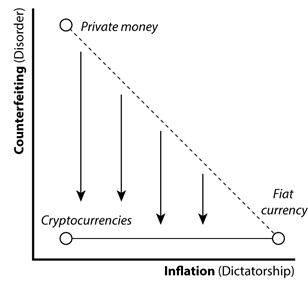
Cryptocurrencies significantly change this dynamic.
Cryptocurrencies are a form of private money that substantially, if not entirely, eliminate the risk of counterfeiting. Blockchains underpin cryptocurrency tokens as a secure, decentralised digital asset.
They’re not just an asset to diversify away from inflationary fiat currency, or a hedge to protect against unwanted dictatorship. Cryptocurrencies are a (near — and increasing) substitute for fiat currency.
This means that the disorder costs of private money drop dramatically.
In fact, the counterfeiting risk for mature cryptocurrencies like Bitcoin is currently less than fiat currency. Fiat currency can still be counterfeited. A stable and secure blockchain eliminates the risk of counterfeiting entirely.
July 12, 2018
Great Blunders of WWII: Japan’s Mistakes at Midway
Anthony Coleman
Published on 3 Nov 2016From the History Channel DVD series “Great Blunders of WWII”
October 14, 2017
BAHFest East 2017 – Jerry Wang: BLANKIE: Baby LAb for iNfant-Kindled innovatIon and Exploration
BAHFest
Published on Sep 24, 2017Watch Jerry propose an ambitious research program to “make big science with tiny people.” By leveraging the unique morphological and neurological capabilities of babies, he aims to advance the frontiers of science and engineering with giant baby steps.
BAHFest is the Festival of Bad Ad Hoc Hypotheses, a celebration of well-researched, logically explained, and clearly wrong evolutionary theory. Additional information is available at http://bahfest.com/
August 12, 2017
Why The Government Shouldn’t Break WhatsApp
Published on 3 Jul 2017
Encryption backdoors – breaking WhatsApp and iMessage’s security to let the government stop Bad Things – sounds like a reasonable idea. Here’s why it isn’t.
A transcript of this video’s available here: https://www.facebook.com/notes/tom-scott/why-the-government-shouldnt-break-whatsapp/1378434365572557/
July 1, 2017
Hunting the Bismarck – III: A Chance to Strike – Extra History
Published on May 25, 2017
Sponsored by Wargaming! New players: Download World of Warships and use the code EXTRA1 for free goodies! http://cpm.wargaming.net/i3v7c6uu/?pu…
The order went out: Sink the Bismarck. Ships converged from all over the Atlantic to hunt down the pride of the German navy, and Swordfish planes launched from the aircraft carrier Ark Royal raced to harry the great warship.
June 7, 2017
“Hey, Joey, ‘splain me public key cryptography!”
Joey deVilla explains public key cryptography for non-geeks:

Have you ever tried to explain public-key cryptography (a.k.a. asymmetric cryptography) or the concept of public and private keys and what they’re for to non-techies? It’s tough, and I’ve spent the last little while trying to come up with an analogy that’s layperson-friendly and memorable.
It turns out that it already exists, and Panayotis Vryonis […], came up with it. Go over to his blog and check out the article titled Public-key cryptography for non-geeks. Whenever I have to explain what private keys and public keys are for to someone who’s new to cryptography, I use Vryonis’ “box with special lock and special keys” analogy. Not only does the explanation work, but it’s so good that the people I’ve used it on have used it themselves to explain public-key crypto to others.
I’ve recently used Vryonis’ analogy in a couple of presentations and thought I’d share images from my slides. Enjoy!
May 16, 2017
The Virtual Lorenz machine
At The Register, Gareth Corfield discusses the new virtual coding device simulating the WW2 German Lorenz cipher machine:

The National Museum of Computing has put an emulation of an “unbreakable” Second World War German cipher machine online for world+dog to admire.
The Virtual Lorenz machine has been launched in honour of WW2 codebreaker Bill Tutte, the man who broke the crypto used in the twelve-rotor cipher machine.
As The National Museum of Computing (TNMOC) puts it, Tutte’s work “shortened the conflict” – even though he had never even seen the cipher machine or its crypto scheme, the breaking of which the museum added was “the greatest intellectual feat of the war”.
TNMOC unveiled the Virtual Lorenz today to celebrate Tutte’s 100th birthday. Built by computing chap Martin Gillow, the simulation accurately reproduces the whirring of the cipher wheels (you might want to turn it down as the “background whirr” is a little too realistic).
The BBC profiled the “gifted mathematician” a few years ago, highlighting how the Lorenz machine whose secrets Tutte cracked was “several degrees more advanced than Enigma”, the cipher famously cracked by Tutte’s colleague Alan Turing. Tutte cracked the Lorenz in about six months, reverse-engineering its workings by reading intercepted Lorenz messages. When the Allies wanted to fool Hitler into believing the D-Day landings would take place in a false location, our ability to read Lorenz was critical for confirming that the ruse had worked – saving thousands of soldiers, sailors and airmen’s lives.
[…]
The Virtual Lorenz can be found here. Word to the wise – it’s not on an HTTPS site, so if you’re hoping to use it to thwart GCHQ, you might want to think again.
January 16, 2017
100 years ago today

From the Facebook page of The Great War:
On this day 100 years ago, a coded telegram was sent by German foreign secretary Arthur Zimmermann to German Ambassador to Mexico, Heinrich von Eckardt. In this telegram, Zimmermann instructed von Eckardt to offer Mexico a military alliance and financial support against the United States should they not remain neutral. This was a possibility since Germany was about to unleash unrestricted submarine warfare by February 1, 1917.
To understand this telegram, it is important to understand that talks about military cooperation and even a military alliance between Mexico and the German Empire had been going on since 1915 already.
The telegram was sent via the American undersea cable since the German cable was interrupted by the British when the war broke out. US President Woodrow Wilson had offered the Germans to use their cable for diplomatic correspondence. What neither Wilson nor the Germans knew: The cable was monitored by the British intelligence at a relay station in England. Furthermore, the British codebreakers of Room 40 had already cracked the German encryption.
The biggest challenge for the British now was to reveal the content of this telegram without admitting that they were monitoring the cable while ensuring it had the desired impact.