Quotulatiousness

January 23, 2020

The EU apparently fears a “Singapore on the Thames”

Filed under: Britain, Bureaucracy, Business, Economics, Europe — Tags: , , , , , — Nicholas @ 03:00

In the Continental Telegraph, Tim Worstall explains why the EU negotiators are reportedly offering a much worse trade deal to the United Kingdom than they’ve already agreed with Canada, Japan, and other trading partners:

Take, for example, this idea of Singapore on Thames. It’s trivially easy to rally the peeps against one or other relaxation of regulation. Chlorine washed chicken for example. But what about lifting the entire burden? Singapore is, after all, about 50% richer than Britain on a per capita basis. The correct question therefore is would you like a 50% pay raise at the price of shooting all the bureaucrats? Given the manner in which the bureaucrats don’t want the question even asked we have a reasonable enough guide that the answer would be yes.

Which is why the terms on offer to a Britain which could do the SonT thing are so terrible. Because of SonT succeeded it would be a death blow to the entire idea of how Europe is regulated. Lille, Leipzig and Livorno will all put up with interfering bureaucracy because that’s just the way the world is. But if Les Rosbifs become richer by half again simply by that bonfire of the regulations then the auto da fes will light up all over Europe.

So, yes, of course the EU is offering shit trade terms. They can’t allow an independent and free Britain to succeed. That we will anyway is what will bring that freedom and liberty to the continent – once again. For as so often it will be us that saves Europe from itself.

January 9, 2020

The “Ostrich” school of Canadian foreign policy

Filed under: Cancon, Government, Politics — Tags: , , , , — Nicholas @ 03:00

Ted Campbell on what former Canadian diplomat David Mulroney calls the “Ostrich” school:

John Ibitson, writing in the Globe and Mail, suggests that Justin Trudeau might want to try what former diplomat, national strategic planner in the Privy Council Office, and commentator David Mulroney refers to (on social media) as …

… “the ‘Ostrich’ school of Canadian foreign policy.” It has, he says, two pillars:

    First, “Canada has no interests/allies“; and

    Second, “The best way to deal with bad regimes, bad people is to pretend they’re nice.”

Mr Ibbitson himself says that it may be impossible to work “with European and Asian allies, including Japan, to forge a coherent response that provokes neither the Americans nor the Iranians.”

The situation in the Middle East is, as I have explained several times, hideously complex. President Trump may have made it worse … although it’s hard for me to see how any added complications really matter all that much. The socio-cultural and religious hatreds that bedevil the region are likely beyond making “worse.”

In fact, there may be an argument that a nice, all-out, albeit contained, Middle East war might be useful. Perhaps the Iranians and Saudis and Iraqis and Syrians and Yemenis and so on need to sort one another out in the way that tends to produce lasting results: on a bloody battlefield … it worked for Europe, more than once, in 1648, in 1815 and again in 1945.

John Ibbitson says that “Iran’s rage over the U.S. assassination of Qassem Soleimani risks dragging Canada and the rest of the Western alliance into a new confrontation in the Middle East, courtesy of Donald Trump … [that true, as far as it goes, and he adds] … Most Canadians would want no part of such a conflict, especially since the U.S. President might simply be seeking to distract attention from his impending impeachment trial in the Senate … [and that, the first part about Canadians wanting no part of any conflict, is also true, but President Trump’s motives are irrelvant]. The fact is that he has ignored many Iranian provocations while he attempts, vainly, in my opinion, to disengage America from the wider world. The attack on a US embassy seems to have crossed a “red line.”

[…]

But, John Ibbitson says, “Mr. Trump’s high stakes gamble – that killing one of the most senior figures in the Iranian regime will deter rather than provoke further acts of aggression from Iran – could lead to some kind of asymmetrical war, with the U.S. military attacking Iranian targets, and Iran responding through militias and proxies in Iraq and possibly in North America and Europe … [true enough, and he asks] … What would Mr. Trump expect from Canada in such a conflict?” That’s the key question.

My guesstimate is that President Trump will ask little or nothing, militarily, because his military chiefs of staff will not even have mentioned Canada when they proffer lists of nations that might help or hinder US efforts. Canada is not on any of their lists of countries that matter. Diplomatically, however, I think we do matter to the USA and I would not be surprised if the phone lines have been busy all weekend as US officials tell (rather than ask) Canadian officials to get our government “onside” with the USA. The Americans hold ALL the high cards in the game of power.

I’m sure that Prime Minister Trudeau will follow John Ibbitson’s advice and adopt the “Ostrich” strategy … head buried in the sand, pretending that Canada has neither interests nor allies and pretending that evil people are good.

Perhaps co-incidentally with the “revenge” Iranian missile attacks on Iraqi airbases known to have US troops in the area, a Ukraine International Airlines Boeing 737-800 passenger jet crashed shortly after take-off from Tehran airport. Officially, the Iranian authorities are saying it was due to catastrophic mechanical breakdown, but they have refused to hand over the aircraft’s “black box” flight recorders for analysis. All of the 176 passengers and crew died in the crash, including 63 Canadians. It has been suggested by many that the timing was not a co-incidence and that the plane was likely hit by an Iranian surface-to-air missile due to the heightened state of tension in Iranian airspace during and after the missile launches against Iraq. Colby Cosh has more:

Some of the wreckage of Ukraine International flight 752 near Tehran, Iran.
Photo from MOJ Newsagency via Wikimedia Commons.

I am writing these words at a strange moment Wednesday morning. The president of the United States has just been on television, reassuring the American public that the crisis inspired by the assassination of Iranian general Qassem Soleimani has reached a satisfactory equilibrium. Iran made a demonstrative show of force against U.S. installations in the Middle East that killed nobody. Honour has been satisfied. Relief, among American observers, is general.

Meanwhile, Canada is mourning the deaths of dozens of its citizens in a passenger jet crash on Iranian soil. Perhaps it is a terrible coincidence. Stranger things have happened. But if you are old enough to remember the shooting down of Iran Air Flight 655 by the U.S. Navy missile cruiser USS Vincennes in 1988, you are old enough to doubt it.

The Vincennes incident is part of the historical litany that has made news consumers innately distrustful of the first draft of history. The ship was in the Persian Gulf, which at the time was swarming with Iranian gunboats trying to squeeze off the supply of arms to its enemy Iraq. The U.S. Navy had rushed to the area to keep one of the world’s economic arteries open to neutrals. But this had foreseeable consequences — plenty of confusing penny-ante firefights, and some notable accidents, including a puzzling Iraqi attack with air-launched Exocet missiles on an American frigate, USS Stark.

January 8, 2020

Trump versus Iran (and significant parts of the US and western media)

Filed under: Middle East, Military, USA — Tags: , , , , — Nicholas @ 03:00

Kurt Schlicter‘s take on the way President Trump has been breaking recent US habits in their dealings with Iran:

A burning vehicle at Baghdad International Airport following an American airstrike, early Friday, Jan. 3, 2020. The Pentagon said Thursday that the U.S. military has killed Gen. Qassem Soleimani, the head of Iran’s elite Quds Force, at the direction of President Donald Trump.
Photo from the Iraqi Prime Minister’s Press Office via Wikimedia Commons.

The Iranians had been getting uppity for a while, but then their punks killed an American contractor in a rocket attack on a U.S. base – and let’s not get distracted about whether we should still be there. They killed an American. We are there, and you don’t get a pass on murdering U.S. citizens because we may or may not have a good reason for them still being there. You get dead.

See, for too long we were asking the wrong question when tinpot dictators dared hurt Americans. We asked, “What would a gender-fluid Oppression Studies major at Yale do?” As I have observed before, the correct question is “WWJC do?” – “What would Julius Caesar do?

Trump ordered hard hits at five Shiite militia weapon sites, and not with any warnings either. They got one of ours, we got about two dozen of theirs. Like the old joke about 1,000 lawyers at the bottom of the sea, that’s a good start.

The Iranians, whose Islamic Revolutionary Guard Corps is the ultimate source of most of the Shiite terror in the world, decided to respond in what they thought was a clever way: send a few thousand of their camo-clad dummies to attack the embassy and hope and pray a bunch of them got mowed down on camera. In the meantime, wave a lot of banners, burn some stuff, and pound on the reinforced glass for the press’s benefit.

But apparently, no one told the “mourners,” as the austere scholars at the endlessly useless New York Times dubbed the members of Islamic Antifa, that they were supposed to get smoked. They went home with the embassy unseized. Getting martyred en masse is not that much fun when you’re just one sucker out of dozens – heck, they may run of virgins.

See, Trump made it clear he was not playing. There would be no Benghazi II: Bagdad Boogaloo on his watch, and he acted well before 13 hours ran on the clock. Rejecting the elite’s preferred model of craven submission to every Third World cretin with a grievance and a camera, the Trump administration flew some Apache gunships over the crowd of unwashed morons, kicking off some flares, and generally sending the unequivocal message that if those SOBs had a problem, the AH-64s had a 30mm solution.

And then the administration sent in 100 Marines, about a company, on Ospreys as a quick reaction force and alerted the ready brigade at Ft. Bragg to start shutting 82nd Airborne Division paratroopers into theater.

Whatever the opposite of “stand down” is, Trump ordered that.

December 21, 2019

The Treaty of Versailles And The Economic Consequences Of The Peace I THE GREAT WAR 1919

Filed under: Books, Economics, Germany, History, USA, WW1 — Tags: , , , , , , — Nicholas @ 06:00

The Great War
Published 19 Dec 2019

Help The Great War and keep it free for everyone: https://patreon.com/thegreatwar

John Maynard Keynes was an economist and part of the Paris Peace Conference in 1919. He had high hopes for a new post-war order but when he realized what Georges Clemenceau, David Lloyd-George and Woodrow Wilson were planning, he resigned from the conference. And then wrote a book about it: The Economic Consequences of the Peace became a bestseller and is one of the best known critiques of the Versailles Treaty.

» SUPPORT THE CHANNEL
Patreon: https://www.patreon.com/thegreatwar
Merchandise: https://shop.spreadshirt.de/thegreatwar/

» SOURCES
Demps, Lorenz and Materna, Ingo (eds.). Geschichte Berlins von den Anfängen bis 1945. Berlin, 1987.
Eichengreen, Barry. Golden Fetters. The Gold Standard and the Great Depression 1919-1939. New York 1995.
Horn. Britain, France and the Financing of the First World War, 2002.
Hudson, Michael. Trade, Development, and Foreign Debt: Volume 2. Pluto Press, London, 1992.
Hudson, Michael. Superimperialism: The Origins and Fundamentals of U.S. World Dominance. Pluto Press, London 2003.
Keynes, John Maynard. The Economic Consequences of the Peace. Harcourt, Brace and Howe, New York, 1919.
Kinzer, Stephen. The True Flag: Theodore Roosevelt, Mark Twain, and the Birth of American Empire. St. Martin’s Griffin, 2018
Shirer, The Rise and Fall of the Third Reich. 1960.
Skidelsky, Robert. John Maynard Keynes, 1883-1946: Economist, Philosopher, Statesman. Penguin Books, New York, New York, 2003.
Skidelsky, Robert. John Maynard Keynes Volume I — Hopes Betrayed. Penguin Books, New York, 1983.

»CREDITS
Presented by: Jesse Alexander
Written by: Mark Newton
Director: Toni Steller & Florian Wittig
Director of Photography: Toni Steller
Sound: Toni Steller
Editing: Toni Steller
Mixing, Mastering & Sound Design: http://above-zero.com
Maps: Daniel Kogosov (https://www.patreon.com/Zalezsky)
Research by: Jesse Alexander
Fact checking: Florian Wittig

Channel Design: Alexander Clark
Original Logo: David van Stephold

A Mediakraft Networks Original Channel

Contains licensed material by getty images
All rights reserved – Real Time History GmbH 2019

December 11, 2019

Franco-Prussian War | Animated History

Filed under: France, Germany, History, Military — Tags: , , , , , , — Nicholas @ 02:00

The Armchair Historian
Published 4 Feb 2018

What was the Franco Prussian War?

Our Website: https://www.thearmchairhistorian.com/

Our Twitter:
@ArmchairHist

Our Discord:
https://discord.gg/Ppb2cUd

Sources:
https://www.britannica.com/event/Fran…
http://francoprussianwar.com/
http://history-world.org/franco_pruss…
http://www.newworldencyclopedia.org/e…
https://www.warhistoryonline.com/hist…
http://geacron.com/home-en/?v=m&lang=…

Music: Music: Antonio Salieri: “Twenty six variations on La Folia de Spagna

December 6, 2019

The End of Polish Democracy – Pilsudski and the Sanacja Regime | BETWEEN 2 WARS | 1935 Part 2 of 4

Filed under: Europe, Germany, History — Tags: , , , , , — Nicholas @ 06:00

TimeGhost History
Published 5 Dec 2019

The Second Polish Republic emerged victorious from the Polish-Soviet War in 1921. But the shine of independence is quickly rubbing off as the new state finds itself burdened with sever economic, political, and social problems. There is one man who sees it as his destiny to save his ailing nation. That man is Józef Piłsudski. But will his undemocratic Sanacja regime be able to solve Poland’s problems?

Join us on Patreon: https://www.patreon.com/TimeGhostHistory

Hosted by: Indy Neidell
Written by: Francis van Berkel
Directed by: Spartacus Olsson and Astrid Deinhard
Executive Producers: Bodo Rittenauer, Astrid Deinhard, Indy Neidell, Spartacus Olsson
Creative Producer: Joram Appel
Post-Production Director: Wieke Kapteijns
Research by: Francis van Berkel
Edited by: Daniel Weiss
Sound design: Marek Kaminski

Colorization:
– Julius Jääskeläinen – https://www.facebook.com/JJcolorization/

Sources:

A TimeGhost chronological documentary produced by OnLion Entertainment GmbH.

From the comments:

TimeGhost History
2 hours ago (edited)
YouTube has age-restricted our Blitz Spirit WW2 video and has REMOVED our Between Two Wars episode on the Holodomor (1932-02). We received a warning, which means that next time this happens we will be banned from publishing content for one week. They state that our “content was removed due to a violation of our Community Guidelines,” on account of publishing “violent of graphic content”, explaining that “Violent or gory content intended to shock or disgust viewers, or content encouraging others to commit violent acts, is not allowed on YouTube.”

Needless to say, we are shocked and disgusted by this action and legitimisation and are currently exploring our options. Meanwhile, this shows how much our independence depends on our Patreon supporters. Without them, we would have been long gone. So please consider supporting our effort and help us spread vital knowledge about our world’s history, albeit hard to swallow or confronting. Don’t let YouTube decide what will be a part of our public memory! You can support us on https://patreon.com/timeghosthistory or https://timeghost.tv.
Cheers,
Joram

December 3, 2019

Canada and China

Filed under: Cancon, China, Economics, Politics — Tags: , , , , — Nicholas @ 05:00

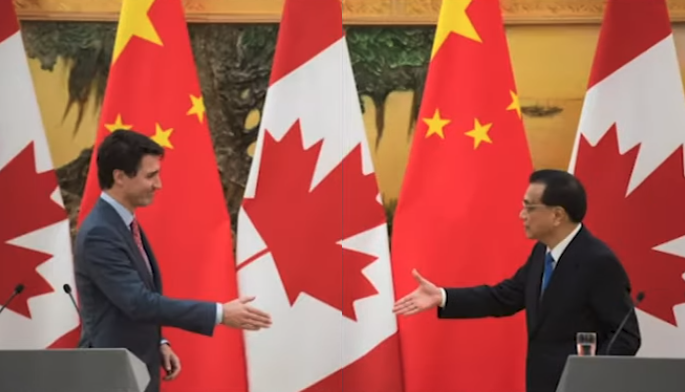
Ted Campbell discusses Canadian foreign policies — or perhaps more accurately Canada’s lack of policies — on China:

“The Chinese People’s Liberation Army is the great school of Mao Zedong Thought”, 1969.
A poster from the Cultural Revolution, featuring an image of Chairman Mao, published by the government of the People’s Republic of China.
Image via Wikimedia Commons.

There were many things that history might find regrettable about the Mulroney years but I doubt that it will fault him for having a principled and coherent foreign policy.

That all changed with Jean Chrétien, who was almost a neo-mercantilist, and for whom principle could never stand in the way of profit.

In the modern (Chrétien-Martin-Harper-Trudeau) era, Conservatives have been, broadly, anti-China, sometimes for reasons that are less than coherent or principled, and Liberals have been too prepared to “go along to get along” with China. This is because both parties reflect the incoherent views of the whole country. But political leaders shouldn’t (mustn’t) just reflect the views of their voters ~ that sort of populism is nonsensical ~ they must, as Edmund Burke said, bring his or her “unbiased opinion … mature judgment … [and] … enlightened conscience” to bear on each issue. But I’m afraid that too many (most?) modern Canadian political tacticians hold all those things in scant regard.

In the 2020s Canadians must listen to a few clear voices who will tell them that China is a competitor in many “markets” including in the marketplace of ideas, ideals, institutions and values. The current Chinese leadership is overtly hostile to Weterm liberal-democratic values and is not unwilling to punish any country with which it disagrees. It is protectionist, relatively rich and growing in military, political and economic power, but, still, somewhat cautious, and Xi Jinping’s China seems to be able to separate its own short-term political interests from its firm, long term, strategic goals. China, as Kevin Rudd reminded us just a few days agois contemptuous of weakness and prevarication,” which explains why it is so obviously contemptuous of Justin Trudeau’s Canadian government.

It is a fact that the Sino-Canadian relationship is “unbalanced:” China is a great power, Canada is not; China is an autocracy, Canada is a democracy; and so on but, as Kevin Rudd said (link just above) “China too has net strengths and weaknesses of which … [our] … strategists should be aware in framing our own strategy … [and we] … should be equally aware of our own strengths, weaknesses and vulnerabilities.” Canadian strategists need to educate Canadians about China so that a solid, informed majority will want a coherent and principled policy ~ one that puts our national vital interests first […]

Our policy towards China needs to be just one part of a coherent, principled foreign policy which Canadians understand and, broadly, support, and that, in turn, needs to be part of a Canadian grand strategy that aims to secure a place, as Paul Martin suggested, “of pride and influence in the world” ~ that, of course, was a place we enjoyed under St Laurent, Diefenbaker and Pearson, all of whom were acutely aware of the many and varied (and very divergent) views about Canada in the world that existed then and persist today in Canada’s many and varied communities.

December 2, 2019

China Rules the Seas – The Invention of the Junk l HISTORY OF CHINA

Filed under: China, History, Japan, Military, Technology — Tags: , , , , — Nicholas @ 02:00

IT’S HISTORY
Published 19 Aug 2015

Imperial China was a great seafaring nation. With the invention of the junks — massive, nearly unsinkable ships — it is safe to say that by the 14th century China had the best sea vessels in the world. The invention of the compass made navigation trustworthy as never before and Admiral Zheng He’s treasure fleet eagerly explored the Seven Seas. The first Chinese navy also depended on the mighty junk for their fighting tactics. But not all emperors were convinced of seafare and so the Chinese maritime power ended somewhat abruptly, giving the rest of the world time to catch up. Learn all about China on the water on IT’S HISTORY.

» The Complete PLAYLIST: http://bit.ly/HistoryOfChina

» SOURCES
Videos: British Pathé (https://www.youtube.com/user/britishp…)
Pictures: mainly Picture Alliance
Content:
“Hadingham, Evan (2001): Ancient Chinese Explorers: http://www.pbs.org/wgbh/nova/ancient/…
Needham, Joseph (1986): Science and Civilization in China, Volume 4, Physics and Physical Technology, Part 3, Civil Engineering and Nautics. Taipei”

» ABOUT US
IT’S HISTORY is a ride through history – Join us discovering the world’s most important eras in IN TIME, BIOGRAPHIES of the GREATEST MINDS and the most important INVENTIONS.

» CREDITS
Presented by: Guy Kiddey
Script by: Martin Haldenmair
Translated by: Guy Kiddey
Directed by: Daniel Czepelczauer
Director of Photography: Markus Kretzschmar
Music: Markus Kretzschmar
Sound Design: Bojan Novic
Editing: Markus Kretzschmar

A Mediakraft Networks original channel
Based on a concept by Florian Wittig and Daniel Czepelczauer
Executive Producers: Astrid Deinhard-Olsson, Spartacus Olsson
Head of Production: Michael Wendt
Producer: Daniel Czepelczauer
Social Media Manager: Laura Pagan and Florian Wittig

Contains material licensed from British Pathé
All rights reserved – © Mediakraft Networks GmbH, 2015

November 17, 2019

Britain shows Japan how to Attack Pearl Harbor – WW2 – 064 – November 16, 1940

Filed under: Britain, Europe, Greece, History, Italy, Japan, Military, Russia, WW2 — Tags: , , , , — Nicholas @ 04:00

World War Two
Published 16 Nov 2019

Japan has two wins this week, and one might turn out to be very consequential for the rest of the war. In the meantime, the British RAF fights the Luftwaffe and Italy struggles in their offensive against Greece.

Join us on Patreon: https://www.patreon.com/TimeGhostHistory
Or join The TimeGhost Army directly at: https://timeghost.tv

Follow WW2 day by day on Instagram @World_war_two_realtime https://www.instagram.com/world_war_t…
Join our Discord Server: https://discord.gg/D6D2aYN.
Between 2 Wars: https://www.youtube.com/playlist?list…
Source list: http://bit.ly/WW2sources

Written and Hosted by: Indy Neidell
Produced and Directed by: Spartacus Olsson and Astrid Deinhard
Executive Producers: Bodo Rittenauer, Astrid Deinhard, Indy Neidell, Spartacus Olsson
Creative Producer: Joram Appel
Post-Production Director: Wieke Kapteijns
Research by: Indy Neidell
Edited by: Iryna Dulka
Map animations: Eastory

Colorisations by: Julius Jääskeläinen, https://www.facebook.com/JJcolorization/

Eastory’s channel: https://www.youtube.com/channel/UCEly…
Archive by Screenocean/Reuters https://www.screenocean.com.

Sources:
– Narodowe Archiwum Cyfrowe
– IWM: CM 164, C 1244
– Destroyed house icon by Gan Khoon Lay, people icon by Gregor Cresnar from the Noun Project

A TimeGhost chronological documentary produced by OnLion Entertainment GmbH.

From the comments:

World War Two
2 days ago
Do you want more World War Two in realtime? We have a great Instagram page, where we make a daily post about what happened in the war on that day. This might be something completely different from what’s covered in these videos, or might add some more details. You can follow it by searching @world_war_two_realtime or by clicking here: https://www.instagram.com/world_war_two_realtime/. See you there!
Cheers, Joram

November 15, 2019

“In a functioning system, the head of the government sets foreign policy and the diplomats enact it. So naturally there’s not a chance of that in Washington”

Filed under: Bureaucracy, Government, Politics, Russia, USA — Tags: , , , — Nicholas @ 03:00

Mark Steyn on the foggiest of Foggy Bottom diplomatic bafflegab on the first day of the :

Yesterday I caught a bit of the impeachment theatre en route to a lunchtime speaking engagement. To be honest, if they’d come round and performed it live in my hotel room, I’d still have fled. If universally respected eminent lifelong career foreign-service bigshots Bill Taylor and George Kent are Adam Schiff’s star witnesses, their chief purpose seems to be to get Democrats pining for the charisma of Bill de Blasio and the self-effacement of John Kerry.

In a functioning system, the head of the government sets foreign policy and the diplomats enact it. So naturally there’s not a chance of that in Washington. When Taylor and Kent whine that there seemed to be a “shadow foreign policy”, the shadow is theirs; they spent a day testifying that everything had been going ticketty-boo for decades just as they’d always done things – and then Trump came along and took a different view. Oh, my! Anyone would think that, as Barack Obama once proposed, “elections have consequences”.

First up was George Kent, the “Deputy Assistant Secretary of State for Eastern Europe and the Caucasus”. He warmed up the crowd with some extensive biographical material about the “nearly sixty years” of George Kents (I believe he’s George III or some such) who have “chosen” to endow America with the blessings of their “public service”. It didn’t help that he wore a bow tie. Eventually he stopped talking about himself and started talking about Ukraine:

    Our strategic aim for the entirety of my foreign service career is not possible without a Ukraine whole, free, and at peace, including Crimea and Donbas, territories currently occupied by Russia.

Crimea is, of course, familiar to anyone who’s read “The Charge of the Light Brigade”:

    Theirs not to reason why
    Theirs but to do or die…

Or, in the case of low-level diplomats who’ve never had a single conversation with the President, theirs not to reason why, theirs but to do or tender their resignations after first ensuring that their pensions won’t be affected. Instead:

    Into the valley of the SCIF
    Rode the six hundred hearsay witnesses…

As I said, any Tom, Dick or Harry can bandy Crimea, but it takes a career striped-pants Foggy Bottom public servant to toss in “Donbas” with gay abandon. It would have been interesting to see whether Adam Schiff or anyone else in the room could have found Donbas on a map. The odds of pinning the tail on the Donbas blindfolded are better. It’s bordered to the north, east and south-east by Russia, so it’s akin to the Russian foreign ministry regarding northern Mexico as a vital national-security interest of Moscow’s.

In fact, northern Mexico is a vital national-security interest of America’s, but, under the mass wankerization of public policy, Perma-Beltway cares more about the borders of Ukraine than it does about the borders of the United States.

October 25, 2019

The World Takes Advantage of American Isolationism | BETWEEN TWO WARS | 1933 part 3 of 3

Filed under: History, Japan, Military, Pacific, USA — Tags: , , , , , , — Nicholas @ 04:00

TimeGhost History
Published 24 Oct 2019

America is very unprepared for rising tensions in the Pacific and in Europe. US President Franklin Roosevelt tries his best to re-arm the American Army and Navy, but the isolationist opposition is a fierce obstacle.

Join us on Patreon: https://www.patreon.com/TimeGhostHistory

Subscribe to our World War Two series: https://www.youtube.com/c/worldwartwo…

Hosted by: Indy Neidell
Written by: Joram Appel
Directed by: Spartacus Olsson and Astrid Deinhard
Executive Producers: Bodo Rittenauer, Astrid Deinhard, Indy Neidell, Spartacus Olsson
Creative Producer: Joram Appel
Post-Production Director: Wieke Kapteijns
Research by: Rune Vaever Hartvig, Sietse Kenter and Joram Appel
Edited by: Daniel Weiss
Sound design: Marek Kaminski

Picture colorizations by: Norman Stewart, Julius Jääskeläinen, Daniel Weiss and Joram Appel

A TimeGhost chronological documentary produced by OnLion Entertainment GmbH.

From the comments:

TimeGhost History
1 day ago (edited)
This episode is very much about the global ramifications of the US’s foreign policy. American inaction and isolationism left room for other nations to develop imperialist ambitions. There are of course a lot of other factors that influenced the rise of expansionist and militarist governments in Europe and East-Asia, many of which are explained in our other Between Two Wars episodes. In no way does this video have any connection to current-day events or our opinion on them. This is what happened, our future episodes will be about what followed. We’re historians and that’s all we want to do here.
Cheers,
Joram

October 9, 2019

QotD: The long history of elite Canadian smugness

Filed under: Cancon, Politics, Quotations — Tags: , , — Nicholas @ 01:00

I’m reminded that, in 1966, the late, great former US Secretary of State Dean Acheson, reflecting on a long, productive life in the international arena, quipped that Canada, very often, too often he suggested, sounded like “the stern daughter of the voice of God.” It was a reflection of a regrettable Canadian tendency, even in the 1950s when we were more than just “pulling our weight,” to preach when we should have been content to practice in silence. He wasn’t faulting Louis St Laurent or even Mike Pearson, he was simply commenting on the fairly general and unfortunate habit that Canadian elites had, then, and retain, now, towards self congratulatory moralizing.

About all we have done, consistently, for most of the past 50 years is look on and do nothing: we have, mostly, been sitting on the sidelines, doing little except to chide and cast reproving glances at those who are acting. That approach almost certainly makes the Laurentian Elites more comfortable, but I suspect that many, many Canadians are just a little bit ashamed of themselves because of what our government is doing.

Ted Campbell, “Hypocrisy”, Ted Campbell’s Point of View, 2017-09-27.

September 15, 2019

Explaining Brexit to liberal Americans

Filed under: Britain, Europe, History, Law, Politics — Tags: , , , , , — Nicholas @ 05:00

Andrew Sullivan tries to put the Brexit debate into terms that coastal, urban Americans can understand:

One of the frustrating aspects of reading the U.S. media’s coverage of Brexit is that you’d never get any idea why it happened in the first place. Brexit is treated, automatically, as some kind of pathology, a populist act of wanton self-harm, an absurd idea, etc etc. And from the perspective of an upstanding member of the left-liberal media establishment, that’s all true. If your idea of Britain is formed by jetting in and out of London, a multicultural, global metropolis that is as lively and European as any city on the Continent, you’d think that E.U. membership is a no-brainer. Now that the full hellish economic consequences of exit are in full view, what could possibly be the impulse to stick with it?

I get this. I would have voted Remain. I find London to be far more fun now than it was when I left the place. But allow me to suggest a parallel version of Britain’s situation — but with the U.S. The U.S. negotiated with Canada and Mexico to create a free trade zone called NAFTA, just as the U.K. negotiated entry to what was then a free trade zone called the “European Economic Community” in 1973. Now imagine further that NAFTA required complete freedom of movement for people across all three countries. Any Mexican or Canadian citizen would have the automatic right to live and work in the U.S., including access to public assistance, and every American could live and work in Mexico and Canada on the same grounds. This three-country grouping then establishes its own Supreme Court, which has a veto over the U.S. Supreme Court. And then there’s a new currency to replace the dollar, governed by a new central bank, located in Ottawa.

How many Americans would support this? How many votes would a candidate for president get if he or she proposed it? The questions answer themselves. It would be unimaginable for the U.S. to allow itself to be governed by an entity more authoritative than its own government. It would signify the end of the American experiment, because it would effectively be the end of the American nation-state. But this is precisely the position the U.K. has been in for most of my lifetime. The U.K. has no control over immigration from 27 other countries in Europe, and its less regulated economy has attracted hundreds of thousands of foreigners to work in the country, transforming its culture and stressing its hospitals, schools and transportation system. Its courts ultimately have to answer to the European Court. Most aspects of its economy are governed by rules set in Brussels. It cannot independently negotiate any aspect of its own trade agreements. I think the cost-benefit analysis still favors being a member of the E.U. But it is not crazy to come to the opposite conclusion.

More to the point, the European Economic Community has evolved over the years into something far more ambitious. Through various treaties — Maastricht and Lisbon, for example — what is now called the European Union (note the shift in language) has embarked on a process of ever-greater integration: a common currency, a common foreign policy and now, if Macron has his way, a common central bank. It is requiring the surrender and pooling of more and more national sovereignty from its members. And in this series of surrenders, Britain is unique in its history and identity. In the last century, every other European country has experienced the most severe loss of sovereignty a nation can experience: the occupation of a foreign army on its soil. Britain hasn’t. Its government has retained control of its own island territory now for a thousand years. More salient: this very resistance has come to define the character of the country, idealized by Churchill in the country’s darkest hour. Britain was always going to have more trouble pooling sovereignty than others. And the more ambitious the E.U. became, the more trouble the U.K. had.

August 26, 2019

Russia attempts to retroactively “normalize” the Molotov-Ribbentrop Pact

Filed under: Germany, History, Military, Russia, WW2 — Tags: , , , , , , , — Nicholas @ 05:00

Just before the outbreak of World War II on the Polish-German frontier, the Soviet Union concluded a non-aggression pact with Hitler’s Germany that included a large slice of Polish territory and a free hand in the Baltic for Soviet expansion (only the early Finnish success prevented total Soviet domination of the eastern Baltic region). The current Russian government is conducting a public relations (propaganda) campaign to recast this pact as being unexceptional diplomatic activity by attempting to cast Britain, France, and all the other countries that had active diplomatic arrangements with Germany as being “just the same” as the infamous Molotov-Ribbentrop Pact. Wikipedia sums up the fate of the two chief diplomats:

Translation of the Russian caption for this image:
People’s Commissar of Foreign Affairs of the USSR V.M. Molotov signs a friendship and border treaty between the USSR and Germany. Among those present: I.V. Stalin, translator of the Ministry of Foreign Affairs V.N. Pavlov, German diplomat G. Hilger (“truncated” version of the photograph of M. Kalashnikov distributed on the net)
Photograph attributed to Mikhail Mikhaylovich Kalashnikov (1906-1944) via Wikimedia Commons.

The Pact was terminated on 22 June 1941, when Nazi Germany launched Operation Barbarossa and invaded the Soviet Union (thus as well executing the ideological goal of Lebensraum). After the war, von Ribbentrop was convicted of war crimes and executed. Molotov died aged 96 in 1986, five years before the USSR’s dissolution. Soon after World War II, the German copy of the secret protocol was found in Nazi archives and published in the West, but the Soviet government denied its existence until 1989, when it was finally acknowledged and denounced. Vladimir Putin, while condemning the pact as “immoral”, has also defended the pact as a “necessary evil”, a U-turn following his earlier condemnation

Ribbentrop arrives at Moscow airport, August 1939.
Photograph via Wikimedia Commons.

Arthur Chrenkoff explains why we should vigorously resist this attempt to “normalize” Molotov-Ribbentrop:

1. While the shameful Western appeasement of Hitler, culminating in the infamy of Munich, allowed the Reich to bloodlessly dismember the sovereign and democratic Czechoslovakia, neither Great Britain nor France participated in or benefited from Germany’s cannibalism of this “faraway country of which we know little”. The difference is that while the West remains ashamed of Munich (a name which quickly become synonymous with a craven sell-out), a few years back, Russia’s culture minister Vladimir Medinsky called the Ribbentrop-Molotov pact “a great achievement of Soviet diplomacy”.

2. Unlike all the other agreements signed with Germany during the 1930s, it was the Ribbentrop-Molotov pact that green-lit the armed German aggression and led to the outbreak of the deadliest war in human history. It’s difficult to blame Germany’s neighbours or countries threatened by the Soviet Union (like Poland, Romania and the Baltic states) for trying to stay on Germany’s good side. It was naive and in any case it didn’t work in the end, as they all later found out to their detriment and downfall. Soviet Union, on the other hand, not only climbed into bed with Nazi Germany but it fully and enthusiastically consummated this marriage of convenience.

3. Unlike other agreements cited above, thanks to the “secret protocols” attached to the Ribbentrop-Molotov pact, the Soviet Union was both a co-aggressor in and a co-beneficiary of the start of World War Two. Stalin has relatively bloodlessly acquired the by-then (mid-September) almost defenseless eastern Poland (subsequently incorporated into Belarussian and Ukrainian Soviet Republics; these historically Polish areas remain today parts of Belarus and Ukraine), Bessarabia from Romania (incorporated into the Moldovan Soviet Republic), the Baltic States of Lithuania, Latvia and Estonia, as well as being given a free hand in the invasion of Finland, a country which otherwise might have counted on German friendship and support. All these aggressive territorial gains were the consequence of the Ribbentrop-Molotov division of Eastern Europe between the Reich and the Soviet Union into the respective spheres of interest, soon confirmed as the “facts on the ground” by Wehrmacht and Red Army.

4. While Britain and France, their empires and their allies, fought Germany for almost two years after September 1939, first through the period of the “phony war”, then through the Blitzkrieg in the West and the Battle of Britain, the Soviet Union remained a de facto Nazi ally, continuing to cooperate in security matters and supplying Germany with food and raw materials. Grain trains were still rolling west across the border with the Reich as Wehrmacht was launching Operation Barbarossa in the morning of 22 June 1941. During the period of Nazi-Soviet cooperation, Germany conquered Poland, Norway, Denmark, Belgium, the Netherlands, Luxembourg, France, Yugoslavia and Greece. Soviet exports helped to feed and build up the German war machine before it was unleashed against the West in 1940; German troops surging into the Low Countries walked on their stomachs (to borrow from Napoleon) full of bread baked from Russian wheat or were carried on the tanks and trucks made with Russian coal and ores. Never forget that for Russia, World War Two – or the Great Patriotic War as it is called there – begins only in June 1941, not September 1939, as it does in all Western history books.

5. It’s true that the Ribbentrop-Molotov pact was partly defensive in nature as far as the Soviet Union was concerned, aiming to postpone the inevitable armed clash between the two rival totalitarianisms and in the meantime give Russia some essential breathing space to build up its army and strategic reserves (the top leadership of the Soviet armed forces was decapitated by Stalin during the purges in 1937-8, leaving them even more unprepared to face Germany than would have otherwise been the case). But as I pointed out above, it was also offensive and directly benefited Stalin’s territorial ambitions while it lasted. In some ways, the legacy of the pact lives on in the shape of Poland’s post-war borders, which have nothing to do with its thousand-year history. This is the real #TruthAboutWWII and this is why the Ribbentrop-Molotov pact remains singled out in the infamy of the interwar European democracy.

August 21, 2019

British-EU negotiations under Boris Johnson

Filed under: Britain, Europe, Government, Politics — Tags: , , , , , , — Nicholas @ 03:00

In a speech to Slovak journalists, Sean Gabb outlines what he expects the British government to be doing about Brexit now that May has been put out to pasture and Boris Johnson is in charge:

Prime Minister Boris Johnson at his first Cabinet meeting in Downing Street, 25 July 2019.
Official photograph via Wikimedia Commons.

Here, I come to a digression on the nature of how Britain is governed. My country is not particularly democratic. At the same time, there is no cabal of evil persons directing all events and appointments from behind the scenes. This is generally not how ruling classes operate. A more realistic model can be taken from Ian Kershaw’s analysis of the National Socialist revolution in Germany. This proceeded with limited central direction. Before 1939, the leaders were concerned mostly with foreign policy, after that with fighting a big war. Instead, the revolution was decentralised. Reliable men were put in key positions and told to “work towards the Fuhrer” – that is, to act in any situation as they might imagine Hitler himself would act. The result was often administrative chaos. The benefit was that the leadership could concentrate on what it saw as the essentials, and more local knowledge could be used in the overall revolution than would otherwise have been possible.

This is largely how things work in Britain. Our own Transformation is not driven by detailed orders from the Shadowy-Ones-on-High, but by creating a bias within every useful institution to those who are broadly in favour of the Transformation. The benefit is a constrained diversity of approaches that can be presented as a genuine diversity of opinion. The disadvantage is that executive power lies in this country where it has since 1701 – that is, in the hands of the Ministers of the Crown, who are accountable to the House of Commons. If the Prime Minister turns out to be a fool, and the other ministers are too cowardly to stab him in the back, there is no easy way to remove him.

I come at last to the Brexit strategy of the new Government. These people are not right-wing extremists who can eventually be forced to give in. Just like Theresa May, they see Brexit as a problem that needs to be solved. If they could wave a magic wand, they would roll back the calendar to 2016 and make sure that Remain won the Referendum. Or they would roll it back a little farther and make sure the Referendum was not called that year, or at all. But they cannot. Instead, they have to deal with the effects of leaving a political fool in charge for three years of the Brexit process.

Theresa May had one job after 2016. This was to produce the minimal departure I have mentioned. Instead, she negotiated a Withdrawal Agreement that caused a storm of outrage among the English. The details of what this Withdrawal Agreement contained are, again, unimportant. What does matter is that the Withdrawal Agreement was published in English on the European Commission website, and millions of us read its 585 pages. We may not have been that interested in the details of our membership. But the details of our “withdrawal” were unacceptable. She tried three times to force it through the House of Commons. Each time, a majority of some very trashy people were terrified to be seen supporting it. Anyone else less stupid would have tried something else. Instead, Theresa May treated us with open contempt. Whether or not we really cared about it, we had been asked if we wanted to remain in the European Union. Having voted “No!” we expected some show of respect for our clear instructions. We did not welcome a Brexit-in-Name-only.

At first, the damage was confined to the possibility of a Labour Government. Then, with the rise of the Brexit Party, the system as a whole moved towards a crisis of legitimacy. The European elections of the month before last were seen as the second Referendum the Remainers had demanded. It was won by the Leavers. The Conservative were crushed. Labour was humiliated. It seemed that a general election would, for the first time, produce a bloc in the House of Commons of Members opposed not only to the peripheral issue of the European Union, but also to the Transformation.

So Theresa May had to go, and she was replaced by Boris Johnson. His own inclination, I have no doubt, is to get a few cosmetic changes to the existing Withdrawal Agreement, and then tell us he is a diplomatic genius. His problem is that this will no longer do. Theresa May has left too much poison in those waters. Brexit must now be more meaningful than was at first projected. Last week, there was an election in Wales to fill a vacancy in the House of Commons – a bye-election. This should have been won by the Conservatives. Instead, the Brexit Party took enough Conservative votes to give the seat to one of the opposition parties – not the Labour Party, which did badly. The political arithmetic is that anything less than a No-Deal Brexit or a diplomatic triumph will mean a collapse of the Conservative vote at the next general election. And this will not mean a Labour Government, but political chaos and a crisis of legitimacy.

In a post at the Continental Telegraph, Alex Noble shows the quite different political trajectories of Change UK (or whatever they’re calling themselves this week) and the Brexit Party:

[Simon Jenkins in the Guardian claims that] the majority of Britain want to stay in the EU.

Is he right?

Well, the recent defectors from the main parties clearly believed he was – Chuka Umunna, Anna Soubry et al abandoned their positions to form the CUKs and provide the disenfranchised British masses with the staunch Remainer party they had all been failing to demand for so long.

They came out of the blocks fast, called in favours with journalists to get favourable press coverage, and burst upon the political consciousness of Great Britain like a glitter-filled Zeppelin of cross-party europhilia.

And then … oh the humanity.

Whereas Brexit geezer Nigel Farage sauntered out of the blocks under withering crossfire from the establishment and its pet churnalists, and immediately went hypersonic – from 0% to 20% before the establishment pollsters could unlimber their clipboards and stutter their leading questions.

Up and down the country, the British voter was encouraged to overlook the Brexit Party by an establishment still traumatised by the referendum, with pollsters snidely relegating the party to the column entitled “Other” during their obfuscatory enquiries.

And the British voter seized them by the lapels and yanked them into a ferocious Brexit headbutt.

The desperate EU stooges in the Tory party, realising their puppet Treason May was fatally wounded, threw her under the bus and began their Stop Boris campaign, but all the manufactured scandalettes failed to prevent the Johnson Juggernaut from roiling over them and into Downing Street.

For now, the Brexit Party have stalled on 20% – they hold their position now like a lioness crouched in the long grass, waiting for Boris Johnson to reveal the slightest Remainer tendencies. And if he does, the catastrophic injuries he and his party will suffer will make Theresa May’s mauling look like the amuse bouche at the Marquis de Sade’s final soundproofed basement party.

« Newer PostsOlder Posts »

Powered by WordPress