
World War Two
Published 4 Jun 2022The Chinese defeat the Japanese at Shipai Fortress and the Americans maul the Japanese in the Aleutians. The Japanese are also worried about the possibility of the USSR joining the war against them. Meanwhile the Allies still plan to invade Sicily, but have no idea what they’ll do after that.
(more…)
June 5, 2022
Banzai Charges in Alaska – WW2 – 197 – June 4, 1943
Comments Off on Banzai Charges in Alaska – WW2 – 197 – June 4, 1943
May 18, 2022
Trident: The Allied Plan to Win the War – Time Ghost News Flash
World War Two
Published 17 May 2022Washington, May 1943. It was the largest Anglo-American conference of the war so far. With the Axis being defeated in North Africa, the Mediterranean, and New Guinea, the need to agree on new strategic goals arose inside the Combined Chiefs of Staff. A new course of action was to be set against Italy, Japan, and Germany to capitalize on the recent successes. But debates and old dilemmas heated up when it came to resources, manpower, and the question “where to attack next”.
(more…)
Comments Off on Trident: The Allied Plan to Win the War – Time Ghost News Flash
May 13, 2022
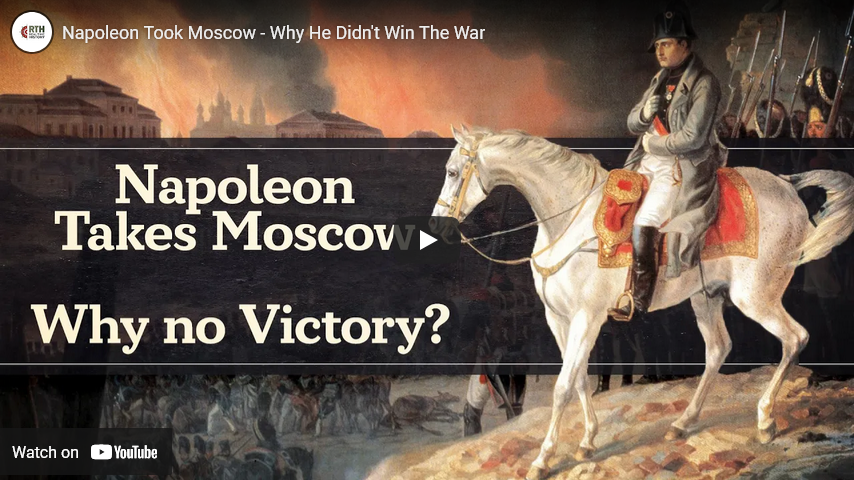
Napoleon Took Moscow – Why He Didn’t Win The War
Real Time History
Published 12 May 2022Support us on Patreon: https://patreon.com/realtimehistory
After the Battle of Borodino, both sides are badly mauled. Napoleon’s army marches on and reaches Moscow, the old Russian capital. In the Emperor’s eyes, capturing the city should win him the war. But while the local Russians set fire to the city, the Tsar in St. Petersburg and the Russian army command are thinking about turning the tide of the war — and not about accepting a French victory.
» THANK YOU TO OUR CO-PRODUCERS
John Ozment, James Darcangelo, Jacob Carter Landt, Thomas Brendan, Kurt Gillies, Scott Deederly, John Belland, Adam Smith, Taylor Allen, Rustem Sharipov, Christoph Wolf, Simen Røste, Marcus Bondura, Ramon Rijkhoek, Theodore Patrick Shannon, Philip Schoffman, Avi Woolf,» SOURCES
Boudon, Jacques-Olivier. Napoléon et la campagne de Russie en 1812. 2021.
Lieven, Dominic. Russia Against Napoleon. 2010.
Rey, Marie-Pierre. L’effroyable tragédie: une nouvelle histoire de la campagne de Russie. 2012.
Zamoyski, Adam. 1812: Napoleon’s Fatal March on Moscow. 2005.» OUR STORE
Website: https://realtimehistory.net»CREDITS
Presented by: Jesse Alexander
Written by: Jesse Alexander
Director: Toni Steller & Florian Wittig
Director of Photography: Toni Steller
Sound: Above Zero
Editing: Toni Steller
Motion Design: Toni Steller
Mixing, Mastering & Sound Design: http://above-zero.com
Digital Maps: Canadian Research and Mapping Association (CRMA)
Research by: Jesse Alexander
Fact checking: Florian WittigChannel Design: Simon Buckmaster
Contains licensed material by getty images
Maps: MapTiler/OpenStreetMap Contributors & GEOlayers3
All rights reserved – Real Time History GmbH 2022
Comments Off on Napoleon Took Moscow – Why He Didn’t Win The War
April 19, 2022
When the Germans had to surrender twice
The end of the war in Europe is usually noted as being the 8th of May, 1945, when General Eisenhower received the surrender of German forces, but the Soviets (and now the Russians) mark the anniversary on the 9th:
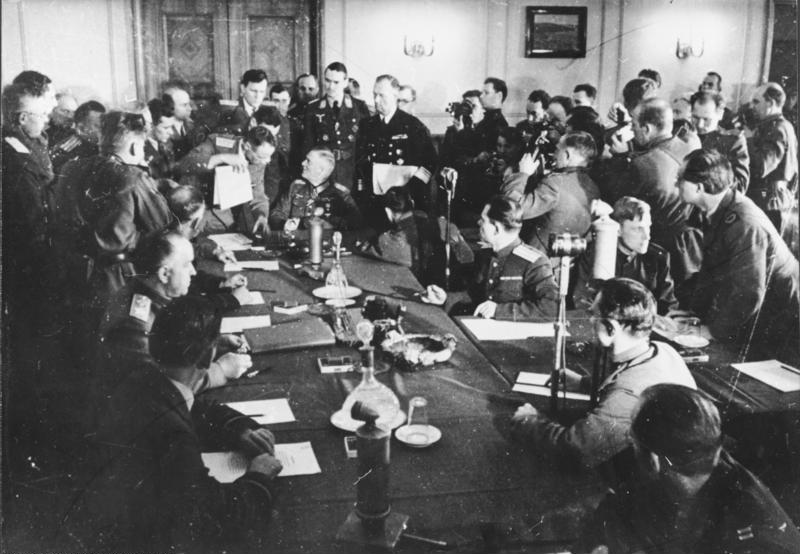
ADN-ZB/Archiv
II.Weltkrieg 1939-1945
Die bedingungslose Kapitulation der faschistischen deutschen Wehrmacht wird am 8. Mai 1945 in Berlin-Karlhorst unterzeichnet.
Links: Der Vertreter des Oberkommandos der Roten Armee, Marschall der Sowjetunion G. K. Shukow, am Tischende Generalfeldmarschall Wilhelm Keitel.
J 0422/600/2 N
It was at three in the morning on Tuesday, 8 May 1945, that Generaloberst Alfred Jodl of the German High Command, signed a surrender document at General Dwight Eisenhower’s headquarters in Rheims, France. The European war was over. It was VE-Day. Stalin’s representative, General Ivan Susloparov, cabled his chief the great news.
However, the Russian leader flew into a rage. He wanted his own observance and insisted on a further ceremony at the Soviet military HQ in Karlshorst, a former Wehrmacht officers’ mess, six miles south-east of central Berlin. Chosen simply because it was one of the few buildings in the capital left with windows and a roof, the formalities were presided over by the captor of the city, Marshal Georgy Zhukov.
This time, it was Generalfeldmarschall Wilhelm Keitel, Jodl’s superior, who read over a near-identical document. Susloparov was again present, along with Carl Spaatz for the Americans and Jean de Lattre de Tassigny, representing France. Newsmen were unaware of the diplomatic spat that delayed proceedings.
De Lattre refused to sign unless the French tricolore was in evidence among the standards and pennants decorating the surrender room. The first Soviet solution hilariously produced a Dutch flag. To pacify an even-more outraged de Lattre, a Red Army seamstress was summoned to run up the appropriate banner. More delays ensued while the Allies bickered over the order of signatures and witnesses, only agreed after the mollifying effects of vodka and some food.
This is why the final ceremony began shortly after midnight. Cameras captured Keitel in full dress uniform, arriving in pompous mood. Flashlights caught the glint of his many medals, and the arrogant flourish of his marshal’s baton, held with gloved hands. He gazed around the room, haughty contempt written across his face. The field marshal removed only his right glove, screwed his monocle into his left eye and applied a fountain pen to the two-page, typewritten document. It was 00:16 local time on Wednesday, 9 May, which became Soviet Victory Day and remains so in Eastern Europe.
Each subsequent year on Victory Day, Red Square has echoed to the “Hurrahs” of vast numbers of Russian soldiers, sailors, marines and paratroopers, national guardsmen and airmen. They are drawn up to listen to their commander-in-chief and inspected by generals. Banners are saluted; swords flash through the air. Serenaded by massed bands playing stirring tunes, they march past the top brass, assembled on the roof of Lenin’s Mausoleum.
Comments Off on When the Germans had to surrender twice
April 4, 2022
The Congress of Vienna (Part 2) (1814 to 1815)
Historia Civilis
Published 2 Apr 2022Patreon | http://historiacivilis.com/patreon
Donate | http://historiacivilis.com/donate
Merch | historiacivilis.com/merch
Mailing List | http://historiacivilis.com/mailinglist
Twitter | http://historiacivilis.com/twitter
Website | http://historiacivilis.comSources:
Eric Hobsbawm, The Age of Revolution, 1789-1848
Adam Zamoyski, Rites of Peace: The Fall of Napoleon and the Congress of Vienna
Richard J. Evans, The Pursuit of Power: Europe 1815-1914
Wolfram Siemann, Metternich: Strategist and Visionary
A. Wess Mitchell, The Grand Strategy of the Habsburg Empire
Robert K. Massie, Dreadnought: Britain, Germany, and the Coming of the Great War
Adam Hochschild, Bury the Chains: Prophets and Rebels in the Fight to Free an Empire’s Slaves
Harry Dickinson, Public Opinion and the Abolition of the Slave Trade | https://bit.ly/2XRMLJC
The History of Parliament: The 5th Parliament of the United Kingdom | https://www.historyofparliamentonline…Music:
“Past,” by Nctrnm
“While She Sleeps (Morning Edit),” by The Lights Galaxia
“Mell’s Parade,” by Broke For Free
“Day Bird,” by Broke For Free
“Thomas Neutrality,” by Enrique Molano
“Infados,” by Kevin MacLeod
“The House Glows (With Almost No Help),” by Chris Zabriskie
“Hallon,” by Christian Bjoerklund
Comments Off on The Congress of Vienna (Part 2) (1814 to 1815)
April 2, 2022
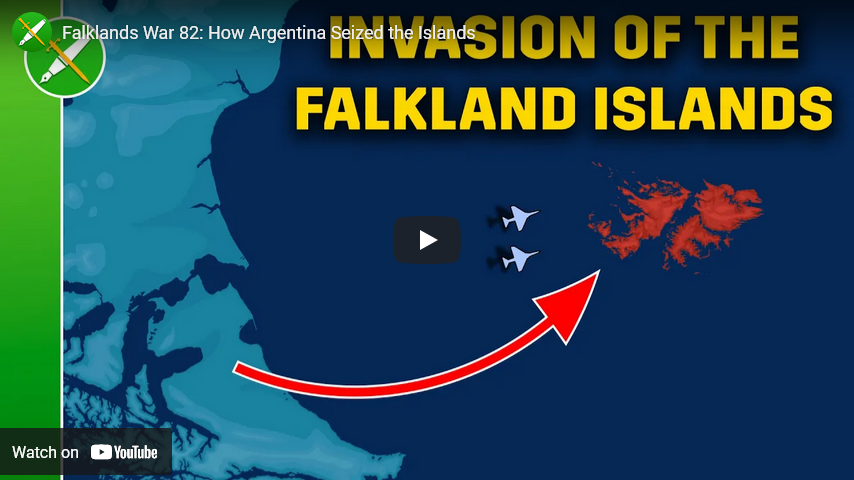
Falklands War 82: How Argentina Seized the Islands
Historigraph
Published 31 Mar 2022For up to 60% off a subscription to Babbel, head over to https://bit.ly/historigraph_babbel
To help support the creation of the rest of the Falklands series, consider supporting on Patreon:
https://www.patreon.com/historigraphCome join the historigraph discord: https://discord.gg/ygypfs3BEB
Buy Historigraph Posters here! historigraph.creator-spring.com
This video was sponsored by Babbel.
► Twitch: https://www.twitch.tv/historigraph
► Second Channel: https://www.youtube.com/channel/UCpIj…
► Twitter: https://twitter.com/historigraph
► Instagram: https://www.instagram.com/historigraphSources for the Falklands War Series (so far):
Max Hastings & Simon Jenkins, Battle for the Falklands
https://archive.org/details/battlefor…
Martin Middlebrook, Operation Corporate
Martin Middlebrook, Battle for the Malvinas
Mike Norman, The Falklands War There and Back Again: The Story of Naval Party 8901
Kenneth Privratsky, Logistics in the Falklands War
Sandy Woodward, One Hundred Days
Paul Brown, Abandon Ship
Julian Thompson, No Picnic
John Shields, Air Power in the Falklands Conflict
Edward Hampshire, The Falklands Naval Campaign 1982
Hugh McManners, Forgotten Voices of the Falklands
Cedric Delves, Across an Angry Sea: The SAS in the Falklands War
Rowland White, Vulcan 607
Vernon Bogdanor, “The Falklands War 1982” lecture https://www.youtube.com/watch?v=a9bWw…
Arthur Gavshon, The sinking of the Belgrano https://archive.org/details/sinkingof…
Gordon Smith, Battle Atlas of the Falklands War 1982 by Land, Sea and Air
http://www.naval-history.net/NAVAL198…
Hansard – https://api.parliament.uk/historic-ha…
Recording of Margaret Thatcher’s statement to the commons is from https://www.youtube.com/watch?v=HvbhV…Music Credits:
“Rynos Theme” Kevin MacLeod (incompetech.com)
Licensed under Creative Commons: By Attribution 4.0 License
http://creativecommons.org/licenses/b…“Crypto” Kevin MacLeod (incompetech.com)
Licensed under Creative Commons: By Attribution 4.0 License
http://creativecommons.org/licenses/b…“Stay the Course” Kevin MacLeod (incompetech.com)
Licensed under Creative Commons: By Attribution 4.0 License
http://creativecommons.org/licenses/b…Other music and SFX from Epidemic Sound
From the comments:
Historigraph
1 day agoThis series has been about four months in the making, and is by far the most ambitious project I’ve set out to complete on Historigraph. It’s going to be 8 (possibly 9) videos over the next three months, charting the course of the Falklands War as it happened 40 years ago.
If you liked this video and want to help support the creation of the remaining seven videos, it would meant the world to me if you could consider supporting on Patreon https://www.patreon.com/historigraph, become a channel member, or even just share this video far and wide.
Comments Off on Falklands War 82: How Argentina Seized the Islands
March 11, 2022
QotD: In 1939, Stalin never imagined Finland would refuse his demands
The one thing Stalin had not reckoned on was that any of these neighbors might object. Certainly he did not expect resistance from the Baltic states. As early as September 24th, 1939, three days before Warsaw surrendered to Germany, Soviet Foreign Minister Vyacheslav Molotov had advised the Estonian foreign minister, Karl Selter, to “yield to the wishes of the Soviet Union in order to avoid something worse.” Latvia was next in line. When Lithuania’s foreign minister, Juozas Urbšys, objected that Soviet occupation would “reduce Lithuania to a vassal state,” Stalin replied brutally, “You talk too much.”
[…]
When Molotov summoned a Finnish delegation to the Kremlin on October 12th, 1939, Stalin made a personal appearance to heighten the intimidation factor, and he handed the Finns a brutal ultimatum demanding, among other things, “that the frontier between Russia and Finland in the Karelian Isthmus region be moved westward to a point only 20 miles east of Viipuri, and that all existing fortifications on the Karelian Isthmus be destroyed.” Stalin made it clear that this was the price that Finland had to pay to avoid the fate of Poland.
Aggressive and insulting as the Soviet demands on Finland were, Stalin and Molotov fully expected them to be accepted. As the Ukrainian party boss and future general secretary Nikita Khrushchev later recalled, the mood in the Politburo at the time was that “all we had to do was raise our voice a little bit and the Finns would obey. If that didn’t work, we could fire one shot and the Finns would put up their hands and surrender.” Stalin ruled, after all, a heavily armed empire of more than 170 million that had been in a state of near-constant mobilization since early September. The Red Army had already deployed 21,000 modern tanks, while the tiny Finnish Army did not possess an anti-tank gun. The Finnish Air Force had maybe a dozen fighter planes, facing a Red Air armada of 15,000, with 10,362 brand-new warplanes built in 1939 alone. Finnish Army reserves still mostly drilled with wooden rifles dating to the 19th century. By contrast, the Red Army was, in late 1939, the largest in the world, the most mechanized, the most heavily armored, and the most lavishly armed, even if surely not — because of Stalin’s purges — the best led.
One can imagine, therefore, Stalin’s shock when the Finns said no. Stunned by this unexpected resistance, Stalin and Molotov did not, at first, know quite what to do. With his highly placed spies in London, Stalin must have known that the mood in foreign capitals was becoming agitated by Soviet moves in the Baltic region. On October 31st, 1939, the British war cabinet took up the question of “Soviet Aggression Against Finland or Other Scandinavian Countries”. And earlier in the month, FDR had written to Moscow, demanding clarification of the Soviet posture on Finland. At this point, the Finnish cause seemed to have the potential to transform the so-far desultory and hypocritical British-French resistance to Hitler alone into a principled war against armed aggression by both totalitarian regimes.
On November 3rd, after yet another encounter in the Kremlin had gone sour with the Finns, Molotov warned the delegates that “we civilians can’t seem to do any more. Now it seems to be up to the soldiers. Now it is their turn to speak.” However, the truth was that, in November 1939, neither side was ready to wage war. Having expected the Finns to come around, Stalin had issued no orders to begin invasion preparations until after talks had finally broken down.
Sean McMeekin, “Stopped Cold: Remembering Russia’s Catastrophic 1939 Campaign Against Finland”, Quillette, 2021-04-20.
Comments Off on QotD: In 1939, Stalin never imagined Finland would refuse his demands
March 4, 2022
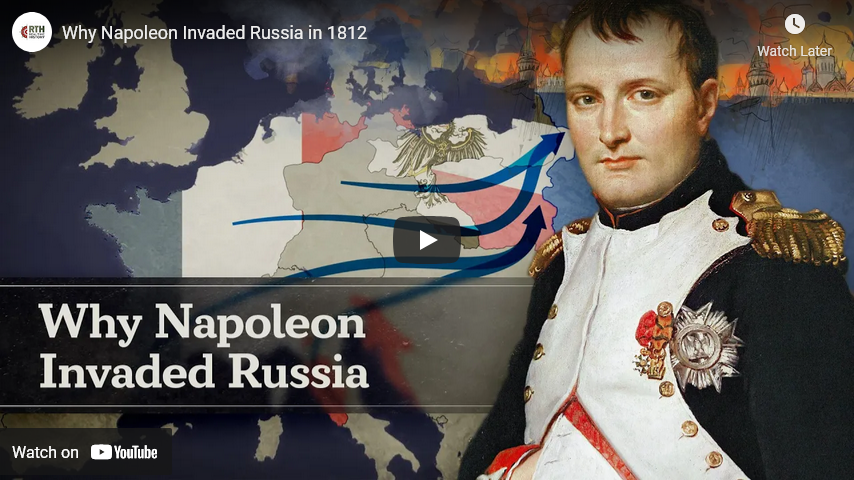
Why Napoleon Invaded Russia in 1812
Real Time History
Published 3 Mar 2022» SUPPORT US ON PATREON: https://patreon.com/realtimehistory
When Napoleon’s Grande Armée crossed the Nemen river into the Russian Empire in 1812, the die had been cast. In the years between the peace of Tilsit and the war against Russia, Tsar Alexander I and Emperor Napoleon had praised each other and Russia had even joined the continental blockade of Napoleon’s arch enemy Great Britain. Still, in 1811 both sides saw war as inevitable.
» THANK YOU TO OUR CO-PRODUCERS
John Ozment, James Darcangelo, Jacob Carter Landt, Thomas Brendan, Kurt Gillies, Scott Deederly, John Belland, Adam Smith, Taylor Allen, Rustem Sharipov, Christoph Wolf, Simen Røste, Marcus Bondura, Ramon Rijkhoek, Theodore Patrick Shannon, Philip Schoffman, Avi Woolf,» SOURCES
Boudon, Jacques-Olivier. Napoléon et la campagne de Russie en 1812. 2021.
Lieven, Dominic. Russia Against Napoleon. 2010.
Rey, Marie-Pierre. L’effroyable tragédie : une nouvelle histoire de la campagne de Russie. 2012.
Zamoyski, Adam. 1812: Napoleon’s Fatal March on Moscow. 2005.» OUR STORE
Website: https://realtimehistory.net»CREDITS
Presented by: Jesse Alexander
Written by: Jesse Alexander
Director: Toni Steller & Florian Wittig
Director of Photography: Toni Steller
Sound: Above Zero
Editing: Toni Steller
Motion Design: Toni Steller
Mixing, Mastering & Sound Design: http://above-zero.com
Digital Maps: Canadian Research and Mapping Association (CRMA)
Research by: Jesse Alexander
Fact checking: Florian WittigChannel Design: Simon Buckmaster
Contains licensed material by getty images
All rights reserved – Real Time History GmbH 2022
From the comments:
Real Time History
10 hours ago» SUPPORT US ON PATREON: https://patreon.com/realtimehistory
Dear RTH supporters and new time viewers,
as I am writing this the Russian invasion of Ukraine is a week old. Our thoughts are with our friends and family in Ukraine as we watch this historic tragedy unfold before our eyes. At the same time we have been working hard to launch our series about Napoleon’s Invasion of Russia in 1812. Most of you will know us for our approach to military history, we don’t just follow the “great men of history” and take the armchair general position that is just moving abstract markers on a map. To the best of our abilities, we are showing the ugly truth of war and the cost for the people on the ground. This will be no different for our Napoleon series.
At the end of this series, you will see that the Russian Empire emerges victorious and indeed 1812 is called “The Patriotic War” in Russia. We began work on the series long before the current phase of the war began, and, as those of you who are familiar with our work already know, this series is in no way a statement of support for the actions of the current Russian government. In our series, we will show how the 1812 campaign was another step towards the totalization of warfare as a whole. We will also show how the question of independence for non-Russians in the Russian Empire was already a thorn in Russia’s side over 200 years ago.
War is never glorious and after studying the 1812 campaign, we can say with certainty that this war was one of the ugliest wars in history. The cost for the common people between Moscow and the Berezina was immense and so was the cost for the French and non-French soldiers in the Grande Armée – and of course for the Russian soldiers too.
Lastly, current events always shape our understanding of history. A crude, perverted version of history has even been used by Vladimir Putin to justify this war of aggression against Ukraine. Undoubtably, this current war will also cause us to see 1812 in a different light. Napoleon’s Invasion of Russia is rightfully considered as one of the most important events in European history and it needs to be remembered for generations to come. With our series, we hope we can contribute to this understanding.
Thank you for your support and keeping a critical view of history alive with us. No to war!
Florian Wittig and the entire Real Time History team
Comments Off on Why Napoleon Invaded Russia in 1812
February 2, 2022
The Congress of Vienna (Part 1) (1814)
Historia Civilis
Published 29 Jan 2022Patreon | http://historiacivilis.com/patreon
Donate | http://historiacivilis.com/donate
Merch | historiacivilis.com/merch
Mailing List | http://historiacivilis.com/mailinglist
Twitter | http://historiacivilis.com/twitter
Website | http://historiacivilis.comSources:
Wolfram Siemann, Metternich: Strategist and Visionary | https://amzn.to/3Glc5c8
Eric Hobsbawm, The Age of Revolution, 1789-1848 | https://amzn.to/3zOQWV4
Adam Zamoyski, Rites of Peace: The Fall of Napoleon and the Congress of Vienna | https://amzn.to/3zSpcir
Richard J. Evans, The Pursuit of Power: Europe 1815-1914 | https://amzn.to/3qhFE8G
A. Wess Mitchell, The Grand Strategy of the Habsburg Empire | https://amzn.to/332Sorj
Robert K. Massie, Dreadnought: Britain, Germany, and the Coming of the Great War | https://amzn.to/3r6jllP
—
N. Gash, “After Waterloo: British Society and the Legacy of the Napoleonic Wars”, from Transactions of the Royal Historical Society, vol. 28, 1978, pp. 145-157. | https://www.jstor.org/stable/3679205
The Annual Register, 1815, Preface | https://hdl.handle.net/2027/mdp.39015…
Voltaire, “An Essay on Universal History, the Manners, and Spirit of Nations” | https://amzn.to/34BGbtL
The History of Parliament: The 5th Parliament of the United Kingdom | https://www.historyofparliamentonline…Music:
“Like,” by Nctrnm
“But Enough About Me Bill Paxton,” by Chris Zabriskie
“I Don’t See the Branches, I See the Leaves,” by Chris Zabriskie
“Orion,” by Josh Stewart
“CGI Snake,” by Chris Zabriskie
“Gown,” by Nctrnm
“Hallon,” by Christian BjoerklundWe are a participant in the Amazon Services LLC Associates Program, an affiliate advertising program designed to provide a means for us to earn fees by linking to Amazon.com and affiliated sites.
Comments Off on The Congress of Vienna (Part 1) (1814)
January 22, 2022
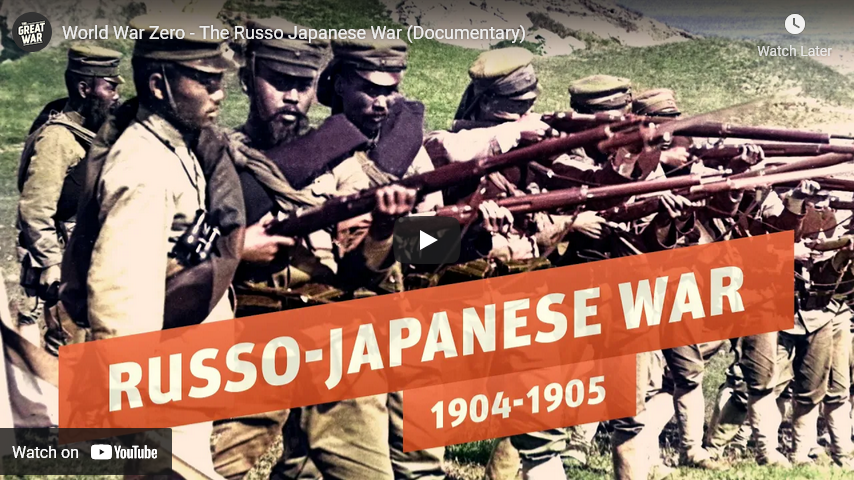
World War Zero – The Russo Japanese War
The Great War
Published 21 Jan 2022Get the Smartest Bundle in Streaming: https://smartbundle.com/thegreatwarsb
The Russo-Japanese War is nicknamed World War Zero – it was a clash between two world powers that foreshadowed war on an industrial scale as seen just 10 years later again. Gigantic land battles like the Battle of Mukden showed the true cost in manpower and materiel when modern armies clashed and the naval side of the war showed the strategic importance of modern navies.
» SUPPORT THE CHANNEL
Patreon: https://www.patreon.com/thegreatwar» THANKS TO OUR CO-PRODUCERS
John Ozment, James Darcangelo, Jacob Carter Landt, Thomas Brendan, Kurt Gillies, Scott Deederly, John Belland, Adam Smith, Taylor Allen, Rustem Sharipov, Christoph Wolf, Simen Røste, Marcus Bondura, Ramon Rijkhoek, Theodore Patrick Shannon, Philip Schoffman, Avi Woolf,» BIBLIOGRAPHY
Akiyama Saneyuki, Gundan (Tokyo: Jitsugyō no Nihonsha, 1917)Atsuo Yokoyama; Toshikatsu Nishikawa & Ichō Konsōshiamu, Heishitachi ga mita Nichi-Ro sensō, (Tokyo: Yūzankaku, 2012)
Corbett, Julian S., Maritime Operations in the Russo-Japanese War, 1904-1905, Volume I, (Annapolis, MD: Naval Institute Press, 2015)
Corbett, Julian S., Maritime Operations in the Russo-Japanese War, 1904-1905, Volume II, (Annapolis, MD: Naval Institute Press, 2015)
Деникин А. И. Путь русского офицера. (Нью-Йорк: Изд. им. А. Чехова, 1953)
Forczyk, Robert, Russian Battleship vs Japanese Battleship: Yellow Sea 1904-05, (Oxford: Osprey Publishing Ltd, 2009)
Hamby, Joel E, “Striking the Balance: Strategy and Force in the Russo-Japanese War” Armed Forces & Society, Vol. 30, No. 3 (2004)
Hosokawa Gentarō, Byōinsen Kōsai Maru kenbunroku (Tokyo: Hakubunkan Shinsha, 1993)
Ivanov, A & Jowett P, The Russo-Japanese War 1904-05, (Oxford: Osprey Publishing Ltd, 2004)
Jacob, Frank, The Russo-Japanese War and its Shaping of the Twentieth Century, (London: Routledge, 2017)
Jukes, Geoffrey, The Russo-Japanese War 1904-1905, (Oxford: Osprey Publishing Ltd, 2014)
Kowner, Rotem (ed), Rethinking the Russo-Japanese War, 1904-5, Volume 1: Centennial Perspectives, (Folkestone: Global Oriental, 2007)
Lynch, George & Palmer, Frederick, In Many Wars By Many War Correspondnets, (Tokyo: Tokyo Printing Co. 1904)
Mozawa Yusaku, Aru hohei no Nichi-Ro Sensō jūgun nikki (Tokyo: Sōshisha, 2005)
Murakami Hyōe, Konoe Rentai ki (Tokyo: Akita Shoten, 1967)
Paine, S. C. M., The Japanese Empire: Grand Strategy from the Meiji Restoration to the Pacific War, (Cambridge: Cambridge University Press, 2017)
Steinberg, John W; Meaning, Bruce W; Schimmelpennick van der Oye, David; Wolff, David & Yokote, Shinji (eds.), The Russo-Japanese War in Global Perspective: World War Zero, (Leiden: Brill, 2005)
Stille, Mark, The Imperial Japanese Navy of the Russo-Japanese War, (Oxford: Osprey Publishing Ltd, 2016)
Takagi Suiu, Jinsei hachimenkan (Tokyo: Teikoku Kyōiku Kenkyūkai, 1927)
van Dijk, Kees, Pacific Strife: The Great Powers and Their Political and Economic Rivalries in Asia and the Western Pacific, 1870-1914, (Amsterdam: Amsterdam University Press, 2015)
Warner, Denis & Warner, Peggy, The Tide at Sunrise: A History of the Russo-Japanese War 1904-1905, (London: Angus & Robertson, 1974)
»CREDITS
Presented by: Jesse Alexander
Written by: Jesse Alexander
Director: Toni Steller & Florian Wittig
Director of Photography: Toni Steller
Sound: Toni Steller
Editing: Jose Gamez
Motion Design: Philipp Appelt
Mixing, Mastering & Sound Design: http://above-zero.com
Research by: Jesse Alexander
Fact checking: Florian Wittig
Channel Design: Yves ThimianContains licensed material by getty images
All rights reserved – Real Time History GmbH 2022
Comments Off on World War Zero – The Russo Japanese War
January 19, 2022
Neville Chamberlain, the “great appeaser”
Alexander Larman considers an attempt to paint British Prime Minister Neville Chamberlain in a much more positive light than his popular image after appeasement failed:
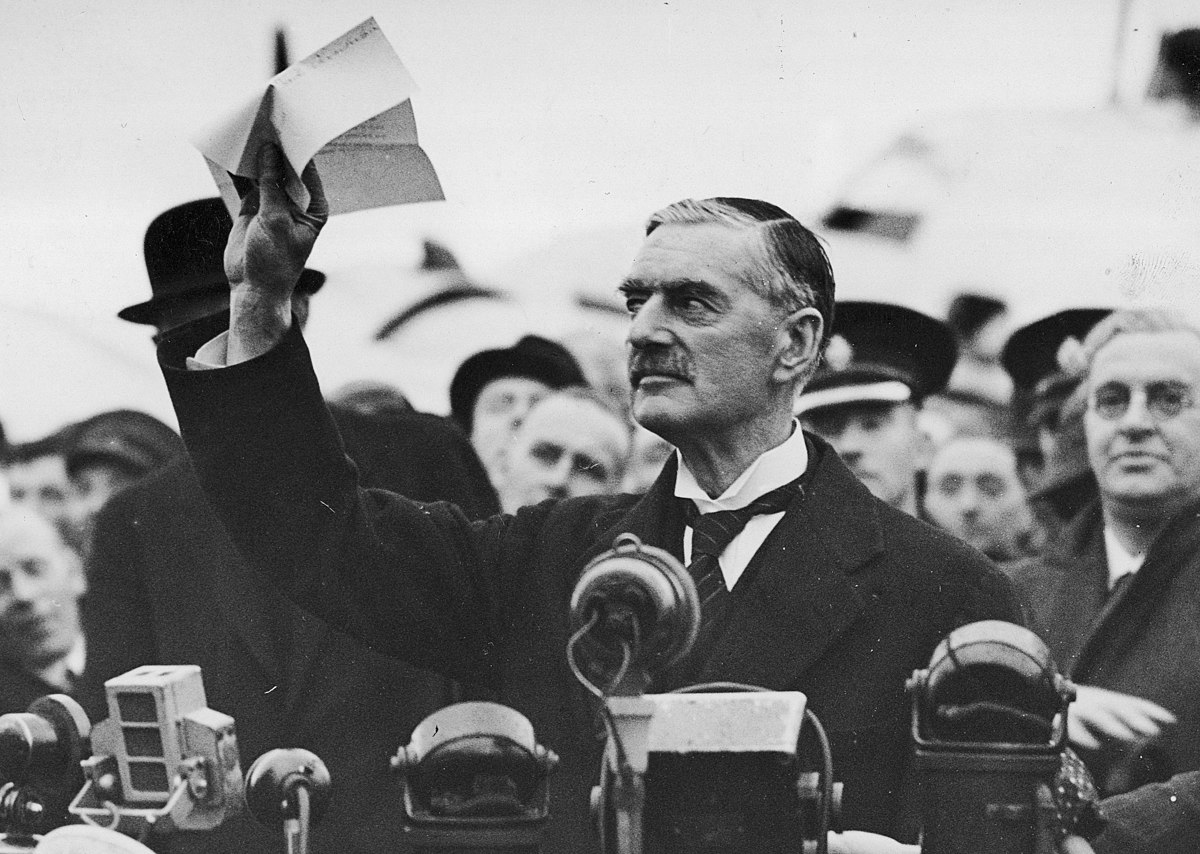
Prime Minister Neville Chamberlain at Heston Aerodrome, holding up a copy of the Anglo-German Declaration he had negotiated with Adolf Hitler, 30 September, 1938.
Narodowe Archiwum Cyfrowe via Wikimedia Commons.
On 30 September 1938, the Prime Minister Neville Chamberlain waved a piece of paper in his hand and declared “My good friends, for the second time in our history, a British Prime Minister has returned from Germany bringing peace with honour. I believe it is peace for our time.” He was, of course, incorrect. Less than a year later, Britain was at war with Germany, and the piece of paper was rendered meaningless.
Posterity has been hard on Chamberlain, regarding him as one of the least effective British premiers, and he has been entirely overshadowed by his more charismatic and successful replacement, Winston Churchill. Yet the bestselling author Robert Harris took a more sympathetic view of Chamberlain, and suggested in his 2017 novel Munich that, far from the Prime Minister being a hapless blunderer, he was in fact a canny tactician who bought his country an invaluable extra year to prepare for the coming conflict. This novel has now been filmed by Netflix, and has attracted particular attention for Jeremy Irons’ sympathetic and warm portrayal of Chamberlain.
Harris has even suggested that “I could perhaps show him as a tragic hero rather than merely the gullible old fool of popular myth … it is a mark of maturity to be able to hold two competing views in one’s head at the same time: that Churchill was vital to the defeat of Germany, and so, in a different way, was Neville Chamberlain.” Does he have a point, or is this just the canny spin of a novelist who has found a new and profitable angle to bring a well-worn story to life?
For my forthcoming book The Windsors at War, dealing with the royals in WWII and their relationships with the politicians of the day, I researched many letters and documents written by Chamberlain, members of the Royal Family and those around him in Downing Street. Several things came to light. There was residual antipathy between Chamberlain, who was an instinctive appeaser, and Churchill, who was not, and the Prime Minister privately derided the other politician as “a bandit” and “a pirate”. He also despised Attlee’s Labour party, calling them experts in “sob-stuff” sentimentality. He can undeniably be accused of high-handedness and complacency. Yet the charge of incompetence is a more deadly one.
Chamberlain himself came from a distinguished political family. His father Joseph was a ruthless Liberal parliamentarian who was said to have originated the phrase “you cannot teach old dogs new tricks”, and his elder brother Austen, one-time Chancellor of the Exchequer and leader of the Conservative Party, demonstrated a confidence in his intellectual abilities that his sibling did his best to emulate. He was not universally popular with his own side – the Conservative MP and diarist Harold Nicolson called him “a bourgeois shit” – but he generally had the support of his party in pursuing his policy of appeasement towards Hitler and Germany, believing – correctly – that Britain could not win the conflict outright.
Comments Off on Neville Chamberlain, the “great appeaser”
December 20, 2021
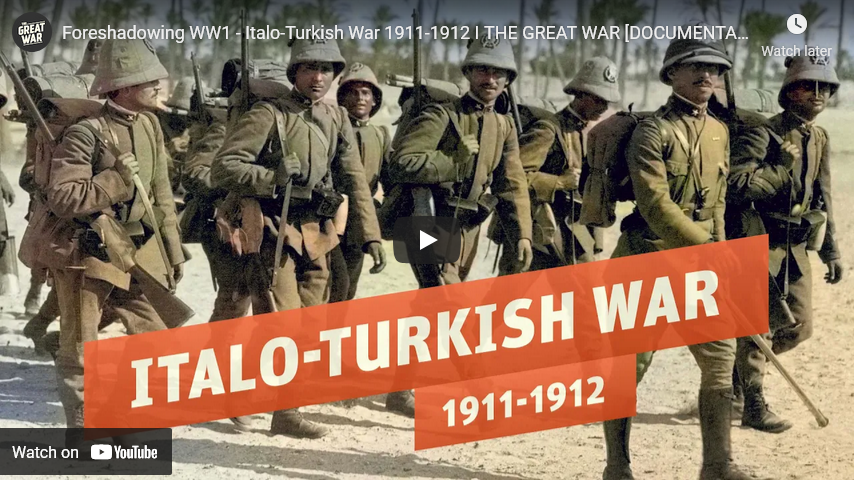
Foreshadowing WW1 – Italo-Turkish War 1911-1912 I THE GREAT WAR
The Great War
Published 17 Dec 2021Sign up for Audible and get 60% off your first three months: https://audible.com/greatwar or text
greatwarto 500-500The Italo-Turkish War 1911 was one of the last classic imperial wars over colonial processions between two great powers. But it was in many ways also a first glimpse into what would come during the First World War: trenches, artillery, combat aircraft, motorboat attacks. This war in Ottoman Libya was fought between the Italian Army and Ottoman-led local Senussi forces.
» SUPPORT THE CHANNEL
Patreon: https://www.patreon.com/thegreatwar» THANKS TO OUR CO-PRODUCERS
John Ozment, James Darcangelo, Jacob Carter Landt, Thomas Brendan, Kurt Gillies, Scott Deederly, John Belland, Adam Smith, Taylor Allen, Rustem Sharipov, Christoph Wolf, Simen Røste, Marcus Bondura, Ramon Rijkhoek, Theodore Patrick Shannon, Philip Schoffman, Avi Woolf,» SOURCES
Askew, William C., Europe and Italy’s Acquisition of Libya, 1911-1912, (Durham, NC: Duke University Press, 1942)Caccamo, Francesco, “Italy, Libya and the Balkans” in Geppert, Dominik; Mulligan, William & Rose, Andreas (eds.), The Wars before the Great War: Conflict and International Politics Before the Outbreak of the First World War, (Cambridge: Cambridge University Press, 2016)
Childs, Timothy W, Italo-Turkish Diplomacy and the War Over Libya, 1911–1912, (Leiden: Brill, 1990)
Griffin, Ernest H., Adventures in Tripoli: A Doctor in the Desert (London: Philip Allen & Co., 1924)
Hindmarsh. Albert E. & Wilson, George Grafton, “War Declared and the Use of Force”, Proceedings of the American Society of International Law at Its Annual Meeting (1921-1969) Vol. 32 (1938)
McCollum Jonathan, “Reimagining Mediterranean Spaces: Libya and the Italo-Turkish War, 1911-1912”, in Mediterraneo cosmopolita, 23 (3) 2015.
McMeekin, Sean, The Ottoman Endgame (Penguin, 2013).
Paris, Michael, “The First Air Wars – North Africa and the Balkans, 1911-13”, Journal of Contemporary History, Vol. 26, No. 1 (1991)
Stephenson, Charles, A Box of Sand: the Italo-Ottoman War 1911-1912: the First Land, Sea and Air War, (Ticehurst: Tattered Flag Press, 2014)
Tittoni, Renato, The Italo-Turkish War (1911-12). Translated and Compiled from the Reports of the Italian General Staff, (Kansas City, MO: Frank Hudson Publishing Company, 1914)
Uyar, Mesut, The Ottoman Army and the First World War, (Abingdon: Routledge, 2021)
Vandervort, Bruce, Wars of Imperial Conquest in Africa 1830-1914, (Bloomington, IN: Indiana University Press, 1998)
Wilcox, Vanda, Italy in the Era of the Great War, (Leiden: Brill, 2018)
Wilcox, Vanda, “The Italian Soldiers’ experience in Libya, 1911-12” in Geppert, Dominik; Mulligan, William & Rose, Andreas (eds.), The Wars before the Great War: Conflict and International Politics Before the Outbreak of the First World War, (Cambridge: Cambridge University Press, 2016)
»CREDITS
Presented by: Jesse Alexander
Written by: Mark Newton, Jesse Alexander
Director: Toni Steller & Florian Wittig
Director of Photography: Toni Steller
Sound: Toni Steller
Editing: Jose Gamez
Motion Design: Philipp Appelt
Mixing, Mastering & Sound Design: http://above-zero.com
Research by: Mark Newton
Fact checking: Florian WittigChannel Design: Yves Thimian
Contains licensed material by getty images
All rights reserved – Real Time History GmbH 2021
Comments Off on Foreshadowing WW1 – Italo-Turkish War 1911-1912 I THE GREAT WAR
December 3, 2021
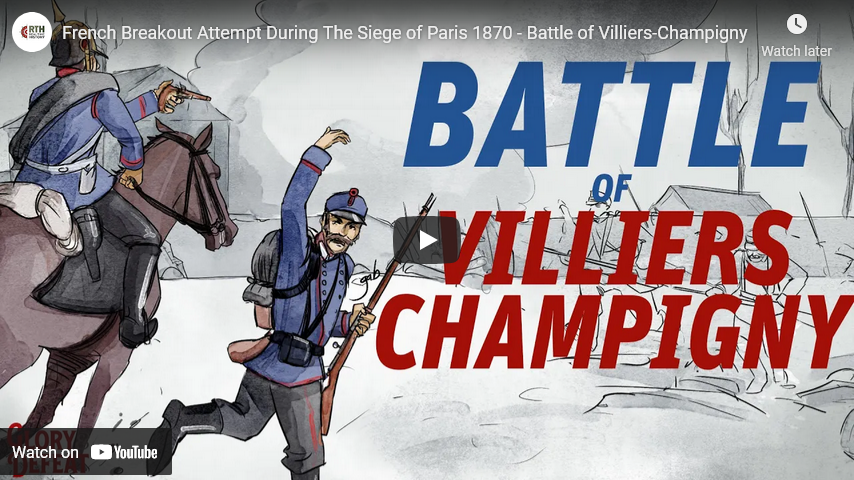
French Breakout Attempt During The Siege of Paris 1870 – Battle of Villiers-Champigny
Real Time History
Published 2 Dec 2021Sign up for Curiosity Stream and get Nebula bundled in and SAVE 26%: https://curiositystream.com/realtimeh…
The Siege of Paris has been going on for months in November 1870 and the population is starving. The French Army has previously tried and failed to break out but this week they are starting their biggest attempt yet — not knowing that it has been doomed from the start.
» THANK YOU TO OUR CO-PRODUCERS
John Ozment
James Darcangelo
Jacob Carter Landt
Thomas Brendan
James Giliberto
Kurt Gillies
Albert B. Knapp MD
Tobias Wildenblanck
Richard L Benkin
Scott Deederly
John Belland
Adam Smith
Taylor Allen
Jim F Barlow
Rustem Sharipov» OUR PODCAST
https://realtimehistory.net/podcast – interviews with historians and background info for the show.» LITERATURE
Arand, Tobias: 1870/71. Der Deutsch-Französische Krieg erzählt in Einzelschicksalen. Hamburg 2018Ders.: “Rogerowski oder Rasumowsky? Überlegungen zur nationalen ‘Meistererzählung’ in Fontanes ‘Kriegsgefangen’“, in: Fontane-Blätter 105 (2018). S. 61-86
Ders.: “‘… dazu find ich keine Worte’ – Der Blick auf den Krieg von 1870/71 in Erinnerungsbüchern deutscher Veteranen“, in: Nation im Siegesrausch. Württemberg und die Gründung des Deutschen Reichs 1870/71, hrsg. u. bearb. von W. Mährle. Stuttgart 2020. S. 85-98
Bourguinat, Nicolas and Gilles Vogt: La guerre franco-allemande de 1870. Une histoire globale. 2020
Gouttman, Alain: La grande défaite. 1870-1871. Paris 2015
Lecaillon, Jean-François: Les Femmes et la Guerre de 1870/71. Histoire d’un engagement occulté. Paris 2020
» SOURCES
Hérisson, Maurice d’: Journal d’un officier d’ordonnance. Paris 1885De Trailles, Paul et Henry: Les femmes de France pendant la guerre et les deux sièges de Paris. Paris 1872
Fontane, Theodor: Der Krieg gegen Frankreich. Bd. 3. Berlin 1874
Fontane, Theodor: Kriegsgefangen. Erlebtes 1870. Briefe 1870/71. Berlin (Ost) 1984
Kühnhauser, Florian: Kriegs-Erinnerungen eines Soldaten des königlich bayerischen Infanterie Leibregiments. Partenkirchen 1898
N. N. (Hrsg.): Bismarcks Briefe an seine Gattin aus dem Kriege 1870/71. Stuttgart, Berlin 1903
Schikorsky, Isa (Hrsg.): “Wenn doch dies Elend ein Ende hätte”, Ein Briefwechsel aus dem Deutsch-Französischen Krieg 1870/71. Köln, Weimar, Wien 1999
Wöllwarth, Julie von: Unter den Verwundeten von 1870/71. Aufzeichnungen aus einer großen Zeit. o.O, o.J. (1890)
Zola, Émile: La Débacle. Paris 1892
» OUR STORE
Website: https://realtimehistory.net»CREDITS
Presented by: Jesse Alexander
Written by: Cathérine Pfauth, Prof. Dr. Tobias Arand, Jesse Alexander
Director: Toni Steller & Florian Wittig
Director of Photography: Toni Steller
Sound: Above Zero
Editing: Toni Steller
Motion Design: Philipp Appelt
Mixing, Mastering & Sound Design: http://above-zero.com
Maps: Battlefield Design
Research by: Cathérine Pfauth, Prof. Dr. Tobias Arand
Fact checking: Cathérine Pfauth, Prof. Dr. Tobias ArandChannel Design: Battlefield Design
Contains licensed material by getty images
All rights reserved – Real Time History GmbH 2021
Comments Off on French Breakout Attempt During The Siege of Paris 1870 – Battle of Villiers-Champigny
November 26, 2021
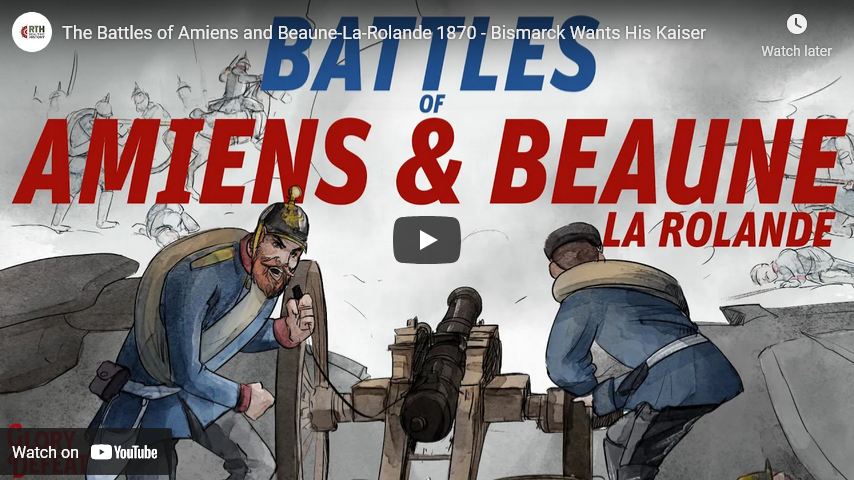
The Battles of Amiens and Beaune-La-Rolande 1870 – Bismarck Wants His Kaiser
Real Time History
Published 25 Nov 2021Support us on Patreon: https://patreon.com/realtimehistory
After a brief break in the fighting, the Franco-Prussian War continues in late November with the Battles of Amiens and Beaune-La-Rolande. Both sides are exhausted and the casualties are mounting. In the meantime Bismarck is trying to convince the German states of a new German Emperor.
» THANK YOU TO OUR CO-PRODUCERS
John Ozment
James Darcangelo
Jacob Carter Landt
Thomas Brendan
James Giliberto
Kurt Gillies
Albert B. Knapp MD
Tobias Wildenblanck
Richard L Benkin
Scott Deederly
John Belland
Adam Smith
Taylor Allen
Jim F Barlow
Rustem Sharipov» OUR PODCAST
https://realtimehistory.net/podcast – interviews with historians and background info for the show.» LITERATURE
Arand, Tobias: 1870/71. Die Geschichte des Deutsch-Französischen Krieges erzählt in Einzelschicksalen. Hamburg 2018Arand, Tobias: Gestorben für “Vaterland” und “Patrie”. Die toten Krieger aus dem Feldzug von 1870/71 auf dem “Alten Friedhof” in Ludwigsburg. Ludwigsburg 2012
Barry, Quintin: The Franco-Prussian War 1870-71. Vol 2 After Sedan. Solihull, 2007
Gouttman, Alain: La grande défaite. 1870-1871. Paris 2015.
Howard, Michael: The Franco-Prussian War. London, 1961
» SOURCES
Braun, Lily (Hrsg.): Kriegsbriefe aus den Jahren 1870/71 von Hans von Kretschman. Berlin 1911Bundesgesetzblatt des Norddeutschen Bundes, Band 1867, Nr. 1, Seite 1–23
Fontane, Theodor: Kriegsgefangen. Erlebtes 1870. Briefe 1870/71. Berlin (Ost) 1984
Haus der Bayerischen Geschichte (Hrsg.): Gründung des Deutschen Kaiserreichs 1871. Unterrichtsmaterialien. o. O. 2011
Königliche Geheime Ober-Hof-Druckerei (Hrsg.): Verlust-Listen der Königlich-Preußischen Armee und der Großherzoglich Badischen Division aus dem Feldzuge 1870-1871. Berlin 1871
Kühnhauser, Florian: Kriegs-Erinnerungen eines Soldaten des königlich bayerischen Infanterie Leibregiments. Partenkirchen 1898
Kürschner, Joseph (Hrsg.): Der große Krieg in Zeitberichten. Leipzig o.J. (1895)
Moltke, Helmuth von: Geschichte des deutsch-französischen Krieges von 1870-71. Berlin 1891
Zeitz, Karl: Kriegserinnerungen eines Feldzugsfreiwilligen aus den Jahren 1870 und 1871. Altenburg 1905
» OUR STORE
Website: https://realtimehistory.net»CREDITS
Presented by: Jesse Alexander
Written by: Cathérine Pfauth, Prof. Dr. Tobias Arand, Jesse Alexander
Director: Toni Steller & Florian Wittig
Director of Photography: Toni Steller
Sound: Above Zero
Editing: Toni Steller
Motion Design: Philipp Appelt
Mixing, Mastering & Sound Design: http://above-zero.com
Maps: Battlefield Design
Research by: Cathérine Pfauth, Prof. Dr. Tobias Arand
Fact checking: Cathérine Pfauth, Prof. Dr. Tobias ArandChannel Design: Battlefield Design
Contains licensed material by getty images
All rights reserved – Real Time History GmbH 2021
Comments Off on The Battles of Amiens and Beaune-La-Rolande 1870 – Bismarck Wants His Kaiser
November 25, 2021
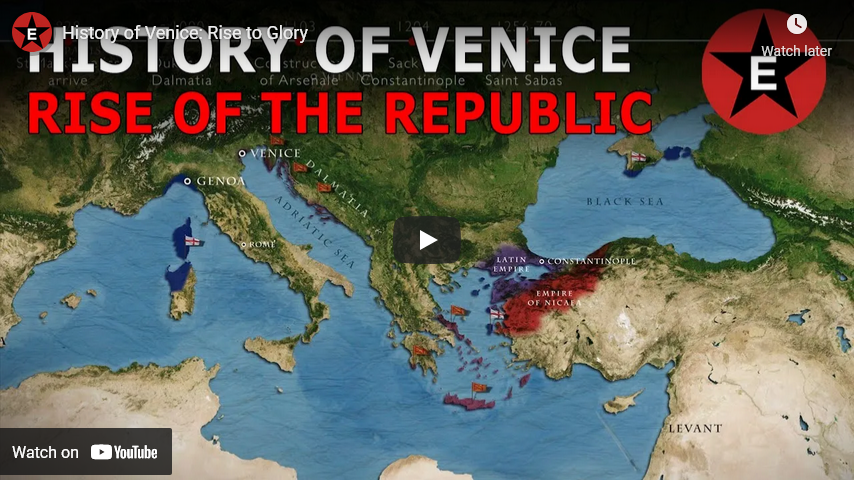
History of Venice: Rise to Glory
Epic History TV
Published 14 Dec 2018Listen to or download the music HERE: smarturl.it/epichistoryvenice
Music by https://www.musicdesigngroup.comThanks to Elias Tsiantas for the 3D Venetian galley footage
Thanks to Miłek Jakubiec for the Battle of Marignano imageSupport the channel & get exclusive previews at Patreon:
https://www.patreon.com/epichistorytvWant to learn more? We recommend A History of Venice by the late John Julius Norwich, a great popular historian on all things Mediterranean (as an Amazon Associate I earn from qualifying purchases): http://geni.us/7q71zx
#EpicHistoryTV #HistoryofVenice
Comments Off on History of Venice: Rise to Glory


