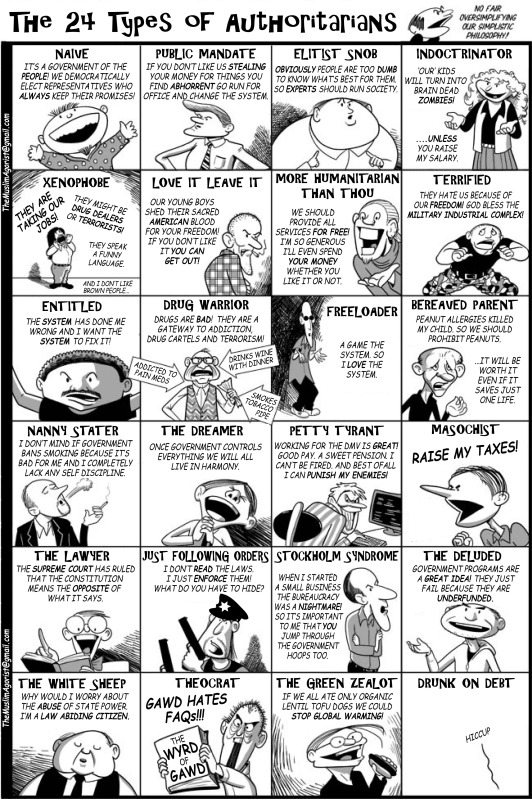
Libertarians are process people, something that our political opponents find impossible to believe can be real, rather than disingenuous. So when I say that I think Lawrence v. Texas might be the right result morally but the wrong result legally, it must be that I secretly want sodomy to be illegal, or at the very least don’t care. Or when I am troubled by government intervening in the Chrysler bankruptcy process, it’s because I hate unions. And of course, when I am against post-hoc legal judgments against bankers or their bonuses, it’s just because I’m an apologist for rich people.
But to a libertarian, process matters. Having a good process is better than getting a good outcome, because a good process is one that maximizes your chances of getting good outcomes over time.
Megan McArdle, “The Process of Passing Health Care”, The Atlantic, 2009-12-22
March 15, 2010
March 13, 2010
Privatization? Let’s not be ideological!
Robert Fulford on the problems with unions in the public service:
Unions hate the very word “privatization.” And no wonder. Their present system is close to perfect: Their workers can’t be fired but can strike, as they do from time to time, demonstrating their power. They win most of their struggles with politicians, who throw billions at them just to keep them quiet. (After all, it’s not as if the politicians were spending their own money.)
This arrangement became commonplace in Canada about half a century ago, turning public-sector employees into princes of the working class who make more money than other people doing the same jobs, and receive more generous benefits.
Union members passionately believe this is no more than their due. The unions and their friends believe public ownership is fundamentally good, private ownership at best dubious. In 1994, when it seemed possible that Ontario would privatize liquor sales, the Ontario Liquor Boards Employees’ Union commissioned a study by a York University economist, Nuri Jazairi. He found, no surprise, that this was a bad idea and that the provincial government should continue to control every ounce of liquor sold within provincial boundaries, presumably for eternity.
But his report was most revealing when he turned to the motives of those who favour privatization. He suggested the idea sprang from “purely political and ideological reasons,” among which he listed “the control of public expenditures” and “limiting the role of government in managing the economy.”
It’s no surprise that the folks who benefit disproportionally from the current arrangement are the most vocally opposed to any changes which would reduce their advantages. If the government did get enough political will to go ahead and privatize, there’s no way (unless the government tied their hands in advance) that private enterprise would give — or could afford to give — their employees the same pay and benefits they currently enjoy under public ownership.
Update: Speaking of situations which could only arise under public ownership, here’s a perfect example:
More than 1,250 Ontario Ministry of Revenue employees will soon be receiving severance packages of up to $45,000 each — but they won’t be out of work. Most of them aren’t even switching desks. They’re simply being transferred from the provincial payroll to the federal payroll when the province moves to a federal harmonized sales tax this summer.
March 12, 2010
Does this movie trailer remind you of every other movie?
It does for movie trailers what the Generic News Report did for TV news. H/T to Virginia Postrel for the link.
March 9, 2010
We’re pulling soft drinks from schools, but we’ll now charge for water
680 News had this delightful little news item in the round-up this morning:
Some parents are questioning a plan by the Toronto District School Board to put a vending machine in a Parkdale elementary school that sells water refills and flavoured water.
The vending machine is scheduled to be installed at Fern Avenue Public School, near Queen Street and Roncesvalles Avenue.
The machine will charge students 50-cents for filtered water and $1 for flavoured water.
The pipes at the school apparently need to be replaced, which has some parents concerned that this little “convenience” will come to replace the water fountains altogether. If that happened, the 50-cents-per-drink machine would be a nice little earner for the school board.
After this became news, the board decided to delay the installation until after a meeting to consult with concerned parents. (Translation: the phones were melting down from the angry responses the board was getting, so they’re at least pretending to pay attention to parental concerns.)
March 5, 2010
The winds of change: UK’s Met Office to abandon seasonal forecasts
You’d almost think someone was paying attention. Britain’s Met Office has given up providing seasonal forecasts:
The Met Office is to stop publishing seasonal forecasts, after it came in for criticism for failing to predict extreme weather.
It was berated for not foreseeing that the UK would suffer this cold winter or the last three wet summers in its seasonal forecasts.
The forecasts, four times a year, will be replaced by monthly predictions.
The Met Office said it decided to change its forecasting approach after carrying out customer research.
Explaining its decision, the Met Office released a statement which said: “By their nature, forecasts become less accurate the further out we look.
That last point is why, in years gone by, newspapers used to have much amusement contrasting official weather forecasts with non-scientific publications like the Old Farmer’s Almanac, where just often enough to be newsworthy, the annual’s predictions were more accurate than those provided by “real weathermen”.
March 4, 2010
QotD: The problem with modern journalism
The Times seems to have forgotten the most important aspect of the news business. For years now ’skeptic’ has been a dirty word at the Times when the subject of climate change comes up. Excuse me, but reporters are supposed to be skeptics. They are supposed to be cynical, hard bitten people who trust their mothers — but cut the cards. They are supposed to think that scientists are probably too much in love with their data, that issue advocates have hidden agendas, that high-toned rhetoric is often a cover for naked self interest, that bloviating politicians have cynical motives and that heroes, even Nobel Prize laureates, have feet of clay. That is their job; it is why we respect them and why we pay attention to what they write.
Reporters are not supposed to be wide-eyed gee-whiz college kids believing everything they hear and using the news columns of the paper to promote a social agenda. They are wet blankets, not cheerleaders, Eeyores, not Piglets and they can safely leave all the advocacy and flag-waving to the editorial writers and the op-ed pages.
This is not just a question of liberal bias. The same wide-eyed gee-whiz culture shaped much of the reporting on the run-up to the Iraq War. Maybe the word we are looking for when trying to describe what’s wrong with the mainstream press isn’t ‘liberal’ — maybe the term is something like ‘credulous’ or ‘naive.’ The gradual substitution of ‘professional journalists’ for the old hard boiled hacks may have given us a generation of journalists who are used to trusting reputable authority. They honestly think that people with good credentials and good manners don’t lie.
Today’s journalists are much too well-bred and well-connected to stand there in the crowd shouting “The emperor has no clothes!” They’ve worked with the tailors, they have had long background interviews with the tailors, they’ve been present for some of the fittings. Of course the emperor’s new clothes are fantastic; only those rude and uncouth ‘clothing deniers’ still have any doubts.
Walter Russell Mead, “Treason is a matter of dates”, The American Interest Online, 2010-03-03
March 2, 2010
SWAT forces now spend more time doing non-SWAT policing
Or, more accurately, militarizing the sort of police activity that ordinary police officers would once have done:
. . . last year Maryland became the first state in the country to make every one of its police departments issue a report on how often and for what purpose they use their SWAT teams. The first reports from the legislation are in, and the results are disturbing.
Over the last six months of 2009, SWAT teams were deployed 804 times in the state of Maryland, or about 4.5 times per day. In Prince George’s County alone, with its 850,000 residents, a SWAT team was deployed about once per day. According to a Baltimore Sun analysis, 94 percent of the state’s SWAT deployments were used to serve search or arrest warrants, leaving just 6 percent in response to the kinds of barricades, bank robberies, hostage takings, and emergency situations for which SWAT teams were originally intended.
Worse even than those dreary numbers is the fact that more than half of the county’s SWAT deployments were for misdemeanors and nonserious felonies. That means more than 100 times last year Prince George’s County brought state-sanctioned violence to confront people suspected of nonviolent crimes. And that’s just one county in Maryland. These outrageous numbers should provide a long-overdue wake-up call to public officials about how far the pendulum has swung toward institutionalized police brutality against its citizenry, usually in the name of the drug war.
It’s easy to see how this happened, all over North America, not just in Maryland. Increasing perception of the dangers of the drug war fed the demand for more SWAT-type forces in more and more police departments. Once in place, extensively equipped and expensively trained, the police authorities needed to justify keeping these teams active and involved . . . that is, they couldn’t pay them to sit around waiting for a hostage-taking or a major drug bust. They needed those officers to be out doing things — preferably media-friendly “big” things.
Even in the most dangerous areas, there are only so many situations that rationally require the heavy hand of the fully-armed SWAT team, so the incentives were already in place to expand the role from the original (and relatively rare) combat-style deployment to other, less dangerous (but often more mediagenic) crime fighting.
Anyone in the army can tell you that even in wartime, the majority of soldiers don’t get shot at: they patrol, they train, they do various military and non-military activites. For policemen-as-combat-troops, there are even fewer chances to use all their expensive equipment and training. The temptation to use the SWAT team for less and less dangerous activities is overwhelming, which is why you get the lads and lasses in bullet-proof vests and army helmets appearing even for non-violent misdemeanor offenses.
The choices for law enforcement are not good: disband your SWAT team and run the risk of not having the resources on hand when you actually do need that kind of force, or stay the course, keep the SWAT team(s), and keep them busy so it doesn’t look like you’re wasting a big chunk of your annual budget on inessential services. The bureaucratic instinct is to avoid courses which carry a potential result that could reflect negatively on the organization — which is why you rarely hear about police departments giving up their SWAT teams.
Those ominous parallels again
I originally just added this as a comment on this post, but it appears to have a bit more life in it.
Gil LeBreton made this pithy observation in his column about the Vancouver Olympics on the 28th of February:
After a spirited torch relay ignited pride in every corner of the country, the Olympic Games began and quickly galvanized the nation.
Flags were everywhere. The country’s national symbol hung from windows and was worn on nearly everyone’s clothing.
Fervent crowds cheered every victory by the host nation.
But enough about the 1936 Berlin Olympics.
I thought it was amusing, so I just added it to the comment thread, but I guess I wasn’t the only one to notice Mr. LeBreton’s insight:
So true. The parallels between Berlin 1936 and Vancouver 2010 are clear, if you just pay attention.
Not everyone has the perspicacity to discern the neo-Nazi threat north of America’s borders. Fortunately, Mr. LeBreton does. Because he’s more observant than most. He makes the cognitive connections others miss:
“For 17 days we were barraged with Canadian flags, rode buses and trains with people in sweatshirts and jerseys adorned with Canadian maple leafs, and were serenaded at venues by Canadian spectators, lustily cheering for Canadian athletes.”
My God. It’s spine-chilling.
The rest of the world was lulled into complacency and Olympic fever. But the Star-Telegram’s crack reporter wasn’t fooled by the crafty Canucks. Their display of patriotism reminded him of something. Something terrifying.
“I didn’t attend the ’36 Olympics, but I’ve seen the pictures. Swastikas everywhere.”
You see? Maple leaf flag equals swastika. Damn you, Canada.
He’s so right. Connect the dots! Look it up, sheeple!
February 27, 2010
Podium odium: Canada’s Olympic shame according to British journalists
I’ve mentioned Fleet Street’s disdain for the Vancouver Olympics before. It’s become its own little side-story to the coverage of the games. But it’s not just the Brits.
After the exit of their men’s hockey team from the games, Russian opinions were channelled by that staunch Slav Timothy Bancroft-Hinchey in Pravda:
We all knew it weeks before the game started, with accusations about doping being levelled at Russian athletes, and we all saw it on day one of the games, with the death of a Georgian athlete on a corner which miraculously was elevated the following day. Vancouver is not fit to hold the Winter Olympics.
[. . .]
We all know Canada has problems with the future lines drawn on Arctic maps and we all know Canada lives in the shadow of its larger neighbour to the south. The abject cruelty shown by Canadian soldiers in international conflicts is scantily referred to, as indeed is the utter incapacity of this county to host a major international event, due to its inferiority complex, born of a trauma being the skinny and weakling bro to a beefy United States and a colonial outpost to the United Kingdom, whose Queen smiles happily from Canadian postage stamps.
Maybe it is this which makes the Canadians so…retentive, or cowardly.
[. . .]
Everybody who knows anything about Olympic skating, Winter Olympic sports and international politics will infer from the pitiful and dangerous conditions provided by the Canadian authorities, which already caused one death, that Vancouver is mutton dressed as lamb. Take off the outer veneer and the stench is horrific.
However, not to be outdone by a mere “Russian” journalist, the mighty Times of London weighs in with their more nuanced condemnation of Canada and the Vancouver Olympics:
The idea was for Canada to emerge as gracious hosts of the Winter Olympics and glorious winners as well. Alas, the Canadians have come across as a bunch of mean-spirited, chippy, unsporting losers.
Things have come to a pretty pass when you find yourself rooting for the United States. But I really have been cheering for stars and stripes rather than maple leaves. The Canadian shenanigans in Vancouver have alienated the entire world.
[. . .]
The Canadians have taken an aggressive line towards any criticism. This kneejerk reaction is both small-minded and small-nation. It is not hostile to point out an error, particularly when the error is rudely thrust in your face.
It is customary at the Olympics to say that the nation holding them has “come of age”. China “came of age” in 2008; Australia “came of age” with the Sydney Games of 2000. In fact, Australia also “came of age” with the Melbourne Games of 1956; that’s because this observation has become an Olympic custom.
But Canada has not come of age in Vancouver 2010. Canada has regressed into a sneering but ultimately impotent adolescence. It’s been — well, rather unattractive on the whole.
So, there you go, Canada. Aren’t you ashamed? Don’t you feel properly dressed down by your betters? Or, like Simon Barnes’ “adolescent”, do you feel like telling him to STFU and GTFO?
February 24, 2010
Tweet of the day
colbycosh:
Remind me how this clownish, feeble US team beat us? Oh, right, our goalie in that game was 52 years old and tripping balls on peyote.
Make up your minds!
American soldiers have been accused of being too “egg-headed” in their approach to war, with much being made about the constant upgrading of equipment with newer electronic and computerized gizmos. But it’s not what it seems — now a New York Times Idea of the Day blogger says the US military has a “fetish” for Wilhelmine and Hitlerian Germany:
“Why do people have a fixation with the German military when they haven’t won a war since 1871?”
That’s the Tom Clancy quote William J. Astore uses to begin this essay on TomDispatch (picked up by Mother Jones), renewing a critique of what some see as a Clausewitz cult among American military strategists.
Mr. Astore, a former Air Force Academy history instructor (and Wehrmacht buff as a boy), says “the American military’s fascination with German military methods and modes of thinking” is reflected outwardly in busts of Clausewitz on display American military academies, and more tangibly in echoes of the Blitzkrieg in the first and second Iraq wars:
In retrospect, what disturbs me most is that the military swallowed the Clausewitzian/German notion of war as a dialectical or creative art, one in which well-trained and highly motivated leaders can impose their will on events. In this notional construct, war became not destructive, but constructive. It became not the last resort of kings, but the preferred recourse of “creative” warlords who demonstrated their mastery of it by cultivating such qualities as flexibility, adaptability and quickness. One aimed to get inside the enemy’s “decision cycle” . . . while at the same time cultivating a “warrior ethos” within a tight-knit professional army that was to stand above, and also separate from, ordinary citizens.
There were lots of things that western armies could profitably learn after 1945 from German tactical and operational models. There was no intrinsic reason why small German units fought better and more effectively than their allied opponents, in spite of Nazi propaganda, there was no “racial” strength that made German soldiers better at their trade than other nations. Remember that a lot of “German” soldiers were Austrians, Poles, Czechs, Slovaks, and other allied or conquered peoples.
German soldiers were better trained, and had much greater tactical autonomy, which gave them more flexibility and encouraged improvisation at all levels. Western armies were much more hierarchical and didn’t delegate decision-making to lower ranks. That alone made German battalions, companies, and platoons far more dangerous: when things didn’t go according to the detailed plan, they adapted and still tried to accomplish their assigned mission. British, French, and (especially) Soviet units were not rewarded for departing from their (inevitably) more detailed orders.
Non-military critics may easily assume that trying to learn anything from the Kaiser’s army or Hitler’s army carries a moral taint, but paradoxically, those soldiers — fighting for an authoritarian or dictatorial government — had more tactical freedom than Allied soldiers who could vote (and whose votes actually mattered).
February 23, 2010
Own the podium? Pwned!
The much-criticized, so-called unCanadian “Own the Podium” dream is done, stick a fork in it:
Own The Podium has officially gone from a winning blueprint to wishful thinking.
Chris Rudge, CEO of the Canadian Olympic Committee, conceded Monday the goal of finishing first in the medal standings at the Vancouver Games is not going to happen.
“There’s going to be a lot of questions asked about Own The Podium,” Rudge acknowledged. “We will eviscerate this program in every detail when we’re finished. It’s painful to go into the autopsy while the patient is still alive and kicking.
“We’ll quantify the success of the program in terms of total medals after the Games are over. We’re still working as hard as we can to make sure these athletes get the support they need and know we are behind them.”
The Canadian public invested heavily in OTP. Of the $117 million invested in athletes, $66 million of it was taxpayer dollars. VANOC, the organizing committee for the Games, covered most of the remainder through corporate sponsorships.
Canada finished Monday with 10 medals (5-4-1), in fifth place and far behind the Americans with 25. The Germans were second with 21 followed by Norway with 14 and Russia with 11.
In some ways I’m surprised that nobody is winding their collective watches over the “dearth” of bronze medal performances by Canadian athletes: of the 10 medals won so far, only one of them was bronze. If you’re looking for silly things to worry about, isn’t that a good placeholder?
Update: Adriana Barton talks about the odd phenomena where bronze medal winners are often happier than silver medallists.
Third-place winners have upward thoughts (“at least I won”) that increase satisfaction, researchers have found, whereas those who come in second tend to have downward “if only” thoughts that decrease happiness.
February 20, 2010
The editors at the National Post have the reverb setting too high
In two different articles I looked at today, there appears to be a slight problem with repetition. For example, in Rex Murphy’s piece on the on-again, off again boycott of oil from Alberta by BB&B, he appears to be trying to make some sort of point by repeating the company’s abbreviated name:
It cannot be very encouraging if one of the most dynamic industries in our recession-plagued country is operating in a state of mental waywardness. And if Bed Bath & Beyond, with an assist from Whole Foods, have rescued the captains of our oil industry from unknowing mental distress, why then this apparent BBB BBB BBB boycott would be worth its weight in stacked linens and whole sacks of the finest nickel-plated multiple-nozzle shower-heads.
[. . .]
Bed Bath & Beyond “clarified” in a press release: “Characterizations that we [BB BB and B] have ‘rejected’ any particular fuels are not accurate as we are not in a position to do so” (emphasis mine). Which is a little ambiguous since it leaves open the thought that were BBB BBB BBB in “a position to do so,” they would. So Albertans might take home the message that Bed Bath & Beyond have distanced themselves from the idea of “rejecting” oil sands fuel, not to spare Albertan sensibilities, but because there is no way for them not to do so. They’re just stuck with it. A little lacking, wouldn’t you say, in grace and tact?
[. . .]
My guess is the wavelet of backlash from Alberta at the ForestEthics press release was sufficient to haul the monks of BBB BBB BBB out of the eco-choir. BBB BBB BBB may have thought that sending a little incense to the Al Gore contingent of The Science is Settled and The Himalayan Glaciers are Toast Church of Global Warming (pre-Climategate Division) would titillate the balance sheet among the eco-fervent. But they quickly thought better of it. Oh that old Gloria Mundi. How Sic it Transits.
[. . .]
The IP IP CC has less prestige now than the Golden Globes, and bears no little resemblance to that farce’s incestuous relationship with its “industry.” The IP IP CC chairman is a rude, busy man who writes erotic novels — his muse, apparently, Jacqueline Susann.
(Emphasis mine). I decided that I just didn’t get the joke, until I looked at the lengthy criticism of the Liberal Party’s insistence on incorporating abortion rights into the government’s plans for targeting foreign aid to mothers and children, where Conrad Black seems to stutter over the acronyms, too:
Canada should tax provincial transactions and elective energy sales, the sale-of non-essential goods, and reduce income taxes and abolish capital gains taxes on sales by Canadians of Canadian securities. We should reintroduce private medicine alongside the public health system, as most advanced countries have done. Our health-care system should not be a model for the United States of what not to do, as it now is. We should be proposing drastic reforms to the UN UN , NATO NATO NATO NATO and the IMF, and building our defence capacity. An army of 19,000 is a scandal for a country as important as Canada. We should assist the private sector in making Canadians owners of a serious automobile manufacturer, and in the fair and advantageous repatriation of more of our industry. And the stocks, if not the lash, should be restored to deal with Dalton McGuinty and Jean Charest for fouling our nest by criticizing the Alberta oil sands at the most futile international conference, Copenhagen, since the Defenestration of Prague.
February 17, 2010
Is “Own the Podium” the end of Canadian niceness?
In another common refrain, Canada’s “Own the Podium” slogan appears to be doing irreparable damage to our international image . . . according to a few bored reporters. Again, it seems to shock and dismay people that Canadians might actually want to compete and win in the Olympics — apparently that’s not “Canadian”. Dahlia Lithwick looks at some of the “we can’t believe it” coverage:
Someday, someone is going to explain to me why it is that journalists so frequently speak about Canadians as though we are all about 2 feet tall and 7 years old. See, for instance, this exceedingly strange New York Times piece about how those tiny little Canadians are building a “giant laser” or some such thing, in order to bring home more Olympic medals than ever before. Look! Look at all those funny little Canadians in their funny little hats, trying to be good at sports! Look at them spending their whole allowance on a top-secret program to create a human slingshot for speed skaters and “super-low-friction bases for snowboards and [to find out] whether curling brooms really melt the ice.” The Seattle Times describes this effort as “Canada’s non-nuclear Manhattan Project.”
It was bad enough when they were calling us “un-Canadian” and “inhospitable” just for wanting to win medals. It got uglier last Friday when Georgian luger Nodar Kumaritashvili was tragically killed in a practice run. The Canadians’ decision to limit outsiders’ use of Olympic facilities before the Games began — a maneuver that every other host country pulls — got spun as “an unfortunate nationalistic impulse” that put patriotism ahead of safety. The subtext: When Canadians care about winning just as much as the rest of the world, can there be any more warmth and goodness left in the universe?
The flip-side of all this is . . . the world barely even knows that Canada exists. Why do we get all worked up about how the world “sees” us? More evidence that Canada still needs to grow up a bit and get over the teenage angst. It’s unbecoming in teenagers, but it’s much worse for a nation.
Of course, this effort to caricature Canadians has been aided most of all by Canadians. You know you’re suffering an international feistiness deficit when your prime minister begs his fellow citizens to show the world a little more testosterone. “We will ask the world to forgive us this time,” declared Stephen Harper in an effort to rouse Canadians into showy displays of patriotism, “this uncharacteristic outburst of patriotism and pride, our pride of being part of a country that is strong, confident and stands tall among the nations.”
What’s strange about all this deep Freudian analysis is that Canada has done pretty darn well on the hardware front in recent years. It jumped from 13 medals in 1994 to 24 at Turin in 2006. Canada ranks seventh overall in winter medal wins. Not bad for a country of 33 million people where per capita spending on Olympians has historically been a fraction of what some other countries spend. Is it possible that Canada has been doing just fine at the Winter Olympics but nobody ever bothered to notice?
However, I have to take issue with one thing she writes:
It has always seemed to me that sweeping efforts to identify a Canadian national character are pointless. It’s a vast country built on compromises between French and English, Canadians and the British. The nation differs so fundamentally from east coast to west that, Olympics notwithstanding, it’s hard to know what a Newfoundlander and a British Columbian might find to talk about.
Get two Canadians together from different parts of the country, and they’ll immediately have something to talk about: their shared loathing of Toronto . . .