Quotulatiousness

November 14, 2013

WikiLeaks strikes again

Filed under: Economics, Government, USA — Tags: , , , , , — Nicholas @ 08:50

This time it’s apparently a recent draft of the Trans-Pacific Partnership agreement. The Register‘s Richard Chirgwin assures us that it’s not as bad as we thought — it’s much worse:

The TPP is a document supposed to harmonise intellectual property protections in participating nations — America, Canada, Australia, New Zealand, Japan, Malaysia, Vietnam, Brunei, Singapore, Chile and Peru. Instead, it looks like a an Australia-US-Japan club force-marching the treaty into America’s favoured position on nearly everything, from criminalisation of copyright infringements through to a blank cheque for pharmaceutical companies.

The document, here, is huge, but some of the key items include:

  • Criminalisation of copyright infringement by all signatories;
  • Stronger DRM and “technological protection measure” regimes;
  • ISPs to be made liable for copyright infringement on their networks;
  • A “take it down first, argue later” DMCA-like process for notifying copyright infringements;
  • Patentable plants and animals;
  • The evergreening of patents — this has become particularly notorious in the pharmaceutical business, where the repackaging of an out-of-patent medication is used to keep common compounds out of the public domain.

America and Japan are opposing consumer protections proposed by the other nations (Australia excepted). These provisions, in Article QQ.A.9, would be designed to prevent the abuse of copyright processes, use of intellectual property rights as a restraint of trade or as the basis of anticompetitive practises.

[…]

America manages to put itself beyond the pale as the sole sponsor of Article QQ.E.1, pretty much a “Monsanto clause” by pushing for patent coverage of plants and animals, including “biological processes for the production of plants and animals.” New Zealand, Canada, Singapore, Chile and Mexico want to specifically exclude these, along with “diagnostic, therapeutic and surgical methods for the treatment of humans or animals”.

October 23, 2013

Game company provokes a massive Streisand Effect

Filed under: Business, Gaming, Media — Tags: , , , , — Nicholas @ 00:01

In Hit and Run, Scott Shackford explains how Wild Games Studio learned (the hard way) about the Streisand Effect:

The game [Day One: Garry’s Incident] is getting terrible reviews, and YouTube is host to a ton of them. The reviews may actually be a little bit of a challenge to find now thanks to Wild Games Studio’s response to one particular review. A gentleman by the name of TotalBiscuit (no, really, that’s his … okay, fine, his real name is John Bain) is probably one of the most successful video game critics on the Internet. His YouTube channel boasts just shy of 1.3 million subscribers. He sampled the game on October 1 and did not find it enjoyable (Sample of response to the game: “Screw everything about this!”).

Video game reviews on YouTube allow critics to do something they can’t do through blog posts or print reviews: They can actually play and demonstrate the game in action in the video. This is a boon for consumers looking to spend their game money on a quality product as the game market grows and grows and grows. It’s also a boon for good game developers, as there’s nothing like the sight of a reviewer with a big audience enjoying your product to push folks off the fence in your favor. For bad games, though, it has the potential to devastate more than those old-fashioned reviews, as video watchers can actually see how terrible the problems are.

Wild Games Studio made their problems even worse by trying to retaliate against Bain. They made a copyright claim against him on YouTube, using a flimsy excuse that he monetizes the videos with advertising (Bain manages a living with his game journalism and announcing) and thus cannot use their assets without their permission. The studio succeeded. YouTube yanked the review. Furthermore, YouTube’s copyright-protection system threatens users that their channel will be deleted if they get three of these takedown claims. In Bain’s case, that would result in the removal of hundreds of videos.

I first encountered TotalBiscuit’s YouTube channel during the Guild Wars 2 beta period, and quite enjoyed his iconoclastic views of the game. I’m happy to hear that this particular thuggish attempt to shut him down has failed, and largely due to the response of gamers and his channel subscribers.

September 17, 2013

Revisiting “Sherlock Holmes and the case of public domain”

Filed under: Books, Law, Media, USA — Tags: , , , — Nicholas @ 08:01

If you’ve been following along at home, the estate of Sir Arthur Conan Doyle has been conducting a remarkable rearguard campaign to ensure that the last ten Sherlock Holmes short stories do not enter public domain. Earlier this year, we looked at The case of the over-extended copyright and Sherlock Holmes and the case of public domain. The estate is now involved in a lawsuit where TechDirt‘s Mike Masnick says they are pushing a theory of copyright that might work to infinitely extend copyright protection to certain works:

For a few years now we’ve discussed a few times some of the confusion as to why Sherlock Holmes isn’t considered in the public domain in the US, even though he probably should be. As we’ve explained, all of Sir Arthur Conan Doyle’s Sherlock Holmes books except for one are in the public domain. The Conan Doyle estate claims that having that single book under copyright means that the entire character is covered by copyright. Earlier this year, we pointed out that a noted Sherlock Holmes scholar (such things exist!) named Leslie Klinger had decided to file for declaratory judgment that Sherlock Holmes is in the public domain, following a legal nastygram from the Estate, arguing that it needed a license fee for Klinger’s latest book.

The Conan Doyle Estate has now filed its response to the motion for summary judgment, and it’s an astounding study of ignorance concerning copyright law and the public domain. While it admits that there are only ten short stories (from that one remaining book) that are under copyright, it still argues that those ten stories lock up pretty much everything else. First, it argues that the characters of Sherlock Holmes and Dr. Watson continued to grow as personalities in those last ten stories, and that the stories were non-linear (i.e., some took place earlier in their fictional lives), it more or less encompasses everything, even those public domain works.

    The facts are that Sir Arthur continued creating the characters in the copyrighted Ten Stories, adding significant aspects of each character’s background, creating new history about the dynamics of their own relationship, changing Holmes’s outlook on the world, and giving him new skills. And Sir Arthur did this in a non-linear way. Each of the Ten Stories is set at various points earlier in the two men’s lives—and even late stories create new aspects of the men’s youthful character. In other words, at any given point in their fictional lives, the characters depend on copyrighted character development.

Of course, if that’s true, it basically presents a way to make copyright on characters perpetual. You just need to have someone continue to release new works that have some minor change to the character, and they get to pretend you have a new starting point for the public domain ticker. That can’t be what the law intended.

Update, 3 January 2014: In a slight surprise, the court has ruled that the character is no longer protected under US copyright laws.

Update the second, 17 June 2014: The appeal has been heard, and the original decision has been confirmed and the characters of Sherlock Holmes and Doctor Watson are in the public domain in the United States.

It is legal to publish stories about Sherlock Holmes and Dr. Watson without the permission of their creator’s estate, because those characters are in the public domain. That’s a straightforward reading of current copyright law, and the Seventh Circuit confirmed it yesterday, upholding a lower court’s ruling that Holmes fan Leslie Klinger has the right to edit an anthology of Sherlock stories by contemporary writers.

It’s a welcome decision. The argument offered by Arthur Conan Doyle’s estate rested on the fact that 10 Sherlock stories were published after 1923 and therefore have not yet entered the public domain. Because those stories introduced new elements to Holmes’ and Watson’s fictional lives, the estate’s attorneys claimed that the characters were not fully created until after 1923 and therefore aren’t in the public domain after all. At a time when copyright terms are constantly being extended into the future, the estate was effectively attempting to enact a stealth extension into the past.

August 20, 2013

Everything Is A Remix

Filed under: Business, Law, Liberty, Media, Technology — Tags: , , , — Nicholas @ 10:09

Remixing is a folk art but the techniques are the same ones used at any level of creation: copy, transform, and combine. You could even say that everything is a remix.

H/T to American Digest for the link.

August 15, 2013

Letting the public share in public domain works of art

Filed under: Law, Media, USA — Tags: , , — Nicholas @ 08:54

Techdirt‘s Glyn Moody on the Getty’s recent innovation in allowing (relatively) unfettered access to public domain artwork in their collection:

Techdirt has published a number of posts that explore the issue of whether art organizations can stop people sharing images of works in their collections when the latter are indisputably in the public domain. Even if museums might be able to claim copyright in their “official” photographic images, the more important question is whether they ought to. The good news is that some institutions are beginning to realize that using copyright monopolies in this way contradicts their basic reason for existing — to share the joy of art. Here, for example, is a wonderful statement of that principle from the Getty Museum entitled “Open Content, An Idea Whose Time Has Come“:

    Today the Getty becomes an even more engaged digital citizen, one that shares its collections, research, and knowledge more openly than ever before. We’ve launched the Open Content Program to share, freely and without restriction, as many of the Getty’s digital resources as possible.

    The initial focus of the Open Content Program is to make available all images of public domain artworks in the Getty’s collections. Today we’ve taken a first step toward this goal by making roughly 4,600 high-resolution images of the Museum’s collection free to use, modify, and publish for any purpose.

    These are high-resolution, reproduction-quality images with embedded metadata, some over 100 megabytes in size. You can browse all available images here, or look for individual “download” links on the Getty Museum’s collection pages. As part of the download, we’ll ask for a very brief description of how you’re planning to use the image. We hope to learn that the images will serve a broad range of needs and projects.

As that makes clear, the scheme is not strictly “freely and without restriction” since you are asked for a description of what you plan to do with the image; there’s also a request that attribution be given. However, these are minor restrictions.

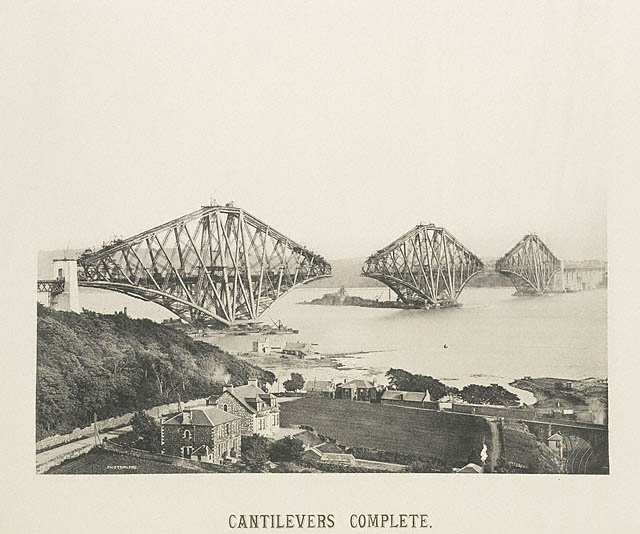
For example, the full-sized version of this photograph of the construction of the Forth bridge in Scotland is available for download:

Cantilevers Complete, 9th July 1889

Cantilevers Complete, 9th July 1889

This image is available for download, without charge, under the Getty’s Open Content Program.

John Fergus
Scottish, July 9, 1889
Photogravure

84.XB.874.3.1.34

Scotland’s Forth Bridge bridge was built to carry the two tracks of the North British Railway one and a half miles over the Firth of Forth between South Queensferry and North Queensferry, a hundred and fifty feet above high tide. This photograph shows the gargantuan structure’s recently completed cantilevers reaching across the firth like outstretched arms. The presence of this mighty bridge drastically altered both the landscape and the lives of nearby residents.

Requiring 55,000 tons of steel, 640,000 cubic feet of granite, and 8,000,000 rivets, the Forth Bridge remains one of the safest bridges in use today. Having witnessed the worst train disaster up to that time in the late 1800s, the Scottish public demanded an exceptionally sound structure. An earlier bridge had swayed and collapsed in the wind, killing seventy-five passengers and crew members on a passing night train. As a result the frightened public needed-and got-a bridge that looked as though it could never tumble down.

July 20, 2013

“A man walks down the street in that hat, people know he’s not afraid of anything” – except copyright lawyers

Filed under: Law, Media — Tags: , , , , — Nicholas @ 08:41

At TechHive, Leah Yamshon talks about the fuzzy edge of law in the fan community:

Undying devotion to your favorite TV show can lead to much worse than a sedentary life parked on the couch. For Stephanie Lucas, it threw her right in the middle of an intellectual-property lawsuit: In March she was hit with a cease-and-desist order from 20th Century Fox Television.

Her actionable offense? She was selling a knitted hat inspired by a Fox TV show on Etsy.

Lucas is a member of the Firefly fan community, a group dedicated to Joss Whedon’s short-lived “space western” series that originally aired on Fox. “I’m absolutely in love with this show and its characters,” Lucas says. And thus her shop features one special item dedicated to her fellow Browncoats (a nickname for the Independence fighters in Firefly, and now for the fans themselves).

[…]

The Etsy market is full of unofficial, handmade hats.

The Etsy market is full of unofficial, handmade hats.

Fans who had been knitting these hats for years were now screwed, thanks to Fox’s claim that they broke the law after the official version debuted. But which law?

“Merchandising rights is a monster that has grown without any proper legal backing,” says Madhavi Sunder, a professor of law currently at University of California, Berkeley, with a specialty in intellectual property and culture. “Under traditional copyright law, the exclusive right to make these goods is not there,” she says. The U.S. Supreme Court has made no rulings in regard to merchandising rights, so intellectual-property violations have to be considered on a case-by-case basis.

Intellectual property is protected under both trademark and copyright, but the two concepts are different: Trademark protects names, terms, and symbols used to identify an original work or brand, and copyright protects the creative work itself. According to U.S. copyright law, the only groups with the right to distribute works based on an original creation are copyright holders. So, technically, only the original story creators are allowed to make pieces featuring images and concepts for which they hold the copyright.

May 29, 2013

Lessons learned in the post-Napster era

Filed under: Business, Law, Media — Tags: , , , — Nicholas @ 16:25

At TechDirt, Mike Masnick discusses the things we learned from Napster:

Last fall, law professor Michael Carrier came out with a really wonderful paper, called Copyright and Innovation: The Untold Story. He interviewed dozens of people involved in the internet world and the music world, to look at what the impact was of the legal case against Napster, leading to the shutdown of the original service (the name and a few related assets were later sold off to another company). The stories (again, coming from a variety of different perspectives) helps fill in a key part of the story that many of us have heard, but which has never really been written about: what an astounding chill that episode cast over the innovation space when it came to music. Entrepreneurs and investors realized that they, too, were likely to get sued, and focused their efforts elsewhere. The record labels, on the other hand, got the wrong idea, and became totally convinced that a legal strategy was the way to stem the tide of innovation.

The Wisconsin Law Review, which published Carrier’s paper, asked a few people to write responses to Carrier’s paper, and they recently published the different responses, including one from a lawyer at the RIAA, one from another law professor… and one from me. This post will be about my paper — and I’ll talk about the other papers in a later post. My piece is entitled When You Let Incumbents Veto Innovation, You Get Less Innovation. It builds on Carrier’s piece, to note that the stories he heard fit quite well with a number of other stories that we’ve seen over the past fifteen years, and the way in which the industry has repeatedly fought innovation via lawsuits.

You can read the whole paper at the link above (or, if you prefer there’s a pdf version). I talk about the nature of innovation — and how it involves an awful lot of trial and error to get it right. The more trials, the faster what works becomes clear, and the faster improvement you get. But the industry’s early success against Napster made that nearly impossible, and massively slowed down innovation in the sector. Yes, a few players kept trying, but it developed much more slowly than other internet-related industries. And you can see why directly in the Carrier paper, where entrepreneurs point out that it’s just not worth doing something in the music space, because if you want to actually do what the technology enables, the kinds of things that are cool and useful and which consumers would really like… you’ll get sued.

May 22, 2013

Fan fiction goes mainstream with Amazon’s Kindle Worlds

Filed under: Books, Business, Media — Tags: , , — Nicholas @ 12:54

People tend to have strong opinions on fan fiction (well, people who know it exists, anyway). This development will polarize fan ficcers very quickly:

The Twitters are abuzz today about Amazon’s new “Kindle Worlds” program, in which people are allowed to write and then sell through Amazon their fan fiction for certain properties owned by Alloy Entertainment, including Vampire Diaries and Pretty Little Liars, with more licenses expected soon. I’ve had a quick look at the program on Amazon’s site, and I have a couple of immediate thoughts on it. Be aware that these thoughts are very preliminary, i.e., I reserve the right to have possibly contradictory thoughts about the program later, when I think (and read) about it more. Also note that these are my personal thoughts and do not reflect the positions or policies of SFWA, of which I am (still but not for much longer) president.

1. The main knock on fan fiction from the rights-holders point of view — i.e., people are using their characters and situations in ways that probably violate copyright — is apparently not at all a problem here, since Alloy Entertainment is on board for allowing people to write what they want (within specific guidelines — more on that in a bit). Since that’s the case, there’s probably a technical argument here about whether this is precisely “fan fiction” or if it’s actually media tie-in writing done with intentionally low bars to participation (the true answer, I suspect, is that it’s both). Either way, if Alloy Entertainment’s on board, everything’s on the level, so why not.

2. So, on one hand it offers people who write fan fiction a chance to get paid for their writing in a way that doesn’t make the rightsholders angry, which is nice for the fan ficcers. On the other hand, as a writer, there are a number of things about the deal Amazon/Alloy are offering that raise red flags for me.

[. . .]

4. This won’t spell the end of unauthorized fan fic, and I’m very sure of that. For one thing, the Kindle Worlds program says it won’t accept “pornography” which means all that slash out there will still be on the outside of the program; likewise crossover fan fic, so those “Vampire Diaries meet Dr Who” stories will be left out in the cold. And besides that, there will be people who a) have no interest in making money and/or b) don’t write well enough to be accepted into the Kindle Worlds program (there does seem that there will be some attempt at quality control, or at least, someone has to go through the stuff to make sure there’s nothing that’s contractually forbidden). So if this was an attempt to squash fan fic through other means, it’s doomed to failure. But I don’t suspect that’s the point.

Update:

April 24, 2013

Copyright terms are almost certainly too long already

Filed under: Books, Business, Economics, Law, Media — Tags: , , , — Nicholas @ 11:59

At Techdirt, Mike Masnick makes the case for reducing the swollen length of time current copyrights are protected:

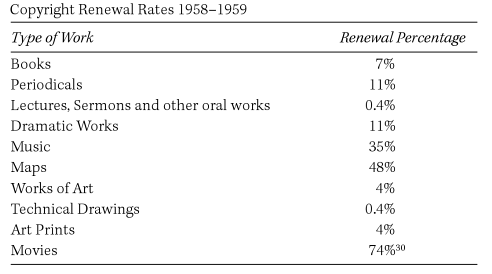
We’ve pointed a few times in the past to a chart from William Patry’s book, looking at how frequently copyright was renewed at the 28 year mark back when copyright (a) required registration and (b) required a “renewal” at 28 years to keep it another 28 years. The data is somewhat amazing:

Copyright renewal rates 1958-59

As you can see, very few works are renewed after 28 years. Only movies, at 74% are over the 50% mark. Only 35% of music and only 7% of books tells quite a story. It makes it quite clear that even the copyright holders see almost no value in their copyrights after a short period of time. It appears that the Bureau of Economic Analysis is coming to the same conclusion from a different angle. As Matthew Yglesias notes, as part of its effort to recalibrate how it calculates GDP, the BEA is considering money spent on the creation of content an “investment” in a capital good, which needs to be depreciated over the time period in which it is valuable. Frankly, I’m not convinced this is the smartest way to account for money spent on the creation of content, but either way, the BEA’s analysis provides some insight into the standard “economic life” of various pieces of content, which match up with the chart above in many ways.

April 16, 2013

Andy Baio: Copyright is the new Prohibition

Filed under: Business, Law, Media, Technology — Tags: , , , , — Nicholas @ 13:58

Techdirt‘s Mike Masnick explains:

Andy Baio has an absolutely fantastic video presentation that he did recently for Creative Mornings/Portland on what he’s calling The New Prohibition. It’s half an hour long, but absolutely worth watching.

[. . .]

This video lets him talk a bit about the aftermath — to explain the true chilling effects of the threat and the eventual settlement. Baio is a creator. It’s in his blood. It’s what he’s always done, but after this he was afraid to create. Being threatened with a lawsuit, even if you believe you’re right, is a scary and possibly life-altering moment. Lots of people who have not been in those shoes think it’s nothing and that they could handle it. You don’t know.

As he notes in the talk, copyright law is probably the most violated law in the US after speeding and jaywalking (and I’m not even sure copyright infringement is really in third place in that list). But getting rung up for one of those gives you a “bad day” situation, not a ruined life. Copyright, on the other hand, can ruin your life. And chill your speech and creativity.

And this is the worst part: so many people, especially kids, are at risk. Baio also famously highlighted the prevalence of the phrase “no copyright intended” on YouTube. Tons of kids uploading videos use clips of music and videos with a phrase like that. Or with statements about fair use. Or with copyright law quotes. All, as he notes, to try to find that magic voodoo that wards off a possible lawsuit. Most of those people aren’t being sued.

But they could be.

March 9, 2013

Good news and bad news about border searches of your electronic devices

Filed under: Bureaucracy, Liberty, USA — Tags: , , , , , — Nicholas @ 11:32

Declan McCullagh on the mixed news from a recent court ruling:

U.S. customs officials must have a reasonable justification before snatching your laptop at the border and scanning through all your files for incriminating data, a federal appeals court ruled today.

The Ninth Circuit Court of Appeals ruled that Homeland Security’s border agents must have “reasonable suspicion” before they can legally conduct a forensics examination of laptops, mobile phones, camera memory cards, and so on.

Today’s opinion is a limited — but hardly complete — rejection of the Obama administration’s claim that any American entering the country may have his or her electronic files minutely examined for evidence of criminal activity. Homeland Security has said the electronic border searches could detect terrorists, drug smugglers, and people violating “copyright or trademark laws.”

March 7, 2013

This is why I recently stopped linking to the National Post

Filed under: Business, Cancon, Media, Quotations — Tags: , , — Nicholas @ 15:18

Michael Geist explains:

… if someone wants to post a quote from Selley or anything else written by the National Post, they are now presented with pop-up box seeking a licence that starts at $150 for the Internet posting of 100 words with an extra fee of 50 cents for each additional word (the price is cut in half for non-profits).

[. . .]

None of this requires a licence or payment. In fact, the amount of copying is often so insubstantial that a fair dealing analysis is not even needed. Last year, the Federal Court of Canada ruled that several paragraphs from a National Post column by Jonathan Kay posted to an Internet chat site did not constitute copying a substantial part of the work. If there was a fair dealing analysis, there is no doubt that copying a hundred words out of an article would easily meet the fair dealing standard. In fact, the Supreme Court of Canada has indicated that copying full articles in some circumstances may be permitted.

I make no money from my blogging … in fact I pay money to maintain the web site. The idea of spending $150 per quotation from any source is pretty much a guarantee that I won’t be linking to that source very much at all. At about the same time the National Post brought in their pay-to-quote policy, they also launched a reader rewards program. The idea seemed to be that you log in to their site, it tracks everything you read and then you get a pony at the end of the day, or week, or month, or Baktun, or something. Or maybe not … I really didn’t pay too much attention.

February 24, 2013

Sherlock Holmes and the case of public domain

Filed under: Books, Law, Media, USA — Tags: , , , , — Nicholas @ 10:36

Following up on an earlier post (“The case of the over-extended copyright“), The Economist explains why there is still legal wrangling going on over the copyright claims on Sherlock Holmes:

The situation is muddled by differing copyright regimes in America and elsewhere. No one disputes that the copyright has expired on Conan Doyle’s work anywhere where protection ceases 70 years after an author’s death (he died in 1930). Yet when America reformed its copyright rules in 1978 to introduce a “life plus” model in harmony with the rest of the world for works created starting in 1978, it retained its older term-limited system for property created between 1923 and 1977. Works produced within that range have had their expiration extended to a fixed 95-year term from first publication; anything produced earlier is in the public domain. This umbrella of protection covers ten Holmes stories published in America for the first time as part of The Case-Book of Sherlock Holmes in 1927. These stories are still under copyright until January 1st 2023.

[. . .]

The estate also asserts some trademark rights on the Holmes characters, but Mr Klinger confirms to your correspondent that this was not part of the license claim. Jennifer Jenkins, the director of Duke University’s Centre for the Study of the Public Domain, says trademark protection would be inapplicable, in any case. “Trademark law doesn’t fit what they’re claiming to own or what they’re trying to stop,” she says. Ms Jenkins also dismisses any copyright claim the estate might have to any pre-1923 elements of Holmes’s biography. “The problem is that Sherlock Holmes and Watson are quite clearly in the public domain.” The estate did not respond to a request for details about its intellectual property.

[. . .]

An expert in the duration of copyright terms in America, Peter Hirtle of Cornell University finds no basis for the Conan Doyle estate to claim general ownership over aspects of Holmes from stories that are in the public domain. “Let’s imagine that the fact that Holmes plays the violin was included for the first time in one of the copyrighted stories,” he says via e-mail, “then it can’t be included in any new story that draws on the public domain versions.” But if the “Company” stories rely entirely on public-domain elements, then the estate has no ground to stand on, he adds.

February 20, 2013

Publicly funded research results should be available to the people who paid for them

Filed under: Books, Government, Media, Science, USA — Tags: , , , — Nicholas @ 09:52

At Techdirt, Mike Masnick explains why publishers are losing their collective shit over a new bill that would require almost all government-funded research to be made generally available:

A year ago, we wrote about Rep. Mike Doyle introducing an important bill to provide public access to publicly funded research. As we’ve been discussing for years, the academic journal business is a huge boondoggle. Unlike just about any other publication, the journals don’t pay their writers (and in many subject areas, authors need to pay to submit), they don’t pay the peer reviewers — and then they charge positively insane amounts to university libraries, often knowing that those libraries feel obligated to pay. Oh yeah, and the journals keep the copyright on everything. I’ve heard of researchers having to redo basic experiments because they were worried they couldn’t even reuse data from earlier experiments due to the copyright assignment agreement they had to sign.

Thankfully, for years, there’s been a law on the books for any NIH-funded research to guarantee that 12-months after publication, those works also had to be published openly. While some publishers have tried to game this system (such as by demanding a mandatory fee to “deposit” the work in an open access database), on the whole this has been hugely important in making sure that taxpayer funded research is actually available and can be built upon. Over the years, there have been multiple bills introduced in both directions on this issue. There have been some bills that sought to take away this requirement under NIH funding and there have been bills that have tried to expand it to the rest of the federal government and any of the research they sponsor.

[. . .]

But, of course, the publishers are really not happy about all of this, calling it “different name, same boondoggle.” This is quite incredible, really, since it’s really the publishers who have been getting away with a giant boondoggle for ages. If that gives you an idea about just how ridiculous the publishers’ claims are, read on. Nearly every claim they make in attacking the bill actually applies to the publishers themselves much more than to the bill [. . .]

Basically, the publishers know that their current position with these journals is such a sweet deal that they don’t want anything to mess with it at all. That’s ridiculous. While they’re fighting for ever bigger profits, we’re talking about access to research that was funded with our own dollars. It’s really sad that the publishers would fight such a thing, though it shows what they really think concerning education. To them, it’s not about how best to disseminate information, but how to lock it up and charge insanely high prices for it.

February 17, 2013

The case of the over-extended copyright

Filed under: Books, Law, Media — Tags: , , — Nicholas @ 10:28

In this story, Sherlock Holmes and Doctor Watson encounter a true mystery: why the heirs of author Sir Arthur Conan Doyle are still able to pressure publishers for licensing fees long after the original stories should have been fully in the public domain:

It isn’t often one gets a ringside seat at a legal-literary battle royal, but it would seem that we’re about to bear witness to some activity in that particular area.

Of course, you’ll recall that recent legal battles in England have revolved around Undershaw, Conan Doyle’s home for about a decade that included when he wrote The Hound of the Baskervilles. [. . .] But this is wholly different.

The noted Sherlockian scholar, Baker Street Irregular and prominent attorney Leslie Klinger, editor of The New Annotated Sherlock Holmes, The Sherlock Holmes Reference Library and The Grand Game: A Celebration of Sherlockian Scholarship, to name a few, has filed a civil lawsuit against the Conan Doyle Estate to determine that the characters of Sherlock Holmes and Dr. Watson are in fact in the public domain.

Currently, the so-called estate undertakes high-handed legal action to levy royalties and other payments from authors who use the characters in their own works. This is despite the fact that there are only 10 stories in the entire Canon that are still under copyright protection (in the United States). Klinger, for one, will not stand for this bullying, and has formally filed suit and issued a press release.

H/T to Tim Harford (and Cory Doctorow) for the link.

« Newer PostsOlder Posts »

Powered by WordPress