Quotulatiousness

September 26, 2021

“… is there a single area of public policy where Canada has its shit together?”

Filed under: Bureaucracy, Cancon, Government — Tags: , , , — Nicholas @ 03:00

In The Line‘s weekly round-up, they point out a little-noticed Globe and Mail article that illustrates something that should really concern Canadians:

Sometimes the big lessons are in the small things. While everyone was busy jawboning about the federal election returns earlier this week, we were also struck by a barely noticed story in the Globe and Mail reporting that the federal government had awarded a contract to begin replacing the disastrous Phoenix payroll system. Phoenix, you’ll recall, was an IT project designed to harmonize the payroll for the entire federal public service. The 2016 rollout was a disaster, resulting in thousands of employees being paid too much, too little, or not at all. Fixing it has cost billions and has not entirely succeeded, and now it is being replaced entirely.

We were still pondering this news when Alex Usher idly wondered: “Genuine question: is there a single area of public policy where Canada has its shit together?”

Alex isn’t some rando Twitter troll. By day he runs Canada’s premier higher education consultancy. But he’s also one of the country’s most perceptive policy analysts, writes a daily blog about just about anything policy related, and is probably one of the three or four smartest Canadians still on Twitter.

Which is why his question was met with more thoughtful responses than the usual schoolyard heckling that is typical of the platform. Fiscal policy between 1993 and 2015, offered Ken Boessenkool. Andrew Coyne half-heartedly suggested monetary policy. Rachel Curran proposed immigration, prisons, and the coast guard, but was quickly set right by people who knew what they were talking about.

So when Usher followed his question with a long Twitter thread showing just how broken Canada is, with a sophisticated and nuanced take on why that’s the case, there really wasn’t anyone left making a serious argument against him. Everyone knows it is true.

Everyone, that is, except two of the most politically polarized groups in the country, who disagree about everything except the capacities of the government.

On the one hand there are the Build Back Better people, mostly housed in the increasingly unpopular Liberal Party of Canada. These people persist in believing that the federal government is poised to make big decisions, to take big actions, on big issues such as climate change, pandemic preparedness, and dealing with the rise of China. They are prepared to talk big talk, and spend big money, in pursuit of their policy objectives.

On the other, there are the paranoid conspiracists who believe that the government is using the cover of the COVID-19 pandemic to implement all manner of social controls. These include suspicions that the government would use a contact tracing app to engage in mass surveillance, that they are putting a 5G payload into the vaccines, or that this is all part of a big Liberal internationalist plan to set up a world government.

While these seem to be diametrically opposed worldviews, what they share is the deep conviction that the government can actually do something. Indeed, what is charming about the conspiratorial worldview is how much faith it actually has in the authorities.

Confront China? Please. We can’t buy ships, planes or even handguns for our military. Pandemic preparedness? You’re kidding, right? We can’t even hire enough nurses for the health-care system. Set up a world government? Lol who would we hire to work for this government? We can’t even figure out how to pay the public servants we already have on staff.

As usual, the correct counter to conspiracy-minded thinking is not to have faith in government, it’s to be realistic about it. Similarly, the correct response to the build back better crew is not enthusiasm, but realism. And ultimately, the right approach to everything the government proposes is deep, deep, deep cynicism.

One of the major reasons I’ve long favoured smaller government — the smaller the better — is that the bigger any organization gets and the more things it tries to do, the less effective it is at all of them. Governments in the western world generally have gotten so big that they’re incapable of doing almost anything in an effective, competent, and repeatable manner. A hypothetical world government would be even worse (just look at the existing United Nations to see how billions of dollars not only get nothing useful done, but often exacerbate existing problems).


May 1, 2021

The more we ask governments to do, the less well they do … everything

Filed under: Cancon, Government, Media, Politics — Tags: , , , , , , — Nicholas @ 05:00

Matt Gurney’s latest Code 47 post reflects on the good and bad of Canadian governance right now (and yes, I agree with his basic take that despite buffoonery and incompetence at all levels of government, Canadians still generally have it good):

Parliament Hill in Ottawa.
Photo by S Nameirakpam via Wikimedia Commons.

In some ways, absolutely. Canada’s relative awesomeness is not an accident. We rest on the accomplishments of prior generations and some of what we do today contributes directly to the common prosperity. A ton of stuff happens behind the scenes, every day, that contribute enormously to our way of life — really, make it possible. But in other ways, the pandemic has revealed just how incompetent and inept our governments have become meeting new challenges. It’s like every last bit of bandwidth our governments have is used up just keeping the status quo running along, and if we ask it to do anything new, it’s like hitting a computer with one process too many for its CPU. It just locks up.

Real-life example: I was watching today as the Ontario and federal governments continued bickering about the proper border controls we should have during what will probably be the last phase of this crisis. And what struck me was the sheer insanity of not having settled this a long time ago. I’m not even saying what I think the answer should have been. There’s a lot of genuinely competing interests there. I have my opinion, you can have yours. But can we at least agree that what to do about the goddamn borders ought not to still be under active decision 14 frickin’ months after this all began?

The federal government, in particular, seems to have fallen into a trap of its own making in that it corporately seems to believe that saying they’ll do something is exactly the same as actually doing something. Often enough, I’m pleased and relieved to find that Trudeau Jr.’s latest brain fart never got further than the press release and obligatory photo op, but it has become a constant in federal affairs. Optics matter far more than achievements, as long as the tame Canadian media play along — and they always played along with their boyfriend PM even before he bought them off with real money — nothing really changes. And everyone seems generally okay with this … except that real problems are not being addressed (ask any First Nations representative about how well the feds are helping with long-standing, known issues, for instance).

Certain provinces have done better than others. It’s tempting to point at them and go, ah ha, there’s what we should have done. And I think this is in large part fair and true. But it’s hard to make direct comparisons. Nova Scotia is not Ontario, and what worked in Nova Scotia wouldn’t necessarily have worked here. Believe me, if I could have swapped in their leaders for ours, I would have. It would have been an upgrade for sure. But the right solution, and personalities, for one crisis, in one time and place, aren’t necessarily the right solution for even that same crisis, at the same time, in a different place. I suspect we’ll spend a long time arguing about this once it’s all over, but I think that’s more or less where I’ve landed. Most of us would have been better off trying to be more like the Atlantic, but that doesn’t mean it would have recreated Atlantic-like successes everywhere.

But all that being said, there have been enormous basic failures, both in leadership and execution. You’ve all heard the joke about how someone new to government is shocked and dispirited to finally seize the levers of power, only to discover they’re not connected to anything. You can push and pull the levers all day long. But they don’t do anything. In Canada, both federally and in some of the provinces, we’ve been shockingly slow, again and again, to pull those levers. And sometimes, even after they’re pulled, nothing happens.

I don’t know if I have this thought through yet in a meaningful, useful way. This is a big, big idea that I’m starting at from different angles, trying to even conceive of its dimensions and scope. But if there is one problem we have — we have more, but if there is a meta-problem — I think it is that Canadian governments have lost the ability to execute new policy agendas. What we already have will generally work, more or less. But new things, or updates to old things? We routinely accept that failure is an option, or that even our successes will be late and overbudget — beyond acceptable real-world margins. (Life is always more complicated than theory.) There are things in my life that I just take for granted will work. If I get into my car and it doesn’t start, that surprises me, even though I am intellectually aware that that’s a possibility every time I try. But too often, with government, there is an entirely justified skepticism that it’ll succeed at all, let alone as intended, and yet, we shrug, because, hey. It’s Canada. Things are still good. How upset can I get about another program failure when I can just go fire up the barbecue and watch some hockey or something.

Governments are generally not very good at solving problems, especially novel problems that don’t already have a template to follow for success in similar circumstances. Set up a bureaucracy, establish processes and procedures, and set it in motion and it’ll carry on until the final Trump, but don’t ask it to cope with a crisis or even just an unexpected event or six. That’s not what they’re good at and they generally lack the organizational flexibility to adapt on the fly. Or at all.

August 1, 2020

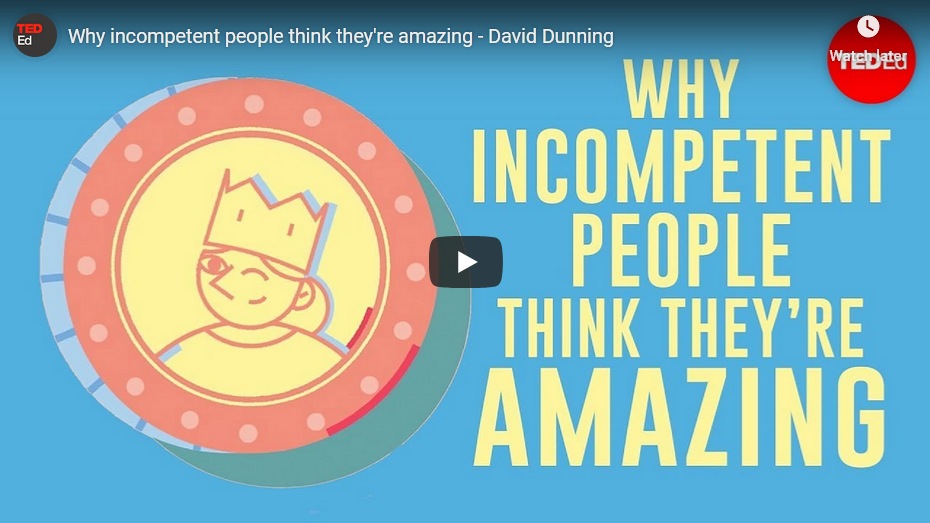
Why incompetent people think they’re amazing – David Dunning

Filed under: Business, Education, Science — Tags: , , — Nicholas @ 06:00

TED-Ed
Published 9 Nov 2017

Check out our Patreon page: https://www.patreon.com/teded

View full lesson: https://ed.ted.com/lessons/why-incomp…

How good are you with money? What about reading people’s emotions? How healthy are you, compared to other people you know? Knowing how our skills stack up against others is useful in many ways. But psychological research suggests that we’re not very good at evaluating ourselves accurately. In fact, we frequently overestimate our own abilities. David Dunning describes the Dunning-Kruger effect.

Lesson by David Dunning, directed by Wednesday Studio, music and sound by Tom Drew.

Thank you so much to our patrons for your support! Without you this video would not be possible!
Juan, Jordan Tang, Kent Logan, Alexandra Panzer, Jen, Ellen Spertus, Ryan Mehendale, Mary Sawyer, Scott Gass, Ruth Fang, Mayank Kaul, Hazel Lam, Tan YH, Be Owusu, Samuel Doerle, David Rosario, Katie Winchester, Michel Reyes, Dominik Kugelmann, Siamak H, Stephen A. Wilson, Manav Parmar, Jhiya Brooks, David Lucsanyi, Querida Owens.

April 5, 2019

The Brexit trainwreck is “revealing to the British public the extent of its political class’s incompetence”

Theodore Dalrymple in City Journal on the scale of political tomfoolery going on in the Brexit clusterfutz:

The imbroglio over Brexit has at least had the merit of revealing to the British public the extent of its political class’s incompetence. If it is accepted that people get the leadership that they deserve, however, thoughts unflattering to self-esteem ought to occur to the British population.

Theresa May did not emerge from a social vacuum. She is typical of the class that has gradually attained power in Britain, from the lowest levels of the administration to the highest: unoriginal, vacillating, humorless, prey to the latest bad ideas, intellectually mediocre, believing in nothing very much, mistaking obstinacy for strength, timid but nevertheless avid for power. Thousands of minor Mays populate our institutions, as thousands of minor Blairs did before them.

Avidity for power is not the same as leadership, and Brexit required leadership. There was none to be had, however, from the political class. From the very first, it overwhelmingly opposed Brexit — for some, the eventual prospect of a tax-free, expense-jewelled job in Brussels was deeply alluring — but found itself in a dilemma, since it could not openly deny the majority’s expressed wish. Many Members of Parliament sat for constituencies in which a solid majority had voted for Brexit. They feared that they would not win their next election.

The opposition Labour Party was as divided as the Conservatives. Irrespective of what its MPs actually believed about Brexit—its leader was, until recently, ardent for leaving the European Union, which he believed to be a capitalists’ club, changing his mind for reasons that he has so far not condescended to disclose — its main concern was to force an election that it believed it could win, a victory that would soon make Brexit seem like a minor episode on the road to ruin. The majority of the Labour MPs wanted first to bring about the downfall of a Conservative government and second to prevent Britain leaving the European Union without an agreement — what might be called the leaving-the-Union-without-leaving option. But they wanted the first more than they wanted the second, so under no circumstances could they accede to anything that Prime Minister May negotiated. Because of her tiny majority in Parliament, the hard-line Brexit members on her own side who want Britain to leave without a deal, and the refusal of her coalition partner, the Democratic Unionist Party, to back her, May needs the support of a considerable proportion of Labour MPs — which, so far, she has not received.

But the House of Commons as a whole, including the Conservatives, deprived May of leverage with which to renegotiate, because it voted that it would not accept leaving the Union without a deal. This deprived the European Union of any reason to renegotiate anything: it was a preemptive surrender to the demands of the E.U. that makes Neville Chamberlain look like a hard-bitten poker champion.

March 3, 2018

QotD: Elite incompetence

Filed under: Britain, Europe, Government, Quotations — Tags: , , — Nicholas @ 01:00

Most people, most of the time, are perfectly happy to let elites run the country. After all, it seems to make the elites happy to run run things, and as long as they’re reasonably competent at it, and do it reasonably unobtrusively, no one much seems to care. But when elite competence is compromised by faulty ideology and cronyism, people become unhappy. And when the elite response to complaints is dismissal or insult, political problems begin to bloom. People begin to think about politics. They begin to do things. It is no coincidence, as our Soviet friends used to say, that the last decade has seen the rise of the TEA Party, the Occupy Movement, and the Trump phenomenon. People of all political stripes are becoming unhappy.

I think we’re about to watch the elites start paying a price for their incompetence, inattention and contempt. Euroskepticism is on the rise elsewhere in Europe. If EU membership were put to a popular vote in the Netherlands, Spain, or Sweden, there is a good chance that Leave would win there, too. Indeed, it’s possible that a vote to leave the EU might even win in France, the nation for whom creating and strengthening the EU has been the primary policy goal for 60 years.

Perhaps the “Vote Remain, you virulent racist!” PR campaign for staying in the EU needs a bit more thought.

Dale Franks, “Vote Properly, You Virulent Racist!”, Questions and Observations, 2016-06-28.

November 22, 2017

Why incompetent people think they’re amazing – David Dunning

Filed under: Health, Randomness — Tags: , , — Nicholas @ 02:00

TED-Ed
Published on 9 Nov 2017

View full lesson: https://ed.ted.com/lessons/why-incompetent-people-think-they-re-amazing-david-dunning

How good are you with money? What about reading people’s emotions? How healthy are you, compared to other people you know? Knowing how our skills stack up against others is useful in many ways. But psychological research suggests that we’re not very good at evaluating ourselves accurately. In fact, we frequently overestimate our own abilities. David Dunning describes the Dunning-Kruger effect.

Lesson by David Dunning, directed by Wednesday Studio, music and sound by Tom Drew.

Thank you so much to our patrons for your support! Without you this video would not be possible!
Juan, Jordan Tang, Kent Logan, Alexandra Panzer, Jen, Ellen Spertus, Ryan Mehendale, Mary Sawyer, Scott Gass, Ruth Fang, Mayank Kaul, Hazel Lam, Tan YH, Be Owusu, Samuel Doerle, David Rosario, Katie Winchester, Michel Reyes, Dominik Kugelmann, Siamak H, Stephen A. Wilson, Manav Parmar, Jhiya Brooks, David Lucsanyi, Querida Owens.

The first rule of Dunning-Kruger Club is that you don’t know you’re in Dunning-Kruger Club…

August 14, 2017

When did you first suspect that the world was being run by incompetent idiots?

Filed under: Government, Media, Politics, USA — Tags: , , , — Nicholas @ 04:00

Ace discusses the moment he realized there was a perfectly reasonable explanation for the otherwise incomprehensible way our government and mainstream media operate:

Here’s a question I’d like to ask. I’ll try to figure out my own answer in the comments. But this is what I’m interested in:

When did you begin to suspect that the people in charge of the government and the media were dumb, ignorant, and sometimes actually deranged, and what confirmed it for you? What were your feelings about this? That is, was it like taking the Red Pill? Was it scary?

I’m trying to remember when this happened to me. Oh, the media I knew was biased; but I didn’t realize until the last decade that it was pig-ignorant and incompetent and filled with people who are mentally unwell.

The government — well, I blithely assumed that people who ran the government (or other major institutions) were generally at least low-level qualified.

At some point I realized we are being led — or rather controlled, as we do not follow willingly, but through coercion — by misfits, morons, and maniacs.

It was both scarifying and liberating, in a dark way.

But I think these realizations came kind of slowly and I’m trying to think of major things that crystallized them.

It also changed my opinion of many of my fellow citizens and onetime allies: I now view them as fools and maniacs (or worse) themselves for apparently seeming to continue to believe that Everything’s Okay and we’re still being led (controlled) by, if not the best and brightest, certainly the somewhat good and reasonably intelligent.

March 18, 2016

QotD: The war on competence

Filed under: Books, Business, Media, Quotations, USA — Tags: , , — Nicholas @ 01:00

There is a war on. People who can do things, even just the things our parents could do, or less, are losing.

[…]

But there is worse. Lately I’ve been running into a new category “people who can’t do their jobs.” And these aren’t just our manual labor imports, I mean, people who supposedly are trained and certified and either can’t or won’t do their jobs.

I know everyone was very impatient with me last year when I was fixing the house for sale, but honestly, there is a reason I do all the manual labor I can. The reason is the tile wall I paid someone 1500 to fix (it had fallen. Long story) and which fell in the night, the day after he put it up. He’d mixed the adhesive wrong. So he came back and fixed it. It fell again. The third time I got a book (this was before Youtube) figured how to do it and did it. This wasn’t an isolated incident. It just keeps happening when someone comes over to fix something. So if I can, I do it.

But there’s more serious cases, like the guy who replaced our brakes but didn’t replace the brake cables. Leading to us losing brake power 15 minutes later. (Thank G-d someone was looking out for us. We lost it a) when Dan was driving. I’d have panicked. Well, he did too, but… he works even panicked. b) we were JUST outside a garage c) we’d been going very slowly.) Or the doctor who convinced himself my 13 year old had an STD and wouldn’t listen to the kid when he insisted he was a virgin. If I hadn’t gone over his head to a urologist, and told the boy to stop taking the antibiotic that was making him ill, my son would probably have died within months. (Of the problem, which was rare, but not unheard of particularly in early teens. As in the urologist identified it on symptoms alone.)

I’ve been given completely wrong instructions by someone selling me a machine or a product. I’ve had ghastly things done to garments or objects taken in for repair because the person who was supposedly an expert on this just couldn’t do it.

[…]

Publishing… well, there’s a reason the houses are floundering. And it’s not just the innovation, the end of push marketing, or the fact they can’t wrap heads around Amazon. That’s all I’ll say. Every time someone tells me they can’t go indie because how do they know the book is good if no professional has read it, I remember when I was sitting in a panel with the editor of my friend’s book, (professional, one of the big five) and it became clear not only hadn’t she read the book, but she had only skimmed the proposal. I later watched for the tells and (other than Baen) most of my books were published without anyone but the copyeditor even looking at them. And the copyeditor often sounded like she (it was always a she) had a high school education, even the ones editing history books.

Movie making. Director’s cuts are illuminating. “I filmed that scene, then it didn’t work. I don’t know why” — usually the reason is a gross error in basic storytelling. One anyone who had read a couples of plotting books could fix. But billionaires in Hollywood have no clue. They were never trained.

Sarah Hoyt, “The War On Competence”, According to Hoyt, 2016-03-04.

February 21, 2014

QotD: The unexpected benefit of government incompetence

Filed under: Bureaucracy, Government, Quotations, USA — Tags: , , — Nicholas @ 14:56

As Eugene McCarthy, of all people, observed: “The only thing that saves us from the bureaucracy is inefficiency. An efficient bureaucracy is the greatest threat to liberty.”

Luckily the United States is blessed with one of the most incompetent governments in the developed world. It isn’t simply that the Americans have a bloated government, it’s that they have a bloated government that accomplishes far less dollar for dollar than the bloated governments of other leading nations.

This is why Americans should have no fear of Canadian style socialized health care being imposed on them, their government isn’t smart enough to run it. That said Obamacare is turning out to be something that makes Canadian Medicare look like the Swiss Army. I grimly await the flood of American health care refugees trickling north of the 49th. That’s bad news for them and worse news for us. What kept the Canadian system semi-functional was the American escape hatch. If upper middle class Canadians can no longer sneak across to Buffalo, Burlington or Seattle for treatment, that puts more pressure on our system.

From time to time I’m asked why government is so incompetent. It’s such a truism among conservatives, libertarians and classical liberals that it’s rarely reflected upon. February is cold in Winnipeg, governments are generally incompetent. We accept these things perhaps too readily. The truism is true, but in assuming it so blithely we fail to communicate its importance to reasonable people who are uncommitted.

Richard Anderson, “The Incompetence of Evil Government”, The Gods of the Copybook Headings, 2014-02-20

November 26, 2013

The illusion of omnicompetence

Filed under: Business, Humour, Technology — Tags: , , , , — Nicholas @ 08:38

I’ve expressed this as variations on “the deeper the specialization, the more those specialists feel they’re experts on much wider subjects”. Megan McArdle‘s formulation is rather neater than that:

Amid the chaos, I got a call from the secretary of a very senior executive at the firm. His new voice-recognition software wasn’t working, and he needed me to come up right away.

I had servers that weren’t working right and a bunch of workstations that couldn’t access the network. “He should call the help desk,” I told her.

Her tone was arctic.

“He doesn’t deal with help desk personnel,” she said. “Please come up here right away.”

So I went to the office of Mr. Senior Executive. He was not at his desk. I played with his new software, which seemed to be working fine — a bit slow, but in 1998, voice-recognition software took a while to become acclimated to your voice. I told the secretary it seemed to be working, and I left my pager number. It went off as I got to the elevator bank. I trekked wearily back to the office, where Mr. Senior Executive gestured at his computer. “It still doesn’t work right,” he said, and started to leave the office again.

“Hold on, please,” I said. “Can you show me exactly what’s not working?”

“It’s not doing what I want,” he said.

“What do you want?” I asked.

“I want it to be,” he replied, “like the computer on Star Trek: The Next Generation.”

“Sir, that’s an actor,” I replied evenly, despite being on the sleepless verge of hysteria. With even more heroic self-restraint, I did not add “We can get you an actor to sit under your desk. But we’d have to pay SAG rates.”

Now, when I used to tell this story to tech people, the moral was that executives are idiots. No, make that “users are idiots.” Tech people tend to regard their end-users as a sort of intermediate form of life between chimps and information-technology staffers: They’ve stopped throwing around their feces, but they can’t really be said to know how to use tools.

And, of course, users can do some idiotic things. But this particular executive was not an idiot. He was, in fact, a very smart man who had led financial institutions on two continents. None of the IT staffers laughing at his elementary mistake would have lasted for a week in his job.

Call it “the illusion of omnicompetence.” When you know a lot about one thing, you spend a lot of time watching the less knowledgeable make elementary errors. You can easily infer from this that you are very smart, and they are very stupid. Presumably, our bank executive knew that the phasers and replicators on Star Trek are fake; why did he think that the talking computer would be any more real?

August 14, 2013

If there’s a conspiracy, it’s a pretty ineffectual, incompetent one

Filed under: Economics, Government, USA — Tags: , , , , , — Nicholas @ 08:20

Jeff Thomas asks whether the gold market is being manipulated by shadowy conspiracies of governments, big banks, and international bodies:

… we are reminded that, no matter how evil we think a given government may be, no matter how greedy we think a given banker may be, both the world’s governments and the worlds banks have proven time and time again to be guilty of overreach; that is, they assume that their position of power will assure that, if they attempt to control a market, they will succeed.

However, history shows that both governments and banks have a patchwork quilt as a record for effectiveness in this regard. Both exhibit a history of misinterpretation of market drivers, inadequate planning and inadequate execution, to say nothing of a penchant for betraying one another. (The admission by Barclays Bank that they manipulated LIBOR is a good example.)

As such, the concept of a finely-tuned conspiracy of bankers and governments in which all the players (including the egotistical heads of countries) all agree on every facet of a “Grand Plan” is unlikely in the extreme. On the other hand, it is highly likely that an endless series of deals between any two or more parties will crop up along the way. They will succeed or fail to varying degrees. (And we should not overlook the likelihood that, whatever one group should attempt, another group may, inadvertently or not, spoil that attempt through their own plan, which may well be a different one.)

By arguing whether or not gold manipulation exists, we may find that we are wasting our brain cells on the question. A better question, and one that we might choose to monitor on a regular basis, might be, “To what degree is successful manipulation taking place?” We might then use the on-going answer as a guide, to inform our reasoning going forward, as to what impact any perceived manipulation is likely to have with regard to our precious metals investment.

June 7, 2012

High-ranking conspiracy or blundering incompetence?

Tim Worstall explores the range of possibilities:

Viewing the ghastly mess that politics makes of anything, it can be difficult to decide between cock-up and conspiracy theories. Are politicians simply too dim to perceive the effects of what they do, or are they are plotting to make the world a worse place?

Which brings us to where I believe the real climate change conspiracy is: in what we’re told we must do about it all. I’ve pointed out that if we assume that the basic science is correct (and I certainly don’t have either the hubris or technical knowledge to check it) then the answer is a simple carbon tax. The British Government employed Nick Stern to run through what was the correct economic response, assuming the IPCC was correct, and that was his answer. So the question has to be why hasn’t that same government enacted that very solution? Which is, as I say, where I think the conspiracy comes in.

For instead of this simple and workable solution we end up with the most ghastly amount of wibble and dribble.

Consider the subsidies to renewables. Our system gives higher subsidies to the more expensive technologies: clearly ludicrous. We have some limited amount of money, whatever that limit is, and we thus want to get as much renewable power as we can from that limited money. But we give five times more money per unit of power to the most expensive technology, solar, than we do to the cheapest, hydro. What have the politicians been smoking to deliberately spend our money in the most inefficient manner possible?

Or we could look at the argument for subsidy to solar itself: we’re told that it will be economic, comparable to coal-generated power, within only a couple of years. Thus we must have subsidy now – which is insane. If something is about to be profitable without subsidies then we don’t want anyone installing it yet; install it in a couple of years when it is profitable without subsidies. Why waste good money when we can just wait?

September 29, 2010

QotD: “Never attribute to malice that which can be explained by malice and incompetence”

Filed under: Media, Quotations — Tags: , , , , — Nicholas @ 13:11

I used to publish in the National Post back in the day Conrad Black ran the show. It was a business run with integrity. The last time I had a call from their editorial board I had to explain the Post paid me 40 cents a word. The man was genuinely scandalized — I mean audibly taken aback and offended — when I told him I would not hand my work over to him for free (btw, Adam, how did selling your integrity work out for you? Looks like you got what it was worth).

These days they don’t bother to call. Last week, they took my Margaret Atwood story and ran with it uncredited. They lacked the decency to do something that would have cost them nothing.

[. . .]

I am a writer. I don’t expect to get paid much. But I do expect to get paid. If this country aspired to be something more than a grasping, pissant kleptocracy celebrating third-raters and UCC school ties my work — this blog and others like it — would be understood as part of the real Canadian cultural establishment.

Fortunately, I don’t require their acknowledgement.

Nicholas Packwood, “Neither honour nor courage: The National Post”, Ghost of a Flea, 2010-09-29

June 14, 2010

Deadly would-be killers, or incompetent bumblers?

Filed under: Media, Middle East — Tags: , , , — Nicholas @ 12:32

An interesting article in The Atlantic points out that the formidable image the media has bestowed upon Al Qaeda and other terrorist organizations belies much of the reality:

To be sure, some terrorists are steely and skilled — people like Mohamed Atta, the careful and well-trained head of the 9/11 hijackers. Their leaders and recruiters can be lethally subtle and manipulative, but the quiet truth is that many of the deluded foot soldiers are foolish and untrained, perhaps even untrainable. Acknowledging this fact could help us tailor our counterterrorism priorities — and publicizing it could help us erode the powerful images of strength and piety that terrorists rely on for recruiting and funding.

Nowhere is the gap between sinister stereotype and ridiculous reality more apparent than in Afghanistan, where it’s fair to say that the Taliban employ the world’s worst suicide bombers: one in two manages to kill only himself. And this success rate hasn’t improved at all in the five years they’ve been using suicide bombers, despite the experience of hundreds of attacks — or attempted attacks. In Afghanistan, as in many cultures, a manly embrace is a time-honored tradition for warriors before they go off to face death. Thus, many suicide bombers never even make it out of their training camp or safe house, as the pressure from these group hugs triggers the explosives in suicide vests. According to several sources at the United Nations, as many as six would-be suicide bombers died last July after one such embrace in Paktika.

Many Taliban operatives are just as clumsy when suicide is not part of the plan. In November 2009, several Talibs transporting an improvised explosive device were killed when it went off unexpectedly. The blast also took out the insurgents’ shadow governor in the province of Balkh.

In the early 1980s, I remember reading a book (possibly Dean Ing’s Soft Targets), which made a strong case for the use of a very different anti-terrorism tactic: ridicule. Instead of investing these shadowy enemies with mystique and cunning, point out their all-too-human failings and poke fun at them for these weaknesses. An attribute of many fanatics is a total lack of any sense of humour or irony: this makes them very attractive foils for this kind of media counter-attack.

It’d be hard to come up with anything to make the Taliban appear more ridiculous than what they’re doing themselves:

If our terrorist enemies have been successful at cultivating a false notion of expertise, they’ve done an equally convincing job of casting themselves as pious warriors of God. The Taliban and al-Qaeda rely on sympathizers who consider them devoted Muslims fighting immoral Western occupiers. But intelligence picked up by Predator drones and other battlefield cameras challenges that idea — sometimes rather graphically. One video, captured recently by the thermal-imagery technology housed in a sniper rifle, shows two Talibs in southern Afghanistan engaged in intimate relations with a donkey. Similar videos abound, including ground-surveillance footage that records a Talib fighter gratifying himself with a cow.

November 10, 2009

QotD: “It’s not that the FBI is merely incompetent”

Filed under: Bureaucracy, Law, Quotations, Religion — Tags: , , , , , , — Nicholas @ 14:11

You know the scariest thing about this? It’s not that the FBI is merely incompetent. It is that, apparently, so many American Muslims in sensitive positions make contact with Al Qaeda that the FBI is forced to conduct investigatory triage and evaluate whether, in their minds, the emails are merely innocent-for-now banter or something demanding a more urgent response.

Otherwise, why the blow-off? I don’t understand how the FBI could possibly deem any chatter with Al Qaeda harmless and not worth investigating unless so much of this was going on that they had decide which illegal chatter with a hot-war enemy was worth their limited let’s-take-a-looksie-at-this resources.

Ace, “FBI: Hassan’s Al Qaeda Emails Were Probably Just Some Research and Social Chatter and Stuff”, Ace of Spades, 2009-11-10

« Newer Posts

Powered by WordPress