
The Great War
Published on 9 Nov 2017After the turmoil of the past weeks in Petrograd, the Soviets and the Red Guards seize the opportunity and topple the provisional government under Alexander Kerensky. Their first goal is to pull out of the war. The Italians were still in full retreat during the Battle of Caporetto and the British Army was still advancing in Palestine.
November 10, 2017
The Russian October Revolution 1917 I THE GREAT WAR Week 172
Comments Off on The Russian October Revolution 1917 I THE GREAT WAR Week 172
November 9, 2017
QotD: The reputation of Che Guevara proves “the triumph of marketing over truth and reality”
The Irish Post Office has issued a stamp to commemorate the fiftieth anniversary of the death of Ernesto Guevara. This is, presumably, because he was both very famous and had some distant Irish ancestry. It is, however, a rather sinister philosophy that the worth of a man’s work or ideas, or his influence on the world, is much affected, either for the better or the worse, by his distant ancestry.
Guevara’s reputation is, of course, the triumph of marketing over truth and reality. There is probably no resort of mass tourism in the world where Guevara kitsch is not on sale and, one must presume, bought; and in an odd way this is only appropriate, for mass tourism makes lemmings seem like unreconstructed individualists, and Guevara was nothing if not an ardent promoter of mass conformity and unthinking obedience. Like many an adolescent psychopath, as he remained all his life, he dreamed of making mankind anew — not in his own image, exactly, for he thought of himself as a leader rather than a follower, but according to his own far-from-profound ideas of what mankind should be. The triumph of marketing is to have made this apostle of the most complete servitude into an apostle of the most complete freedom.
The triumph of marketing over truth and reality is nothing new, however. To expect people who are trying to sell you something also to tell you the truth, the whole truth, and nothing but the truth is to expect what never did happen and what never will happen. The buyer will always have to beware, no matter what legal protections are put in place for the unwary; the necessity is inscribed, as it were, in human nature itself.
Theodore Dalrymple, “The Way of Che”, Taki’s Magazine, 2017-10-28.
Comments Off on QotD: The reputation of Che Guevara proves “the triumph of marketing over truth and reality”
November 4, 2017
November 2, 2017
George Orwell had a lot of rejection slips for Animal Farm
But of those, this one from T.S. Eliot is perhaps the most representative:
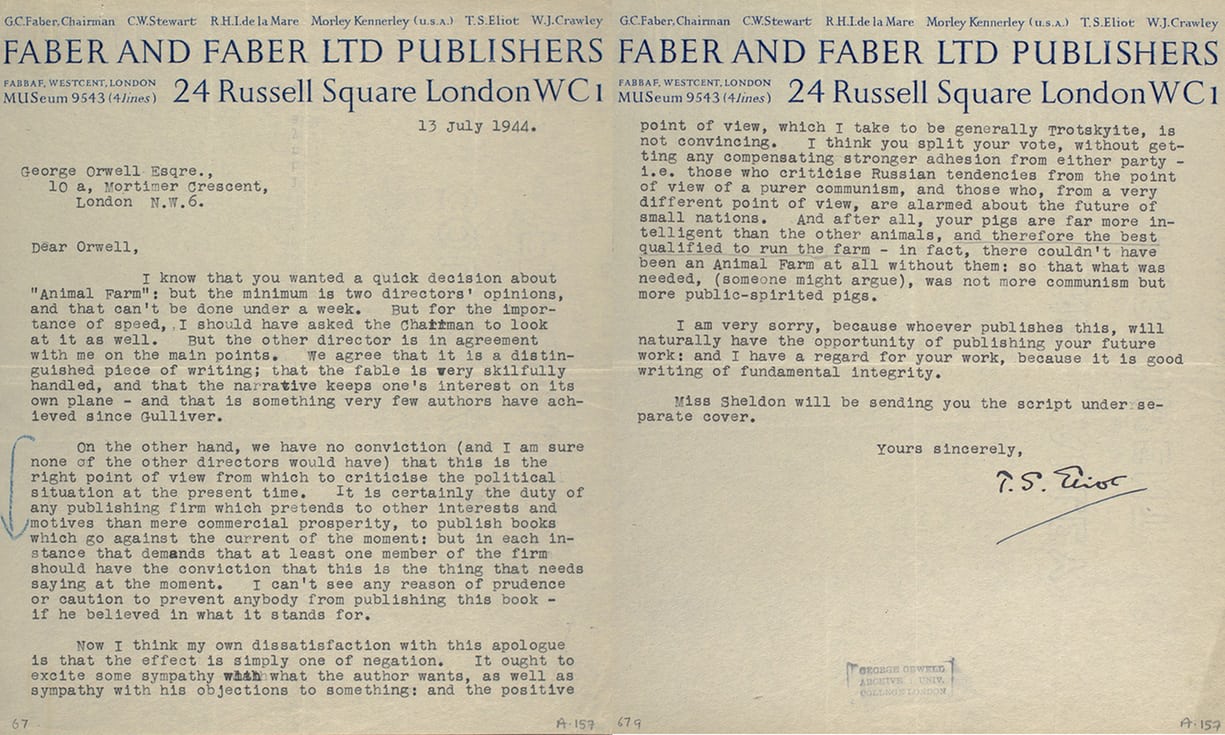 (Click to see full-size)
H/T to Raj Balasubramanyam for the image.
Comments Off on George Orwell had a lot of rejection slips for Animal Farm
October 4, 2017
QotD: Transnational progressivism
The Soviets didn’t invent [transnational progressivism], but they promoted it heavily in a deliberate — and appallingly successful — attempt to weaken the Lockean, individualist tradition that underlies classical liberalism and the U.S. Constitution. The reduction of Western politics to a bitter war for government favor between ascriptive identity groups is exactly the outcome the Soviets wanted and worked hard to arrange.
Call it what you will — various other commentators have favored ‘volk-Marxism’ or ‘postmodern leftism’. I’ve called it suicidalism. It was designed to paralyze the West against one enemy, but it’s now being used against us by another. It is no accident that Osama bin Laden so often sounds like he’s reading from back issues of Z magazine, and no accident that both constantly echo the hoariest old cliches of Soviet propaganda in the 1930s and ’40s.
Another consequence of Stalin’s meme war is that today’s left-wing antiwar demonstrators wear kaffiyehs without any sense of how grotesque it is for ostensible Marxists to cuddle up to religious absolutists who want to restore the power relations of the 7th century CE. In Stalin’s hands, even Marxism itself was hollowed out to serve as a memetic weapon — it became increasingly nihilist, hatred-focused and destructive. The postmodern left is now defined not by what it’s for but by what it’s against: classical-liberal individualism, free markets, dead white males, America, and the idea of objective reality itself.
The first step to recovery is understanding the problem. Knowing that suicidalist memes were launched at us as war weapons by the espionage apparatus of the most evil despotism in human history is in itself liberating. Liberating, too, it is to realize that the Noam Chomskys and Michael Moores and Robert Fisks of the world (and their thousands of lesser imitators in faculty lounges everywhere) are not brave transgressive forward-thinkers but pathetic memebots running the program of a dead tyrant.
Brittingham and other have worried that postmodern leftism may yet win. If so, the victory would be short-lived. One of the clearest lessons of recent times (exemplified not just by kaffiyeh-wearing western leftists but by Hamas’s recent clobbering of al-Fatah in the first Palestinian elections) is that po-mo leftism is weaker than liberal individualism in one important respect; it has only the weakest defenses against absolutist fervor. Brittingham tellingly notes po-mo philosopher Richard Rorty’s realization that when the babble of conflicting tribal narratives collapses in exhaustion, the only thing left is the will to power.
Again, this is by design. Lenin and Stalin wanted classical-liberal individualism replaced with something less able to resist totalitarianism, not more. Volk-Marxist fantasy and postmodern nihilism served their purposes; the emergence of an adhesive counter-ideology would not have. Thus, the Chomskys and Moores and Fisks are running a program carefully designed to dead-end at nothing.
Eric S. Raymond, “Gramscian damage”, Armed and Dangerous, 2006-02-11.
Comments Off on QotD: Transnational progressivism
September 27, 2017
Stalin’s Great Purge – Effects on the Red Army 1936-1938
Military History Visualized
Published on 25 Aug 2017The Great Purge had a massive effect on Soviet Society and the Red Army. This video gives various insights in the numbers, effects and other aspects.
Comments Off on Stalin’s Great Purge – Effects on the Red Army 1936-1938
September 16, 2017
Moral and philosophical conflict in Wilhelmine Germany
At Samizdata, Paul Marks looks at intra-German conflicts that were played out during and after the First World War:
The conflict between German Generals Falkenhayn and Ludendorff was over a lot more than military policy – indeed Falkenhayn made some horrible mistakes in military tactics, for example allowing himself to be pushed into continuing the Verdun offensive much longer than he intended (at least much longer than he later claimed had been his original intention), and insisting that General Fritz Von Below recapture any position he lost to the British in the Somme offensive – an order that led to terrible German casualties.
The conflict may have been presented as a military one (between the “Westerner” Falkenhayn and the “Easterner” Lundendorff ) over whether to concentrate German military resources in the West or the East – but it was really a lot more than a dispute over military policy. Nor was it really a dispute over the form of government – as neither Falkenhayn or Ludendorff was a democrat. It was fundamentally a MORAL (ethical) dispute.
General Lundendorff had absorbed (even more than Kaiser Wilhelm II had) the moral relativism and historicism that had become fashionable in the German elite in the decades running up to the First World War – ideas that can be traced all the way back to (in their different ways) such philosophers as Hegel and (far more) Fichte, whereas General Falkenhayn still clung to concepts of universal justice (morality) and rejected such things as the extermination or enslavement of whole races, and the destruction of historic civilisations such as that of Russia. Lundendorff, and those who thought like him, regarded Falkenhayn as hopelessly reactionary – for example thinking in terms of making peace with Russia on terms favourable to Germany, rather than destroying Russia and using the population as slaves. In the Middle East Falkenhayn came to hear of the Ottoman Turk plan to destroy the Jews (as the Armenian Christians had been destroyed), and he was horrified by the plan and worked to frustrate it. Advanced and Progressive thinkers, such as Ludnedorff, had great contempt for Reactionaries such as Falkenhayn who did not realise that ideas of universal justice and personal honour were “myths” only believed in by silly schoolgirls. Falkenhayn even took Christianity seriously, to Lundendorff this was clearly the mark of an inferior and uneducated mind. And Falkenhayn, for his part, came to think that his country (the Germany that he so loved) was under the influence of monsters – although while their plans to exterminate or enslave whole races and to control (in utter tyranny) every aspect of peacetime (not just wartime) life remained theoretical, he never had to make the final break.
The conflict continued into the next generation. Famously Admiral Canaris (head of German military intelligence) became an enemy of the National Socialists – not because he was a believer in a democratic form of government, but because he believed that the Nazis were a moral outrage violating the most basic principles of universal truth and justice. But the point of view in Germany opposed to men such as Admiral Canaris. the point of view that made itself felt in such things as the German Declaration of War upon France in 1914 – a pack of lies, and (perhaps more importantly) a deliberately OBVIOUS pack of lies (in order to make a philosophical point – as the President of France, a philosopher, noticed at once), had long had nothing but contempt for the very idea of universal objective truth and justice.
I’d always thought that the rise of Fascism and Communism in the 1920s was primarily due to the political chaos and material privations suffered by German citizens through the latter stages of WW1 and continuing through the Versailles Treaty negotiations. Paul shows that the groundwork for both strains of totalitarian thought were already well underway even before the catastrophe of 1914. Of course, as I think I illustrated in the origins of WW1 posts, nothing about the situation in Europe at that time was simple or straight-forward.
Comments Off on Moral and philosophical conflict in Wilhelmine Germany
September 14, 2017
Ken Burns and Lynn Novick: The Vietnam War Is the Key to Understanding America
Published on 13 Sep 2017
Nick Gillespie interviews Ken Burns and Lynn Novick about their new documentary series: The Vietnam War.
The Vietnam War led to more than 1.3 million deaths and it’s one of the most divisive, painful, and poorly understood episodes in American history.
Documentarians Ken Burns and Lynn Novick have spent the past decade making a film that aims to exhume the war’s buried history. Their 10-part series, which premieres on PBS next week, is a comprehensive look at the secrecy, disinformation, and spin surrounding Vietnam, and its lasting impact on two nations. The 18-hour film combines never-before-seen historical footage, with testimonies from nearly 80 witnesses, including soldiers on both sides of the conflict, leaders of the protest movement, and civilians from North and South Vietnam.
A two-time Academy Award winner, Burns is among the most celebrated documentary filmmakers of our time, best-known for the 1990 PBS miniseries The Civil War, which drew a television viewership of 40 million. He and Novick are longtime collaborators, and in 2011 she co-directed and produced Prohibition with Burns. In 2011, Reason’s Nick Gillespie interviewed Burns that film and the role of public television in underwriting his work.
With the release of The Vietnam War, Gillespie sat down with Burns and Novick to talk about the decade-long process of making their new film, and why understanding what happened in Vietnam is essential to interpreting American life today.
Produced by Todd Krainin. Cameras by Meredith Bragg, Mark McDaniel, and Krainin.
Full interview transcript available at http://bit.ly/2x0e5U4
Comments Off on Ken Burns and Lynn Novick: The Vietnam War Is the Key to Understanding America
September 13, 2017
QotD: The changed nature of “class”
For a while communists went around looking lost [after the collapse of the Soviet Union]. Umberto Ecco referred to them as “defrocked priests” who have lost their vision of paradise. And then … And then they decided we just hadn’t tried it hard enough or well enough.
But by the time they found this “new vision” (these doomsday cults never admit they were wrong, you know) they had given up on the idea of the proletariat conquering the bourgeoisie and rich, and had instead turned into sort of missionaries of victims and wounded people.
Instead of social class meaning what it meant to Marx, which was entirely economics based, it now meant “group vaguely aligned through some (usually natural) characteristic.” So we have the oppressed class of oh, gay people who come from all backgrounds and regions and who face differing levels of acceptance from family and society, but who are deemed to be all equally victimized, and as such to need equal intervention from the elites to make them whole. Then there are racial groups, so factionalized that at some point we’re all going to become a race of one.
The elites took to this new way of viewing society like ducks to water, partly because you don’t actually need to do anything to help anyone anywhere. Like Marx, who mistreated his illegitimate son from the woman who was somewhere between an indentured servant and a slave to his family, even as he preached social revolution and the triumph of the lower classes, they can simply preach acceptance and talk about how poor victims suffer without bothering to notice that their neighbor is unemployed and surviving on cat food. If you ask them about this particular instance, they’ll tell you that, well, come the revolution he will have a job and food… Meanwhile they’re working for the greater cause of bringing about the revolution.
And thus, more dreary than the “quality” that consisted of unpleasant people doing unpleasant things, we have the taste makers hailing the new “quality” which consists of “fighting patriarchy” or “white hegemony” or whatever latest crazycakes lens is applied to society. Yep, the people with the power are accusing other people of keeping them down because they have a vagina or can tan or whatever. (And the proof of this is the Dolezals of the world who find great rewards in pretending to be victims.)
Sarah A. Hoyt, “The Quality of Writing”, According to Hoyt, 2015-10-11.
Comments Off on QotD: The changed nature of “class”
September 1, 2017
The Moscow State Conference – Black Sea Revolutionaries I THE GREAT WAR Week 162
Published on 31 Aug 2017
The political factions that oppose the rise of Bolshevism in post-revolutionary Russia come together for a conference this week 100 years ago. But apart from the Moscow State Conference, some people in the military actually aim for a military dictatorship to restore order in Russia and continue the war. At the same time the 2nd Battle of Verdun comes to an end with a French victory and revolutionary fever also spreads across the Black Sea Fleet.
Comments Off on The Moscow State Conference – Black Sea Revolutionaries I THE GREAT WAR Week 162
August 28, 2017
QotD: Gramscian damage
Americans have never really understood ideological warfare. Our gut-level assumption is that everybody in the world really wants the same comfortable material success we have. We use “extremist” as a negative epithet. Even the few fanatics and revolutionary idealists we have, whatever their political flavor, expect everybody else to behave like a bourgeois.
We don’t expect ideas to matter — or, when they do, we expect them to matter only because people have been flipped into a vulnerable mode by repression or poverty. Thus all our divagation about the “root causes” of Islamic terrorism, as if the terrorists’ very clear and very ideological account of their own theory and motivations is somehow not to be believed.
By contrast, ideological and memetic warfare has been a favored tactic for all of America’s three great adversaries of the last hundred years — Nazis, Communists, and Islamists. All three put substantial effort into cultivating American proxies to influence U.S. domestic policy and foreign policy in favorable directions. Yes, the Nazis did this, through organizations like the “German-American Bund” that was outlawed when World War II went hot. Today, the Islamists are having some success at manipulating our politics through fairly transparent front organizations like the Council on American-Islamic Relations.
But it was the Soviet Union, in its day, that was the master of this game. They made dezinformatsiya (disinformation) a central weapon of their war against “the main adversary”, the U.S. They conducted memetic subversion against the U.S. on many levels at a scale that is only now becoming clear as historians burrow through their archives and ex-KGB officers sell their memoirs.
The Soviets had an entire “active measures” department devoted to churning out anti-American dezinformatsiya. A classic example is the rumor that AIDS was the result of research aimed at building a ‘race bomb’ that would selectively kill black people.
On a different level, in the 1930s members of CPUSA (the Communist Party of the USA) got instructions from Moscow to promote non-representational art so that the US’s public spaces would become arid and ugly.
Americans hearing that last one tend to laugh. But the Soviets, following the lead of Marxist theoreticians like Antonio Gramsci, took very seriously the idea that by blighting the U.S.’s intellectual and esthetic life, they could sap Americans’ will to resist Communist ideology and an eventual Communist takeover. The explicit goal was to erode the confidence of America’s ruling class and create an ideological vacuum to be filled by Marxism-Leninism.
Eric S. Raymond, “Gramscian damage”, Armed and Dangerous, 2006-02-11.
Comments Off on QotD: Gramscian damage
August 27, 2017
August 25, 2017
August 7, 2017
July 28, 2017
QotD: Soviet agitprop still echoes today
Stalinist agitprop created Western suicidalism by successfully building on the Christian idea that self-sacrifice (and even self-loathing) are the primary indicators of virtue. In this way of thinking, when we surrender our well-being to others we store up grace in Heaven that is far more important than the momentary discomfort of submitting to criminals, predatory governments, and terrorists.
The Communist atheists of Department V understood that Christian self-abnegation tends to inculcate a cult of self-sacrifice even among Westerners who are themselves agnostics or atheists. All the propagandists had to do was make the case that the value of self-abnegation applies to culture as well as individuals. By doing so, they were able to entrench the idea that suicidalists are morally superior to non-suicidalists.
They did this so successfully that at least one major form of Western self-abnegation seems to have developed as a secondary phenomenon: “deep environmentalism”. I can’t find any sign that this traces back to the usual Stalinist suspects, but it is rather obviously a result of generalizing suicidalism not just to culture but to species.
I think it’s important to understand that, although suicidalism builds on some pre-existing pathologies of Western culture, it is not a native or natural development. It is an infection that evildoers and their dupes created and then spread as part of a war against the West; their goal was totalitarian control, and part of their method was to talk the West into slitting its own throat.
Eric S. Raymond, “Suicidalism”, Armed and Dangerous, 2005-09-13.
Comments Off on QotD: Soviet agitprop still echoes today


