Quotulatiousness

December 14, 2012

40 years ago today, man last walked on the moon

Filed under: History, Space, Technology, USA — Tags: , , , — Nicholas @ 10:51

At sp!ked, Patrick West notes an under-observed anniversary:

It is a fine testament to NASA’s Apollo programme that of all the world-shaking events in living memory, men landing on the moon is the only one that doesn’t involve death. As Andrew Smith, author of Moon Dust (2006), notes, everyone remembers where they were when John F Kennedy was assassinated, Princess Diana died, or on 9/11. Most people, if they were alive at the time, also vividly recall when a man first walked on the moon on 20 July 1969.

Few, however, will remember what they were doing when the last man walked on the moon. That was 40 years ago today.

As he fired up the engines of Apollo 17‘s Lunar Module, Gene Cernan, the last man on the moon, delivered a final message to the world: ‘America’s challenge has forged man’s destiny of tomorrow. And as we leave the moon at Taurus-Littrow, we leave as we came and, God willing, as we shall return with peace and hope for all mankind.’ On this date, many of us lament that we haven’t gone back to the moon. Others won’t, citing the vast expense of this Cold War sideshow, equivalent to roughly $130 billion in today’s money.

We certainly aren’t likely to return to the moon in such cynical and pessimistic times, of Mayan prophecies, omens of economic stagnation and environmental catastrophe, Frankie Boyle misanthropy and books called Is It Just Me Or Is Everything Shit?. In other words, everything the Apollo programme didn’t represent. America’s race to the moon may have been partly a means of getting one over the Soviets, but it also embodied the spirit of adventure and progress, as encapsulated by Neil Armstrong’s first words from the moon.

September 2, 2012

Margaret Thatcher and the British intelligence organizations

Filed under: Britain, Government — Tags: , , , , — Nicholas @ 00:01

An interesting post at the official website for Prime Minister David Cameron talks about former Prime Minister Margaret Thatcher and her relationship with the Joint Intelligence Committee during her time in office:

Soon after taking office a new Prime Minister receives special briefings from the Cabinet Secretary. One is on the ‘letters of last resort’, which give instructions to the commander of the British submarine on patrol with the nuclear deterrent, in the event of an attack that destroys the Government. Another briefing outlines the structure and control of the intelligence machinery, including the Joint Intelligence Committee (JIC) in the Cabinet Office. Sir John Hunt, the Cabinet Secretary in 1979, briefed Margaret Thatcher on the intelligence structure, including counter-subversion activities, the day after her election victory of 3 May.

Thatcher had started a programme of visits to Government departments to see first-hand what some of the 732,000 officials inherited from James Callaghan’s administration actually did. In September, during a routine briefing by Brian Tovey, the Director of GCHQ, Thatcher showed great interest in the way in which intelligence was collated and assessed by the JIC, stressing that assessment should be free from policy (or political) considerations. She also expressed a wish to attend a JIC meeting. It would be the first time a Prime Minister had attended the JIC since its creation in 1936.

It fell to Sir John Hunt, a former Secretary of the JIC, to make the arrangements, but there were complications. First, the JIC Chairman, Sir Antony Duff of the Foreign and Commonwealth Office (FCO), had also been made Deputy Governor of Southern Rhodesia (now Zimbabwe) after the British Government assumed direct rule of the rebellious colony. He was a key participant in the Lancaster House Conference, aiming finally to settle the Rhodesian problem, and could not be sure to attend the JIC until after its conclusion. Second, the JIC normally met on Thursday mornings in 70 Whitehall, which was also when the Cabinet met in 10 Downing Street, so a special JIC meeting would need to be arranged.

August 17, 2012

The plight of Russian submariners

Filed under: History, Military, Russia — Tags: , , , , — Nicholas @ 08:36

An update from Strategy Page on how far the Russian nuclear submarine threat has diminished from its peak during the cold war:

Three years ago two Akulas were detected (by the U.S. Navy) off the east coast of the United States, in international waters. Russia admitted two of its Akula class boats were out there. This was the first time Russian subs had been off the North American coast in over a decade. This spotlights something the Russian admirals would rather not dwell on. The Russian Navy has not only shrunk since the end of the Cold War in 1991, but it has also become much less active. In the previous three years, only ten of their nuclear subs had gone to sea, on a combat patrol, each year. Most of the boats going to sea were SSNs, the minority were SSBNs (ballistic missile boats). There were often short range training missions, which often lasted a few days, or just a few hours.

The true measure of a fleet’s combat ability is the number of “combat patrols” or “deployments” in makes in a year and how long they are. In the U.S. Navy, most of these last from 2-6 months. Currently U.S. nuclear subs have carry out ten times as many patrols as their Russian counterparts. Russia is trying to catch up, but has a long way to go.

Russia has only 14 SSNs (nuclear attack subs) in service and eight of them are 7,000 ton, Akulas. These began building in the late 1980s and are roughly comparable to the American Los Angeles class. All of the earlier Russian SSNs are trash, and most have been decommissioned. There are also eight SSGN (nuclear subs carrying cruise missiles) and 20 diesel electric boats. There is a new class of SSGNs under construction, but progress has been slow.

[. . .]

The peak year for Russian nuclear sub patrols was 1984, when there were 230. That number rapidly declined until, in 2002, there were none. Since the late 1990s, the Russian navy has been hustling to try and reverse this decline. But the navy budget, despite recent increases, is not large enough to build new ships to replace the current Cold War era fleet that is falling apart. The rapid decline of Russia’s nuclear submarine fleet needed international help to safely decommission over a hundred obsolete, worn out, defective or broken down nuclear subs. This effort has been going on for over a decade, and was driven by the Russian threat to just sink their older nuclear subs in the Arctic Ocean. That might work with conventional ships, but there was an international uproar over what would happen with all those nuclear reactors sitting on the ocean floor forever. Russia generously offered to accept donations to fund a dismantling program that included safe disposal of the nuclear reactors.

June 13, 2012

John Kay on the Finnish frontier

Filed under: Europe, History, Military, Russia, WW1, WW2 — Tags: , , , , — Nicholas @ 08:58

Finland had a very chancy time over the last hundred years. John Kay is visiting now, and reflects on how Finland survived to today:

The Finnish border is an anomaly. In 1918 the Finns won independence for a state that extended to the gates of St Petersburg. Russia captured territory in the 1939-40 Winter War. Finland then fought on the losing side in the second world war and did not remain neutral in the cold war. So the once thriving Finnish industrial city of Viipuri is today the depressed Russian outpost of Vyborg.

A cynical commentator on 20th-century history might observe that the political ineptitude of Kaiser Wilhelm and subsequently of Adolf Hitler brought America in on the opposite side of Germany’s quarrel with Russia in 1917 and 1941. Only when the democratic politicians of modern Germany made the rational alliance did Finland achieve the favourable political and economic outcomes it now enjoys. To pass the watchtowers and barbed-wire fences on the Finnish-Russian border is to be reminded of how fragile, and how recent, are the stability and security we take for granted today.

[. . .]

That observation is evident on the Finnish-Russian border. The razor wire kept Russian citizens in when the living standards of planned societies and market economies diverged. But now the border is easy to cross and the gap in per capita income has narrowed, though not by much. The very different income distributions of egalitarian Finland and inegalitarian Russia can be seen in the car parks and designer shops of Lappeenranta.

In the Soviet era, Finland produced Marimekko; Russia made no clothes any fashion-conscious woman would want to buy. Post-Communist but still autocratic Russia made surveillance equipment; democratic Finland led the world in mobile phones. Today Russia’s geeks hack into your bank account, while those of Finland develop Angry Birds.

The pristine countryside of Finland contrasts with the degraded physical state of much of Russia: a demonstration of the unexpected finding that regulated democratic capitalism preserves the environment more successfully than any other system of government.

May 23, 2012

Review of Savage Continent: Europe in the Aftermath of World War II

Filed under: Europe, Germany, History, Military, Russia, WW2 — Tags: , , — Nicholas @ 10:41

Roger Moorhouse reviews the new book by Keith Lowe for History Today:

It examines Europe in the years immediately after the end of the Second World War, when the guns stopped firing. Yet, as Lowe clearly demonstrates, the absence of war is not the same as an outbreak of peace.

Savage Continent is a grim catalogue of humanity at its lowest ebb. Necessarily pointillist, given its broad scope, it ranges across much of the European continent, portraying a world where civil society and the rule of law were yet to be re-established and where revenge, antisemitism, ethnic cleansing and heightened political sensibilities gave rise to a renewed wave of inter-communal and political violence.

According to Lowe’s account, those immediate postwar years had a thoroughly unedifying air. From the Yugoslav partisans cutting off the noses of their erstwhile opponents, to antisemitic pogroms in Poland, to the massacres of Sudeten Germans in Czechoslovakia, he shows a dystopian continent in which the all-pervasive dehumanisation of the war proved difficult to reverse, provoking a hangover of violence that would last, in some places, into the 1950s.

Alongside the now rather well-documented episodes of brutality from the period, such as the Communist takeover of Eastern Europe, or the expulsion of the German populations from the same region, Lowe does well to uncover some lesser-known examples of man’s postwar inhumanity to his fellow man. The story of the Lithuanian ‘Forest Brothers’, for instance, and their brave, futile resistance to the imposition of Soviet rule, is one that deserves to be much wider known and is outlined well. Similarly the ethnic cleansing of Ukrainians in postwar Poland is rightly placed alongside better-known events, such as the Kielce pogrom and the Vertreibung (expulsion) of the Germans.

I just started reading Postwar: A History of Europe Since 1945 by Tony Judt, and he covers much of the same period of history as Lowe in the first part of his book. I’m moderately well-read on World War II, but the amount of violence and human misery in Europe for more than a decade after the war was “over” is indeed an under-covered and misunderstood aspect of that turbulent period.

Western European countries (France, Belgium, the Netherlands, Norway, and even western Germany) recovered faster in all senses because the Nazi occupiers did much less damage to the social structures in those countries. It’s rather eye-opening to find how few Nazi officials were needed to oversee the local governments in those countries: 800 in Norway, and only 1,500 in France (plus 6,000 military and civil police auxiliaries). Local governments continued to operate pretty much as they had before the war, under the control of a tiny group of German overseers. Economic demands meant the local industries were harnessed to the Nazi war effort (but largely kept under the control of their original owners).

Central and eastern European countries suffered far more disruption as the Nazi racial “logic” did not allow local governments the same relative lack of interference the western local governments got. Local industry was more frequently nationalized and run by German managers directly, not working through the original owners, and local labour was more readily drafted to work in Germany. And unlike in the west, the experiences of newly “liberated” countries in the east often started with a fresh purge of local governments, business owners, and middle class professionals.

What we’d now call “ethnic cleansing” was a frequent second act after the Soviet armies moved in: ethnic Germans were expelled, ethnic Slavs were moved into the cleared areas. Jews, Gypsies, and other groups that suffered terribly under the Nazis did not necessarily see much improvement under the Soviets. Former resistance fighters were hunted down and eliminated (except for those belonging to identified Communist movements … and not even that was guaranteed protection).

Under the circumstances, it may well be nothing short of a secular miracle that Europe recovered economically and socially so soon after the war and the post-war convulsions.

March 30, 2012

The mystery of Le Pain Maudit (Cursed Bread) finally solved

Filed under: Europe, France, History, USA — Tags: , , , — Nicholas @ 10:01

In a twist that will delight conspiracy theorists everywhere, it really was a CIA plot:

In 1951, a quiet, picturesque village in southern France was suddenly and mysteriously struck down with mass insanity and hallucinations. At least five people died, dozens were interned in asylums and hundreds afflicted.

For decades it was assumed that the local bread had been unwittingly poisoned with a psychedelic mould. Now, however, an American investigative journalist has uncovered evidence suggesting the CIA peppered local food with the hallucinogenic drug LSD as part of a mind control experiment at the height of the Cold War.

The mystery of Le Pain Maudit (Cursed Bread) still haunts the inhabitants of Pont-Saint-Esprit, in the Gard, southeast France.

March 24, 2012

The less-than-glamorous reality of Cold War spy work

Filed under: Books, Britain, Europe, Germany, History, Military, Russia — Tags: , , , , — Nicholas @ 00:08

A review of Steve Gibson’s Live and Let Spy: BRIXMIS – The Last Cold War Mission by Bill Durodié at spiked!:

Called the British Commander-in-Chief’s Mission to the Group Soviet Forces of Occupation in Germany, or BRIXMIS for short, it was part of an officially sanctioned exchange of observers between the Red Army and the British Army established by the victorious Allied powers and the USSR through the Robertson-Malinin agreement in 1946. Its ostensible purpose was to improve communication and relations between them.

In addition to BRIXMIS — and their French and American counterparts in the East — the Red Army also conducted similar operations through a unit in West Germany. But, diplomatic liaison and translation duties aside, the real purpose of these units soon became clear: to find out what each other was up to by heading out into those areas where they had been specifically told not to go.

[. . .]

For anyone who imagines that spying is glamorous, or somehow akin to being in a Bond movie, they will be disabused by Gibson’s chapter on document-gathering from dumps (literally). It had been recognised for some time that, when they went on manoeuvres in East Germany, the Soviet forces were not supplied with any toilet paper. They would use whatever came to hand — a copy of Pravda, a letter from a loved one, or even their mission papers. And after they were done, it was then that Her Majesty’s specially trained and equipped Cold War warriors really came into their own…

The book is republished with an expanded final chapter reflecting on what happened in the time following the fall of the Iron Curtain:

As a professor of political science at the University of Warwick, Robert Aldrich, notes in the new foreword, Gibson is now clearly of the mind that ‘much of what [he] was led to believe [during the Cold War], and some of what he was told, was simply wrong!’

[. . .]

Gibson’s resolute clearsightedness is to be admired. So despite having been caught up in the exhilaration of it all as a young man, despite devoting the prime of his life to the East-West conflict, he refuses to lie to himself. ‘The Cold War’, he notes, ‘was a giant historical cul-de-sac where all enlightened efforts at producing a good society were suspended’.

Aldrich astutely summarises a key argument of Live and Let Spy: ‘while Cold War warriors fought a tyrannical and ruthless version of Communism abroad, they remained ignorant of — and lost — an ideological battle at home’. He then adds accusingly: ‘Western politicians now offer a watered-down version of the interfering, intolerant, controlling and authoritarian government that they were initially set against rather than anything freer.’

March 19, 2012

Finland’s cold-cut warrior, RIP

Filed under: Economics, Europe, History, Media, Russia — Tags: , , , , , — Nicholas @ 10:13

The most unusual cold war hero died recently. Eero Iloniemi tells the story of Finland’s Väinö Purje and how his TV commercials featured in the Cold War in the Baltic:

While Purje is virtually unknown in the West his exploits are legendary in the Baltic States, especially in Estonia. Alo Lohmus of Estonia’s leading daily Postimees referred to Purje’s contribution to the Cold War as part of a ‘spiritual nuclear bomb’ that blew apart a corrupt system.

High praise, indeed, for a modest tradesman. That a butcher could gain such a position in a global conflict is one of the most curious chapters of Cold War history.

Due to its proximity to the Baltic Soviet republics, Finnish television broadcasts penetrated the Iron Curtain, into Estonia and on occasion Latvia. Purje, who was the star of Finnish retail chain Kesko’s food adverts, became a cult figure in Estonia. From 1974 to 1981 he featured in more than 100 television spots showcasing sausages and cutlets, all virtually unknown in the then Soviet republics.

The beached corpse of a Caspian Sea Monster

Filed under: History, Technology — Tags: , , , , — Nicholas @ 09:22

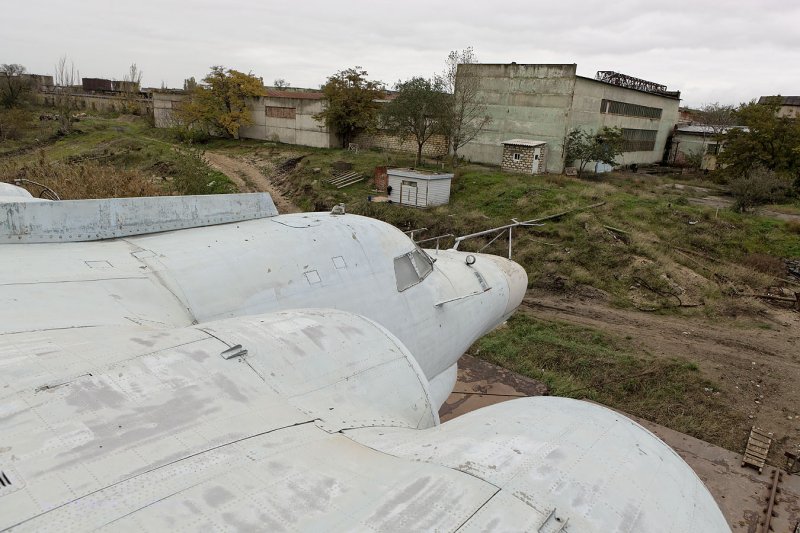
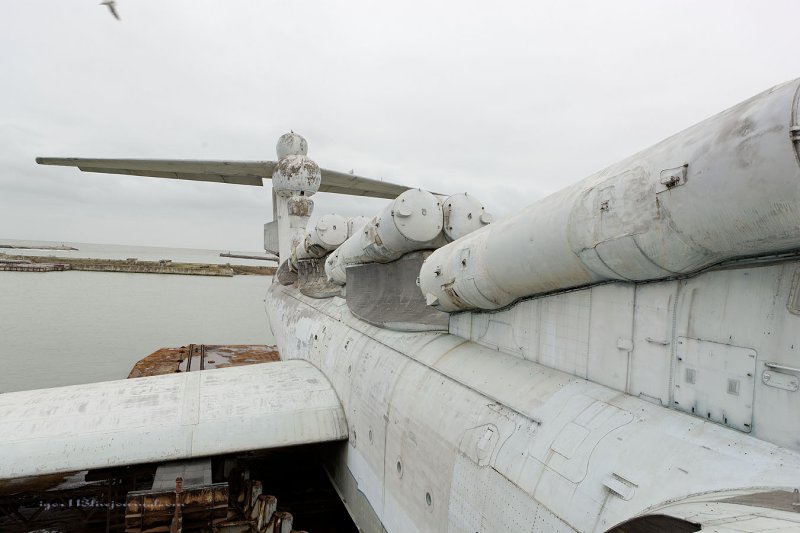
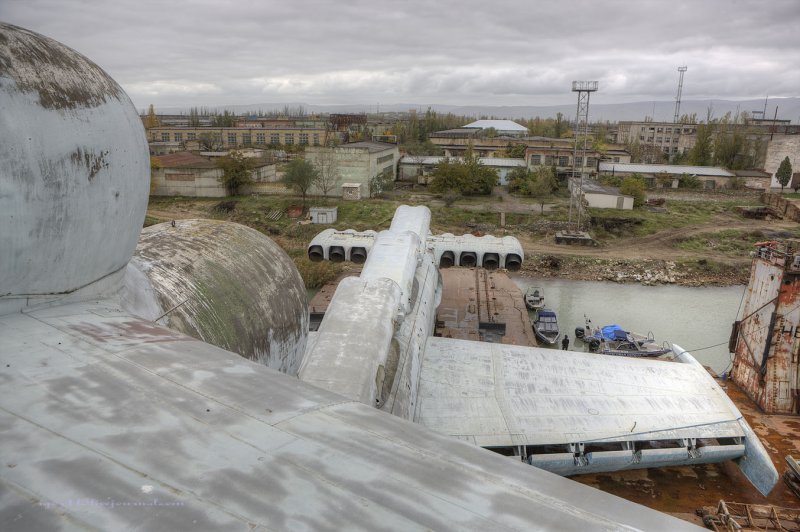
A LiveJournal post by Igor113 has lots of photos (and text in Russian) of a visit to the resting place of one of the most fascinating technological relics of the Soviet era — an Ekranoplan:

Google translate offers this as the introduction to Igor’s post:

Here are my hands and came up ekranoplana. Ya break a story about it for 3 or 4 parts: a winged-outside (1 or 2 parts), 2-winged inside the 3-winged dock.

In 1987 the water came, “Lun” the first ship of a series of missile-carrying combat WIG weighing 400 tons was the chief designer V.Kirillovyh. The ship was armed with three pairs of cruise missile 3M80 or 80M “Mosquito” (NATO membership designation SS-N-22 Sunburn). The second “Lun” is also being laid as a missile, but the outbreak of the conversion brought about changes, and planned to finish a rescue.

LTH:
Modification of the Lun
Wingspan, m 44.00
Length, m 73.80
Height, m ​​19.20
Wing area, m2 550.00
Weight, kg
Empty 243 000
maximum take-off 380 000
8 turbojet engine type NC-87
Thrust, kg 8 x 13 000
Maximum speed, km / h 500
Operational range, km 2000
The height of the flight on the screen, 5.1 m
Seaworthiness, 6.5 points
Crew 10
Armament: 6 IP ASM ZM-80 Mosquito

Wikipedia has more. In spite of the apparent derelict condition of the Lun, Wikipedia mentions plans to resume development in 2012.

Update: Charles Stross sent a tweet with a link to this satellite shot of the Lun in dry dock: http://mapper.acme.com/?ll=42.88184,47.65690&z=19&t=H

February 5, 2012

Celebrating 1989

Filed under: Europe, History, Liberty — Tags: , , , , , — Nicholas @ 11:03

Janet Daley thinks we’ve been under-appreciating one of the most momentous years in modern history: the end of the Cold War and the collapse of state communism.

Can I suggest that you try the following experiment? Gather up a group of bright, reasonably well-educated 18-year-olds and ask them what world event occurred in 1945. They will, almost certainly, be able to give you an informed account of how the Second World War ended, and at least a generally accurate picture of its aftermath. Now try asking them what historical milestone came to pass in 1989. I am willing to bet that this question will produce mute, blank looks.

The fall of the Berlin Wall and the collapse of communism which followed it are hugely important to any proper understanding of the present world and of the contemporary political economy. Why is it that they have failed to be addressed with anything like their appropriate awesome significance, let alone found their place in the sixth-form curriculum?

The failure of communism should have been, after all, not just a turning point in geo-political power — the ending of the Cold War and the break-up of the Warsaw Pact — but in modern thinking about the state and its relationship to the economy, about collectivism vs individualism, and about public vs private power. Where was the discussion, the trenchant analysis, or the fundamental debate about how and why the collectivist solutions failed, which should have been so pervasive that it would have percolated down from the educated classes to the bright 18-year-olds? Fascism is so thoroughly (and, of course, rightly) repudiated that even the use of the word as a casual slur is considered slanderous, while communism, which enslaved more people for longer (and also committed mass murder), is regarded with almost sentimental condescension.

December 10, 2011

“It was not, all in all, Canada’s finest hour. Perhaps that’s why we still don’t talk about it much.”

Filed under: Books, Cancon, History, Media — Tags: , , , , , — Nicholas @ 12:48

Robert Fulford on the event in Ottawa that started the Cold War:

For just one moment in history, Canada found itself at the dangerous centre of global politics. That was in 1945, when Igor Gouzenko left the Russian embassy in Ottawa with documents proving the Soviet Union was spying on Canada with the help of Canadian communists.

Gouzenko’s revelations were the opening shot in the Cold War. A new book, Stalin’s Man in Canada: Fred Rose and Soviet Espionage by David Levy, takes a rambling, anecdotal approach to a major figure in the story, the only Canadian member of Parliament ever convicted of conducting espionage for a foreign state.

Official Ottawa reacted badly to the news that there were spies in its midst. The government arrested the suspects and locked them up for weeks, without access to lawyers or families. They were paraded before a secret royal commission and persuaded to incriminate themselves. Gouzenko was given a new identity to protect him from Soviet assassins but the Mounties leaked nasty stories about him. For decades journalists treated him as a money-grubbing clown rather than the hero that he was.

Today the case remains largely unexplored and poorly remembered. Among those involved, only Gouzenko described his experience in a book, This Was My Choice, a rather thin and hasty account. Twentieth Century Fox produced a forgettable adaptation, The Iron Curtain, with Dana Andrews as Gouzenko.

August 31, 2011

The “official” start of the Cold War: 5 September, 1945

Filed under: Cancon, Government, History, Liberty — Tags: , , , — Nicholas @ 09:28

George Jonas, in a review of Mark Steyn’s latest book, gives a thumbnail sketch of the real trigger event that started the Cold War:

Sixty-six years earlier, another writer put together a manuscript of sorts to let Western readers know they were headed for hell in a hand-basket. He wasn’t in Steyn’s league as a wordsmith, although he did write a non-fiction bestseller and win a Governor General’s Award for a novel called The Fall Of A Titan. But far from making the apocalypse amusing, Igor Gouzenko could make a slapstick comedy apocalyptic. No two writers were less alike, yet their work carried a similar message.

The Cold War began on a Wednesday, a few minutes after 8 p.m., on September 5, 1945. This was when a young, slight, nondescript man closed the door of an embassy building on Charlotte Street and walked out into the humid Ottawa evening. He looked a little bulky for a reason. He carried 109 documents under his shirt.

During August, 1945, while the atomic bombs were exploding over Hiroshima and Nagasaki, Gouzenko had been discussing his defection with his wife Svetlana in their small apartment on Somerset Street. As a cipher clerk, Gouzenko knew a great deal about a Soviet spy ring operating through the office of GRU (military intelligence) Colonel Nikolai Zabotin. The aim of Zabotin’s spy ring was to secure atomic secrets. Gouzenko’s tour of duty in Ottawa was ending, and he feared that being privy to such information would reduce his chances of survival in Moscow. In self-defence, he triggered the Cold War.

The thing was damn hard to trigger. When it came to international intrigue, Canadians were wet behind the ears. Having just concluded a victorious war, they resisted the idea that they were at war again, this time with their former comrades-in-arms. Gouzenko knew that his tale might sound far-fetched, and carried documents with him for proof.

For two harrowing days, with his pregnant wife and their two-year-old son in tow, Gouzenko tried to convince incredulous Canadian journalists and Ministry of Justice officials that he was worthy of a hearing. Mackenzie King’s government couldn’t make up its mind about the defectors, and for a brief period actually considered returning them to the Soviets. Messengers bring bad tidings at their peril.

Gouzenko didn’t start the Cold War; he just warned us to do something, or get ready for Armageddon. So we did something, but 66 years later we’ve another Cassandra at the doorstep, telling us it wasn’t enough.

June 10, 2011

Cold War thinking on Chinese-US relations

Filed under: China, Economics, History, USA — Tags: , , — Nicholas @ 09:13

Brad Glosserman asks if China is using its new-found economic muscle to bankrupt the United States.

One popular narrative credits the end of the Cold War to a US strategy to bankrupt the Soviet Union. Well aware of the advantage conferred by its superior economic performance, Washington pushed Moscow into a military competition that drained the USSR of its resources. In this narrative, US President Ronald Reagan’s push to create a missile defence system — realistic or not — was the straw that broke the Soviet back.

Are Chinese strategists pursuing a similar approach to the United States? Is Beijing pushing US buttons, forcing it to spend increasingly scarce resources on defence assets and diverting them from other more productive uses? Far-fetched though it may seem — and the reasons to be sceptical are pretty compelling — there is evidence that China is doing just that: ringing American alarm bells, forcing the US to respond, and compounding fiscal dilemmas within the United States. Call it Cold War redux.

If that is indeed China’s strategy, then they’re wasting their efforts: without strong action in the very near term, the US government is going to bankrupt the country with no additional help from overseas required. The “popular narrative” Glosserman refers to handily glosses over the fact that the Soviet economy had been on a downward slide for decades. The Reagan-era military build-up merely hastened the end for Soviet economics, it did not bring it on in the first place. As Adam Smith famously noted, there is a lot of ruin in a nation, but eventually it does go smash — especially if no efforts are made to avert that nasty ending.

H/T to Jon, my former virtual landlord, for the link.

June 3, 2011

“The Amnesty film … was documentary as corporate hagiography”

Filed under: History, Liberty, Media — Tags: , , , , , — Nicholas @ 09:04

David Bowden reviews Amnesty! When They Are All Free, a BBC documentary on the 50th anniversary of Amnesty International:

The Amnesty film, by contrast, was documentary as corporate hagiography, evading nuance in favour of quick and easy narrative with a facile message: it ain’t easy being righteous.

It was a shame, because the story it told was potentially a fascinating one. Amnesty was born in the first wave of Sixties radicalism, and faced with the realisation that the apparently progressive politics of universal human rights adopted after the Second World War was being hijacked in the interests of Cold War realpolitik. The organisation began as a documentary news organisation, chronicling the disappearances and abuses under repressive regimes around the world. In the spirit of its famous torch image, Amnesty shone a light on human-rights abuses wherever it found them.

Certainly, as a product of the British postwar liberal intelligentsia, much of the organisation’s self-proclaimed apolitical stance smacked of naivety from the off; founder Peter Benenson was quickly forced to fall on his sword after accepting funding from the British government. Yet this overview of its early days was captivating stuff, offering a reminder of the genuine risks posed to its researchers and witnesses as this small organisation routinely found itself on the wrong side of Western and Soviet-backed juntas alike in its pursuit of accurate reporting of the human costs of the broader superpower struggle.

But Amnesty’s interventions were having distressing and unintended side effects — notably, the new tactic of ‘disappearing’ political prisoners before they became international causes célèbres. In the film, this raised interesting questions of journalistic ethics and apolitical campaigning, particularly pertinent in the context of the more cavalier instincts of the Wikileaks era.

Sadly, however, while willing to touch upon some of the uglier aspects of Amnesty’s growth from small, earnest campaign into the international China-baiting behemoth it is today, When They Are All Free tended to sideline difficult questions in favour of its heartwarming narrative. While there was a degree of soul-searching on offer, the problem with critiquing human rights as a political agenda today is that much of it is done by those on the inside. As Alex de Waal once remarked, ‘it is as though the sociological study of the church were undertaken by committed Christians only; criticism would be solely within the context of advancing the faith itself’.

December 16, 2009

QotD: The importance of markets

Filed under: Economics, History, Quotations — Tags: , , , — Nicholas @ 09:24

America debated three strategies during the Cold War. The Right wanted “roll back” — dreams of Patton driving his tank into Red Square. The Left wanted détente — which is French for “surrender.” The country loosely followed containment, a program outlined by George Kennan in 1946, which argued that the political contradictions of the Soviet state would eventually cause its own demise. America had but to be patient.

Kennan may have been the first to realize that a society based on Communism would not survive politically, but it was Ludwig von Mises, in his 1922 work Socialism, who demonstrated that any such society could not survive economically.

When a collection of free individuals — the market — is willing to pay a price for a product that creates “excess” profits, it signals producers to provide more of that product. If the market does not support a given price, producers are forced to redeploy their assets for more pressing social needs. Similarly, if a factor of production, such as labor or capital, changes in price, producers instantly react, sending signals — through the prices of intermediate goods — down to the consumer. Prices effortlessly allocate society’s assets to reflect consumer preference and adjust to accommodate the ever-changing availability of scarce resources.

Mises argued that governmental interference in prices, through taxation, subsidies, and regulation, complicates this process — affecting not only the consumption of final goods, but also the economic calculations that are necessary to provide intermediate goods and services. Higher-order division of labor fails. Poverty results. For example, while Chinese and Russian central planners were busy setting quotas for steel mills, there was no method for consumers to signal that they preferred food — and millions starved to death.

Dan Oliver Jr., “Socialism in Stages: Even soft, incremental expansions of government produce poverty”, National Review, 2009-12-15

« Newer PostsOlder Posts »

Powered by WordPress